How Sulekha Achieved Revenue Milestones Using a Marketplace Model
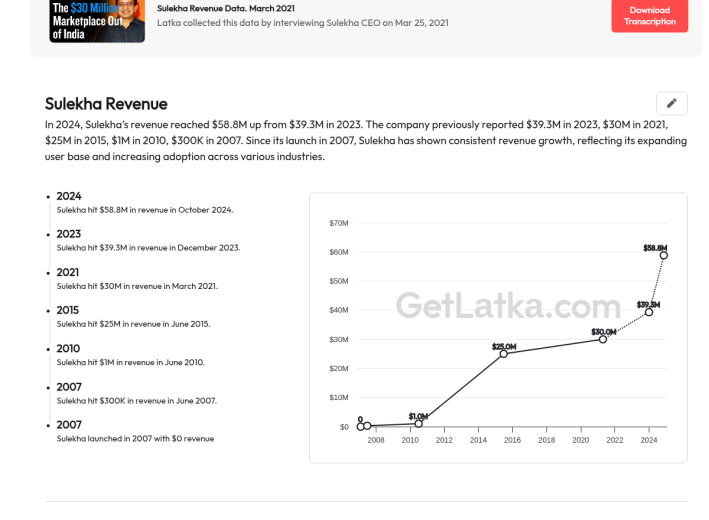

Sulekha, a leading tech AI platform for expert services in India, has grown significantly over the years since its inception in 2007. Founded by Satya Prabhakar, an Indian-American entrepreneur, Sulekha has successfully matched service providers with consumers using a marketplace business model. This blog post delves into the strategies and tactics used by Satya Prabhakar to hit specific revenue milestones, leveraging the unique dynamics of the Indian market and the company’s innovative approach to connecting service providers and consumers.
2007: Launching in a Nascent Internet Market
When Sulekha launched in 2007, the internet landscape in India was vastly different from today. With limited access and high costs, the challenge was significant. Despite these hurdles, Sulekha managed to generate between $100,000 to $200,000 in revenue in its first year. This initial success was primarily driven by the company’s classified service model, which laid the foundation for its transition into a marketplace for expert services.
2010: Breaking the $1 Million Revenue Mark
By 2010, Sulekha had evolved its business model to focus more on services, which became the mainstay of the platform. This shift was crucial in helping the company break the $1 million revenue mark. The platform’s ability to match consumers with service providers in need of credibility and reputation played a significant role in this growth. The company’s focus on building a robust platform for service providers to connect with motivated buyers was instrumental in achieving this milestone.
2015: Projected Revenue of $30 Million
In 2015, Sulekha projected a revenue of $30 million, including its US operations. Although the company missed this target by 20-25%, this projection highlighted Sulekha’s aggressive growth strategy and its ambition to scale its operations. The company’s approach to leveraging AI algorithms to match service providers with consumers based on location, service type, and demand was key to driving this growth.
2018: Expanding the Marketplace Model
As Sulekha continued to grow, it expanded its marketplace model by incorporating SaaS marketing services. This allowed service providers to reach consumers across various platforms, not just within Sulekha. Additionally, the company capitalized on services that did not require the consumer and provider to be in the same location, a strategy that gained traction during the COVID-19 pandemic. This expansion enabled Sulekha to cater to a broader market and diversify its revenue streams.
2020: Navigating the COVID-19 Impact
The COVID-19 pandemic posed significant challenges for Sulekha, as sales dropped by 80% in March 2020. The service sector SMEs, which form the core of Sulekha’s marketplace, were hit hard by the lockdowns. However, the company adapted by focusing on services that could be delivered remotely, such as business consulting and legal advice. As the economy began to recover, Sulekha’s growth trajectory resumed, aided by the increased acceptance of remote services.
2023: Aiming for $50 Million in Revenue
Looking ahead, Sulekha aims to achieve $50 million in revenue by 2023. The company’s strategy involves revitalizing its US events market, which was severely impacted by the pandemic, and continuing to expand its SaaS marketing model. By focusing on these areas, Sulekha plans to regain its pre-pandemic momentum and capitalize on the growing demand for remote and digital services.
Key Growth Tactics and Insights
- Marketplace Model: Sulekha’s core business model connects service providers with consumers, allowing for scalable growth and high user engagement.
- SaaS Marketing Expansion: By offering marketing services to SMEs, Sulekha diversified its revenue streams and increased its market reach.
- Remote Services Focus: The company adapted to the pandemic by emphasizing services that do not require physical proximity, thus maintaining service continuity.
- Strategic Funding: With $40 million raised in venture capital, Sulekha has the resources to fuel its growth and expand its operations.
- AI-Driven Matching: Using AI algorithms to match service providers with consumers based on various parameters has been a critical factor in Sulekha’s success.
For more insights into Sulekha’s journey and growth strategies, visit their GetLatka company profile or their company website. Explore more about companies from India here and delve into the industry category here.
Recent Articles
How 1Mind Achieved Rapid Revenue Growth with AI-Powered Sales Solutions
In the ever-evolving world of technology, few companies have managed to disrupt traditional sales and marketing processes as effectively as…
How Rev's CEO Adi Bathla Drove Revenue to $10M by Revolutionizing Auto Shop Workflows
Building a company from scratch and driving it to hit significant revenue milestones is no small feat. Adi Bathla, the…
How Practice by Numbers Achieved $16.5M Revenue in 2026 with Innovative SaaS Solutions
2015: Launched Practice by Numbers to Fill a Market Gap Practice by Numbers (PBN), co-founded by Rohit Garg and Dr.…