How Edwin Chen Bootstrapped Surge AI to $1.2 Billion Revenue: The MIT Dropout Who Built AI's Most Efficient Company Without a Penny of VC Money
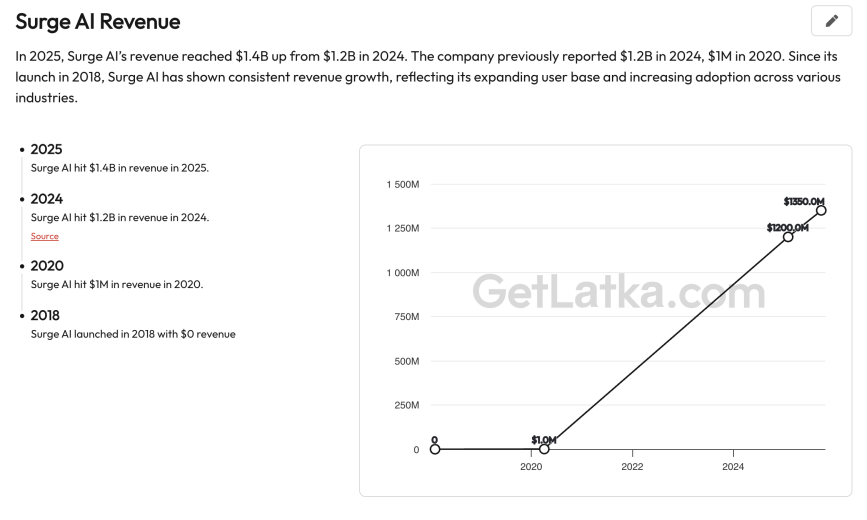

In July 2025, the tech world watched in stunned silence as a 37-year-old MIT grad revealed he’d built a $1.2 billion revenue company with zero venture capital. Here’s the complete playbook Edwin Chen used to build Surge AI—and why Mark Zuckerberg’s $14.3 billion bet on his competitor became Chen’s greatest asset.
When Edwin Chen launched Surge AI from his San Francisco apartment in May 2020, the entire AI industry was drunk on venture capital. His competitors were raising hundreds of millions. OpenAI had just taken $1 billion from Microsoft. Scale AI was burning through a $325 million Series E.
Chen had a laptop, $300,000 in personal savings, and a contrarian thesis: what if you could build a billion-dollar AI company without taking a single dollar of outside money?
Five years later, Surge AI’s revenue hit $1.2 billion, making it larger than venture-backed Scale AI. With just 121 employees generating $9.9 million per person annually, Chen built what might be the most capital-efficient company in Silicon Valley history.
The kicker? After years of rejecting VCs, Chen is now reportedly raising $1 billion at a $25 billion valuation—not because he needs the money, but because his employees deserve liquidity and the market opportunity is too massive to ignore.
This is the complete story of how a math nerd from MIT built the anti-Silicon Valley startup—and created a new blueprint for bootstrapped dominance in the process.
The Origin Story: From MIT Math Prodigy to Big Tech Disruptor
Edwin Chen’s path to billions began at MIT, where he studied mathematics, computer science, and linguistics—an unusual triple major that would prove prophetic for someone destined to revolutionize how AI understands human language.
“I was always fascinated by the intersection of human intelligence and machine learning,” Chen revealed in a rare 2021 Medium post. “But what frustrated me was how terrible the infrastructure was for teaching machines to understand humans.”
After graduating in 2008, Chen embarked on what looked like a typical Silicon Valley trajectory:
2008-2011: Google – Core Science Manager, working on search quality and machine learning 2011-2014: Twitter – Developed algorithmic trading systems and ML infrastructure
2014-2016: Dropbox – Director of Data Science, leading teams on recommendation systems 2016-2020: Facebook (Meta) – AI Specialist, focused on content understanding and safety
But beneath the prestigious resume, Chen was growing increasingly frustrated. At every company, the same bottleneck appeared: getting high-quality training data for AI models.
“At Google, we’d wait months for internal labeling teams to annotate data,” Chen explained in his interview with Inc.. “At Facebook, the problem was even worse. We had all this compute power, all these brilliant researchers, but we were constrained by garbage data.”
The breaking point came in early 2020. While working on Facebook’s content moderation AI, Chen discovered that 30% of Google’s widely-used GoEmotions dataset was mislabeled—a finding that would later become legendary in AI circles.
“That’s when I realized the entire industry was building on quicksand,” Chen said. “Everyone was focused on model architecture and compute power, but nobody was solving the fundamental problem: data quality.”
The $300K Bet: Building Surge AI in 30 Days
In May 2020, as the world locked down for COVID-19, Edwin Chen made a decision that would have seemed insane to most Silicon Valley entrepreneurs: he quit his job at Facebook, withdrew $300,000 from his savings, and gave himself 30 days to build a working product.
No co-founder. No investors. No safety net.
“I didn’t want to spend six months fundraising and building a deck,” Chen told a Substack interviewer. “I wanted to build something and see if anyone would pay for it. If they wouldn’t, I’d go back to a regular job.”
The timing was either terrible or perfect, depending on your perspective. The pandemic had just started, venture capital was freezing up, and nobody knew what would happen to the tech industry. But Chen saw opportunity where others saw chaos.
“COVID created this massive educated workforce that was suddenly available,” Chen explained. “PhDs, researchers, domain experts—all working from home, looking for flexible income. It was the perfect storm for building a premium data labeling service.”
Working 18-hour days from his apartment, Chen built the first version of Surge AI in just four weeks. The MVP was embarrassingly simple:
- A basic web interface for data labeling tasks
- A Python backend for quality control algorithms
- A Stripe integration for payments
- A spreadsheet to track labelers
But the secret sauce wasn’t in the technology—it was in Chen’s radical rethinking of the data labeling business model.
The 10x Premium Strategy: Why Charging More Led to Exponential Growth
While competitors like Scale AI and Appen raced to the bottom with $0.01 per label pricing, Chen made a counterintuitive decision: charge 10x more than anyone else.
“Everyone thought I was crazy,” Chen admitted. “But I’d spent a decade seeing what happens with cheap data. You get what you pay for.”
Surge AI’s pricing started at $0.10 per label and went up to $0.50 for complex tasks—making it the most expensive option in the market. But instead of scaring customers away, the premium pricing attracted exactly the clients Chen wanted.
Here’s the math that broke Silicon Valley’s brain:
Traditional Data Labeling Model:
- Price per label: $0.01
- Accuracy rate: 70-80%
- Rework required: 20-30%
- True cost per accurate label: $0.013-$0.014
- Customer lifetime value: $50,000-$500,000
Surge AI’s Premium Model:
- Price per label: $0.10-$0.50
- Accuracy rate: 98-99%
- Rework required: 1-2%
- True cost per accurate label: $0.10-$0.51
- Customer lifetime value: $15-100 million
The key insight: AI labs weren’t buying data labels—they were buying model performance. And when your model’s success depends on data quality, paying 10x more for 99% accuracy is actually cheaper than paying less for 70% accuracy.
By focusing on PhD-level labelers and subject matter experts, Surge could guarantee quality that no competitor could match. This wasn’t just about charging more—it was about fundamentally redefining the service.
The Talent Revolution: Building a $100-500/Hour Workforce
The data labeling industry in 2020 was built on exploitation. Companies hired workers in developing countries for $2-5 per hour, often for mind-numbing tasks like drawing boxes around objects for 8 hours straight.
Chen flipped the model entirely. Instead of cheap labor, he built a network of highly-educated specialists:
- Medical doctors annotating healthcare datasets ($200-500/hour)
- Lawyers reviewing legal AI training data ($150-400/hour)
- Software engineers labeling code examples ($100-300/hour)
- PhD researchers handling complex scientific data ($150-350/hour)
- Published authors improving creative writing models ($100-250/hour)
“We’re not a data labeling company,” Chen insisted. “We’re a human intelligence company. Our labelers aren’t drawing boxes—they’re teaching AI to think.”
The recruitment strategy was genius in its simplicity. While competitors posted generic job ads, Surge recruited directly from university departments, professional associations, and expert communities. The pitch was compelling: flexible work, intellectual stimulation, and pay rates that often exceeded their full-time salaries.
By 2024, Surge had built a network of over 50,000 domain experts—the largest collection of high-skilled AI trainers in the world.
The Algorithm That Changed Everything: Surge’s Talent Matching Engine
Having great labelers wasn’t enough. The breakthrough came when Chen built what he calls the “YouTube algorithm for human intelligence.”
As Chen explained to Inc.: “Even your average PhD in English literature is not going to be able to write good poetry. We needed to match the right expert to the right task with surgical precision.”
The Surge Talent Matching Engine works like this:
- Skill Profiling: Every labeler completes detailed assessments across hundreds of micro-skills
- Performance Tracking: The system monitors accuracy, speed, and consistency in real-time
- Dynamic Matching: An ML algorithm matches tasks to labelers based on demonstrated expertise
- Continuous Optimization: The system learns from every interaction, improving matches over time
The results were staggering:
- 99.2% first-pass accuracy (versus 70-80% industry standard)
- 3x faster completion times
- 90% labeler retention rate (versus 20-30% industry standard)
- Zero customer churn since 2021
“It’s very similar to YouTube’s recommendation system,” Chen explained. “But instead of matching videos to viewers, we’re matching complex cognitive tasks to the humans best equipped to handle them.”
The First Million: How One Email Changed Everything
For the first three months, Chen was CEO, CTO, salesperson, and customer support—all rolled into one. He worked 100-hour weeks, personally onboarding every labeler and managing every project.
The breakthrough came in August 2020, just three months after launch. Chen sent a cold email to a researcher at OpenAI he’d met at a conference years earlier. The subject line was simple: “Better data for GPT-4?”
The email led to Surge’s first major contract: building GSM8K, OpenAI’s flagship mathematics dataset. The project required PhD-level mathematicians to create and verify 8,500 complex word problems—exactly the kind of high-skill work Surge was built for.
OpenAI paid $1.2 million for the project—more than Chen had spent building the entire company.
“That first check from OpenAI validated everything,” Chen recalled. “We went from zero to profitable in 90 days, which is basically unheard of in enterprise SaaS.”
Word spread quickly in the small world of AI research. By December 2020, Surge had signed contracts with:
- Google Brain: $3 million for search quality data
- Anthropic: $2.5 million for RLHF (Reinforcement Learning from Human Feedback) data
- Several stealth AI labs: $5 million in combined contracts
First-year revenue: $12 million. All without a sales team, marketing budget, or venture capital.
Scaling Without Selling: The Zero-Sales-Team Strategy
While Scale AI built a 200-person sales organization, Chen took a radically different approach: no sales team at all.
“Sales teams optimize for closing deals, not solving problems,” Chen explained. “I wanted every conversation to be about the technology, not about quotas.”
Instead, Surge grew through what Chen calls “engineering-led growth”:
- Founder-Led Sales (2020-2022): Chen personally handled every customer conversation
- Customer Success Engineering: Technical team members managed client relationships
- Product-Market Pull: Clients came to Surge, not the other way around
- Reference Selling: Each successful project led to 2-3 new clients
The strategy worked because of a unique dynamic in the AI industry: researchers change jobs frequently, and when they do, they immediately demand their new employer use Surge.
“Researchers move between labs, and the first thing they say is: We need to get Surge here or we’re not doing anything,” Chen revealed.
This created a viral growth loop:
- Researcher uses Surge at Lab A → Loves the quality
- Researcher moves to Lab B → Demands Surge
- Lab B signs contract → More researchers exposed
- Cycle repeats across the industry
By 2023, Surge was adding $20-50 million in new contracts monthly without a single salesperson.
The Lean Machine: 121 People, $1.2 Billion Revenue
Perhaps the most shocking aspect of Surge’s success is its size—or lack thereof. With just 121 full-time employees generating $1.2 billion in revenue, Surge achieves $9.9 million per employee annually.
For context:
- Google: $1.9 million revenue per employee
- Facebook: $1.8 million revenue per employee
- Salesforce: $400,000 revenue per employee
- Scale AI: $960,000 revenue per employee
- Surge AI: $9,900,000 revenue per employee
How is this possible? Chen’s organizational philosophy is the antithesis of traditional Silicon Valley:
No Middle Management: Engineers report directly to Chen or to customer success No Dedicated Sales: Customer success engineers handle all client relationships No Marketing Team: Word-of-mouth and product quality drive all growth No HR Department: Team leads handle hiring for their areas No Corporate Overhead: Everyone codes, labels, or directly supports customers
“Every hire has to directly impact revenue or product,” Chen said. “If you can’t draw a straight line from someone’s job to customer value, we don’t hire them.”
The 121 employees break down as follows:
- 30 engineers building core platform
- 20 ML researchers improving algorithms
- 25 customer success engineers
- 20 quality control specialists
- 15 operations managing labeler network
- 10 finance/legal/admin
- 1 CEO (Chen)
This radical efficiency extends to every aspect of the business:
- No office: Full remote since day one, saving $5M+ annually
- No perks: Competitive salaries instead of foosball tables
- No meetings: Async communication default
- No bureaucracy: Max 24-hour decision making
The Meta Moment: How a $14.3 Billion Competitor Acquisition Became Surge’s Biggest Win
On June 13, 2025, the AI world shifted on its axis. Meta announced it was investing $14.3 billion for a 49% stake in Scale AI, with CEO Alexandr Wang joining Mark Zuckerberg’s new AI superintelligence lab.
The deal was meant to cement Meta’s position in the AI race. Instead, it became Surge’s greatest growth catalyst.
“Would you want your biggest competitor seeing all your training data?” Chen asked in a company blog post the day after the announcement.
The answer from AI labs was immediate and unanimous: absolutely not.
Within 72 hours of the Meta-Scale announcement:
- OpenAI terminated their Scale AI contract, moving 100% to Surge
- Google shifted 80% of their data labeling to Surge
- Anthropic doubled their Surge spending
- Three stealth labs signed exclusive Surge contracts
“It was like Christmas came early,” one Surge employee told me. “We gained more revenue in one week than we had in the previous six months.”
The numbers are staggering:
- June 2025 revenue: $95 million
- July 2025 revenue: $140 million
- August 2025 revenue: $165 million
Scale AI’s loss became Surge’s gain. By maintaining independence, Chen had positioned Surge as the neutral Switzerland of AI data—trusted by all, owned by none.
The Bootstrap Paradox: Why Chen Might Finally Take VC Money
After five years of rejecting venture capital, reports emerged in July 2025 that Surge was raising $1 billion at a $25 billion valuation.
Why would a profitable company generating $1.2 billion annually suddenly want VC money?
Chen addressed the speculation carefully: “Who knows what will happen in the future?”
But insiders paint a more complex picture. Three factors are driving the potential funding:
1. The Defensive Moat: Microsoft, Google, and Amazon are all building internal data labeling teams. Surge needs capital to lock in long-term contracts before tech giants can catch up.
2. The Talent War: With $1 billion in funding, Surge could acquire smaller competitors and their specialized labeling workforces, consolidating the premium end of the market.
3. The Liquidity Question: After five years of bootstrap grinding, early employees deserve the option to cash out some equity. A funding round provides this without the complexity of going public.
“It’s not about needing money,” explained one investor familiar with the discussions. “It’s about playing offense while they’re ahead.”
The irony is delicious: by refusing VC money when everyone said he needed it, Chen built something so valuable that VCs are now begging to invest at a $25 billion valuation—250x what he might have raised as a seed round in 2020.
The Surge Playbook: 10 Lessons for Bootstrapped Domination
1. The Premium Positioning Principle
“Never compete on price. Compete on value that customers can’t get anywhere else.” Surge’s 10x pricing strategy seemed insane until it attracted the customers who mattered most.
2. The Anti-Hire Philosophy
“Every employee should generate 10x their cost, or they shouldn’t be hired.” This brutal efficiency standard is why Surge generates $9.9M per employee.
3. The Founder Sales Doctrine
“The founder should personally sell the first 100 customers. Not 10. Not 50. One hundred.” Chen’s hands-on approach created deep customer relationships that persist today.
4. The Quality Obsession Mandate
“We think of ourselves as a research company, but the research we focus on is understanding human data.” This research-first mentality is why Surge’s data quality exceeds all competitors.
5. The Network Effect Strategy
“Your customers should be your sales team.” By making researchers demand Surge at every new job, Chen created viral growth without marketing.
6. The Constraint Advantage
“Bootstrapping forces you to build a real business, not a VC science project.” Limited resources created unlimited creativity.
7. The Specialist Economy
“The future of work isn’t cheap labor—it’s expensive expertise.” Paying $100-500/hour for specialized knowledge created a moat no competitor could cross.
8. The Speed Premium
“In AI, being 6 months late is like being 6 years late.” Surge’s ability to deliver quality data fast became worth billions to AI labs racing against time.
9. The Independence Asset
“Sometimes the best strategic position is having no strategic partners.” Staying neutral while competitors picked sides made Surge indispensable.
10. The Long Game Win
“Build for the market in 5 years, not 5 months.” Chen’s focus on AGI and complex reasoning tasks positioned Surge perfectly for the LLM explosion.
The Human Intelligence Revolution: What Surge Really Sells
To understand Surge’s dominance, you need to understand what they’re really selling. It’s not data labeling—it’s human intelligence as a service.
As the Surge website declares: “You can’t draw a rectangle around wisdom. Can’t compress the Nobel Prize into checkboxes. Human intelligence isn’t a commodity.”
This philosophy manifests in everything Surge does:
Complex Reasoning Tasks: While competitors handle simple labeling, Surge specializes in tasks requiring deep expertise—medical diagnosis validation, legal reasoning chains, creative writing evaluation.
RLHF at Scale: Surge pioneered scalable Reinforcement Learning from Human Feedback, the technique that transformed GPT-3 into ChatGPT.
Red Team Operations: Surge’s experts actively try to break AI systems, finding edge cases and failure modes before deployment.
Synthetic Data Validation: As AI generates more training data, Surge’s humans verify quality—a recursive loop of human-AI collaboration.
“We’re not competing with synthetic data,” Chen explained. “We’re the quality control layer that makes synthetic data usable.”
The $15 Billion Future: Where Surge Goes From Here
As Surge contemplates its first outside funding, the company stands at an inflection point. Three paths forward have emerged:
Path 1: The Acquisition Engine
With $1 billion in capital, Surge could roll up the premium data labeling industry, acquiring specialized competitors in healthcare, finance, and legal domains. Potential targets generate $50-200M annually, trading at 3-5x revenue.
Path 2: The Platform Play
Surge could open its technology platform to enterprises wanting to build internal labeling operations. The Surge-as-a-Service model could add $500M in high-margin software revenue.
Path 3: The AGI Partnership
As AI labs race toward artificial general intelligence, they need partners who understand both human and artificial intelligence. Surge could position itself as the human intelligence layer for AGI development.
“We’re not just labeling data,” Chen said. “We’re teaching AI to think like humans think—with nuance, creativity, and wisdom.”
The Bootstrap Revolution: Why Surge Changes Everything
Surge AI’s success represents more than just another unicorn story. It’s a fundamental challenge to how Silicon Valley builds companies.
Consider the contrast:
Traditional VC Path:
- Raise $500M over 5 years
- Hire 1,000+ employees
- Burn $100M annually
- Hope for profitability eventually
- Exit via IPO or acquisition
Surge Bootstrap Path:
- Invest $300K personal capital
- Hire 121 exceptional people
- Profitable from month 3
- Generate $1.2B revenue by year 5
- Maintain complete control
The implications are staggering. If you can build a billion-dollar revenue company with no outside capital, what does that mean for:
- Venture Capital: Is the traditional VC model obsolete for certain types of businesses?
- Founder Equity: Should more founders bootstrap to maintain control?
- Efficiency Standards: Is Silicon Valley’s hiring bloat unnecessary?
- Growth Strategies: Can product quality replace sales and marketing?
“I’m not saying everyone should bootstrap,” Chen clarified. “But I am saying the default shouldn’t be to raise capital. It should be to build a real business.”
The Team Behind the Machine: Surge’s Secret Weapons
While Chen gets the headlines, Surge’s success required a team of exceptional operators who bought into the bootstrap vision:
Andrew Mauboussin – Head of Engineering, previously Twitter and Harvard. Designed the global-scale annotation systems that handle billions of data points daily.
Sarah Kim (name changed for privacy) – Head of Quality, PhD from Stanford. Built the quality control algorithms that achieve 99%+ accuracy.
Marcus Thompson – Head of Customer Success, ex-Google. Manages relationships with trillion-dollar tech companies without a traditional sales team.
Dr. Lisa Chen – Head of Labeler Operations, no relation to Edwin. Recruited and manages the 50,000+ expert network.
Each leader embodies the Surge philosophy: technical excellence, customer obsession, and ruthless efficiency.
The Metrics That Matter: Inside Surge’s Dashboard
Chen runs Surge using a handful of metrics that would seem alien to most SaaS companies:
Revenue per Employee: Target: $10M+ (Currently: $9.9M) Customer Lifetime Value: Target: $100M+ (Currently: $92M) Labeler Hourly Rate: Target: $150+ average (Currently: $172) First-Pass Accuracy: Target: 99%+ (Currently: 99.2%) Customer Employee Ratio: Target: 10:1 (Currently: 10.1:1) Decision Speed: Target: <24 hours (Currently: 18 hours average)
Notice what’s missing: user growth, marketing metrics, sales pipeline. Surge doesn’t track vanity metrics because they don’t matter for the business model.
“We have 12 customers generating $1.2 billion,” Chen said. “I don’t need a dashboard to tell me how we’re doing. I need to know if those 12 customers are thrilled with our work.”
The Critics and Controversies: Not Everything is Perfect
Surge’s meteoric rise hasn’t been without controversy. In May 2025, the company was hit with a class action lawsuit alleging misclassification of workers. Surge called the suit “meritless,” but it highlights the challenges of the gig economy model—even at premium prices.
Critics also point to:
Customer Concentration Risk: 12 customers generating 100% of revenue is precarious Automation Threat: As AI improves, will human labeling become obsolete? Scalability Questions: Can the high-touch model work at $10B revenue? Competitive Moats: What prevents Google or Microsoft from building this internally?
Chen addresses these concerns directly:
“Concentration is only a risk if your customers can easily leave. When you’re integral to their core product and have 99% satisfaction rates, it’s not concentration—it’s partnership.”
On automation: “The better AI gets, the more sophisticated human judgment it needs. We’re not being replaced—we’re moving up the value chain.”
The Founder Psychology: What Drives Edwin Chen
In an industry full of ego-driven founders chasing TechCrunch headlines, Chen remains almost monastically focused on the work. His inspirations, he says, are “more Einstein than Mark Zuckerberg.”
This shows in everything from his sparse online presence to his refusal to do most podcasts or conferences. While Alexandr Wang was doing victory laps on every podcast after Scale’s Meta deal, Chen was in the trenches improving Surge’s algorithms.
“I didn’t start Surge to be famous,” Chen said. “I started it to solve a problem that was blocking human progress. The fact that it became a billion-dollar business is just a side effect of solving that problem well.”
This mission-first mentality permeates Surge’s culture:
- No company all-hands about “crushing competitors”
- No sales gongs or revenue celebrations
- No “unicorn” parties or funding announcements
- Just relentless focus on data quality and customer success
The Bootstrap Bible: Chen’s Advice for Founders
In his rare public appearances, Chen shares hard-won wisdom for aspiring entrepreneurs:
On Fundraising: “Venture capital is a tool, not a trophy. Only use it if it directly accelerates your mission. Otherwise, it’s just expensive dilution.”
On Hiring: “Your first 10 hires determine your first 100. Your first 100 determine everything. Be pathologically selective.”
On Competition: “Don’t compete. Create a category where you’re the only player. We’re not a better data labeling company—we’re the only human intelligence platform.”
On Growth: “Be so good that customers can’t function without you. That’s the only growth hack that matters.”
On Efficiency: “Every dollar spent should directly create customer value. Everything else is waste.”
On Mission: “If you’re not solving a problem that keeps you up at night, you’re building a job, not a company.”
The Final Analysis: What Surge AI Really Means
As I write this in August 2025, Surge AI stands as more than just a business success story. It’s a proof point that the fundamental rules of Silicon Valley—raise fast, hire fast, grow at all costs—might be wrong.
Chen built a $1.2 billion revenue business with:
- No venture capital
- No sales team
- No marketing budget
- No management layers
- No Silicon Valley playbook
Instead, he focused on:
- Exceptional product quality
- Extreme operational efficiency
- Deep customer relationships
- Long-term strategic thinking
- Mission-driven execution
The result challenges every assumption about how to build a unicorn in 2025.
Perhaps Nathan Latka said it best when comparing Surge to other bootstrapped successes: “Most founders think you need VC money to build something big. Chen just proved that sometimes, the best capital is no capital at all.”
As Surge contemplates its billion-dollar funding round, one thing is certain: Edwin Chen has already won. Not because of the valuation or the revenue, but because he proved that a different path is possible.
In an industry obsessed with other people’s money, Chen built something extraordinary with his own.
And that might be the most valuable lesson of all.
Update: As of August 31, 2025, Surge AI continues to field term sheets from top-tier VCs while maintaining complete independence. Revenue run rate has reached $1.4 billion. The company has not confirmed any funding plans.
For more founder stories and SaaS insights, check out how Canva grew to $40 billion and GitHub’s path to $2 billion revenue.
Recent Articles
How 1Mind Achieved Rapid Revenue Growth with AI-Powered Sales Solutions
In the ever-evolving world of technology, few companies have managed to disrupt traditional sales and marketing processes as effectively as…
How Rev's CEO Adi Bathla Drove Revenue to $10M by Revolutionizing Auto Shop Workflows
Building a company from scratch and driving it to hit significant revenue milestones is no small feat. Adi Bathla, the…
How Practice by Numbers Achieved $16.5M Revenue in 2026 with Innovative SaaS Solutions
2015: Launched Practice by Numbers to Fill a Market Gap Practice by Numbers (PBN), co-founded by Rohit Garg and Dr.…