How Cledara Hit 3x Pipeline and 2x Growth in Revenue ($8.2M)
June 18, 2024 • 6 min read
On This Page
Nathan Latka
Launched in 2018
$720k in revenue in 2020
$8.2M in revenue in 2023
In the fast-paced world of SaaS, staying agile and responsive to market dynamics is crucial. For Cledara, an all-in-one SaaS management solution that helps businesses discover, buy, manage, and cancel the cloud software they use, this meant making bold moves and significant changes to their go-to-market strategy between Christmas and New Year of 2023. This article explores why Cledara made these changes, the insights they gained from their extensive data, and the results they achieved.
Cledara Revenue is $8.2 Million as of 2024
Launched in 2018, Cledara has demonstrated momentum. By 2020, Cledara had already reached $720,000 in revenue. This growth accelerated, and by 2023, Cledara’s revenue stood at an impressive $8.2 million.
This achievement is particularly noteworthy considering that Cledara has managed this rapid scale while maintaining strategic focus and innovative service offerings. Their ability to grow so effectively in a short span of time is a testament to the strength of their product and the strategic vision of the founders.
The Need for Change
Cledara’s decision to pivot its go-to-market strategy was driven by a deep understanding of shifting buyer behaviors. They noticed a plateau in pipeline generation, which hindered their goal of doubling revenue. This stagnation led them to reevaluate their approach and expand their target market.
In 2022, the market started to get tough. Cledara observed that larger software buyers were becoming more reliable, making them a safer target for sales efforts. However, as 2023 progressed, smaller buyers began outperforming the larger ones as market conditions improved. This shift in buyer behavior necessitated a strategic adjustment.
The 3 Steps Needed To Boost the Pipeline
1. Widening the Aperture
Initially, Cledara focused on their Ideal Customer Profile (ICP). However, faced with a challenging market, they decided they needed to cast a wider net. They began targeting larger companies, some with several thousand employees, to see if they could generate leads from these big players. Despite closing deals with these larger entities, it didn’t significantly impact their overall pipeline.
Realizing that widening their aperture wasn’t yielding the desired results, Cledara turned to their data. They found that their average sales cycle had lengthened. Traditionally, deals closed within 30 days, but the shift in focus led to selling to unfamiliar personas and large buying committees, diverting attention from quickly closable deals.
2. Leveraging Cledara’s Insights
Cledara’s comprehensive SaaS management solution provides businesses with the best real-time view of SaaS buying anywhere in the world. With data from over 1,000 companies across 32 countries, Cledara offered a comprehensive view of the SaaS market. This included 713,681 SaaS renewals in the past 12 months and insights from over 5,250 vendors, generating more than 2 million data points daily.
When onboarding new customers, Cledara’s first priority was understanding the software landscape of these businesses. This holistic view enabled Cledara to see their entire software estate, whether known or unknown to them. Cledara’s dataset is one of the largest in the world, providing unparalleled insights into the real-time state of the SaaS market.
3. Implementing the SaaS Buyers Index
Cledara developed a SaaS Buyers Index to track software spend across companies. By analyzing whether companies spent more, less, or the same on software each month, they could better understand market trends and buyer behavior. Companies spending less received a score of 0, those spending the same scored 100, and those spending more scored 200. By averaging these scores, Cledara could gauge the overall health of the SaaS market and refine their sales strategy accordingly. By implementing this index, Cledara realized what they needed to do in order to get their pipeline back on track. The company then decided to adjust pricing and packaging.
The 4 Strategies that Actually Boosted the Pipeline
1. Adjusting Pricing and Packaging
One of the most significant changes Cledara made was overhauling their pricing structure. They simplified their offerings by removing IT features from their core plans and shifting them to add-ons. This change allowed them to target a single buyer within organizations, reducing the complexity of their sales process.
Before this change, Cledara’s product had grown over time, incorporating features that catered to both finance and IT. This led to complex buying committees and longer sales cycles. By stripping down to essential features and offering IT functionalities as add-ons, Cledara made it easier for customers to purchase and for their sales team to close deals.
To avoid cannibalizing their existing customer base, they ensured that customers who retained all previous features paid the same amount. This careful balancing act preserved their revenue while making it easier for new customers to buy.
2. Introducing a Free Plan
To drive conversions, Cledara leaned heavily into offering a free plan. This move aimed to attract customers earlier in their buying journey, confident that their low churn rate would help retain these customers long-term. The free plan also helped increase interest and intrigue, significantly boosting their pipeline.
3. Streamlining the Sales Process
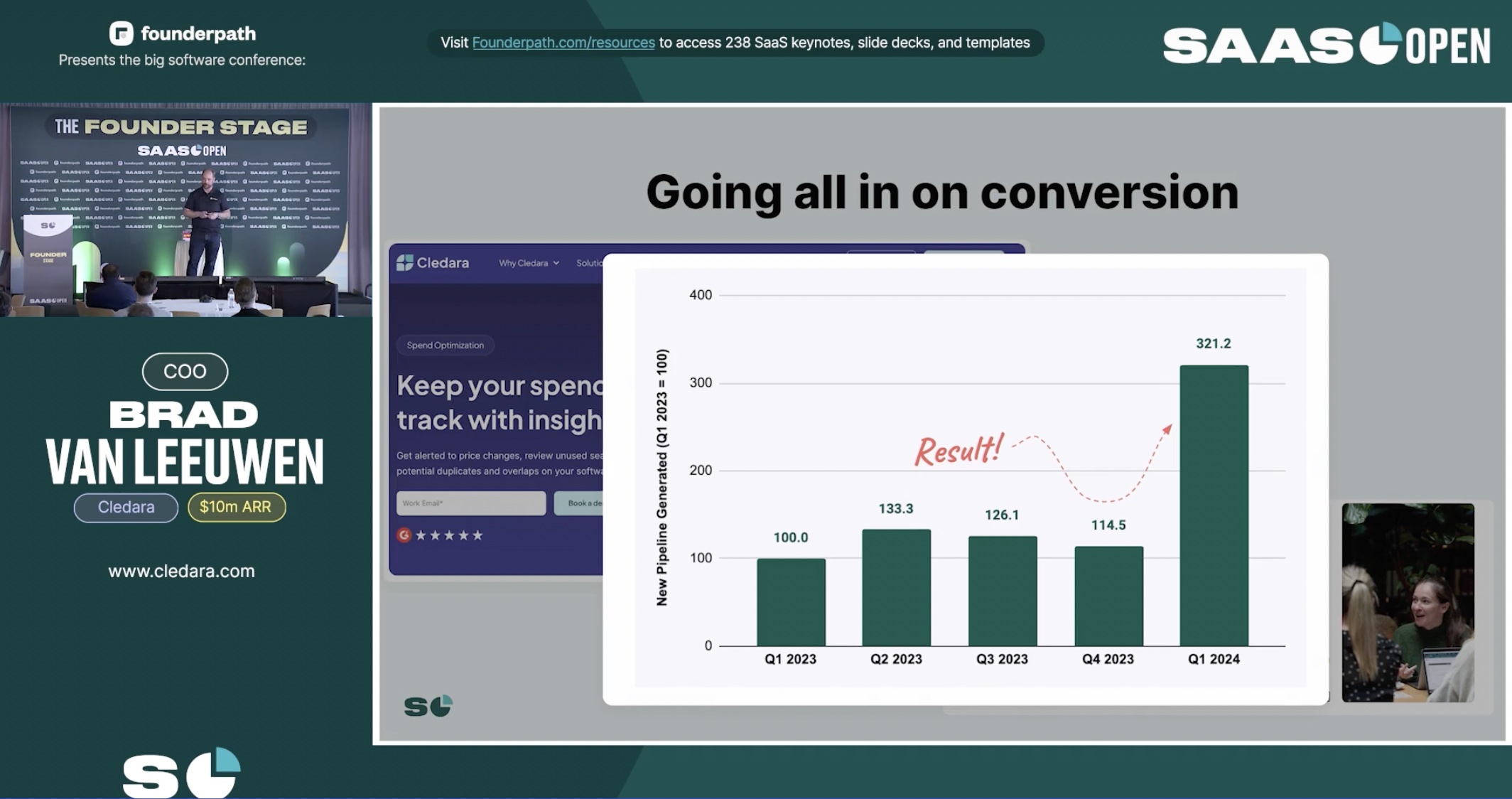
Cledara tested different calls to action, discovering that “Get Started Free” had a nine times higher click-through rate than “Book a Demo.” This change, along with reducing their discovery process to just eight minutes, enabled them to focus on pain points during demo calls and drive quicker closes.
They also experimented with quotas based on the number of logos (customers) rather than revenue, fostering urgency and speeding up the sales cycle. These strategies nearly tripled their pipeline from one quarter to the next.
Cledara’s objective was to drive a one-call close, even guiding prospects through the sign-up process during the demo call. This approach reduced the time to value for new customers, ensuring they saw benefits from Cledara’s services as quickly as possible.
Cledara’s shift to prioritize conversion over traditional sales metrics proved to be a game-changer. By focusing on the speed and efficiency of their sales process, they maximized their pipeline’s potential. They emphasized the importance of quick wins and rapid onboarding, tailoring their approach to meet the needs of smaller, more agile buyers who could quickly make decisions.
Their outbound strategy was also revamped to align with this new focus. Sales Development Representatives (SDRs) were instructed to drive prospects towards the “Get Started Free” option rather than a demo. This subtle but impactful change in strategy led to a significant increase in conversions, as prospects were more willing to explore the product without committing to a lengthy demo.
Results and Key Takeaways
Cledara’s strategic pivot in late 2023 highlights the importance of agility and data-driven decision-making in the SaaS industry. By widening their aperture, adjusting pricing and packaging, and refining their sales process, they successfully revitalized their pipeline and set the stage for continued growth in a competitive market.
Several key takeaways can be drawn from Cledara’s experience:
Adapt Quickly to Market Changes: Use data to make informed decisions and pivot strategies rapidly.
Simplify the Buying Process: Streamline pricing and packaging to reduce complexity and speed up sales cycles.
Leverage Free Plans: Attract and retain customers with value-driven free offerings.
Focus on Conversion: Optimize calls to action and sales processes to maximize conversions.
Data is King: Leveraging real-time data from tools like Cledara can provide crucial insights that drive strategic decisions.