
What is HubSpot’s Valuation?
HubSpot’s valuation is $37.75B as of 2025.
What is HubSpot’s Revenue?
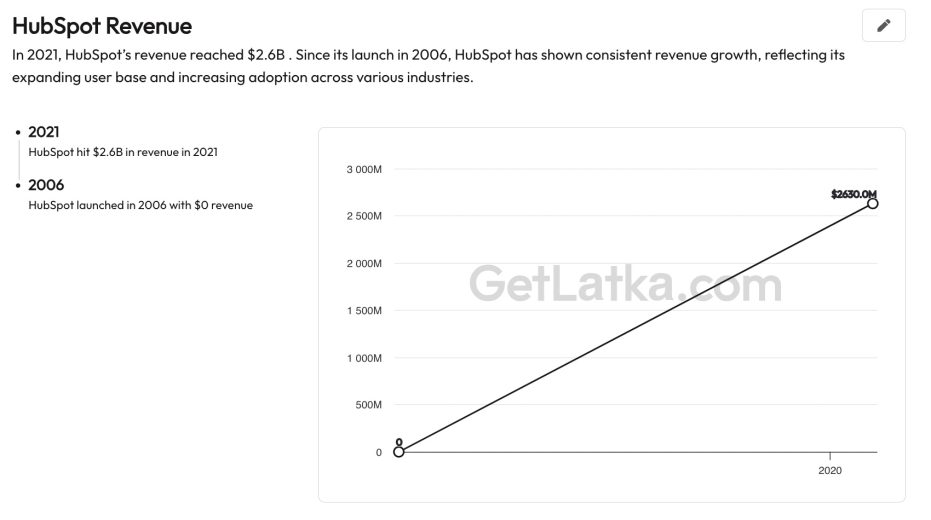
HubSpot’s revenue reached $2.63B in 2024.
| Year | Revenue |
|---|---|
| 2006 | Launched ($0 revenue) |
| 2021 | $883M |
| 2022 | $1.731B |
| 2023 | $2.17B |
| 2024 | $2.628B |
Who is the CEO of HubSpot?
HubSpot’s CEO is Yamini Rangan.
Who Are HubSpot’s Competitors?
HubSpot faces strong competition from companies like Salesforce, Marketo, and Pardot.
For more statistics on Hubspot and other companies, check out the database.
How HubSpot Turned a $100K Idea Into Multi-Billion Dollar Revenue

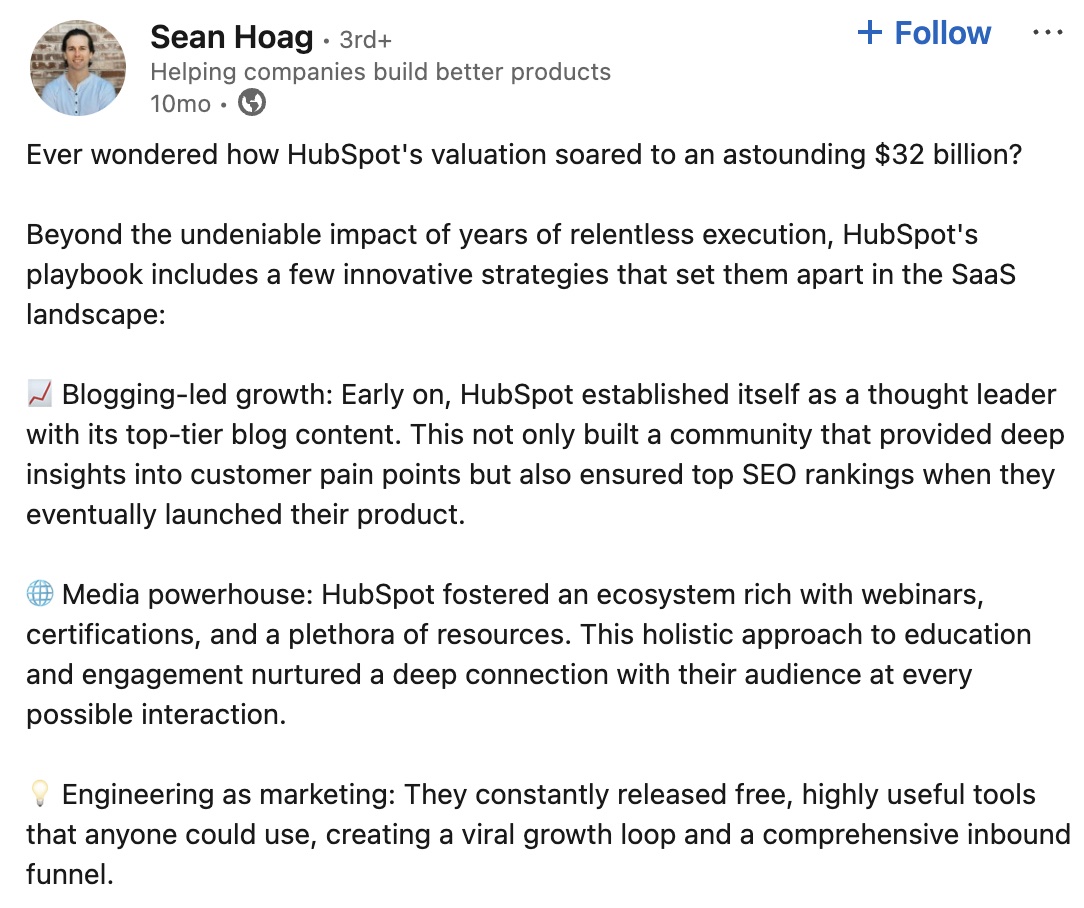
When Dharmesh Shah and Brian Halligan co-founded HubSpot in 2006, they weren’t just building another marketing tool—they were pioneering a new approach to attracting customers.
At the time, traditional marketing relied on cold calls and expensive ads, but Shah and Halligan saw a shift: people wanted to engage with brands that provided value first.
“People don’t want to be interrupted by marketers. They want to be helped,” Shah once said.
This mindset led to inbound marketing, a strategy that turned HubSpot into an industry disruptor.
Revolutionizing Marketing with Inbound Strategy
Instead of pushing ads, HubSpot focused on attracting customers through blogs, SEO, and free educational content.
By practicing what they preached, their website traffic skyrocketed, and businesses signed up—not because of aggressive sales tactics, but because they found HubSpot’s insights valuable.
By 2010, HubSpot had surpassed $15M in annual revenue, proving that inbound marketing worked.
The Subscription Model That Scaled to $1B HubSpot Revenue
Like any successful SaaS brand, HubSpot scaled with a subscription model.
Businesses could start small and upgrade as they grew, making HubSpot more accessible than competitors like Salesforce.
This flexible pricing fueled rapid adoption—today, over 184,000 customers use HubSpot, driving its $879M annual revenue.
Customer-Centric Growth: The HubSpot Flywheel Effect
Instead of treating customers as one-time buyers, HubSpot designed its platform to keep them engaged long-term.
This Flywheel Model increased retention rates and turned satisfied customers into promoters, creating a cycle of organic growth.
How HubSpot Grew From $0 to $2.6B—Year by Year
Since its inception in 2006, HubSpot has experienced remarkable growth, evolving from a modest startup into a leading force in the SaaS industry.
This journey is marked by significant HubSpot revenue milestones that highlight the company’s strategic expansion and market influence.
2007: Early Beginnings
In its first full year of operations, HubSpot reported revenues of $255,000. This foundational period was crucial as the company introduced its inbound marketing methodology, setting the stage for future growth.
2010: Crossing the $15 Million Threshold
By 2010, HubSpot’s innovative approach led to a substantial increase in revenue, reaching $15.6 million. This growth was driven by the adoption of inbound marketing strategies by a growing number of businesses seeking effective customer engagement.
2014: Going Public
On August 25, 2014, HubSpot filed for an initial public offering (IPO) with the Securities and Exchange Commission, aiming to be listed on the New York Stock Exchange under the ticker symbol HUBS.
This move not only validated HubSpot’s business model but also provided capital for further expansion.
2017: Surpassing $375 Million
Continuing its upward trajectory, HubSpot’s revenue exceeded $375.6 million in 2017. This period saw the company broadening its product offerings and expanding its global footprint, attracting a diverse clientele.
2021: Achieving the $1 Billion Mark
A significant milestone was reached in 2021 when HubSpot’s annual revenue hit $1 billion. This achievement underscored the company’s position as a dominant player in the CRM and marketing software sectors.
2023: Revenue Reaches $2.17 Billion
In 2023, HubSpot reported total revenue of $2.17 billion, reflecting a 25% increase from the previous year. This impressive growth was accompanied by a customer base expansion to 205,091, highlighting the company’s ability to scale effectively.
2024: Continued Growth With a Dash of Drama
The momentum continued into 2024, with HubSpot generating $617.4 million in revenue in the first quarter alone, marking a 23% year-over-year increase.
Although there has been great growth for HubSpot, just recently there have been whispers regarding blog traffic disappearing…
Then you have them writing an article that has nothing to do with their company on “how to do shrug emoji”…

Even though revenue has been growing, their blog has not been doing well.
How HubSpot’s Revenue Hit $1B and Beyond
HubSpot’s journey to surpassing $1 billion in annual recurring revenue (ARR) is a testament to its strategic foresight and adaptability in the dynamic SaaS landscape.
Founded in 2006 by Brian Halligan and Dharmesh Shah, HubSpot introduced the inbound marketing methodology, focusing on attracting customers through valuable content rather than traditional advertising.
This innovative approach resonated with businesses seeking more authentic engagement with their audiences.
Strategic Expansion and Diversification
Initially concentrating on marketing automation, HubSpot recognized the evolving needs of its customer base and expanded its offerings to become a comprehensive customer relationship management (CRM) platform.
This strategic diversification included tools for sales, customer service, and content management, enabling businesses to streamline their operations within a unified ecosystem.
By 2021, this broadened suite of services attracted over 100,000 paying customers, propelling HubSpot’s ARR beyond the $1 billion mark.
Commitment to Customer Success
Central to HubSpot’s growth is its unwavering commitment to customer success. The company invested heavily in educational resources, including the HubSpot Academy, offering free courses and certifications to empower users.
This emphasis on education fostered a loyal community of customers proficient in leveraging HubSpot’s tools to drive their own business growth, creating a symbiotic relationship that fueled HubSpot’s expansion.
Embracing Innovation and AI
In recent years, HubSpot has embraced artificial intelligence (AI) to enhance its platform’s capabilities. The integration of AI-driven features has enabled businesses to automate complex tasks, gain deeper insights from their data, and deliver personalized customer experiences at scale.
This commitment to innovation has not only improved customer retention but also attracted new users seeking cutting-edge solutions, contributing to HubSpot revenue growth.
Financial Milestones
HubSpot’s financial trajectory showcases its consistent growth:
- 2017: Annual revenue reached $375.6 million.
- 2021: Surpassed $1 billion in ARR.
- 2023: Total revenue climbed to $2.17 billion, a 25% increase from the previous year.
- 2024: Revenue continued its upward trajectory, reaching $2.63 billion, marking a 21% year-over-year growth.
CEO Insights on Achieving Record Revenue

When Yamini Rangan took the helm as HubSpot’s CEO in 2021, she wasn’t just stepping into a leadership role—she was taking charge of a company on the brink of its biggest growth phase yet.
HubSpot had already built a strong foundation, but the challenge was clear: how could they scale beyond $1 billion in revenue while staying true to their customer-first philosophy?
At the time, the SaaS industry was becoming increasingly competitive, with Salesforce, Marketo, and other enterprise solutions vying for market share. But Rangan saw an opportunity to double down on what made HubSpot unique: a focus on seamless, scalable growth for businesses of all sizes.
Fast forward to 2024, and HubSpot’s revenue has soared past $2.17 billion, a 25% increase year-over-year. But what exactly fueled this surge?
Doubling Down on the “Customer Code”
HubSpot’s secret weapon has always been its customer-centric approach, a principle Rangan made sure to amplify. Instead of chasing short-term gains, HubSpot focused on long-term relationships, ensuring businesses had the tools they needed to scale effortlessly.
“The best way to grow is to make sure our customers are growing first,” Rangan explained in an interview.
Under her leadership, HubSpot expanded its product suite beyond marketing automation, making its CRM platform an all-in-one powerhouse for sales, service, and operations.
This move didn’t just boost revenue—it cemented HubSpot as an essential tool for scaling businesses, driving higher retention rates and subscription upgrades.
AI-Powered Growth: How HubSpot Embraced the Future
One of Rangan’s boldest moves was integrating artificial intelligence (AI) into HubSpot’s ecosystem. AI-driven automation tools, predictive analytics, and intelligent chatbots allowed businesses to operate more efficiently while improving customer engagement.
The impact was immediate: HubSpot customers using AI features reported a 30% increase in lead conversion rates and a 40% reduction in manual workload. By leaning into AI, HubSpot not only enhanced its product value but also created new revenue streams, further solidifying its position as a market leader.
Expanding the Flywheel: From $1B to $2B Revenue
Rangan also refined HubSpot’s flywheel model, shifting away from a traditional sales funnel and focusing on customer retention as a primary growth driver.
By ensuring that existing customers remained engaged and successful, HubSpot maximized lifetime value (LTV)—a key factor in achieving record-breaking revenue.
This approach led to a 98% retention rate among enterprise clients, proving that keeping customers happy was just as important as acquiring new ones.
Key Takeaway: Yamini Rangan leadership proves that sustainable revenue growth isn’t just about selling—it’s about continuously evolving to meet customer needs.
From Startup to Giant: The Evolution of HubSpot’s Revenue Model

In 2006, Brian Halligan and Dharmesh Shah founded HubSpot with a vision to transform marketing through inbound marketing. Instead of relying on cold calls and paid ads, they believed businesses could attract customers by providing valuable content.
This concept revolutionized digital marketing, and HubSpot quickly gained traction among small businesses looking to grow online.
Fast forward to today, and HubSpot has grown into a multi-billion-dollar SaaS leader. But how did its revenue model evolve to support this explosive growth?
The Shift from Startups to Enterprise Solutions
HubSpot initially catered to small businesses, offering an all-in-one marketing platform with tools for website building, blogging, and email marketing But as demand grew, so did HubSpot’s vision.
By 2010, the company expanded its offerings to include customer relationship management (CRM), sales automation, and analytics, allowing mid-sized businesses and enterprises to streamline their operations.
This shift proved pivotal—HubSpot’s revenue surged to $15.6 million in 2010, marking its first major milestone.
The Power of Subscription-Based Revenue
Unlike traditional software companies that relied on one-time license fees, HubSpot embraced a subscription-based pricing model. By offering tiered plans, businesses could pay for only the features they needed, making HubSpot a flexible and scalable solution.
This model created predictable recurring revenue, which helped HubSpot scale rapidly. By 2018, the company reported $513 million in revenue, reflecting a 37% increase year-over-year.
In 2024, HubSpot further refined its pricing strategy by introducing a seat-based model, allowing businesses to pay per user, ensuring more cost-effective solutions for growing teams.
Key Takeaway: From its modest beginnings to its current status as a SaaS industry leader, HubSpot’s adaptive revenue model and strategic growth initiatives have been instrumental in its ascent.
How HubSpot’s $30B Valuation Reflects Its Revenue Performance

Brian Halligan and Dharmesh Shah believed that instead of bombarding potential customers with unsolicited advertisements, businesses could attract them by providing valuable content.
This philosophy resonated with many, and HubSpot quickly became a go-to platform for small and medium-sized enterprises seeking effective marketing solutions.
Fast forward to 2025, and HubSpot’s journey from a modest startup to a tech giant with a valuation surpassing $30 billion is nothing short of remarkable. This impressive HubSpot valuation is a direct reflection of the company’s consistent revenue growth and strategic expansions.
Strategic Expansions and Innovations
Several strategic decisions have propelled HubSpot’s growth:
- AI Integration: Recognizing the transformative potential of artificial intelligence, HubSpot introduced “Breeze,” an AI engine designed to enhance automation tools. This innovation has not only improved user experience but also attracted a broader clientele.
- Acquisitions: To diversify and strengthen its offerings, HubSpot acquired companies like Clearbit in 2023, enhancing its data management capabilities, and Frame AI in 2024, bolstering its AI-driven customer service solutions.
Market Valuation and Stock Performance
HubSpot’s market valuation is a testament to investor confidence and market performance:
- Stock Price: As of February 26, 2025, HubSpot’s stock trades at $736.36, reflecting positive investor sentiment.
- Market Capitalization: The company’s market cap stands at approximately $38.43 billion, highlighting its significant presence in the tech industry.
This valuation is not just a reflection of current earnings but also of future growth potential, driven by continuous innovation and market expansion.
Key Takeaway: HubSpot’s ascent to a $30 billion valuation exemplifies how a steadfast commitment to innovation, strategic growth, and understanding market dynamics can propel a company from a startup to an industry leader.
How HubSpot Maintained Revenue Growth Amid Market Turbulence
Economic downturns, shifting market dynamics, and rising competition have caused turbulence for many SaaS companies. Yet, HubSpot has defied these challenges, consistently increasing its revenue while solidifying its place as an industry leader.
As of 2025, HubSpot’s stock price stands at $736.12, reflecting investor confidence in its ability to navigate market uncertainty. But how has HubSpot managed to maintain its revenue growth while others struggled?
Strategic Diversification: Expanding Beyond Marketing
HubSpot’s foundation was built on inbound marketing, but relying solely on a single product category could have stifled its growth.
Recognizing this, the company strategically expanded into CRM, sales automation, and customer service tools, transforming its platform into a comprehensive business solution. This move allowed HubSpot to appeal to a wider range of businesses, from startups to large enterprises, ensuring it wasn’t solely dependent on one revenue stream.
By 2024, these expanded offerings fueled HubSpot’s total revenue to $2.628 billion, a 21% increase from the previous year.
Rather than focusing only on new customer acquisition, HubSpot’s diversified product suite encouraged higher customer retention and increased upselling opportunities, further strengthening its financial performance.
AI-Driven Innovation: Staying Ahead of the Curve
As AI reshaped the SaaS industry, HubSpot leaned into automation and intelligence-driven tools, ensuring it remained competitive.
In 2024, the company introduced Breeze, an advanced AI engine that revolutionized marketing automation, customer insights, and lead generation. This innovation provided businesses with personalized recommendations, automated workflows, and predictive analytics, making HubSpot’s platform more powerful than ever.
As a result, customers using AI-driven features reported a 30% increase in conversion rates and a 40% reduction in manual marketing tasks, reinforcing HubSpot’s role as a productivity enabler.
Rather than cutting costs in uncertain times, HubSpot invested in AI research and development, ensuring its tools remained at the forefront of the industry.
This future-proofing strategy has been pivotal in maintaining revenue growth and increasing customer demand, even during economic slowdowns.
Customer-Centric Strategy: The Flywheel in Action
Unlike traditional sales funnels, HubSpot operates on a flywheel model, where customer success fuels business growth. By prioritizing customer education, seamless onboarding, and ongoing support, HubSpot has cultivated high retention rates and strong referrals.
Rather than aggressively pushing sales, the company empowers customers with free educational content, AI-powered tools, and community engagement, turning satisfied users into brand advocates.
This approach has created organic growth, where customers themselves drive new revenue streams through referrals and continued platform adoption.
Key Takeaway: HubSpot’s strategic expansion, AI-driven innovation, and customer-first approach have positioned it as a SaaS leader that thrives even during economic challenges. While market turbulence has slowed down many of HubSpot competitors, the company’s ability to adapt and evolve ensures its revenue growth remains on an upward trajectory.
How Leadership Fueled HubSpot’s Explosive Revenue

HubSpot’s rise from a startup to a $30 billion SaaS powerhouse didn’t happen by accident. It was the result of strong, visionary leadership that adapted to changing market conditions, embraced innovation, and placed customer success at the core of its strategy.
Founders Brian Halligan and Dharmesh Shah laid the foundation, pioneering inbound marketing and disrupting the traditional advertising-driven approach. But as HubSpot scaled, leadership had to evolve to maintain its growth momentum.
When Yamini Rangan took over as CEO in 2021, HubSpot was entering a new phase—one that required sustained revenue expansion, deeper product diversification, and a stronger global presence.
Under her leadership, HubSpot soared past $1 billion in revenue, reached $2.17 billion by 2023, and continued its upward trajectory toward $3 billion in 2025.
Visionary Leadership: Scaling Beyond Inbound Marketing
HubSpot started as a marketing automation company, but the leadership team recognized early on that growth required diversification. Halligan and Shah laid the groundwork by expanding HubSpot’s offerings into CRM, sales automation, and customer service tools, turning the platform into a full-scale business solution.
“It’s not what you sell that matters as much as how you sell it!” – Brian Halligan, CEO and co-founder, HubSpot.
Yamini Rangan took this expansion even further, ensuring HubSpot was not just a marketing tool, but an all-in-one growth engine for businesses. This shift allowed HubSpot to move beyond small businesses and attract mid-market and enterprise clients, accelerating its revenue growth.
By 2024, HubSpot’s CRM platform accounted for over 50% of its revenue, proving that leadership’s ability to adapt its business model was key to its financial success.
Data-Driven Decision Making: The Key to Revenue Growth
One of the defining aspects of HubSpot’s leadership is its commitment to data-driven decision-making. Instead of relying on aggressive sales tactics, leadership focused on analyzing customer behavior, optimizing pricing strategies, and expanding product functionality based on real user needs.
By leveraging AI-powered analytics, HubSpot identified key customer pain points and introduced new automation features that streamlined business operations. This resulted in higher customer retention rates and increased subscription upgrades, further fueling revenue growth.
As a result, by Q4 2024, HubSpot’s revenue hit $703.2 million, reflecting a 21% year-over-year increase, proving that data-driven innovation directly impacts revenue performance.
Building a Culture of Customer-Centric Leadership
HubSpot’s leadership understands that long-term growth isn’t just about acquiring new customers—it’s about keeping them engaged. The company operates on a flywheel model, where customer satisfaction drives organic growth and higher lifetime value.
Under Yamini Rangan’s leadership, HubSpot invested heavily in customer education, self-service resources, and AI-driven personalization, ensuring that users could maximize the platform’s potential. This strategy reduced churn and increased average revenue per user, reinforcing the company’s financial stability.
In 2023, HubSpot reported a 98% retention rate among enterprise customers, proving that strong leadership isn’t just about revenue growth—it’s about creating a business model that sustains itself.
Key Takeaway: HubSpot’s leadership—through strategic expansion, data-driven innovation, and a customer-first mindset—has propelled the company to record-breaking revenue.
Investing in Innovation: How R&D Boosted HubSpot’s Revenue Stream

HubSpot’s remarkable revenue growth can be largely attributed to its substantial investments in research and development (R&D). By prioritizing innovation, the company has consistently enhanced its product offerings, meeting the evolving needs of its customers and staying ahead in the competitive market.
Escalating R&D Investments
Over the past decade, HubSpot has significantly increased its R&D expenditures. In 2014, the company allocated $26 million to R&D. By 2024, this figure had escalated to $779 million, marking a 2,300% increase over the ten-year period. This aggressive investment strategy underscores HubSpot’s commitment to innovation and market expansion.
Correlation Between R&D and Revenue Growth
The surge in R&D spending has paralleled HubSpot’s impressive revenue trajectory. In 2023, the company reported revenues of $2.17 billion, a 25% increase from the previous year. Projections for 2025 estimate revenues between $2.985 billion and $2.995 billion, indicating continued robust growth.
This growth is not coincidental. HubSpot’s R&D investments have led to the development of advanced tools and features that attract and retain customers. For instance, the introduction of “Breeze” has enhanced user experience and expanded the company’s clientele.
Strategic Acquisitions Enhancing Innovation
Beyond internal development, HubSpot has strategically acquired companies to bolster its technological capabilities. Notable acquisitions include Clearbit, enhancing data management, and Frame AI, strengthening AI-driven customer service solutions.\
These acquisitions have enriched HubSpot’s product suite, offering more comprehensive solutions to its users.
Key Takeaway: HubSpot’s dedication to R&D has been a cornerstone of its revenue growth. By continually investing in innovation and expanding its technological horizons, the company has solidified its position as a leader in the SaaS industry.
The Impact of Digital Transformation on HubSpot’s Revenue Strategy

In today’s rapidly evolving digital landscape, companies must adapt to maintain a competitive edge. HubSpot, a leading provider of marketing and sales software, has embraced digital transformation to enhance its revenue strategy and deliver superior customer experiences.
Embracing Digital Transformation
Digital transformation involves integrating digital technologies into all business areas, fundamentally changing operations and value delivery. HubSpot has fully embraced this shift, evolving from a marketing automation platform to a comprehensive customer relationship management (CRM) solution.
This transformation has enabled HubSpot to offer a unified platform that aligns marketing, sales, and customer service teams, fostering better collaboration and communication.
Implementing Revenue Operations (RevOps)
A significant aspect of HubSpot’s digital transformation is the adoption of Revenue Operations (RevOps). RevOps centralizes and streamlines operations across sales, marketing, and customer service, ensuring all departments work towards common revenue goals.
By integrating data and processes, HubSpot’s RevOps framework enhances efficiency and provides a holistic view of the customer journey, enabling more personalized and effective strategies.
Leveraging Data-Driven Insights
HubSpot’s digital transformation emphasizes the importance of data-driven decision-making. By collecting and analyzing data from various customer touchpoints, HubSpot gains valuable insights into customer behavior and preferences.]
These insights inform marketing, sales, and customer service efforts, allowing for tailored strategies that resonate with target audiences. This data-centric approach has been instrumental in driving revenue growth and enhancing customer satisfaction.
Key Takeaway: HubSpot’s commitment to digital transformation has been pivotal in refining its revenue strategy. By embracing RevOps, leveraging data-driven insights, and integrating AI technologies, HubSpot has positioned itself as a leader in the SaaS industry.
How HubSpot Embraced SaaS for Scalable Growth

HubSpot’s transformation from a modest startup to a leading SaaS powerhouse is a testament to its strategic embrace of the Software-as-a-Service (SaaS) model, which has been pivotal in driving scalable growth.
Transition to a Comprehensive SaaS Platform
Initially, HubSpot focused on providing marketing automation tools. Recognizing the evolving needs of businesses, the company expanded its offerings to include a full suite of services encompassing sales automation, customer relationship management (CRM), and customer service solutions.
This strategic shift transformed HubSpot into an all-encompassing SaaS platform, enabling clients to manage various business functions seamlessly within a unified ecosystem.
Revenue Growth Through SaaS Adoption
The adoption of the SaaS model has been instrumental in HubSpot’s financial ascent. By offering subscription-based services, HubSpot has ensured a steady and predictable revenue stream.
This model not only enhances customer retention through continuous value delivery but also attracts new clients seeking scalable and flexible solutions. As a result, HubSpot’s annual revenue reached $2.63 billion in 2024, marking a 21.07% increase from the previous year.
Scalability and Customer Expansion
The SaaS framework has empowered HubSpot to scale its operations efficiently. Cloud-based services facilitate rapid deployment of updates and new features, ensuring that all customers benefit simultaneously without the need for complex installations.
This agility has attracted a diverse clientele, expanding HubSpot’s customer base to 247,939 by the end of 2024, a 21% increase from the previous year.
Continuous Innovation and Market Adaptation
Embracing the SaaS model has also fostered a culture of continuous innovation within HubSpot. The company regularly integrates advanced technologies, such as artificial intelligence, to enhance its service offerings. For instance, the introduction of “Breeze,” has augmented automation tools, improving user experience and broadening HubSpot’s market appeal.
Key Takeaway: HubSpot’s strategic adoption of the SaaS model has been a cornerstone of its scalable growth, enabling the company to expand its service offerings, achieve significant revenue milestones, and continuously adapt to market demands through innovation.
Future Forecast: Projecting HubSpot’s Revenue Trajectory in the Next 5 Years

“The way we live, work, and buy will change. We are going from acquiring information to acting on intelligence” – HubSpot CEO, Yamini Rangan.
HubSpot’s impressive growth trajectory has positioned it as a formidable player in the SaaS industry. As of February 2025, the company’s stock price stands at $734.78, reflecting strong investor confidence. Looking ahead, several factors are poised to influence HubSpot’s revenue over the next five years.
Projected Revenue Growth
Analysts anticipate that HubSpot’s revenue will continue its upward trend. Projections suggest that by 2025, the company’s revenue will reach approximately $3.04 billion, representing a compound annual growth rate (CAGR) of 21% from 2022 to 2025.
This growth is expected to be driven by the company’s expanding product offerings and its ability to attract a diverse clientele.
Strategic Investments in Artificial Intelligence
HubSpot’s commitment to integrating artificial intelligence (AI) into its platform is a significant driver of its future growth.
The introduction of “Breeze” exemplifies this strategy. By enhancing automation and personalization capabilities, HubSpot aims to provide more value to its customers, thereby increasing adoption rates and revenue.
Market Expansion and Customer Acquisition
The global sales technology market is projected to grow at a CAGR of 16.3% from 2024 to 2030, reaching $104.47 billion by 2030.
This expansion presents a substantial opportunity for HubSpot to capture a larger market share. By continuously innovating and adapting to market trends, the company is well-positioned to attract new customers and retain existing ones, contributing to sustained revenue growth.
Stock Performance Outlook
Financial forecasts indicate a positive outlook for HubSpot’s stock performance. Projections estimate that the stock price could reach $809.37 by 2026 and $993.09 by 2030.
These figures reflect investor optimism about the company’s strategic direction and growth potential.
Key Takeaway: As the company capitalizes on emerging opportunities and adapts to industry trends, HubSpot is poised to enhance its market position and deliver increased value to shareholders.
Sources:
- https://www.youtube.com/watch?v=6r_nRptzRpk
- https://www.youtube.com/watch?v=FEYjpv5QDVg
- https://www.youtube.com/watch?v=K5wZFnmPNqc
- https://www.youtube.com/watch?v=ZFhE_m_TWSM
- HubSpot Reports Q4 and Full Year 2023 Results
- HubSpot User and Revenue Stats
- HubSpot Surpasses 100,000 Customers and $1 Billion in Annual Recurring Revenue, Celebrates the Companies Using its CRM Platform to Scale
- The Evolution of HubSpot and the Power of Pivot for Business Growth
- https://en.wikipedia.org/wiki/HubSpot
- Upcoming changes to HubSpot’s pricing
- IBD Stock Of The Day HubSpot Builds AI Marketing Platform
- Subscription Rockstars: How HubSpot Went From Zero to $500+ Million in Annual Revenue
- HubSpot Surpasses 100,000 Customers and $1 Billion in Annual Recurring Revenue, Celebrates the Companies Using its CRM Platform to Scale
- https://stockanalysis.com/stocks/hubs/statistics
- Why HubSpot Isn’t Just Another CRM: Its Role in Comprehensive Revenue Strategies
- A Comprehensive Guide to Revenue Operations HubSpot
- HubSpot Revenue 2012-2024 | HUBS
- Could HubSpot Become the Next Salesforce?
- The Modern Sales Stack You Need in 2025
- HubSpot Inc / USD Stock Forecast, HUBS Stock price prediction: Buy or sell HubSpot Inc?
- https://blog.hubspot.com/marketing
Recent Articles
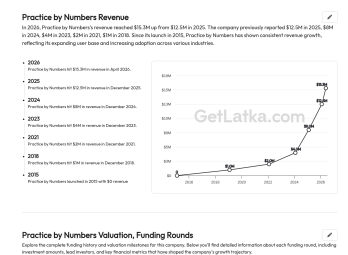
How Practice by Numbers Achieved $16.5M Revenue in 2026 with Innovative SaaS Solutions
2015: Launched Practice by Numbers to Fill a Market Gap Practice by Numbers (PBN), co-founded by Rohit Garg and Dr.…
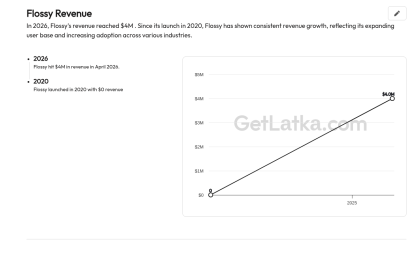
How Flossy Achieved $4M Revenue and Continues to Grow with AI Innovations
In a rapidly evolving world, where technology and healthcare intersect more intricately than ever, Flossy has emerged as a beacon…
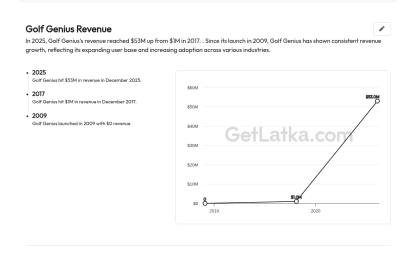
How Golf Genius Revenue Skyrocketed: From Startup to $60 Million Using Strategic Acquisitions
2009: Launching Golf Genius in a Niche Market Golf Genius, founded by Mike Zisman in 2009, began its journey focusing…