How Motion CEO Harry Qi Left $1 Million Hedge Fund Job to Build AI Productivity Platform with 10,000 Paying Customers
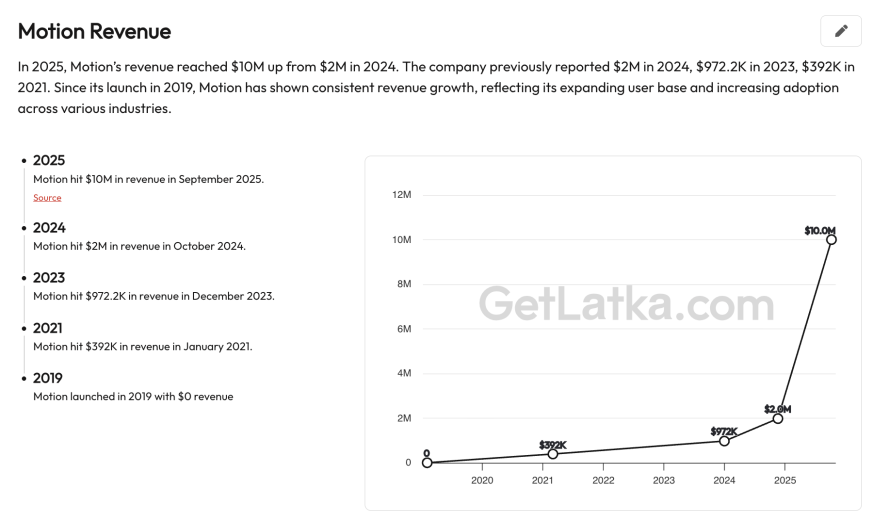

The 29-year-old founder’s AI agent bundle went from $0 to $10 million+ revenue in just 3 months after launching its new product in May 2025 – here’s the exact playbook Motion used to grow 3x year-over-year with just 67 employees
When Harry Qi walked away from his $1 million per year hedge fund job at age 23, his colleagues at Optiver thought he was throwing away a golden career. The young quantitative trader had everything most finance professionals dream of – a seven-figure salary, prestigious position, and clear path to even greater wealth.
Today, the 29-year-old CEO runs Motion, an AI productivity platform growing 300% year-over-year with over 10,000 business customers. The company just closed a $60 million funding round at a $550 million valuation in September 2025, with investors fighting to get in on a round that was 5x oversubscribed.
The most explosive part of Motion’s growth story happened this year. Their AI Employees product launched in May 2025 and surged from $0 to 8-figure ARR in just three months – making it one of the fastest AI SaaS revenue ramps in history, even faster than Instantly.ai’s famous 9-month sprint to $2.4 million.
“If I’m answering very honestly, financially speaking, it was still a bad decision. I’d probably be making somewhere between 3 and 10 million a year right now,” Qi jokes about leaving finance. But with Motion’s B2B revenue rapidly growing 3x year-over-year into 8-figures of ARR, that decision is looking better every day.
This is the complete, detailed playbook of how three hedge fund quants built one of the fastest-growing AI productivity platforms in the world, including the exact tactics driving their growth, the technical challenges they overcame, and the contrarian decisions that helped them succeed where 150 investors said they’d fail.
The Hedge Fund Years: Why Three Quants Making Millions Felt Empty (2017-2019)
To understand Motion’s origin story, you need to understand the world Harry Qi, Omid Rooholfada, and Ethan Yu were leaving behind. By the time Harry Qi was 23 years old, he had achieved the kind of financial success that most people will never attain: making about $1 million a year as a “quant” – hedge-fund speak for a stock-trading analyst at a statistical-model-driven quant fund.
All three founders come from quantitative or engineering backgrounds where they felt they wasted too much time on task prioritization, downtime between meetings, and worrying about deadlines. Despite having sophisticated systems for analyzing markets and executing trades worth millions, they couldn’t manage their own calendars efficiently.
The irony wasn’t lost on them. Here they were, using advanced algorithms to optimize trading strategies, yet spending hours each week in scheduling hell – double-booked meetings, forgotten tasks, and endless email chains trying to find time that worked for everyone. “At some point you just want to make a much bigger impact on this world,” Qi explains about the growing dissatisfaction that led to their dramatic career pivot.
The tipping point came in late 2018 when Qi realized he was spending more mental energy managing his calendar than analyzing markets. He reached out to his high school friend Rooholfada and college buddy Yu, discovering they shared the same frustrations. Over drinks in San Francisco, they sketched out ideas for solving their own productivity problems. What started as venting sessions turned into product brainstorming, then into late-night coding sessions.
By early 2019, they had made their decision. Despite combined salaries approaching $3 million annually, all three would quit their lucrative finance careers to build something that actually mattered to them. Their parents were horrified. Their colleagues were baffled. But the trio had caught the startup bug, and there was no going back.
Building the MVP: 60 Days of Non-Stop Coding in a San Francisco Apartment (January-March 2019)
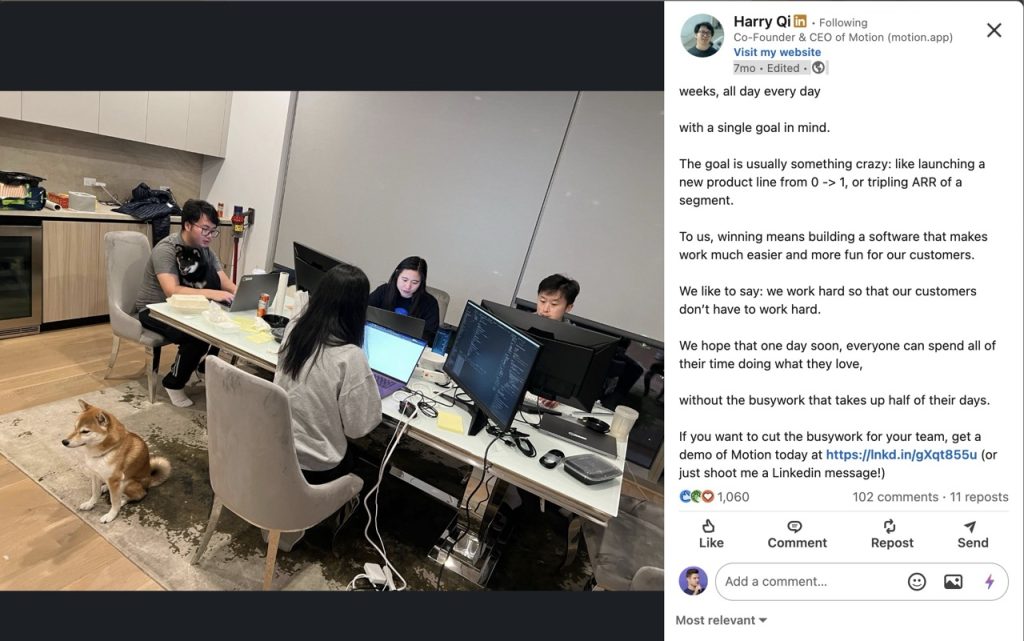
The founders gave themselves exactly 60 days to build something worth showing to Y Combinator. Working out of Qi’s cramped San Francisco apartment, they established a brutal routine: wake up at 7 AM, code until 2 AM, repeat. No weekends off. No social life. Just three guys, multiple monitors, and a whiteboard covered in feature ideas.
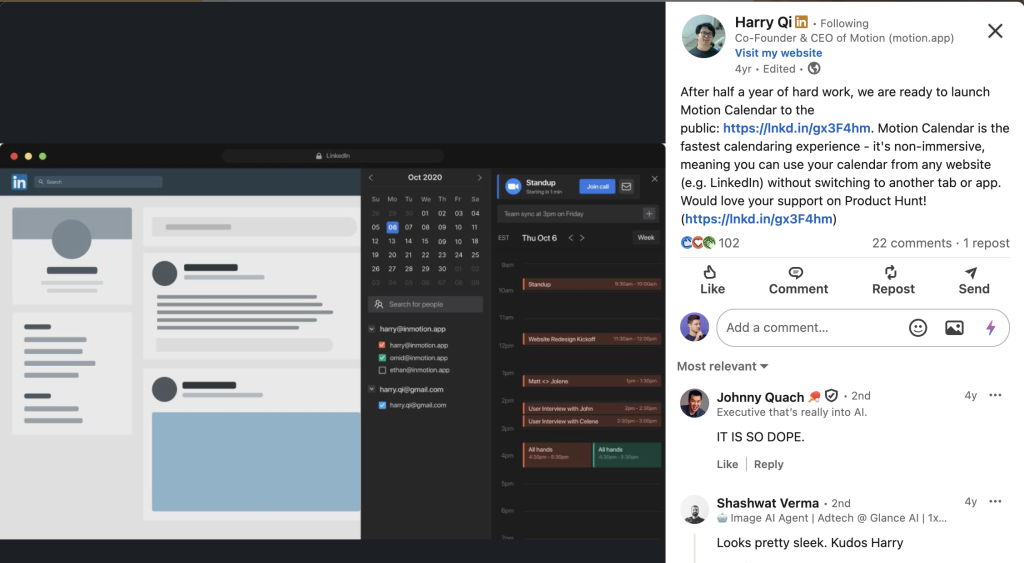
So in 2019, they built an AI calendaring and task management app and applied to Y Combinator. But this wasn’t their first attempt at the idea. They went through multiple iterations:
Version 1 (Week 1-2): A simple Chrome extension that organized tabs. Users could save tab groups and restore them later. It worked, but wasn’t compelling enough.
Version 2 (Week 3-4): Added calendar integration. Now users could see their Google Calendar from any webpage without switching tabs. Better, but still felt like a feature, not a product.
Version 3 (Week 5-6): The breakthrough – they added AI-powered task scheduling. The system would look at your calendar, your task list, and automatically schedule time blocks for deep work. This felt magical.
Version 4 (Week 7-8): Polish and refinement. They added website blocking during focus time, time tracking to show where hours actually went, and smart notifications that knew when not to interrupt.
The technical stack was deliberately simple – React for the frontend, Node.js for the backend, and TensorFlow.js for the AI components. They hosted everything on AWS and used Firebase for real-time sync. Nothing fancy, but it worked reliably.
Y Combinator and the COVID Crash: Getting Rejected by 150 Investors (Winter 2020)
They were accepted into the Winter 2020 batch and promptly quit their jobs to become founders. The Y Combinator experience was transformative. Office hours with partners like Michael Seibel and Dalton Caldwell pushed them to think bigger. Their batchmates included future unicorns, creating an environment of extreme ambition.
But YC’s famous Demo Day in March 2020 turned into a nightmare. COVID-19 had just been declared a pandemic. Markets were in freefall. The Dow Jones had its worst day since 1987. Venture capitalists were pulling term sheets and battening down the hatches.
“We were rejected by 150 investors at YC demo day,” Qi recalls in his LinkedIn posts. The rejections came with painful feedback:
- “The productivity space is a graveyard of failed startups”
- “Consumers won’t pay for productivity tools when free alternatives exist”
- “Your customer acquisition costs will always exceed lifetime value”
- “You’re competing with Google, Microsoft, and Notion – good luck”
- “Come back when you have enterprise features”
One particularly harsh investor told them: “You guys are obviously smart, but you’re wasting your talent on a problem that’s been solved a thousand times.” The rejection stung because it hit close to home – were they just building another to-do list app?
The Two Investors Who Said Yes When Everyone Said No (April 2020)
While 150 investors passed, two saw something different. Victor Wang from HOF Capital had been tracking the team since their YC application. He was impressed not by their product, but by their approach to solving problems. “These guys think like systems engineers, not like typical consumer app founders,” Wang told his partners.
Jonathan Lim from SignalFire ran his firm’s data analysis on the productivity space and found something interesting – while hundreds of productivity apps had failed, the few that succeeded had all started by solving a very specific problem for a very specific audience. Motion’s focus on busy professionals felt like the right wedge.
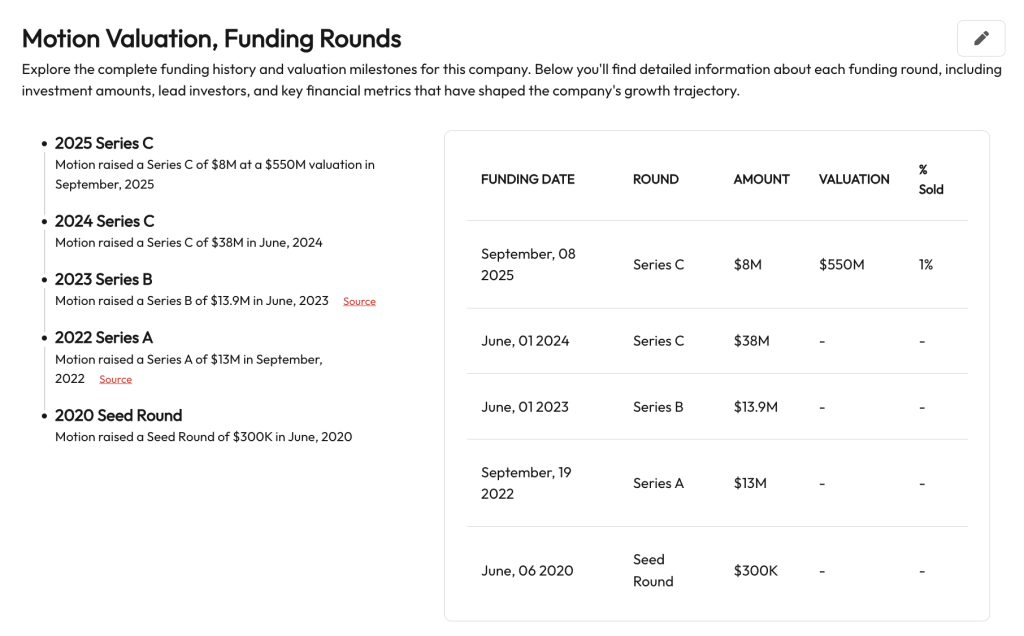
The seed round came together quickly – $1.5 million at a $10 million valuation, with HOF Capital and SignalFire leading, and Y Combinator participating. This wasn’t a massive round by 2020 standards, but it gave them 18 months of runway to find product-market fit. Both Wang and Lim would later invest in every subsequent round, with Y Combinator investing in every round as well.
The Long, Slow Climb to Product-Market Fit (2020-2021)
With funding secured, Motion entered what Qi calls “the grind years.” They had money in the bank but no clear path to growth. Monthly revenue hovered around $10,000. User retention was mediocre. The team of three worked out of a small office in San Francisco’s Mission district, iterating constantly.
Motion is a productivity tool that helps busy people optimize their time and reclaim precious, previously-lost hours each day. But finding the right approach took hundreds of experiments. They tried everything:
- B2C Marketing: Facebook ads targeting productivity enthusiasts. Result: High CAC, low retention.
- Freemium Model: Free tier with paid upgrades. Result: Thousands of free users, few conversions.
- Enterprise Sales: Pitching to HR departments. Result: Six-month sales cycles leading nowhere.
- Influencer Partnerships: Working with productivity YouTubers. Result: Spike in signups, quick churn.
The breakthrough came from an unexpected source. Qi noticed that their best users – the ones who stuck around and happily paid – weren’t productivity enthusiasts or early adopters. They were business owners, consultants, and agency founders. People whose time was literally money.
This insight led to a crucial pivot. Instead of building for everyone who wanted to be “more productive,” they focused exclusively on professionals who billed by the hour or ran small teams. The product roadmap changed overnight. Out went features like habit tracking and mood journaling. In came business-focused capabilities like:
- Client meeting scheduling with buffer time
- Project-based time blocking
- Team capacity planning
- Integration with invoicing tools
- Automatic task prioritization based on deadlines and revenue impact
Revenue Milestones: The Slow Build That Set the Foundation (2021-2024)
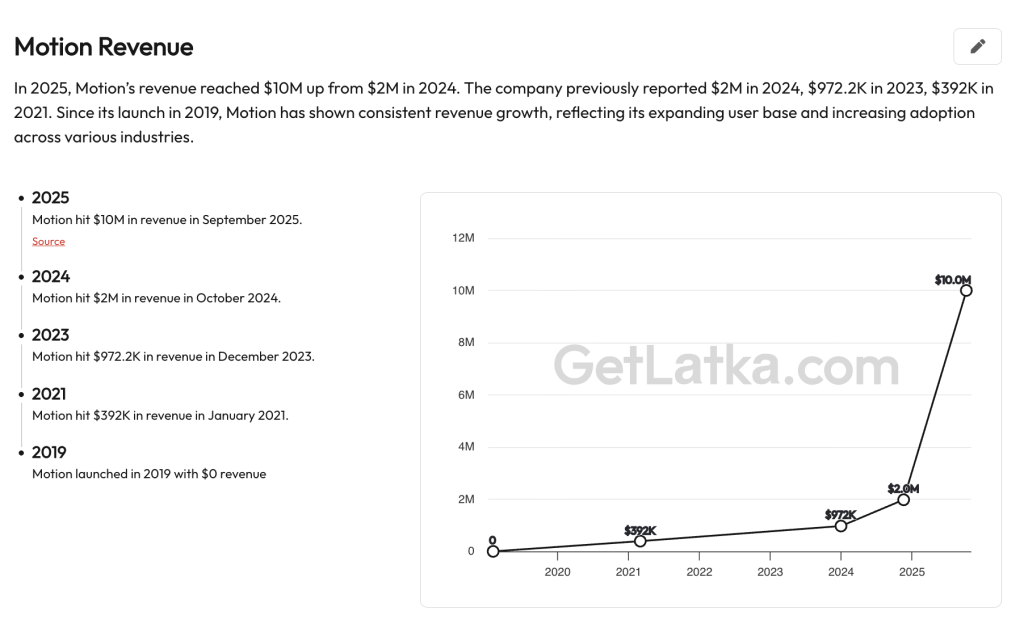
Motion’s revenue growth started slowly but built momentum through disciplined execution. According to GetLatka’s verified data:
- Motion hit $392K in revenue in January 2021
- Motion hit $972.2K in revenue in December 2023
- Motion hit $2M in revenue in October 2024
While these numbers might seem modest compared to viral B2C apps, they represented something more valuable – sustainable, predictable growth from customers who truly needed the product. Each revenue milestone came with important learnings:
Reaching $392K (2021): This came primarily from individual professionals. Average revenue per user was just $20/month, but churn was dropping as they improved the product. The key insight: professionals would pay more for a product that actually saved them time.
Crossing $972K (2023): The jump to nearly $1 million came from introducing team features. Suddenly, instead of selling to individuals at $20/month, they were selling to 5-10 person teams at $200-500/month. The product complexity increased, but so did the value provided.
Hitting $2M (2024): This milestone marked their transition to true B2B SaaS. Motion has 67 total employees, and they had built robust systems for onboarding, support, and success. More importantly, they had proven that SMBs would pay premium prices for productivity tools that actually worked.
The Series A Story: Why They Raised $13 Million to Solve a Computer Science Problem (June 2022)
By mid-2022, Motion had found product-market fit but faced a technical wall. Customer feedback was consistent: “We love Motion, but the scheduling could be smarter.” Users wanted the system to understand complex constraints like:
- “Don’t schedule deep work after client calls”
- “Keep Mondays free for planning”
- “Batch similar tasks together”
- “Account for energy levels throughout the day”
This wasn’t a simple feature request – it was a fundamental computer science challenge. As Qi explained in their Series A announcement: “Solving scheduling is a difficult engineering problem. There are so many variables to account for when personalizing a schedule to each user. Solutions today like Monday and ClickUp ask users to do this manually.”
The Series A raised $13 million led by SignalFire, with HOF Capital and Y Combinator participating. But this wasn’t about typical SaaS scaling – hiring salespeople and buying ads. Instead, they had one focused goal: hire world-class engineers to crack the scheduling optimization problem.
The hiring bar was extreme. They rejected hundreds of candidates, looking specifically for:
- PhD-level understanding of optimization algorithms
- Experience with constraint satisfaction problems
- Ability to ship production code, not just research
- Genuine interest in productivity and time management
The breakthrough hire was Chander Ramesh, an engineer who had been planning to start his own company. Motion has since added a fourth co-founder, early employee Chander Ramesh, who became so invested in the technical challenges that he abandoned his startup plans to join the founding team.
Building the Scheduling Engine: 18 Months of R&D That Changed Everything (2022-2023)
With the Series A funding, Motion assembled a team of engineers who had worked on optimization problems at Google, Uber, and Amazon. The challenge they faced was deceptively complex: create a scheduling algorithm that could handle millions of permutations while running fast enough for real-time updates.
The technical approach involved several innovations:
1. Constraint Propagation: Instead of brute-force checking every possible schedule, the system eliminates invalid options early. If you have a 2-hour task and only 1-hour gaps in your calendar, it doesn’t waste time trying to fit it.
2. Machine Learning Integration: The system learns your actual behavior. If you consistently mark certain tasks as “done early” or reschedule specific types of work, it adjusts future scheduling accordingly.
3. Multi-Objective Optimization: The algorithm balances multiple goals – minimizing context switching, maximizing deep work blocks, hitting deadlines, and maintaining work-life balance. Users can adjust these priorities.
4. Real-Time Replanning: When something changes – a meeting runs long, an urgent task appears – the entire schedule reorganizes instantly. This required significant infrastructure work to handle the computational load.
The result was magical. Users would add tasks with deadlines and time estimates, and Motion would automatically create an optimal schedule. When plans changed (as they always do), the system adapted immediately. Customer testimonials consistently mentioned this as the killer feature.
The AI Revolution: How Motion Built AI Employees in 90 Days (February-May 2025)
By early 2025, Motion had solid revenue growth and happy customers. But the AI revolution represented both an opportunity and a threat. Competitors were adding ChatGPT integrations. Microsoft was pushing Copilot. Google had Gemini. Motion needed to move fast or risk being left behind.
The insight came from customer interviews. Users didn’t want another chatbot – they wanted AI that actually did work. As one agency owner told them: “I don’t need AI to tell me how to write an email. I need AI to write the email, send it, and follow up if I don’t get a response.”
This led to Motion’s boldest product decision yet: building AI Employees – autonomous agents that could handle entire workflows. The development process was intense:
Week 1-4: Architecture design. The team decided to build agents with full read-write access to Motion’s system, not just chat interfaces.
Week 5-8: Building the Executive Assistant. This was the proof of concept – an AI that could manage email, schedule meetings, and take notes.
Week 9-12: Rapid iteration. Based on early user feedback, they added the Sales Rep (CRM management), Customer Support (ticket handling), and Marketing Assistant (content creation).
The technical stack leveraged OpenAI’s GPT-4 for language understanding, but Motion built proprietary systems for:
- Action execution (actually clicking buttons, filling forms)
- Memory management (remembering context across sessions)
- Error handling (knowing when to ask for human help)
- Integration orchestration (working across multiple tools)
The Launch That Broke Motion’s Revenue Records (May 2025)
Motion launched AI Employees to their existing customer base on May 1, 2025. The pricing model was usage-based: $29 per month for one seat with limited features, scaling to $600 for 25 seats and all agents with 250,000 credits. They expected gradual adoption. What happened instead shocked everyone.
Within 24 hours, hundreds of customers upgraded to try AI Employees. By the end of week one, they had processed over 1 million AI actions. Customer feedback was overwhelming:
“Motion’s AI Project Manager cut our project delivery time by 30%. The Executive Assistant agent gives me back hours every week to win new clients. It’s the first platform where the AI feels truly built-in, not bolted on” – Joel, CEO of Ally
The numbers tell the story: In four months, that segment of their business alone grew to over 10,000 B2B customers and $10 million in ARR. This wasn’t just product adoption – it was a fundamental shift in how businesses operated. Similar to other AI success stories, Motion had found a way to make AI indispensable rather than just interesting.
The Funding Frenzy: From $25M Plan to $60M Reality (September 2025)
The AI Employees success created a perfect storm for fundraising. Motion’s metrics were off the charts:
- B2B revenue rapidly growing 3x year-over-year into 8-figures of ARR
- Over 10,000 SMB customers running their entire businesses on Motion’s platform
- Net revenue retention above 140%
- Gross margins over 90%
What started as a planned $25 million Series B turned into a feeding frenzy. Motion raised a 5x oversubscribed $38 million Series C round, led by Stacey Bishop at Scale Venture Partners, and a fast preemptive C2 round at a $550 million post-money valuation.
The investor lineup read like a who’s who of Silicon Valley:
- Scale Venture Partners (Stacey Bishop, who led HubSpot’s Series C, joined the board)
- Valor Equity Partners (early Tesla and SpaceX backers)
- Fellows Fund (Peter Thiel’s new fund)
- Apollo Projects (Sam and Jack Altman’s family office)
- Over 15 unicorn founders as angel investors
Total funding reached $75 million, as announced in their September 2025 blog post. But more important than the money was the validation – Motion had proven that AI agents could drive real revenue growth.
Motion’s Contrarian Playbook: Breaking Every Silicon Valley “Rule”
Motion’s success comes from deliberately ignoring conventional wisdom. Here’s their contrarian playbook that actually works:
No Sales Team Philosophy
At 8-figure revenue, most B2B SaaS companies would have 50-100 salespeople. Motion has exactly zero. This isn’t an oversight – it’s strategy. By targeting CEOs and founders as primary users, they create natural top-down adoption. When the boss uses Motion, the entire company follows.
Harry checks his Facebook Ads manager every two or three days, and “whenever I see a cost increase, the first thing I do is I cross-reference the numbers with Varos” – showing how the CEO stays directly involved in growth metrics rather than delegating to a VP of Sales.
Premium Pricing as Market Positioning
Motion charges 3-4x more than competitors:
- Notion: $8/user/month
- Monday.com: $9/user/month
- ClickUp: $7/user/month
- Motion: Starting at $29/user/month
This pricing strategy filters for serious customers who value their time. As pricing psychology research shows, higher prices can actually increase perceived value and customer satisfaction.
Engineers as Customer Success
Every Motion engineer spends hours weekly on customer support. This creates a direct feedback loop – the person who can fix a bug is the one hearing about it. Traditional companies would see this as inefficient. Motion sees it as a competitive advantage.
Daily Shipping Cadence
While competitors plan quarterly releases, Motion ships improvements daily. They achieve this by:
- No sprint planning or formal roadmaps
- Engineers own features end-to-end
- Automated testing and deployment
- Culture of “good enough to ship”
SMB Focus Despite Enterprise Demand
Despite Fortune 500 companies requesting enterprise features, Motion stays focused on SMBs. Motion is specifically geared toward small and midsized businesses (SMBs) that don’t have bazillion-dollar budgets. This focus allows faster development and happier customers.
The Technical Moat: Why Competitors Can’t Simply Copy Motion
Many competitors have tried to replicate Motion’s success by adding AI features. They’ve all fallen short. Here’s why Motion’s technical advantages create a deep moat:
The Scheduling Algorithm
Motion spent years and millions perfecting their constraint satisfaction engine. This isn’t something you can replicate by calling an API. The algorithm handles:
- Millions of possible schedule permutations
- Real-time replanning when things change
- Learning from user behavior
- Balancing multiple optimization objectives
Integrated Architecture
While competitors bolt on AI features, Motion built their entire system around autonomous agents. This means:
- Agents have full system access, not limited API permissions
- Context flows seamlessly between features
- Actions happen instantly, not through webhooks
- The UI adapts to agent actions naturally
Data Advantages
With millions of tasks scheduled and completed, Motion has training data competitors can’t match:
- How long tasks actually take vs. estimates
- When people are most productive
- Which meeting types run over
- How work patterns vary by industry
This data improves their AI daily, widening the gap with competitors who started later.
Customer Success Stories: Real Businesses Seeing Real Results
Motion’s impact on actual businesses demonstrates why they’re growing so fast. Here are detailed customer stories:
Marketing Agency Saves 30% on Project Delivery
Joel runs Ally, an IT services company in Alabama. Before Motion, project management was chaos:
- Constant status update meetings
- Tasks falling through cracks
- Team members unclear on priorities
- Clients frustrated with delays
After implementing Motion with AI Employees:
- AI Project Manager automatically updates task status
- Executive Assistant handles all meeting scheduling
- Team focuses on actual work, not coordination
- Project delivery time cut by 30%
Consultant Wins More Clients with AI Assistant
Sarah, a strategy consultant in New York, was losing deals because follow-up took too long:
- Proposals sent days after meetings
- Email responses delayed by busy schedule
- Calendar always showing “booked”
- Missing opportunities while handling admin work
Motion’s AI Executive Assistant transformed her business:
- Proposals sent within 2 hours of meetings
- Emails answered in minutes, not days
- Calendar optimized to show availability
- More time for high-value client work
Design Agency Scales Without Hiring
A Tennessee design agency hit a growth ceiling at $2M revenue:
- Couldn’t afford more full-time staff
- Freelancers required too much management
- Administrative work overwhelming small team
- Growth stalled despite demand
Motion’s AI Employees provided virtual scale:
- Marketing Assistant manages social media
- Sales Rep handles CRM updates
- Customer Support answers routine questions
- Team focuses on creative work
Results: 40% revenue growth without adding headcount.
The Product Roadmap: What’s Next for Motion (Q4 2025 and Beyond)
Motion’s ambitions extend far beyond current capabilities. Here’s what’s coming:
New AI Employees (Q4 2025)
Motion is developing specialized agents for new departments:
Finance Assistant
- Invoice processing and sending
- Expense report management
- Basic bookkeeping tasks
- Cash flow forecasting
HR Assistant
- Employee onboarding workflows
- Time-off request processing
- Benefits questions answering
- Performance review scheduling
Legal Assistant
- Contract review and flagging
- NDA management
- Compliance checklist tracking
- Document organization
International Expansion (Q1 2026)
Motion plans to enter new markets with localized versions:
- Spanish for Latin America (200M potential SMBs)
- German for DACH region (50M potential SMBs)
- Japanese (30M potential SMBs)
Each version requires not just translation but cultural adaptation of AI behavior and business workflows.
The Platform Vision
Qi views Motion like building the agentic equivalent of Microsoft Office. “There’s an opportunity here to build the next Microsoft,” he said. “You basically have to build all the applications.”
This means expanding beyond productivity into:
- Financial planning tools
- Sales CRM capabilities
- Marketing automation
- HR management systems
All powered by AI agents that work together seamlessly.
Lessons for AI-First Founders: Motion’s Tactical Playbook
After studying Motion’s journey from zero to 8-figures, here are detailed lessons for founders building AI companies:
1. Start with a Hair-on-Fire Problem
Motion succeeded because the founders solved their own urgent problem. They weren’t building theoretical solutions – they were scratching their own itch. This gave them:
- Deep understanding of user needs
- Ability to test solutions immediately
- Authentic passion that attracted early adopters
- Clear vision when investors doubted
Similar to successful B2B companies, solving your own problem accelerates everything.
2. Pick Your Customer, Then Build Everything for Them
Motion’s focus on SMBs over enterprise wasn’t limiting – it was liberating. By saying no to enterprise requirements, they could:
- Ship features in days, not months
- Keep the product simple and intuitive
- Avoid complex procurement processes
- Build genuine relationships with customers
3. AI Should Do Work, Not Just Chat
Motion’s growth is powered by the AI Employees product—agents that autonomously complete work inside Motion’s existing work management platform. While competitors added chatbots, Motion built agents that:
- Complete tasks without human intervention
- Learn from patterns and improve
- Handle complex multi-step workflows
- Integrate deeply with existing tools
4. Price Based on Value, Not Competition
Motion charges premium prices because they deliver premium value. If your product saves someone 10 hours per month and they value their time at $100/hour, you’re creating $1,000 in value. Charging $29 leaves money on the table.
5. Technical Moats Beat Feature Wars
Competitors can copy features but can’t copy years of algorithm development. Motion’s scheduling engine represents millions in R&D that creates lasting differentiation. Build something technically hard that solves a real problem.
6. Keep Teams Small and Senior
Motion has 67 total employees despite rapid growth. By hiring senior engineers who own entire features, they maintain velocity that larger teams can’t match. One great engineer is worth five average ones.
7. Distribution Can Be Your Moat Too
Motion’s CEO-first strategy creates viral growth within organizations. By designing the product for natural expansion, they achieve 142% net revenue retention without a sales team. Build distribution into the product itself.
The Financial Reality: From Million-Dollar Salary to Startup Life
One of the most honest aspects of Motion’s story is Qi’s reflection on the financial trade-offs. “If I’m answering very honestly, financially speaking, it was still a bad decision. I’d probably be making somewhere between 3 and 10 million a year right now,” he admits about leaving hedge fund life.
But the calculation isn’t just about money. “Despite the admitted ‘stress’ he endures as a founder building in AI’s fast-changing field, he says he wouldn’t go back to his old life” because “every day one of them tells him how Motion makes their lives easier, increases their productivity or revenue.”
For founders considering similar trade-offs, Motion’s story offers perspective:
- Financial success might come eventually (or not)
- The journey will be harder than employment
- Impact and meaning matter more than you think
- Building something people love is addictive
- Regret comes from not trying, not from failing
The Bottom Line: Why Motion’s Playbook Is the Future of B2B SaaS
Motion’s journey from three friends quitting million-dollar jobs to building a $550 million valuation company in five years demonstrates the new playbook for AI-first B2B SaaS:
Build AI That Actually Works: Not chatbots or features, but autonomous agents that complete real tasks and save measurable time.
Focus Relentlessly on One Segment: Say no to enterprise, consumer, and every other distraction. Own your niche completely.
Ship Daily, Not Quarterly: Velocity beats perfection. Get feedback, improve, repeat.
Price for Value, Not Market: If you’re creating massive value, charge accordingly. Premium pricing attracts premium customers.
Technical Depth Matters: Solve hard problems that create lasting moats. Anyone can add AI features – few can build AI systems.
Small Teams Win: 67 people built what thousand-person companies couldn’t. Hire the best, keep teams tiny.
As AI transforms every industry, Motion’s success formula becomes increasingly relevant. They’ve proven that small teams with deep technical skills, clear focus, and contrarian thinking can build massive businesses by solving real problems with AI that actually works.
For founders watching Motion’s rise and wondering if they should build an AI-first company, Qi’s advice is simple but powerful: “Stop talking about AI and start shipping AI that actually helps people. The market is desperate for real solutions, not more demos.”
Ready to see why 10,000+ businesses trust Motion to transform their productivity? Visit Motion to start your free trial and experience the future of work.
Want more tactical SaaS growth insights? Discover how other founders built billion-dollar companies in Nathan Latka’s exclusive database at GetLatka.com
Recent Articles
How 1Mind Achieved Rapid Revenue Growth with AI-Powered Sales Solutions
In the ever-evolving world of technology, few companies have managed to disrupt traditional sales and marketing processes as effectively as…
How Rev's CEO Adi Bathla Drove Revenue to $10M by Revolutionizing Auto Shop Workflows
Building a company from scratch and driving it to hit significant revenue milestones is no small feat. Adi Bathla, the…
How Practice by Numbers Achieved $16.5M Revenue in 2026 with Innovative SaaS Solutions
2015: Launched Practice by Numbers to Fill a Market Gap Practice by Numbers (PBN), co-founded by Rohit Garg and Dr.…