The CEO and founder of Salesforce is Marc Benioff.
The founders of Salesforce are Marc Benioff, Parker Harris, Frank Dominguez, and Dave Moellenhoff
Who Are Salesforce’s Competitors?
Salesforce’s competitors are Microsoft, HubSpot, Oracle CX, Zoho CRM, SAP.
Salesforce Sales Are at an All-Time High in 2025… Why?
Salesforce’s sales increased by 8% to $9.4B this last quarter (December 2024).
All thanks to a piece of new technology, AI agents!
“We’re not adding any software engineers next year because we have increased the productivity this year with agent force to the point where engineering velocity is incredible.”
1. Be The First To Do Something: Salesforce Embraced The Cloud in 1999
The headquarters of Salesforce was inside of an apartment in 1999.
During this time, most companies relied on expensive on-premise software that required installations, hardware, and IT support.
The founders saw an opportunity to change this.
They aimed to offer businesses a CRM solution that was accessible online, affordable, and scalable.
The Bold Move to the Cloud
Marc Benioff saw the limitations of traditional software models. It slowed businesses down.
His solution?
Create a cloud platform that didn’t require companies to spend heavily on infrastructure.
Instead, businesses could access their CRM through the internet, gaining flexibility and scalability!
“The future of software is no software.”
-CEO Marc Benioff
The cloud-first approach was a gamble, but it allowed Salesforce to stand out in a market dominated by traditional software companies.
How the Cloud Was Essential to Salesforce’s Growth
The cloud didn’t just make Salesforce’s product more accessible; it changed how the company operated.
Salesforce’s subscription-based model allowed businesses to pay monthly fees instead of large upfront costs. This shift resulted in predictable, recurring revenue streams.
This model was a significant departure from the norm. Most software companies at the time relied on large one-time purchases, followed by high maintenance fees.
Salesforce’s cloud model simplified the purchasing process for businesses, while making sure of consistent cash flow.
Winning Over Skeptics
At the time, businesses and investors were unsure about trusting such important data to the cloud.
Salesforce faced stiff competition from established CRM providers who offered on-premise solutions.
Benioff tackled these challenges by focusing on product quality and customer satisfaction.
Early adopters became advocates for Salesforce, sharing how the platform improved their operations and reduced costs. This positive word-of-mouth became a key growth driver.
Over time, the advantages of cloud computing became undeniable, and Salesforce’s early bet on the cloud began to pay off.
Key Takeaway: Salesforce’s early embrace of the cloud was transformative. By focusing on accessibility, scalability, and customer satisfaction, they turned skepticism into adoption.
2. What is Salesforce #1 Revenue Source?
I see subscription models being game changers for every single successful company.
When Salesforce introduced its cloud-based CRM, one of the most pivotal decisions was to embrace a subscription-based pricing model.
Instead of charging businesses large, one-time fees for software licenses, Salesforce offered its CRM through monthly or yearly subscriptions.
This approach not only made Salesforce accessible to businesses of all sizes but also established a steady stream of recurring revenue, a key factor in the company’s rapid growth.
Traditional companies sold software licenses once, while Salesforce’s model created predictable, recurring revenue.
This subscription-based model became a critical driver of the company’s long-term success.
Shifting from One-Time Sales to Recurring Revenue
Before cloud computing became the norm, software companies generated revenue through one-time sales of licenses and expensive upgrades. This meant customers would make a large upfront payment, often followed by yearly maintenance fees.
However, once the software was purchased, revenue would cease unless additional upgrades were sold.
Salesforce transformed this model by offering businesses a subscription-based service, where customers paid recurring fees over time.
This shift allowed businesses to access CRM tools without the significant initial investment, making Salesforce attractive to both small and large enterprises.
The company’s success in implementing this model has since been adopted by the broader SaaS industry.
“Our number one asset in Salesforce is our customers, and that’s why we invest in customer success and making our customers successful every single day.” (Dreamforce 2014 Keynote)
The subscription model created predictable revenue streams, letting Salesforce to reinvest in innovation and growth. Unlike traditional sales models, where income fluctuated with each sale, the subscription model provided a consistent cash flow.
Recurring Revenue = Scalability
Another key advantage of the subscription model was scalability.
Traditional software companies often faced challenges when onboarding new customers, such as the need for additional personnel, installations, and maintenance.
Salesforce, however, operated entirely in the cloud, allowing them to scale up quickly without significant additional costs.
Once a customer subscribed to Salesforce’s CRM, they could instantly access the software through the cloud, with no need for complex installations.
Benioff remarked on the cloud’s ability to support scalability during Dreamforce 2013, saying:
“The cloud is for everyone. The cloud is a democracy.”
Customer-Centric Focus and Long-Term Relationships
Salesforce’s subscription model fundamentally shifted the company’s relationship with its customers. Instead of focusing on a one-time sale, Salesforce’s success was tied to ongoing customer satisfaction.
If customers didn’t find value in the service, they could cancel their subscription, putting pressure on Salesforce to continually deliver value.
This customer-centric focus became one of Salesforce’s greatest strengths.
The company introduced customer success teams dedicated to helping clients achieve their business goals through the effective use of Salesforce’s CRM tools. This personalized support ensured that customers were not only satisfied but also became loyal, long-term users.
By aligning their success with that of their customers, Salesforce was able to retain clients and continually grow their recurring revenue base.
Expanding Beyond CRM Through the Subscription Model
The success of Salesforce’s subscription model didn’t end with CRM software…
As the company grew, it expanded its product offerings into new areas, such as marketing, analytics, and artificial intelligence.
Each of these services was bundled into the same subscription model, allowing Salesforce to generate additional recurring revenue while delivering more value to their customers.
By offering these complementary products and services, Salesforce was able to deepen its relationships with existing customers, increasing the lifetime value of each customer which allowed Salesforce to tap into new markets while maintaining the subscription-based foundation that drove their success.
Salesforce’s decision to adopt a subscription-based model was a pivotal moment in its history, fundamentally changing how they approached customer relationships and revenue generation.
Key Takeaway: Marc Benioff’s commitment to customer satisfaction and the cloud-based subscription model helped propel Salesforce to become one of the most successful SaaS companies in the world. Today, Salesforce’s recurring revenue model continues to drive its growth, cementing its place as a leader in cloud computing and enterprise software.
3. Expanding Product Offerings Beyond CRM
Salesforce’s growth didn’t stop with its cloud-based CRM.
Once they established themselves as a leader in customer relationship management, they recognized the need to diversify and offer more tools for businesses.
Salesforce’s expansion into marketing, analytics, artificial intelligence (AI), and other business solutions significantly boosted their revenue streams.
Solutions
When Salesforce began, its primary focus was on CRM. However, Marc Benioff had a broader vision for how the cloud could transform business operations.
By adding additional products to their portfolio, Salesforce was able to build an ecosystem that allowed businesses to manage various aspects of their operations using a single platform.
“We need to transform how companies work with their customers, partners, and employees. It’s about creating a platform that brings everything together.”
This was a major turning point for Salesforce, as it shifted from a single-product company to an all-encompassing enterprise software provider.
The expansion wasn’t just about creating more tools; it was about delivering integrated solutions that made business operations more seamless.
Salesforce wanted to eliminate the need for multiple software providers. They saw an opportunity to become the go-to platform for businesses looking to streamline their processes.
Entering the Marketing and Sales Automation Space
One of Salesforce’s first major expansions was into the marketing and sales automation space.
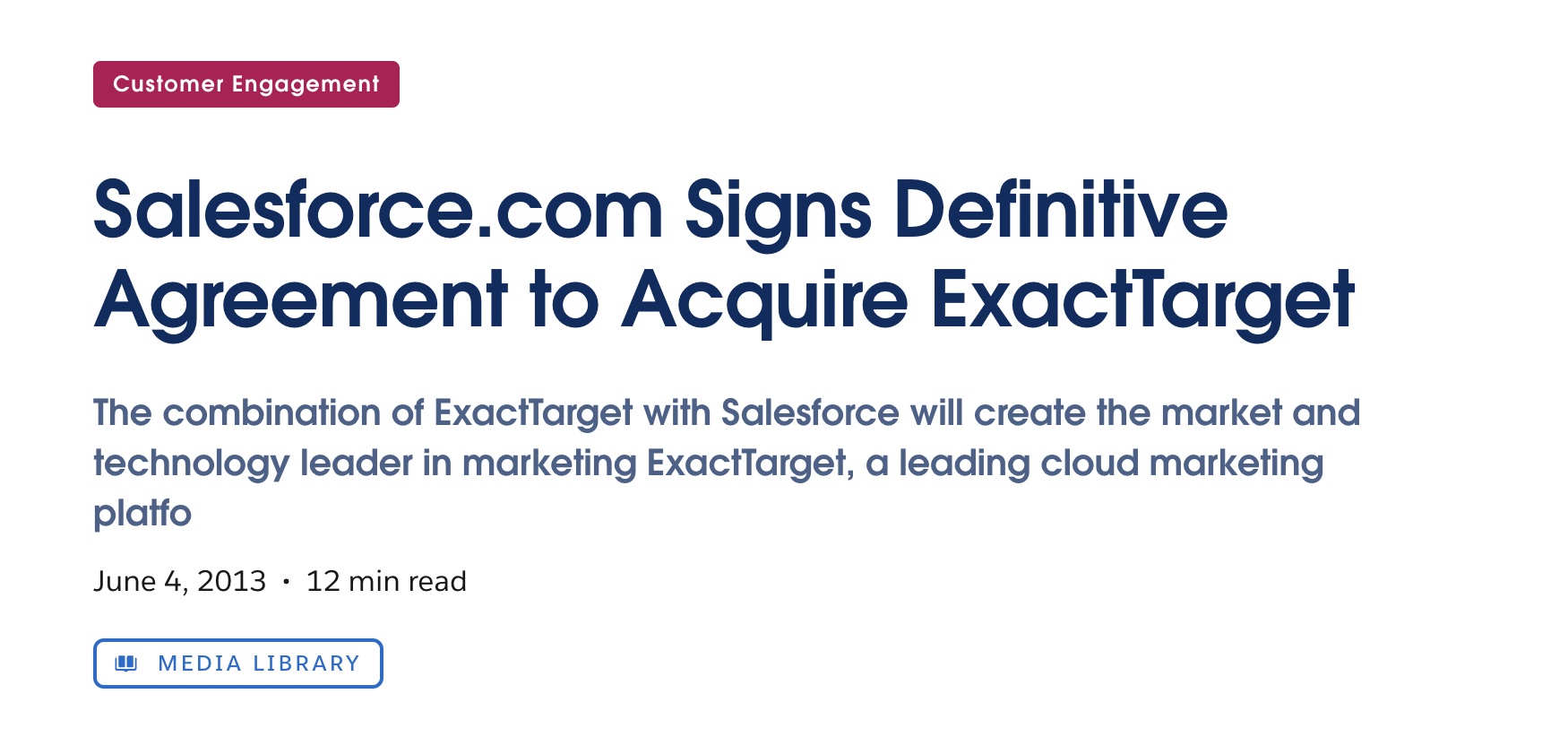
In 2013, Salesforce acquired ExactTarget for $2.5 billion, marking its official entry into digital marketing.
This acquisition allowed Salesforce to offer marketing automation tools that helped businesses manage email campaigns, customer journeys, and social media outreach.
With the addition of marketing automation tools, Salesforce could now provide businesses with solutions that covered the entire customer lifecycle—from lead generation to conversion and retention.
This end-to-end solution meant that businesses no longer needed to rely on separate platforms for marketing and CRM; they could manage everything within Salesforce.
This move not only increased Salesforce’s revenue but also made their platform stickier, meaning customers were more likely to stay once they had adopted multiple products within the Salesforce ecosystem.
Adding Analytics to the Toolbox
As businesses began to generate more data, the demand for analytics tools grew rapidly. Salesforce saw the opportunity to give their customers the ability to analyze and leverage their data more effectively.
In 2014, they introduced Salesforce Analytics Cloud, known as “Wave,” which provided businesses with powerful analytics tools to visualize data, track performance, and gain actionable insights.
The Analytics Cloud allowed businesses to make data-driven decisions in real time.
By integrating analytics into their existing CRM and marketing platforms, Salesforce provided a seamless way for companies to turn their data into a competitive advantage.
This offering was particularly attractive to large enterprises that needed sophisticated tools to manage and analyze vast amounts of customer data.
The addition of analytics tools helped Salesforce capture even more of the enterprise market, further cementing its dominance.
Artificial Intelligence: The Introduction of Einstein
In 2016, Salesforce took another significant step by integrating artificial intelligence (AI) into its platform with the launch of Salesforce Einstein.
Einstein brought AI capabilities directly into Salesforce products, enabling businesses to automate processes, predict customer behavior, and personalize their interactions with customers.
Einstein’s AI capabilities meant that businesses could now harness machine learning, natural language processing, and predictive analytics without needing to hire data scientists or build custom AI models.
The AI tools were embedded directly into Salesforce’s cloud offerings, making them accessible to any business, regardless of size.
This integration further strengthened Salesforce’s product offerings by allowing businesses to work smarter, not harder. Tasks like lead scoring, email personalization, and customer service responses could now be automated, giving businesses more time to focus on higher-level strategic initiatives.
Salesforce’s push into AI was part of Benioff’s larger vision for the future of business software. He said:
“We’re bringing AI to the masses. Every company needs to become smarter and faster, and Einstein is helping make that happen.”
This move into AI set Salesforce apart from competitors, positioning it as a leader in the AI-driven business solutions space.
Commerce and Service Spaces
Beyond marketing, analytics, and AI, Salesforce also expanded into commerce and customer service platforms.
In 2016, Salesforce acquired Demandware, a cloud-based commerce platform, for $2.8 billion. This acquisition allowed Salesforce to offer eCommerce solutions, helping businesses manage their online storefronts and shopping experiences.
By offering integrated commerce solutions, Salesforce could now support businesses across retail, manufacturing, and B2B sectors.
This further expanded Salesforce’s reach and allowed businesses to manage all aspects of the customer experience—from marketing to sales, service, and now commerce.
In the customer service space, Salesforce introduced Service Cloud, which helped companies manage customer support tickets, live chat, and phone support. Service Cloud became one of Salesforce’s fastest-growing products, as more businesses recognized the need for seamless, omnichannel customer support.
The continuous expansion of Salesforce’s product offerings meant that businesses were able to centralize more of their operations within the Salesforce platform. This made Salesforce not just a CRM tool but a comprehensive business solution that touched every aspect of the customer experience.
Key Takeaway: Marc Benioff’s vision of creating a platform that brings together all aspects of business operations under one roof proved to be a winning strategy. As Salesforce continues to innovate and add new products, its integrated approach remains one of the key drivers behind its $34.9 billion in revenue.
4. Expanding into the Commerce and Service Spaces
While Salesforce had already established itself as a leader in customer relationship management (CRM) and sales, the company recognized that businesses needed a more comprehensive platform to manage various aspects of their operations.
With acquisitions and new product launches, Salesforce extended its offerings to include powerful solutions for eCommerce and customer service.
The Acquisition of Demandware and the Entry into eCommerce
The acquestion of Demandware marked Salesforce’s official entry into the eCommerce space by:
Giving the company the tools to offer businesses complete control over their online storefronts
Demandware provided a cloud-based infrastructure for retailers to manage their websites, process payments, and handle orders.
This acquisition was critical in Salesforce’s mission to become an all-in-one platform for businesses.
By incorporating eCommerce capabilities, Salesforce allowed businesses to manage every part of the customer journey—from marketing to sales, service, and now, online transactions—all within one integrated platform.
“Our goal is to give every company the tools they need to succeed in today’s connected, digital world. eCommerce is a critical part of that transformation.”
By entering the eCommerce space, Salesforce could now serve a wide variety of industries, from retail to manufacturing, offering tools that supported their entire sales process, both online and offline.
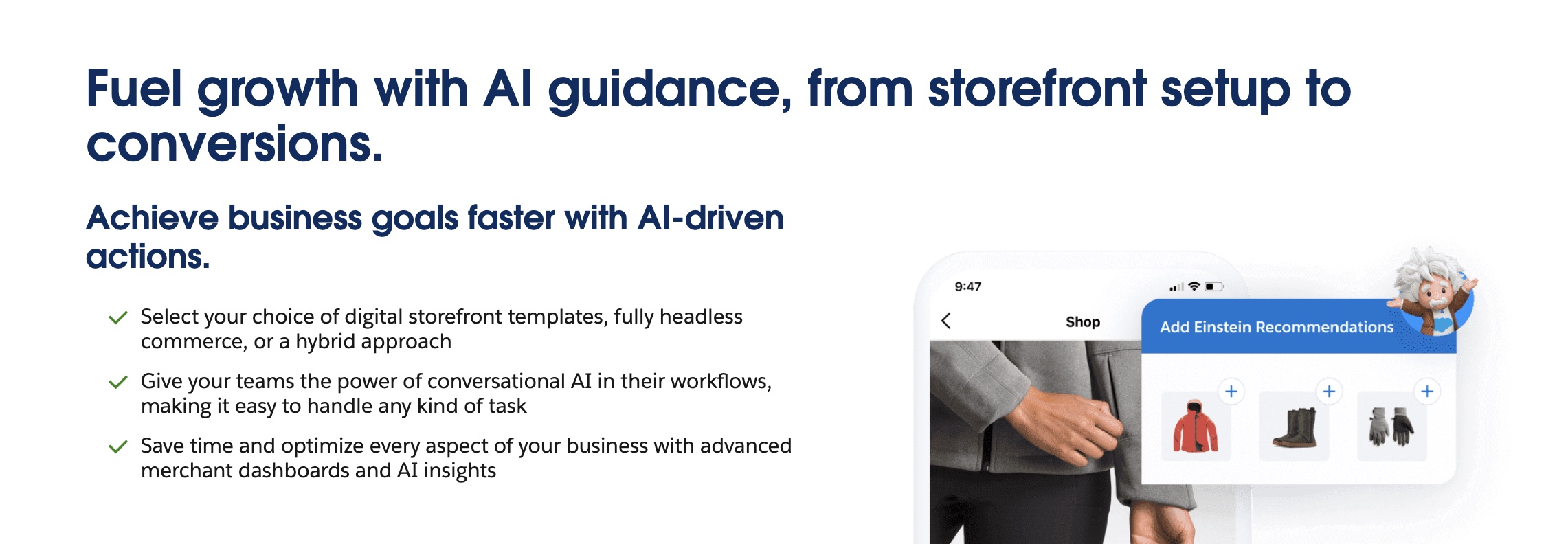
With Demandware, Salesforce gave businesses the power to create personalized shopping experiences for their customers. This meant not only managing transactions but also delivering product recommendations, personalized offers, and tailored marketing campaigns, all based on a customer’s behavior and preferences.
The integration of these features helped companies increase their conversion rates and build stronger relationships with their online customers.
Introducing Salesforce Commerce Cloud
Following the acquisition of Demandware, Salesforce rebranded the platform as Salesforce Commerce Cloud.
This product allowed businesses to create seamless, personalized shopping experiences across various channels, including web, mobile, social media, and in-store. Commerce Cloud was designed to help businesses manage all aspects of eCommerce, from merchandising to order management, customer service, and fulfillment.
Salesforce Commerce Cloud provided tools for businesses to optimize their digital storefronts, offering real-time insights and AI-driven recommendations to help companies engage customers more effectively.
The platform was especially appealing to retailers looking to unify their online and offline experiences, giving them the ability to create a consistent brand presence across every touchpoint.
Commerce Cloud became a key part of Salesforce’s product portfolio, helping the company serve industries beyond its traditional CRM base. Retailers, in particular, found value in the platform’s ability to deliver a unified shopping experience across multiple channels.
This ability to integrate eCommerce into a company’s broader marketing, sales, and service strategy was a major differentiator for Salesforce.
Service Cloud: Revolutionizing Customer Support
In addition to expanding into eCommerce, Salesforce also made significant strides in customer service with its Service Cloud offering.
Service Cloud was developed to help businesses deliver high-quality customer support across multiple channels:
Email
Phone
Live chat
Social media
With Service Cloud, companies could manage customer inquiries, automate ticket routing, and deliver faster, more efficient resolutions.
Before Service Cloud, many companies struggled to provide consistent customer support across different channels. Customers often experienced long wait times, poor issue resolution, and a lack of continuity between their interactions with support teams.
Salesforce introduced a platform unifying customer service, giving support teams a full view of customer history and interactions.
Service Cloud also introduced tools like Einstein Bots, which allowed businesses to automate common customer service tasks using artificial intelligence.
These bots could handle routine inquiries, such as checking order statuses or answering frequently asked questions. This made more time for human agents to focus on more complex issues.
With Service Cloud, businesses were able to deliver faster, more personalized customer support. Customers appreciated the quicker response times, and businesses benefited from the ability to resolve issues more efficiently.
This emphasis on service not only improved customer satisfaction but also helped businesses retain customers, contributing to long-term growth.
Building an Omnichannel Experience
One of the key advantages of both Commerce Cloud and Service Cloud was their ability to provide businesses with an omnichannel experience.
In today’s digital-first world, customers expect seamless interactions across all channels, whether they’re browsing online, engaging with social media, or visiting a physical store. Salesforce’s omnichannel capabilities allowed businesses to meet these expectations.
A customer could browse online, get email recommendations, and complete their purchase in-store with consistent support.
This level of integration and personalization was crucial for businesses looking to provide the best possible customer experience.
The combination of Commerce Cloud and Service Cloud enabled businesses to deliver these omnichannel experiences effortlessly.
By integrating eCommerce and customer service, Salesforce allowed companies to offer more cohesive and engaging customer journeys, increasing customer satisfaction and loyalty.
Driving Growth Through Expansion
Salesforce’s entry into the commerce and service spaces helped the company grow beyond its CRM roots and opened up new revenue streams.
These expansions allowed Salesforce to serve a broader range of industries and business types, from small retailers to large enterprises. By offering solutions that supported every part of the customer journey, Salesforce positioned itself as a one-stop shop for businesses looking to thrive in the digital age.
Benioff often emphasizes the importance of continuous innovation at Salesforce, saying, “To be successful, we must constantly evolve and offer our customers more ways to connect, engage, and succeed.” This quote underscores the driving force behind Salesforce’s decision to expand into eCommerce and customer service, as both areas play a critical role in building long-term customer relationships.
Key Takeaway: By continuing to innovate and adapt to the changing needs of businesses, Salesforce positioned itself as a leader not only in CRM but in every aspect of customer engagement.
5. The Focus on Customer Success as a Growth Driver
One of the key differentiators in Salesforce’s growth strategy has been its unwavering focus on customer success.
From the start, Marc Benioff knew growth relied on acquiring customers and making sure they found value in Salesforce’s products.
Defining Customer Success
Salesforce pioneered the concept of customer success as a core business function.
Salesforce built a team to help clients achieve business goals, not just offering software for customers to navigate alone.
This approach was different from traditional tech support; it was about building a partnership with customers to ensure they were gaining maximum value from Salesforce’s solutions.
Marc Benioff has frequently spoken about the importance of customer success to Salesforce’s mission. During a Dreamforce keynote, he said:
“Our number one asset in Salesforce is our customers, and that’s why we invest in customer success and making our customers successful every single day.”
Salesforce’s focus on customer success has not only reduced churn but has also turned satisfied customers into loyal advocates for the platform.
As these customers experienced tangible improvements in their sales, marketing, and customer service operations, they often expanded their use of Salesforce products and recommended the platform to others.
Building a Dedicated Customer Success Team
To formalize its commitment to customer success, Salesforce created dedicated customer success teams tasked with helping clients achieve their desired outcomes.
These teams worked closely with businesses to understand their unique challenges and provide tailored solutions using Salesforce’s platform.Whether through training, implementation support, or ongoing optimization, the customer success teams were essential in ensuring that clients saw positive results from their investment in Salesforce.
This proactive approach to customer support represented a shift from the traditional model of waiting for customers to reach out with problems.
Salesforce aimed to be a partner from the beginning. They guided businesses through the process of adopting and scaling their use of the platform.
The success of this model was reflected in the company’s impressive customer retention rates. Benioff often emphasizes the importance of customer satisfaction, saying:
“The success of Salesforce depends on the success of our customers. If they grow, we grow.”
Turning Customers into Advocates
Salesforce’s investment in customer success has paid off not only in retention but also in customer advocacy. Satisfied customers often become brand advocates, sharing their positive experiences with others in their industry.
This word-of-mouth marketing has been invaluable for Salesforce, helping to drive new customer acquisition without relying heavily on traditional sales tactics.
One of the key elements of Salesforce’s strategy has been creating opportunities for customers to share their success stories. Events like Dreamforce serve as a platform for businesses to showcase how they’ve used Salesforce to achieve significant results.
These real-world examples help potential customers see the value of the platform and provide inspiration for how they might leverage Salesforce to solve their own challenges.
Benioff has long recognized the power of customer advocacy, stating:
“Our best salespeople are our customers. When they’re successful, they spread the word about Salesforce.”
The Role of Technology in Customer Success
Technology has played a critical role in enabling Salesforce’s customer success efforts.
Salesforce’s own platform has been instrumental in tracking customer interactions, measuring success, and identifying opportunities for improvement.
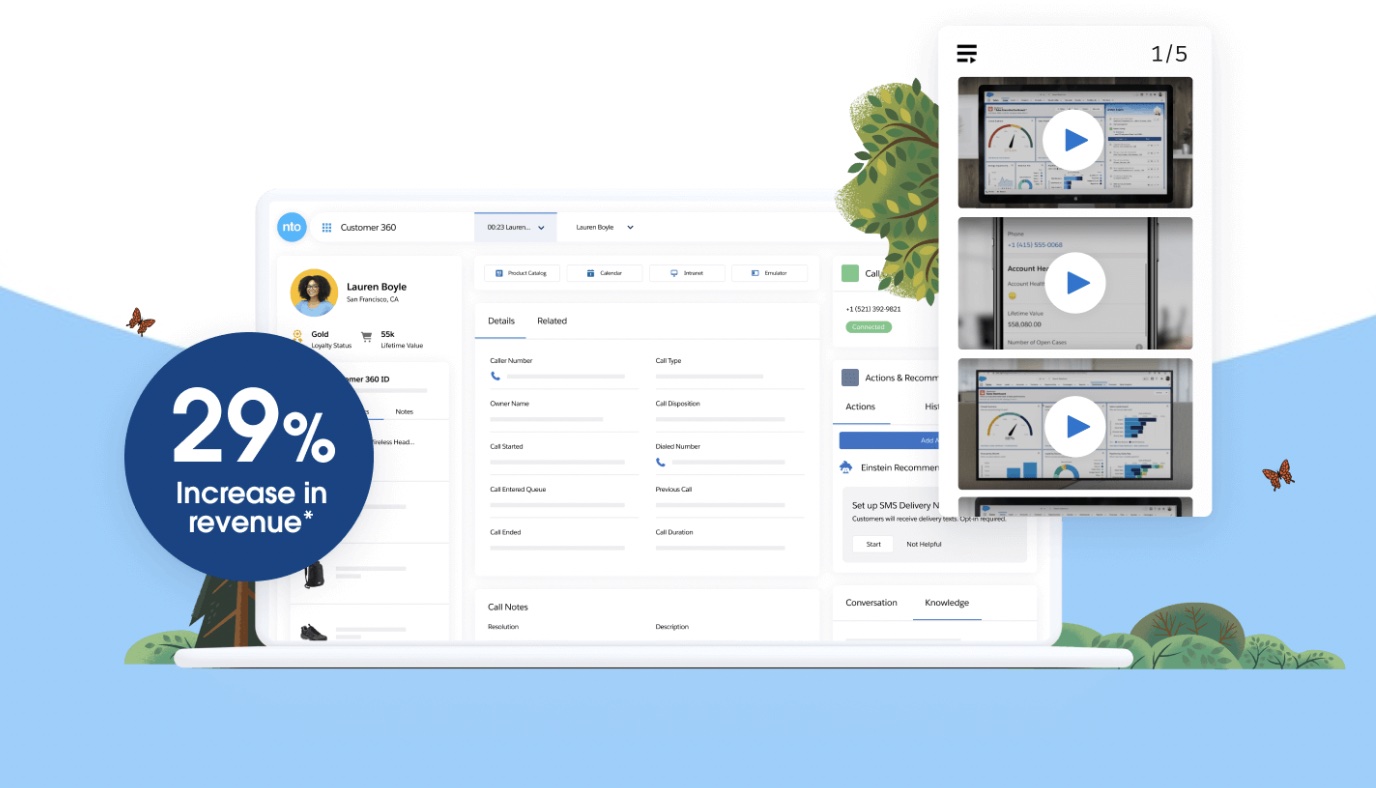
Through its Customer 360 approach, Salesforce provides a complete view of each customer’s journey, enabling success teams to deliver personalized support and recommendations.
Salesforce also uses artificial intelligence (AI) to enhance customer success. Tools like Einstein Analytics help customer success teams predict potential challenges and proactively address issues before they impact the customer experience.
This commitment to using technology to enhance customer relationships has been a key factor in Salesforce’s ability to deliver consistent results across its global customer base.
Salesforce’s focus on customer success has been one of the most important drivers of its growth. By investing in dedicated customer success teams and building long-term relationships with its clients, Salesforce has created a foundation for steady, recurring revenue.
Key Takeaway: As Salesforce continues to expand its product offerings and enter new markets, its commitment to customer success remains a core part of its strategy. By ensuring that customers are successful, Salesforce has built a sustainable growth model that will continue to drive the company forward in the years to come.
Salesforce’s rise to become a $34.9 billion revenue powerhouse was not solely the result of organic growth.
Strategic acquisitions played a key role in expanding the company’s product offerings, market reach, and technological capabilities.
By acquiring companies that aligned with Salesforce’s vision, Marc Benioff and his team positioned the company as a one-stop platform for businesses looking to manage everything from customer relationships to eCommerce and analytics.
The Acquisition Strategy
Salesforce’s acquisition strategy wasn’t just about adding new products; it was about creating a holistic ecosystem where businesses could manage all their operations in one place.
Rather than reinventing the wheel for every new product, Salesforce often chose to acquire innovative companies that had already made significant strides in areas like eCommerce, data analytics, and artificial intelligence.
The acquisitions weren’t just about products—they were about people, too. Salesforce consistently retained the talent from acquired companies, bringing new perspectives and expertise into its organization. This helped ensure smooth integration and allowed Salesforce to continue innovating.
The Demandware Acquisition: Entering the eCommerce Space
One of Salesforce’s most significant acquisitions was Demandware, a leading cloud-based eCommerce platform.
This acquisition of Demandware was a strategic move that allowed Salesforce to offer a comprehensive commerce platform alongside its existing CRM and sales tools.
The newly branded Salesforce Commerce Cloud allowed businesses to do the following
Manage their digital storefronts
Process transactions
Personalize the online shopping experience for their customers
With Commerce Cloud, Salesforce was able to serve retailers and eCommerce companies that needed robust, scalable solutions to manage their online operations.
The integration of Commerce Cloud allowed Salesforce to expand its offerings beyond CRM and marketing, helping businesses manage every aspect of their customer interactions, both online and offline.
MuleSoft: Connecting Everything
In 2018, Salesforce made one of its largest acquisitions to date by purchasing MuleSoft, a company specializing in integration software, for $6.5 billion.
MuleSoft’s platform allowed businesses to connect their various systems, applications, and data sources, making it easier for them to operate efficiently across different platforms.
This acquisition was a game-changer for Salesforce, as it enabled the company to offer a unified platform for businesses to integrate all of their tools and processes.
The integration of MuleSoft into Salesforce’s ecosystem provided businesses with the ability to connect their CRM data with other critical systems, such as ERP (enterprise resource planning) and supply chain management software. This allowed for better data flow, improved decision-making, and more efficient operations.
With MuleSoft, Salesforce extended its reach into industries that required complex, multi-platform integrations, further solidifying its position as an indispensable tool for large enterprises.
Tableau: Empowering Data-Driven Decisions
In 2019, Salesforce acquired Tableau, a leader in data visualization and business intelligence, for $15.7 billion. Tableau’s platform allowed businesses to turn their data into actionable insights through easy-to-understand visualizations.
This acquisition aligned perfectly with Salesforce’s vision of helping businesses harness the power of data to drive better decision-making.
The addition of Tableau to Salesforce’s ecosystem enhanced the company’s analytics capabilities. With Tableau, Salesforce customers could not only manage their customer relationships but also analyze and visualize complex data sets to uncover trends, forecast outcomes, and make data-driven decisions.
This acquisition catered to the growing demand for advanced analytics tools in the business world, where data has become a critical asset for companies of all sizes.
Benioff highlighted the impact of Tableau, stating:
“Data is the foundation of every digital transformation, and Tableau gives our customers the ability to see and understand their data like never before.”
Slack: Redefining Collaboration
One of Salesforce’s most recent and significant acquisitions was Slack, a workplace collaboration tool, which Salesforce purchased for $27.7 billion in 2021.
Slack had become an essential communication tool for businesses, offering real-time messaging, file sharing, and integrations with other business applications.
Salesforce’s acquisition of Slack was a strategic move to strengthen its position in the workplace collaboration space and to offer businesses a unified platform for both customer management and internal communication.
The integration of Slack into Salesforce’s platform provided customers with new ways to collaborate internally while managing their customer relationships. Slack became the digital headquarters for businesses, enabling teams to communicate more effectively and work seamlessly with Salesforce’s CRM and other products.
Benioff noted the importance of this acquisition, saying:
“Slack is the central nervous system for the future of work, and together with Salesforce, we’re creating the operating system for the digital workplace.”
Driving Growth Through Acquisitions
Salesforce’s acquisitions have played a crucial role in driving the company’s growth. By acquiring innovative companies like Demandware, MuleSoft, Tableau, and Slack, Salesforce has been able to rapidly expand its product offerings, enter new markets, and serve a broader range of customers.
nEach acquisition has brought new capabilities to the Salesforce platform, allowing businesses to manage everything from customer relationships to data analytics and internal collaboration.
Key Takeaway: As Salesforce continues to grow, its ability to strategically acquire companies that align with its mission will remain a critical part of its success. By staying focused on innovation and expanding its capabilities, Salesforce is well-positioned to continue leading the SaaS industry for years to come.
7. Going Global: Salesforce’s International Expansion
While Salesforce initially found success in the U.S. market, its true growth potential was unlocked when the company expanded internationally.
Salesforce recognized early on that the demand for cloud-based solutions wasn’t limited to one region. Businesses around the world were looking for more scalable, efficient, and flexible ways to manage their operations, and Salesforce was uniquely positioned to meet that need.
By strategically entering new markets and localizing its offerings, Salesforce fueled significant revenue growth and solidified its place as a global leader in the SaaS space.
The Early Stages of International Growth
Salesforce’s first steps toward international expansion came after it had already established a strong presence in the United States.
The company’s cloud-based model gave Salesforce an advantage over traditional software companies that had to build out local data centers or establish reseller networks to serve international markets.
Europe was one of the first regions Salesforce entered, followed by Asia-Pacific. These regions were ripe for cloud adoption, with businesses eager to move away from expensive on-premise solutions in favor of the cloud.
Salesforce’s flexible, scalable CRM, tailored to local markets, quickly resonated with businesses globally.
Localizing Offerings for Global Markets
One of the keys to Salesforce’s international success was its ability to adapt its platform to meet the specific needs of each market.
While the core functionality of Salesforce’s CRM was the same, the company recognized that businesses in different regions had unique regulatory requirements, cultural differences, and operational challenges.
Salesforce made it a priority to localize its offerings, ensuring that the platform complied with local laws and catered to the specific needs of businesses in each market.
In Europe, Salesforce prioritized data privacy and security. It complied with the GDPR, governing EU data protection.
By proactively addressing these concerns, Salesforce was able to build trust with businesses that were wary of moving sensitive customer data to the cloud.
Strategic Partnerships to Drive International Expansion
Salesforce also leveraged strategic partnerships to accelerate its international growth.
By partnering with local technology companies, resellers, and system integrators, Salesforce was able to build a stronger presence in new markets.
These partners helped Salesforce navigate the complexities of local business environments, while also providing the technical expertise needed to implement and support Salesforce’s platform for new customers.
In regions like Japan and India, partnerships played a critical role in driving adoption.
Salesforce also formed alliances with global consulting firms like Deloitte and Accenture, who helped large enterprises implement Salesforce’s platform and manage their digital transformation efforts.
Benioff discussed the role of partnerships in Salesforce’s global strategy:
“We’ve built incredible partnerships around the world that help us reach new customers and ensure they’re successful with Salesforce. These partnerships are a key part of our growth story.”
By working with trusted local and global partners, Salesforce was able to scale quickly in new regions while maintaining high levels of customer satisfaction.
Expanding into Emerging Markets
One of Salesforce’s boldest moves in its international expansion was its decision to enter emerging markets.
While many companies focused on established regions like Europe and North America, Salesforce saw significant growth potential in countries like Brazil, India, and China.
These markets were adopting digital technologies rapidly, and Salesforce offered cloud-based CRM solutions for their transformation.
In Brazil, for instance, Salesforce saw strong demand from both multinational corporations and local businesses looking to modernize their operations.
Salesforce’s approach to these markets was similar to its strategy in more established regions.
The company focused on building strong local teams, partnering with regional experts, and localizing its platform to meet the specific needs of businesses in each country.
The Role of Dreamforce in International Expansion
Salesforce’s flagship event, Dreamforce, has also played a key role in driving international growth.
What started as a small conference in San Francisco has grown into one of the largest technology conferences in the world, attracting tens of thousands of attendees from every corner of the globe.
Dreamforce serves as a platform for Salesforce to showcase its latest innovations, but it also provides an opportunity for the company to engage directly with customers, partners, and prospects from around the world.
Dreamforce has helped Salesforce build a global community of users, partners, and developers.
By hosting local Dreamforce events in regions like Europe and Asia-Pacific, Salesforce has been able to bring the excitement and innovation of the conference to new markets, further accelerating its international expansion.
Key Takeaway: Marc Benioff’s vision of taking Salesforce global has paid off, with the company now serving customers in nearly every region of the world.
Key Takeaways
Embracing the Cloud from Day One:
Salesforce’s early focus on cloud technology revolutionized CRM, allowing the company to lead the way in the SaaS industry globally.
The Subscription Model: A Game-Changer for Recurring Revenue:
Salesforce’s subscription model created reliable, recurring revenue, driving rapid scalability and enabling the company to build lasting customer relationships.
Expanding Product Offerings Beyond CRM:
Expanding into marketing, analytics, and AI allowed Salesforce to evolve into a multi-solution platform, significantly increasing customer engagement and revenue streams.
Artificial Intelligence: The Introduction of Einstein:
Salesforce’s Einstein AI platform transformed business automation by offering predictive analytics and personalization, enabling smarter and more effective customer interactions.
Expanding into the Commerce and Service Spaces:
Salesforce’s move into eCommerce and customer service through strategic acquisitions enhanced its ability to provide end-to-end customer solutions across industries.
The Focus on Customer Success as a Growth Driver:
By prioritizing customer success, Salesforce reduced churn, increased customer retention, and turned satisfied clients into loyal advocates for the platform.
Strategic Acquisitions to Broaden Their Impact:
Acquisitions like Tableau and MuleSoft accelerated Salesforce’s innovation, allowing the company to strengthen its market position and expand across industries.