How Harvey Scaled from $0 to $100 Million Revenue in 36 Months: The 5-Part Legal AI Playbook That Built a $5 Billion Company
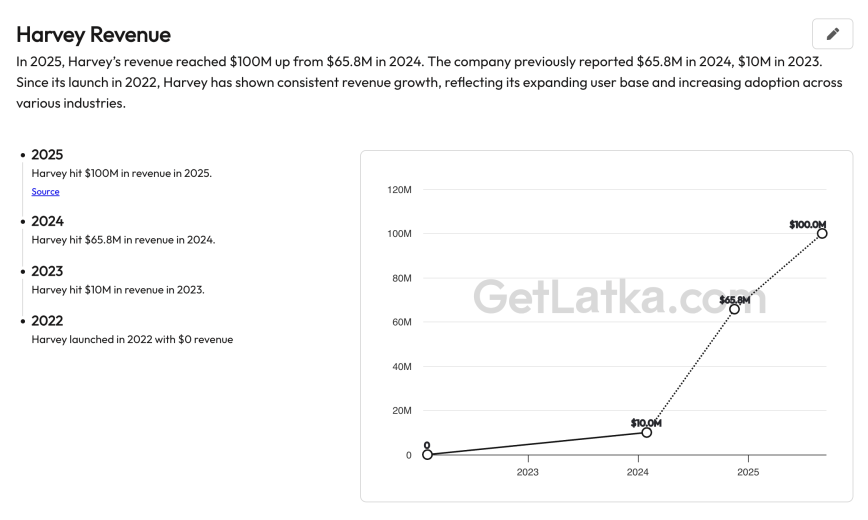

In August 2025, Harvey CEO Winston Weinberg announced a milestone that shocked the enterprise software world: his legal AI startup had reached $100 million in annual recurring revenue just three years after launch. The company’s weekly active users had quadrupled in a single year, and its customer base expanded from 40 to over 500 companies across 53 countries, according to CNBC’s exclusive report.
Harvey’s hypergrowth represents one of the fastest B2B SaaS ascents ever recorded. From zero revenue in 2022 to a $5 billion valuation by mid-2025, the company captured the majority of top 10 US law firms while expanding into corporate legal departments at giants like Comcast, KKR, and PwC. This is the complete playbook behind their meteoric rise.
Harvey Revenue Timeline: From $0 to $100 Million in 3 Years
The numbers tell a story of perfect market timing. Harvey launched in November 2022 with zero revenue and just 5 employees. By the end of 2023, they hit $10 million in annual recurring revenue. The real explosion came in 2024, when Harvey reached $65.8 million – a 558% year-over-year increase, according to GetLatka data.
The growth accelerated further in 2025. By April, Harvey reached $75 million in revenue, as reported by Sacra. Just four months later in August 2025, they crossed the $100 million ARR threshold. “Most of our accounts grow pretty massively,” Weinberg told CNBC. “You’ll sell to a Comcast or to a law firm, and they’ll buy a couple hundred seats, and then they expand that usage pretty quickly.”
This growth trajectory mirrors other AI success stories like Arcads, which hit $6 million revenue in just 16 months with only 5 employees, showcasing the leverage AI companies can achieve with small teams.
The 2 Roommates Who Coded Harvey’s MVP in 4 Months
The Harvey origin story starts with an unlikely partnership. Winston Weinberg was grinding through 80-hour weeks as a first-year securities litigator at O’Melveny & Myers in Los Angeles. His roommate Gabriel Pereyra had spent years as a research scientist at Google DeepMind and Meta, working on large language models before they became mainstream.
In early 2022, Pereyra showed Weinberg OpenAI’s GPT-3. The lightbulb moment was instant. “Legal work is incredibly complex and requires so much context, that a simple chatbot doesn’t work,” Weinberg explained to Fortune.
The duo built a prototype chatbot that could answer legal questions pulled from Reddit. Then they made a bold move: they cold-emailed OpenAI with their demo. “They also sent it to OpenAI’s general counsel at the time, because they knew a lawyer could understand the chatbot’s outputs and how good they were,” Fortune reported.
That email changed everything. It led to a July 4th meeting with OpenAI’s C-suite, who immediately made Harvey their first OpenAI Startup Fund investment. Between July and November 2022, the roommates coded furiously, building Harvey’s initial product from their San Francisco apartment.
The company’s name itself tells a story. Harvey is partially inspired by the sharp-suited lawyer from the TV series “Suits” – a character who represented the kind of legal excellence their AI aimed to deliver.
Harvey Customer Acquisition: 40 to 500+ Customers in 18 Months
Harvey’s customer growth reflects a land-and-expand strategy executed to perfection. The company grew from 40 customers in early 2024 to 235 customers across 42 countries by year-end. By August 2025, they surpassed 500 customers across 53 countries.
Quality trumped quantity from day one. Harvey captured the majority of top 10 US law firms, including prestigious names like Paul Weiss (which began testing in January 2023), Allen & Overy, and international firms like Ireland’s A&L Goodbody and Singapore’s WongPartnership, according to Wikipedia.
The expansion beyond traditional law firms proved crucial. “Harvey has shifted from its initial focus on biglaw firms to serving corporate in-house counsel and legal services firms like PricewaterhouseCoopers (tax compliance) and Adecco Group (outsourced legal support),” according to Sacra’s analysis. Major corporations including CNBC parent company Comcast adopted Harvey for their legal departments.
Harvey’s secret weapon for customer acquisition? Domain expertise. “We have tons of lawyers on staff designing and evaluating the product, and they’re all from large law firms or from large in-house teams,” Weinberg told Fortune. These ex-BigLaw attorneys didn’t just build features – they designed workflows that mirror how elite lawyers actually work.
The sales strategy was equally sophisticated. Harvey hired lawyers from top firms like White & Case, Latham & Watkins, and Skadden for their sales team. When a former Wachtell Lipton partner calls to discuss legal AI, general counsels take the meeting.
Harvey Fundraising Velocity: $800 Million Raised at Lightning Speed
Harvey’s fundraising trajectory reads like a venture capital fever dream. The company raised over $800 million across multiple rounds, achieving increasingly astronomical valuations at each stage:
- November 2022: $5 million seed round led by OpenAI Startup Fund
- April 2023: $21 million Series A led by Sequoia Capital
- December 2023: $80 million Series B at $715 million valuation
- July 2024: $100 million Series C at $1.5 billion valuation
- February 2025: $300 million Series D at $3 billion valuation
- June 2025: Undisclosed Series E at $5 billion valuation
The investor roster includes Silicon Valley royalty: Sequoia Capital, Kleiner Perkins, Coatue, Google Ventures, and the OpenAI Startup Fund. Strategic investor RELX Group (owner of LexisNexis) joined later rounds, signaling industry validation.
“If you expand as quickly as we are, you just need to do raises like this,” Weinberg explained to Fortune about the rapid fundraising pace. The capital fueled aggressive hiring and global expansion, with Harvey planning to double its headcount following the Series E.
Harvey’s partnership with OpenAI echoes the broader trend of OpenAI’s $3.7 billion revenue and its API serving companies of every size, with Harvey being one of their earliest and most successful implementations.
Harvey Product Innovation: Building AI That Lawyers Actually Trust
Harvey succeeded where countless legal tech startups failed by solving the fundamental trust problem. Lawyers won’t use AI they can’t verify, and Harvey built technology that provides both powerful capabilities and transparent reasoning.
The breakthrough came through Harvey’s deep partnership with OpenAI. Rather than using off-the-shelf models, they co-developed custom models trained specifically for legal use cases. “We looked at all options, but we only trusted building a custom-trained model with OpenAI,” Pereyra told OpenAI.
The custom case law model added the equivalent of 10 billion tokens of legal data, starting with Delaware case law before expanding to all US jurisdictions. When tested with lawyers from 10 major firms, “97% of the time, the lawyers preferred the output from the case law model” compared to standard GPT-4.
By 2025, Harvey’s platform had evolved far beyond simple Q&A:
- Document analysis for due diligence and contract review
- Legal research across case law and regulatory databases
- Direct integration with Microsoft Word for contract drafting
- Custom workflows tailored to each firm’s processes
- Multi-language support for international transactions
- Tax and regulatory compliance capabilities through PwC partnership
The company didn’t stop at OpenAI. In May 2025, Harvey announced it would use models from Anthropic’s Claude and Google, giving customers choice and redundancy. “We are energized to add to our options for customers as we continue to serve the needs of our customers globally,” Weinberg stated.
Harvey Team Scaling: Strategic Hiring of Legal Domain Experts
Harvey’s hiring strategy reflects a core belief: to build AI for lawyers, you need lawyers building the AI. The company grew from 5 employees at founding to 82 by March 2024, then to over 340 by mid-2025.
The hiring focus was laser-targeted on domain expertise. Harvey recruited attorneys from elite firms including White & Case, Latham & Watkins, Skadden, Gunderson Dettmer, and Paul Weiss. These weren’t token hires – former BigLaw associates and partners worked directly on product development.
Key strategic hires signaled Harvey’s ambitions:
- Gordon Moodie: Corporate partner at Wachtell Lipton who joined as Chief Product Officer in July 2023
- Siva Gurumurthy: Former director of engineering at Twitter who became CTO
- John Haddock: Decade at Stripe before joining as Chief Business Officer
“We’re starting to get to the point where we have really good leadership in place,” Weinberg told CNBC. “That just changes your ability to scale to such a massive degree.”
The company maintained this hiring momentum globally, opening offices in New York, London, and Bangalore in 2025 to tap local talent pools and serve regional markets.
Harvey Competition: Turning “GPT Wrapper” Criticism into Competitive Advantage
Critics initially dismissed Harvey as just another “GPT wrapper” – a thin application layer on top of OpenAI’s models. Harvey turned this perceived weakness into their greatest strategic advantage.
“We have been delighted to let that narrative persist,” Sequoia’s Pat Grady told Fortune. “We’ve been loading up on application companies.” While competitors spent years and millions building proprietary models, Harvey focused relentlessly on the user experience lawyers actually wanted.
The legal AI market attracted serious competition:
- Thomson Reuters acquired Casetext for $650 million in 2023
- Ironclad reached over $50 million ARR
- Andreessen Horowitz backed Eve
- Spellbook, Robin AI, and Lex Machina (owned by LexisNexis) entered the space
But Harvey’s multi-model approach and deep legal expertise created defensibility. They weren’t just using AI – they were teaching AI to think like lawyers. The custom models co-developed with OpenAI couldn’t be replicated without similar partnerships and domain knowledge.
“The integration of former ‘Big Law’ attorneys into product and sales teams has been attributed as a major factor in Harvey’s success,” according to industry analysis. Competitors could copy features but not the collective legal expertise embedded in Harvey’s product decisions.
This focus on application over infrastructure mirrors successful strategies in other verticals, like Smith.AI’s approach to reaching $22M ARR by focusing on sales and marketing rather than just building AI technology.
Harvey Market Expansion: From BigLaw to Every Knowledge Worker
Harvey’s vision extends far beyond legal. The company systematically expanded from its law firm beachhead into adjacent markets with similar characteristics: complex knowledge work, high hourly rates, and regulatory requirements.
The progression was strategic:
- Elite law firms (2022-2023): Prove the technology with the most demanding users
- Corporate legal departments (2023-2024): Expand to in-house counsel at major corporations
- Professional services (2024-2025): Enter tax, accounting, and compliance through PwC partnership
- Global markets (2025): Open offices in London and Bangalore to serve international demand
The May 2024 launch on Microsoft Azure Marketplace represented another expansion vector. Smaller firms and corporate departments that couldn’t afford enterprise pricing suddenly gained access to Harvey’s capabilities.
Winston Weinberg’s vision is audacious: “The opportunity we have, not just with legal but with all professional services, is to take care of the routine tasks so professionals can focus their time on client interactions.” The $90 billion AI market projected to reach $1 trillion by 2034 provides massive room for growth.
Harvey’s Future: The Path from $100 Million to $1 Billion Revenue
At $100 million ARR with 500+ customers, Harvey has achieved escape velocity. The question now: can they 10x again to reach $1 billion revenue?
The math suggests it’s not just possible but probable. Harvey currently serves the majority of top 10 US law firms but has barely penetrated the thousands of smaller firms worldwide. With 340+ employees and growing, they have the resources to execute multiple growth vectors simultaneously.
Three factors position Harvey for continued hypergrowth:
1. Market Timing: The legal industry’s AI adoption is accelerating. “I think it’ll get to a certain point where you aren’t able to compete—or able to support large corporations—unless you are using tools like this,” Weinberg told Fortune.
2. Product Evolution: Harvey’s focus on autonomous agents that handle end-to-end workflows represents the next frontier. They’re building AI that doesn’t just assist lawyers but handles entire legal processes independently.
3. Geographic Expansion: The recent India office opening signals global ambitions. “Long-term goal is that every lawyer in India uses our platform,” Weinberg stated in a July 2025 interview.
The risks are real. Microsoft, Google, and Amazon all eye the professional services AI market. But Harvey’s three-year head start, custom legal models, and deep enterprise relationships create formidable moats.
Harvey’s growth story parallels other AI success stories like Instantly.ai’s journey from $0 to $2.4M ARR in just 9 months, but at enterprise scale with significantly higher ACVs and longer-term contracts.
Summary: The 5-Part Harvey Playbook for Building a $5 Billion Legal AI Company
Harvey’s journey from $0 to $100 million revenue in 36 months offers five essential lessons for B2B SaaS founders:
1. Domain expertise beats technical brilliance alone. Weinberg’s legal background proved as crucial as Pereyra’s AI expertise. Harvey succeeded because lawyers built it for lawyers.
2. Partner with platforms rather than competing. Harvey’s OpenAI partnership provided technology no startup could build independently. They focused on the application layer while leveraging best-in-class foundation models.
3. Hire your customers. Ex-BigLaw attorneys selling to BigLaw created a sales machine competitors couldn’t match. Domain credibility accelerated enterprise deals.
4. Land and expand with premium customers. Harvey ignored the long tail to focus on elite firms willing to pay premium prices. Average contract values grew as usage expanded within accounts.
5. Let critics underestimate you. While competitors worried about being “GPT wrappers,” Harvey shipped products lawyers loved. They built a $5 billion company while others built models.
“With gen AI, and how fast everything’s moving, you just have to learn how to scale really, really fast,” Weinberg told CNBC. “I’d say, like every six months I go through a new scaling experience.”
That scaling experience has created one of the fastest-growing enterprise software companies in history. Harvey didn’t just build legal AI – they built the blueprint for how AI transforms professional services. And at their current trajectory, the legal industry represents just the beginning.
For more insights on rapid SaaS growth stories and founder interviews, check out the GetLatka blog featuring in-depth case studies of the world’s fastest-growing software companies.
Recent Articles
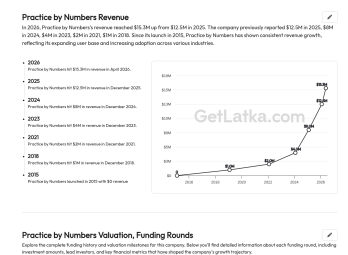
How Practice by Numbers Achieved $16.5M Revenue in 2026 with Innovative SaaS Solutions
2015: Launched Practice by Numbers to Fill a Market Gap Practice by Numbers (PBN), co-founded by Rohit Garg and Dr.…
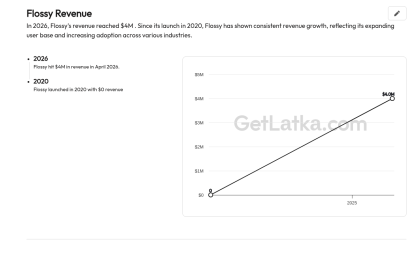
How Flossy Achieved $4M Revenue and Continues to Grow with AI Innovations
In a rapidly evolving world, where technology and healthcare intersect more intricately than ever, Flossy has emerged as a beacon…
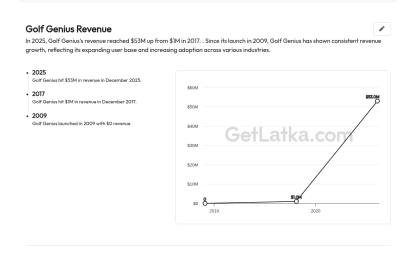
How Golf Genius Revenue Skyrocketed: From Startup to $60 Million Using Strategic Acquisitions
2009: Launching Golf Genius in a Niche Market Golf Genius, founded by Mike Zisman in 2009, began its journey focusing…