How Divvy Achieved Explosive Revenue Growth with a Free Software Model
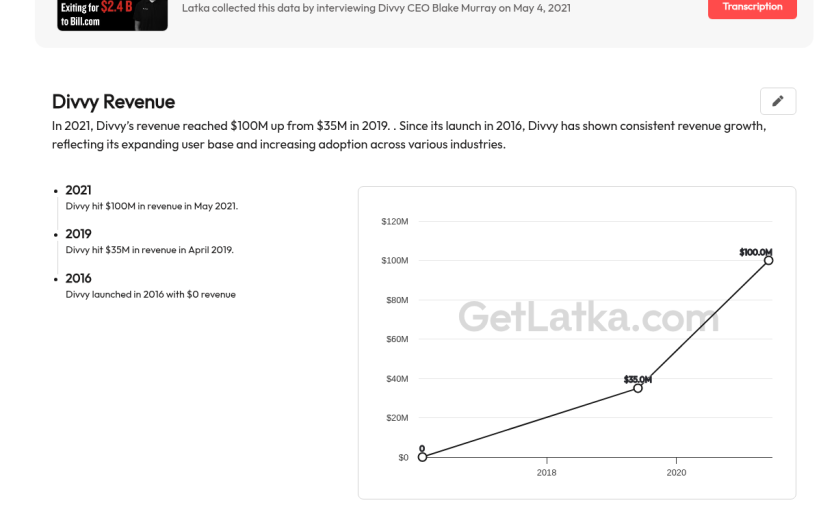

In the ever-evolving world of fintech, Divvy has emerged as a trailblazer by offering businesses a unique blend of expense management software and smart corporate cards. Founded by Alex Bean and Blake Murray, Divvy has carved a niche in the market by providing free software while generating revenue through the credit card model. In this blog post, we’ll delve into how Divvy achieved significant revenue milestones, the strategies employed by its leaders, and how their innovative approach continues to disrupt the industry.
2016: Laying the Foundation for Divvy’s Growth
Divvy’s journey began in 2016 when co-founders Alex Bean and Blake Murray decided to tackle the challenges that small and medium-sized businesses (SMBs) faced in managing expenses. Drawing from their own experiences as business owners, they envisioned a platform that combined financial visibility and control with the ease of use of modern software. Their mission was to provide Main Street America with the tools they needed to spend smarter and stay within budget.
2017: Raising Initial Capital to Drive Innovation
Understanding the massive opportunity in trillion-dollar markets, Divvy’s founders made the strategic decision to raise venture capital early on. In 2017, they secured $10 million in funding from Pelion Partners, allowing them to build the team and infrastructure necessary to support their ambitious goals. This early investment was crucial in developing the robust platform that would later disrupt the fintech space.
2019: Achieving 1,000 Customers with a Free Model
By 2019, Divvy had reached a significant milestone—serving over 1,000 SMB customers. The key to this growth was their innovative model of offering free expense management software while monetizing through interchange fees on corporate card transactions. This approach not only attracted customers by eliminating software costs but also provided a seamless, integrated solution that outperformed traditional offerings.
2020: Doubling Customer Base with 4,500 SMBs
Divvy’s momentum continued in 2020 as they more than doubled their customer base to 4,500 SMBs. Their ability to offer a comprehensive solution for spend management, combined with the allure of no-cost software, proved to be an irresistible proposition for many businesses. This growth was supported by strategic partnerships and an ever-expanding suite of features, including AP management and credit fund options.
2021: Breaking the 10,000 Customer Mark
In 2021, Divvy surpassed 10,000 customers, showcasing their ability to scale rapidly while maintaining high customer satisfaction. At this stage, the company’s growth rate was over 100% year-over-year, highlighting the effectiveness of their business model. The free software attracted businesses, while the credit card interchange fees provided a steady revenue stream.
2022: Securing Series D Funding and Valuation
Divvy’s impressive growth trajectory caught the attention of investors, leading to a Series D funding round in 2022. They raised $165 million, valuing the company at $1.6 billion. This influx of capital enabled Divvy to accelerate its product development and expand its market reach, positioning it as a formidable player in the fintech industry.
How Divvy Monetizes a Free Software Model
At the core of Divvy’s revenue strategy is the interchange fees generated from their corporate card transactions. By acting like a traditional bank, Divvy earns a percentage of each transaction processed through their cards. This model allows them to offer free software while still generating substantial income—a key differentiator from competitors who charge for similar services.
Interchange Fees: The Backbone of Revenue
- Divvy makes the majority of its revenue from interchange fees.
- These fees are similar to those charged by traditional credit card companies.
- Revenue grows as customer spending through Divvy’s platform increases.
Innovative Features Drive Adoption
Divvy’s success is also attributed to its continuous innovation. By integrating multiple financial management tools into a single platform, Divvy simplifies processes for SMBs. Features such as virtual cards, real-time spend tracking, and budget management make it easier for businesses to control expenses and improve financial health.
Looking Ahead: The Path to $100 Million ARR
With a clear path to reaching $100 million in annual recurring revenue (ARR) within the next two years, Divvy’s future looks promising. The company plans to introduce more financial products, such as a credit fund for small business loans, further enhancing its value proposition. As Divvy continues to expand its offerings and customer base, its innovative model is set to redefine the landscape of financial management for SMBs.
For more insights into Divvy’s growth and strategies, visit their GetLatka company profile. To learn about other successful companies in the United States, explore the GetLatka companies by country page. For industry-specific insights, check out the GetLatka industry category page. To see Divvy’s offerings firsthand, visit their company website.
Recent Articles

How 1Mind Achieved Rapid Revenue Growth with AI-Driven Sales Solutions
The journey of 1Mind, under the leadership of CEO Amanda Kahlow, is a remarkable testament to the power of innovative…

How Rev Grew to $10M Revenue Using AI and Strategic Expansion
In the ever-evolving landscape of the automotive repair industry, Rev has positioned itself as a pivotal player, thanks to the…

How Test-Company Achieved $1M ARR and Expanded to 100 Employees
Test-company has emerged as a significant player in the ‘Other Agency’ industry, achieving impressive growth milestones such as reaching $1…