Can $19M Typeform Keep Doubling Revenue Year Over Year With $40 Product?


Typeform is an interactive online form tool that spun out of a design agency
Over 50 million users fill out Typeforms each month
CEO David Okuniev is optimistic about doubling revenue going forward
David Okuniev used to be a musician, and it didn’t take long before he took his creative zest to building amazing products. This explains the super-creative logo of Fat Man Collective—the name of his creative agency. None of the team members were fat—but together, Okuniev explains, they formed an all-powerful fat man of design.
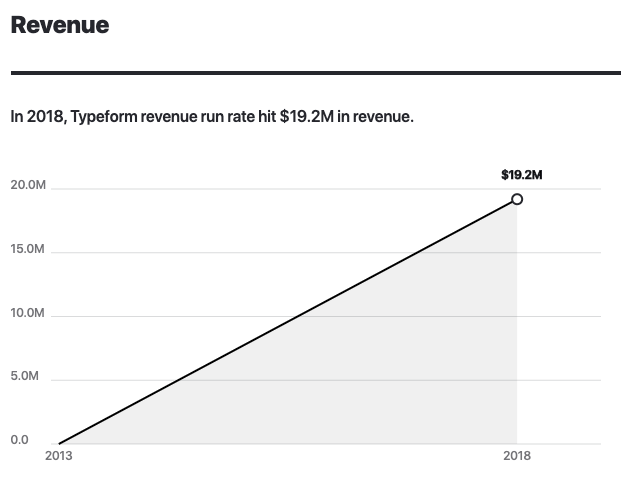
While building his agency at a co-working space, Okuniev met his future co-founder, Robert Munoz. Their current venture, Typeform, generates $19 million in annual recurring revenue with over 40,000 customers backing the startup. Okuniev himself takes on the role of a visionary within the company, pondering future directions and possible synergies. Our host Nathan Latka sat down with the man to figure out just how good his vision is.
Interactive Typeforms Boost Lead Conversions
So many SaaS companies are spinouts of problems that agency founders face over and over again. This is particularly pronounced with marketing SaaS’es. From Quickpath to Decibel—all those tech products were once client problems that agencies had to solve over and over again via manual labor.
Okuniev’s Typeform is no exception. While working with clients under Fat Man Collective, Okuniev was eager to get out of the client space and get into the customer space. So when he realized there’s a need for better-converting online forms, he jumped at the opportunity.

Source: https://getlatka.com/companies/typeform
We’re all familiar with traditional online forms that feel more like medical insurance documents rather than interactive online experiences. You have to look up zip codes, ponder whether you’re a “marketing” person or a “director” within your organization, and then squint through blurry CAPTCHAs.
What you may have not yet encountered—but probably have—are Typeforms. These are conversational forms that talk to you, instead of at you. Instead of having you interpret which of the 10 form fields are required and which ones you can get away with leaving empty, Typeforms will ask you one simple question after another. This, Okuniev says, increases the number of successful form fill-ups dramatically.
CEO Waits 12 Months to Monetize His User Base, Introduces $40/mo Pro Plan
The average customer pays Typeform $40 a month, and they have over 40,000 of those. It’s imperative that a SaaS company knows who its clientele is, and Okuniev says they’re dead clear about the fact that they’re serving small customers, not enterprises. “Our sales team is about 3 people,” he clarifies.
Like many lightweight SaaS products, Typeform used to be free. Many founders approach our host Nathan Latka with a question on when is the right time to introduce the paywall and how to do it properly. There have been countless cases where SaaS companies go under purely due to an introduction of a pricing model that does not synergize with an already existing base of free users.
Source: https://getlatka.com/companies/typeform
For this reason, Okuniev took his time before he introduced the paid plans for Typeform. A year, to be exact. Only 12 months after launching Typeform did he introduce the Pro plan. But it wasn’t a rough transition: most of the core product remained available for free, while the Pro plan offered a few additional features.
For example, if you wanted to customize the final “thank you” screen at the end of your Typeform, you had to purchase the Pro plan. If you wanted to use logic or the calculation form in your Typeform, you had to purchase the Pro plan. Okuniev didn’t seal the product off behind a paywall—he introduced a slightly enhanced version for a small optional fee.
Typeform Bootstrapped For Year One, Now $52 In Funding
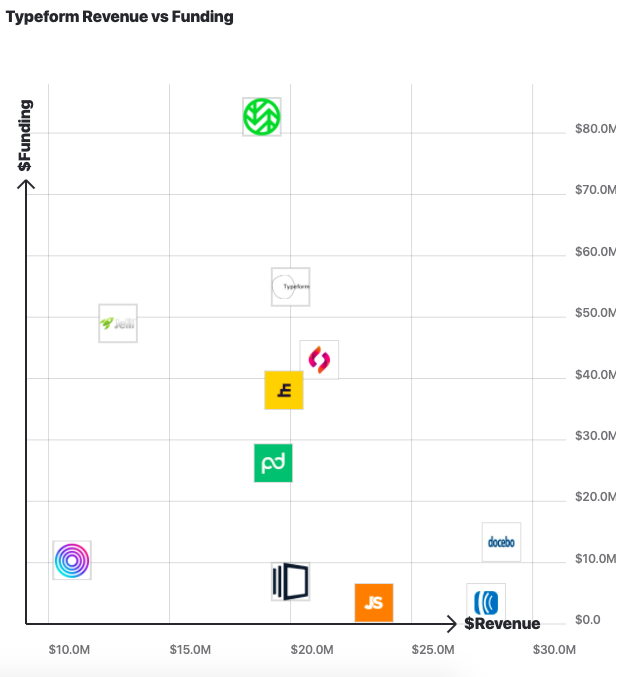
Typeform was completely bootstrapped from the get-go, funded by Okuniev’s agency revenues. “We managed to stay the first year without raising,” he says. As of June 2020, Typeform has raised around $52 million in four rounds.
But it wasn’t exactly a smooth ride. Local Spanish VCs, whose names Okuniev honorably doesn’t mention, told the young founders they were “too green” to run a business. Looking back, the CEO agrees, and he says that he learned a ton from his initial investors. “I didn’t even know what a KPI was,” he laughs.
Source: https://getlatka.com/companies/typeform
Nathan remembers a funny VC story of his own, when he walked into a VC meeting and they asked him about his company’s ARPU (annual revenue per user.) Nathan didn’t know what the hell ARPU was.
But Okuniev’s investors saw the light in both his products and his eyes, and they bet $550,000 on Typeform.
Doubling $19M Revenue By Understanding Users Better
Back in June 2018, when Latka talked to Okuniev, the CEO was optimistic about doubling their $19 million annual revenue. However, with the average contract value of $480, keeping up with 100% year-over-year growth gets tricky. How does the visionary founder plan to do that?
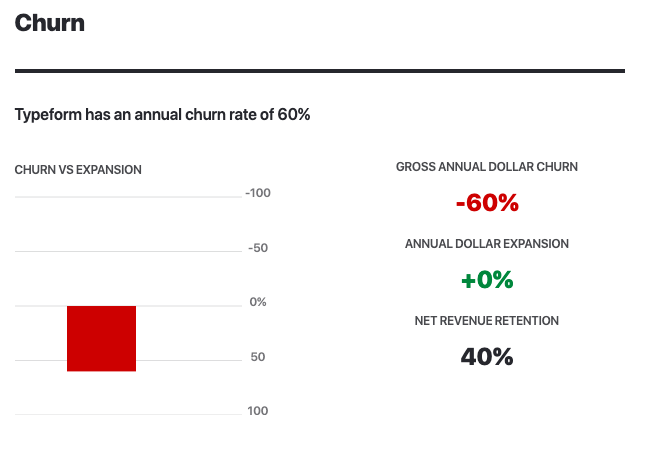
It’s difficult, Okuniev agrees. One thing he is focusing on is activation—how do the users actually get the most out of Typeform? At a monthly price of roughly $40, Typeform’s gross monthly revenue churn was at a 5% back in 2018, which, at this scale, is massive, Okuniev says. “If we didn’t have churn, we wouldn’t have so much pressure to add new users every month,” he admits.
Source: https://getlatka.com/companies/typeform
The problem is that users tend to deactivate their accounts after creating a Typeform. Most people are not serial entrepreneurs with hundreds of landing pages—they’re small business owners who just need a high-converting form. Okuniev’s challenge is to figure out how to turn that one-time success into an ongoing commitment.
Right now, he says, Typeform is like an open playing field: you come in and get to play around with all sorts of functionality under one pricing plan. Okuniev is hard at work trying to understand what it is his users are trying to achieve. One he gets enough insight, he plans on dividing his ecosystem of form functionality into smaller sub-products—a win-win for both the user and the company.
Typeform’s activation metric is when a user collects five form sign-ups over the first 7 days.
Typeform Remains an Engagement Tool for Now, CEO Says
Back in July of 2018, Typeform had 190 employees in total. The team is always looking to make the product better and more conversational, but for now, Okuniev says, it’s just a neatly presented, pre-recorded form. He doesn’t rule out the opportunity to play around with machine learning to build a form that would speak in your name, not just your words.
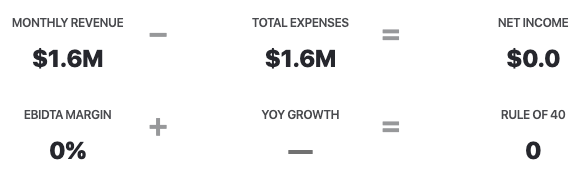
For now, Okuniev considers Typeform to be a system of engagement, not recording. People come to Typeform because they want better, more attractive packaging for their online forms—not because they want better content. It works: some 50 million Typeforms are filled every month.
Source: https://getlatka.com/companies/typeform
This massive number is the source of Typeform’s organic word-of-mouth growth which enabled them to keep doubling their revenue for 5 years straight. Every Typeform is accompanied by a “Powered by Typeform” byline. As a curiously new but pleasantly familiar product, that byline is generating a lot of interest.
While the byline looks innocent to the user, a team of engineers are actively A/B testing everything around the feature. They would test the button design and the placement. They would monitor how users react to the button on mobile devices versus their laptops. So whatever Okuniev is going to see in a vision next, his current approach is rock solid.
Nathan Latka’s 5 Questions With Typeform Co-Founder and CEO David Okuniev

- Favorite business book? “Rework by Jason Fried.”
- Is there a CEO David is following or studying? “No.”
- Favorite online tool to grow Typeform? “I’m a big fan of Mailchimp.”
- How many hours of sleep does David get? Married, single? Kids? Age? “7 hours. About to get married. I have two kids. I’m 41 now.”
- What does David wish his 20 year old self knew? “Know that everything is going to be okay.”
Recent Articles
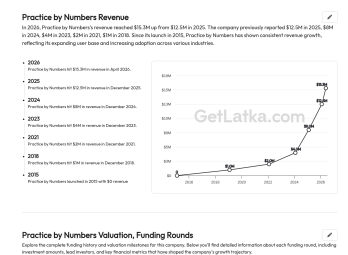
How Practice by Numbers Achieved $16.5M Revenue in 2026 with Innovative SaaS Solutions
2015: Launched Practice by Numbers to Fill a Market Gap Practice by Numbers (PBN), co-founded by Rohit Garg and Dr.…
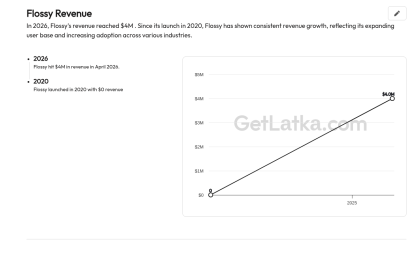
How Flossy Achieved $4M Revenue and Continues to Grow with AI Innovations
In a rapidly evolving world, where technology and healthcare intersect more intricately than ever, Flossy has emerged as a beacon…
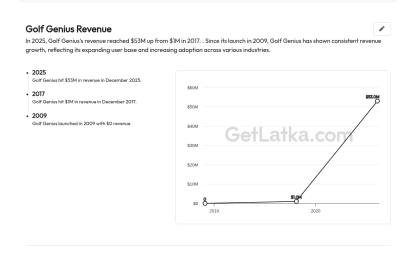
How Golf Genius Revenue Skyrocketed: From Startup to $60 Million Using Strategic Acquisitions
2009: Launching Golf Genius in a Niche Market Golf Genius, founded by Mike Zisman in 2009, began its journey focusing…