Expensify Revenue: How CEO David Barrett Grew the Company to $100M ARR

2008: From Gaming to Expense Management
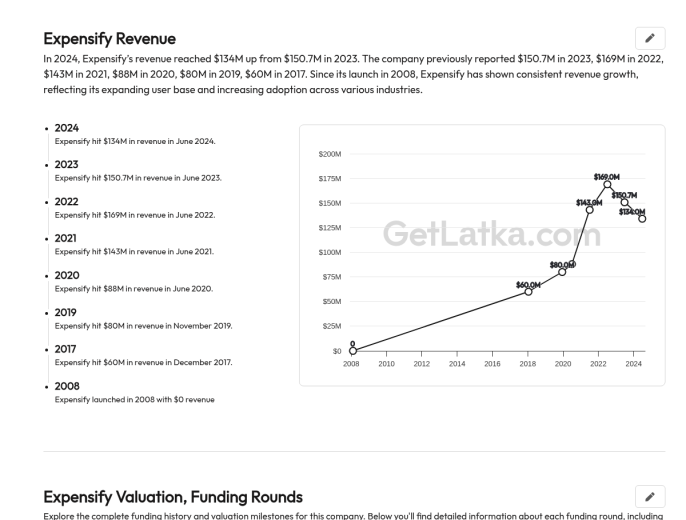
Expensify’s journey started in 2008 when founder David Barrett shifted his focus from 3D graphics engines in the gaming industry to solving a common business frustration: expense reporting. Initially, Barrett had no interest in expense management. His aim was to leverage prepaid debit cards, but due to the banks’ reluctance, he pivoted to creating a mobile app for expense management as a ‘Trojan Horse’ to gain traction in the financial sector.
2010: Lean Beginnings and Word of Mouth
The core of Expensify’s growth strategy was its consumer-first approach. Barrett designed the app to be user-friendly for individuals, enabling them to easily snap photos of receipts and automate expense reports. This focus on the end-user as a champion within organizations laid the groundwork for organic growth. The word-of-mouth strategy was pivotal, allowing Expensify to grow without significant marketing spend.
2015: Hitting 45,000 Paying Companies
By 2015, Expensify had secured around 45,000 paying companies. This was achieved through a unique pricing model that started free, enticing individuals to advocate internally for company-wide adoption. The model effectively turned users into brand ambassadors, further expanding Expensify’s reach into organizations.
2017: Crossing the $60M Revenue Mark
Expensify’s revenue was reported between $60M and $100M in 2017. The growth was attributed to a focus on the mid-market and SMB sector, where Expensify saw the most potential. By optimizing the product for smaller businesses, Expensify was able to accelerate revenue growth, moving away from the slower enterprise sales cycles.
2018: Scaling Without Ads
In 2018, Expensify continued to grow rapidly without the use of paid advertising, relying entirely on organic growth and user referrals. This model not only reduced customer acquisition costs but also allowed for a more sustainable growth trajectory. Expensify’s approach contradicted the traditional VC-backed strategy of heavy ad spend, proving that significant ARR growth was achievable through alternative methods.
2019: Maintaining Growth and Market Position
Expensify maintained its growth momentum by continuing to improve its user experience and expand its market share in the SMB sector. The company’s focus remained on expanding its customer base rather than increasing revenue from existing clients, emphasizing volume over margin extraction.
2020 and Beyond: Future Prospects
Looking forward, Expensify’s strategy involves further optimizing its product for small businesses and exploring potential expansions into related financial services. However, Barrett remains cautious about diluting the company with external capital, focusing instead on organic growth and maintaining a lean operational model.
For more information on Expensify, check out their GetLatka company profile, their location category, and their industry category. Visit Expensify’s official website for further details.
Recent Articles
How 1Mind Achieved Rapid Revenue Growth with AI-Powered Sales Solutions
In the ever-evolving world of technology, few companies have managed to disrupt traditional sales and marketing processes as effectively as…
How Rev's CEO Adi Bathla Drove Revenue to $10M by Revolutionizing Auto Shop Workflows
Building a company from scratch and driving it to hit significant revenue milestones is no small feat. Adi Bathla, the…
How Practice by Numbers Achieved $16.5M Revenue in 2026 with Innovative SaaS Solutions
2015: Launched Practice by Numbers to Fill a Market Gap Practice by Numbers (PBN), co-founded by Rohit Garg and Dr.…