

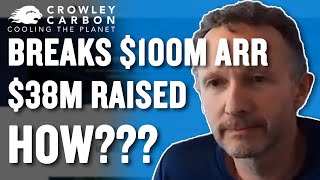
 Watch: Manufacturing Plant Software Breaks $100m Revenue, Just $38m Raised
November 2020
Manufacturing Plant Software Breaks $100m Revenue, Just $38m Raised
Read the transcript
hello everyone my guest today is norman crowley he founded and sold three businesses for over 750 million dollars before the age of 40. he's on a mission to cool the planet and is the current founder of an energy efficient company an electric car manufacturing company and a solar energy company norman you're ready to take it to the top yeah okay so people can read more about you at crowleycarbon.com what's your main business today though um our main business is the business of starting climate change and if you look at climate change there are three things that you need to do uh it all centers around energy transport and food and they're the three areas that we work in so energy energy efficiency the world wastes three of the four billion dollars that we spend every year on energy so solar is great and wind is great but how about we stop wasting it to begin with so that side of our business works with some of the biggest companies in the world saves them up to a hundred million dollars each annually which is a lot of dough um and then our car business is interesting so rather than trying to do what elon is doing and make electric cars what we do is we retrofit specialist vehicles so of the there's over 1.4 billion vehicles in the world there's over 60 million new vehicles every year so if we're going to wait for all of them to become teslas it's going to take about 100 years and so what we do is we retrofit things like mining support vehicles and classic cars so we do a good line in electric classic cars and so that business thankfully is booming um and then for food we're doing a startup in the area of food uh in particular the area of selag or cellular agriculture and are any of these so are there software components to any of these businesses or is it the car is obviously heavy hardware it sounds like yeah so software is so in our energy efficiency business it's all about software there's a thing in the world of energy efficiency or in the world of industry called industry 4.0 i don't know if you've come across that it's basically it's the current evolution of industry and everything now in industry is going digital from 3d printing to cellular agriculture and in order to make that work you need software basically in order to make it work properly you need to understand everything that's going on in your factory and how you understand that is with this internet of things um and our platform in that space is called clarity and because it gives you clarity as to what's going on in your factory yeah yep so let's talk more about clarity um so help me understand i guess it sounds like you're selling directly to the manufacturing plant yeah yeah and and so it's it's like if you think about a manufacturing plant it's just full of components full of machinery clunking away all the time making things and that could be anything from a pharmaceutical plant all the way through to a food plant right um and the thing all the time is you have no idea what's going on there are machines everywhere and they're up to all sorts of things and so if a machine decides to slightly change how it's operating that could mean that you're losing hundreds of thousands of dollars a day but in energy terms for instance but you don't know that or it might be affecting the throughput in the factory or the quality of what's coming out of the factory and so what we do is we give you this monster window into what's happening so we have sensors plugged in to everything so these super low cost sensors that have a five-year battery five kilometer range and that you can click onto anything in a factory and then once you have those the next thing you need is well then you have a huge amount of data so then what do you do with all this data right so that's where artificial intelligence comes into play machine learning comes into play but also it's where kind of people come into play because like you can have all the smarts in the world but in the end you just need people looking at it as well and making decisions and so what it does ultimately is it makes a kind of slightly dumb factory um very smart very quick and you have to figure out how to do that in an economic way you can't just say well i'm going to charge you a fortune for doing this so the way our one works most of the time is what we call share savings so if we improve the situation and then either you can pay for the software or you can just split the savings with us that's a very risky model because i imagine you find yourself in a lot of debates about attribution did you your software save the energy or did they do something not related to that save the energy right yeah yeah it's a great observation well after 10 years we've kind of figured out how the contract works and so what we do is we basically say is that right the software's been around for 10 years yeah it's been around for 10 years it's getting slicker and sicker all the time but um it's um it's been around a long time and like some of the biggest it's great like some of the biggest companies in the world use it like three of the top four food companies seven of the top eight pharmaceutical companies and and we're operating in kind of 23 countries this is impressive so norman let's let's really i want to hyperfocus you're doing so much but this is really interesting to me so i want to i'm going to naturally ask questions about this so there's a two-part play here there's an iot play where you have to sell an upfront hardware expense to get the monitors installed and there's an upsell related to the ongoing fee whether it's a cut of billing saved or a flat software fee if a manufacturer is going to pay you a fat a flat software fee what are they typically paying you on average for that i'm on average between per factory about 20 to 35 000 bucks um and the reason they're doing that is because they're saving kind of 10x that otherwise you wouldn't do it you know and it's much more like 25 grand annually annually yeah yeah and like look some are paying if we're saving somebody quite a lot of money they could be paying us a quarter of a million annually you know because like that's the average price is 20 to 30 but like if you have a very big factory or if you're saving them a lot of money then it it could end up being a lot of money norman can i ask what your biggest contract is what is your most you know the the con the manufacturer you've saved the most for paying you every year yeah we're we're not allowed to say who it is but it's a very large food company and we're saving them a hundred million annually and they're paying us about three million annually wow fascinating okay yeah that's more than one factory by the way that's in multiple factories around the world how many out of curiosity um it at last count about 34 35 yeah and so how many factories today around the world do you have at least one of your iot devices installed then uh at least one now actually about four thousand yeah and so quite a lot of factories yeah wow so there's now is it four thousand factories or four thousand iot devices installed across all your phones no no 4 000 factories how many iot devices uh i couldn't answer right today but it's in the millions yeah because it's not just our iot devices it's actually when we plug in we plug into all of their devices as well so you could get in one factory you could get 70 000 data points off them right and then you add your own yeah um and so in fact um let me we're this is a video podcast right yeah yeah throw it up you got something you want to throw up on yeah so just give me one second i'm gonna get a prop for this hello i love i love a good problem so these are the sensors these are pretty cool right can you see that well yeah for those for those of you listening only to audio what you're seeing here it's about it's smaller than the size of your palm of your hand it looks like a very small black almost battery pack kind of yeah and then they're magnetic so if you want to install one you just do that oh wow click on to whatever piece of machinery and i'll just show you so there's a qr code then on the top of it so if you wanna and they're they're all kinds of sensors so vibration sensors temperature sensors flow you name it and you can install like 250 sensors a day right in a factory so it's pretty it's pretty phenomenal and so you can make a very old clunky factory with no data available and within a day you can know everything that's going on you know and then the big trick then is it's not really a tech problem after that it's a people problem right because then you've gotta you can do all of this in a factory and make it all smarter and alert people to problems but the people who run that factory have to really engage with you and a lot of the time what happens is the ceo of the whole group he wants like or she wants energy savings and true put savings and quality improvements but at a factory level a lot of time they want just can i can this do my esg report so i can say how much carbon i'm saving so i don't have to spend saturday night working on these stupid reports all the time are can it you know can it stop something from breaking down so i don't get a call on friday night just when i'm heading for beers and so kind of predict a break right and so the thing that the ceo wants is very different from the thing the finance director wants is very different from the plant manager it's very different engineers a lot of them just want to work with cool cutting-edge right and so everybody wants a slightly different thing and it took us a long time to figure out how do we appeal to everybody how does everybody get a win out of this because just because the guy the ceo is saving a fortune doesn't mean you gotta win right that just means somebody is saving a lot of money everybody we find in order for this to become ubiquitous everybody has to get a win yep that makes good sense let me break into some economics here real quick that device you just showed me what does that cost you to produce um it depends on the sensor it can it's rangy right so it could be as low as 30 bucks and it could be as high as five grand but the one you showed me is just just just the one you showed me yeah one of those was about 30 bucks one of those was about 80 bucks custom production interesting and then yeah you subsidize that if you know someone's going to pay you a lot in a software fee where you subsidize the hardware installation or we say like because meters can be a capital expense and guys can struggle to get capex we say to people hey look why don't you pay us three bucks a month for that sensor and it's saving you a hundred bucks a month so you're happy we're happy uh and so we can do it as sensor as a service as well are you doing loans there is there a finance product there are you making no it's kind of just we use our own balance sheet to put those in yeah interesting okay we get paid forever yeah take me back to year one 2011. he said if it's been around for 10 years do you remember how much revenue you did way back then year one yeah we probably did about 150 000 books the first year how did that feel uh look it's scary like this is my fifth company so they're all scary in the beginning because you don't know what you're doing and you're just hoping that it's all going to be okay and that somebody will buy it off you you know and then it's that maturity curve to today where where you know i i can only tell you today what went on by looking at our systems i have no idea what happened and who met who like or what their feedback was so it goes from you're emptying the bins the first year and taking out the garbage to today which is that you're just you're hearing it all anecdotally from hubspot or whatever yeah how many folks are on the team today full time um in the energy division it's about 180 all in across everything we have close to a thousand so you have all these businesses the car business the food business the energy business is this all on one cap table it's all one business yeah yeah it's so well cool planet group yep and um it's it's all to do with cooling the planet and we have our investor group we're very lucky how much how much have we raised um not that much actually relatively speaking probably about 38 million bucks and so um like up until the beginning of 2020 we'd only raised five million bucks into the business and we were in 23 countries so i think raising money is not you know i know there's a path at the moment then everyone does series a series b and all of that but i would encourage people not to put a whole lot of state in that it is you just you just recently did a 33 million round that it sounds like huh yeah that's right yeah um so we took on a strategic partner which is a french group called t2 and they're at climate change or what's called an energy transition fund and they're a billion dollar energy transition fund and they are fantastic because you know it's one thing just to get money from a bank or be it a venture capitalist or an investment bank it's another thing to have a partner and somebody who believes in the mission and this is very much a belief in the mission type business not you know yes we worry about making money but we worry much more about the mission well yeah let's go back to the money real quick do you remember the year you passed a million in revenue um yeah i would say it was year three okay it's about like 2013 and then it kind of exploded yeah and it was kind of nascent enough until 2015 probably went to 5 million and then from 2015 on it just exploded because we kind of figured out some of the secret sauce yeah and uh and it was then it was tripling every year and fairly consistently for a long time mm-hmm and what are you at today yeah we don't disclose that but it's big yeah it's in the hundreds of millions yeah yeah i mean i can we can we can take four thousand factories right times that twenty five thousand dollars yeah that's a hundred minutes some of them are getting it on the cheap some of them are getting it expensive okay but but but if we only because again you have three business sectors i really wanna focus this podcast just on the one the energy when we've talked about the software is that one alone four thousand factories times twenty five thousand dollar ac that's a hundred million in revenue is that one alone doing more than a hundred million well it yeah it is worth more than 100 all right revenues would be an article you're almost you're almost you're almost shy to admit that a little bit well we don't the reason we don't is we're not we enjoy not being publicly quoted and also what we find is that you know it's better for people not to really understand the breadth of everything that's going on it's simpler unless you're an investor why is that i mean when people see what you're doing go wow he really is cooling the planet he's at 4 000 factories they pay 30 grand on average i mean holy cow it's incredible yeah but what we find is that competitors if if competitors understand every single thing you're doing and your margins on everything then that's not so good yeah yeah but even if they knew that so they're not they're not norman crowley no and i'm not worried about them really catching up but i'm more worried about them competing with us on a bid and knowing what margin is getting and all that kind of stuff you know and so and also i floated a company in the mid 2000s and i did my quarterly reporting and my revenue disclosures and all of that and i much prefer that our group is is not on the market and our goal is not to float this business norman is scarred for life after his foray into public markets he will never talk about metro publicly again yeah no we don't we disclose things like how many tons of carbon we're saving and things like that but that's it well i think i think these numbers tell a more compelling story so the ones you've chosen to share i want to thank you for for sharing those um yeah so so talk to me a little bit about are there synergies on how these three different businesses work together like elon musk right there's a battery business and then you do solar tiles and then it also powers tesla batteries right do you have these synergies yeah we have crazy synergies in some parts we have crazy synergies and i'll explain those in other parts they don't connect at all like if somebody spends a million bucks for an electric classic car then there's no tie-in to energy whatsoever right and but in the bigger parts of our vehicle business so if you think about putting an electric vehicle into industry then it has to have a charging infrastructure that we deeply understand it has to have solar well it should have solar to supply some of the power and then also if we're doing your electric vehicles what's the point in having evs if you don't have an efficient plant as well or an efficient office so they don't tell very closely and what we're building now is what we call etas so e-t-a-a-s so is energy and transport as a service so you you get the vehicle office for a service fee and that includes the energy that that is supplied to the vehicle and also because on top of that we can get the vehicle tacked as what's called a vpp a virtual power plant so when the vehicle is plugged in it can help to balance the grid as well and so that's the first area where they're all fully integrated and then where food comes in is if you're doing cellular agriculture which is the control of a bioreactor to create meat for instance well we happen to understand controlling bioreactors deeply because we have a lot of brewing customers and a lot of pharmaceutical customers and so they tie together very well actually you know this makes tons of sense now if you look at don't disclose the actual revenue figure but if you take the whole pie of all three businesses what percent of revenue comes from each if you had to break it it's all about energy at the moment food is cellular agriculture as a startup almost all revenue and um and then cars is is smaller and but is coming up very quickly the eevees are as you know are exploding at the moment completely loading got it so your business that we've talked about today the manufacturing one of the physical devices that is your 99 of your revenue so the other two are really startups yeah yeah yeah like i can disclose in cars cars will do well next year is easier cars will do about 70 million next year and this year it'll do hard to tell with the pandemic but it'll probably do something like 15 or 20. and that'll give you a flavor for the speed of growth yeah that's that's good growth what did it do last year the car business oh like it was well 2019 it was a start up with 2020 20 20 though so 2020 it did about 2 million away and how do you get to 2 million or is that actually your margin yeah yeah no no that's if you added the cars it's not that many cars last year how many so the curve is scary you know and it's um last year would have been about 20 cars yeah yeah um i mean that's the fun number right is when you can see a plan where you're putting you know 1000 cars on the market every quarter yeah yeah the funny well i was about to use terrible english and say the funner number the number that gets us properly excited about cars now is um the software that transport as a service energy as a service number so the recurring income on that is it looks like it's going to be everything combined looks like it's going to be about 35 000 bucks per vehicle per year all in so it's kind of serious money um and and that's quite exciting so it's much more money than you can charge just for a vehicle on its own like if you were leasing a tesla it wouldn't be that kind of money you know this is when you combine energy and vehicle um together as a service the revenue goes through i'm confused so so i'm actually that's i'm leasing a tesla here in la right at seven thousand dollars for the year then i have to give it back at the end of the year how do you make thirty five thousand dollars extra for me yeah we're giving away slight secret sauce here let's let's go for it so first of all there's the vehicle itself then there's the amount of energy that that vehicle is saving right so fuel bill for a vehicle could be twenty thousand bucks a year whereas fuel bill for an ev is two thousand bucks a year right then there's the energy efficiency in the plant bolted onto that and then the final one which is the real secret sauce is a vehicle can you can get paid about 7 000 bucks a year for the vehicle supporting the grid just one vehicle right it virtual power plant idea that you talked about these are like little floating power plants everywhere well it's crazy right because the vehicle's not being used a lot of the time and then you can plug it in um and then in the particular case of the 30 40 000 bucks the energy efficiency thing in some industries the fact that the vehicle becomes electric as opposed to a hydrocarbon vehicle ends up saving like 20 000 bucks a year on something like air extraction for example so in a lot of industries that carbon monoxide or that nox has to be stocked out of somewhere and then if you're saving that as well then it's massively profitable yeah yeah norman this is great i could talk to you for a long time let me hyper focus on one or two last questions where i wrap up on the iot business where you install the thing in the 4000 manufacturing plants one of the things i always talk to sas founders about is if you have an iot play usually your net dollar retention once the installation happens goes through the roof nobody churns are you seeing the same pattern do you have higher than 120 net dollar retention yeah we have greater net dollar retention um every year it's a negative churn right and the reason for that there's good news bad news the good news or the bad news is getting a customer in our industry is very difficult because you have to install stuff you can't just convince them to use your cdrn so that the sales cycle is way longer like nine months between four and nine months and depending on the scale of customer then the good news is because the platform is good they don't go anywhere because the difficulty of going somewhere else is just too difficult you know and so it is it's good and bad right but definitely time to deal or proof of value is long and then is your number one way to drive up sell revenue like you did with your biggest customer paying three million dollars per year really just selling it them installing your hardware and additional plants and and more plants more hardware more value actually because the more you can save them the more sensors they'll put in because the more they'll want to save and that's that's getting very big you know and um and our team who run that are exceptional they're very serious industrial engineers who really know where they can add value and you're talking kind of phds who really understand process and stuff and what we find in competitors is they have a lot they can give you data in a bucket but they can't tell you what it means and the customer wants to know what it means they need to know what it means and so that's where you need people and ai and stuff as well if you don't have that you don't know anything norman before we wrap up with the famous five last year how many pounds of co2 did you take out of the air you know it's kind of embarrassing but without going on our website i can't tell you that and a couple of years ago and i've stopped looking a couple of years ago it was the same amount of co2 as all of dublin which is the capital of ireland uses yeah so because why don't you publish why don't you publish i mean is that the exciting number it's on our website but yeah oh it's on our website you just don't know you don't know it off top of your head i just don't know i've stopped looking yeah i see and also we haven't integrated cars into it yet so it's probably not as accurate as it should be right now got it all right norman let's wrap up with a famous five number one your favorite book oh um delivering happiness by tony shea number two is their ceo you're following or studying yeah elon musk nobody else number three what's your favorite online tool for building crowley carbon uh currently home spot but it changes number four how many hours of sleep do you get every night uh i'm pretty good now i get about eight yeah that's good and what's your situation married saying meditation man meditation nathan that's the key are you married single kids what's your situation married with two kids growing up 12 22. and how old are you uh 50 50. last year i feel like 90 but 50. we love that last question what's something you wishing when you were 20. say that again something you wishing you when you were 20. uh just well medita a couple of things meditation well exercise diet food meditation or the things right if you do that all the time then everything else works guys crowley carbon launched in 2011 has a very interesting play of a physical installation of an iot device to save manufacturing plants energy then they sell software on the back side of that today they're in over 4 000 plants each plant plays between call it 20 and 30 thousand dollars a year on average the largest plant pays are the largest group pays three million dollars per year because they're saving them so much time energy and money they broke a million dollars in revenue in 2013 5 million in 2015 and now just this business line more than 100 million dollars in revenue as he starts to reinvest into two new lines of business in food and cars which sound very exciting norman thank you for taking us to the top one more thing before you go we have a brand new show every thursday at 1 pm central it's called shark tank for sas we call it deal or bust one founder comes on three hungry buyers they try and do a deal live and the founder shares back end dashboards their expenses their revenue arpu cac ltv you name it they share it and the buyers try and make a deal live it is fun to watch every thursday 1 pm central additionally remember these recorded founder interviews go live we release them here on youtube every day at 2 p.m central to make sure you don't miss any of that make sure you click the subscribe button below here on youtube the big red button and then click the little bell notification to make sure you get notifications when we do go live i wouldn't want you to miss breaking news in the sas world whether it's an acquisition a big fundraise a big sale a big profitability statement or something else i don't want you to miss it additionally if you want to take this conversation deeper and further we have by far the largest private slack community for b2b sas founders you want to get in there we've probably talked about your tool if you're running a company or your firm if you're investing you can go in there and quickly search and see what people are saying sign up for that at nathanlacka.com forward slash slack in the meantime i'm hanging out with you here on youtube i'll be in the comments for the next 30 minutes feel free to let me know what you thought about this episode if you enjoyed it click the thumbs up we get a lot of haters that are mad at how aggressive i am on these shows but i do it so that we can all learn we have to counter those people we got to push them away click the thumbs up below to counter them and know that i appreciate your guys support all right i'll be in the comments see ya