
Founder Interview
How TJM Labs Reached $25M Revenue Charging 450 Pharmacy's $45k/yr Per Bot (Interview with Founder Jonathan Adly)
- Interview Date
- July 8, 2026
- Interviewee
- Jonathan Adly, Founder & CEOFounder & CEO
Company Metrics at Interview Time
ARR
$25M
Customers
450 pharmacies
Growth
2400%
EBITDA Margin
40%
Total Funding
$100M
Historical Snapshot
These numbers were reported by Jonathan Adly during his interview recorded in July 2026 and represent a historical snapshot of TJM Labs at that point in time, not current figures. See TJM Labs’s current numbers.
Key Takeaways
- 01TJM Labs reached $25M ARR as of mid-2026, up from $1M in February 2025
- 02The company serves 450 pharmacy logos at an average ACV of $45,000 per digital worker
- 03Each pharmacy uses an average of 2.5 bots, implying roughly $112,500 per pharmacy per year
- 04TJM Labs raised $100M total across a $10M Series A in December 2025, a $15M Series A1 in March 2026, and a $75M Series B from Elephant in June 2026
- 05The company operates at a 40% EBITDA margin and was profitable before raising the Series B
- 06The biggest single customer pays more than $1M per year
- 07TJM Labs bots were processing approximately 500,000 prescriptions per day as of roughly April 2026
- 08Less than 5% of revenue growth was inorganic, coming from two acquisitions made for team talent
- 09LinkedIn outbound is the primary growth channel
- 10Jonathan Adly previously founded Galen AI, which was acquired by Carrie RX in a bootstrapped exit
Company Metrics at Time of Interview
| Metric | Value | Source |
|---|---|---|
| ARR (mid-2026) | $25M | Founder interview, July 2026 |
| ARR (December 2025) | $15M | Founder interview, July 2026 |
| ARR (February 2025) | $1M | Founder interview, July 2026 |
| Revenue Growth | 2400% | Founder interview, July 2026 |
| Customers | 450 pharmacies | Founder interview, July 2026 |
| Average ACV per digital worker | $45,000 | Founder interview, July 2026 |
| Average bots per pharmacy | 2.5 | Founder interview, July 2026 |
| Biggest customer contract | >$1M per year | Founder interview, July 2026 |
| EBITDA Margin | 40% | Founder interview, July 2026 |
| Series A funding | $10M | Founder interview, July 2026 |
| Series A1 funding | $15M | Founder interview, July 2026 |
| Series B funding (Elephant) | $75M | Founder interview, July 2026 |
| Total funding | $100M | Founder interview, July 2026 |
| Valuation multiple | >15x ARR | Founder interview, July 2026 |
| Prescriptions processed per day | 500,000 | Founder interview, July 2026 |
| Total addressable pharmacies (US) | 16,000 | Founder interview, July 2026 |
| Inorganic revenue contribution | <5% | Founder interview, July 2026 |
| Year founded | 2024 | Founder interview, July 2026 |
| First line of code | November 2024 | Founder interview, July 2026 |
Growth Breakdown
Revenue
TJM Labs grew from $1M ARR in February 2025 to $15M ARR by December 2025, then added another $10M in the first half of 2026 to reach $25M ARR. Jonathan Adly described the growth trajectory as completely vertical, driven almost entirely by organic new customer additions rather than acquisitions, which contributed less than 5% of revenue.
Customers
The company scaled from its first customer in late 2024 to 450 pharmacy logos by mid-2026. Early customers came entirely through personal relationships and referrals, including one deal that originated from a conversation on an airplane. The company began formal sales motions around 30 customers and has since expanded to serve both independent pharmacies and large grocery chain pharmacy networks.
Team and Acquisitions
TJM Labs made two acquisitions, Encore RX and PharmaSol, primarily to bring in exceptional domain-expert technical talent rather than for revenue. Jonathan described the rationale as assembling a Manhattan Project of the roughly five people in the world with the right combination of 15 years of pharmacy domain expertise and technical AI skills.
Profitability and Funding
The company reached a 40% EBITDA margin before raising its Series B. Jonathan raised $100M across three rounds in roughly six months, not out of necessity but to build a fortress balance sheet, fund M and A, and attract top talent by signaling financial stability. Elephant led the $75M Series B in June 2026.
Growth Strategy
Trust-Based Network Sales
The first 30 customers came entirely from personal relationships built over 15 years in the pharmacy industry. The second customer was a direct referral from the first, and a third came from an unsolicited call after a pharmacy owner demonstrated the product on an airplane. Jonathan credited deep domain trust as the only viable go-to-market in a regulated space where access to live prescription systems requires years of established credibility.
LinkedIn Outbound
LinkedIn is TJM Labs primary outbound sales channel. Jonathan noted the team does great work there and pointed prospective followers to his LinkedIn profile as the best way to follow the company.
Digital Worker Pricing Model
TJM Labs priced its AI agents as digital workers at $45,000 per year per bot, deliberately benchmarked just below the salary of a pharmacy technician. This framing made the ROI immediately legible to pharmacy operators: one digital worker replaces two to three human technicians, converting a cost of roughly $150,000 or more in human labor into a $45,000 annual subscription.
Expansion Within Accounts
Because a single pharmacy logo can operate hundreds of locations and deploy many bots, TJM Labs grows revenue within existing customers as those customers expand usage. The average of 2.5 bots per pharmacy today reflects early-stage penetration of accounts that could eventually deploy far more digital workers.
Strategic Acquisitions for Talent Consolidation
Jonathan used the Series A and Series A1 capital to acquire Encore RX and PharmaSol, consolidating a small pool of highly qualified pharmacy AI talent into one team. The goal was to prevent well-matched competitors from scaling independently and to concentrate the domain expertise needed to win the vertical software category.
Best Quotes
“Our average ACV is about forty five K a year, right? And if you notice, that is slightly less than the salary of a a pharmacy technician, and that's how we price it. We this is digital workers. That's what you should hold the company accountable for.”
“I can tell I can share my revenue. My revenue is about it's close to twenty five million ARR. Right. That's not that's not a a secret.”
“We only started selling to other pharmacies February 2025. So it's been a year and like five months now. And that's when we went from one to four fifty and went from a million to twenty five million.”
“No, we had forty percent EBITDA.”
“I didn't want to raise actually. I didn't to this day we still don't have an investment deck.”
“You want to raise when you don't need to because that's when the easiest way to do it.”
“We are doing last we checked about three months ago, about half a million scripts per day.”
“I know there's 16,000 pharmacies out there, right? I can go from 450 to a thousand to three thousand. Great. So easily I can backtrack into the valuation from that.”
“Zero to one is really hard. You know, one to hundred, there's playbooks and I think can be executed on somewhat programmatically, but zero to one is that's the part when there's no playbook for.”
“I don't care about being the system of record, I wanna be the system of action.”
What Happened Next
This interview was recorded in July 2026 and captures TJM Labs at a specific moment in its growth trajectory, with $25M ARR, 450 pharmacy customers, and $100M in total funding just raised. The figures Jonathan Adly shared reflect the company's state at that point in time and will have changed since. Visit the TJM Labs company profile on getLatka for the most current reported metrics and funding history.
View TJM Labs’s current profile and metricsFull Transcript
Chapters
- 0:01Introduction and Guest Background
- 0:33Jonathan's Path from Pharmacy School to Entrepreneurship
- 3:07Galen AI: Bootstrapped Exit and Early Lessons
- 5:11Joining Carrie RX and the Decision to Leave
- 7:33What TJM Labs Sells: AI Digital Workers for Pharmacies
- 9:04Pricing Model: Digital Workers at $45K Per Year
- 11:01Company Launch: First Line of Code and First Customer
- 12:50Getting the First 30 Customers Through Trust and Relationships
- 13:50Scale Today: 450 Pharmacies and $25M ARR
- 16:52Fundraising: Series A, A1, and the Elephant Series B
- 22:38Profitability: 40% EBITDA Margin
- 23:41Valuation: Greater Than 15x ARR Multiple
- 26:49Prescriptions Processed: 500,000 Scripts Per Day
- 27:14How to Follow Jonathan and TJM Labs
Introduction and Guest Background
Nathan Latka
0:01Hey folks, today we have a triple threat. Jonathan Adley spent 15 years working inside pharmacies before founding TJM Labs and combines three disciplines. He's a licensed pharmacist, an AI software engineer, and an operator. He previously worked on AI infrastructure at Carrie RX and founded Gallen AI. He holds a PharmD, a postdoctoral residency, and an MBA. TJM Labs is a pharmacy AI platform that automates operational work, prescription intake, data entry, refills. And more. Jonathan, you ready to take us to the top?
Jonathan Adly, Founder & CEO
0:32Yeah, I'm ready.
Jonathan's Path from Pharmacy School to Entrepreneurship
Nathan Latka
0:33All right. So take us into the story here first. What came first? Were you running what you know, did you get your doctorate first? Were you a pharmacist first? Were you a coder first? What what started this?
Jonathan Adly, Founder & CEO
0:43You know, I don't know how far back you you want to go, but ⁓ I remember I'm being in high school and we're talking about colleges with my parents and what you want to do. And classic immigrant story, they always want you to be a doctor. And I did not want to be a doctor. I actually ⁓ healthcare in general was not something I'm interested about. So we ended up basically fighting for six months on pharmacy was the compromise. And the idea is go to pharmacy school. Get your license, right? That puts a really hard floor in your career. Because if you have a pharmacy license, you always have a job. And then go pursue whatever you need to do. So that's what happened. I got, you know, my pharmacy degree. I did well in school. ⁓ Typically in pharmacy school, when you do well, they push you into academia. So I ended up publishing a paper, doing a residency, did some postdoctoral residency work. And ⁓ I ended up I would say in a great job, very comfortable in a health system. ⁓ eventually promoted to do some admin work, understand where the money is as far as the pharmacy supply chain, ⁓ all the government interventions that could be well meaning but ends up having a secondary side effect. ⁓ seen I would say how the sausage gets made. ⁓ and That made me wanna be an entrepreneur. There's a great opportunity there. And that's when I started pursuing my MBA. obviously as when anybody when they start being an entrepreneur, it's usually a tough journey, right? There's no one try something and get succeed at it the first time around. ⁓ so tried a couple of things, didn't really work out. I was a consultant, ended up working, I would say first as a a product person because I had the domain expertise, but eventually took on more and more actual engineering tasks and self taught myself. And ⁓ at some point, you know, I was consulting, the same the same problem showed up again and again and again. and it screamed, This is a product, not a consulting engagement. and that's how Gal and AI was born. Gallenai was Did super well. ⁓ in about a year and a half it got acquired. ⁓ after that I went and became the head of
Galen AI: Bootstrapped Exit and Early Lessons
Nathan Latka
3:07Jonathan, what does super well mean? Did you raise capital for that company?
3:11I did not I did not raise capital. It was bootstrapped, right? And we when we got acquired, we had our first enterprise, like true enterprise customer. And if you have one enterprise customer, usually that means you can get the second and the third and the fourth. ⁓ and there's also a lot of smaller customers.
3:27financially, was that a massive part of you know, point in your life? I mean, was that a meaningful financial exit for you or no?
Jonathan Adly, Founder & CEO
3:33It was a hundred percent a meaningful financial exit. I would say so Galen AI ended up ⁓ it was a very similar software stack, like a company like Open Evidence. And Open Evidence, I think it's a unicorn now, like a multi billion dollar valuation. The difference is Galen AI was very BTB focused versus open evidence when there's just physicians can sign up and and work out of it. if paper, if you just go by spreadsheets, ⁓ Gallen AI exit was too early. Everybody would have said you sold way too early. You should have stuck around, right? However, from a personal
Nathan Latka
4:11What what was revenue when you sold?
4:14I actually can't say because this is like our under the NDA when we got acquired. ⁓ but I can tell you that we first when you sign an enterprise customer, usually there's like an implementation, it takes some time to ramp up their revenue. ⁓ it would have been enough again as a bootstrap company where I can just have this one enterprise customer and not do anything else. And it would be enough for me because it was a small team. We'll pay everybody a good salary, I myself get a good salary and we're good. But that's that was not the ambition.
Jonathan Adly, Founder & CEO
4:43When play say enterprise customer though, I mean, are you talking like one customer paying seven figures above a million a year, or was it more like, you know, a hundred thousand or fifty thousand?
4:50Yeah. No, in healthcare, typically enterprise is more than two hundred and fifty K a year. Half a million is is reasonable, but there is million, two million contracts. Yeah.
Nathan Latka
5:04Okay. And then how did you go from Gallon AI to Carry R X? Was Carrie R X the acquirer of Gallen?
Jonathan Adly, Founder & CEO
5:09Carry Carrier X was the acquirers. We shared ⁓ I would say an enterprise customer and I was an easy conversation. and ⁓ yeah they were they were a great software company. AI was just starting to bloom, so to speak. And Galen AI had I would say the AI stack very early ahead of the curve. So it was a great acquisition for both parties. And Carrie exited six months ago. So they also got They they did well and they they sold to someone else. and yeah, it was successful for me ⁓ as a founder to have that first exit because that tells you ⁓ you can build at least a zero to one stage. And people don't realize this. Zero to one is really hard. You know, one to hundred, there's playbooks and I think can be executed on somewhat programmatically, but zero to one is that's the part when there's no playbook for. You have to go and figure it out.
Nathan Latka
5:54Mm-hmm. So fast forward to to where you're at today, I and I don't wanna I don't wanna bear the lead, but why did you feel like you had to leave ⁓ Kerry to build this business versus building it inside of Kerry?
Jonathan Adly, Founder & CEO
6:17That's a that's a that's a really good question. I think I just miss being a founder, right? there is some personality traits for folks that makes them a really good founder, but are really bad embluee, right? And similarly, there's some traits that can make someone a really good emblue, but would not make them a good founder. ⁓ I had the vision, especially early in AI, that it's gonna evolve extremely fast, that we should not ⁓ do the classic enterprise software motion when we tell our customers what should happen when we own the system of record rather that we should execute on top whatever their processes is to treat a AI not as software, not like software plus plus, but as true l labor replacement. And that was way too early to convince the whole mature and successful organization. That's the way to do it. Right. ⁓ everybody in in in that period was thinking like, I wanna be the system of record for this specific slice of industry, and that would be the win. ⁓ versus I was like, I don't care about being the system of record, I wanna be the system of action.
What TJM Labs Sells: AI Digital Workers for Pharmacies
Jonathan Adly, Founder & CEO
7:33So if we fast forward to today, and then we'll get more of the launch story of the business, but if we fast forward to today here in middle of twenty twenty six, what is TGM la or T J labs selling to these pharmacies? What what do they get when they pay you?
Nathan Latka
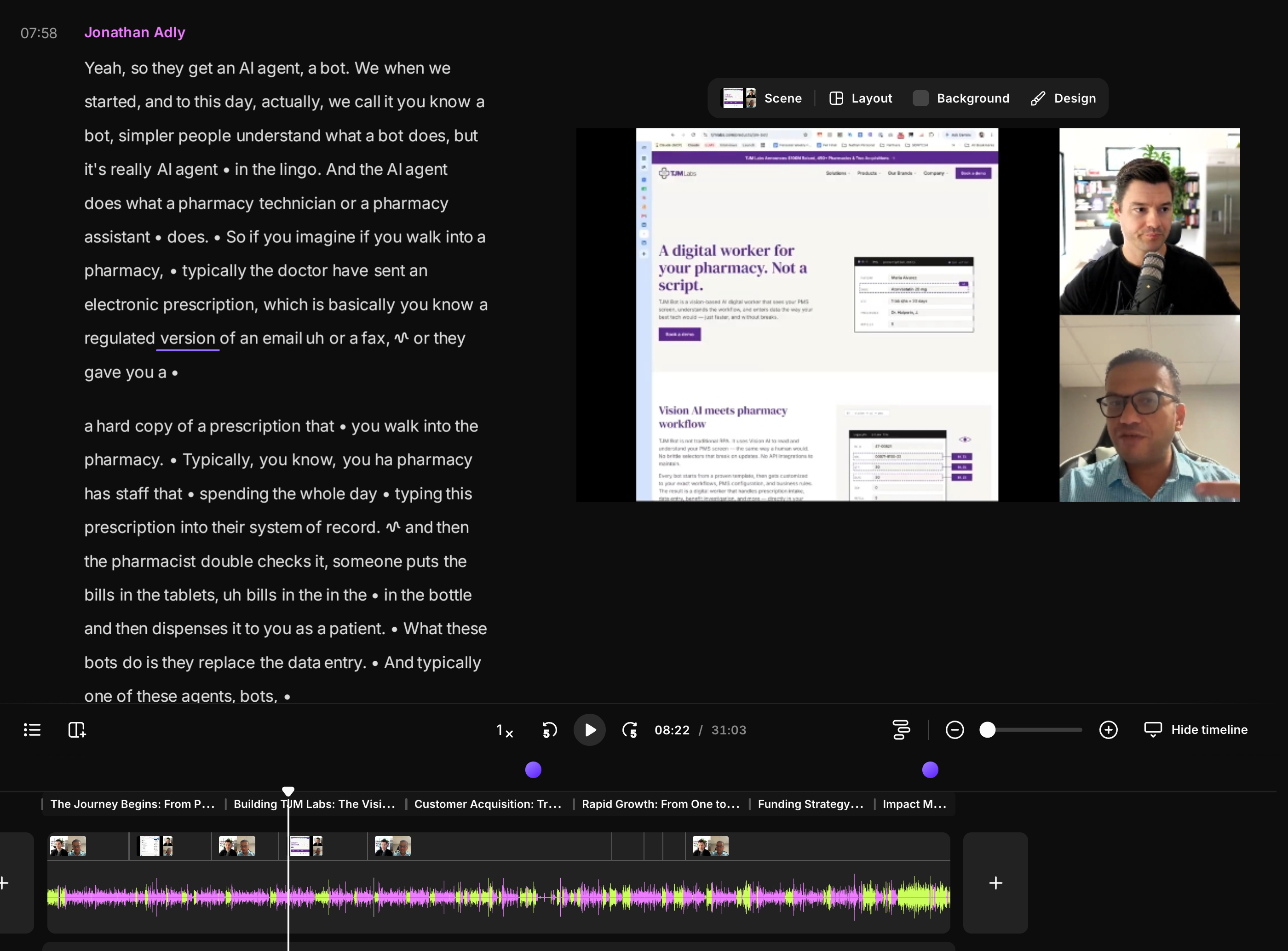
7:45⁓ Yeah, so they get an AI agent, a bot. We when we started, and to this day, actually, we call it you know a bot, simpler people understand what a bot does, but it's really AI agent in the lingo. And the AI agent does what a pharmacy technician or a pharmacy assistant does. So if you imagine if you walk into a pharmacy, typically the doctor have sent an electronic prescription, which is basically you know a regulated version of an email ⁓ or a fax, or they gave you a a hard copy of a prescription that you walk into the pharmacy. Typically, you know, you ha pharmacy has staff that spending the whole day typing this prescription into their system of record. and then the pharmacist double checks it, someone puts the bills in the tablets, ⁓ bills in the in the in the bottle and then dispenses it to you as a patient. What these bots do is they replace the data entry. And typically one of these agents, bots, is two to three pharmacy technicians. So again, you're no longer thinking in software land, you're thinking in labor land, right? Which is someone does a job, the job is repeatable, high volume, with a a natural human in the loop element to it. That's a great fit for an AI workflow.
Pricing Model: Digital Workers at $45K Per Year
Nathan Latka
9:04And so we've had several really impressive AI first founders on the show, you know, doing north of a hundred million of revenue. And they always I always ask them about their pricing and their pricing evolution around pricing, whether it was price per seat, price per task, price per job to be done, price per credit, et cetera. We w I wanna get I wanna know how you originally launched pricing, but I want to start with what you what you charge today. How do you structure your price and what's the average pharmacy paying you today per year to use your technology?
Jonathan Adly, Founder & CEO
9:32Yeah, so our average ACV is about forty five K a year, right? And if you notice, that is slightly less than the salary of a a pharmacy technician, and that's how we price it. We this is digital workers. That's what you should hold the company accountable for. And you can hire a digital worker for forty five K a year, or you can hire three human worker and that will cost you 150K a year. Right, or more if you count benefits and payroll and all of that stuff. ⁓ an idea is these agents work twenty four seven, you know, you hire someone, they work for eight hours, you train them once and they work with you forever. You can always retrain them and make them do additional things. so it's we like, you know, the digital worker ⁓ comparison.
Nathan Latka
10:22Mm. Mm-hmm. Okay. And did you always price this way, even going back to twenty twenty, last year when you launched?
Jonathan Adly, Founder & CEO
10:28Yeah, that was the vision. The vision was always digital workers. We didn't think per seat pricing makes any sense in the AI world, right? We don't think task also makes sense. This is very close to tokens. ⁓ tasks could be very ambiguous. Imagine you're hiring someone and you tell them you're gonna only work in this one task and that's it. Typically that's not how people work, right? ⁓ people you hire someone and you say maybe from ten to twelve do this from twelve to six do something else and that's what these agents can do as well.
Company Launch: First Line of Code and First Customer
Nathan Latka
11:01And so with that in mind, y accom according to your blog, you officially launched in twenty twenty five, but when did you write the first line of code for the platform?
Jonathan Adly, Founder & CEO
11:07Yeah, we wrote the first code actually in November 2024. ⁓ I remember it was a holiday break. we had our first customer ⁓ essentially win a really rash contract. They had to hire about 200 technicians for and they had four weeks to do that. That is a monumental, difficult task to hire this amount of people and train them. so they were pretty disparate and you know, disparate times called for disparate solutions. So ⁓ That's how our company was born. we said, let me try it. Let me see how can how many bots agents we can put in. ⁓ so instead of hiring 200, maybe you have to hire only 100, right? ⁓ but it ended up being extremely successful. And over time, as the AI capability got better and and and and higher, the solutions just kept getting better and the tasks that it can do kept expanding as well.
Nathan Latka
12:04So that was your first customer, I assume your ability to get that deal was just from your network being at Carrie and your experience in the pharmaceutical space, correct?
Jonathan Adly, Founder & CEO
12:12Hundred percent. And this is if you think about it, it was like an immaculate inception because pharmacy is a very regulated flow. ⁓ where's there's no test sandboxes. You actually have to work on real prescriptions, real medication that can cause serious harm. So you cannot just have a landing page. I'm gonna do this, and people will just say, Here's the keys to the kingdom, because you might actually kill somebody. ⁓ you have to have a ton of trust built into the system already. over many many many years right in order for people to say great go ahead here's access to our production system let's go live
Getting the First 30 Customers Through Trust and Relationships
Jonathan Adly, Founder & CEO
12:50So, how did you convert your years of experience in the space, your network, into hard paying customers at TGM Labs? How did you get the first 10 customers?
13:01Yeah, it's all trust, you know. I think ⁓ the first customer was obviously a r a relationship that was built over many years. The second customer was literally ⁓ a friend of the first customer. And he's like, I see what you have done for them, please do it for us too. the third customer, this is when I got convinced I need a sales team, was one of ⁓ my customers in an airplane sitting next to a guy and they were chatting and he showed him. Like what these Asians are doing. And a guy came down from the airplane and called my cell phone and said, I want that too. ⁓ and we stayed this way until about thirty pharmacies or so.
Nathan Latka
13:41That's great. Okay. So your first thirty customers is pure relationship, airport, airport h airplane hustling. Fast forward to today. How many, how many customers do you work with today?
Scale Today: 450 Pharmacies and $25M ARR
Jonathan Adly, Founder & CEO
13:50We have about four hundred and fifty pharmacies. And this is logos. One pharmacy obviously can have a hundred location. So
13:53Okay, four. Mm. Mm-hmm. But ⁓ the the average you gave me earlier is that per location or per pharmacy?
14:04That's burbat, bur digital worker, right? And a pharmacy can get a hundred digital workers if they're big enough. Right. So that is
14:11Okay. But what what is the like your first customer story you told me? It's not like they had a big appetite for these different bots. But if you look at your pharmacies today, I imagine some of them have a hundred locations, some of them are mom and pops with one or two locations. What's the average number of bots per your four hundred and fifty pharmacies? Would you guess?
Nathan Latka
14:17Yeah. Exactly. Yeah. ⁓ I would say probably two point five almost three. So yeah. Yes.
Jonathan Adly, Founder & CEO
14:33Okay. Okay. Interesting. Ca can I can I take that math? I mean, two point five bots at forty five grand per year per bot means each of the four hundred and fifty pharmacies would be somewhere around a hundred thousand dollars, one hundred and twelve thousand paying you per year. Is that accurate?
14:46Yeah. Yeah, and then obviously there's segments. There's an enterprise segment. Yeah, I mean I can tell I can share my revenue. My revenue is about it's close to twenty five million ARR. Right. That's not that's not a a secret. and ⁓ yeah, yeah.
14:50Okay. So we can obviously back into your revenue that way, right? I mean that that yeah. Right now. And what growth rate does that represent? If you go back to December of twenty twenty five, where did you finish there?
15:11⁓ we so we had the first customer I just told you about, we stayed nine months for them. And that's obviously a massive customer, a million plus a year. We only started selling to other pharmacies February 2025. So it's been a year and like five months now. And that's when we went from one to four fifty and went from a million to twenty five million. And yep, the gross is basically completely vertical. So
Nathan Latka
15:45Yeah, I'm trying to quantify that. So we have to compare same terms in each year. So end of twenty twenty four you only had one customer and it sounds like they were a million dollar customer. So end of twenty twenty four was a million dollar run rate. I believe that's accurate, correct?
Jonathan Adly, Founder & CEO
15:56Yeah. Yes, February twenty twenty five is one million run rate, exactly.
Nathan Latka
16:00And then by December of twenty twenty five and then December of twenty twenty five, you grew that to what run rate? Fifteen. Okay.
16:03We were like fifteen. Bye bye. Yeah, and then we have another another ten.
16:11Jonathan, your Wi Fi is really breaking up. Is there is there any way you can get on stronger Wi Fi?
16:17⁓ nope, that is let me try something once. What's going on? How about now, Mason?
16:22I think you're better now.
16:24Can you hear me okay? Hold on. It's still showing that it's switching networks. So
16:29There's just a very large delay when we talk and I don't want people to think that we're talking over each us in post production.
16:35Yeah, no no problem at all, yeah.
16:37This is slightly better now. Are you on the new network?
16:37Are we good? I am. I'm actually slowing down intentionally because this still shows that it's switching the network. ⁓ but ⁓ it I think it's okay. So
Fundraising: Series A, A1, and the Elephant Series B
Nathan Latka
16:52This is good. So yeah, so just to sum all that up, can you give us the revenue growth from December twenty four to December twenty five to today?
16:59Yeah, so one million to about fifteen to to twenty five, twenty five million.
Jonathan Adly, Founder & CEO
17:06That's incredible. So the last six months you've added about ten million bucks of ARR. How the heck did you do that? Expansion or new customers?
17:13Yeah, I mean look, it's a good product. We know what we're doing. It's what we call it is a fifteen year overnight success. It pharmacy is an incredibly difficult space. An average retail mama bob, their margin is two percent. When you come in and implement solution for this, they they go from a two percent margin to an eight percent margin. Who would not want this, right, as a small and bob business in America? These enterprise customers, like I say, a grocery chain, their pharmacies lose money. It's a loss leader. you come in and implement is no longer a last leader. Right. and we have we had an incredibly strong team. We made two acquisitions during that time. and yeah, there's a reason we raised a hundred million in like six months. So
Nathan Latka
17:59We'll get into that in a second. How much of the revenue growth was inorganic? It came from the acquired companies.
Jonathan Adly, Founder & CEO
18:05less than five percent. We we essentially had the acquisition more for the team than anything.
18:12I see. Okay, let's jump into that story. So you've been pretty aggressive on the Capitol front. this press release you put out said a ten million Series A, a fifteen million A one, and seventy five million from Elephant. what was the timing on those?
18:25Yeah, so series A December twenty twenty twenty-five. Right. Series A one Marsh. ⁓ series B June.
Nathan Latka
18:32Mm-hmm. Okay. So take me back to the ten million series A in December, because you were already doing significant revenues at this point. You said fifteen million of ARR. Why raise it? I mean, wh I guess why raise the money at all? And if not, why why not go all in? Why not raise as much as you possibly could?
Jonathan Adly, Founder & CEO
18:53That's a great question. I didn't want to raise actually. ⁓ I didn't to this day we still don't have an investment deck. ⁓ the only reason I raised that Series A, because there's exceptional, there was two exceptional teams out there, right? they were doing, I would say, adjacent things that very easily can overlap what we're doing. ⁓ their both were pharmacies, they were both had that journey, 15 years domain expert, technical. knew what they're doing and I was like, if we can combine, it would be almost like the Manhattan Project. We actually internally called it the Manhattan Project. You combine all of these great minds in one room. There's no one else, maybe like five guys in the whole world that can do that. We have all five. Right. And that was why we raised. because in vertical software, the problem is always STAM. Right. What's your total addressable if you really want to be a big company, what's your total addressable market? And if there's like four, five, six people kind of like competing and all of them are really good, your TEM is never gonna get big enough.
Nathan Latka
19:56So just to be clear, you bought, you used some of that $10 million to buy Encore RX and PharmaSol, or was the original $10 million just for Encore RX?
20:04No, the ten one ten million was Ancore and then fifteen million was reformers. Well obviously the acquisition numbers are not exactly the same and we did some other stuff with the money, not exclusively acquisitions, but that was essentially the how how we structured it.
20:21And the combined revenue of Encorn Pharmacist was under like two or three million bucks when you bought them, quote, five percent of your total AR. Okay. Okay. Really team led. Okay, take me into the elephant round series B, which just closed a couple of days ago. Why do this deal? And was this all primary or secondary as well?
20:28Yeah, yeah. So yeah. ⁓ so that was actually last month. So we decided in the beginning, we decided not to announce. Again, we had this mindset of like we are there's there's a company called the Viva, a public company, they're SB five hundred. No one ever heard of them. But if you are a pharma company, they are your software provider. Right? And we're like our role model is Viva, how we raise money, how we work is is is Viva.
Jonathan Adly, Founder & CEO
20:58Mm-hmm.
21:04so it's the same mentality we don't wanna announce. however, we have decided ⁓ that announcing is a good idea because as we're hiring and we're ramping up, it helps a lot with talent. People don't wanna jump in a company and then essentially the company goes away. ⁓ when you say we raised seventy five million, it just makes conversations a lot easier. So
21:24Mm-hmm. Mm-hmm. Okay, that didn't my answer my question though. You also have to manage dilution as a founder, right? So does Elephant come in and put all this on the balance sheet as operating capital, or was there some liquidity and secondary for early employees? How did you view the money?
21:36Was there was yeah, there was some liquidity. It was always secondary. I also believe if you raise, there has to be a secondary. I don't believe in raising without secondaries. ⁓ a lot or a little depends on the dynamic and what do you feel the market is is looks like. ⁓ but we the goal of the raise was again, ⁓ we wanna have a four hours balance sheet where we never have to raise again if we don't want to. And we're still profitable and continue to be profitable. And MA. We really believe ⁓ MA is is important. Right now it's the same as a transition between cloud and on-premise. And you have to run. You cannot walk. Because that transition is gonna finish in like a year from now. And whoever is the AI agent category winner is the category winner.
Nathan Latka
22:28Mm. Jonathan, you said you were profitable. So you had a lot of leverage going into the elephant round. You probably didn't have to do the deal. Can you share? Are we talking like ten percent profit margin or more?
Profitability: 40% EBITDA Margin
Jonathan Adly, Founder & CEO
22:38No, we had forty percent EBITDA.
Nathan Latka
22:41What? That's insane. Wow. Well, so what were you doing? Now I'm even more curious. Why take external money and take all the dilution? It's just really because you want to signal to the market, hey, listen, come work for us. We've got a lot of money. We want the best talent.
22:42Yes. Yes. Yeah, look, in the end of the day, I ha I came from an acquisition already. I sold a company. Right. If I'm strictly thinking about this like money, like I don't have to work. I can just sit at home and do nothing. The idea is, right? Yes, exactly. And I tried doing that and it didn't work out. I just yeah. the idea is you wanna build a company of a significant proportion. You want you played a game for the love of the game in the end of the day.
23:10You're a builder. You would never do that.
Jonathan Adly, Founder & CEO
23:25Right. And if you want to win the category, right, if you want to be a classic vertical software company, if you want to beat Viva, right? If Viva's for pharma, TGM Labs is for pharmacy, you have to raise money and you have to be aggressive, right? And you have to basically run, run, run as fast as you can. And raising, people don't realize this. ⁓ every raise is a miracle, because someone actually puts their hand in their pocket and gives you lots of money to go build your company. So when it all the factors are right, you want to raise. You don't want to raise when you need to. That's actually the opposite. You want to raise when you don't need to because that's when the easiest way to do it.
24:06Can you share more, Pete? The biggest question I get is Nathan, I'm considering raising what valuations will the markets giving AI companies today. I'm gonna assume you're not able to share your exact valuation, but can you maybe give us an a r a range? You know, was it twenty to thirty X or more or less? Coach us up there.
24:21Yeah. Yeah, I I I personally again there's always people always sometimes raise on vibes. I have I always like to look at the public companies and see, right, what is their multiple. And if someone has a 10x multiple like Fegma, when they went public, they had like a 15x multiple or something like that, or maybe 10x multiple. And they were growing 40% a year. Again, close something close to that. if I'm growing 10x. Right, then it's not gonna be less than 15x a year. That doesn't just make any sense. So even in this conversation, when you want a valuation, you always wanna based on on real numbers and not just vibes. And again, it would be good to know what's your total market, right? What's your forecast? And if you have these fundamental financial understanding, you know because if you raise at a high valuation, it actually comes back and bite you. Right. So you want to raise that the right valuation based on realistic forecasting numbers that you can actually hit realistically if you execute division.
Nathan Latka
25:24So are you able to confirm you guys were greater than a fifteen X multiple?
Jonathan Adly, Founder & CEO
25:28Yeah, yeah. Easily, yeah.
Nathan Latka
25:30And how to your point, it's a good one. There is such a thing as too high evaluation. So what multiple is too much? Like how do you figure out what the cap is?
Jonathan Adly, Founder & CEO
25:39Yeah, it it really depends on your forecast. Like we sat down when I raised when I talked to the elephant folks, we sat down and we said, okay, let's make a vision. How could we hit 100 million ARR? And we have a good relationship. Sometimes people don't have good relationships with their investors. I do. ⁓ how are we gonna hit 100 million ARR? What's the timeline? What's the forecasting? And we sat down and did the napkin mass and be like, okay, so here it is. Does that valuation make sense? If we execute on this forecast and is the plan to execute on it realistic? And if it is, then great, the valuation makes sense. But if you're sitting there saying, you know, I think when SpaceX went public, they said like their total addressable market is like all the money in the world. Okay, you know, that's so that's what I'm saying, is like but I can I I can say I have 450 pharmacies today. I know there's 16,000 pharmacies out there, right? I can go from 450. to a thousand to three thousand. Great. So easily I can backtrack into the valuation from that.
26:45Yeah, sixteen thousand pharmacies with two point five bots each at forty five thousand per bot per year is one point eight billion of ARR. that would be a wonderful place for you to hit. Okay. Ver very good. Well, hey, look, as we move towards wrapping up here, focusing back on the niche specifically, I imagine one of the usage metrics you track is how many millions of prescriptions are your bots filling every month or year? What's that number?
27:09Yeah. Yeah, so we actually w what we measure is the metadata of these bots because with zero data retention, again, that's another healthcare complication. ⁓ we are doing last we checked about three months ago, about half a million scripts per day.
27:25Your bots are processing half a million of prescriptions per day. Wow. Okay.
27:28Yeah. And that just prescription. The bots are doing other stuff. But prescriptions are easy to kind of wrap your head around. Yeah.
Nathan Latka
27:34It's wild. Well, hey, look, I I think a lot of people are gonna want to follow your story. If they want to follow you online, where can they where can they find you?
27:41Best way is LinkedIn, you know? Johnson Adley. ⁓ we are very this is LinkedIn is our outbound channel. The team does great work there. and and yeah, so
27:54Guys, there you have it. He comes from years in the pharmaceutical space as a coder, as a as a PhD, as a doctor, you know, got all the good stuff, launched ⁓ TJM labs back in 2024. First line of code. His first customer was a million dollar per year customer. 2025, December, they finished with 15 million of ARR, got their first 30 ⁓ customers set up, and hit did a 10 million Series A. Fast forward out of this year, they are growing like wildfire. They're charging 450 pharmacies. On average, forty-five thousand dollars per bot. Each pharmacy is using about two point five bots today. So revenue as of recording is about twenty-five million bucks of ARR. Again, that's up ten million just in six months, and an incredible growth rate. And that's part of why they did a an A1 round of $15 million in March this year. Very profitable, 40% input on multiples. And then Elephant jumped in just last week. Jonathan chose them to a $75 million round at greater than a $15x multiple, which would put the valuation Well above three hundred and fifty million bucks. But ultimately the goal is to scale to additional pharmacies, help them get more efficient in this age of AI. Jonathan, thank you for taking us to the top.
Jonathan Adly, Founder & CEO
28:58Thanks, Nathan.
Nathan Latka
29:00All right, guys, cut. Jonathan, what'd you think, man? You have fun?
Jonathan Adly, Founder & CEO
29:03Good, yeah, great. Love it, man.
Nathan Latka
29:05Aw thanks for let me push you. We're rooting for ya.
29:08I I love it, man. Bushing is good. So we haven't done any of these, so this is good. So
29:11Yeah, yeah. You're good. You're a great storyteller. And again, I do thousands of these. I mean, whenever I find a founder that actually comes from their space, I mean, man, i I'd bet on you, right? If I had a billion dollar venture fund, I'd bet on you. So we're getting by the way, we're getting a bunch of vertical SaaS founders like you together in Napa Valley. They're all doing between fifteen and a hundred million of revenue. If you want to join, I'm happy to shoot you an invite. You can come as my guest.
Jonathan Adly, Founder & CEO
29:33Please Yeah, please invite me. Well if it makes sense we don't have a conference or anything.
29:37If you're available. Yeah, yeah. What's your best email?
29:41Jonathan at TGM Labs.
29:43All right, I'll get it out to you. Thanks for your time.
29:45Thanks, Nason. Talk you soon. Bye-bye.
29:47Yeah, my.