
Each Tuesday, we reverse-engineer a real SaaS company's revenue, profit, CAC, funnels, and its top growth tactic.
Sign up to access all features
Sign up with GoogleSign up with LinkedInAlready have an account? Log in
GetLatka is trusted by 200k+ founders, researchers, and marketers.
No contracts, cancel at any time
Founder Interview
Company Metrics at Interview Time
Net Revenue (2026)
$1.2M
Gross Bookings (2026)
$8M to $9M
Lifetime GMV
$50M
Active Brands (monthly)
30
Creators on Platform
30,000
Historical Snapshot
These numbers were reported by Stephen Titus during his interview with Nathan Latka recorded in August 2026 and are a historical snapshot, not current figures. See Faved’s current numbers.
| Metric | Value | Source |
|---|---|---|
| Net Revenue (2026) | $1.2M | Founder interview, Aug 2026 |
| Gross Bookings (2026) | $8M to $9M | Founder interview, Aug 2026 |
| Lifetime GMV | $50M | Founder interview, Aug 2026 |
| Lifetime Orders | 20,000+ | Founder interview, Aug 2026 |
| Lifetime Brands | 300+ | Founder interview, Aug 2026 |
| Creators on Platform | 30,000 | Founder interview, Aug 2026 |
| Active Brands per Month | 30 | Founder interview, Aug 2026 |
| Active Creators Paid per Month | 1,000 | Founder interview, Aug 2026 |
| Take Rate | 15 to 20 percent | Founder interview, Aug 2026 |
Faved launched in 2022 with roughly $100K in net revenue on $1M of GMV. By 2023 net revenue grew approximately 40 to 50 percent to around $150K. In 2026 gross bookings reached $8M to $9M, translating to $1.2M in net revenue at a 15 to 20 percent take rate.
In any given month approximately 30 brands spend at least a dollar on the platform, though the brand composition shifts as campaigns are seasonal. Lifetime the platform has served over 300 brands. On the supply side, over 30,000 creators are on the platform and roughly 1,000 receive payment in a typical month.
Faved has processed over $50 million in total GMV across more than 20,000 orders since launching in 2022, giving the team a large proprietary data set on which creator and brand pairings convert.
The company is entirely bootstrapped. Stephen Titus stated the team believed that crossing a critical mass of brands and total spend would allow them to use revenue to keep growing, and that has proven correct.
Rather than charging a SaaS subscription, Faved takes a percentage of gross bookings, aligning its incentives with brands spending more through the platform each month. The team designed the platform to help brands hit a target CAC or ROI so that spending compounds over time.
Faved gates brand access to creator data to protect creator information and ensure only legitimate brands send offers. The platform tracks which brands creators already work with, allowing Faved to satisfy most new brand requests from its existing pool of 30,000 creators within the first two to three months.
Stephen Titus described the core value proposition as marrying creators who want to charge a CPM rate with brands that want to pay a cost per lead or cost per acquisition. Faved maps how many impressions within a given audience demographic are needed to generate a target number of leads.
When a brand needs a highly specific creator audience not already on the platform, the creator team manually reaches out to creators and their talent agents to onboard the right supply, typically within seven to ten days.
When a brand submits interest through the landing page, Faved's sales team reviews the inbound lead and vets the brand before granting platform access. This process filters for brands that the team believes will scale their creator spend within three to four months.
“We will process somewhere around eight to nine million of gross bookings on the platform this year. And your follow-up question is probably going to be: what's our take rate? Because we're a marketplace. We roughly take about 15 to 20%, which will put us somewhere in the 1.2 to 2 mil net revenue range.”
“We've processed over fifty million dollars worth of orders, over twenty thousand across over twenty thousand orders.”
“Last month we've probably gone closer to 30 brands having spent at least a dollar. And that would have gone to close to a thousand creators. And lifetime we've done and and the composition of 30 brands every month keeps changing because brands can be seasonal in their campaigns. We've done over 300 brands lifetime and over 30,000 creators on the platform.”
“We've bootstrapped entirely and we we believed that if we cross a critical mass of brands and total spend, we'd be able to use revenue to keep growing the business, and that's proven right.”
“By taking by by having a take rate model. We're incentivized for our customers to spend more money on influences month on month through us. And how will they spend more money every month is by getting more customers through those influences every month.”
“Creator selection is quite important, and I think that's where Faved really stands out.”
“I feel that with influencer marketing, the industry is gonna grow ten X in the next decade for sure. And if we just keep our head above water and Whenever the economic downturn comes about, we survive as a business.”
“It's our job to marry the expectation of creators wanting a CPM rate and brands wanting to pay a cost per leader, cost per acquisition, and be able to match the right creators to the right brands.”
“We ran into these micro communities on Reddit that would get behind you and rally behind you as a product, no matter what you were selling, as long as you told them that whatever niche. Itch they were trying to scratch, you could satisfy. And that opened our eyes to the idea of if you find evangelists around the internet, you can sell anything by finding the rust right customer pool.”
This interview captures Faved at a specific moment in August 2026, when the company had processed over $50M in lifetime GMV and was on track for $1.2M in net revenue for the year, all without outside funding. The figures Stephen Titus shared reflect the state of the business at that recording date and will have changed since. Visit the Faved company profile on getLatka for the most current available numbers.
View Faved’s current profile and metrics| GMV in 2022 | $1M | Founder interview, Aug 2026 |
| Net Revenue in 2022 | $100K | Founder interview, Aug 2026 |
| GMV in 2023 | $1.8M to $2M | Founder interview, Aug 2026 |
| Net Revenue in 2023 | $150K | Founder interview, Aug 2026 |
| Kickstarter Raise (death watch) | $20,000 | Founder interview, Aug 2026 |
| Outside Funding | $0 (bootstrapped) | Founder interview, Aug 2026 |
“Being an influencer marketing, we have to be entertaining ourselves. So always open to chat.”
Nathan Latka
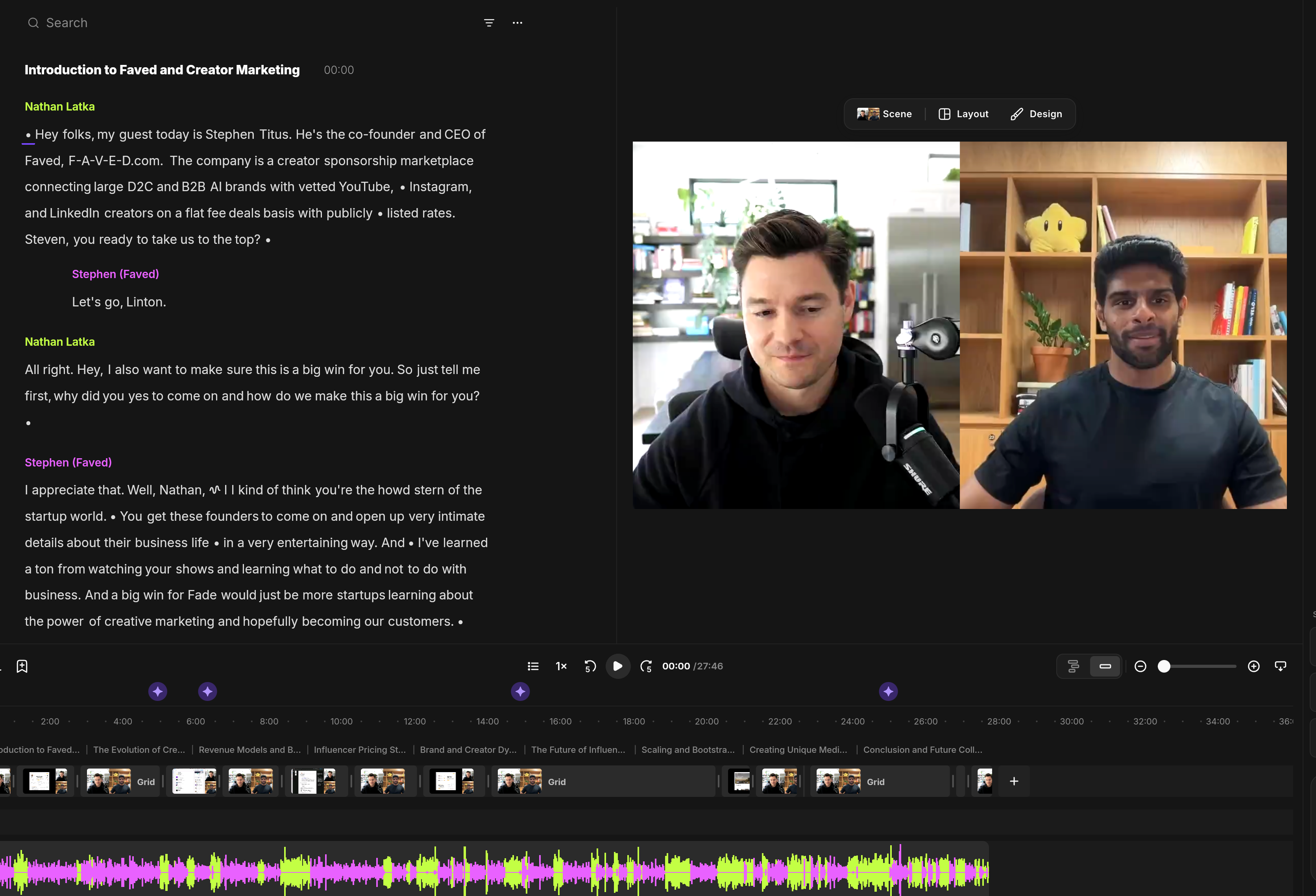
0:00Hey folks, my guest today is Stephen Titus. He's the co-founder and CEO of Faved, F-A-V-E-D.com. The company is a creator sponsorship marketplace connecting large D2C and B2B AI brands with vetted YouTube, Instagram, and LinkedIn creators on a flat fee deals basis with publicly listed rates. Steven, you ready to take us to the top?
Stephen Titus, Co-Founder & CEO
0:21Let's go, Linton.
Nathan Latka
0:22All right. Hey, I also want to make sure this is a big win for you. So just tell me first, why did you yes to come on and how do we make this a big win for you?
Stephen Titus, Co-Founder & CEO
0:28I appreciate that. Well, Nathan, I I kind of think you're the howd stern of the startup world. You get these founders to come on and open up very intimate details about their business life in a very entertaining way. And I've learned a ton from watching your shows and learning what to do and not to do with business. And a big win for Fade would just be more startups learning about the power of creative marketing and hopefully becoming our customers.
Nathan Latka
0:54Okay, yeah. So tell us more about this. You know, some people love these creator marketing. Other people say, it's a total waste of money. You look my own experience, you know, I put some money behind WAP to do like a clipping army. It was the biggest waste of money I ever did ever. However, the flip side of that is I find people like Ben Murray at the SaaS CFO, who's like a creator I know. And when I sponsor his newsletter, it works great. So I've had both experiences. What do you see?
Stephen Titus, Co-Founder & CEO
1:19I think there is a humongous void in education when it comes to creator marketing. And the first piece for brands or startups or businesses to understand is that creator marketing comes in all forms. You've got clipping, which is what you've described. That's UGC. That's a bunch of people who don't really have a trusted audience of their own making content on your behalf and then distributing it on different platforms. And then you've got the far end of celebrity partnerships, which is people who are globally recognized, have trusted audiences, that if they endorse your product, it's quite likely you will get some uptick in sales. And modern-day creator marketing sits somewhere in between these two. So I I I think of this as if you think of Vanta, Aramp, Squarespace, they've partnered with creators across YouTube, podcasts, LinkedIn that have maybe 50,000, 100,000. Followers who are tuning in to listen to Nathan about all things B2B SaaS. And if Nathan now tells me that I need to go and try the CRM or this email tool, it's quite likely I'll at least have my interest peaked. And we see hundreds of brands successfully acquire customers profitably by partnering with the right creators. Creator selection is quite important, and I think that's where Faved really stands out.
Nathan Latka
2:37And and so tell me more about your background. Like why are you uniquely qualified to build this business? Do you have some horror story or what?
Stephen Titus, Co-Founder & CEO
2:45In fact, I'd say I was part of the horror of the horror story. My co-founder Tush, who's our CTO and I, when we were at university, we launched a Kickstarter project trying to build a death watch. We thought
2:58A what?
3:00exactly as the name indicates, a death watch.
3:03Watch W A T C H. Okay.
3:05A death smartwatch that counted down to your death every single time you looked at it. And we felt that as engineers, if you know how much time you've got left to live, you'll be way more mindful about how you spend it. Are you gonna spend it
3:18yeah.
3:19with your loved ones, work, etcetera? And now clearly we had no marketing prowess and we didn't realize no one wants to really spend their life looking down at their countdown. Brian Johnson might disagree, but for most people, Death Watch wasn't really appealing. But we went to Kickstarter and we raised about $20,000, sold a few hundred units of that watch, and we ran into these micro communities on Reddit that would get behind you and rally behind you as a product, no matter what you were selling, as long as you told them that whatever niche. Itch they were trying to scratch, you could satisfy. And that opened our eyes to the idea of if you find evangelists around the internet, you can sell anything by finding the rust right customer pool. And that led us to a bunch more of failed startups and eventually got us talking to creators. And creators would tell us that: look, I'm a YouTuber, full-time the way I monetize is by getting brand deals. But brand deals is a very fragmented process. My email is publicly available, I have to sift through a bunch of junk. of fans emailing me, a bunch of scamsters emailing me. I never know which email is truly a brand dealer or not. And on the flip side, we'd go to an Athletic Greens, a Squarespace, a Nord VPN, and we'd say Guys, you guys are on every podcast and YouTube video. Surely this is no longer a problem for you. You've got a well-oiled machine. And they'd retrade the same thing, which is, no, I need a pool of a hundred new creators every month that gets in front of my right audience. I don't know how to do this systematically, apart from hiring tens of people. And even then, it's a very inefficient process.
Nathan Latka
4:55Yeah, no, this makes tons of sense. You're just to get more of your background though, I'm looking at your LinkedIn right now. Let me just share it on screen here really quick. You have sort of an interesting combination here at your, you know, FinTech little bit. Were you actually writing code or were you trading at Goldman and and BlackRock?
Stephen Titus, Co-Founder & CEO
5:09These were all internships because I realized studying engineering, I'm never going to be a great engineer. I should do something that all engineers who don't want to do engineering do, which is go into finance. And I
5:19Yeah.
5:20got into finance and I realized, okay, I'm not gonna be great at this either. I don't want spend the rest of my life here. Which is when I ran into my now best friend and co-founder and I told him, Look, if you've got any project you're working on, help me out. I just don't want to get a regular day job. And he goes, Look, I'm an engineer, I know how to build things, let's partner up and work on Star. Yeah.
Nathan Latka
5:40All I want to dive deeper on how people find creators, how do we decide what to actually pay them, how to make sure we actually get a return, et cetera. Before I do that though, I don't want to lose our audience. Let's not bury the lead here. Are you comfortable sharing what revenue is today?
Stephen Titus, Co-Founder & CEO
5:52Let's go for it. I've I've stalked a lot of people, thanks to you, so I'm happy to do the same. We will process somewhere around eight to nine million of gross bookings on the platform this year. And your follow-up question is probably going to be: what's our take rate? Because we're a marketplace. We roughly take about 15 to 20%, which will put us somewhere in the 1.2 to 2 mil net revenue range.
Nathan Latka
6:17Well, if you ever don't want to do Faves anymore, you can take over his podcast host because you pretty much know exactly what I'm what I'm gonna ask before I ask it. Okay, why is a take rate model the right way to do this business? I mean, it is how most have done it that I've interviewed in this space, but but i is that the right model?
Stephen Titus, Co-Founder & CEO
6:35To be seen, is that the right model? Hopefully I'll come back in 10 years and prove that it is. So
6:41Yeah.
6:42we as a bootstrap business realize that the best way to grow the business is align our incentives to our customers, who are the brands. And instead of if we charge them a SaaS fee, all we're gonna do is ship a bunch of features and then try to upsell as much as we can or try to sell as many seats as we can, but we'll never care about. Are the brands getting the results to your earlier point about wasting a ton of money on influences or not? We'll just care that they hire more people, buy more seats. By taking by by having a take rate model. We're incentivized for our customers to spend more money on influences month on month through us. And how will they spend more money every month is by getting more customers through those influences every month. So we design the whole platform in a way that we, of course, help them find the right creators, but ultimately we help them get the target CAC or the target ROI that they aim for.
Nathan Latka
7:35Yep. Can you do you ever consult and help train some of your public personas you work with on how to restructure their pricing model to increase the likelihood they get more brands willing to pay?
Stephen Titus, Co-Founder & CEO
7:47We work on a bunch of different factors to increase that conversion rate. It'll be everything from how do you pitch the product itself, how do you what kind of CTAs are you using, how much discounting do you apply, down to maybe even pricing. So in the age of AI today, we'll try to encourage brands to offer a different price per token or offer more credits if someone's buying through a creator link versus their landing page.
8:13Yeah, it's it's I mean, this world changing fast. Like I'm I'm approaching now year 10 of doing this podcast. And this I I haven't shared this before, but I'll share it this one. This is one of our first ever sponsor agreements. And this was the first big one, right? It was a hundred thousand, a hundred and eighty thousand per year paid up front hostgater. And it was crazy, Steven. What happened here is like I I was charging on a CPM basis, but then I said, Listen, how many leads do you need if you pay me 180 grand? And I just said, Okay, I'll guarantee the number of leads. And then I would just run as many ads across all my properties until I delivered. the CAC they needed. And they were very, very happy with this model. So I'm still trying to figure out like when I see the CPM basis in some of your case studies, I'm like, are people still, I mean, are people comfortable still paying CPM or do they really want a CPC or cost per lead or cost per new customer? You know, CAC, what are you seeing? What's popular right now?
Nathan Latka
9:02So the holy grail of marketing in itself is can I put a dollar in and get more than a dollar out? And every marketing channel promises that you can do that. And then we'll get into debates about measurement and attribution. With influencer, there are effectively three ways you can work with influencers. Either you gift them free product and hope that they talk about your service because of it and your brand because of it. Or you can offer some sort of a commission-based agreement, which is what you were describing, where for every lead that they bring in, you pay them a certain amount. That also has basically your incentive as a business tied in with them. We've focused on a third vertical of influencer marketing, which is you will pay influencers as a brand a flat fee. And in some sense, you're taking the risk of how many impressions is that gonna hit? And out of those impressions, how many conversions are you gonna get? The reason brands are happy to pay this is because we've gotten really good at mapping out how many impressions do you need to hit within a certain audience demographic in order to get a certain number of leads. If you wanna work with the largest creators in the world, a Nathan Latka might be an exception, but I suspect even you will over time start saying, Look, my my podcast is pretty valuable, my name is pretty valuable, my audience trusts me. It's not my job to get you the leads. I'm gonna shout out your brand four times, five times, and you're gonna pay me X amount. Now it's on you as a brand to go and figure out the rest of your funnel to convert my audience. The largest creators in the world, and we've mapped that there are probably about 100,000 in the world that fit this, have all moved to a pricing model of we're gonna charge per impression effectively. We're gonna charge you for the size of the audience and the quality of the audience we've built. The convergence is convergence is more on you as a brand. Frankly, that's where the opportunity for Fave lies. Is it's our job to marry the expectation of creators wanting a CPM rate and brands wanting to pay a cost per leader, cost per acquisition, and be able to match the right creators to the right brands.
Nathan Latka
11:02So how many in any given month, let's just do last month, right? July of twenty twenty six, how many creators made at least a dollar on your platform and how many brands spent at least a dollar on your platform?
11:17So last month we've probably gone closer to 30 brands having spent at least a dollar. And that would have gone to close to a thousand creators. And lifetime we've done and and the composition of 30 brands every month keeps changing because brands can be seasonal in their campaigns. We've done over 300 brands lifetime and over 30,000 creators on the platform.
11:40And gimme come on, gimme the big headline number. What's the total GMV through the platform life to date?
11:46We've processed over fifty million dollars worth of orders, over twenty thousand across over twenty thousand orders.
Stephen Titus, Co-Founder & CEO
11:56It's a that's a big budget. That's a big so your your data set is sort of growing, which is good. What would it actually look like if I let me let me actually just do it? I love doing this kind of stuff live. So if I was gonna sign up here as a brand, let me let me get in the right headspace. Let's say that I want to target founders because I have a summit coming up in Napa and I want to sell a couple more tickets. We've got a great lineup. I want to sell a couple more tickets. So I'm gonna use fav. I'm gonna go in here, I'm gonna sign up. I'm gonna say I'm a brand, and I'm gonna just I'll put in my email here. Tell me what you're doing here. I mean, you're very intentional, I'm sure about all this. What are looking to figure out in this cat in this field here?
12:32So RICP are brands who want to spend over fifty thousand dollars a month on paid partnerships. And they've either decided that it's gonna take them a few hundred K before they niche down on the type of creators that work for them, and they've also decided that influencer marketing works. So by taking them
12:52What should I pick here? What's better? A lot of small creators or two big ones?
12:57So that is more for us to assess the appetite of how much you're willing to pay a creator. So any of those works, but we wanna know combining the size of creator you want to work with and the budget, what is the total spend you intend to do?
13:12I see. I see. Interesting. I mean I
13:14And
13:15I I believe like in the future w where the where the alpha's gonna lie is actually working with a larger number of smaller creators who have more niche audiences.
13:24That's right. And a lot of LinkedIn pontification is around na nanocreators are the ones that deliver results. The truth is you need to have a mixed model where you do need to have five to ten ultra-large names legitimatize your brand and increase awareness. And then you need to also have a compounding of smaller niche communities that you've never actually worked with or tapped into that
13:49Yeah.
Nathan Latka
13:50get you in.
13:50So what's happening here? What happens now?
Stephen Titus, Co-Founder & CEO
13:53So now we get, this is our sales team that gets an inbound lead request that, hey, this brand is interested in joining the platform. And we have to actually give you an account as a brand. The reason for that being we have proprietary data that's visible to you as a brand. And we don't want that to be available across the public. We want to
14:10Yeah, yeah.
14:11that you are the right brand. We want a vet that if you're gonna send Nathan Latka an offer, you're a legitimate brand, and Nathan's not gonna get upset that Faith sent him this $1 offer.
Nathan Latka
14:21Well, Steven, I mean, it's that, but also there used to be someone in the space called paved dot com that I used to use, but they would publicly disclose they were email marketing newsletter, you could find where to sponsor them. They'd publicly disclose how big the newsletters were, what the average CPC was. And I know people would just go scrape the site and then go around paved. It destroyed the whole marketplace model. So part of your reasoning to having a gate like this is you need to make sure also that you can deliver more value by making sure you help can facilitate you can facilitate the relationship and track the spend.
Stephen Titus, Co-Founder & CEO
14:50Correct. Yeah. And what we're also trying to do is sorry, Nathan. Give me a sec.
14:55You're good on the the background noise is fine, we can edit that out, it's no problem.
Nathan Latka
14:58Okay, cool. What we're also trying to do with brands is show them that we can pick the right converters for you. In order to pick the right converters for you as a brand, we need to make sure that they're the creators have some sense of trust on the platform. So, yeah, we don't want their information being publicly shared. We don't want them to be disturbed by bad brands. And we also want creators to respond super quick. Speed is very critical in influencer marketing. And they're only gonna do that if they feel that you're serious about working with them. You're not gonna waste the time their time. And so doing this vetting process when someone submits their information on our landing page helps us only work with the brands that we know that in three to four months are gonna be covered all around Spotify, podcasts, or YouTube.
15:42Mm-hmm. Do you all the brands on your platform today, do you have to go personally, sorry, the creators, do you personally go recruit them? Or if brand comes to you and says, I need to find a thousand hippies in Austin, will you say, of course we have a thousand hippies in Austin and then go quickly find a thousand hippies in Austin to add to your platform?
Nathan Latka
15:58Yeah, that one might be an easier one to get, so it wouldn't be that difficult.
16:00Yeah.
16:02We part of the power of the 30,000 creators on the platform is we've seen which brands they already work with, and we can in most cases already satisfy the appetite of any brand that comes on the platform for the first few hundred creators they want to work with. That means that for the first two to three months, we already have most creators that are branding specs. Now, if you do want a super niche audience, say you want knitting creators who live in Australia that also love B2B SaaS, that our creator team is pretty good at onboarding the number of creators you want, but it'll take about seven to ten days to get there. And we
16:35Mm-hmm.
16:35do have to go out and reach out to these creators manually, build relationships with them and their talent agents in order to get them on the platform.
16:42Mm-hmm. Mm-hmm. Interesting. Okay. Give me more. We have about four or five minutes left here. The backstory, the first sign of code for the platform, your first partnership, when was that launched? What year?
Nathan Latka
16:52two thousand twenty two.
16:54And do you remember how much revenue you did that year?
Stephen Titus, Co-Founder & CEO
16:56We that year we just about processed a million dollars in total GMV and I think we might have scratched a hundred K in revenue.
Nathan Latka
17:05Okay. And what about next year, twenty twenty three?
Stephen Titus, Co-Founder & CEO
17:09Twenty three think we went to about two million or one point eight million in GM V and probably grew revenue by about forty to fifty percent.
17:19Okay. So like hundred and fifty, two hundred K of of real revenue. And then you obviously scale to eight to nine million of GMV today. Did you bootstrap this? I mean, how are you surviving off such low revenue for more than twenty four months?
Nathan Latka
17:30We we've bootstrapped entirely and we we believed that if we cross a critical mass of brands and total spend, we'd be able to use revenue to keep growing the business, and that's proven right.
17:42If you know Tyler Denk came on and did a really good interview on the show, if Beehive reached out and offered to acquire the company for ten million bucks all cash, do you take the deal?
Stephen Titus, Co-Founder & CEO
17:53Sadly at 10 milliO cash we wouldn't. We'd be looking at an order of magnitude higher. And that's
18:00How old are you, Steven?
18:02I just turned 30 last year.
18:04Come on, you don't want a ten million dollar paycheck on your th on your thirty first birthday? You wouldn't take it?
Nathan Latka
18:08I feel that with influencer marketing, the industry is gonna grow ten X in the next decade for sure. And if we just keep our head above water and Whenever the economic downturn comes about, we survive as a business. I've looked at every other advertising channel, whether it's radio, TV, digital marketing, media buying platforms, obviously we're tied with economic waves, but if you survive, there will be four to five really large players that let people buy creator ad spots. If we're one of those, even a few hundred will probably look like a bargain.
Stephen Titus, Co-Founder & CEO
18:43Mm-hmm. Are you Founder Path? We're always thinking about new ways to connect with founders. Something that unexpectedly worked. I didn't think it would work because I just started saying, Hey, if you're in San if you're in Austin and you're a founder and you play Catan, come to my house. We're playing katan tonight. Well, it took off. Like I was expecting, we'll get five, six people. No, we're like 60. So now it's like seven boards in that. And then I said, Let me do it with chess and let me do it with poker. And I'm Well, it's bringing in the right audience. You have thirty thousand creators on your platform. Aren't you in a very unique position to be able to launch your own media properties like the conference for hippies in Austin? Because you already have all the all like you can basically invite the brands plus the influencers. They're all at the conference and facilitate deeper relationship building there.
19:27Absolutely. One of the exciting aspects of creator pools is that you can use creators to raise money, to form some sort of a syndicate and raise money. You can use creators to obviously acquire customers. You can use creators to acquire employees even. There are 15 to 20 different verticals, including launching your own media properties that you can do having creators overlapping. We feel that if we just focus on enabling advertisers to tap into creators as advent inventory, we'll build a mega business. But there's as simple as it seems, you're matching a buyer and a seller, there's a ton of infrastructure work to be done. And I think it would be distracting for us to do anything apart from just getting supply and demand and connecting the two.
Nathan Latka
20:11Would you would you ever consider something? I mean, so you know, I think about like Allen and company, their Sun Valley Retreat. Like we're basically doing that. We we buy this ranch in Napa Valley out every year, right? There's fifty rooms. It's like a beautiful sort of vineyard situation. This is what it looks like, right? And right here next to the lavender pool, next to the lavender lawn, we want to have like a media area, sort of like at Davos UC CNBC with a little thing. So we want to find creators like YouTube hosts that focus on founders and let all the incredible founders that we have coming, you know. Alex with a hundred million of revenue, a cool with forty million of revenue to just go through basically the creator booth. So it's value to the creators, it's value to our founders, and it's also value to our brand. But I don't have time to do all this. I'd rather just cut you a blank check to do it. Is that something you'd be interested in?
20:55As fav, would we be open to hosting a meeting?
20:57Yeah, like is that something you would effectively do? We pay creators to show up and then we get them excited by saying we're literally gonna give you a lineup of rock star talent to feature on whatever media property they're big on, whether it's Instagram, YouTube, whatever.
21:10Absolutely. One of the things we do is we're constantly looking to talk to more creators and share their stories. And TBPN are probably the best example of now doing this for the startup AI world. We'd gladly do that because it it directly benefits us as well.
21:24Yeah, interesting. Okay, let's talk more about that. I think that's a really interesting way to add life back to these boring, dead ass business conferences we all hate going to.
21:33A hundred percent. And look, this is one of the reasons why you as a creator I've I've been following for a long time is because SAS is perhaps the most boring feel one can think of. And somehow you've made it contentious. Somehow
21:47Yeah.
21:47you invite these people on. You would think
21:49It's tricky.
21:51you would think that people have these numbers. cold in their head and they're able to spin it however they want or they're able to deflect however they want. But it's interesting. It's interesting to watch a host push back and go, no, that's GMV, that's not net revenue. And I think there's more work to be done on that front.
Nathan Latka
22:06I don't always love people have this mistake about me if they don't meet me in person. They think I'm just like an asshole and I just want to collect data and numbers. What I actually found though is like your podcast just won't get views unless there's something you're known for. And it became sort of the data podcast, and we leaned into that. But to your point, like, man, media is so interesting. And the best media is really connecting these great creators with brands that are typically more boring. so we'll have fun. We just acquired actually SASDOC, the the you know, 30,000
Stephen Titus, Co-Founder & CEO
22:33no.
22:34attendees. Yeah, founder path my fund, we just acquired this. So like we're gonna be thinking about all kinds of interesting ways to add media to these experiences. And so we'll have to do more together. I will we'll follow up after the podcast and see what happens.
22:45Always open to ideas. We just this year started doing a bunch of marketing activities and I think that we've learned being an influencer marketing, we have to be entertaining ourselves. So always open to chat.
22:56Awesome, Steven. All right. Hey, this is good stuff, man. If people want to follow you online, where can they find you?
23:01Search my name on LinkedIn, even better, search for Faved on LinkedIn or Instagram. I'll guarantee you the team will entertain them.
23:07All right. And what'd you think, man? You've listened for a while, we're wrapping up. Is it what you expected?
Nathan Latka
23:12It's almost exactly as I'd expected. And I appreciate you having me on because I in some sense feel indebted to you. And it's difficult to describe. I feel that I've learned about my personal curiosity on businesses. I love if someone can just open up their numbers and teach me what's working, not working. But also I think it gives me some sense of just balancing of my own business. I think about what are the what are the mistakes I've heard people talk about? How should we position our business for growth, but also enterprise value? So thank you for having me on and I I look forward to doing more of these.
23:44Course, man. That's the little secret just between you and I. The reason I've been able to do like 3,000 episodes and people say, Nathan, how are you not tired? It's because I would do it if no one listened. I learned so much from every founder. I'm like blessed every day. I have eight back to back today. I mean, I'm just literally learning back to back. It's just incredible. So thank you and your time for coming on. You're the one in the arena. You're the one building. And guys, again, if you want to go check out Fave, check him out. Launched in 2022 with a million bucks of GMV, 100K of revenue for themselves. We'll call it gross profit in the marketplace model. They more than doubled that in 2023. Now, fast forward to today in 2026. Steven and his co-founder did eight to nine million bucks of GMV this year. They take between 15 and 20 percent as they're connecting brands to influencers and creators. That means they'll do about 1.2 million net revenue or gross revenue to themselves. They'll Any any given month, they'll work with 30 brands that spend at least a dollar on their platform and they'll then pay out up to, you called a thousand creators making at least a dollar each month. Lifetime to date, they've processed over $50 million in brands sponsoring these creators. And hopefully that, you know, will add zeros to that over the next couple of years as Steven keeps coming back on. They've done this all a hundred percent bootstrapped. Check them out at faved.com. Steven, thanks for taking us to the top.
24:54Thank you so much, Nathan. Appreciate it.
Nathan Latka
24:56All right, Steven, what'd you think, man? You have fun?
Stephen Titus, Co-Founder & CEO
24:58I had a ton of fun and you are very good at this because I think it's easy to make this monotone. I don't know how you prepare the questions. You mentioned eight back to back. I have no idea how much contact switching that requires. But I'm jealous in some sense. I genuinely my friends hate me for this because when I meet friends of friends, I'll sit them down and I'll go, tell me about your business, tell me your numbers. And it's uncomfortable.
25:18Yes. Yeah, yeah.
25:20Especially if you're a VC funded, it's uncomfortable because you want to control the narrative and I get that.
Nathan Latka
25:24Totally. Where are you based, by the way? You're London?
Stephen Titus, Co-Founder & CEO
25:27We're in London, but we're all we're in the US at least once a month now.
Nathan Latka
25:30Okay, cool. We have a huge event in May in London. We'll have 2,000 founders. Like I'd love to figure out how to do more with you. So maybe think more about what I propose. Like I I I'm serious. Maybe we do it at the London event so that you don't have to travel with your whole team over here. But if that's a model that you're interested in, we would propose something to me. I'm open to paying to have you manage that.
Stephen Titus, Co-Founder & CEO
25:47I'd love to. let me shoot you an email. I think I took your email when we were DMing on LinkedIn. If not
Nathan Latka
25:53Yeah, it's Nathan at I'll I'll date DM it to you right now, but it's Nathan at founderpath dot com.
Stephen Titus, Co-Founder & CEO
25:57Yeah, that'd be great. I'd love to do that. I also noticed you have a second YouTube channel where you go and interview these business owners.
26:03Dude, I'm having so much fun on this thing. Nobody knows about it. In my SaaS world, nobody knows about this other thing, but it is so much fun.
26:11It's almost diametrically a different customer segment you've or business segment you've gone for.
26:15It's because my fund we've I've started investing in non-SaS. So I need to launch a new property. I'm like, do I have it in me? Can I actually start from zero in a brand new segment with and sure enough, like we are I mean, look, some of the episodes flop, right? That's to be expected. But others, like they've gotten like a hundred and eighty thousand views.
26:32I was I I did see that and I made a note in my calendar to ask you about it. If you want if you are taking sponsorships on there, I'm pretty sure I can get a bunch of brands. They'll
Nathan Latka
26:40We haven't even like let people know about it. So yeah, if you bring me someone, we we can get really creative with featuring them. I just we won't do a lot of brands. We would prefer to work with one over a long period, like do a small test with them. But again, like some of these, like this one, it's like a hundred and seventy one thousand views. It's insane. We only have eight thousand subscribers.
26:58Yeah, you've I mean, this is a category of channel that works really well. There aren't enough of them that get to scale. So we have a ton of B2B brands that'll be open to sponsoring it. I know just based on numbers, they'll probably offer a few hundred dollars per episode. I don't know if that's even worth you or your
Stephen Titus, Co-Founder & CEO
27:14Yeah, yeah. Because what happens you start the relationship right and then they get addicted and then you can scale from there. So yes, I won't say no to anything. Like propose something fair and let's talk about it. Shoot me an email.
Nathan Latka
27:22Cool, I'll do that. you sent me the emails
Stephen Titus, Co-Founder & CEO
27:27I let me get it to you on LinkedIn really quick. Boom.
27:33Perfect. Yeah.
Nathan Latka
27:34on the deal YouTube. Cool. All right. I'll wait to hear from you, man. All right. Thanks for coming on. All right. See ya.
Stephen Titus, Co-Founder & CEO
27:40Sounds good and thank you so much for doing this. See ya.
27:44Bye.