
Each Tuesday, we reverse-engineer a real SaaS company's revenue, profit, CAC, funnels, and its top growth tactic.
Sign up to access all features
Sign up with GoogleSign up with LinkedInAlready have an account? Log in
GetLatka is trusted by 200k+ founders, researchers, and marketers.
No contracts, cancel at any time
Founder Interview
Company Metrics at Interview Time
Revenue (Annualized)
$40M
Revenue at LBO
$30M
Valuation
$100M
EBITDA
$10M
EBITDA Margin
25%
Historical Snapshot
These numbers were reported by Sevan Marian during his interview with Nathan Latka recorded in July 2026 and represent a historical snapshot of Fleet at that point in time, not current figures. See Fleet’s current numbers.
| Metric | Value | Source |
|---|---|---|
| Revenue (2019) | $1.5M | Founder interview, July 2026 |
| Revenue (2020) | $3M | Founder interview, July 2026 |
| Revenue (2021) | $8M | Founder interview, July 2026 |
| Revenue (2022) | $10M | Founder interview, July 2026 |
| Revenue (2023) | $8M | Founder interview, July 2026 |
| Revenue at LBO (Feb 2026) | $30M | Founder interview, July 2026 |
| Revenue Annualized (2026) | $40M | Founder interview, July 2026 |
| EBITDA | $10M | Founder interview, July 2026 |
| EBITDA Margin | 25% | Founder interview, July 2026 |
Fleet grew from $1.5M in 2019 to $3M in 2020, then surged to $8M in 2021 on the back of post-COVID startup hiring. Revenue reached $10M in 2022, dipped back to $8M in 2023 as the European tech ecosystem contracted, then accelerated sharply with 60% growth in 2024 and 90% growth in 2025, reaching $30M at the time of the LBO in February 2026 and $40M annualized by mid-2026.
Fleet has managed over 50,000 devices across its lifetime and now operates in 20 countries across Europe and the US. The company started exclusively in France and launched Spain as its first international market in 2022, using that success to drive a broader internationalization push from 2023 onward.
Fleet employs approximately 50 people as of mid-2026. During the 2023 downturn, the leadership team was significantly restructured, with roughly half of the leadership replaced to improve talent density and align with the new growth strategy.
Fleet remained profitable throughout its history, including during the 2023 revenue decline, and generated close to $10M in EBITDA annually by 2026 at a 25% EBITDA margin. The company took no outside equity capital for seven years, completing its first transaction in February 2026 as a $30M secondary LBO at a $100M valuation, with approximately two thirds in equity and one third in bank debt.
Fleet sells 24 to 36 month device rental contracts and immediately resells those contracts to a bank, which pays the full contract value upfront minus a 10% rate. This makes the business cash flow positive from day one and eliminates inventory risk, credit risk, and the need for working capital to fund growth.
After proving the model in France, Fleet launched Spain in 2022 and used the success there to accelerate expansion into 20 countries. Reducing dependence on a single market was a deliberate strategic response to the 2023 downturn in the French tech ecosystem.
During the 2023 reset, Fleet invested in adding more software and MDM cybersecurity capabilities to its platform to attract larger enterprise customers and reduce dependence on early-stage startups that were most affected by the hiring slowdown.
Fleet granted equity to employees and, at the LBO, allowed 100% of vested shares to be cashed out regardless of whether the employee stayed or left. This created a concrete liquidity story that Sevan uses to attract senior talent, and the new 5% ESOP pool at a $100M base gives employees a credible path to further gains.
Fleet works directly with suppliers who deliver devices to clients, avoiding warehouse inventory risk. At end of contract, Fleet buys back devices from the bank at a nominal amount, refurbishes them, and resells to the secondary market, adding a margin layer beyond the initial rental contract.
“Yeah, so we did a first, we did the LBO. So we get some capital, but it's only secondary. So me and IcoFounder, we sold shares, but we didn't bring money inside the company because in the beginning we are profitable and we do almost not far from 10 million EBITDA per year. So the company doesn't need outside capital. Our revenue is almost 40 million revenue annualized today. And when we did the LBO, it was around 30 million.”
“We went from zero to 40 million revenue from one country, France, to 20 countries today in Europe, but also in the US. And yeah, we're very proud of our story.”
“Yeah, first year we did 1.5 revenue. Second year, we did three. And we had a huge growth in 2021. So we went from three to eight in 2021. So it was post-COVID.”
“We grew 60 % year on year in 2024, and then 90 % year on year in 2025, which is huge. And this year, I think we are around 40 % growth year on year. So we are still growing a lot.”
“I think what's difficult and for your audience, think it's something that they really need to focus on is being able to make difficult decisions. let go people and do what's right for the company, regardless how difficult it is to make the decision or regardless the history you have with people.”
“We allowed everyone including. So usually LBO, what happened is that the investors, as a traditional LBO, the investors, they say that people that stays after the LBO, so that re-engage for a new cycle, they shouldn't be able to cash out 100 % because they want them to be skin in the game. I don't think it makes sense. What makes sense, I think, is to allow everyone to cash out 100 % to make everyone happy.”
“The fact that it's a 36 month contract allows us to resell the contract to a bank. And the bank will pay us upfront for the total value of the contract. So we buy the computer, but we get the full value of the contract upfront, which allow us to make our margin and our profits from day one.”
This interview captures Fleet at a specific moment in July 2026, when the company had just completed its first outside capital transaction and was tracking $40M in annualized revenue. The numbers and strategy described here reflect what Sevan Marian reported at that point in time and may not reflect Fleet's current scale, team size, or market position. For the latest figures, visit Fleet's live company profile on getLatka.
View Fleet’s current profile and metrics| Valuation |
| $100M |
| Founder interview, July 2026 |
| LBO Secondary Total | $40M | Founder interview, July 2026 |
| LBO Equity Portion | Two thirds of deal | Founder interview, July 2026 |
| LBO Debt Portion | One third of deal | Founder interview, July 2026 |
| Bank Debt Raised | 50M euros | Founder interview, July 2026 |
| Investor Equity Stake | 25% | Founder interview, July 2026 |
| New ESOP Pool | 5% | Founder interview, July 2026 |
| Year-on-Year Growth (2024) | 60% | Founder interview, July 2026 |
| Year-on-Year Growth (2025) | 90% | Founder interview, July 2026 |
| Year-on-Year Growth (2026) | 40% | Founder interview, July 2026 |
| Devices Managed (Lifetime) | 50,000 | Founder interview, July 2026 |
| Countries Operating | 20 | Founder interview, July 2026 |
| Team Size | 50 | Founder interview, July 2026 |
| SaaS and MDM ARR | 1M euros | Founder interview, July 2026 |
| Bank Financing Rate | 10% | Founder interview, July 2026 |
| Basic Bank Debt Interest Rate | 3% to 4% | Founder interview, July 2026 |
| Higher Leverage Debt Rate | 6% to 8% | Founder interview, July 2026 |
| Max Debt Leverage on EBITDA | 5x | Founder interview, July 2026 |
| Year Founded | 2019 | Founder interview, July 2026 |
“And this is a little part of our revenue. It's around 1 million RR today. So it's not so much, but still, it allows you to have more stickiness also with our clients.”
“When you're profitable, you can raise until 5x your EBITDA on debt. So it's not only, I mean, there is different level of debt. So the basic debt, the bank debt at 3 % or 4 % interest rate, you can go up to 2x your ABDA on this.”
“The new pool is a 5 % pool. I think it's enough at 100 million valuation. The idea is to go to almost, I mean, at least 300 million and maybe 500 million in the next five years.”
Nathan Latka
0:00Hey folks, my guest today is Savon Marion. He's the co-founder and CEO of Fleet.co, a Paris-based IT device management scale up. He started in twenty nineteen with co-founder Alexandre. He bootstrapped the company for seven straight years to a hundred million valuation before taking his first outside capital in early twenty twenty six. Savon, you ready to take us the top?
Sevan Marian, Co-Founder & CEO
0:21Yeah, perfectly. Thank you. Thanks for the invitation.
Nathan Latka
0:22I'm you bet we have a mutual friend and and Shaw and Guillaume at Lemmlist and they said great things about you. So excited to feature. It sounds like Paris is just spitting out like bootstrapped, capital efficient founders. What's going on over there?
Sevan Marian, Co-Founder & CEO
0:36Yeah, well, I mean, the ecosystem in Paris, the fundraising ecosystem is not in the best shape those days. We've had great years in 2021, 2022. But now, if you remove the big AI companies like Mistral AI, fundraising of more like classic startups are... I mean, it's not going very well, but we have great bootstrap stories, including ours and them list, of course. So yeah, I think we have a culture of bootstrapping in Paris.
1:12We'll jump deep into your product in a second, but I also don't want to bury the lead. Are you comfortable sharing what you guys grew revenue to before you first your first before you took your first dollar of outside capital?
Sevan Marian, Co-Founder & CEO
1:23Yeah, for sure we have no hidden numbers now so we can tell everything.
1:29What's that what was that number?
Nathan Latka
1:31Yeah, so we did a first, we did the LBO. So we get some capital, but it's only secondary. So me and IcoFounder, we sold shares, but we didn't bring money inside the company because in the beginning we are profitable and we do almost not far from 10 million EBITDA per year. So the company doesn't need outside capital. Our revenue is almost 40 million revenue annualized today. And when we did the LBO, it was around 30 million.
2:04Okay. And when was it LBO?
2:07It was six months ago.
2:10Okay. So February twenty twenty six.
2:12Yeah.
2:14And when most Americans hear LBO, they think like private equity like leveraged buyout. when you use the word LBO, you you really mean a secondary, right? You guys sold a second did a secondary round.
Sevan Marian, Co-Founder & CEO
2:24Yeah, only secondary round we took. So it's an LBO because we brought an investor that obviously took equity of the company, a minority stake of the company, but we also took bank loan, bank debt. So yeah, the definition of LBO is when you do a round with some equity, but also it includes also some debts, some traditional bank loan.
2:50How much of the thirty million LBO was equity versus debt?
2:53I think it was like two thirds of equity and one third of debt.
2:58Okay. Okay. We'll have to come back to that. I I I don't wanna go too deep on the numbers before we learn about the business. So let's go into the business here for a second. Tell us what you're selling here as I share your website.
Nathan Latka
3:06Yeah, so we are a platform for IT procurement and management. It means that we manage the entire IT lifecycle for companies everywhere in the world. So if you're a company that grows, that need to hire people in your country, but also outside because you have people that work remotely or several office in different countries, you can procure, secure and manage all your IT device, computer, phones, tablets. with our platform. So we centralize and simplify IT management for growing companies and international companies.
Sevan Marian, Co-Founder & CEO
3:44Where tell me more about your background. Where'd you come up with this idea?
Nathan Latka
3:48Yeah, so me and my co-founder, met at Rocket Internet. It's a European startup studio back in 2012. It was one of the biggest startup studios in Europe. And they had a lot of successful ventures. And we worked in North Africa. We launched a kind of Amazon for Africa called Jumia that is already today listed in the New York Stock Exchange, Jumia Group. So we met there when we were young and we learned how to build business thanks to this experience. So it was not our company, we were like employees, but we had to grow the business ourselves. So we met back in those days, we went back to Europe, we had some managing director experience in different startups and we realized... during those experience that IT management was a little bit of chaos for SMBs and startups. So most of the time SMBs, startup, they were buying computers directly with Apple or on Amazon, which is quite costly first. Plus when there is issues, you scale, you have a lot of issues because you behave like a traditional customer, you don't have services included. So we came up with this idea of... creating this device as a service solution fleet to help companies to procure, manage their IT in a monthly subscription. So instead of buying a computer for 2000 euro, you will rent computer for 50 euro per month. This is what we do. And you have the whole service included, so guarantee platform to manage and secure your IT. So we came with this idea based on our own experience as a startup leaders. We launched this in 2019 and we immediately had success, product market fit, so it grew very fast. And we realized that we had a very efficient business model. So we were both profitable, but we were also cash flow positive. That is very important because when you don't need working capital to grow, then you can grow without external funding. Not only profitability, but also cash flow is very important. And so along the way, we realized that we didn't have to raise funds and we were able to grow without self-funding. And so, we went from zero to 40 million revenue from one country, France, to 20 countries today in Europe, but also in the US. And yeah, we're very proud of our story.
Nathan Latka
6:30That's a hell of a story. Give me more of the growth story. So tw you make it sound so easy. Let me break it down for my audience. Twenty nineteen, you get going. What did you finish first year revenue? Do you remember?
Sevan Marian, Co-Founder & CEO
6:39Yeah, first year we did 1.5 revenue. Second year, we did three. And we had a huge growth in 2021. So we went from three to eight in 2021. So it was post-COVID. You remember post-COVID, it was almost a bubble in the ecosystem. So our clients, that was a startup scale up. were fundraising, a lot of... raising a lot of capital, growing a lot, so taking a lot of computers for the new joiners. So it was a huge year for us. And then 2022, we stabilized a little bit. And in 2023, we decreased the revenue from 15%. So we had a tough year in 2023.
7:25Where did it go?
Sevan Marian, Co-Founder & CEO
7:27Yeah, so it was a difficult year because the whole ecosystem was broken, especially in France, but in whole Europe. So a lot of companies were laying off employees, so giving back the computer to us. So it was difficult environment. I think the hiring in the ecosystem decreased by 70%, which is huge. So in this very bad market, we did only minus 15%. So it was okay. We stayed profitable, but it was a good year for us because it allowed us also to work on our product, to reinvent ourselves, to focus on what works. At this time, we launched our first outside country in 2022, Spain. And we realized in 2023 that Spain was working well. Internationalization for us was working well. So we refocused. our effort in growing in more markets, be less dependent on friends, work on our product, add more software dimension to our product, more cybersecurity dimension to attract bigger customers, less dependent on fundraising. And yeah, it helps us a lot. And then from 2023 to 2020 to today, 2026, we scaled a lot. We grew 60 % year on year in 2024, and then 90 % year on year in 2025, which is huge. And this year, I think we are around 40 % growth year on year. So we are still growing a lot.
Nathan Latka
9:07You think you'll grow forty percent this year? Yeah. So take me I I like vulnerability is obviously critical. I mean, right, you you have this great story looking back, like you always knew you were gonna be successful. But I I I just wanna get in your head a bit more during those down years. So when you say you were eight million peak in twenty twenty one, then twenty twenty two you said, quote, you stabilized around maybe eight million, and then twenty twenty three you declined by fifty percent. Does that mean you went down to about four million of revenue in twenty twenty three?
Sevan Marian, Co-Founder & CEO
9:09I think so, yeah. No, 15, 15. So we went eight in 2021. I think it was 10 in 2022. So it was we were growing, but not a lot. And then we went down to eight again in 2023. So hopefully we were still profitable. So it was not so difficult for us, but still, you know, it's difficult because you know what happens now, like in startup, when you grow, everybody is happy. You don't have any issues like, you know, it's
9:35one five.
Nathan Latka
10:02Everybody is happy. Everybody is good. And when you start having tough numbers, no problem arises, no issues arise. You have issues with people. People are not happy. So we had to change, I think, almost half of the leadership team by this time and to rebuild on a new leadership team, on a new strategy. So it was not easy. We had to make tough decisions. But hopefully, the company was not at risk. It was just that you to grow as a company. So even if you're not at risk in terms of going bankrupt or whatever, when you don't grow, you always have issues that arise. So it's not a good time to face. But it allows us also to refocus on what matters and also to increase the talent density in the company, to change some people. And I think it was a good decision that would make to improve the next phase.
Nathan Latka
11:04A lot of my audience watching right now is pivoting to AI and maybe they're experiencing temporary flatness in their revenue or even slight declines. And they have, you know, Slack messages from employees going, Are my options still in the money or not? Maybe they're having some turnover. You actually went through this. So what were you saying to those new folks you were recruiting to your leadership team who, when they said, Okay, I'm ready to join, but let me see your PL first, they see the revenue decline, they still decide to join. What were you telling them?
Sevan Marian, Co-Founder & CEO
11:30Yeah, I think so. Hopefully we were going abroad, opening new markets. So we had a good story to tell. Okay, we decreased, but it was a very difficult and challenging environment. The market is going down, but we have other levels to grow, including going to new markets, going also up market in terms of size of companies we want to target. So we had a clear strategy in mind. Also we gave equity to people, which is also a very good thing to attract talent. So when we did the LBO, we allowed all our employees to cash out 100 % of their equity, which is also a great story. So our employees cash out several million euros. We have very young employees that became rich thanks to our LBO. And it's also a great, great thing to attract talent because now when I need to attract a huge talent, I I tell this story of your equity is not bullshit, People cash out and so it's real paper, it's real money. So yeah, mean, we use all those levers to attract people, new people, but yeah, also I think the most difficult is not to attract talent, I think, as a founder. mean, you have to, of course it's difficult, but when you're a founder, usually you're able to sell your business. if you have to sell your business to investors, to clients and to of course, a new joiner. But I think what's difficult and for your audience, think it's something that they really need to focus on is being able to make difficult decisions. let go people and do what's right for the company, regardless how difficult it is to make the decision or regardless the... the history you have with people. think what's like make great founders is their ability, their courage, their boldness of making difficult decision, especially regarding people and be very, very tough on talent density, culture inside the company, meritocracy. Because when you start letting people, average people inside the company and you don't make those decisions, then everybody in the team, things that finally there is not so much meritocracy because when they see people being average that don't get penalized for it. So for me I think it's very important in difficult times to be able to make those decisions.
Nathan Latka
14:08And so just some quick rapid fires here, just so we can get the full context. You know, February twenty twenty six, you know, today, how many folks are full time at the business?
Sevan Marian, Co-Founder & CEO
14:16I think we are around 50, 50 to 60 people.
14:20Okay. And when you did, you know, February twenty twenty six, you passed thirty million of revenue. You also do the thirty million LBO at that time point. Did a hundred percent of that money go out to either early employees or founders, or did some of it stay on the company balance sheet?
14:31Yeah, no, % of the money went out. It was only cash out.
14:38That's awesome. Yeah. So you're you're telling your folks, listen, your options have real value. You don't have to wait 30 years for maybe when we IPO. So here's my second question on that. When you pass 30 million of revenue in February this year, 2026, and you do the 30 million LBO and you email all your employees who have some amount of options, how do you write that email so they understand how much they can sell? Can they sell a hundred percent of their vested shares? Do you accelerate unvested shares? Like how did you structure that?
Nathan Latka
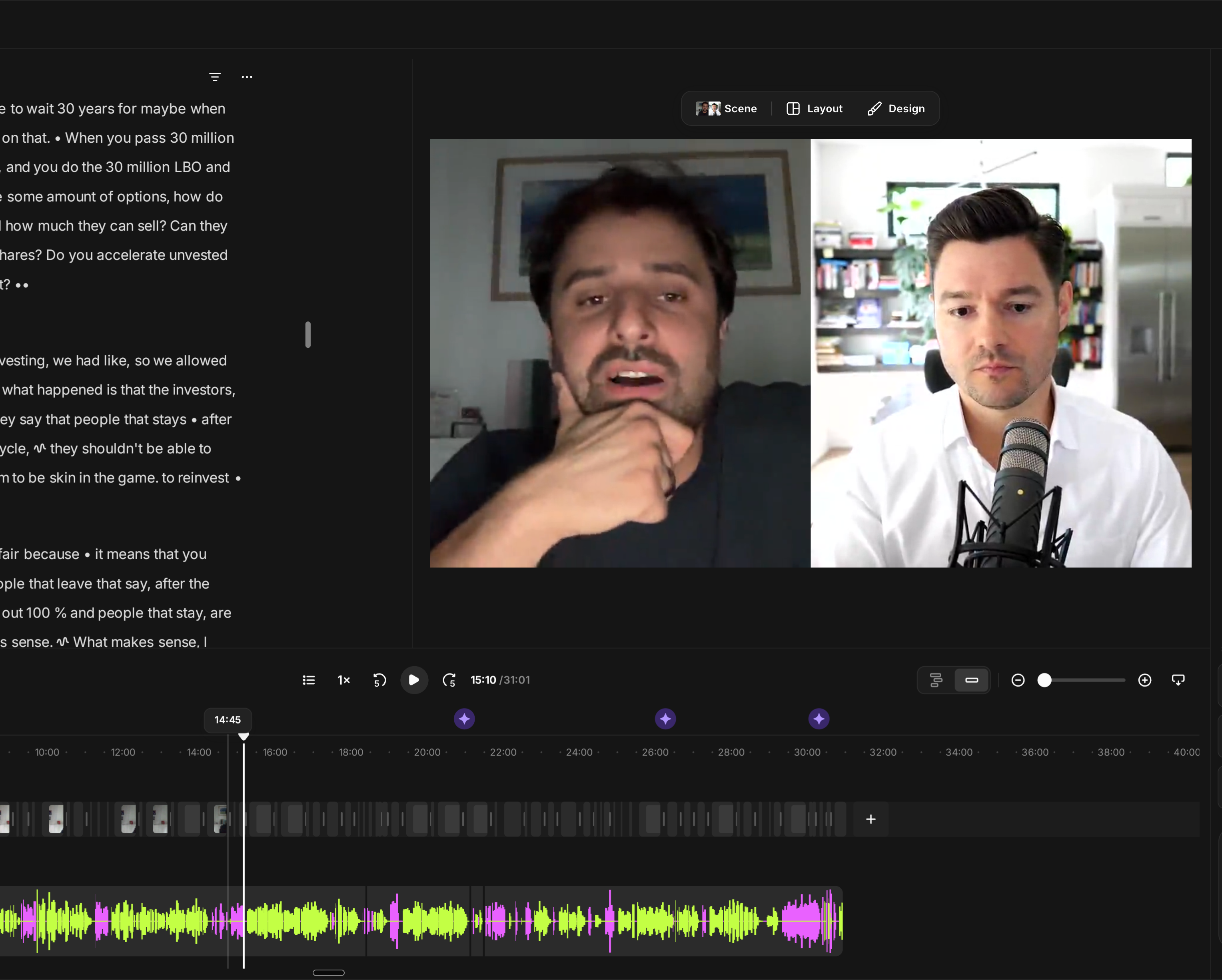
15:04Yeah, so we didn't have accelerated investing, we had like, so we allowed everyone including. So usually LBO, what happened is that the investors, as a traditional LBO, the investors, they say that people that stays after the LBO, so that re-engage for a new cycle, they shouldn't be able to cash out 100 % because they want them to be skin in the game. to reinvest almost half of their shares, into the new cycle. I think it's very unfair because it means that you penalize people that stay with you. People that leave that say, after the LBO, I want to leave. They able to cash out 100 % and people that stay, are not able to do it. I don't think it makes sense. What makes sense, I think, is to allow everyone to cash out 100 % to make everyone happy. And then the one that stays, you do a new equity plan for the next cycle. So this is exactly what we did. It was very, very appreciated by the team. I think it's a huge mark of trust also as a founder to do this. know, like, trust you. I owe you to cash out 100%. You will make money, but I trust you being still motivated for the next cycle. This is also my case, you know, I cash out a lot of money, but I still, I stay CEO of the company and the investors, they trust me to be re-engaged for the next cycle and still motivated. And also I don't know what it would be different for employees. So I think it was a big move that we did, a big sign of trust. And I think today we have people even more engaged now because they see that, yeah, we trust them. And the good thing also with LBO is that it's the money, I mean, like when you engage in the LBO cycle, it's every three to five years, because the investor that goes in wants to go out after maximum five years. So you also tell your employees, hey guy, man. We are almost sure that we'll have a liquidity event in the next five years. Unless the company goes almost bankrupt, there will be a liquidity event. So people are also happy to be in this circus of LBO because they know that there is liquidity and that they will be able to make money on a regular basis.
Nathan Latka
17:18When you did the thirty million raise earlier this year, as you passed thirty million of revenue, what valuation did you raise at?
Sevan Marian, Co-Founder & CEO
17:23100 million valuation.
17:25Post money.
17:28There is no post money because there is no money in the company, know, so it's free or post money is the same No, because so I think the total amount we cash out is almost 40 million and We had around 20 like a little bit less than 30 million in equity and a little bit more than Yeah, almost almost 15 million in debt so
17:32So they bought thirty they bought thirty percent.
17:57Yeah, I mean, I cannot share the exact, exact number, but more or less, yeah, the investors, get, you know, one fourth of the company, something like that, 25 % of equity. Yeah.
Nathan Latka
18:06Okay. Okay. So if we look at the and then I guess some founders watching, they're maybe in your same shoes, they're wondering wha what do they have to reset their ESOP pool in if they bring in one of these growth equity investors that do a big secondary. So did you recreate like a five percent, a ten percent, a thirty percent ESOP pool, or what's that look like?
Sevan Marian, Co-Founder & CEO
18:23So the new pool is a 5 % pool. I think it's enough at 100 million valuation. The idea is to go to almost, I mean, at least 300 million and maybe 500 million in the next five years. So I think with a 5 % pool, you have more than enough to make people happy with the money they will be able to make.
18:27Okay. And let's sh let's shift back to the the business model here. So you mentioned early on, like I we just got your revenue story for all the way back in twenty nineteen. You said you didn't need to raise outside capital, but let me just make sure understand something. So let's say your first customer ever, right? They're renting a MacBook Air 13 inch with an M3 chip, right? And you're charging them fifty, nine ninety a month. Don't you guys have to go buy the computer for two K?
Nathan Latka
19:09Yeah, that's a good question. So our contract are 24 or 36 months contract. So it's not like it's not monthly. know, the customer pay monthly but cannot like after one month say, hey, I don't want the computer anymore. I give it back to you because it wouldn't work as a business model. you have to buy the machine and then you get a machine back. It's I mean, it doesn't make sense. So the fact that it's a 36 month contract allows us to resell the contract to a bank. And the bank will pay us upfront for the total value of the contract. So we buy the computer, but we get the full value of the contract upfront, which allow us to make our margin and our profits from day one. And that's why the business model is strong. It's also a great thing because we don't take the risk on the client side. So if the client goes bankrupt, with 100 fleet computer, know, we already got the money for the contract and it's the bank who takes the risk, the credit risk. So we don't, know, we, the business model is very low risk, you know, we don't, I mean, we get the cash, we don't take any risk on the client side. And the other thing that is really good in this business model is that we don't pre-buy computer and have them in the warehouse waiting to sell them, no. We work on in that directly with suppliers. So our suppliers deliver the client directly, you know, so we don't have stock inventory risk also. So it's very, very asset like business model. And that's why we are, we can scale, we can double the revenue next month with the existing team. will not change anything in, you know, in our operations.
20:58Savon, real quick, start and stop your video just 'cause you froze. I wanna make sure we get your feed working.
21:05so yeah, okay. Is it good?
21:08I s I d I see a black screen right now.
21:11Okay. I restart my video, but I don't know if, let me check if I can go to a better connection.
Sevan Marian, Co-Founder & CEO
21:20It's not your connection because your c your audio is coming through crystal clear. It's something with with your webcam or your video. Maybe switch to a different camera, then switch back to the one that you want to use.
21:27Can you hear me? Hey. Yeah, can you hear me?
21:31I can hear you great. Your audio is not the problem. Okay, let's just we're almost done anyway. So let's just assume just make sure you have it shows on your side that your your camera's turned on and hopefully it's recording locally to you. It's recording your face. So we'll get that copy later. Okay. Okay, great. So just to confirm this, right? If someone's paying you fifty nine bucks a month, right? Time is thirty-six month contract, that's two thousand one hundred and twenty four dollars. You're taking that contract and selling it to a bank, and the bank is wiring you two thousand one hundred and twenty four dollars on day one. Is that right?
Nathan Latka
21:57Yeah, minus their profit margin. they take a 10 % rate. So 2,100 minus 10%.
22:07Okay. And have how many how many times have you done that? Have you done that across thirty thousand devices over the past seven years or a hundred thousand devices?
Sevan Marian, Co-Founder & CEO
22:17Yeah, mean, I don't know. I mean, it's around 50,000, something like that. Yeah.
22:23Wow. And what so what does the bank do? Let's say they they they it's basically equipment financing. They equipment financing a hundred MacBook Airs and your client then goes out of business. How do they go actually physically get the MacBook Airs so they can make do on their collateral?
22:37Yes, so now the bank, mean, we are the supplier, we are the service provider. So the bank doesn't touch the device, no. And at end of the contract, we buy back to the bank ourselves, buy back the computer for like a very small amount of money. So then we get back the computer at the end of the contract, we refurbish the computer and we resell it to the secondary market.
Nathan Latka
23:07Interesting. Interesting. So if we looked at your balance sheet today, what dollars of inventory would you s would we see you guys holding on your balance sheet that you haven't sold off to the bank? Is it in the millions?
Sevan Marian, Co-Founder & CEO
23:16Very few, very few. It's just like some spare computer that we use for, I mean, we promise to our client that like to replace if there is an issue with a computer, we replace it in 24 hours. So we have a stock of computer that we keep for fast replacement, because we ensure client in B2B, very important, we ensure client continuity in the use of the device. So if there is an issue with a computer, We don't make the client wait for a repair and get back the computer because the employee will not be able to work on the machine during this time. So we replace it. So we have a little stock to ensure the service in every country we operate, it's almost nothing compared to the volume.
Nathan Latka
24:02Under understood. Yeah. I guess the last question as we wrap up, you mentioned you guys are very profitable. Are are we talking like twenty percent EBITDA margin post the LBO or are you still like thirty, forty percent?
Sevan Marian, Co-Founder & CEO
24:13Between 25 to 30, it depends. I think we are more around 25 today, especially because we hired a bunch of people for the next phase of growth. But the idea is to go to 30 % as soon as possible.
Nathan Latka
24:29And and and the way that you guys actually make money here is again the fifty-nine dollar per month contract over thirty-six months is two thousand one hundred and twenty-four dollars. You then sell that off minus ten percent to the bank. So you're bringing in, let's say, about eighteen hundred dollars. That's hopefully though more than what's gonna cost you to go buy the MacBook Air thirteen. What's the markup you typically like to make there?
24:50Yeah. Yeah. So I cannot communicate exactly on our margin. know, it's confidential. But basically, how do we make our margin? Of course, it's higher price at the MacBook, of course. But because the client is ready to pay for financing, service, all those things, you So we had a lot of things on top. We also have a platform, a SaaS that is included to the rent and the platform.
25:15y so you you make money in other ways besides just marking up the rental fees?
Sevan Marian, Co-Founder & CEO
25:21I mean, majority of the revenue is marking up the real-time field because include, I mean, the rental is the machine, the guarantee and the free version of our SaaS, which is already an advanced version that allows you to have a real-time monitoring of your fleet. So this is a majority of our revenue. And on top of that, we sell We sell cyber security solutions that allow you to secure your device, to manage remotely your device, your software, and everything. It's called MDM. And this is a little part of our revenue. It's around 1 million RR today. So it's not so much, but still, it allows you to have more stickiness also with our clients. But yeah, how do we make money?
26:16Or seeing some of your software here on the inside.
26:18Sorry? Yeah, yeah.
26:19We're seeing your software here on the I'm screen sharing right now. This is what you're referring to.
26:23Yeah, exactly. And so how do we make money? We buy the computer at a much lower price than on public markets. And then we provide the logistic and guarantee service at scale that is also at a much better cost than if you have to subscribe to Apple Care or the service included with the brand. So yeah, the overall value of the contract is much, much higher than what we pay. But the perception of the client is that it makes sense and it's not so expensive.
Nathan Latka
27:02Saban, we're out of time, but I do wanna just have you touch on the debt side of things. You mentioned one third of the deal you did was debt. How much debt did you raise and are you comfortable sharing sort of what people can expect to pay on an interest rate on that sort of thing?
Sevan Marian, Co-Founder & CEO
27:14Yeah, so we raise around 50 million euro of debt. I would say that debt is, I mean, so you can raise debt when you are profitable, or maybe when you are a SaaS with a very, very recurring revenue, you can have some solutions to raise debt. But it's much, even much better when you're profitable. And so when you're profitable, you can raise until 5x your EBITDA on debt. So it's not only, I mean, there is different level of debt. So the basic debt, the bank debt at 3 % or 4 % interest rate, you can go up to 2x your ABDA on this. And then if you want to leverage even more to 3, 4, 5x, then you go in... other kind of debt that is more expensive. It's like more like six, seven, eight percent debt because it's a little bit more risky. But in total, you can raise up to four, five X ABDA on debt. yeah, I mean, it's also a great way of getting money in your company and to not dilute yourself, you know. So we try to push as much as possible on debt. And I think it's a good thing to do when you're a profitable company.
Nathan Latka
28:39Love that. All Savon, let's wrap up here. If people want to follow your story after this interview, where can they find you online?
Sevan Marian, Co-Founder & CEO
28:44Yeah, so LinkedIn, 7Marion, fleet.co, of course, to subscribe. if you want to rent computer with us, if you are growing internationally, feel free, of course. And my mail also, if you want to reach me, 7S-E-V-A-N at fleet.co.
Nathan Latka
29:08Guys, there you have it. Launched in 2019, broke 1.5 million of revenue quickly, scaled to 3 million in 2020, then 8 million, still only France. 2022, they grew to 10 million of revenue and launched Spain. They then shrunk a little bit in 2023 down to 8 million, but focused on refactoring their product, growing to more markets. And now fast forward to today in 2026, they're doing almost $40 million of revenue and they're creating great optionality for their employees, which is a really good retention mechanism for. Those really valuable team members. They a 30 million LBO earlier this year in February 2026 when they broke 30 million of revenue. They did that at about a hundred million valuation, and that included debt and equity. So the equity investors came in and bought about a fourth of the business. But what's great is Sabon and his co-founder let early employees sell up to 100% of their vested shares. So everyone got a great, nice earnout. Now they're re-motivated, refocused on driving growth from 40 million of revenue today up to maybe double or triple. We'll see where it goes. But again, if you want to Rent computers instead of spending three grand on that new Apple, MacBook, Air, Fleet.co is for you. They've done this over with over fifty thousand devices and thousands of paying customers. Sabon, thank you for taking us to the top.
Sevan Marian, Co-Founder & CEO
30:15Great setup. Thank you. Thank you very much.
Nathan Latka
30:18All right guys, cut. Savan, what'd you think? You have fun?
Sevan Marian, Co-Founder & CEO
30:21Yeah, it was great. It was intense, but great. And the summary at the end was amazing.
Nathan Latka
30:23Yeah. Well it's easy for you. You've got a great story. Well, I love great stories like what you guys have done. I mean, seriously, congratulations. I can't wait to promote the hell out of this because I want more founders to do exactly what you've done. So thanks for coming on and being so transparent.
Sevan Marian, Co-Founder & CEO
30:39Okay, you should have my co-founder on your podcast because he's not only founder of Fleet, he's also one of the biggest angel investors in Europe. yeah, mean, let me check with him if he's interested, but if yes, I will introduce you to him.
Nathan Latka
30:48Will you introduce me to him? All right, Saban. Thanks. It was good to meet you. Take care. Bye-bye.
Sevan Marian, Co-Founder & CEO
30:58Okay, see you. Bye bye.