
Founder Interview
How Lyzr AI Reached $12M Revenue and a $250M Valuation (Interview with CEO Siva Surendira)
- Interview Date
- July 8, 2026
- Interviewee
- Siva Surendira, CEOCEO
Company Metrics at Interview Time
ARR
$12,000,000
Valuation
$250,000,000
Enterprise Customers
32
Gross Margin
95%
Total Funding
$14,500,000
Historical Snapshot
These numbers were reported by Siva Surendira during his interview with Nathan Latka recorded in July 2026 and represent a historical snapshot, not current figures. See Lyzr AI’s current numbers.
Key Takeaways
- 01Lyzr AI reached $12M ARR by end of June 2026, up from $650K ARR in Q3 2025
- 02The company raised a $6.5M Series A+ at a $250M valuation in February 2026 when ARR was $3.5M
- 03Largest customer is a federal agency paying close to $2M per year
- 0432 enterprise customers with average contract values between $250K and $1M
- 0580,000 free builders on the platform as of July 2026
- 06Lyzr grew 300% quarter over quarter in Q4 2025 and Q1 2026, then 200% in Q2 2026
- 07Total funding of $14.5M combines an $8M Series A led by RocketShip and a $6.5M Series A+ with Accenture Ventures
- 08Lyzr Optimus on-prem hardware appliance starts at $10K and goes up to $1M per configuration
- 09Company was on track to break even within 30 days of the July 2026 recording
- 10Siva Surendira previously built and sold Power Up Cloud, an AWS consulting firm, in 2019
Company Metrics at Time of Interview
| Metric | Value | Source |
|---|---|---|
| ARR (June 2026) | $12,000,000 | Founder interview, July 2026 |
| ARR (February 2026) | $3,500,000 | Founder interview, July 2026 |
| ARR (Q3 2025) | $650,000 | Founder interview, July 2026 |
| ARR (Q1 2025) | $250,000 | Founder interview, July 2026 |
| Valuation (February 2026) | $250,000,000 | Founder interview, July 2026 |
| Valuation (Series A, 2025) | $50,000,000 | Founder interview, July 2026 |
| Series A Funding | $8,000,000 | Founder interview, July 2026 |
| Series A+ Funding | $6,500,000 | Founder interview, July 2026 |
| Total Funding | $14,500,000 | Founder interview, July 2026 |
| Enterprise Customers | 32 | Founder interview, July 2026 |
| Free Platform Users | 80,000 | Founder interview, July 2026 |
| Largest Customer ACV | $2,000,000 | Founder interview, July 2026 |
| Average Contract Value (2026) | $250,000 | Founder interview, July 2026 |
| Average Contract Value (2025, high) | $100,000 | Founder interview, July 2026 |
| Average Contract Value (2025, initial) | $10,000 | Founder interview, July 2026 |
| Gross Margin | 95% | Founder interview, July 2026 |
| New Customers Q1 2025 | 25 | Founder interview, July 2026 |
| New Customers June 2026 | 3 | Founder interview, July 2026 |
| Revenue Growth 2025 | 300% | Founder interview, July 2026 |
| Revenue Growth 2026 | 200% | Founder interview, July 2026 |
| Q3 2026 ARR Target | $20,000,000 | Founder interview, July 2026 |
| Year-End 2026 ARR Target (base) | $30,000,000 | Founder interview, July 2026 |
| Year-End 2026 ARR Target (with government deal) | $50,000,000 | Founder interview, July 2026 |
| July 2026 ARR Projection | $15,000,000 | Founder interview, July 2026 |
| Optimus Personal Price | $10,000 | Founder interview, July 2026 |
| Optimus Max Price | $1,000,000 | Founder interview, July 2026 |
| Hardware COGS as Pct of Hardware Revenue | 48% to 50% | Founder interview, July 2026 |
| Partner Pipeline Share | 50% | Founder interview, July 2026 |
| Direct Revenue Share | 90% | Founder interview, July 2026 |
| Year Founded | 2023 | Founder interview, July 2026 |
| Team Size at Founding | 5 | Founder interview, July 2026 |
Growth Breakdown
Revenue
Lyzr AI closed June 2026 at $12M ARR, up from $3.5M in February 2026 and $650K in Q3 2025. The company grew 300% quarter over quarter in Q4 2025 and Q1 2026, then 200% in Q2 2026, and was projecting $15M ARR by July 2026 and at least $30M by year end.
Customers
As of July 2026, Lyzr had 32 enterprise customers including KPMG and Deloitte, with deal values ranging from $250K to $1M and one federal agency customer paying close to $2M. The company also had 80,000 free builders on its platform. In Q1 2025, the company onboarded its first 25 customers at a $10K annual plan.
Team
The founding team of five came together through early 2024, with co-founders Jitin and Anni joining around January 2024, roughly six months after Siva Surendira wrote the first line of code in April 2023. Anni leads growth and Jitin leads engineering alongside three other founding architects.
Funding and Profitability
Lyzr raised an $8M Series A led by RocketShip with participation from Accenture Ventures in 2025 at a $50M valuation, followed by a $6.5M Series A+ in February 2026 at a $250M valuation, bringing total funding to $14.5M. The company operates at 95% gross margin on software and was projecting to break even within 30 days of the July 2026 recording. A $100M Series B was in early discussions at the time of the interview.
Growth Strategy
Inbound SEO and Social Seeding
Lyzr's early growth came from seeding content on Twitter, LinkedIn, and Reddit, positioning its open source AI SDR agent as a free alternative to paid competitors like Levinex. This drove 400 inbound leads per month during the peak period, with a 60% demo-to-contracted-ARR conversion rate.
Partner and System Integrator Channel
Lyzr built a network of 10 large BCAP and SI partners and 45 emerging partners within six months, modeled on the AWS partner ecosystem. Accenture Ventures invested twice in six months and co-sells with Lyzr, while KPMG and Deloitte are both customers and partners. Partner-sourced pipeline grew to 50% of total pipeline by mid-2026.
AWS-Funded Pilot Model
In its early enterprise sales motion, Lyzr structured contracts so that AWS funded the first three months of each pilot, with the customer converting to a paid contract for the remaining nine months. This reduced buyer risk and enabled rapid conversion of early enterprise logos.
Product-Led Competitive Wins
Lyzr won deals against Palantir and Databricks Agent Bricks by shipping working prototypes in 10 days, compared to competitors who could not deliver in three months. The company credited its agent-first architecture and the breadth of its building blocks, claiming 50% more agent modules than leading competitors.
Free Tier and Developer Community
Lyzr offers a free account with 500 credits on its Agent Studio, which attracted 80,000 builders by mid-2026. This free tier serves as a top-of-funnel for enterprise deals and builds ecosystem familiarity with the platform before commercial conversations begin.
Best Quotes
“a lot of the videos that you did was extremely helpful. kind of reaffirmed the confidence that a founder needs, to be honest.”
“I took it to about two hundred and twenty million in under two and a half years. So did about four hundred million for the business unit in three years.”
“we went from zero to four million in contracted ARR in three months. Just three months.”
“we started getting 400 inbound leads a month during that season, during the season. And we had a 60% demo conversion rate to a contracted ARR customer because the demo was showing it was showing really well.”
“we gave the open source option to all our customers who had already signed up. And we just discontinued the AISDR to go back to the core product, which is the agent framework itself.”
“Q3, 2025, 650k ARR, and we closed Q2 this season, this 2026 at 12 million ARR. So we grew by 20x in the last nine months.”
“all the three deals that we closed in June, all deals are million dollar ARR each. Three customers.”
“We are a sovereign full stack agent platform that enterprises could run locally within their own cloud or even on-premise system. That is what we are.”
“we are operating at ninety five percent gross margin.”
“We will break even in thirty days.”
“we competed with Palantir to win those two deals. we are the agentic Palantir, if you look at us.”
What Happened Next
This interview captures Lyzr AI at a specific moment in July 2026, when the company had just closed June at $12M ARR and was in early discussions for a $100M Series B. The numbers, customer counts, and product details reflect what Siva Surendira reported during this conversation and may have changed significantly since. Visit the Lyzr AI company profile on getLatka for the most current reported metrics and funding history.
View Lyzr AI’s current profile and metricsFull Transcript
Chapters
- 0:01Introduction and Guest Background
- 0:59Origin Story: From Power Up Cloud to Lyzr AI
- 3:52First Line of Code and Co-Founder Team
- 5:282024 Revenue Story and the AI SDR Experiment
- 12:21Why Lyzr Shut Down the AI SDR Product
- 15:21Prediction for AI SDR Companies
- 22:01January 2025 Relaunch and First Enterprise Customers
- 26:23Series A Raise, Valuation, and Series A+ Round
- 28:17Sovereign On-Prem Agent Platform and Competitive Positioning
- 32:00Lyzr Optimus Hardware Appliance Deep Dive
- 37:09Agent Studio and Architect Product Walkthrough
- 38:57Revenue Growth Targets and Path to Profitability
- 39:12Partner Strategy and Winning Against Palantir
- 39:53Series B Plans and Acquisition Offer Response
- 42:12Closing and Top Founders Summit Invitation
Introduction and Guest Background
Nathan Latka
0:01Hey folks, my guest today is Siva Surendira. He's the CEO of Lyzr.ai, a two-time founder, previously built Power Up Cloud, an AWS consulting firm, which was acquired in 2019, where he then ran the AWS business group globally. Today, Lizer builds enterprise infrastructure for deploying and governing AI agents, pursuing a vision it calls organizational general intelligence. Siva, you ready to take us to the top? All right.
Siva Surendira, CEO
0:26Absolutely. Nice to meet you.
Nathan Latka
0:28It's good to have you on, and we were talking before the show. You know what to expect. It sounds like you you caught some early episodes back in the day, huh?
Siva Surendira, CEO
0:34Absolutely. I mean I've been like I mentioned earlier, I'm a big fan and a lot of during the early stages of building Lyzer, a lot of the videos that you did was extremely helpful. kind of reaffirmed the confidence that a founder needs, to be honest. so yeah, it was extremely helpful.
Nathan Latka
0:52Well, take me to your backstory before we jump into Lizer. So I'll I'll show your LinkedIn here in a second, but where did you come up with the idea for this?
Origin Story: From Power Up Cloud to Lyzr AI
Siva Surendira, CEO
0:59Yeah. so after I sold my previous startup to this large global system integrator, I I sold Power Up Cloud. Power Up Cloud. This is the company that I built and ran, and it was an all-cash deal, which is good for me and the whole team. And we sold it and I moved to the US as part of the sale in 2020. And I was leading this global AWS business unit at LTI.
Nathan Latka
1:05Which which one? power up cloud, okay.
1:28Which was doing sixty-five million when it took over the whole business unit. And I did about I took it to about two hundred and twenty million in under two and a half years. So did about four hundred million for the business unit in three years. And during that time, I used to go into this QBRs with Excel sheets, spreadsheets, and pivot tables, and only for the leaders to ask a lot of questions, which I'm not prepared at all. I mean, I know my business really well, but The line of questioning was very different from the management team. And so when my time was up at LTI, which is when my golden handcuffs came off, I wanted to come back to building startups. and the timing was perfect because that's when we had the GPT 3.5 API come out. So I obviously, as a big data engineer, I started got back to coding, started building few systems, and I realized, okay, what if we address The problem that I faced, like Paul Graham says, right? If you're trying to find a problem to fix, try and go back in your own life and see what was the problem that you are facing. So I thought, okay, what if we build an AI data analyst that can not only analyze your spreadsheet, but also can prepare you with all these questions and ideas that you may have so that you can understand the data really well. That was a whole thought process. And when I spoke to a lot of these vice presidents in large services firms and banks, I realized that all of them, all these folks are on the same boat. None of them have business analysts or dedicated EAs who does the work for them, which is exactly where AI can play a massive role. So that's the whole background of where the idea for Lyzer came from. So Lyzer in its infancy was an AI data analyst platform, right? While building it, I realized that there is a bigger problem to solve because even as a solo developer, I found it very hard to deploy and manage all these open source packages. And for enterprise, it would definitely be a nightmare. So that insight led to pivot in the first three months of starting Lyzer to becoming an enterprise framework and platform, allowing enterprises to build AI systems and agents. So that was the backstory of where Lyzer came.
First Line of Code and Co-Founder Team
Siva Surendira, CEO
3:52Let's take a step back for a second. What year did you write the first line of code for the platform?
3:57which year you mean? Twenty it was April twenty twenty three.
Nathan Latka
3:58What year? Yeah, twenty twenty two, twenty twenty one. the first line of code was April twenty twenty-three. okay. And you you have a ton I mean, when founders come to, you know, Founder Path to raise from our fund, I go, okay, if it's a solo founder, great. They can move fast, they can break things, they don't have to get seven people to agree. I'm reading here for my research team. Co founders include Jithin, Anke, and Or and Roda, and then you. Is there four of you? And how do you agree? How'd you split equity on day one? This is a lot of people.
4:06Yes. Right. Yeah, yeah. Yeah. So at least my style was a bit different even in my previous startup. I start alone, then I start building something, and I have some interns who might probably I might hire to build something. I get to a stage where I am convinced that okay, there is some potential here. And then I start building the team together. So Jimmy and which is Jitin and Anni were introduced to me. Anni and Anni I knew Anni earlier as well. and Jimmy was introduced to me and we started speaking with one another and they came on board in I ran Jan twenty twenty four, almost six months into the system. And and then we had Shreyas and Kush, who also are founding architects who came on board. So this is the code team, five of us, of which four of them can code. Ani is our growth expert. So that is how the whole team came together. At least that's my style. It's not that I need a co founder to start something. You just need an idea. start something and then obviously you can build a team.
2024 Revenue Story and the AI SDR Experiment
Nathan Latka
5:28Take us through the revenue story and then I want to nerd out on product with you. What did you finish at the end of 2024 with in terms of revenue? Do you remember ARR?
Siva Surendira, CEO
5:32Yes. Yeah. we finished 2024 at zero revenue, right? But this is what happened. 2023 is when we started building something. 2024 is when we started doing some early experiments. And you won't believe during that experiment, around July 2024, we built an AI SDR as an open source agent on our framework. The idea was to show that. Hey, you can have AISDR completely open source. And during that time, Levinex and Artisan were two popular AISDR companies that I think Andres and Horowitz invested 80 million or something in Levinex, right? So my thesis was that okay, why should you pay so much for an AISDR if you could build it as an open source agent on Lyzer framework? And interestingly, we started getting a lot of demand for what we built. So we
6:09Yeah. Lemonic.
6:33Hosted it all.
6:33Wait, Steva, real quick, sorry to cut you off. What was the name of the open source project?
6:38JSON J-A-Z-O-N. JSON AI S DR. If you Google JSON AI S DR, you will find tons of mentions about the AISDR product that we
6:49Well, I just I like showing this because I think a lot of people say, Nathan, where are where's the crop of the fastest growing startups coming from? And I just think if you put a scraper together to track GitHub stars on these open source products, that's a great leading indicator if something's got legs or not. But I'm you have to help me out here. I'm sure this is not it because this one do only has one star. So this is probably a copycat.
7:11no, this is one of the libraries that we launched. I mean, I think no, this is just a shell represent. There's no code here actually. So JSON was part of Lyser Automata. You see Lyser Automata? So JSON was yeah, JSON was one of the rep one of the frameworks or one of the agent templates available within Lyser Automata. This was our core automation framework that we launched, multi-agent automation framework. And JSON was one of the agent instruction set that you can launch within this.
7:22Laser automator. So this was the initial business plan basically. This was the initial product.
7:41Now what exactly was the initial product? And here is what happened. We went from zero to four million in contracted ARR in three months. Just three months. Now, why contracted? Because we told our customers that, very honestly, that hey, we don't know whether it'll work, but sign up with us and we'll work with AWS to even fund the internal the pi the pilot. And AWS has a plan to Fund these pilots. We said we will try and do this for you. And if it works, you convert into a paying customer. So that is why it's a contracted era. They started with a contract. The first three months was covered by AWS, and the rest, nine months, by the customer. This is the business model that allowed us to show the product really well, and and then we were able to convert a lot of customers who came on board. this was the bull run that AISDR companies had, right? And
Nathan Latka
8:38How did you get that initial tranche of like ten, fifteen customers? Did it come from the ones that were like starring the open like the the open source project or somewhere else?
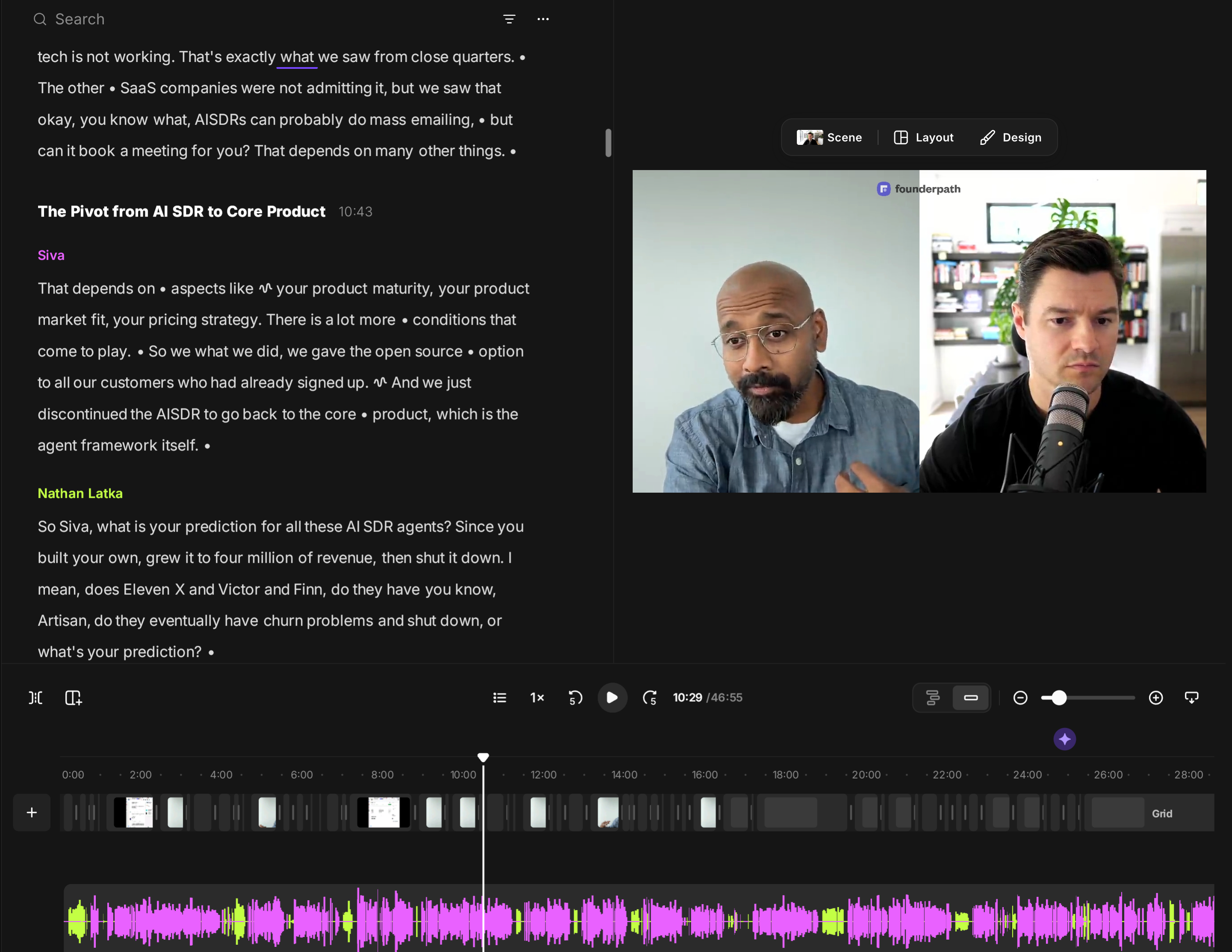
8:46No, we started sharing this on Twitter and LinkedIn. wherever Levinx was mentioned. I mean it always pays if you go after the the the the number one player and show an alternative option. So we started seeding on Twitter and LinkedIn and Reddit, highlighting that you have an open source version that is available that you could try. You don't have to necessarily spend I think Levinx was back then charging seventy thousand to hundred thousand dollars per year for a plan. So So that is how we started building the initial I would say demand. And then Ani, who's my co-founder and head of growth, he is fantastic. His team was able to then get the SEO in play. And we started getting 400 inbound leads a month during that season, during the season. And we had a 60% demo conversion rate to a contracted ARR customer because the The demo was showing it was showing really well. We had integrations to upper low and all of that. So that is the bull run that we had in 2024. right. And we went to four million ARR, contracted ARR in by September, only in October, we said we are not gonna do this anymore, and we stopped doing it because we realized that AI SDRs don't work. or don't the the promise of AI SDRs. If and and Nathan, you would know this really well. The promise was that it is supposed to book meetings for you. It is supposed to write emails automatically book meetings for you. The moment that promise was broken, customers felt that okay, you know what, this tech is not working. That's exactly what we saw from close quarters. The other SaaS companies were not admitting it, but we saw that okay, you know what, AISDRs can probably do mass emailing, but can it book a meeting for you? That depends on many other things. That depends on aspects like your product maturity, your product market fit, your pricing strategy. There is a lot more conditions that come to play. So we what we did, we gave the open source option to all our customers who had already signed up. And we just discontinued the AISDR to go back to the core product, which is the agent framework itself.
11:07So Siva, what is your prediction for all these AI SDR agents? Since you built your own, grew it to four million of revenue, then shut it down. I mean, does Eleven X and Victor and Finn, do they have you know, Artisan, do they eventually have churn problems and shut down, or what's your prediction?
11:19massive churn problem. Not just I mean in fact one of the AISDR founders and I we did a we did a podcast, 30 minute podcast. So he had built a very good AISDR product, I forgot the name. it was easy to use and even I liked how he had built it. and he built it after us. we were early and he built after us. Long story short, we actually discussed that in detail in a 30 minute conversation on what failed, why it failed. They raised five million dollars capital, they grew really fast, but then they shut it down. They pivoted into a different business. The same happened to us also. Just that we were not a different business. It was kind of an experiment that we did from our out of outside of our core business. But then we realized that it's not gonna work. So long story short to your question, where does AISDS really work? It works if you are trying to just send mass emails. Without expecting it to book meetings for you. If you just want the message to go out to say Fortune 2000 customers. So AISDS can do that. The moment you start expecting AISDS to book meetings for you, that's when it falls free.
Siva Surendira, CEO
12:33Even the mass emailing, how are people setting up their email architecture to make sure they have warm inboxes, to make sure they show up in the primary inbox of the Fortune two hundred brand that they're targeting? I mean, even getting that to work is not easy.
12:44It's not easy. Options are like buy 30 to 40 domains on LEM list or instantly. My favorite is instantly. Exactly. Exactly, right? So buy that, warm it up, then start scheduling, use the API to integrate an agent or cloud directly. So it is it is a process. There is no set infrastructure. but but yeah, eventually you just it's it's probably the lowest cost when it comes to marketing.
12:51Warm warmly, instantly, yeah.
13:13Which is landing in an inbox. If your agent could write a really good opening email, I think you would have caught the attention of the of the ICP. Over a period of time, what we realized was do not try and do the seven email drip campaign stuff, etc. Try two emails, hit the point, give them the links and screenshots to decide. If they don't decide in two emails, they're not gonna decide in seven emails. As simple as that. So we realized that. so your product. So focus more on building the product, trying to showcase it really well, build a good demo video. So do all of that really well. Then just rely on one or two emails to share the value to your IC.
Nathan Latka
13:58So there's something I don't understand here about the story. You have some traction, you're a successful entrepreneur, you shut this four million AR company down in October twenty twenty five, but my research team told me you also at the same time raised a series A led by rocket ship of eight million dollars. Is that accurate?
Siva Surendira, CEO
14:16I think the year, right? October twenty twenty four is when we shut down the AISDR product. Yes. Which is why. Which is where, right? October Exactly. We went up and shut it down, gave it free because I realized that AISD is not gonna work. We go went back to our drawing board, which is hey, we wanted to be an enterprise agent company, let's do that. And we took three more months to build out the developer studio and Jan twenty twenty five.
14:21I thought you said you had zero ARR in in twenty twenty four. You you you you had revenue and then you shut it down.
14:45Is when we launched the Lyzer Agent Studio, which is a low-code, no code builder platform for developers. So it was a very hard call. I mean, Ani, Anni, who's my co-founder and Ed of Growth, he and I had a lot of conversations because he was like, Siva, we have invested a lot of assets here. Everyone knows what JSON is. Someone types 11x, they're able to see JSON appear organically, should we leave all of it? And I convinced Anni that Anni, I think we should go back to the drawing.
14:51I see. Okay.
15:13Go back to the larger calling, don't get distracted with the AISTR. And that eventually turned out to be a good decision for us.
Prediction for AI SDR Companies
Nathan Latka
15:21Okay, so new launch in January of twenty twenty five. How'd you get your first ten customers? What were you charging?
15:24Yes. again, good question. So we started with the $10,000 annual plan. Q1, we've we onboarded 25 customers, mostly startups and SMBs, and we went to 250k in ARR by Q1, right? And then by Q3, we were like we went, we launched a $50,000 plan and a $100,000 plan. By Q3, we went to $650K in ARR. That is when we signed our term sheet with RocketShip, who led our Series A. Accenture Ventures participated. But what happened after that is the growth story, right? Q3, 2025, 650k ARR, and we closed Q2 this season, this 2026 at 12 million ARR. So we grew by 20x in the last nine months. We are projected to get to 30 million minimum by the end of the year. but there is one large government deal, and if that comes in, we'll get to 50 million by end of the year.
Siva Surendira, CEO
16:23Well, as we're recording this here in July of twenty twenty six, what you're telling me is you just closed out June and you did a million of MRR in June, annualizes a twelve million dollar run rate.
16:32Twelve million ARR, yes. Right? All all the three deals that we closed in June, all deals are million dollar ARR each. Three customers.
16:34Yep, yep, yep. That's wild. So what is your l don't say their name obviously, but what's your largest customer pay you today?
16:47it is a federal agency, close to two million dollars.
16:52Wild, interesting. And and well, I wanna I'm now I'm curious, but I don't want you to give the customer name away. Can you talk about their use case at all without giving them away?
16:59Exactly. So so what did we eventually build? Why is Lyzer growing really fast? We are a sovereign full stack agent platform that enterprises could run locally within their own cloud or even on-premise system. That is what we are. So today companies are understanding what OpenA and Anthropic are doing. They are obviously charging you for tokens, but eventually they're able to take all the intelligence away from you. The if you are an insurance firm, the moment you upload your underwriting handbook to OpenAI or Anthropic, it's gone. The intelligence is now with them. They can share the same decision making to every other insurance firm in the world. Your secret sauce just went out. So this is something that enterprises are realizing very quickly. So they are looking at full-stack sovereign platforms like us, which they could deploy within their own cloud or even on-prem systems so that they can. Really own the intelligence. And that is what is resulting in our growth. Lyzer is full stack, which means all the necessary building blocks that you need for a complex agency system are available within our single platform. We kind of replaced 20 different individual technologies under one single homogenous platform, which is why we had Accenture invest in us twice in six months, and they are the world's largest IT services provider. And So so that's and we've been going to customers together. We have KPMG working with us, Deloitte working with us. So many consulting firms and system integrators are both our customers and are also our partners.
18:43If I'm watching this interview, what I'm thinking is, I agree with you, Siva. I remember seeing Alex Carpo on CNBC a couple of days ago talking about, you know, going crazy about, you know, his new platform and helping people keep their alpha and their intelligence. You're doing a version of this. But if I'm actually thinking, like as someone watching this as a founder of a $10 million AR company, I'm going, Yeah, I want to keep my alpha and my intelligence with me, but how do I like do I have to If I I think back to like the the rack space days, do I have to have a closet on my business with events a bunch of HP two hundred you know, and H two hundreds running or Blackwells running and then put your application layer on top of it? Like what's the infrastructure under it? How do I get the compute power if I use your application?
Nathan Latka
19:20Good question, right? And since you brought up CARP, the last two deals we won, we competed with Palantir to win those two deals. we are the agentic Palantir, if you look at us, right? So Palantir came from the ontology world and now they have an agentic platform. We did the other way around. We started with agentic offering and then we went into data site. So now coming back to your question, it is going to be a combination, Nathan. It is going to be An on-prem appliance which has H200s, H100s, or AMD chips that can have few open source models, even Chinese models like Deep Seek for that matter. So that is your on-prem appliance completely cut off from internet. But you can your CFO office, your RD team, your say biotech team could use it for local intelligence to build agents and automate a lot of work. The second, so I would say probably 20% of a large enterprise workloads will actually have to run. Within the hardware, and we are seeing that already, which is why just last week we launched Lizer Optimus, which is an on-prem appliance that you can buy from us. It can support up to 10,000 concurrent users. You won't find that on the platform yet because we just started pre-orders, pre-orders for our existing clients. So 20% of any enterprise workload will run with local hardware. And about the next 50% will be on one of their hyperscaler platforms like Amazon or Azure or Google. And they will be using models that these hyperscaler platforms provide, or they will be using open source models behind bedrocks of the world, which is semi-sense data sensitive. And the rest 20 percentages where or 30 percentages where they will be open to sharing with OpenAI or Anthropic directly. Because say Fable Five is phenomenal. You don't get that performance with other models, obviously. So there are few coding scenarios, etc., where you need fable five. You don't have a choice. So which is why even OpenAI stopped their fine-tuning API, right? They said, you know what, I I like Cloud. I don't want you to fine-tune any models. I want you to use our best in class model whenever we release. So long story short, we are seeing the split to be a 20, 50, 30 scenario. And companies are very I think they are actively building these strategies. I was speaking to an event management firm. This this particular firm manages events for Taylor Swifts of the World, Justin Bieber's of the world. They are not a bank. They are not an insurance firm. And they said that they want fifty percentage of their agents to run locally with local hardware with H two hundreds. So enterprises are very fast moving towards owning the intelligence.
21:52Mm-hmm. Mm-hmm. Mm-hmm. Well, so let me let me ask you a follow up on this because my audience is a combination of tech people that are following everything you're saying and people that are not tech and they might get lost. And that's sort of me. So if they think literally about, okay, I want to own my intelligence, are they going on eBay and buying for forty grand, you know, 10 H two hundreds and then putting in a closet and then putting your app on top of it and running it? Or are they renting are they renting GPU space from a middleman somewhere and then putting your intelligence on top of your application layer on top of it?
Siva Surendira, CEO
22:26Question, yeah. Three options, right? The option that is on fire right now is the inference providers. Together AI, Fireworks, and Basedon. These companies are inference providers. They allow they give you open source models and you can fine-tune. So you don't have to buy hardware. And these companies ensure data privacy. They are not the big labs like OpenAir Anthropic who use who uses your data to retrain something. Their job is straightforward. They will host an open source model like a Deep Seek, for example, or a GLM or a Quen, and then they give you inference capability. You can fine-tune.
23:03These are these are the ones that you t tell me the top who who are the top three in your opinion you think are gonna win the space?
23:09Number one is together AI, followed by fireworks, followed by Basedon.
23:15Base t okay, base ten fireworks. What was the first one?
23:17Together, together AI. Yeah. They are the number one. I think they just raised eight hundred million yesterday or day before.
23:21Got it. When what makes their business model hard? Is or is it easy to copy? You just have to go rent GPU space from the the hyperscalers and then rent it out at a higher rate.
23:33sometimes they rent, some and mostly they buy. So both, right? So it's all about demand. So two things. One, do you have enough hardware capacity? And number two, do you have a really I would say optimized software stack? The reason why Together Base Tin and Fireworks are good is because their software stack is very strong. take Cursor. Cursor runs their open source models, which is Kimi 2.6. Which they are fine-tuned and they call it as cursor composer, I think. It is powered by BASTIN. So it just because of BASTEN, cursor is able to give you that very fast experience, which is what the customer the developer pays for, right? So, which is why cursor is able to take on the likes of anthropic, like clot code for that matter. So, which is why, if you are an individual, you don't have to buy these Nvidia H200s yourself. You can rent it out from these inference providers. Option number two. Big hyperscalers like AWS, Azure, and Google, they also have some capacity, Core Viv, all the neo cloud, right? Core Viv, Nabs, they also have these options. Then option number three is buying hardware appliance from companies like us, because it's not just the H200s. You need to think about that, it GPU for you. You need to have CPU, which is where the software stack will run. You need cooling.
Nathan Latka
24:55Wait, wait, wait, hold on. While you're explaining this, where can I go on your website to actually see the hardware you're selling?
25:00No, we we are launching it next week to for public pre orders. Right now we initiated the private pre orders, which is what we are covering right now. We are launching the public pre orders. I can share from my screen here, but I don't know.
25:03Mm. I see. Yeah, yeah. Share screen. The more you can show a visual to help my own and wrap their head around what it is, the better.
25:15yeah. Me shattered.
25:17And I'll follow your lead on time. I know we're four minutes over. I have time, but it's up to you.
25:21sure, no, I have time as well. are you able to see my screen? This is yeah, this is Lyzer Optimus, an on-prem agent factory for enterprises and teams who wants to own their intelligence, right? It comes with it can support up to 10,000 concurrent users, which means even a large bank can adopt this. 95% lower cost compared to a frontier API usage like GPT 5.5 so the world. It just takes 30 minutes to set up and get started. And
Siva Surendira, CEO
25:24Yes, yeah. Walk us through this.
25:50hundred percent on premise. There is not even like you cannot even connect to models via Wi-Fi. It is just LAN. And to I mean, look at our current lineups, right? So we have banks, we have federal organizations, we have biotech firms who are already doing the initial orders with us.
25:57What are you gonna sell this for? No, I I see that. But what do you what is this gonna sell for? One of these one of these hardware devices.
26:12yeah, yeah, yeah. Yeah, it's here. It's here. So there are four configurations that we are launching. Optimus Personal is for the CXOs. Imagine a CEO or a CFO who wants to have a device on their desk. So that is Optimus Personal starts at ten thousand dollars. Optimus Max is one million dollars, it comes with eight small models, two medium models, two large models, one OCR model and one voice model. It can support up to ten thousand users, concurrent users that we're talking about. If you look at
Nathan Latka
26:40Where are you getting all of your NVIDIA H two hundreds from? Everyone's reading depressed today how hard it is to get these chips.
Siva Surendira, CEO
26:46No, there are a lot of distributors actually. So Ingrams of the World, Ace Computers, there are a lot of distributors who have the stock available. And and interestingly, AMD, the latest AMD chips are better for small and medium models compared to Nvidia Nvidia H200s. So you have options available right now. You won't have you even have Intel chips available that is also very good for small and medium models. You need Nvidia and AMD for large models. But for small and medium, you have more options available.
27:19And how does your Optimus, just for my k pro Sumer audience watching, if they want to build their own little mini foundation models at their house, what's the difference between your Optimus personal plan at ten K versus like what most people are doing now, which is like stacking Mac Studios for three K a pop?
Nathan Latka
27:34I think so what okay, what what is different with Lyzer is it is not just the hardware that you get. What you also get is the software, right? This is what you get. The whole studio. You
Siva Surendira, CEO
27:44Okay. Wait, wait, tell okay, so this is great. I love a visual so just to be clear, we're this is like what a paying customer would see. We're now logged into your platform. Okay. Yep.
27:52Yes. Right? So let me show this. So this is the studio that you get. You get an end-to-end studio where all the agents that you are building across are registered here. You have an option to create a task agent or a voice agent or even a workflow or even bring third-party agents via proxy agent. You are able to build complex multi-agent systems through the studio. You are able to build even superflows, which is I would call it as a l lot more like NATO style multi-agent system with if else conditions, et cetera, for a lot more items. Like Zapier sort of, but agentic by nature. in fact, six months back, we lost a deal to NATON and that triggered our team to build something that's far superior and enterprise ready for compared to NATON. And since then we've never lost a deal to NATO since we launched Superflow.
Nathan Latka
28:29Like zapier sort of. How many customers are you serving today?
Siva Surendira, CEO
28:50Today, 32 very large enterprise customers. like I said, the deal values are between two fifty thousand dollars to one million dollars, and one customer obviously closer to two million dollars. And we have eighty thousand builders on the platform. You can go to studio today, create a free account, you get 500 credits, and you can start building agents yourself. So a lot of startups and small businesses are building agents on our platform. We have 80,000.
29:15And just again, so they understand why would they build on you versus going directly to Zapier, NADN or all these other agent building tools?
29:22because Lyzer is much more broader and comprehensive, right? Today, why would a customer running on Microsoft AI Foundry or Gemini Enterprise or Amazon choose Lyzer? Because Lyzer has 50% more agent building blocks or modules compared to what even some of the best or top agent platforms in the market have today. So it is the comprehensiveness of what we bring to the table allows us to obviously help our enterprise customers build. Really complex systems. Like for example, simulation engine. Building an agent is one part, but take it through the simulation engine where it r writes up to 10,000 simulations, runs these simulations on your agent, real-time simulations to see where your agent could fail. And it explains why it fails. And then when you enable hardening, it automatically runs in a recursive loop to improve your agent instructions for tool calling, etc. And it fixes this. So we are talking about three months of work done by a QA engineer delivered in 45 minutes through the Lyzer.
30:28I mean this a this is a light version of if you guys nerd out on the early days of the foundation models. I mean, this is effectively neural networks, cue tables with the reward column, closed loop, you know, you know, deep learning and and human and loop training that's happening here, but in sort of an interface that a non engineer would understand.
Nathan Latka
30:47yeah, correct. Right. And while Lyza developer studio, this is a developer studio, right? Built for developers. We then wanted to build something for business users, which is why we built architect.new. So this is something that I would encourage the users to try. This is purely built for business users. It sits on top of the developer studio, but you could just go in and like for example, let me show one example here. I was speaking with somebody at Marriott from the marketing team. And during the call, I entered this prompt. I said, okay, I'm from Marriott and I want to build an agentic loyalty management system for our customers. And I had a few more ex I would say instructions. So what architect does, it is think of architect as lovable or replic, but for building agents. It is not just an app builder, but an agent builder primarily. So architect goes out and plans in detail the kind of agent that you want to build. It then visually builds the agent for you, writing the prompt, selecting the models automatically. Then it also builds the app for you. All three in one shot. So architect completes the loop, planning, building an agent, and building a beautiful app so that you can really touch and feel what it could look like for your end customer. And I can play around with the app, I can chat with the agent to see if the agent is doing exactly what I want. If not, I can go on further. Vipe code like you do on cursor, et cetera. So this is Architect is a layer purely built for business users. But when you click on say edit agents in studio, you will see that Architect automatically is connected to the backend studio and all the agents that you build on Architect gets registered in the agent registry here. So that is how we built it, yeah.
Siva Surendira, CEO
32:31This makes sense. Okay. So and again, I I think this is very useful when people seal these agents because people are building their these own things inside of Claude or others right now. And basically the argument that you're making is hey, when you build the agents inside of here, it's your own data, it's private. You're not passing your business intelligence to the foundation models who then might distribute it to every other law firm on earth. Yeah. All right.
Nathan Latka
32:50That's correct. That's correct.
Siva Surendira, CEO
32:52Let's jump back into your story here and then we'll and then we'll move towards wrapping up. So you did the you did the let me see, let me summarize. September twenty twenty five, you hit six hundred fifty thousand dollars of ARR and you did it eight million series A, right? Are you comfortable sharing the valuation?
33:04That's correct. yeah, we did it fifty million valuation and then
33:10Okay. That's a crazy. So, I mean, how did you think about the multiple then? I mean, look, I mean, obviously you want to get the highest multiple possible, but you've been through this before. You know raising at a high multiple can sometimes hurt you.
33:18Yeah, yeah. And also I'm not a Bay Area founder. I'm a New York founder and I'm an immigrant. so I didn't have any network. So raising the first round was pretty hard to be honest. and I I think so we had to raise purely on ARR. So you know this really well, right? if you come from, say, this what is it, fang companies, etcetera, or Stanfords of the world, you raise based on your resume. But in our case, instead of in spite of my previous success that I had. We had to raise purely on our ARR growth. So it became just a multiple of whatever ARR was.
Nathan Latka
33:52That's a seventy six X ARR multiple, right? On six hundred fifty K of ARR?
33:56Because we had a good pipeline. We had a good pipeline. So the forward ARR was the thought pro was the was what allowed us to raise. But h here is what interesting thing, right? This is October. In Feb we did our series A plus at two fifty billion valuation. Our valuation jumped five times in a matter of four months because of
33:58Yeah, okay. Okay. And what was what was revenue in February this year?
34:21in Feb when we raised that round it was three and a half million.
34:26So you've gone from three point five million of ARR in Feb twenty twenty six to now to June twelve million of ARR. So in three, four months you more than almost trip more than tripled revenue.
34:32That's correct, yes. Yeah, and in July we will be at fifteen and we are targeting thirty by end of the year.
34:41Wow. I mean, even though two hundred and fifty million, right, divided by three point five million, you're still trading in a seventy X revenue multiple. I mean, but your growth, you'd argue you the growth justifies it.
34:49That's correct. And and Nathan, we are operating at ninety five percent gross margin.
34:54What about net net margin? Are you profitable or burning today?
34:58We will break even in thirty days.
Siva Surendira, CEO
35:00I okay, if you wanted to. I imagine you're not. You're gonna keep burning to grow. Okay. Where is most of your cost structure? I mean, buying all this hardware. Like you just said you show me that one that's gonna retail for a million bucks, but what will that cost you?
35:03Exactly, exactly, exactly, exactly. Right. We are we are not buying hardware at all because customer pays upfront, then it gets drop shipped. So that is literally we are not even stocking anything with us hardware wise.
Nathan Latka
35:19But that hardware you just show me, the most expensive one for a million bucks, what will your cost to goods sold beyond that based off the manufacturer, the chips you're putting inside it, et cetera?
Siva Surendira, CEO
35:26I think just the hardware bomb alone is fifty percent, forty eight to fifty percent.
35:31So you're you're reverse engineering to get like a forty eight percent hardware margin and then you'll upsell obviously ninety five percent margin software and application layer on top of it.
35:39Exactly. Because the real value is a software, right? Hardware anyone could ship. The real value is what we built over the last two years, which even Microsofts and Googles of the World are at least twelve months behind in terms of the roadmap. So that is the real mode that we are able to table.
35:51Mm hmm. Mm-hmm. Okay. And that series A size that was fourteen point five million, right?
35:58series A and A plus put together.
36:01Series A and A plus put together was fourteen point five. Okay, so how much total have you raised today?
Nathan Latka
36:06Fourteen point five.
36:08one four point five.
Siva Surendira, CEO
36:09That's correct. And and we are now in talks to do our series B. It's a hundred million round that we are in talks.
36:15Yeah. Yeah. Man, this is really, really interesting. how do you if you're worried about competitors coming after you, right? And just you're like growth at all costs, basically, what's the fastest way to go? Do you go do you go through inorganic growth, buy a bunch of companies in your space just to buy your way to a hundred million of ARR or or just keep doing what you're doing, grow organically?
36:37I I don't think inorganic growth is buying other companies. I have a different take on inorganic growth, like what AWS and Snowflake did. Go and enable your partners win deals. Why is Accenture why did Extensure invest twice? Why are they coming back again for the third time? Why we have several other system integrators investing in Lyzer and also partnering with us? Because we help them. Ship agents that can go to production for their end customer. So that is inorganic growth for us, right? We have 10 very large I would say BCAP and SI partners, and we have almost 45 emerging partners just in the last six months. So that is the growth, that is what I liked about AWS. You when you read my initial intro, you you highlighted how we were an AWS consulting partner. So that's what I learned being a partner of AWS. that if you make your partner win, they will take care of building the pipeline for you, bringing in the demand. And
37:40So you're saying these customers, your gross strategy, you it's value added reseller play. There's other people bringing you these customers.
37:46So our current out of the current era, 90 percentage is direct and 10 percentage was through partners, but our the pipeline that we are sitting on, 50 percentage is from partners. So
37:58No, I get that. I mean, I'm just what I'm trying to wrap my head around is when you're going head to head with head with Palantir on a deal and it's a gu and the and the government, the US government is the buyer, how are you winning these two million dollar contracts? Right. People are thinking Palantir, they raised a bunch, they're worth billions of dollars. Why would they give, you know, w respectfully, right, your little startup a shot?
38:17Exactly. I think that is the underdog tag that gives us the the advantage both in two deals, both Palantir and the other large enterprise, which is a critical infrastructure for the US, who I cannot name. and and the other the first one is the US government themselves. Both deals were Palantir compete. We were able to win, number one, because of the product superiority, because the product is agent first, right? We we didn't have a baggage of ontology and all the other previous softwares to sell. We just had one focus, which is How do I build agentics systems that can go production? So that is the focus. I think that product superiority helped us win. The second one is we were able to ship a prototype in 10 days to our customer. And they saw which they couldn't get from the other competitors. In fact, the third party in both the deals, the the third competition was Agent Bricks by Databricks. And Agent Bricks couldn't ship something in three months, and we were able to ship something in 10 days. So I think the Underdog underdog aspect and also probably the product maturity allowed us to win these deals. And it's always been a it's always been a dog fight, Nathan, to be honest. Like almost all the large deals that we won, we were picked against either a Palantir or an Agent Bricks or one of these or lang chains of the world. It was always one of these dog fights that we have to win. And and and yeah, thankfully we've been winning all these deals. And these are all multi-speakers.
39:23Interesting. Well look If one of the if one of those firms approached you today and offered to buy the whole business for four hundred million dollars, all cash up front, do you take the deal?
39:50They can't afford us.
39:51You said that so quickly. Four hundred million bucks on thirteen million of ARR. You wouldn't just
Nathan Latka
39:55Not all. I I sold my previous company, I made cash. This is not for that. It's different. Maybe if I did not do my previous firm, absolutely yes, this could have been lucrative. But but yeah, we are currently raising a hundred million dollar round and you you could probably guess the valuation that we are moving towards. So so which is why I don't think we can
40:13No, I can't. What what valuation are you targeting?
Siva Surendira, CEO
40:16let the market say it's too early right now, so I I don't wanna take a call and burn. But but it's it's about the pipeline that we have and the kind of customers that we have, right? All at at this young stage we are still signing three year deals with all our large customers.
40:33What's the month over month? Like we're recording this in July. You finish June at twelve million ARR. How much revenue ARR do you think you'll add in this month?
Nathan Latka
40:41we have a Q three target of twenty million. So yeah, so if you if you look at Q four and Q one we grew three hundred percent quarter and quarter. Q two we grew two hundred percent quarter and quarter. And obviously as the number grows up the percentage comes down. So this quarter we'll probably grow eighty percent. So
40:44Okay. So is it fair to say you're adding one to three million of new ARR per month? Yep. Well, listen, on that note, if people want to follow your story, Siva, where can they find you online?
Siva Surendira, CEO
41:04Yes. Yes. I am LinkedIn is the best place. you can find me Siva, Surendra, Lyser. I'm on LinkedIn. LinkedIn is my social network that is that I spend a lot of time. So yes, I'm there.
41:24Guys, there you have it. Started in 2008 as a big data engineer at Tesco in Bangalore. And look at him now. Had his own launched his own company called Power Up Cloud in 2015, deep in the AWS space, ultimately sold that, got a nice financial win, and now he's going for it all. Lizer.ai launched first line of code in 2023, grew to four million of revenue, shut that whole idea off. It was an open source model on GitHub, the AI SDR space. 2024 ended with zero.
41:29Yes. Yeah.
41:52ARR. Fast forward to 2025, they launched their new agent studio. And by the end of the year, September, they hit 650K of ARR, raised an 8 million Series A at a 50 million valuation, had ACVs in the 10K range, 25 first customers, nice growth. And now fast forward to today in June of 2026, broke 12 million of ARR, adding one to three million of new AR per month. Their February round was a 250 million valuation. at about a 70x multiple, really healthy. And they've got customers today paying in the millions, 32 customers, as he looks to scale across not just software anymore, not just the application layer. We got a nice sneak peek at the hardware layer coming out here soon. Seva, thank you for taking us to the top.
Nathan Latka
42:32Thanks, Nathan. Thanks for having me.
42:34All right, guys. Cut. Steva, what'd you think, man? What you you knew what to expect 'cause you've seen it before, but what'd you think?
42:39No, good. I think you covered all this all the topics. I mean, it was thank I think that's what I I could expect from you because you knew your audience and and you're able to put push me to the right direction actually. Sometimes I tend to get more technical. I do understand that. So so thanks for that, Neither.
42:57No, I'm I'm I'm actively trying to figure out where the space is going. You know, we have invested two hundred and fifty million now at Founder Path and we're trying to figure out if we put our playbooks, you know, into the models to help us underwrite companies faster, but we don't want to give that intelligence to the models. So I'm actively thinking about how do I build my own hardware setup, all that stuff.
Siva Surendira, CEO
43:18I mean, it to be honest, yes. see Harvey is a good example, right? Harvey is fifty percent some basic agents that Cloud could do. The other fifty percentage is where Harvey is able to retain customers, which is the custom agents that they build, which is where the FDEs come into picture. My own console, he moved out of Harvey because he said that I'm able to get stuff done with Cloud actually. So so that is that is
43:35Yeah.
43:44The stickiness comes in from custom agents, like something that you build very custom. And having built Lyzer for the last three years, I can say this for sure. We are trying to build a software that is probabilistic and not deterministic. Our previous generation was all deterministic software. New generation is probabilistic. And what is the issue there? Two companies that might look exactly alike are very different in the way they work and they operate. So, which is why. A deterministic software cannot, I mean, in the previous generation, like a CRM or an SAP could obviously solve, can suit can sit on both the companies and they used to build the workflows on top. But right now, we are trying to automate the workflow itself with agents, which is probabilistic in nature. So long story short, the for example, the marketing workbench that we built for a UK based bank looks 80% different from a similar sized bank from Switzerland.
Nathan Latka
44:30Mm-hmm.
44:42Both banks, EU banks, EU AI Act, they are both marketing teams, but 80% difference between how they operate. So
44:50Yeah, yeah. No, it's a look, it's a fascinating space. We'll we'll see who wins. I've got to hop here to another founder interview, but hey, one thing I wanted to put in front of you. If you on your browser open up topfoundersummit.com, topfoundersummit.com, I'm getting some of our most successful portfolio companies together. I rented out a beautiful ranch in Napa Valley September eight, nine, and ten. They're all curious about this hardware stuff, and they're all curious about building agents for their individual vertical AI companies, whether it's dentists. or pharmaceutical company, like pharmacies, et cetera. If you're available, I would love to host you out there and give you time to bring your hardware and and showcase a little bit about how you're thinking about the space, assuming you're available and can make it. I'll cover your cost in terms of putting you on the ranch and all that stuff. You just have to get there.
Siva Surendira, CEO
45:36Let's do that, I'll be there.
45:38Amazing. All right. I'll shoot you the link to to actually let me just give it to you right now so that you don't hit the paywall give.
45:44I have a it's it's it's top founder summit dot com, right? Should I just register there, request invite.
45:49Yeah, but I don't want you to have to pay. I'm gonna give you the link that takes you around the paywall, which is right here. I'm gonna send it to is there a there might not be a chat here. here it is. Here it is. Public chat. See if that link works for you.
45:59There is a chat, I think. Yeah, I'm also searching. There is a chat. Right top, you see, below people. Studio chat.
46:07Will you have one of these hardware, like one of the models available to bring out? Okay.
Nathan Latka
46:10Yeah, yeah, yeah, yeah. Yeah. So in fact, the government is coming to us on first week of August for an on site demo. So we are having it showing. I can see chat. yeah, I got the link.
46:17August. Okay, great. Great. Yeah. And pick the pick the estate one, the fifty nine hundred dollar one. And then it should go to zero at checkout because my the discount the VIP discount be applied. And the trade off is I'm willing to cover this for you because I want you to teach a workshop and go deep on this stuff with these founders. They're all doing between call ten million and three hundred million of ARR. I think they're gonna love your session.
46:32Makes sense. Absolutely. I think by the time we'll be twenty million plus, so we'll be there. Thanks, thanks Satan for having me. Take care. Again a big fan. Thank you. Bye.
Siva Surendira, CEO
46:46All right, man. Looking forward to meeting you in person. Of course. Take care. Bye-bye. You're the no, I appreciate that, man. Thank you.