
Founder Interview
How String AI Reached $1M ARR with 30 Hedge Fund Customers (Interview with Co-Founder Rohit Shinoi)
- Interview Date
- August 4, 2026
- Interviewee
- Rohit ShinoiCo-Founder
Company Metrics at Interview Time
ARR
$1M
Customers
30
Team Size
10
Total Funding
$1M
Cash in Bank
$1M
Historical Snapshot
These numbers were reported by Rohit Shinoi during his interview recorded in August 2026 and are a historical snapshot, not current figures. See String AI’s current numbers.
Key Takeaways
- 01String AI crossed $1M ARR at the end of 2025, its first seven-figure year
- 02The company had approximately 30 paying customers as of the interview, primarily hedge funds
- 03String AI raised a $1M seed round roughly one year before the interview and has not spent any of it
- 04The team operates at roughly break-even and is profitable without drawing on its seed capital
- 05The company was founded in 2023 and finished that first year with essentially zero revenue
- 06Revenue reached low six figures in 2024 before crossing $1M ARR in 2025
- 07The team grew to 10 people by the time of the interview
- 08Investors include Auren Hoffman, the GLG founder, Zapier, and Charlie Songhurst
- 09String AI launched a public self-serve product in 2026 alongside its existing managed hedge fund offering
- 10The first customer was the hedge fund where Rohit previously worked, with subsequent customers won through cold outbound and conferences
Company Metrics at Time of Interview
| Metric | Value | Source |
|---|---|---|
| ARR (2025 year-end) | $1M | Founder interview, Aug 2026 |
| ARR (2024) | $100K | Founder interview, Aug 2026 |
| ARR (2023) | $0 | Founder interview, Aug 2026 |
| Customers | 30 | Founder interview, Aug 2026 |
| Team Size | 10 | Founder interview, Aug 2026 |
| Seed Funding Raised | $1M | Founder interview, Aug 2026 |
| Cash in Bank | $1M | Founder interview, Aug 2026 |
| Year Founded | 2023 | Founder interview, Aug 2026 |
| Products | 2 | Founder interview, Aug 2026 |
Growth Breakdown
Revenue
String AI finished 2023 with essentially no revenue, grew to low six figures in ARR during 2024, and crossed $1M ARR at the end of 2025. Rohit confirmed the company is under $5M ARR as of the August 2026 interview.
Customers
The company had roughly 30 paying customers at interview time, up from fewer than 5 in its entire first year. Rohit noted that last month alone the team added 5 new customers, illustrating the compounding effect of early relationship-building.
Team
String AI has grown to 10 people as of August 2026. Early engineering hires came from an unconventional source: a Discord community called Sneaker Dev, where developers built bots to purchase limited-release sneakers.
Profitability and Funding
The company raised a $1M seed round approximately one year before the interview and has not drawn on those funds, operating at roughly break-even using revenue alone. The full $1M remains in the bank as a growth cushion.
Growth Strategy
Cold Outreach and Conference Networking
After landing the first customer through a prior employer relationship, the team relied heavily on outbound cold outreach and in-person conference attendance to win early hedge fund clients. Rohit acknowledged this was a grind, especially as a 23-year-old selling into a gray-hair industry.
Product Hunt Launch
String AI used a Product Hunt launch as part of its go-to-market strategy for the new self-serve public product, targeting a broader developer and enterprise audience beyond hedge funds.
Blog Content and SEO
The team invests in written content, articles, and blogs to drive product-led growth for the self-serve tier, complementing the sales-led motion used for managed hedge fund accounts.
Open Source Benchmark
String AI created the Web Data Frontier benchmark, comparing its success rates, latency, and costs against competitors such as Bright Data, Firecrawl, and Browserbase. Rohit described this as a conversion tool: every prospect who sees the benchmark finds the choice straightforward.
Investor Network for Enterprise Introductions
The cap table was deliberately built with former operators, including Auren Hoffman of LiveRamp and Safegraph and the founder of GLG, who provide warm introductions to fund managers and enterprise customers and offer free expert network calls.
Best Quotes
“we're seven figures in ARR. we're growing well. the usage within funds and adding new funds is like going pretty well.”
“five million would be a stretch. so we're under five.”
“we raised it about a year ago. it was it was a fairly small round, so we raised between one and two million dollars. and we've been we've actually not even touched the money so far.”
“it's still all in the bank. we've just been using the cash coming in to continue to grow. and we've like generally operated at like a break even line.”
“for the first year, I don't even think we crossed five customers in our first year. And like last month we added like five customers. so it's it like compounding definitely works.”
“twenty twenty four was when we like really had a product that we could like actually sell. and I can't like again give the exact numbers, but we were in the six figures of AirR, like lower end of the six figures. twenty twenty five was amazing. We just cracked seven figures at the end of twenty twenty five.”
“literally every single investor on our cap table is someone who has like run a company before. that's like always super helpful whenever like we can get their thoughts on a problem that we're facing.”
“we created an open source benchmark that we call the Web Data Frontier benchmark. And we have compared ourselves to basically every major web access API that's out there. and we're significantly better than them in terms of success rates, latency, costs, et cetera.”
What Happened Next
This interview captures String AI at a specific moment in August 2026, when the company had just crossed $1M ARR, launched its first public self-serve product, and was expanding beyond its original hedge fund niche. The numbers and product details here reflect what Rohit Shinoi reported on that recording date and will not be updated on this page. Visit the String AI company profile on getLatka for the most current revenue, customer, and funding figures.
View String AI’s current profile and metricsFull Transcript
Chapters
- 0:00Introduction and What String AI Does
- 0:36Why AI Agents Get Blocked on Websites
- 1:46Technical Approach: Proxies, Browser Emulation, and Bot Detection
- 2:41Hedge Fund Use Case: Predicting Carvana Revenue from Web Data
- 3:28Rohit's Background: From India to Bain to String AI
- 9:54Revenue Milestones: Zero in 2023, Six Figures in 2024, $1M ARR in 2025
- 12:20Why Raise a Seed Round You Haven't Spent
- 13:40Investor Lineup: Auren Hoffman, GLG Founder, Zapier, Charlie Songhurst
- 16:17Finding Early Engineers Through Sneaker Dev Discord
- 17:03Product Roadmap: Web Data Frontier Benchmark and Composer
- 22:48Go-to-Market: Sales-Led for Hedge Funds, Product-Led for Self-Serve
- 24:16Closing Thoughts and Where to Find String AI
- 25:16Post-Interview: Nathan Discusses Potential Investment
Introduction and What String AI Does
Nathan Latka
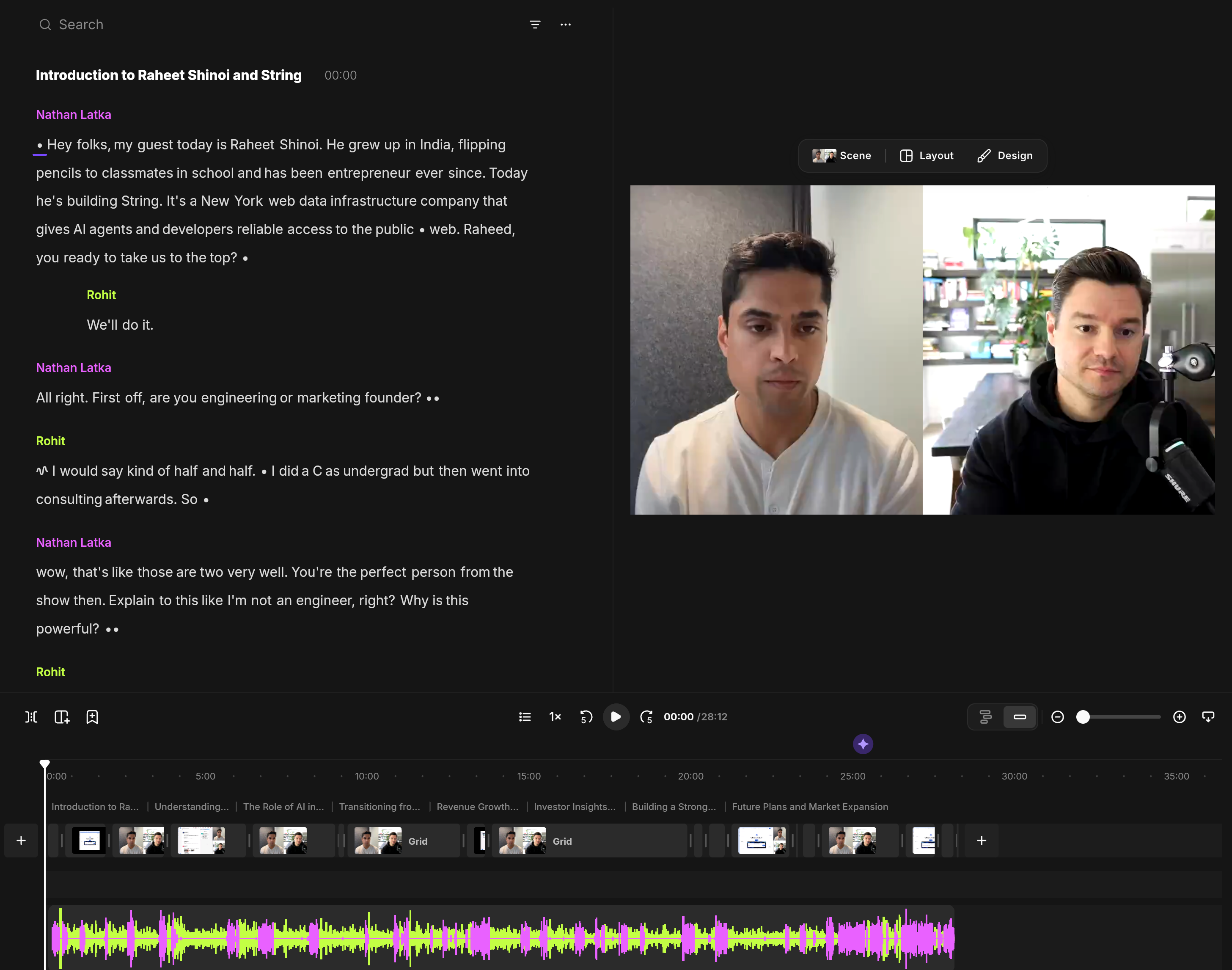
0:00Hey folks, my guest today is Raheet Shinoi. He grew up in India, flipping pencils to classmates in school and has been entrepreneur ever since. Today he's building String. It's a New York web data infrastructure company that gives AI agents and developers reliable access to the public web. Raheed, you ready to take us to the top?
Rohit Shinoi
0:18We'll do it.
0:18All right. First off, are you engineering or marketing founder?
0:23I would say kind of half and half. I did a C as undergrad but then went into consulting afterwards. So
Nathan Latka
0:27wow, that's like those are two very well. You're the perfect person from the show then. Explain to this like I'm not an engineer, right? Why is this powerful?
Why AI Agents Get Blocked on Websites
Rohit Shinoi
0:36Yeah, yeah. The easiest way to explain it is if you use Cloud or Chat TPT and ask it to compare airline prices to go from New York to SF, it's gonna get blocked on every single airline website, like American Airlines, Delta, et cetera. what our tool does fundamentally is it helps you get unblocked or your agents unblocked whenever they're accessing a website. and it handles all of the complex infrastructure layers that are underneath that, which we can get into later.
Nathan Latka
0:59Mm-hmm and and why is that technically? Get a little nerdy with us for a second. Is that cause Cloudflare balking like bot scraping or what's happening there?
Rohit Shinoi
1:08Yeah, yeah, that's exactly right. so there's the way to think about it is they yeah, there's companies like Cloudflare, Akamai, Datadome, there's many of them that are essentially built around blocking programmatic access to websites. and the main reason for that is like it's actually a good reason. Like they don't want their websites to be DDoSed or bots to just like take over the website. but it also denies access to agents, which is a big problem because that's how a lot of people are now accessing the web. and so there's kind of a the mismatch and like the the problem that they're solving and like that's why we're trying to give them like reliable access but also, you know, without spamming the website.
Technical Approach: Proxies, Browser Emulation, and Bot Detection
Nathan Latka
1:46Mm-hmm. And so how do you do that? How what's the technical insight that you guys found that made this possible?
Rohit Shinoi
1:52Yeah, yeah, yeah. It's it's quite complex, I would say. it it gets into a lot of how the web is even structured, like at the networking layer. but essentially you need to access the websites through reliable proxies or IP addresses. You need to be able to emulate a browser such that you don't look like a bot. And then you also need to be able to take actions on the website that like don't show that you're clearly a bot. and so it's kind of a combination of all those things that fundamentally get you to like seem like your agent's a human when it's actually like an agent.
Nathan Latka
2:28And can you maybe just to really let this land, you just talked sort of general about what the product does. Can you tell us a story about how someone's using you? You you put hedge funds right and prominently six of the top hedge funds use you. Are you are you are you able to share how one of them use you?
Hedge Fund Use Case: Predicting Carvana Revenue from Web Data
Rohit Shinoi
2:41Yeah, yeah, definitely. so yeah, our main customer segment right now I would say are hedge funds. Like a lot of the big hedge funds that you've probably heard of use our platform for web research tasks. And the way they use us is really to deeply understand a company and how they're performing. One of the like really good examples of this is a company called Curvana, if you've heard of them, they sell used cars online. if you collect the cars that are posted on their website and removed from their website every single day, you can actually accurately predict what their revenue's gonna be because you know the cars that are removed, you the prices of those cars, you just add them up and you know that what their revenue's gonna be. So our like web data there actually like drives stock performance for Carvana because funds can see real time what their revenue is versus waiting for the quarterly announcement.
Rohit's Background: From India to Bain to String AI
Nathan Latka
3:28You're an ex hedge fund guy, which is maybe why this is your initial marketing segment. Can you connect the tissue for me? How do you go from sort of college to to I think hedge fund and Bain to okay, I need to leave and go go build string?
Rohit Shinoi
3:41Yeah, yeah. Great question. so it it really started when I I see you have my LinkedIn
Nathan Latka
3:50With with with with a little YouTube content creator in there. A little you you're a podcast host in between, I guess, or something like that.
Rohit Shinoi
3:56Yeah, we we we I started a channel with my best friend to basically help people get
3:59Yeah.
3:59into control thing. and then we that's actually funny, we got shut down by Bane. But that's a whole other story. we so at least with string, like I saw this problem both at the hedge fund and at Bane, where like there would basically be like a team of engineers and their whole job is to like build web scrapers. And like you'd maybe ask like why is there a whole engineering team dedicated to this? It's because there's like huge problem with like getting blocked and then also a problem with like websites changing all the time. And so the way you scrape a website is you write a an actual code script and then you run that code script that grab the information that you want from the site. But when the website changes your script crashes and that means you have to go in and like change your script again. And so there's a whole team of engineers that's just dedicated to this problem. And then what me and my co-founder realized was like this is gonna fundamentally change with AI. we could solve the access layer very easily. Just because of a lot of like experience that we have in the scraping space. And then on the parsing side, which is actually getting the data, you can have the agents write the scripts instead of like humans going in and manually writing and editing everything. and so they can basically you can basically build agents that'll create the scripts and then maintain the scripts over time. and so the way that a lot of hedge funds use us is at least like they don't have to maintain a team of engineers anymore that will just like fix these scripts all the time and like fix like the reasons why these scrapers break all the time. They can just go through us, everything is handled, data pipelines are reliable, and they can like reallocate the engineering time to like much higher leverage tasks like building models or data engineering or things like that.
Nathan Latka
5:32Yep. Ha i is this I mean, you're coming on a show. I have a lot of exposure. I would assume everyone already knows about this. That's actually in the space. So the alpha is gone, right? If everyone's doing this, then there's actually no alpha anymore. Would you disagree with that?
Rohit Shinoi
5:48You mean on the hedge fund side?
Nathan Latka
5:50Yeah, right. If every hedge fund is doing the same thing on Carvana, there's no arbitrage anymore.
Rohit Shinoi
5:54Yeah, that's that's a question. so I would actually argue that if you are a hedge fund that tracks Carvana and you don't have this data, you're at a disadvantage versus the funds that actually do have this. And so I would say that string is actually table stakes for hedge funds that do anything in web data. because otherwise you have like a pretty inefficient system that you have to maintain with the team of engineers. and while one fund that uses string is like scaling to hundreds or thousands of scrapes, you're, you know, fundamentally bottlenecked by maybe like a few dozen scripts. and so like Fonda uses string has a lot more alpha in that sense.
Nathan Latka
6:30Well, so that's what I would love to talk about next, right? Is so your tool is now table stakes, but you clearly have a creative brain, literally creative on YouTube side, but also on the Bane encoding side. You're you're a journalist, but can probably go deep in a lot of things. Who how do you get alpha? If I was gonna use you and launch a hedge fund hedge fund tomorrow, how do I generate alpha on top of your tool? Is it is it you know, is it what I do with the data, how I process the data? Is it just a speed thing? What's your opinion? Is it the is it what I point the Python scrapers at? Like what's the alpha?
Rohit Shinoi
7:00Yeah. I think it's very similar to like investing, right? Where it's like there's so many stocks that you could track. There's so many like ideas you could go investigate. Like it's really like the judgment layer of like where do you spend your time that is like I think determines like how good of an investor you are. and I think it's pretty similar with the web data piece where it's like now like this whole internet is opened up to you. Like you can go get data from any single website that you want. And so the investors that are smart and realize that like, I can use web data to let's say like track grocery prices and therefore track like food inflation or like track airline prices and then get that line out of inflation or track carvana or like six flag prices or there's so many things that you could go track. And so you're only limited by like your imagination. whereas before you were actually limited by your ability to get the data. And so I think like the investors like string is gonna be a table stakes tool, but like the investors that will get alpha from string are the ones that are like I would say more creative in how they think about what you actually get data on.
Nathan Latka
8:01I just hung up with founder Joe Lee. He barely raped Yeah, what they do with the data. Yeah. Okay. This makes sense. T I guess take me back to getting this off the ground. I imagine what you gave up at Bain was not small, right? It takes some guts to say, you know what, I'm gonna go out and sort of do my own thing. What was that moment? I mean, when did you realize, you know what, fine, you know, I really have to go take this shot right now.
Rohit Shinoi
8:23Yeah. I appreciate you asking that question. I I'd say like I've always been pretty entrepreneurial, like like you said at the start of the video, of like selling classes or selling pencils in the in class. in high school I started a tutoring business and in college I started a a food delivery company with the same GoFundMe I have now for string. and I think throughout all of it I really enjoyed the process of going from like zero to one, building a company and like taking advantage of some kind of arbitrage. opportunity. So in like the college example, it was like there's a ton of kids on campus. they're all paying delivery fees individually for DoorDash Uber reads. How about we just aggregate it, cut out the delivery fees, and then make it cheaper for students. I think this is a very similar concept, right? It's like there's all this data out there on the internet. It's hard to get how do we like build like an arbitrage opportunity where like you can structure this data that's free basically that's on the internet and sell it to someone who's gonna pay for it. I think I think like I'm very just interested in like finding those kinds of arbitrage opportunities and like acting on it. And I would say it's like very similar to my co-founder. like he used to trade, like he used to arbitrage like polymarket versus calories versus like a bunch of other things. We used to like have these bots that would like trade on coin based listings and like we've always just like looked for kind of these like interesting opportunities.
Nathan Latka
9:48Well so tell me more about this one, right? Is it working? Are you comfortable sharing what revenue is today or a range?
Revenue Milestones: Zero in 2023, Six Figures in 2024, $1M ARR in 2025
Rohit Shinoi
9:54Yeah, yeah. Thankfully it it is working. I would say the previous businesses I've built have like not reached anywhere close to where we are now. like we're I was I can't say the exact number, but we're seven figures in ARR. we're growing well. the usage within funds and adding new funds is like going pretty well. And we just launched a new product that gives the access layer that we've traditionally sold to hedge funds to now everybody. And so Anyone can go sign up to our like website with an account and start using the platform. we've already had many like sign ups and many enterprises start using it and that process is going pretty well and so yeah, we're pretty excited to see what happens next with this with this new product launch as well.
Nathan Latka
10:41Mm. Can you I I I wanna be respectful that you don't want to share the exact number. Can I push to get a little more clarity? Like, do you guys think you can break five million of ARR this year or would that be a stretch?
Rohit Shinoi
10:52Yeah, that's good question. I think this year, five million would be a stretch. so we're under five. but yeah, generally
Nathan Latka
10:56Okay. Yeah. Yeah. Rohe's a pro guys, by the way. He told me before we were recording that he's listened to the show, right, Rohe. So wh why'd you agree to bio you have to tell me, why'd agree to come on?
Rohit Shinoi
11:09Yeah, I think I've I've really appreciated the show because I think it brings a lot of different founder perspectives on. Like there was a moment I think last year when I was deciding if we should raise or not. And I actually reached out to you on LinkedIn and I asked you, hey, here are our current numbers. Do you think we should raise or not? and I watched a bunch of your episodes back then on the podcast across like Bootstrap Founders and CHTrap Founders and VC Back Founders. I just thought it was like very like helpful that you're doing this content for everyone and so yeah, figured like I'd love to be on the show and and maybe help the next row hit.
Nathan Latka
11:50So what'd you decide to do? Did you raise or did you stay bootstrapped?
Rohit Shinoi
11:53Yeah, so we raised we raised a a seed round. we thankfully got some incredible investors on board. they've been super helpful to our growth journey. and so overall very happy with the decision and then also yeah, very much appreciated your advice over LinkedIn.
Nathan Latka
12:12no, I I I take no credit for this, man. You are in the arena. You are doing it. So get what what how much did you end up raising in the seed? What year was that?
Why Raise a Seed Round You Haven't Spent
Rohit Shinoi
12:20Yeah, so we raised it about a year ago. it was it was a fairly small round, so we raised between one and two million dollars. and we've been we've actually not even touched the money so far, which is also interesting.
Nathan Latka
12:35So it's all still in your bank today.
Rohit Shinoi
12:37it's still all in the bank. we've just been using the cash coming in to continue to grow. and we've like generally operated at like a break even line. so yeah, we haven't used the money yet, but it is nice to have in case like we need to dip into it to fund growth whenever we need.
Nathan Latka
12:54Is this is this your full time team?
Rohit Shinoi
13:00it's a bit bigger now. I think this was a w we took this picture a while ago. we're at ten people now, but yeah.
Nathan Latka
13:04Okay. Ten people. Okay. That's pretty good. Ten people over a million of ARR. You know, my my it's actually the reason I have like Git Latka right in the podcast is because there's all these people saying, Nathan, you should further structure the data you collect via voice on your podcast, right? And build like sell it to Bains of the World Hedge fund. I'm like, you know, if I really think there's alpha here, I should just launch my own fund. It's why I launched Founder Path. I would ask you the same question, right? If you believe there's real alpha in what you're building, isn't the way to really change the world actually launch your own fund and and and and use the alpha of your own tool and not let anyone else touch it?
Investor Lineup: Auren Hoffman, GLG Founder, Zapier, Charlie Songhurst
Rohit Shinoi
13:40Yeah, yeah. I think it it it is a good point. I will say that like I think investing at the highest levels is it takes a lot more than like understanding web data. I think like you really need to understand how to think about companies and like how other investors think. It's like it's a very complex game and I think like our team is very good at like the web data piece. I wouldn't say we're very good at the investing piece. and I think like I would say our our team has like some of the best talent when it comes to understanding like how the internet works and like network architecture and proxies and all of that. and so I think it's I think it's a much like easier path for us to scale using that knowledge and like giving it to the world versus like building our fund and like learning all the like cash flow investments and balance sheets and all of that.
Nathan Latka
14:38How did you I mean you the first line of code is launched in twenty t written in twenty twenty three, right?
Rohit Shinoi
14:43yes, first line of code in twenty two three.
Nathan Latka
14:45And my understanding was we you had maybe a select one or two hedge fund clients before launching pretty publicly, you know, here in twenty twenty six. Is that right?
Rohit Shinoi
14:54So we we've had hedge fund customers for a while. We have like several dozen hedge fund customers. and that business is growing really well. and that's like kind of like what got us started. and like now we are opening it up more so to the public beyond.
Nathan Latka
15:12see. I see. I okay. So I guess how many paying customers say, like between thirty and fifty, something like that?
Rohit Shinoi
15:18Yeah, between thirty and fifty.
Nathan Latka
15:20I think the answer to this is obvious, but I'm gonna ask it anyway, in case you did something creative I don't know about. How'd you get your first couple of customers?
Rohit Shinoi
15:26Yeah, the it was it was a really a grind. I feel like whenever people say like compounding works, like that is very true. I'd say like for the first year, I don't even think we crossed five customers in our first year. And like last month we added like five customers. so it's it like compounding definitely works. but yeah, our first customer was was the hatch fund I used to work at. so that was easy, but like the second customer was really hard. Like that was that just took a lot of outbound and going to conferences and meeting people. it also doesn't help that like I was pretty young when I started. like I was twenty twenty three when I started. and like I I don't think hedge fund people really take twenty three year olds seriously. so it's it was definitely like an uphill battle to like get the first one and it just took a lot of outbound and grinding.
Finding Early Engineers Through Sneaker Dev Discord
Nathan Latka
16:17I feel like if they feel like you're sort of a cracked cracked out AI pilled young person, they're like, Whoa, I need to get this person, right? But if but if you're young and naive, then it's like not I mean, I know a lot of people right that are saying, like, how do I get younger? Because they're just at more of the cutting edge. But your point is like in some of these worlds you need to have some gray hair.
Rohit Shinoi
16:34Exactly. Exactly. Yeah. Like I think I think like yeah, if you were to sell something to like open AI anthropic, like like or big tech companies, like I think it helps a lot. But like if you sell the hedge funds or like yeah, more traditional industries like banks and PE which are all star customers, like it helps to have some grey hairs.
Nathan Latka
16:54Mm-hmm. Mm-hmm. A hundred percent. Okay. So the first first customer was your old boss or old old company. Do you remember what you finished twenty twenty three with in terms of revenue?
Product Roadmap: Web Data Frontier Benchmark and Composer
Rohit Shinoi
17:03I mean it was like basically zero. yeah.
Nathan Latka
17:05Okay. And what did you let's go into twenty twenty four. What sort of happened there and what'd you end the year with?
Rohit Shinoi
17:13twenty twenty four was good. twenty fo twenty four twenty twenty four was when we like really had a product that we could like actually sell. and I can't like again give the exact numbers, but we were in the six figures of AirR, like lower end of the six figures. twenty twenty five was amazing. We just cracked seven figures at the end of twenty twenty five.
Nathan Latka
17:38Congrats.
Rohit Shinoi
17:39thank you, thank you. And then twenty twenty six has been also great.
Nathan Latka
17:43Yeah, yeah, that's awesome. So last year, your first million dollar year, you do the raise. I guess w why do the raise if you haven't touched the money? Was it just like just for like a stamp of approval or what why did you why'd you do it?
Rohit Shinoi
17:55Yeah. I i it's a good question. I think really two things. Like one is, I do think it's helpful to have like some cushion that you can use whenever you want to be able to grow faster if you want to. that's generally how me and my like co founder have thought about it. and the second one is like the investors have actually been super helpful. Like, the investors that we have on the cat table are
Nathan Latka
18:18G give s give some love. Some people will shit all over the investors other you know, so if if if they do good work, we gotta celebrate right? G give some love.
Rohit Shinoi
18:26Yeah, yeah, yeah, definitely. so one of our investors, his name's Orin Hoffman. He used to run a data company called LiveRamp that went public. also the founder of a company called Safegraph. he basically just knows like a ton about our space and like he knows a lot of like CEOs and fund managers. so he's been very helpful in terms of intros. the founder of GLG, which is like the biggest expert network in the world, is one of our investors. so he's also been super helpful in connecting us too. you know customers and actually we get free GLG expert calls through him which is also really nice. and we have a ton of other great investors. like Zapier's an investor Charlie Songhurst who's like on the board of meta and used to run strategy at Microsoft like CEO of Waltfront former CEO of Waltfront like just a lot of people we really optimized for people who have been operators before. Like literally every single investor on our cap table is someone who has like run a company before. that's like always super helpful whenever like we can get their thoughts on a problem that we're facing.
Nathan Latka
19:36Yep. Talk to me about how you found I know you have some some sort of tech skills, but looking at your LinkedIn posts, you really were happy when you guys recruited, you and Logan recruited, I I'm gonna butcher his name, Tifal, your founding engineer. Is am I saying that right?
Rohit Shinoi
19:49Yeah, yeah.
Nathan Latka
19:51How'd you guys meet? He has like a hundred connections on LinkedIn. He's basically not findable online from what I can tell. How'd you guys meet up?
Rohit Shinoi
19:59Yeah. yeah, Tefal's great. we actually met so both me and Logan spent a lot of time in like the scraping space even before we started this company. And we were building like these bots that would trade prediction markets and crypto exchanges. And so a very active community for this is this Discord community called Sneaker Dev, where they would basically build these bots to like get the sneakers before other people would, like when all the sneakers were going crazy. I think like five years ago, the Yeezys and whatnot. And so there's a lot of like really talented people. And maybe I shouldn't give the secret sauce away, but there's a lot of talented people in that Discord group.
20:41Yeah.
20:41actually gotten several engineers from that from that Discord group.
Nathan Latka
20:44That that's awesome. That's awesome. Well, where do you think the future's sort of going? You've started very specialized in hedge funds. You've built an interesting product with deep technical expertise. You've raised some money. You've got some cushion. You know, you're your default alive. What's the next year look like for you guys in terms of product?
Rohit Shinoi
21:01Yeah, in terms of product, what we're really excited about is the product that we made that's public. Yeah, the one that you have here. it is currently the best product in the market when it comes to being able to access websites. so we created an open source benchmark that we call the Web Data Frontier benchmark. And we have compared ourselves to basically every major web access API that's out there. so like Bright data, fire crawl, browser base, et cetera. and we're significantly better than them in terms of success rates, latency, costs, et cetera. And so, like every conversation we have with anyone who wants to try it, it's like kind of a no-brainer of like, this is clearly the best in the market, like let's buy it. and so the goal is this is kind of a cat and mouse game because Cloudflare improves, Akamai improves, like every one of these companies improves. And so you want to continuously be better than them. and so on the product roadmap at least is like always staying like a step ahead. and then also we're releasing another product called composer pretty soon. And what Composer allows you to do is you just prompt something like, hey, I want to track the prices of Lululemon, all their products, all their discounts, and I want to like structure data feed that delivers to me every day. You just send that prompt and you will get the enterprise grade data feed to wherever you consume it. so this is fundamentally gonna change a lot of how scraping works. and where you don't have to worry about literally anything like none of the data quality monitoring, none of the governance, none of the compliance, none of the like scripts breaking all the time. and so this is this is gonna be pretty revolutionary for a lot of enterprises.
Go-to-Market: Sales-Led for Hedge Funds, Product-Led for Self-Serve
Nathan Latka
22:48And what's your plan to go from thirty six hedge fund customers to you know three thousand six hundred sort of mass market customers?
Rohit Shinoi
22:55Yeah, we are doing a lot on the like kind of like both sales led and product led front. so on the sales led front we have like a team of AEs that's you know signing up funds you know every week and helping them use the platform. on the product led front it's kind of a
Nathan Latka
23:15Sorry, Rohe, on the I started to cut you off, but on the AE site, how do you make that math work? I mean, these price points are super low and the AE would have to close like a thousand deals for them to hit any sort of meaningful quota in earner commission.
Rohit Shinoi
23:26Yeah, yeah, that's a great question. So on the sales led front, like what the hedge funds buy, that is not at this pricing plan. This that they have a very like different pricing plan. that's like more like a managed service type model.
Nathan Latka
23:40I see.
Rohit Shinoi
23:41so yeah, that is that is a separate motion. And then for this motion, we're doing much more like product led, which is like you know, your typical launches, you know, product hunt. AEO, GEO, writing articles, blogs, content, creating the benchmark, like all that kind of stuff.
Nathan Latka
24:02Yep. Yep. Makes a ton of sense, man. Well look, I'm rooting for you. I'm I'm super pumped you took the leap to go build this and it sounds like you're building a great team and you're not stressed about cash because you're default alive. So eager to see what you build next. If people want to follow your story or heat, where can they find you online?
Closing Thoughts and Where to Find String AI
Rohit Shinoi
24:16Yeah, you can find us at UString dot AI. you can also reach out to me on LinkedIn, check it pretty often, or X at Real Bro Hitchenoi.
Nathan Latka
24:26Guys, use string.ai from the homepage, quote, the best web data API ever made, backed up with benchmarks. He cut his teeth on YouTube and with Bain. So he's working both sides of his brain. Ultimately, with one of his friends in 2023 23, launched this tool. less than five customers that first year, basically no revenue. Grew to caught low six figures in 2024. Now today, over a million dollars of ARR, several dozen customers, now open to a larger market instead of just hedge funds. Where again that was his initial niche. We'll see what they build next. But again, the idea here is in the age of AI, how do you enable your agents, your workflows, et cetera, to get reliable and up to date data from websites that are, you know, spitting out new, you know, new schemas, new data sets every day in a structured way so you can actually take action. Roheet, thank you for taking us to the top.
Rohit Shinoi
25:14Thanks, Nathan. Really appreciate it.
Post-Interview: Nathan Discusses Potential Investment
Nathan Latka
25:16Alright, guys, cut. Rahid, what'd you think, man? You have fun?
Rohit Shinoi
25:19Yeah, that was really fun. I I won't lie I was nervous about the interview but
Nathan Latka
25:24Yeah, you were great, man. You were you were awesome. It was super cool. Look, I I don't know if you're open to but like when I have people on that I could see me being a user of, I need to actually test the product before I do anything here. And assuming you'll even have me, I'd love to cut a ten or twenty K check in here if there's still room. obviously my main value is just distribution, right? If I fall in love with this thing, I put it everywhere. You know, email list, blog, YouTube, my in person events, everything.
Rohit Shinoi
25:47Yeah, yeah, yeah, no, I really appreciate it. yeah, obviously would love for you to try out the product before you commit to anything. but yeah, obvious
Nathan Latka
25:54Well yeah, and talk to your people too. Like I'll try it first.
Rohit Shinoi
25:58Yeah, yeah, yeah. y you know, we'd love to have you. I think we we're not currently raising right now, so we'll have to figure out like whatever what the maybe like intermediary terms are between now our last round and our next round or
Nathan Latka
26:10When did that one close? How long ago was it? Yeah, yeah.
Rohit Shinoi
26:12was a year ago. so we'll probably need to figure that out. But yeah, no, I mean I it means a lot to me that you would want to invest in us. yeah, so
Nathan Latka
26:23We just we feel this problem, right? Like this is a this is like so w at Founder Path, one of the ways we're helping our companies make more money is we're actually for deploying an AI agent in every business we invest in and it's actually making them more money. So we just decided to actually spin it out at GaryGenius.com. And one of the things that we're building into what what makes Gary really interesting to use is it's got so many, I'll show it to you really. quick if I can quickly get in. it's got a bunch of connections already built, but getting real time data from any website and scraping, like you can see we are have like 30,000 integrations built, but having another one that's basically string, right? That allows you to query and get data from any website on the internet like instantly and then just talk to Gary in Slack with your data from string. It's it's super compelling use case.
Rohit Shinoi
27:21Yeah, yeah. That that makes sense.
27:23So
27:25very interesting. I've I've seen like a few things that are adjacent to this, like a very
Nathan Latka
27:30There's tons of these. Everyone's launching this right now. Victor, Marcus. I mean, there's tons of these tools. Yeah.
Rohit Shinoi
27:35Right. Right. very cool. And this is like your own company or this is like a company you like know about?
Nathan Latka
27:41No, no, it's part of Founder Path. We we just have held it back because it's actually helping our portfolio companies make money. so like we don't know that we want to actually release it to the world. So we're gonna do a wait list invite only approach and I'll select who I wanna let in or not.
Rohit Shinoi
27:54Gotcha. Very cool. Is that what you were asking me about the fun? Like you keep
Nathan Latka
27:57Yes.
Rohit Shinoi
27:58yourself to make
Nathan Latka
27:59Yes. Yeah. So anyways, good to meet you, man. Let's see what happens here. I'll sign up for the product and we'll go from there.
Rohit Shinoi
28:06Amazing. Yeah. Thanks so much, Nathan. Nice
Nathan Latka
28:07Great to meet ya.
Rohit Shinoi
28:09meeting you.
28:09Bye.