
Founder Interview
How Trumpet Hit $8M ARR with 5,000 Paying Customers (Interview with Co-Founder & CMO Nick Telson-Sillett)
- Interview Date
- August 4, 2026
- Interviewee
- Nick Telson-SillettCo-Founder & CMO
Company Metrics at Interview Time
ARR
$8M
Paying Customers
5,000
YoY Growth (reported Aug 2026)
150%
Total Funding
$8M
Seat Price
$100/month
Historical Snapshot
These numbers were reported by Nick Telson-Sillett during his interview recorded in August 2026 and represent a historical snapshot, not current figures. See trumpet’s current numbers.
Key Takeaways
- 01Trumpet surpassed $8M ARR as of August 2026
- 02The company has 5,000 paying customers and 15,000 total users
- 03Year-over-year growth is 150% as of 2026
- 04Total funding raised is approximately $8M to $9M across pre-seed, seed boost, and seed rounds
- 05Seat pricing started at $40 per month in 2021 and has risen to $100 per month in 2026
- 0690% of customers are on the top pricing tier at $100 per month
- 07Trumpet raised a $2M pre-seed in 2021 at a valuation over $8M, a $1M seed boost in 2022, and a $6M seed round in 2023
- 08Nick Telson-Sillett previously co-founded Design My Night, which sold for over $30M to a UK software house
- 09Trumpet shipped approximately 400 t-shirts pre-launch to build waitlist momentum
- 10The company uses a signal-based go-to-market engine combining LinkedIn content, Clay enrichment, HubSpot CRM, HeyReach, and Instantly
Company Metrics at Time of Interview
| Metric | Value | Source |
|---|---|---|
| ARR | $8M | Founder interview, Aug 2026 |
| Paying Customers | 5,000 | Founder interview, Aug 2026 |
| Total Users | 15,000 | Founder interview, Aug 2026 |
| YoY Growth (reported Aug 2026) | 150% | Founder interview, Aug 2026 |
| Seat Price (2021) | $40/month | Founder interview, Aug 2026 |
| Seat Price (2026) | $100/month | Founder interview, Aug 2026 |
| Customers on Top Tier | 90% | Founder interview, Aug 2026 |
| Pre-Seed Round (2021) | $2M | Founder interview, Aug 2026 |
| Pre-Seed Valuation (2021) | $8M | Founder interview, Aug 2026 |
| Seed Boost Round (2022) | $1M | Founder interview, Aug 2026 |
| Seed Round (2023) | $6M | Founder interview, Aug 2026 |
| Total Funding | $8M | Founder interview, Aug 2026 |
| Prior Exit (Design My Night) | $30M | Founder interview, Aug 2026 |
| Pre-Launch T-Shirts Shipped | 400 | Founder interview, Aug 2026 |
| Revenue at End of 2021 | $100K | Founder interview, Aug 2026 |
| Waitlist Signups (pre-launch) | Thousands | Founder interview, Aug 2026 |
| Founders' Angel Investments (pre-Trumpet) | 50+ startups | Founder interview, Aug 2026 |
| Pre-Launch Customer Discovery Interviews | 100+ salespeople | Founder interview, Aug 2026 |
Growth Breakdown
Revenue
Trumpet reached over $8M ARR as of August 2026, up 150% year over year. The company closed 2021 with approximately $100K in revenue and has scaled rapidly since, with the CEO noting a clear line of sight to profitability.
Customers
Trumpet has 5,000 paying customers and 15,000 total users as of August 2026. Notable logos include HubSpot, Gong, and Stripe. Customer count varies widely in seat size, from single-seat accounts to teams with hundreds of seats.
Team and Founding
Trumpet was co-founded in 2021 by Nick Telson-Sillett (CMO), Andrew (operations and product), and Rory Sadler (CEO). The company launched its first product version through a development agency before bringing on a lead engineer who had previously worked with the founders at Design My Night.
Funding and Profitability
Trumpet has raised approximately $8M to $9M in total across a $2M pre-seed in 2021, a $1M seed boost in 2022, and a $6M seed round in 2023. The company is close to profitability and is pursuing optionality between reaching default-alive status and raising a further growth round.
Growth Strategy
Founder Personal Brand on LinkedIn
Nick Telson-Sillett and CEO Rory Sadler both built large LinkedIn followings before and during Trumpet's launch. Nick focused on founder content and Rory on sales content, generating inbound interest and signals that feed directly into the company's outbound engine.
Signal-Based Outbound Engine
Trumpet built a go-to-market system that scrapes LinkedIn engagement with a proprietary tool, enriches contacts through Clay, filters by ICP, checks against HubSpot, and then routes high-priority leads to automated outreach via HeyReach and Instantly or to account executives for personal outreach.
Partner Co-Marketing
Trumpet works closely with integration partners such as Gong, HubSpot, and Consensus to run co-marketing activities, leveraging partner brand reach and shared audiences to generate additional signals and pipeline.
Webinars, Events, and Dinners
The team runs five to six recurring signal-generation activities including webinars, live events, and hosted dinners. Each activity feeds engagement data into Clay and HubSpot for scoring and follow-up.
Waitlist Virality and Merch
Pre-launch, Trumpet used Viral Loops to gamify its waitlist, rewarding referrals with branded t-shirts. Approximately 400 t-shirts were shipped before the product launched, generating organic sharing in sales Slack channels and on LinkedIn and building thousands of waitlist signups.
Best Quotes
“we've got over fifteen thousand revenue teams that that use us. teams like HubSpot, Gong, Stripe, so some amazing logos that we're delighted to be working with.”
“we bootstrapped that. We raised half a million from Angels. we Took it to Exit, so about seven to eight years working on that. We took it to Exit for over thirty million dollars to a UK software house.”
“I I had I wouldn't say depression for me, but I I did feel a sense of loss like that next day. You know, I was so involved in this business, it was everything I'd known, it was all of my twenties.”
“we spoke to over a hundred salespeople and we built like a notion page. Everyone we spoke to, was it a positive sentiment, negative or indifferent? what was their comments? What would they like to see in the product?”
“we were probably around like the forty bucks a month for seat type pricing, seat pricing. and how did we come up with that pricing? We were sort of looking at other RevTech, sales tech products in the space that were serving a similar ICP to us.”
“in the last I would say year and a half, two years, 90% of our customers are on the top tier, which is around a hundred bucks a month, just because of the value that we put in that top tier.”
“yeah, like we're like we're north of like eight million at the moment.”
“we're growing like over like a hundred and fifty percent on last year.”
“the secret to growing B2B, I think in this world right now, where number one is Outbound is so noisy. and number two, it's there's so many different ways to generate signals. That's how I look at marketing at the moment. Is how can I generate a signal?”
“Copilot basically allows you to do it the whole product that we built over the last four years on autopilot. So basically you can drop in a gong call and then from that we have trained agents in the background that will pick up that gong call, we'll analyze the gong call, we'll pick out the key points, we will build your sales room for you automatically.”
What Happened Next
This interview captures Trumpet at a specific moment in August 2026, when the company reported $8M ARR, 5,000 paying customers, and 150% year-over-year growth. Nick Telson-Sillett indicated the company was close to profitability and weighing whether to raise a further growth round or reach default-alive status first. For current revenue, customer count, and funding figures, visit Trumpet's live company profile on getLatka.
View trumpet’s current profile and metricsFull Transcript
Chapters
- 0:00Introduction and What Trumpet Does Today
- 0:33Product Overview: AI Buyer-Facing Execution Layer
- 1:28Customer Count and Key Logos
- 2:06Backstory: Design My Night and the $30M Exit
- 4:08Post-Exit Feelings and the Decision to Start Again
- 5:57Co-Founding Trumpet and Bringing in Rory Sadler
- 7:34Building V1 with an Agency and Early Revenue
- 8:54Pre-Launch Customer Discovery and Waitlist Strategy
- 14:10Pricing Evolution from $40 to $100 Per Seat
- 17:27Funding History: Pre-Seed, Seed Boost, and Seed Round
- 20:58Growth Tactics: LinkedIn, Clay, and Signal-Based Outbound
- 26:08Partner Co-Marketing and Go-to-Market Engine
- 27:23Path to Profitability vs. Raising Another Round
- 29:33New AI Copilot Product Walkthrough
Introduction and What Trumpet Does Today
Nathan Latka
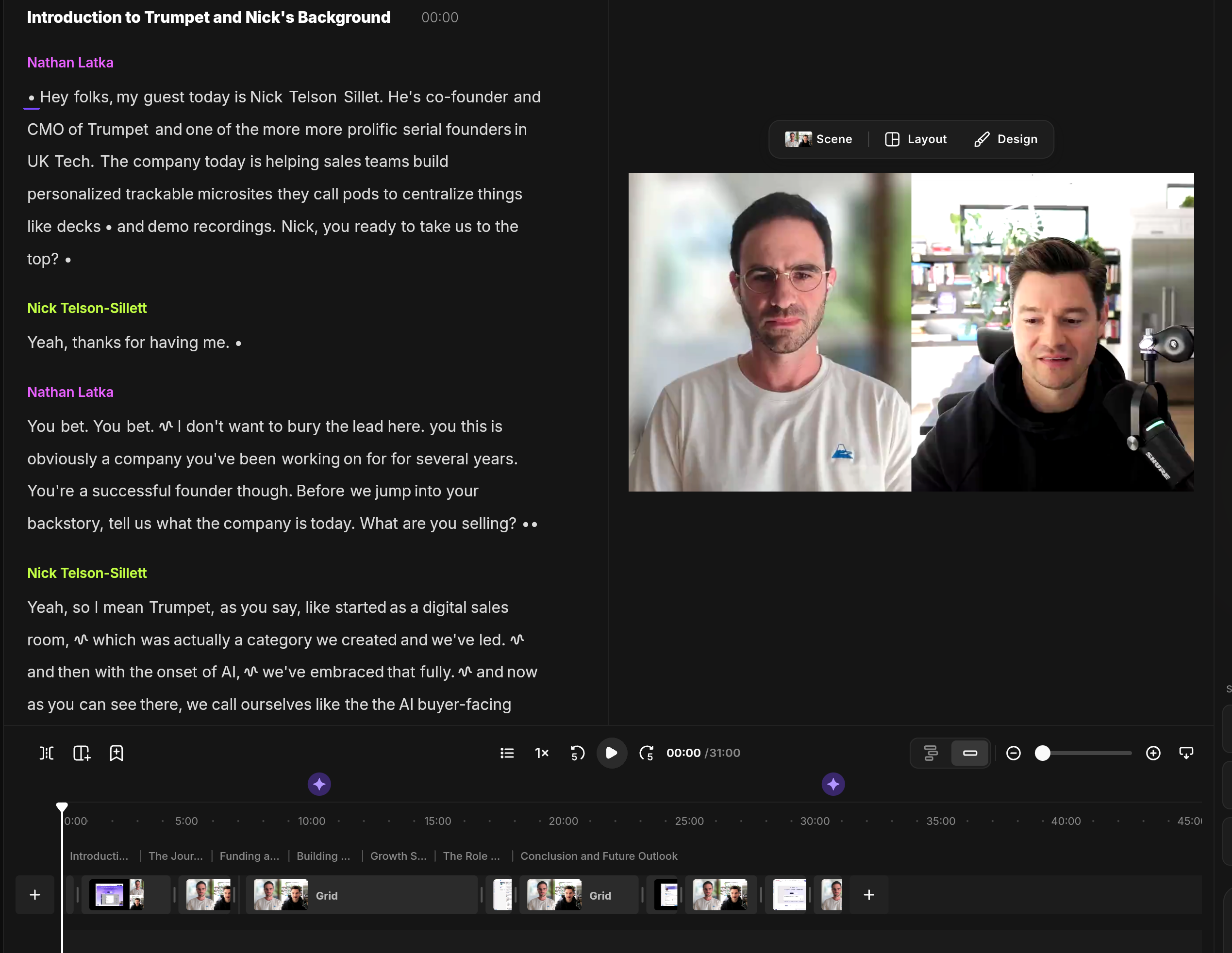
0:00Hey folks, my guest today is Nick Telson Sillet. He's co-founder and CMO of Trumpet and one of the more more prolific serial founders in UK Tech. The company today is helping sales teams build personalized trackable microsites they call pods to centralize things like decks and demo recordings. Nick, you ready to take us to the top?
Nick Telson-Sillett
0:19Yeah, thanks for having me.
Nathan Latka
0:20You bet. You bet. I don't want to bury the lead here. you this is obviously a company you've been working on for for several years. You're a successful founder though. Before we jump into your backstory, tell us what the company is today. What are you selling?
Product Overview: AI Buyer-Facing Execution Layer
Nick Telson-Sillett
0:33Yeah, so I mean Trumpet, as you say, like started as a digital sales room, which was actually a category we created and we've led. and then with the onset of AI, we've embraced that fully. and now as you can see there, we call ourselves like the the AI buyer-facing execution layer. So anything that you deal with the customer or prospect, we handle. So you can spin up microsites that all of you collaborate in. we hold all of your sales and customer success collateral, which you can share with the customer or prospect as well. And then the big thing is the execution layer is the the juicy data. So we can see who's in that that shared space, what they're doing, is it anyone you've met, are they important to get the deal done? and we can then execute with agents to help you move those deals forward on autopilot.
Customer Count and Key Logos
Nathan Latka
1:28And you're ca you just hit as of today a nice big customer number. Where are you guys at today?
Nick Telson-Sillett
1:33Well yeah, we've got over fifteen thousand revenue teams that that use us. teams like HubSpot, Gong, Stripe, so some amazing logos that we're delighted to be working with.
Nathan Latka
1:46You put in your bio though when you signed up for the show, you got it just passed, I think, five thousand paying customers. Is that accurate?
Nick Telson-Sillett
1:51Yeah, yeah. So fifteen thousand like users of the product as well.
Nathan Latka
1:55Does that mean there's five thousand like paying logos and they each have on average three seats per team?
Nick Telson-Sillett
2:00Yeah, I mean it varies wildly. So we have lots that have one or two and then we have others that have hundreds.
Backstory: Design My Night and the $30M Exit
Nathan Latka
2:06I see. I see. Okay. Take us more into the backstory here as we hop over to your LinkedIn profile. I had it up here. you've you've been around the block before. It looks like you were an SEO whiz back in your teenage years building this nightlife site. Tell us what happened with this business. Did this make you rich or what happened?
Nick Telson-Sillett
2:22Yeah, that was my first first startup, early twenties. it was I guess the easiest way to describe it was in London, it was a sort of open table, but for bars. So no one was looking at the bar scene. and we built a booking software like open table, but specifically for bars. we built a discovery platform as well. and yeah, we bootstrapped that. We raised half a million from Angels. we Took it to Exit, so about seven to eight years working on that. We took it to Exit for over thirty million dollars to a UK software house. so yeah, like that was my my first first go at being a founder and was fortunate enough to exit.
Nathan Latka
3:07Was at thirty million cash? So that I mean, that must have felt great. A lot of founders, when they have a success like that, especially after building for seven years, they tell me that they go into a state of depression.
Nick Telson-Sillett
3:18Yeah, I mean, I I had I wouldn't say depression for me, but I I did feel a sense of loss like that next day. You know, I was so involved in this business, it was everything I'd known, it was all of my twenties. so it is a very strange feeling where the next day you've sort of reached where you think is the peak of your Everest, but actually, you know, you need purpose in life. and that was my purpose was that company, it was everything I knew, everything I did. so then it's very strange like the next day to sort of have the your wildest dreams and all the cash that you want, but actually no purpose in your day to day. which made me then want to set up Trumpet 'cause I realised actually my purpose, my love is building companies and building teams and building culture.
Post-Exit Feelings and the Decision to Start Again
Nathan Latka
4:08There's a lot going here on your LinkedIn in between the exit in gen twenty twenty two and today, but it sounds like a lot of this is sort of filler or side things, podcasts, angel investing, et cetera. You basically went right into Trumpet like twelve months later.
Nick Telson-Sillett
4:20Yeah, like it w we we sold and then we had a two year earno and literally like two months after the earnout COVID hit. So you know, those plans of traveling for a year and having lots of fun were put on hold. So we were stuck at home, myself and my co-founder. and that's when we had that chat. We were like, Okay, what do we love doing? We'd invested in over like fifty startups in those couple of years as well. And while we enjoyed that, we realized it wasn't really fulfilling us, like, you know. Ancient investing is good and you meet lots of great people and you learn a lot, but actually you're not that involved in the companies. and I think Andrew and I are operators and we love to be involved. So yeah, we had a long chat of like shall we do it again? We had different parameters on what we wanted before we started another business and we had like six or seven ideas and we spent probably four or five months ideating on on those and seeing if they were a goer or not. And Trumpet was the only one that sort of stood the test of time. So then we were like, let's let's do it.
Nathan Latka
5:24What percent of the thirty million exit price was stuck in earnout?
Nick Telson-Sillett
5:29we were about sixty percent up front, forty percent on earnout.
Nathan Latka
5:33Okay, so call it ten million in earnout. Did you lose a bunch of that when COVID hit?
Nick Telson-Sillett
5:37No, because we we literally finished our earnout just as COVID hit. So we were incredibly lucky. because yeah, obviously nightlife and going out, you know, nothing happened for two years. So yeah, I thank the stars most weeks about that timing, to be honest.
Co-Founding Trumpet and Bringing in Rory Sadler
Nathan Latka
5:57So take us now into Trumpet. You went through a bunch of ideas through your co founder. You go back for round two here. Was the first line of code written in twenty twenty one?
Nick Telson-Sillett
6:05Yeah, yeah, yeah, yeah. So we actually so Andrew and myself aren't technical. We wanted to bring in a third co-founder for Trumpet as well. and the decision on that was we were like, if we're gonna go again, let's let's actually do what we love doing and let's try not do the stuff we don't love doing. so we decided to actually bring in a CEO, which is Rory, who we'd known for ages and is like an absolute sales guru. And because this was The idea was originally in sales tech. We wanted someone who like really understood the customer that we'd be selling to. I'm more marketing and brand, and Andrew's more of the operation side. So we wanted us three to make this really work. and it allowed Andrew and I to focus on the things we love, me brand. I built the whole brand, I still am CMO to date. Andrew deals with all the operations and product and then Rory like heads up the sales side of the business.
Nathan Latka
6:59Mm sorry, maybe I misunderstood this. who who's doing the engineering? Are one of the co founders leading the engineering team?
Nick Telson-Sillett
7:05No, so we we actually the the first iteration was with an agency that we knew and really like. and
Nathan Latka
7:12Who do you use? Which agency?
Nick Telson-Sillett
7:15their name has just escaped me.
Nathan Latka
7:18Must not have been that good if you don't remember.
Nick Telson-Sillett
7:20Yeah, I know. I'll send it to you after you can put it in the show notes.
Nathan Latka
7:23Mm-hmm.
Nick Telson-Sillett
7:24I'm getting too old, my mind's going. but
Nathan Latka
7:26I is it a smart strategy though, as a business founder to launch with an agency to like relying on them for all the tech?
Building V1 with an Agency and Early Revenue
Nick Telson-Sillett
7:34I get that question a lot. I'm very against like bringing in like a CTO straight from the bat. I think no startup needs a CTO. I think actually what you need is like a very strong engineer, like a lead engineer. And I I I see people hiring CTOs or co-found with a CTO because they need that technical skill, give them a lot of equity, have to pay big salaries because they've given them that CTO title. But actually You just need that proof point. You know, you just need that first iteration to get out the door without having to hire a CTO and give up a ton of equity. So it's unorthodox, but we decided to go down the agency route first, get that first product into people's hands. And then actually what we did is we went and got our lead developer who worked with us at Design My Night. and he came in as lead engineer and then he's become head of engineering and director of engineering. So he's then grown with us as well. and he has obviously very meaningful equity. but yeah, I I see a lot of people think you have to have like a technical co founder and both times Andrew and I haven't done that.
Nathan Latka
8:45So let's go back to the founding story. Then you use the agency to get the product launched. It's twenty twenty one. What did you finish twenty twenty one with in terms of revenue? Do you remember?
Pre-Launch Customer Discovery and Waitlist Strategy
Nick Telson-Sillett
8:54In the low like hundred thousand.
Nathan Latka
8:58How did it feel?
Nick Telson-Sillett
9:01It felt good to be honest, just to be out there, have people buying the product, proving the the point that we we thought we were trying to solve. When as I said, when we were ideating on Trumpet and spending like three or four months before we even built a single line of code or spoke to an agency, we spoke to over a hundred salespeople and we built like a notion page. Everyone we spoke to, was it a positive sentiment, negative or indifferent? what was their comments? What would they like to see in the product? And We did that for four or five different startups at the same time. And then Trumpet was the one that was like overwhelmingly positive. but then we took all of that learning, those ideas, those early ideas, built them into V1 of the product. And then obviously when we launched, we then had those hundred people to go back to and say, Hey, look, that thing we discussed that you were, you know, happy to give up your time to give me some feedback. Here's V one, you know, I'd love to give you a go on that. And we actually raised our pre seed. before we actually launched the product as well. And that was off the back of that like hundred people with their positive sentiments.
Nathan Latka
10:07How much did you raise in the pre seed in twenty twenty one?
Nick Telson-Sillett
10:09Pre-se we were about two million dollars. so we did a very
Nathan Latka
10:13Okay. Okay. And you'd been around the block.
Nick Telson-Sillett
10:16different yeah, I was gonna say we did a very different strategy because Design My Night was purely angel and bootstrap, but because Trumpet we knew could be bigger and global instantly, and we were creating this category, we wanted to go much quicker. I think as you're gonna say, I've been around the blocks, I had lots of contacts, I'd I'd been an angel investor, I knew lots of VCs as well. And obviously being a second time founder, you know, that gives you that that boost as well. So yeah, we were fortunate enough to raise pre product.
Nathan Latka
10:46Well, so how much equity did you give up in the two million pre seed round?
Nick Telson-Sillett
10:50I can't say exact figures, but the the valuation was over eight million.
Nathan Latka
10:56Okay. I how do you even set it when you're so early on like that? I mean, is it just sort of you put your finger in the air, you decide what you're comfortable with or what?
Nick Telson-Sillett
11:05I think we were looking at we sort of planned it like, okay, well, you know, how many rounds do we think we're gonna need to to to to to raise to get to a certain scenario where we're either profitability and the power's in our hands, or we just, you know, keep raising and revenue like keeps rocketing and we wanna, you know, go A, B, C, D. And and we sort of modelled out those scenarios. and Had decided how much we were happy to give away. We knew we'd have to raise again pretty soon if there was like positive sentiment and we could see traction. So we didn't want to give away too much. and then it was based on our knowledge. Like obviously we'd invested in lots of companies. So we were like, look, we've got this huge TAM, you've got two exited founders, and a third founder who's incredibly accomplished, who will be working with us. we had those hundred people that we that, you know, were were positive about the product in the main, we'd also launched our wait list. So we had thousands on our wait list as as well. so we did a big wait list campaign. So, you know, we weighed all that up and a a and came up with a a valuation that that fortunate enough we had lots of people that wanted to invest so we could like maintain that price high.
Nathan Latka
12:20Mm-hmm. So that was the plan obviously going in. You were determining how how do we get to profitability? How much are we comfortable sharing? Fast forward like four or five years. Are you comfortable sharing today? I mean, are you guys profitable now? Default alive.
Nick Telson-Sillett
12:32there's a view to profitability. So we are close to profitability. it's not miles it's not
Nathan Latka
12:36That's the political answer.
Nick Telson-Sillett
12:39it's not miles off. Like we we raised like a we've raised about eight, nine million in total now. and we've decided to give ourselves optionality. So we've got a ton of interest in VCs and we always have. but there is a a clear line of sights of profitability while still growing very quickly. So we've decided to give ourselves that optional optionality, get to profitability or as close as possible to show that it's an option and then decide do we keep growing like this or or do we raise another round?
Nathan Latka
13:13Let's just finish the funding story. Then when I want to go back to the product story and how you built the wait list. So you said you raised eight or nine million total today. We know where two million came in the pre seed. Where'd the rest come in?
Nick Telson-Sillett
13:23So our first backers backed us again and then we got a new lead investor who put in the the rest of that.
Nathan Latka
13:32So like what years? Like twenty twenty two, you brought another three million and
Nick Telson-Sillett
13:37Yeah, so it was twenty twenty. So we did a we called it a a pre seed boost, which was something we
Nathan Latka
13:44Mm-hmm.
Nick Telson-Sillett
13:45made up, which was like another million from our current backers, at a a slightly larger valuation, and then we did like a a seed pre seed round of like another six and a lot of that was taken from our our new lead.
Nathan Latka
14:03Okay, got it. So two million in twenty twenty-one, pre-seed boost of a million in twenty twenty two, and then like six million official seed in twenty-three. Okay,
Pricing Evolution from $40 to $100 Per Seat
Nick Telson-Sillett
14:10Yeah.
Nathan Latka
14:11got it. Cool. All right. Take me back to the wait. You mentioned something, a thousand's on the wait list. How did you build the wait list? There's people listening right now going, I'd love to have thousands on my wait list.
Nick Telson-Sillett
14:20Yeah. so the first thing we did, and it and it's something a lot of B2B founders don't think about, is brand. so like from day one, we wanted to build, I called it a B2B brand with a B2C flair. So if you look at our branding, if you look at our logo, the way we talk, is not like a you know a standard B2B sales software. and that attracted attention. So people were like, what what is this thing? People building. Rory and myself had then decided to go big on LinkedIn. So since I sold Design My Night, I then did a lot of work on building up my profile on LinkedIn. I then helped Rory to do the same. So I focused on founder content. Obviously, being exited founder, more people are willing to listen to you. Rory doubled down on sales content to show all of the sales stuff he'd learned. So we'd built up big followers, big following on LinkedIn for both of us. And then it was just like teasing the product. So like this is what we're building, showing screenshots of our Figma, showing wireframes of what we were building, the problems we're trying to solve, and just sort of teasing that in. We had like a very simple one pager website which was more about like getting people excited about what was coming. And because we were creating a new category, we could really get that excitement building, if you know what I mean. People were like, what are they trying to build here? and our merch, we then our t-shirts just became like a bit of a phenomenon. we built like very good quality t-shirts. It just had our little trumpet logo mark on the chest. Like we didn't put trumpet anywhere. and they're just really nice, cool t-shirts that people loved. people were signing up to the wait list, we were sending them a t-shirt. And no joke, people were like posting it in Slack sales channels about like the Trumpet t shirt. People were tagging us on LinkedIn when they got their t shirt. we tried to have a bit of
Nathan Latka
16:25How many t shirts did you end up shipping?
Nick Telson-Sillett
16:28I think we must have shipped in those early times pre-product about four hundred.
Nathan Latka
16:37Wow, okay. Yeah, and I I you you
Nick Telson-Sillett
16:38So a lot.
Nathan Latka
16:39talked a little bit about this too in this LinkedIn post. That's where I'm generating some of my questions from. But it sort of it matches up pretty directly with what you just articulated.
Nick Telson-Sillett
16:46Yes. Yeah, yeah, yeah. and then yeah, the we used at the time a a product called Viral Loops, which was like, if you want to get up the wait list, you need to like promote us and talk about us. because people were like we you know, we were like, you know, as founders, you're at you know you're just gonna let everyone on anyway. But we were like, you know, we're gonna let the first hundred on, get your feedback, use it, get that FOMO building. So then yeah, we use that viral product. to be like, okay, well if you share us, share the link, talk about us. If people sign up to the waitlist via your link, you will move up the the funnel and you'll get our merch. and yeah, people connected with it.
Funding History: Pre-Seed, Seed Boost, and Seed Round
Nathan Latka
17:27Yep. Let let's put real quick just to how you've grown your LinkedIn profile. So you know you're at 40,000 followers now. And I think this is maybe a good time just to go back. I was looking with my team. I mean, you were promoting hard sort of your the pitch deck. you were building media here. It was on Spotify. You quit though after season six. There's a lot of founders that really are trying today to build their own media brands and they're finding it very, very difficult. What were you trying to build here? Why'd you quit? What are you doing now instead?
Nick Telson-Sillett
17:55Yeah, so Pitch Deck was an idea I had that was sort of like a real dragon's den or you guys like Shark Tank. you know, I watch those shows and it's not the reality. and what I wanted to do, I just came up with this idea of a half an hour show where I bring one of my angel investor friends on the show with me. We have a founder pitch us for like two minutes, and then the twenty minutes is actually like us quizzing that founder as you would. in a Angel Investor meeting. so sort of lifting the lid on what angel investors ask founders. And then at the end of it, the angel investor and myself did like a five minute summary of what we liked, what we didn't like. We were very clear with the founders that would come onto it, that it might not all be positive.
Nathan Latka
18:40But but Nick, tactically, like I know that's what the show's about. But tactically you can have the best concept ever. But if no one watches, you're gonna lose motivation and quit. So like why do you think more people didn't download it and why'd you strategically decide to quit it?
Nick Telson-Sillett
18:52So I got got really good downloads, like thousands were watching the episodes. and and a bit of that was like Ego Bait, as you call it. So obviously the ancient investors that I were bringing on had a following. So like they were sharing it with their network and same with the founders that I picked to go on it, they also had had a following, a lot of them. So they were all sharing the show. Obviously I had built up my network on LinkedIn as well. and the content was just good. why I decided to quit was it was just too much work. to do that and run Trumpet. Like Trumpet has then become successful and is like way beyond even a full time job like any founder is used to. So the effort to create high quality just became too difficult for me to keep up. It might
Nathan Latka
19:36Yeah.
19:36be something I go back to after Trumpet.
19:39It's a hard it's a hard it's a hard thing to do. let's put it back to Trumpet. talk to me a little bit about how you did pricing. So are you comfortable sharing what the average customer pays today? And then tell me if that was always the case or if you've increased prices over time.
Nick Telson-Sillett
19:52Yeah, so we started relatively cheap, I would say, as probably a lot of founders do. So we were probably around like the forty bucks a month for seat type pricing, seat pricing. and how did we come up with that pricing? We were sort of looking at other RevTech, sales tech products in the space that were serving a similar ICP to us. And to be honest, just shot somewhere in the middle. you know in my mind you never want to be too cheap. You want people to value your product, but we weren't confident enough to go to the top end. and then as as the product has grown significantly, we were able to then introduce the tiers. and actually in the last I would say year and a half, two years, 90% of our customers are on the top tier, which is around a hundred bucks a month, just because of the value that we put in that top tier. and the ROI that you get for Trumpet is is quite obvious, so it it is value for money. and now we're obviously weighing up how we price AI into the product as well.
Growth Tactics: LinkedIn, Clay, and Signal-Based Outbound
Nathan Latka
20:58So I guess ki so can we take the the five thousand paying customers times a hundred bucks a month? That would put you around five hundred grand a month of revenue today. Is that directionally correct?
Nick Telson-Sillett
21:09yeah, I would say we're we're north of yeah, what I can say is yeah, like we're like we're north of like eight million at the moment.
Nathan Latka
21:16That's a you sort of shake while you say that, but that's exciting. That's impressive. Congratulations.
Nick Telson-Sillett
21:20Thank you. Yeah, yeah, no, like we're we are we are super pleased we're growing really quickly, but yeah, always looking to do more and quicker.
Nathan Latka
21:28Anytime a anytime a founder has has raised less than their ARR, I just think that always deserves a massive pat on the back. It shows that you're using creativity to win market share versus just throwing money at problems.
Nick Telson-Sillett
21:40Yeah, I mean, totally agree with that. Not giving myself a pat on the back, but yeah, not you know, we're we're very big on that is like, okay, every dollar we spend, and and we said that when we were raising VC, all three of us were like, that does not mean we're just gonna blow this money to grow revenue and then be able to go and raise another round, especially if you want to get to profitability. So, you know, the the tactics we use to grow Trump bit and you know, and we've thrown a lot at the wall over the years. But then we've like really doubled down on the things that are working, and and spent that money very carefully.
Nathan Latka
22:16What has growth rate looked like if you're at about eight million AR today, where were you one year ago, like December twenty twenty five?
Nick Telson-Sillett
22:22Yeah, we're growing like over like a hundred and fifty percent on last year. and and and then
Nathan Latka
22:28Okay. So you were like three, four million end of year last year and you'll break, you know, nine, ten million end of year this year or something like that.
Nick Telson-Sillett
22:35Yeah, we'll yeah, we'll be hoping to get over that in in fact this year, yeah.
Nathan Latka
22:38Yeah, very cool. Okay. Talk to me about what is working today. How are you getting customers today?
Nick Telson-Sillett
22:45So yeah, like again, one thing is is brand. So personal brand, it it gets us a lot of customers. So sharing like really useful content on LinkedIn. we're lucky, our ICP being salespeople and customer success people are on LinkedIn. so I think it's often a a medium that's frowned upon in the social media world, but for us it it it
Nathan Latka
23:03Nick, how do you actually do it though? Right. People hear, you know, founders say stuff like what you just said on my show. And they go, Nathan, what does that actually mean? Yeah, he has 40,000 followers, but how is he actually getting customers from his LinkedIn posts?
Nick Telson-Sillett
23:14Well, I guess it's it's it's a mixture for me. It's a mixture of like like teasing stuff that Trump is doing and also giving advice. So it's like very useful content. It's not like AI slop, I'm big on that. And then obviously it's having the we built a huge go to market engine behind the scenes of that. So it's not just like posting and getting engagement and leaving it at that. It's we are like scraping all of our engagement. That then goes into clay, that filters everyone.
Nathan Latka
23:41What what tool?
Nick Telson-Sillett
23:44So we use well we actually built our own tool to to scrape AI, to scrape engagement from LinkedIn. We then push that into clay to enrich all of that and filter out by ICP and check against HubSpot, which is our CRM. and then we use like HeyReach to like automate LinkedIn, we use instantly to like automate email outreach. And now we've like plugged in obviously Claude or Chat GPT to like personalise the messaging. so it's like knowing who engage, what they engage with, what may have interested them, sending them personal messages, sending them personal connections. we also don't do everything on autopilot. So like after Clay and it hits Hubspot, like if it's like a peak persona at like a very good customer, we will flag that to us and we will personally outreach to them. or personally send that to one of our AEs to personally outreach. 'Cause I'm a big believer
Nathan Latka
24:44Well, so what are you automating? I mean, a lot of people are very nervous about attaching like Hay Reach or or things to LinkedIn because LinkedIn is so valuable for the business. You don't want to risk getting stopped, like shut down by LinkedIn because you breach an APA API limit. So what are you using Hay Reach for?
Nick Telson-Sillett
24:59It's it's for like connecting to the right people and then sending them a message,
Nathan Latka
25:03Mm.
Nick Telson-Sillett
25:04but within the parameters. So yeah, it's not sending
Nathan Latka
25:07I see.
Nick Telson-Sillett
25:08like a thousand connections. and
Nathan Latka
25:10I T
25:10like via Clay and our HubSpot where we set up lots of segments, like we are prioritizing. So then we're giving the priority score to all of our engagement. And and and that, you know, the secret to growing B2B, I think in this world right now, where number one is Outbound is so noisy. and number two, it's there's so many different ways to generate signals. That's how I look at marketing at the moment. Is how can I generate a signal? And that might be our LinkedIn, it might be a webinar, it might be a report that we've launched, it might be a LinkedIn ad, it might be a Google ad, it might be a dinner, it might be an event we do. All of these things, all all we do them for is to generate signals that then go into clay. that then goes into HubSpot, which we then score and then decide how we're gonna outbound to them. So it's like very meticulously done and it's taken us years to build this.
Partner Co-Marketing and Go-to-Market Engine
Nathan Latka
26:08So just to be clear, all those things you just listed are actual things you're doing. You're running webinars, you're doing dinners, you're doing obviously LinkedIn.
Nick Telson-Sillett
26:16Yeah, yeah, yeah, yeah. So yeah, we we have like five or six things that we do regularly that generate signals for us. and also then look to work with partners. So it's like, okay, well what partner, you know, we're very close with like Gong or we're very close with HubSpot or Consensus, who we integrate with and are customers of ours. So the story makes sense. so it's like, okay, what can we do that's, you know, co with them and lean on their brand and their marketing as well.
Nathan Latka
26:42And so sort of going forward, you know this because you're an investor, right? you your last rate, like once you raise, you sort of have to be raising every twelve to sixteen months, right? Because that's just the nature of power laws, right? You haven't raised right since twenty twenty three. You said you have a path to profitability. You know, a lot of people don't want to go test the market right now. We just saw the air table deal this morning, which basically traded at, you know, however you want to do it, whether it's a one point two billion exit after you take out their cash on four hundred and thirty million of ARR, but it's not good times for SAS right now. So How are you thinking about like are you more likely, am I more likely to read press from you in the next twelve months that you raise a big round at a down round or or a flat valuation or that you hit profitability and you're default alive?
Path to Profitability vs. Raising Another Round
Nick Telson-Sillett
27:23To be honest, we just want to get that optionality to be able to choose. Like the we have a ton of VC interest and have done over the last two years. So for us, if we do raise a big round, we are confident it will it will be at a big valuation. Like we're growing incredibly quickly. The AI we've just launched is like game changing. The usage is super high.
Nathan Latka
27:43Can you tell us about that? What is the AI just as the in the last sixty seconds here? What is this new AI product?
Nick Telson-Sillett
27:49Yeah, so basically w Copilot basically allows you to do it the whole product that we built over the last four years on autopilot. So basically you can drop in a co g gong call and then from that we have trained agents in the background that will pick up that gong call, we'll analyze the gong call, we'll pick out the key points, we will build your sales room for you automatically, we will build a mutual action plan, we'll build an executive summary, we'll build the key points from the call. and then you send that to the customer. So it does that all on autopilot. and then you have that space with the customer. And then anything that the customer does, you know, co-pilot can pick that up and be like, okay, well, the head of finance has just come into our space. Let's look at that head of finance. Have you got any content that's relevant to that head of finance? No. Okay. We've got vibe coding in Trumpet now as well. So it's like, let's build some c content or a tool. that will be relevant to that head of finance and drop that in the space. So it's constantly reading all the data and then it's smart enough to like go to CMS and find the right data, vibe code some content or some tools that are relevant to that person. And it just allows reps to like execute at scale super quickly but super accurately. And then we've got the MCP within Copilots. You can connect HubSpot, you can connect Notion, you can let Google Workspace. So it just has full context of the whole deal and we're sort of the only tool that has the full context of everything that's going on in the deal because we connect goal, we connect HubSpot, Salesforce, and then we have all that bar engagement data as well. So we actually have the full picture of the day of the deal, which no one else really has.
New AI Copilot Product Walkthrough
Nathan Latka
29:33Nick, we hope obviously the new AI product takes off. On that note, where can folks follow you online?
Nick Telson-Sillett
29:38so as as you guessed, probably best to find me on LinkedIn. so yeah, drop me a connect, engage with in my content and I'm always happy to help founders as well.
Nathan Latka
29:48Guys, revenue data rooms first code launched in 2021. His first big exit though was much earlier. Sold a company for 30 million bucks all cash, got his earnout, left after COVID, and went for round two with his from his or with his original co-founder here to build Trumpet. added a third co-founder in 2021, got 300k of ARR after a thousand plus folks on their wait list. Giving out t-shirts proved to work very well with some viral coefficients. built in there to the wait list gamification process. Ultimately use that to raise a precede two million round. And north of an eight million valuation in 2021, our poo back then was like forty month, forty dollars per seat today. it's almost tripled, a hundred bucks per month on average, over eight million bucks of revenue, five thousand customers with a clear path to profitability as he's fending off VC interest. Nick, thanks for taking us to the top.
Nick Telson-Sillett
30:37Thanks so much for having me, really appreciate it.
Nathan Latka
30:40All right, guys, cut. Nick, what do you think, man? You have fun?
Nick Telson-Sillett
30:43Yeah, all good. Really enjoyed it.
Nathan Latka
30:45Cool man. Thanks for coming on. Well, my team will have fun in post production. If there's anything you want us to include that we didn't cover live, links in the description, things like that, just feel free to message it over.
Nick Telson-Sillett
30:54Sounds good. Thanks a lot.
Nathan Latka
30:56You bet. Thanks for coming on.
Nick Telson-Sillett
30:58Big scene.
Nathan Latka
30:59See ya.