
Each Tuesday, we reverse-engineer a real SaaS company's revenue, profit, CAC, funnels, and its top growth tactic.
Sign up to access all features
Sign up with GoogleSign up with LinkedInAlready have an account? Log in
GetLatka is trusted by 200k+ founders, researchers, and marketers.
No contracts, cancel at any time
Founder Interview
Company Metrics at Interview Time
Current ARR
$420K
Peak Revenue Year
$1M (2023)
Free Users
10,000,000
Paying Customers
2,500
Team Size
12
Historical Snapshot
These numbers were reported by Tao Feng during his interview recorded in July 2026 and represent a historical snapshot of VanceAI at that point in time, not current figures. See VanceAI’s current numbers.
| Metric | Value | Source |
|---|---|---|
| Peak Revenue (2023) | $1M | Founder interview, July 2026 |
| Revenue (2025) | $800K | Founder interview, July 2026 |
| Monthly Revenue (June 2026) | $35K | Founder interview, July 2026 |
| Annualized Revenue (2026) | $420K | Founder interview, July 2026 |
| Free Registered Users | 10,000,000 | Founder interview, July 2026 |
| Paying Customers | 2,500 | Founder interview, July 2026 |
| Team Size | 12 | Founder interview, July 2026 |
| Year Founded | 2020 | Founder interview, July 2026 |
| Model Parameter Count | Less than 1 billion | Founder interview, July 2026 |
VanceAI peaked at over $1M in revenue in 2023, roughly three to four years after its 2020 founding. Revenue declined to $800K in 2025 and further to an annualized $420K as of June 2026, driven by increased competition from general AI platforms adding image enhancement features.
The platform has 10 million registered, email-verified free users globally. Paying customers number approximately 2,500, reflecting a very low free-to-paid conversion rate that Tao Feng attributes to low-demand users exhausting the 5 free trial credits without needing more.
VanceAI operates with a team of 12 full-time employees. The team includes experienced AI researchers who design and train the company's proprietary models.
VanceAI is fully bootstrapped with no outside capital raised. Tao Feng confirmed the company has not taken investment and has funded its research and operations internally.
VanceAI drives the majority of its traffic through free AI tools that rank organically in search. The site receives approximately 83,000 organic clicks per month, with the Make Photos HD tool alone generating about 28,600 clicks per month.
Users can rate outputs from one to five and indicate preferences between before and after results. This preference data feeds back into model training, creating a continuous improvement loop that Tao Feng credits for the model getting better over time.
VanceAI built its initial training dataset from a combination of publicly available datasets and data acquired through its other software products. This proprietary data advantage supports model differentiation from open-source baselines.
Recognizing the decline in image processing revenue, VanceAI is pivoting toward video enhancement tools. The company sees demand from AI video creators who generate lower-quality outputs and need upscaling to 4K with cinema-quality results, and already has over 1,000 video processing users.
VanceAI is applying the technology and architecture learnings from its image models directly to its video models, reducing the research cost and time needed to build competitive video enhancement capabilities.
“We have our own in-house developed AI model. the technology is different with others. And we have like over 10 million users and we have many user feedback to help us to refine our models. So basically it's a It's a closed loop for us to improve our models step by step. it's become better and better.”
“we have user preference for each processing and we use that as an input. to train the model again and again. So basically the model getting better. It's like this way.”
“We changed the model from scratch. The model is not as big as the current model. So this is like less than 1 billion. The model size is not very big because it's only for the process for the image.”
“for the image processing, the highest revenue year is 2023. So basically, we start from 2020. So after three and a... three to four years, we reached highest revenue as of the year. And that year, the revenue is like over one million US dollars. That's the top revenue.”
“For 2025, it's like, I will say like 0.8 millions.”
“I think the biggest chance for us is we released the video processing models recently. We see a big change, difference from the image processing. I think it's a big change. big opportunities, the video enhancement and more and more AI GC, AI generated video are getting more and more popular.”
“We are betting on the future. The future is the video model. And we have seen the horizon for the video processing. We have over 1,000 video processing users for now. And we see a very good chance that this kind of user use the AI processing much more frequently.”
“if only with the image processing there is no way to make this business successful. So I agree with you. If we only have this image processing, we may shut down the company and do something else.”
This interview captures VanceAI at a pivotal moment in July 2026, when the company was transitioning from a declining image enhancement business toward a video enhancement product it hopes will drive renewed growth. At the time of recording, monthly revenue stood at $35,000 and the team was 12 people strong, all bootstrapped. The numbers and strategy described here reflect the company as it stood during this conversation and may have changed significantly since. Visit the VanceAI company profile on getLatka for the most current reported figures.
View VanceAI’s current profile and metrics| Organic Clicks Per Month | 83,000 | Founder interview, July 2026 |
| Clicks Per Month (Make Photos HD tool) | 28,600 | Founder interview, July 2026 |
| Video Processing Users | 1,000+ | Founder interview, July 2026 |
| Free Trial Image Credits | 5 | Founder interview, July 2026 |
| Subscription Price | $17/month | Founder interview, July 2026 |
“Some users only have several images to process. The requirement is not very strong. And we offer five free image processing for the trial account. So some users will only process with the free account.”
“the recent research lead us to the diffusion-based model. And we also are researching the merged model from the CNN-based and the diffusion-based. So we kind of do the frontier research for the processing models.”
Nathan Latka
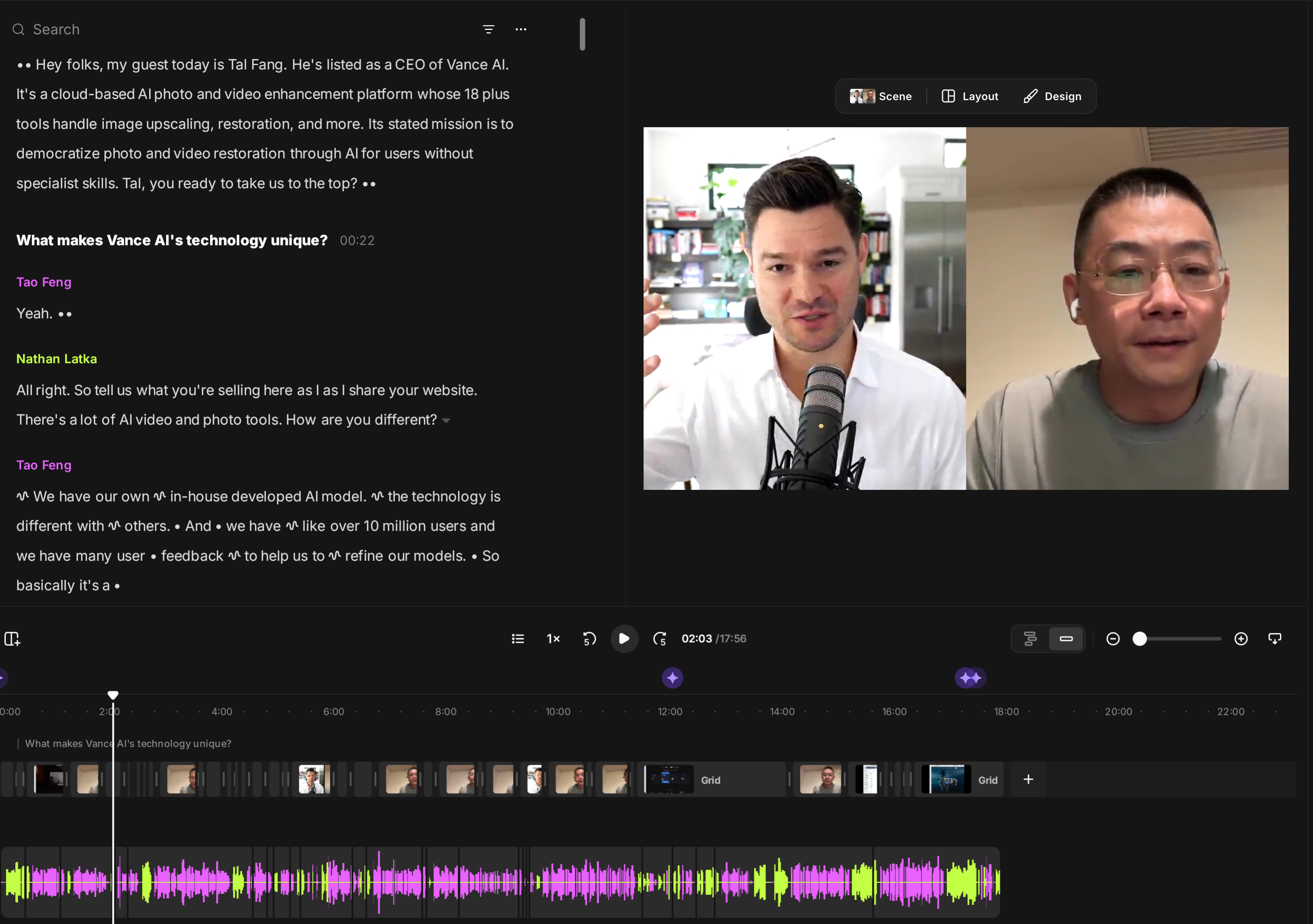
0:01Hey folks, my guest today is Tal Fang. He's listed as a CEO of Vance AI. It's a cloud-based AI photo and video enhancement platform whose 18 plus tools handle image upscaling, restoration, and more. Its stated mission is to democratize photo and video restoration through AI for users without specialist skills. Tal, you ready to take us to the top?
Tao Feng, CEO
0:22Yeah.
Nathan Latka
0:23All right. So tell us what you're selling here as I as I share your website. There's a lot of AI video and photo tools. How are you different?
Tao Feng, CEO
0:30We have our own in-house developed AI model. the technology is different with others. And we have like over 10 million users and we have many user feedback to help us to refine our models. So basically it's a It's a closed loop for us to improve our models step by step. it's become better and better.
Nathan Latka
1:07Can you tell me more about how you built that closed loop system to just help your foundation or your model learn faster than anybody else?
Tao Feng, CEO
1:15Yeah, we have many different ways to help us to tell us their opinions. Like they can rate our output from one to five and they can tell us which one they like more from the before and after process. So basically we have user preference for each processing and we use that as an input. to train the model again and again. So basically the model getting better. It's like this way.
Nathan Latka
1:53Is your background in engineering? I mean, how do you know how to build a powerful model that is a closed loop learning system?
Tao Feng, CEO
2:00You mean for me as an engineering?
Nathan Latka
2:02How long have you been doing this though? Help us understand more about your background.
Tao Feng, CEO
2:06the website was started back to 2020. So for now it's like, over five years in the six years and, Yes, so we have been here for over five years.
2:27And when you say you built your own model, can you tell me more about what you mean by that? You know, did you train from scratch or fine-tune an open source base? You know, what architecture did you use? Diffusion transformer, or you know, how many parameters, how big is the model at inference?
Tao Feng, CEO
2:40We changed the model from scratch. The model is not as big as the current model. So this is like less than 1 billion. The model size is not very big because it's only for the process for the image. And we built our own dataset from our other software. The initial model is not that complete. As I said, it's iterated many versions. So we're still training the new version model. The initial model is a traditional CNN-based model. We improved the architecture. many times, many versions. And the recent research lead us to the diffusion-based model. And we also are researching the merged model from the CNN-based and the diffusion-based. So we kind of do the frontier research for the processing models.
Tao Feng, CEO
4:03For anyone else building, maybe not in your direct space, but they're trying to build their own model, one of the big questions is obviously what initial data do you train on? You mentioned you have some other softwares. Is that what you trained your initial V one model on? Was data sets from your other software companies?
4:20Yeah, we have are. Yeah, we have a different software's and. We. Basically, we get the image from different ways. Some are public available data set, as you know, and some are acquired for the business model, business acquired.
4:48And when you're building this initial model with this initial data set you just articulated, how many GPUs did you train on and what did a full training run cost?
Nathan Latka
4:55For the image mode, as I said, it's not that big. So basically we can change on some consumer GPUs. But the times maybe for full training, maybe one or two weeks to a full train.
Tao Feng, CEO
5:13Well, that's that's very nice. What I'm trying to get at is have you been able to do this bootstrapped, right? What did it cost you to process one image and how is that trended? This ties directly to whether, you know, your ten million users are profitable or not.
5:24You mean for the inference time? Just wait for the.
5:29I guess the easy the easy question would be have you bootstrapped this or raised capital?
Nathan Latka
5:33yeah, yeah, yeah. It's bootstrap. So we don't have capital for this.
Tao Feng, CEO
5:39Okay. This sounds like expensive though to get going. How I mean, how much did you put are you already wealthy? Did you just invest a bunch of your own money?
5:47Yes, as I said, have... Yeah. I think the training, the hardware is not the most expensive part for such project. The research is expensive, even in China. So we basically have many, we have several...
5:49Ha ha.
6:14very experienced AI researchers, they know how to design the model and they know how to train the model.
Nathan Latka
6:19How many people are full time today at the business?
6:2312.
6:25Okay, got it. So there's twelve people. And I guess so that's a smaller team than I would have expected, right? What can your model do that, you know, real, you know, ESR GAN out of the box can't?
Tao Feng, CEO
6:37We do the comparison with the EScan and that's a very good start point, I mean. And we have done a lot of improvement from that, from the model and the dataset. I think it's... The fundamental part is the same. It's still CNN-based. So it's not a complete different story, there are many small improvements over that. I think it's basically we have some evolution to compare the different versions. So we know we are... making improvements from the last version. And the user feedback also confirms that.
Nathan Latka
7:34Can you tell me more about how many of the ten million free users you've converted into paid today?
Tao Feng, CEO
7:41We have 10 million users, registered users. We verified their emails. So basically, you can say they are free users. And the conversion rate is low because we are offering to the global website. So there many from, you know... developing country, as it will register account. we have, I mean, for the image processing, the highest revenue year is 2023. So basically, we start from 2020. So after three and a... three to four years, we reached highest revenue as of the year. And that year, the revenue is like over one million US dollars. That's the top revenue. And after that, as you know, the AI, the Shared GPT and JMNI, many different AI apps they provide. image enhancement features and image generation, something like that. the revenue is going down for the image processing from that year.
Nathan Latka
9:17When look at total revenue in twenty twenty five across your entire business, what was that?
Tao Feng, CEO
9:22And for 2025, it's like, I will say like 0.8 millions.
9:29So twenty twenty five, your total revenue was eight hundred thousand dollars per year. And what do you think you'll grow to here in twenty twenty six, Tal?
9:37For the image processing, it's still going downside. And I think the biggest chance for us is we released the video processing models recently. We see a big change, difference from the image processing. I think it's a big change. big opportunities, the video enhancement and more and more AI GC, AI generated video are getting more and more popular. And we see many creators are using different AI video generation tools to create lower quality videos like 720 videos and we Our advantages we can upscale a low quality video to even 4k videos and the best part is the output video will have cinema quality video like Hollywood style so basically the creator can have highest quality videos from the AI generated low quality video and we see a big chance big change for this move
Nathan Latka
11:17So Tal, when you add up all of your revenue just from last month, right, you're charging seventeen dollars a month, and this is for both image and video workspaces. So when you add up all of your revenue last month, how much did you do in June of twenty twenty six?
Tao Feng, CEO
11:29It means last month it's like 350k
Nathan Latka
11:32Yes, in June. Okay. So three hundred and fifty K and is the majority of that monthly revenue coming from your your video tools or your image tools?
Tao Feng, CEO
11:42Mm-hmm. mostly image tools.
11:50Okay, so still image.
11:52Yeah, yeah,
11:54So can I take three hundred and fifty thousand dollars a month? That means you're on you know, you're doing four point two million dollars of annual recurring revenue and it annualized.
Nathan Latka
12:03Sorry, I mean for last month.
12:05If I take Yep.
Tao Feng, CEO
12:08No, my mistake. mean, for the last month, the total revenue is... 35k
12:20Okay. So thirty five thousand dollars per month. So you're annualizing to four hundred and twenty thousand dollars per year in revenue currently.
12:27Yes, for the image.
12:30So Tal, your your business is declining, right? You're a smart I can just I can feel it based off the answers earlier to my technical questions. You're a you're a talented engineer, you've built something, you know how to get customers and a lot of free users. Why not shut this company down since it's shrinking and go invest your time and energy in something else with more potential?
12:47We are doing that. We are investing on the video enhancement models. So we inherit many technologies from the image processing model. And we invest on the video enhancement model for the video enlargement and different processing models for the video. I think that's the point for the future.
Nathan Latka
13:21Okay. And if I take thirty five thousand dollars per month right now in revenue divided by sort of an average price point of around fifteen or sixteen or seventeen per month, that would mean you have about two thousand three hundred paying customers. Is that about right?
13:33Mm-hmm. Yeah, something like that. More than that, but similar.
13:43Okay. If we take ten million free users, right, and then the two thousand five hundred paying customers, it's a very, very, very low free to paid conversion rate. You know, world class free to paid conversion rate would be something like three to five percent. What's your current thesis on why your free to paid conversion rate is so low?
Tao Feng, CEO
14:01Yeah, I think the terminal is, we need to explain it. So as I said, the 10 million is the registered user. We verify the email, but you know, the terminal is very deep and the user have to try our AI processing function and The problem is like this. Some users only have several images to process. The requirement is not very strong. And we offer five free image processing for the trial account. So some users will only process with the free account. If they don't have a high demand, high amount demand, so they don't like to pay. So.
15:06Yeah, this is a big question. I mean, when I look at your website SEO structure, you're getting about 83,000 organic clicks per month. And a lot of that comes in through your Make Photos HD tool, which is getting about 28,600 clicks per month. This correlates nicely to how you structure your website. You've got these image tools that get a lot of free traffic. But how do you change this towel from a collection of free tools? Right into a business that's a full product suite that can scale to a million, five million, a hundred million of revenue.
Nathan Latka
15:37Yes, I have to agree if only with the image processing there is no way to make this business successful. So I agree with you. If we only have this image processing, we may shut down the company and do something else. But for now we see a... Yeah. So...
Tao Feng, CEO
15:58So you're betting it all on your image model.
Nathan Latka
16:04We are betting on the future. The future is the video model. And we have seen the horizon for the video processing. We have over 1,000 video processing users for now. And we see a very good chance that this kind of user use the AI processing much more frequently. And the video processing uses more AI tokens. So basically, they will use these features much more frequently than the image.
Tao Feng, CEO
16:48Yep. Well, Tao, very good. I've enjoyed learning more about your business. Guys, Tal launched his business in 2020, built his own image model, scaled that up to his highest revenue year in 2023 of a million dollars that year. They've now shrunk a little bit. Last month they're doing $35,000 a month in revenue, and he's betting everything on moving from just being a suite of image tools. to video tools, increasing the quality of the videos. They're investing a lot of money there in hopes to turn the company around and scale again. Tao, thanks for taking us to the top. And if you guys want to follow his story, go check out Vanceai.com. Tao, thanks for taking us to the top.
Nathan Latka
17:24Thank you very much. Listen, thank you.
17:27You bet. All right guys, cut. Tal, what did you think? Did you have fun?
17:30Yeah, yeah. I think you are very sharp and then you asked the correct question. So very good.
17:32Awesome. Well, congrats on what you've built. Come come back on in six months and tell us how the video product is doing, okay?
17:46Yeah, sure, I'm looking forward to see you again with more success.
17:48All right. Me too, Tal. Take care. Good to meet ya.
Tao Feng, CEO
17:55Thank you. Bye bye.