

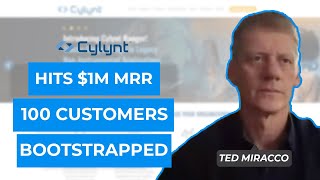
 Watch: Cylynt Security SaaS To Break $10m Up From $6m Last Year, Bootstrapped
October 2021
Cylynt Security SaaS To Break $10m Up From $6m Last Year, Bootstrapped
Read the transcript
hello everyone my guest today is ted morocco he is a co-founder and ceo of silent a cyber security firm that provides sas based anti-piracy license compliance and software monetization technology for the world's leading software companies before that he was co-founder of the eda company awr corporation which was acquired by national instruments in 2011. awr a leading high frequency analog design company has played an important role in the design of semiconductors used in locations all right ted you ready to take us to the top absolutely yeah let's get started nathan all right for folks that haven't heard of silence maybe they're not in the security space what do you guys do uh basically what we do is we we uh we started out addressing piracy so software piracy as i think everybody knows is a big deal um we're honest in a specific area of anti-piracy where we're not really concerned about music or consumer piracy but um companies that are that are using inappropriately software licenses for expensive uh applications so design tools so my background a lot was from semiconductors and semi the semiconductor industry was one of the industries that um i had a front row seat to a great deal of piracy you know with my previous company and we started this company me and my co-founder chris lauten uh we worked together on the piracy problems while i was at awr and when we sold the company i became really excited about you know taking everything that we had learned over the years of working together and starting another company a commercial venture to really help uh primarily on premise software vendors deal with piracy and since we've done that the company has evolved we're now working on usage analytics and we're we've expanded our perspective and we've rebranded as silent you know today as part of a broader vision to give on-premise companies on-premise software vendors the same kind of visibility that sas companies have where you can see who's using the technology are they properly licensed are they using all the features and the functionality in the tools and how can you use that um data to really generate more revenue so i'm not sure i'm following can you can you tell me well first off what year did you guys launch the company uh we launched it in 2014. okay 2014. and sorry when did when was awr required awr was acquired in 2011 and i stayed for three years during i was down there with you and frequently in austin uh with with national instruments during the transition and after we had transitioned the company um i left in 2014 and be became a co-founder with chris at uh what we were then called smart flow compliance solutions okay and what um what was the sale price back in 2013 for awr yeah um it wasn't disclosed i i i guess the public information there was an earn out it was a little complicated but i think the the publicly disclosed number was 57 and then there was like an earn out that was quite a bit more that brought the number up you know i i see and it looks like it was just it was just resold recently for like 160 million by cadence right correct yeah so cadence design systems bought it from from uh national instruments yeah for around 160 correct yep interesting okay cool so you then use that capital to seed silent in 2014 with your partner is that accurate correct yeah we chris and i chris is also a successful entrepreneur he has another company called itca with very strong cash flow i had you know kind of income or from the sale of awr so we bootstrapped the company for the first couple years we became profitable around 2018 and um you know the companies has no funding you know we're we're self self financed and and we're profitable and we love that how much did you guys pump into the company yourselves personally before you turn profitable in 2018 do you remember not yeah of course you remember i had to write those checks um we we put about uh probably in two to three million dollars into the company over over that period of time um but you know we were we were pretty close to break even early on and and we didn't invest that far ahead of the curve but um you know we we were we were always we were we were well run you know and and pretty fiscally conservative through the early years um and yeah i don't regret that at all you know we could have raised money at the time but you know the dilution in the strings that can come with the early funding it can be very dilutive to founders so i would advise against that if you have the financial wherewithal to not have to do that and help me understand today when companies are paying you for your technology what are they paying you per month on average um around around a thousand dollars per how many users the most companies yeah uh probably around uh 10 i would say on average and we have about you know we we have a couple with with close to 100 users so they kind of tip the scales a little bit but i would say we have about 1500 users that's great across how many companies are brands uh around um a hundred less than a hundred yeah okay so take me back to your first customer you sold and and what was the pitch then what did you sell them okay so um part of what really made this company possible was the completion of a um a legal case that i was involved in against a chinese telecom company that was stealing the awr technology and we won a very significant summary judgment against this company and it became very um um newsworthy so uh some of the other companies in the in the electronic design automation industry in the semiconductor industry noticed this and when i left the company i brought a lot of credibility because i kind of was involved in proving that you can protect it number one this kind of technology is being widely stolen and that there are technical means of protecting it and there are processes that you can put in place to protect your intellectual property so that allowed us to go talk to some of the large large players you know publicly traded companies uh billion dollar plus companies about what they could do about this and uh we were able to get some pretty marquee uh clients from the very start of the company all because of the press surrounding you successfully defending awr technology being stolen by the chinese i think it was a credibility i mean i think that a lot of a lot of people had this philosophy that there are people who will buy and there are people that will steal and never the twain shall meet and that there really was no way to kind of fill that gap between people who are stealing uh intellectual property and people who want to buy it and there is a huge amount of gray area between those two things this licensing of software is very complicated so there's inadvertent overuse there's blatant piracy and there's everything in between and the way that you you uh take advantage of the way you monetize this opportunity is you need good data and and that's really what what silence is all about is telemetry data to figure out how intellectual property is being used how how it's um maybe being abused or overused and over deployed and figuring out a way to amicably bring these clients in and get them to true up their licensing and to pay for what they're using and that was the other thing i think that was very deceptive is that a lot of clients kind of think that this is uh a hostile discussion or leads to litigation and that's the exception that's not the rule in most cases you know software companies want to use they want to pay for the intellectual property that's running their business and they want to be legally licensed so we show we show customers how you can do that how you can actually have pleasant meaningful significant conversations that lead to bigger contracts so ted let me try and repeat this back you so i and my audience clearly understand what you're selling i am a founder or a company at scale or a billion dollar fortune 500 company that sells some sort of physical on-prem device to companies let's say i sell to company y yeah company y i install the on-prem software they pay a license fee a servicing fee whatever and they say we're going to start with 10 seats so they're paying me a license fee for 10 seats but they don't even realize it but my technology takes off with their company and before you know it 60 seats are using the same on-prem software but they don't even know they should be paying me for the 50 extra licenses your technology will ping me and say hey you should be billing them for 50 extra licenses because we see there's more people using it yes yeah there are all kinds of ways that things get over deployed and you know for example but that's the use case is that the main use is that that is right that is the use case and okay and and the you know there's a tremendous you know this is why sas is so successful is because with sas you know what people are using and you know how much they should be paying with on-prem it's still the wild west of chaos where you might have channel partners who are selling um there's evaluation licenses that get over deployed and then cracked with key generators there's a million different ways that the that the horses get out of the barn and and and all of this replication and over installations that take place that are outside of the eula um and companies just don't know how to track it how to measure it and how to monetize it and and that's where we excel you know we know how to identify who's using it how to look at the licenses to tell a counterfeit license from a legal license from an over-deployed legal license or an educational understand being misused you know are over deployed all over the place in fact one of our clients you know um they were they have a very generous university policy and it turned out that the key generator for the university was publicly available on the website anybody could go get a five thousand dollar license uh by just putting in their this serial number and generate a license so they had you know tens of thousands of university licenses all over the world being used commercially understood i think i think everyone clearly understands the product now it's just super helpful so now let's go back to the back story get your first customers from sort of the press and the credibility defending yourself uh via awr you know obviously launch this tool you've bootstrapped it so far let's keep flying sort of a customer journey so did you pass would you say maybe your first 10 customers was that also in the first year um first that was in the second year it was in the second year 2015. and do you remember that first what first full year revenue was um yeah it was about a million dollars yeah okay so that's pretty impressive zero to a million in 12 months yes yeah these were big contracts you were selling even early on correct and and that's you know that kind of leads us to one of the i mean one of the challenges i'm sure you're going to get to as we go through the interview is customer acquisition costs you know the achilles heel of our company has always been customer acquisition costs because it takes a tremendous amount of effort to get a customer on board because you have data privacy concerns you have data security concerns you know how do you convince a multi-billion dollar company to share valuable information about their users and licensing and all of that stuff with a startup company so getting over that hurdle was was tough in the beginning and it was as much work to bring on a billion dollar client as it was to bring on a 10 million dollar prospect so ted let's talk about cac you said average customers today are paying about 10 000 a month it's again one logo but they have 10 seats and that's what they're paying per month which means they're 120 000 sort of average contract values what do you say think you spend on full sort of cac to get a new 120 000 your account um we spend probably about a hundred thousand dollars to get into that account yeah and how long will it say it it's expensive now that now the good news is this is extremely sticky technology so can you quantify that what's your churn annually our churn is about two and a half percent wow we don't even like to use the word churn we use customer retention more internally and it's yeah you know it's pretty close to 100 we we've had we've just had a a handful of unsuccessful deployments for various reasons customers weren't adopting their new versions in fact we actually have a solution to that now we've come up with some new technology to help are you saying are you saying your net revenue retention is 100 uh our uh yeah our our uh no our gross our gross retention is close to 100 our our our increase our our net is more like 125 got it so you have about 3 or 2.5 percent uh gross return annually you expand by about 25 to 30 percent which means your net is 125 percent net revenue retention annually correct yeah yeah got it that makes sense now when you drive that expansion revenue do you have quota carrying sales reps and if so how many do we have one quota carrying sales reps yes we do how many we just we just we we have less than a handful we we've put what we one of the things that we've done is we've really been investing in r d so so you know most of the customer acquisition has really been me and my co-founder have had relationships in this industry that have allowed us to kind of get to the c-level suite which is which is uh critical besides how many reps do you have today though besides you two selling how many reps three and how many engineers you said you're investing in r d um our total company size is about 40 and uh you know the sales and marketing organization is about seven so how many they're all engineers some of our uh application engineers and some of them are software developers so that's the bulk of the rest of the company correct yeah in ireland in our r d facility in dublin okay uh why choose dublin you know um dublin ended up and has a tremendous talent pool and the the ability to retain talent there is is is excellent so um we've been able to we've just been able to staff better more economically in in ireland and it works out really well uh between the us and ireland as far as um you know language and everything else my partner is is dutch and i don't speak dutch so incorporating in the netherlands was sort of out of the question and uh yeah we ended up choosing choosing ireland just because of the the diversity of the talent pool and the high uh the access to to good technical resources there understood and sticking to your team here we talked about three quota carrying sales reps they're some of the hardest first hires for a company scaling right is when you hire your first you know quota carrying rep what quota do you give them what quota did you give your first couple reps um generally what we're looking at is about a million dollars a year why um because that's that's kind of the number that uh that's just the target that we've we've uh we've come up with we've we have experience we have uh uh we've seen it over over the years that it takes people a lot of time to learn how to sell this product uh so there's about six months worth of learning before they kind of hit the ground running and um you know so we want to try to set up set them up for success that makes good sense and so if they obviously earn their base but they also hit their quota so they full on target earnings well how much can they make if they hit hit their quota total our models you know 50 50 model consistent with the sas industry you know in the us it's usually a 150 150 kind of model so what what base then are you paying typically it might differ between but just at a high level what are you paying base on average 150. oh so if they hit quota then they can earn up to 300. correct oh i see you got it so your ratio of sort of quota relative to if they've hit full on target earnings is about a 3x correct that's uh so that's actually low i mean most of the sas companies are scaling with healthy margins and effectively it's much closer to like a five or six x you have plans to increase quota um i i'd like to but you know the the uh uh yeah i guess that's kind of the model that we're at right now are you actively hiring new sales reps like are the ones you currently have hitting quota well we're we're in the process of planning for next year as to what we're what we're going to do from an expansion so covet has been a impact on everybody's business and the ability to get out and travel and visit customers has been reduced so we're uh you know one of the things that we're trying to do right now since we've been very successful at onboarding some significant large clients is we're looking at making those we're actually looking at investing more in customer success right now than than than sales because it's just really keeping that churn you know where it's at and making sure that that we onboard people successful successfully has been really critical and our sales growth is actually driven a lot by customer referrals and so with those with those referrals coming in with the power of the tech with your sales team what run rate do you think you'll hit this year um this year target is around 10. and are you where are you at right now are you on track to hit that yes nice and what was revenue what'd you finish 2019 with around six okay i mean so super healthy growth and you're bootstrapped right yeah that's great take me back one more year what did you finish 2018 with um 2018 probably around four and a half four and a half or something like that okay and then interesting so you so it took you from 2014 where you were a millionaire you know we've had about we've been pretty consistent in having about a 50 to 70 year-over-year growth so it's it doesn't vary that much um from year to year the point i was going to make is if you launched in 2014 and broke a million dollar run right that year it took you about another two three years to 2018 to add another 3.5 million of revenue and break that 4.5 million dollar mark yeah yeah interesting um where how do you think you get up to like forty five months in a whole year so so we you know we started like mid-year so that's where the break break is off a little bit so you're really looking at 2015 to being your first full year yeah you said you did over a million dollars in sales in 2014 correct no we started the company in 2014 late 2014 so the first 12 months was closer to the end of 2015. well i see so 2015 you broke a million right let's see got it okay very cool and then so where do you think you'll get you know to scale up to 15 thousand fifty million dollars in ar is it gonna be expanding these 100 customer accounts or is it gonna be going and landing new accounts all together it's gonna be a combination of those things we have a tremendous opportunity to grow within the existing accounts which is one of the reasons why we invest so much in in the customer success uh functionality of the company is that with with the success with these large uh accounts there are more uh products that we can be deployed into and there are more users that we can grow within those accounts so we might have an account with with 10 users today next year they could have 25 users if we're if we successfully execute and then there's also the addition of new logos um but you know with with new logos it usually takes about three years to to take the company from an initial deployment to being very successful it's a that's a long because you have to start gathering data there's the telemetry data that comes in and and it just takes a little bit of time to ramp up a customer because it's all a data driven model understood ted on that note let's wrap up with the famous five number one favorite business book well it's not really a business book but five lessons by ben hogan number two number two is there a ceo you're following or studying um i follow a guy named rich roll he's not really a ceo but more of a lifestyle you know athlete uh inspirational kind of uh he actually does a podcast your podcast and his are the two ones that i kind of go to nice appreciate that man number three what's your favorite online tool for building silent um well just recently we've adopted uh slack and you know we've been drowning an email for the last couple years and and i think slack is going to be one of those tools that's going to help us from a collaborative perspective reduce the email clutter and uh kind of allow us to scale a little bit better so we're enjoying that number four how many hours of sleep are you getting every night seven and a half that's great situation married single kids um happily married 55 single are 55 married no kids no kiddos last question what's something you wish you knew when you were 20. i think that it comes back to um lifestyle you know i think when i was 20 i i felt like it could burn the candle at both ends and and and kind of get through that way but as you know as years have gone by really focusing on on on all aspects of of health work-life balance nutrition sleep meditation those factors really pay off big dividends when when you get to 55 so that's that's my kind of kind of advice for for somebody in their 20s is that you know take care of the machine take care of your body take care of your mind take care of your health because it's a it's a marathon it's not a sprint security software silent on track to break 10 million bucks in arr this year up from 6 million last year serving over 100 customers and called a thousand seats they are bootstrapped operating right at breakeven or just on site of profitability 40 folks on the team 33 engineers three quota carrying sales reps with million dollar quotas net revenue retention 125 and payback periods on landing new accounts at somewhere between 11 and 12 months all right thank you so much for taking us to the top thank you nathan one more thing before you go we have a brand new show every thursday at 1 pm central it's called shark tank for sas we call it deal or bust one founder comes on three hungry buyers they try and do a deal live and the founder shares back end dashboards their expenses their revenue arpu cac ltv you name it they share it and the buyers try and make a deal live it is fun to watch every thursday 1 pm central additionally remember these recorded founder interviews go live we release them here on youtube every day at 2 p.m central to make sure you don't miss any of that make sure you click the subscribe button below here on youtube the big red button and then click the little bell notification to make sure you get notifications when we do go live i wouldn't want you to miss breaking news in the sas world whether it's an acquisition a big fundraise a big sale a big profitability statement or something else i don't want you to miss it additionally if you want to take this conversation deeper and further we have by far the largest private slack community for b2b sas founders you want to get in there we've probably talked about your tool if you're running a company or your firm if you're investing you can go in there and quickly search and see what people are saying sign up for that at nathan lacka dot com forward slash slack in the meantime i'm hanging out with you here on youtube i'll be in the comments for the next 30 minutes feel free to let me know what you thought about this episode if you enjoyed it click the thumbs up we get a lot of haters that are mad at how aggressive i am on these shows but i do it so that we can all learn we have to counter those people we gotta push them away click the thumbs up below to counter them and know that i appreciate your guys's support all right i'll be in the comments see ya