Latka logo

Valuation

$3M

2025 Revenue

$550K(Est.)

Customers · 2023

20

Funding

$500K

Team · 2024

5

Founded

2023

Quash Revenue, Valuation & Funding (2025)

Quash, operating at quashbugs.com, is a mobile testing platform designed to make bug reporting and resolution faster for software development teams. Founded in 2023 by three co-founders, the company builds an SDK-based tool that captures session recordings, crash logs, and bug reports directly from mobile devices, then routes structured tickets to developer workflows including Jira integrations and a centralized dashboard.

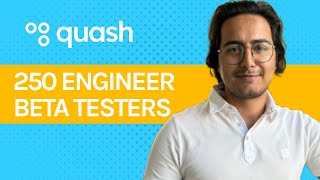
As of September 2023, Quash was pre-revenue, running a beta program with 20 companies and approximately 250 engineers on the platform. Those beta users were reporting an average of 50 bugs per company per week. The company was preparing to launch version one of the product with free trials, with plans to charge between $15 and $20 per user per month once pricing is formalized.

Quash was seeking $500,000 in a pre-seed round at a $3 million post-money valuation, implying a 15% equity sale. The team at the time of the interview consisted of three co-founders and five additional full-time employees, for a total of eight people. The company had been operating in full-time mode since June 2023, with the first line of code written in March 2023 and the beta launched in July 2023.

Last updated

Quash Revenue

Quash was pre-revenue as of the September 2023 interview. Hamza confirmed directly that no customer was paying at that time. The company planned to begin free trials of version one in the weeks following the interview, with paid conversions expected to follow on a negotiated basis with early adopters.

Quash Revenue GrowthReported revenue / ARR over time · latest figure estimated$0$125K$250K$375K$500K$625K202320242025$0$550KSource: GetLatka.com interview on Sep 20, 2023 with Quash CEO Ameer Hamza
YearMilestoneSource
2025Quash Hit $550k revenue in September 2025Estimated
2023Launched with $0 revenue

Because no revenue had been recorded and no forward revenue commitment was stated, GetLatka cannot produce a meaningful revenue projection. Any forward estimate would be entirely speculative given the pre-revenue stage, the unset pricing, and the absence of a conversion rate or sales pipeline figure. Revenue figures and growth rates will be trackable once the company closes its first paying accounts.

Quash Valuation, Funding Rounds

Quash reached a $3M valuation in 2023, set during its Pre-Seed round.

Quash has raised $500K in total funding across 1 round, most recently a $500K Pre-Seed round in 2023.

Quash Capital Raised & ValuationCumulative capital raised and post-money valuation by roundCapital raised (cum.)Valuation$0$0$750K$125K$1.5M$250K$2.3M$375K$3M$500K$3.8M$625K2023$3MSource: GetLatka.com interview on Sep 20, 2023 with Quash CEO Ameer Hamza
YearRoundAmountValuation% SoldSource
2023Pre Seed$500K$3M17%

Founder / CEO

Ameer Hamza

CEO

Quash has three co-founders. Ameer Hamza, confirmed as CEO by the known people roster, was 24 years old at the time of the September 2023 interview. He holds an interaction design degree from what the host described as India's top school and spent approximately two years at Honeywell working on the company's enterprise SaaS division before co-founding a product design agency with Prakhar. Hamza and Prakhar both graduated from college in the 2021 batch.

The third co-founder, Ayush, came from a technical background and had eight years of industry experience at the time of the interview. Ayush originated the idea for Quash and began writing code independently before the three came together formally. Because of that head start and his experience gap over Hamza and Prakhar, Ayush holds the largest equity stake among the three founders. Hamza confirmed in the interview that Ayush owns approximately 50% of the company, with the remaining equity split between Hamza and Prakhar, though Hamza declined to give the exact figures for his own and Prakhar's individual shares.

Net worth was not discussed in the interview. A rough GetLatka estimate for Ayush's stake, based on his approximate 50% ownership applied to the $3 million post-money valuation target, would place the implied value of his equity at roughly $1.5 million, but this is a modeled figure using an unpriced pre-seed target valuation and should be treated as speculative.

Q&A

QuestionAnswer
What's your age?27
Favorite online tool?-
Favorite book?-
Favorite CEO?-
Advice for 20 year old self-

Customers

As of September 2023, Quash had 20 companies and approximately 250 engineers using the platform on a beta basis, all at no charge. One named customer was Riggy, a platform that matches content creators with advertising deals. Riggy was described as an early proof-of-concept deployment that validated the core bug-reporting workflow and generated feature requests including Jira integration and a bug management dashboard.

Quash was pre-revenue at the time of the interview. Hamza said the company planned to offer free trials of version one to the first cohort of paying prospects, with the intention of negotiating price individually with the first five to ten customers before publishing a price on the website. Planned pricing was $15 to $20 per user per month, though Hamza described that range as preliminary and subject to market feedback.

Quash serves 20 customers.

Quash Business Model

Quash's intended business model is a per-user, per-month SaaS subscription priced between $15 and $20 per user. The product is delivered as an SDK embedded in mobile applications, meaning adoption requires a technical integration step rather than a simple sign-up flow. At the time of the interview the company had no paying customers and no published pricing page.

The platform's two stated value propositions are streamlined bug reporting for testers, who can file reports directly from the device under test, and richer bug tickets for developers, which include session recordings and crash logs. Beta users across 20 companies were reporting an average of 50 bugs per company per week as of September 2023, providing a usage baseline for eventual conversion conversations.

Profitability, gross margin, churn, LTV, CAC, and burn rate were not discussed in the interview. The company had not yet generated revenue, so no revenue-per-customer or payback-period figures were available.

Point-in-time figures shared on the GetLatka podcast, each linked to the exact moment it was said on camera.

Customers (2023)

20

Nathan Latka: How many beta users do you have on the platform today? Ameer Hamza: 20 customers. Nathan Latka: So there's 20 users on average reported 50 bugs last week each. Ameer Hamza: Not 20 users, 20 companies using our product. The number of users would be somewhere around 250.

Watch

Free users (2023)

250

Ameer Hamza: Not 20 users, 20 companies using our product. The number of users would be somewhere around 250.

Watch

Quash Employees & Team Size

Quash had a total of eight people working on the product as of September 2023, consisting of three co-founders and five additional full-time employees. All three founders went full-time on the company in June 2023, having maintained other primary jobs through May 2023 while building the product. The five non-founder employees were not described by function in the interview.

Quash employs approximately 5 people as of 2026, down from 8 in 2023. It serves 20 customers that rely on its solutions.

Quash Team GrowthReported headcount over time0246810202320248855Source: GetLatka.com interview on Sep 20, 2023 with Quash CEO Ameer Hamza
YearMilestoneSource
2024Reached 5 employees (October 2024)
2023Reached 8 employees (September 2023)

Frequently Asked Questions about Quash

What is Quash's revenue?

Quash generates an estimated $550K in annual revenue.

Who founded Quash?

Quash was founded by Ameer Hamza.

Who is the CEO of Quash?

The CEO of Quash is Ameer Hamza.

How much funding does Quash have?

Quash raised $500K across 1 round.

How many employees does Quash have?

Quash has 5 employees.

Where is Quash headquarters?

Quash is headquartered in Bangalore, Karnataka, India.

Full Interview Transcripts

Can this company leverage 250 engineer beta testers for bug testing tool to close $3m pre seed round?Sep 20, 2023

[00:00] Quashbugs.com currently helps 20 companies and two fifty engineers identify an average 50 bugs per week, which they can then go smash or quash as the URL says. The company today is seeking $500,000 in a pre seed round of 3,000,000 post money valuation. That means they want to sell 15% of the company. There's three co founders, two others building this so far. Again, the goal now is can they convert these free beta users into real paying customers? [00:24] We'll see if they can do it over the course of the rest of the year. Hey folks, my guest today is Ameer Hamza graduating with an interaction design degree from India's top school. He first ventured into Honeywell as a product designer. After spending two years there, leading the design and user strategy for multiple products, he launched his own product design agency along to this current co founder Prakhar. They built multiple products zero to one for clients [00:45] in the agency. And from there, they came together as three co founders to build quash, a platform to make mobile testing faster and easier. Hamza, are you ready to take us to the top? [00:54] >> Yes, that's good. [00:56] Honeywell, you know, people think Honeywell, they think physical products. So just to be clear, what do you think mobile testing? Were you working on, like, the Honeywell mobile app and that's where you identified this problem? [01:04] >> No. So Honeywell recently, like, a couple years back, came up with their own software wing where they where they're offering is an enterprise performance solution. It's a SaaS offering. It's all software focused. So Honeywell is going into that that business, and that's where I was involved in. I was not specifically involved in any mobile applications, but I got to got the hang of SaaS and b to b products and how they built Scratch up because that [01:31] >> was a very new vertical for Honeywell. So I got that experience there. [01:35] Very cool. Okay. So what are I guess, give me a customer story today. Who can you name somebody that's using you? [01:42] >> So we have a customer, Riggy. Riggy is a it's a so they make tools for content creators to match them to, you know, prospective deals that they can get, that they can advertise using their content. So they have a platform for that, and they are one of our customers. So they so we deployed our POC there. That was one of the very initial versions that we had created of quash, which had very limited capabilities. But yeah. [02:19] >> So after being deployed there, we had a very good response. There were some major feature requests that we were getting. So that version could the the only thing that that version could do was was let testers, you know, report bugs directly from the mobile device that they were testing on, and then it would just export all of the bugs into a Google Sheet. So then after testing that, we got some validation from there, and they started [02:45] >> asking for Jira integrations and a dashboard, a place to manage all of the bugs that were being reported. So we have right now built all of that and we would be having a formal version one launch in the coming weeks sometime. [02:59] So are you pre revenue today, or do you have a customer paying you? [03:02] >> We do not have a customer paying us at the moment. We will be releasing free trials of the v one of the product in the coming week. And we are in deals with some of these companies who are ready to pay us, but the first month would, of course, still be a trial. [03:18] How do you know they're ready to pay you? [03:20] >> We have been talking to them. We have so they have already been using our product, whatever state it had been up until this point, and they are interested in it. And we How do you [03:34] know that though? Hamza? Mean, try and use numbers here, Hamza. So when they're using you, did they quash $6 on average bugs on average per month for the past six months and and that's why you know they're willing to pay? [03:45] >> No. The the numbers are way higher than that in terms of the bugs being reported. [03:49] What's the number? [03:51] >> So an average company an average mobile company reports in in India reports 50 bugs in a week. Like, that's an average number that we have reached. And we [04:04] that's for your that's for your beta users? [04:07] >> Yes. Yes. [04:08] Okay. 50 bugs per week. And how many of those bugs do you help them? Like, many were fixed? [04:14] >> So all of them are in fact fixed. So we do not so where we come in is not the actual task of fixing bugs. Our product helps customers at two ends. One is to report the bugs easily. And then the second value proposition that we have is for the developers who need to fix the bugs. So we make sure that the tickets that they're getting from the bugs being reported are very comprehensive in terms of that [04:43] >> the the session recordings of where the apps crash and the the logs the exact logs of the crash that the developer needs in order to [04:51] Understood. [04:52] >> And how many of [04:53] these how many of these I don't mean to cut you off, it's a quick show, so I apologize for that. How many beta users do you have on the platform today? [04:59] >> 20 customers. [05:00] Okay. [05:01] So there's 20 there's 20 users on average reported 50 bugs last week each. [05:05] >> Not 20 users, 20 companies using our product. The number of users would be somewhere around 250. [05:13] Okay. So 20 companies with 250 users, they reported on average 50 bugs per company last week? [05:19] >> Yes. [05:20] Okay. And when did you launch the beta program? What what month? [05:24] >> Two months back. So that would be July. [05:28] And when did you guys write the first line of code for the platform? [05:32] >> The first line of code was written back in March. So my other cofounder, Ayush, had been working on building this up individually in his own capacity for, like, some time now. Because our our application is also an SDK. It's not, like, something that is, like, very easy to build, and it it takes some some and some expertise in terms of knowing Android or iOS and, like, the the base codes of these platforms. So it has been [06:05] >> in the works since March, but we launched the beta a couple of months back. [06:10] Oh, what's going on there, YouTube? Good to see you guys. Now imagine this. You love watching these interviews with SaaS founders, but imagine if we took all of the valuation data out from over 2,807 interviews I've done manually. Saves you a lot of time. Well, we've done this. We've built it into the beautiful interface inside of Founderpath. Check this out. I'll show you how you can access this in a second, but you log in, you connect [06:33] your Stripe account, you see your valuation real time. You can see what it changed over the past eighty eight days and even set goals for valuation this year. Now the secret evaluation is there's many different ways to value a SaaS business. So the reason you're gonna see three or four different valuations inside of your Founderpath dashboard, this is all free by the way, is because depending on who's doing the buying of your SaaS company, you're gonna [06:57] get a different valuation. A VC is gonna pay a different valuation. Private equity firm is different. If you're gonna do a minority sale, that's different. And if you sell the whole business, that's a different valuation. You can see all those when I hover over here. Right? So the teal is what a VC would pay. Yellow is what private equity And red is if you sold the whole thing outright. Now what's cool about this is this is [07:19] not built off random data. Again, you guys hear these interviews on YouTube. All these datas are built from real time valuation data points founder share with us on the show. So traction 1,200,000 seed round 3.7 raise. They sold 22% of their business. Go in here and filter by the event. Maybe you only wanna see companies that have sold the whole business. Well, here are a bunch that have been acquired the valuation and the multiple. Maybe you're [07:45] going out right now and you're raising your seed round. We'll go in here and look at all this recent seed deals that went down, what they raised, what valuation they raised at and what percent that they sold. There's never been a larger dataset of SaaS valuations than what you can get now inside of Founderpath. And we're thrilled to bring it to you. All right, we're gonna go back to the YouTube video here in a second. But [08:07] if you wanna check this tool out, if you wanna jump in and sign up, you can check it out for free to get your valuation at this link. This link, founderpath.com/products/valuations. Or if you go to founderpath.com and hover over products, click on get your valuation here, and go ahead and sign up to give it a whirl. Again, all that valuation data live right inside the platform. I hope to see you there. Alright. Let's jump back into [08:33] the interview. So since he worked on it before you, is it is it fair to say he owns more equity than you do, or do you guys split it fifty fifty? [08:41] >> Could you repeat the question? [08:42] Who owns more equity? [08:45] >> He does. He does. [08:46] How did you guys have that conversation? [08:49] >> So he had been like, we we had known him for some time. Like, the the agency you mentioned about in the bio that I had written for you, Prakhar and I were primarily the the two main founders of the agency. But Ayush, the third cofounder, he is from a technical background. So we would often call him in for some of the development work that we required. And then he approached us with this idea that he was [09:14] >> working on. And, yeah, given the gap in experience, like, he's been in the industry for, like, eight years now. Prakhar and I are fresh graduates of college from 2021 batch. So yeah, we we did not really have a problem with the splitting of equity bid. [09:32] So Hamza, what's I'm just trying to get to the split. So the the the original guy owns how much and then how much do you and Prakhar own? [09:40] >> So I I would like prefer not to get into the exact numbers of it [09:46] Why? [09:47] >> In this conversation. Because that's something [09:51] >> that is [09:53] This is the trade this is the this is the trade of the show. Right? We've got 20,000 listeners per episode. I'm giving you free exposure that sponsors pay for. The exchanges you give me information, people can't get anywhere else. [10:04] >> Yeah. So are you showing half the company? The other half is split between Prakrit and I. [10:08] Okay. And you guys are bootstrapped? No outside capital? [10:11] >> Up until now, yes. But we are in the process of raising capital at the moment. [10:15] And and I guess why do you guys wanna raise capital? Obviously, that leads to dilution. Would you absolutely need the money? [10:21] >> Yes. We would. Because our product is development heavy. So we would need so right now, we have only our product is has only works for Android. But in order to cover more platforms like iOS, Flutter, React, we would need larger development team that we that would, you know, build it for us. And then there is a large part of growth and acquisition costs that would be involved in order to, you know, get to a certain goal [10:49] >> of customers. [10:50] How much are you looking to raise? [10:53] >> Right now, we are looking to raise 500 k dollars. [10:57] And what percent of the company would you be willing to sell if you raise that money? [11:02] >> Around 15%. [11:04] Okay. 15%. So you're you're looking for like a 2.5 or or 3,000,000 post money valuation on a pre revenue company? Yes. What gives you confidence that you'll be able to sort of sell that story to an investor? [11:16] >> We have been already in in talks with a lot of investors that we have personal connections with, and they have been, like, confident about it since the beginning. So right now, we are talking to a lot of them. [11:30] And yeah. Hamza, has anyone given you a has anyone given you a term sheet as the lead investor, which means they're gonna put in more than 50% of the round size? [11:39] >> Not at the moment. We do have some contributions that we have gotten from founders of other companies, but they have like, they were just sufficient for us to, you know, go for, like, three or four months. But, yeah, we are still looking for a a lead investor. [11:55] Sorry. You people have already given you money, but without signing paperwork? I guess I don't understand. How did you close on the smaller checks if you don't have a lead investor yet? [12:04] >> So the these people are are not investors per se by profession. So they they are founders of other companies who happen to have, like who are interested in investing very small amounts. And so how that works is they invest now, and we give them equity later on when we're closing the round based on how much they had invested. [12:26] What if you don't what if you don't close the round? [12:30] >> We will close the round. Like, there there has been paperwork that has been done, which so it's it's in years time at max that we have before we can, you know until we can delay the conversion of the amount in into equity. [12:46] So you sign convertible notes on these smaller checks and they'll convert Yes. A future equity round? Yes. Okay. Got it. Got it. When you mentioned again, you've got these customers currently using you on a beta motion, right? So I think you said there's 20 companies with two fifty developers using it. What do you plan to launch in terms of a pricing plan? [13:08] >> In terms of a pricing plan right now for the capability that we have developed, our pricing, we are thinking of it to be somewhere around 15 to $20 per user per month. But, of course, like, we still are pre revenue, so we are willing to experiment with that, and we aren't married to, like, a single number per se. [13:31] How are you testing that price point and when does it go live on the website? [13:36] >> It won't go live on the website for quite a while, I'm sure. Because the first, I would say like five to 10 customers that we would get, we would not we would be negotiating with them in terms of how much value they think we provide them. And we we will let the market, you know, pick up a price point and see how much we can stretch it before we actually, like, put it out on the website. [14:01] How many folks are full time at the team today? [14:05] >> We have five five people, excluding the three founders. [14:10] Mhmm. And I guess you guys started working on this code back in March 2023. So how have you been paying for food and your rent and personal expenses? [14:18] >> So up until June this year, all of us did have, like, the the other primary jobs that we had. Only in June, we left the jobs and got into it full time. So it hasn't been pretty long. [14:32] Alright. We're rooting for you guys. We're out of time now. Let's wrap up here with the famous five. Number one, what's your favorite book, Hamza? [14:38] >> What's my favorite book? I'm currently reading Don Quixote and that's a brilliant book. [14:43] Number two, is there a CEO you're following or studying? [14:49] >> Is there a CEO I'm following or studying? So I have been, like, looking closely at the CEOs of some of the the testing companies itself. So Asit Khan from LambdaTest is one person that I we also, I had the chance to get to chat with him as well. So that's interesting. Yeah. [15:09] Number two, what's your fair three, what's your favorite online tool for building quashbugs? [15:14] >> What's my favorite tool for building on online, for building quashbugs? So a lot of the work here in building quashbugs has been, like, the tech part, and I haven't been directly very directly involved tonight. I have been handling the product side. So I would say I what I have been using most is Figma, a FigJam for brainstorming, and then of course, the good old Jira. [15:41] Okay. Number four. [15:42] >> How many hours of sleep are you getting every night? [15:45] >> Six. [15:46] Okay. And what's your situation? Married, single, kids? [15:49] >> Single. Single. [15:51] Okay. And how old are you? [15:54] >> 24. [15:55] Last question. Something you wish knew when you were 20. [15:58] >> Something I wish I knew when I was 20. Okay. I would say [16:04] >> don't really stick to don't really be very strict about sticking to one plan in life. Try things out. And because you will probably end up where you never thought you would. [16:18] Guys, quashbugs.com currently helps 20 companies and two fifty engineers identify an average 50 bugs per week, which they can then go smash or quash as the URL says. The company today is seeking $500,000 in a pre seed round of 3,000,000 post money valuation. That means they wanna sell 15% of the company. There's three co founders, two others building this so far. Again, the goal now is can they convert these free beta users into real paying customers? [16:43] We'll see if they can do it over the course of the rest of the year. Hamza, thanks for taking us to the top. [16:48] >> Thank you. Thanks so much, Nathan. [16:50] One more thing before you go. We have a brand new show every Thursday at 1PM central. It's called Shark Tank for SaaS. We call it deal or bust. One founder comes on, three hungry buyers, they try and do a deal live, and the founder shares back end dashboards, their expenses, their revenue, ARPU CAC, LTV, you name it, they share it and the buyers try and make a deal live. It is fun to watch every Thursday 1PM [17:15] Central. Additionally, remember these recorded founder interviews go live. We release them here on YouTube every day at 2PM Central. To make sure you don't miss any of that, make sure you click the subscribe button below here on YouTube, the big red button and then click the little bell notification to make sure you get notifications when we do go live. I wouldn't want you to miss breaking news in the SaaS world, whether it's an acquisition, a big [17:38] fundraise, a big sale, a big profitability statement or something else. I don't want you to miss it. Additionally, if you wanna take this conversation deeper and further, we have by far the largest private Slack community for B2B SaaS founders. You want to get in there. We've probably talked about your tool if you're running a company or your firm if you're investing. You can go in there and quickly search and see what people are saying. Sign up [17:59] for that at nathanlatka.com/slack. In the meantime, I'm hanging out with you here on YouTube. I'll be in the comments for the next thirty minutes. Feel free to let me know what you thought about this episode and if you enjoyed it, click the thumbs up. We get a lot of haters that are mad at how aggressive I am on these shows, but I do it so that we can all learn. We have to counter those people. We [18:19] got to push them away. Click the thumbs up below to counter them and know that I appreciate your guys'support. All right. I'll be in the comments. See you.

Data and Sources

All figures on this page are taken directly from interviews or are estimates from public sources and proprietary models. Not financial advice. Read full disclaimer.

Claim this profile