Latka logo

Valuation

$200M

2024 Revenue

$20.5M(Est.)

Customers · 2023

500

Funding

$43M

YOY

40%

Team

53

Founded

2015

Sourcepoint Revenue, Valuation & Funding (2024)

Sourcepoint is a data privacy software company founded in 2015 and headquartered in New York, with additional offices in London and Berlin. The company provides large-scale digital enterprises with tools to evaluate data privacy risk and mitigate it, serving clients primarily in the media and marketing sector before expanding into broader enterprise verticals.

Ben Barokas, co-founder and CEO, built Sourcepoint after founding AdMeld in 2007, which was acquired by Google in 2011 for a reported $400 million after raising $40 million in venture capital. Following three years at Google, Barokas launched Sourcepoint in 2015 alongside co-founder Brian Kane, who also serves as Chief Operating Officer.

As of early 2023, Sourcepoint serves approximately 500 customers, has averaged roughly 40% year-over-year growth since its first clients in 2017, and generates a meaningful share of revenue from Europe, which accounts for 60% of the business due to the more advanced regulatory environment there. The company has raised a total of $43 million across three rounds and is targeting $50 million in ARR, which Barokas described as a stretch goal for 2023 but a firm expectation for 2024.

Last updated

Sourcepoint Revenue

Sourcepoint has averaged approximately 40% year-over-year revenue growth since its first clients came on board in 2017. Barokas told Latka in March 2023 that the company serves about 500 customers with an average contract value of roughly $100,000 per year, though he clarified that not all customers are on all products, meaning a simple multiplication of those two figures does not yield current ARR. When the host suggested the math implied $50 million in ARR, Barokas said that figure was not accurate given the multi-product structure.

Sourcepoint Revenue GrowthReported revenue / ARR over time · latest figure estimated$0$5M$10M$15M$20M$25M201520172019202120232024$0$1M$5M$6.8M$8.5M$12M$20.5MSource: GetLatka.com interview on Mar 20, 2023 with Sourcepoint CEO Ben Barokas
YearMilestoneSource
2024Sourcepoint Hit $20.5m revenue in October 2024Estimated
2023Sourcepoint Hit $12m revenue in March 2023
2022Sourcepoint Hit $8.5m revenue in November 2022
2021Sourcepoint Hit $6.8m revenue in November 2021
2020Sourcepoint Hit $5m revenue in December 2020
2017Sourcepoint Hit $1m revenue in January 2017
2015Launched with $0 revenue

Barokas described $50 million in ARR as a stretch goal for 2023 and a firm target for 2024, with the company hoping to grow 40% to 50% in the current year. Europe accounts for 60% of revenue as of early 2023, driven by the more mature regulatory environment there. The company expects North American revenue to accelerate as additional US states pass comprehensive data privacy legislation, with four states having done so at the time of the interview and a fifth pending.

GetLatka estimates that if Sourcepoint achieves its stated 40% to 50% growth target on a base consistent with the $50 million ARR goal for 2024, 2023 revenue would fall in a range of roughly $33 million to $36 million, using a deceleration-adjusted floor and the stated ceiling growth rate. This is a GetLatka estimate; Barokas did not confirm a specific current ARR figure.

Sourcepoint Valuation, Funding Rounds

Sourcepoint reached a $200M valuation in 2020.

Sourcepoint has raised $43M in total funding across 3 rounds, with its most recent round in 2020.

Sourcepoint Capital Raised & ValuationCumulative capital raised and post-money valuation by roundCapital raised (cum.)Valuation$0$0$50M$10M$100M$20M$150M$30M$200M$40M$250M$50M201520162017201820192020$70M$200MSource: GetLatka.com interview on Mar 20, 2023 with Sourcepoint CEO Ben Barokas
YearRoundAmountValuation% SoldSource
2020Funding round$17M$200M9%
2017Series B$16M$144M11%
2015Series A$10M$70M14%

Founders

Ben Barokas

Founder & CEO

Ben Barokas is the co-founder and CEO of Sourcepoint. He is also the co-founder of AdMeld, a supply-side advertising platform he founded in 2007 alongside Brian Adams. AdMeld raised $40 million in venture capital before being acquired by Google in 2011 for a reported $400 million, a figure Barokas described as complex given bonuses paid to employees on top of the purchase price. He spent three years at Google following the acquisition before founding Sourcepoint in 2015.

Brian Kane, listed in the company roster as Co-Founder and Chief Operating Officer, also served as Barokas's chief operating officer at AdMeld and co-founded Sourcepoint with him. Barokas noted prior experience at Jump TV and AOL before AdMeld. As of the March 2023 interview, Barokas was almost 50 years old and had been married for almost 21 years.

Net worth was not discussed in the interview. GetLatka does not produce an estimate given that ownership percentages after dilution across three rounds and the current valuation were not confirmed.

Brian Kane

Co-Founder & Chief Operating Officer

Brian Kane is listed as Co-Founder & Chief Operating Officer at Sourcepoint.

Jeroen Seghers

Founder

Jeroen Seghers is listed as Founder at Sourcepoint.

Q&A

QuestionAnswer
What's your age?52
Favorite online tool?-
Favorite book?-
Favorite CEO?-
Advice for 20 year old self-

Customers

Sourcepoint serves approximately 500 customers as of early 2023, drawn primarily from the largest media companies in the world. The average annual contract value is approximately $100,000, though Barokas clarified that this figure reflects standalone products and that not all customers are on all three products, so average revenue per customer across the full base is lower than that headline ACV.

Sourcepoint operates a three-tier pricing model. The first tier is based on volume of API calls, reflecting the number of times a client pings the platform to launch its tools on a website or app. The second is a pure SaaS fee that unlocks features and seats. The third is a take-rate model applied to the advertising or data spend that Sourcepoint helps protect, charged at under 1% of that spend in basis points depending on volume. A free tier was not discussed in the interview.

Sourcepoint serves 500 customers.

Sourcepoint Business Model

Sourcepoint generates revenue through three distinct pricing structures. The first is a usage-based model tied to API call volume, charged each time a client website or app initiates the platform. The second is a traditional SaaS subscription that unlocks features and seats. The third is a take-rate on protected advertising or data spend, set at under 1% in basis points, applied to clients that spend hundreds of millions of dollars on marketing or data purchasing.

Barokas described the company's go-to-market as focused on large digital enterprises, with an ACV of approximately $100,000 for standalone products. The company is working to expand each of its 500 customers across all three products to reach that ACV level, using net dollar retention as the expansion mechanism. The initial sales team, consisting of a VP of sales and two reps, operated against a combined quota of $1 million per quarter when the go-to-market was first built out around 2017.

Gross margin, churn, LTV, CAC, burn rate, and runway were not discussed in the interview. Profitability was not discussed.

Point-in-time figures shared on the GetLatka podcast, each linked to the exact moment it was said on camera.

Customers (2023)

500

Ben Barokas: We're solving problems for about 500 customers today [March 2023].

Watch

Sourcepoint Employees & Team Size

Sourcepoint employs approximately 60 full-time staff as of early 2023, with additional contractors working globally. Barokas described the team as evenly distributed across engineering, product, sales, and marketing. The company operates out of three offices: New York, London, and Berlin.

Sourcepoint employs approximately 53 people as of 2026, down from 60 in 2023, including 8 sales reps that carry a quota. It serves 500 customers that rely on its solutions.

Sourcepoint Team GrowthReported headcount over time01530456075201520172019202120232024005353Source: GetLatka.com interview on Mar 20, 2023 with Sourcepoint CEO Ben Barokas
YearMilestoneSource
2024Reached 53 employees (October 2024)
2023Reached 60 employees (January 2023)Estimated
2022Reached 51 employees (November 2022)
2022Reached 51 employees (January 2022)
2021Reached 59 employees (November 2021)
2021Reached 59 employees (August 2021)

Frequently Asked Questions about Sourcepoint

What is Sourcepoint's revenue?

Sourcepoint generates an estimated $20.5M in annual revenue.

Who founded Sourcepoint?

Sourcepoint was founded by Ben Barokas.

Who is the CEO of Sourcepoint?

The CEO of Sourcepoint is Ben Barokas.

How much funding does Sourcepoint have?

Sourcepoint raised $43M across 3 rounds.

How many employees does Sourcepoint have?

Sourcepoint has 53 employees.

Where is Sourcepoint headquarters?

Sourcepoint is headquartered in New York, New York, United States.

Compare Sourcepoint to the industry

Sourcepoint operates across multiple industries. Browse revenue, funding, and growth data for Sourcepoint in each sector below.

Full Interview Transcripts

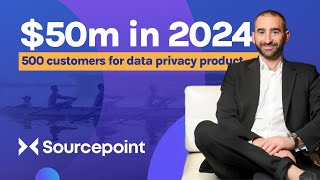
Sourcepoint Hits 500 Customers for Data Privacy Product, Will "definitely hit $50m in 2024"Mar 20, 2023

[00:00] Sourcepoint launched in 2015 after its $400,000,000 exit that was ad mailed to Google. Now working on a sort of a three tiered pricing plan, what folks can pay him on a on a volume of API call a plan, a pure SaaS plan, which is traditional seeing unlocking features. And then lastly, what percent of spend is sourcepoint helping you protect? They take under 1% call it take rate on that. They're growing nicely. They raised recently a series [00:22] c in 2020 for $17,000,000. They've got a team of 60 evenly distributed call it and a nice go to market plan leaning on a lot of his ex teammates from admin as they look to scale to 50,000,000. This year will be a stretch goal, but definitely in 2024 serving 500 customers today. Hey, folks. My guest today is Ben Barokas. He's the co founder and CEO at source now leading the strategic direction. It's a data privacy company [00:45] for digital marketing. He's got a proven track record of growing companies that transform the digital content industry, founding and leading the preeminent supply side platform AdMelt to its acquisition by Google for reported 400,000,000 in 2011. He then served as general manager of global marketplace development team. Prior to that, he drove business and operations for Jump TV and AOL. Ben, you ready to take us to the top? [01:05] >> Sure. Let's do it, buddy. [01:06] Alright. Your bio said 400,000,000 reported. That was in 2011. I mean, can you create clarity there? Was that is that confirmed? Is that close enough? [01:13] >> I mean, it's all about how do you do your fancy accounting. There's there are bonuses on top of the cap price that was paid that were given to employees. And so it was significantly above that in terms of price, but it's also, you know, what gets recorded in the purchase price is the complexity of the exact price. But yeah, that was startup number three, and we did quite well. I'm [01:43] You have cofounders there or still founder? [01:46] >> No. Cofounders. Cofounder a different Brian. I have a cofounder currently named Brian Cain, who was also my chief operating officer at AdMel. But I cofounded that business with a gentleman named Brian Adams, also an incredible operator, engineer, and product person. Yeah, we founded that company in 2007, exited in 2011. This one, after three years at Google, founded in 2015, have been rocking and rolling almost eight years, and it's been a great journey. [02:16] That's great. Now at Admiral, did you were you guys pretty capital efficient, or had you raised a bunch of money to grow that company? [02:21] >> We raised a bunch of money, and we have had history of working with the best and most incredible venture capitalists in [02:29] >> the world. Raised at AdMel? 40. [02:30] Okay. Four well, that's not terrible. [02:32] >> So if it's 40 and you sell for four I mean, you read companies all the time today that, you know, they raise a 100,000,000, they sell for a 100,000,000, no one makes any money. [02:40] >> That doesn't work out really well. [02:42] It doesn't work out well. So when you say a bunch of money, just to be clear, again, that's I would just call that pretty darn capital efficient. It was a good one for everybody. [02:49] >> Yeah. Where I come from, $40,000,000 is just still a bunch of money. It's not 400,000,000. It's 1,800,000,000, but 40,000,000 in most people's minds is a bunch of money. [02:59] Yeah. Well, it's all it's all relative is how we like to look at it here Let's on the talk about sourcepoint. So was this a problem that you had at AdMelt? You said I need to leave and actually just build this for everyone else. Or how did you identify this problem? [03:12] >> Oh, no. I I mean, I I think data privacy is one of those things that has been building for the past three, four, five decades. I mean, data is the lifeblood and is the oil of what runs the digital enterprise today. And the understanding that from a user perspective, most users don't understand what the value exchange by giving their data away. And more and more, that data can be stolen or utilized in ways that the individual [03:45] >> user doesn't want. Digital advertising, digital marketing made a lot of this data available. And there are a number of brokers that don't act responsibly, like good digital citizens, don't act ethically, and don't keep that data secure. And so while I was at Google, after we almost created the problem, while there we developed a protocol called real time bidding. And the RTB protocol enables marketers to bid on individual users based on their data profile. And that made [04:23] >> data available on just about everyone. Understanding that you're in thousands, if not hundreds of thousands of data graphs around the world might make you feel uncomfortable. At any rate, we knew that the digital media ecosystem needed to clean up its act, and we wanted to provide a solution. And that's what we did when we created the best solution in the world for large scale digital enterprises to evaluate what their data privacy risk is and provide a [04:57] >> series of tools in order to mitigate that risk and act in an ethical and good citizenship [05:03] like So Ben, we'll go back and get the backstory here on the first customer, second customer, etcetera. But help us understand today as the company stands, you just described the product well for a customer that wants to pay for and use the product today, what sort of market are you serving? What's the average ACV would you say? A $100, a million bucks, something in between? [05:21] >> Yep, something between, call it a $100,000 a year in annual contract value. [05:28] >> And our clients are the biggest media companies in the world. [05:33] Oh, what's going on there, YouTube? Good to see you guys. Now imagine this, you love watching these interviews with SaaS founders, but imagine if we took all of the valuation data out from over 2,807 interviews I've done manually. Saves you a lot of time. Well, we've done this. We've built it into the beautiful interface inside of Founderpath. Check this out. I'll show you how you can access this in a second, but you log in, you connect [05:56] your Stripe account, you see your valuation real time. You can see what it changed over the past eighty eight days and even set goals for valuation this year. Now the secret evaluation is there's many different ways to value a SaaS business. So the reason you're gonna see three or four different valuations inside of your Founderpath dashboard, this is all free by the way, is because depending on who's doing the buying of your SaaS company, you're gonna [06:20] get a different valuation. A VC is gonna pay a different valuation. Private equity firm is different. If you're gonna do a minority sale, that's different. And if you sell the whole business, that's a different valuation. You can see all those when I hover over here, Right? So the teal is what a VC would pay. Yellow is what private equity and red is if you sold the whole thing outright. Now what's cool about this is this is [06:42] not built off random data. Again, you guys hear these interviews on YouTube. All these datas are built from real time valuation data points founders share with us on the show. So traction, 1,200,000 seed round, 3.7 raise. They sold 22% of their business. Go in here and filter by the event. Maybe you only wanna see companies that have sold the whole business. Well, here are a bunch that have been acquired the valuation and the multiple. Maybe you're [07:08] going out right now and you're raising your seed round. We'll go in here and look at all this recent seed deals that went down, what they raised, what valuation they raised at and what percent that they sold. There's never been a larger dataset of SaaS valuations than what you can get now inside of Founderpath. And we're thrilled to bring it to you. All We're right, gonna go back to the YouTube video here in a second, but [07:30] if you wanna check this tool out, if you wanna jump in and sign up, you can check it out for free to get your valuation at this link. This link, founderpath.com/products/valuations. Or if you go to founderpath.com and hover over products, click on get your valuation here, and go ahead and sign up to give it a whirl. Again, all that valuation data live right inside the platform. I hope to see you there. Alright. Let's jump back into [07:56] the interview. What do you price against in terms of your utility based pricing? Is it number of seats, number of datas, you know, number profiles protected? What do you price against? [08:05] >> It's more about implementation and volume. So we serve the digital enterprise. And so in terms of how we integrate, it's on every website call, every initiation of an app with an SDK, and so however many times you're pinging us to launch our platform is how you pay for one of our products. I think another product is a pure SaaS play, and a third is about how much of the spend that we are helping you protect, if [08:40] >> that makes sense. So product one and two of three are very SaaS based models based on volume and evaluated data, and one is really on the percentage of overlap that we protect. [08:57] And that third one that you're talking about, percent of spend that you're protecting, are you taking, like is that it's traditional take rate model there, percent of spend or no? [09:05] >> Yeah, but it's basis points. So with companies that spend hundreds of millions of dollar of marketing in buying advertising or buying data to inform addressability, [09:22] >> we, depending on how much your spend is, we take basis points in order to protect that spend and make sure that you mitigate risk as it relates to placing messages on places that it shouldn't or purchasing data that hasn't been evaluated in the appropriate [09:39] So Ben, when you say basis points though, you're talking like under 1%, Right? [09:43] >> That's exactly right. [09:45] Okay. Got it. Okay. That's super helpful. Then again, the first one is pricing on volume of API calls, sounds like. And then another the second product is based on like a pure SaaS fee, unlock x y z features in this many seats sort of deal. [09:56] >> That's exactly it. [09:57] Very cool. Okay. Now that we have that part of the story, take us back to the early days. What year did you write the first line of code for the platform? [10:04] >> Yeah. It was the end of twenty fifteen. We wrote the first code. I think it got us till beginning of 'seventeen where we had our first clients and then scaled up. I think we've averaged about 40% growth year over year. Some years were better, some years were less good, but that's kind of how we've averaged out. We've been certainly incredibly successful among the digital marketing ecosystem. We are now expanding beyond that to a more generalized enterprise [10:40] >> solution, we've realized that being the best at what we do has translated very well to other verticals. And so we're spending a lot of time making sure that we're the easy button for data privacy programs And for those teams, everyone within the Fortune one thousand needs to have a series of tools and a platform by which to execute their privacy program. And we've penetrated very deep into the media and marketing space, and now we're really expanding [11:12] >> to the rest of the ecosystem. [11:15] Can you put all that in a bundle for me? So across all those markets you just described, how many customers are you serving today? [11:21] >> We're solving problems for about 500 customers today. And [11:28] >> we're hoping to, again, grow by 40% to 50% this year. [11:32] That's great. Now talk me the original funding here. I think you did a series, a 10,000,000 series A back in 2015 and then a 16,000,000 series B in 2017. Were both those rounds totally pre revenue or was a series B raised after your first customer came in? [11:47] >> I think our Series B was after our first customer came in. We had limited customers then, [11:54] >> those customers were very, very large enterprise customers and so there was a proof point there. [11:59] I see. I guess the question I have is a lot of second time, third time founders will listen to this show. And I always wonder, someone that has a $400,000,000 exit, you wanna swing for the fences to go build a massive company, you wanna try and own as much as you Why use $10,000,000 of other people's money there for your series A in 2015 instead of just saying, I want to own 100%, keep as much as [12:19] I possibly can and then scale this thing? [12:23] >> Oh, because it just makes every difference to have smart partners on the VC side of the equation. I think it's a great accelerator for anything that you want to do. If you want to change the world, then your best bet at changing the world is doing so in conjunction with people who have seen and have invested in changing the world. And I've had the incredible luck of working with some of the most accomplished VCs in the [12:51] >> industry. You can see on our cap table, North Zone, Spark, Graycroft, Excel, Foundry. These are all incredible companies with incredible partners that have been very, very helpful along my entrepreneurial path. And so, again, I wouldn't raise venture if you're just starting a lifestyle business or you're starting something that has been done before, but in all of the cases where I've founded companies, we were doing something that has never been done before. And we set out to, [13:27] >> like you said, swing for the fences and do that with partners. And I think no man is an island, and you want to increase your success rate by working closely with partners. [13:39] I mean, Ben, one of the things that always about raising capital is using our island analogy. The waves are crashing harder, right? Whether it's Greycoft and Spark coming in your Series A or North Zone in your Series B, they have a growth expectation which can limit your optionality into the future. You've got to accelerate speed. These guys are expecting a 100%, especially in the early days, maybe 200, 300% year over year growth. You manage an average [13:58] of 40% year over year growth. The expectations there are not aligned. How do you create alignment? [14:05] >> You know, again, by having a long term view and having an understanding of our particular investors for particular stages, they will help you when they can help you, and when they can't, they will say that they can't. And so you find other investors that are more aligned with the particular stage of a company that you have. And there are times by which the market doesn't move as fast as you would like it to move. And in [14:32] >> our case, data privacy legislation in The United States moved much more slowly than we thought that it would. And still to this day, we don't have national data privacy legislation that has been passed, we're probably a couple years away. That would account for 60 to 70% of our revenue coming from Europe. We do see that [14:53] That's today 60 to 70% kicking off. [14:54] >> 60% today comes from Europe because of the laws over there? [14:58] >> Correct. Yeah. Correct. And now where we've had already four states pass comprehensive data privacy legislation, now a fifth, the tailwinds are starting to blow very, very hard and we're seeing an exciting opportunity to to grow much more quickly in the North American market. [15:21] Mhmm. And then I guess, Ben, take me back at series A, most folks now look at 2015, it was when we were just launching the show, so I don't have a ton of data points from back then, but most folks series a the past couple years, you know, you're selling, you know, 10 to 15% of the company. Did you do sort of do something standard? You were sort of in that same range? [15:37] >> Yeah. Exactly. [15:38] Okay. And same with, know, series b, you know, you're selling five to 10% sort of in that same range? [15:44] >> Same [15:44] thing. Okay. How do you think about Arrowroot coming in with 17,000,000 in 2020? It's not labeled any of that as any kind of round and crunch based. So how do you think about them? Is that a series c? [15:54] >> Sure. I mean, again, you can label them however you want. They were the right capital for the right time. [15:59] Well, was it the same paper that series b set on, or do they repaper the deal at a higher valuation? [16:05] >> Oh, certainly. They repapered it. There there are a number of different negotiations and buttons and levers that you do with different funders at different times. [16:14] Mhmm. Was a part of that Arrowroot deal secondary, or was it all for operating capital? [16:20] >> All for operating character. As you said, like, you know, both my co founder and I have been lucky enough to have significant exits in the past, and so while, we wouldn't turn it down if it was at the right terms, it wasn't something that we were interested in at that time. [16:36] Sorry, just to be clear, if you incentivized your early employees in 2015 with option grants, they've been waiting now for five years. It might be nice to create secondary for some of them. So necessarily, it wasn't for you. But did have you created a liquidity opportunity for any of your early early employees who are incentivized with option grants? [16:52] >> Certainly not. [16:53] Interesting. How did you how do you think about that moving forward? If you wanna buy yourself [16:57] more time, but folks are getting anxious having, know, these options for five, six, seven, eight, nine, ten years, do you try and alleviate that that pressure at all? [17:04] >> I don't. I mean, I'm not hiring people with the incentive of being able to cash out their options. If the company does well and if a strategic comes along and purchases the firm for a very high price, then fantastic, and then we'll all share in those spoils, but if not, I don't see funding for secondary [17:27] >> for employees to be something that's going to primary driver of a funding event. [17:33] Tell me more about the team today. How many folks are full time, and how do you think about your engineering, your product, your sales teams? [17:40] >> We're about 60 people worldwide. We also have some contractors around the world. We're pretty evenly distributed across engineering, product, sales, and marketing. We have offices in New York, in London, and in Berlin. [18:01] >> Yeah, I mean, [18:02] it Tell us is about your first sales hire. A lot of folks it's our number one question we get is, Nathan, I'm at 10,000,000 in ARR. We wanna make our first enterprise sales rep. What should quota be? What should OTE be? How'd you put that together for you and your ACV? [18:16] >> Oh, it was just spectacular to be able to work with people that had worked for me in the past. My VP of sales became my CRO for this company. We had, again, it's a wonderful, wonderful way to found and start a company to be able to bring someone on early that you trust that will help you get to that $10,000,000 ARR. [18:36] Well, teach my crew though. You talking nine ks? Is it a million dollar quota and a two fifty ks OTE or sort of what ratio did you start with? [18:44] >> Well, we're doing enterprise deals. Yeah. I think it was more like a million dollars a quarter for him and the two sales reps that he hired right away. Altogether. And we were able to scale pretty, correct, we were able to scale pretty quickly in those initial quarters, and then you know there were some bumps in the road, and we had to reevaluate technology that we're building and the different use cases. We did exactly that, and course [19:14] >> corrected and evolved and then got back to growth. So again, opportunities of [19:23] >> are all kind of straight line, everyone takes their own zigging and zagging in order to find the right level of product market fit, as well as the appropriate tools internally to utilize in order to drive the appropriate go to market strategy. [19:39] And Ben, before we wrap up, you mentioned earlier ACV, 100,000, and customer count about 500. Can we multiply those to get a revenue range? [19:48] >> You can do whatever you'd like. [19:51] Well, I I don't wanna say anything misrepresented. You said earlier 500 customers and you said ACV [19:56] >> a 100 We we don't disclose yeah. We're not disclosing the details, but you certainly can do the math. [20:04] Well, disclosed 500 customers and disclosed a $100,000 ACV. If I multiply those, it puts you at 50,000,000 in ARR. Is that accurate? [20:11] >> That's not accurate. [20:13] Okay. So is it because you moved [20:14] >> at different vendors? [20:17] >> No. We have we have a number of different products. And so while that may be the ACV for our standalone products, all of our customers are not on all of our products. [20:27] I see. I see. So you're working on getting as many of the 500 at that 100,000, expand them net dollar retention to the $100,000 per year level with your three different pricing plans? [20:37] >> Exactly. [20:38] Can you break 50,000,000 this year you think, or is that gonna be a 2024 goal? [20:42] >> If everything goes to plan, certainly, but it it certainly it will happen in 2024. Whether it'll happen in 2023, it's a bit of a stretch. [20:52] All right, fair enough. Ben, that's helpful. Thanks. Let's wrap up here with the famous five. Number one, your favorite book? [20:58] >> My favorite book, The Hard Thing About Hard Things. [21:01] Number two, is there a CEO you're following or studying? [21:05] >> Many. I mean, today, I was yeah. There's an interesting thing that's going on in the finance sector, and I think we all need to be aware of what folks like Jamie Dimon are doing and how they navigate the current pressure on the finance sector. [21:19] Number three, what's your favorite online tool for building sourcepoint? [21:24] >> Oh, my favorite online tool. I would say that what's used most today is the Google Suite of Work products. How about that? [21:34] >> That's a good one. [21:35] Number four, how many hours of sleep do you get every night? [21:38] >> At least six and a half. [21:40] Okay, that's good. [21:41] >> And situation, married, single kids? [21:43] >> Married, happily for almost twenty one years. [21:45] Oh, congratulations. Any kiddos? [21:48] >> Nope. [21:49] >> No kiddos. [21:50] Alright. And how old are you, Ben? [21:52] >> I am almost 50. [21:53] >> Almost 50. [21:54] Great. We'll call it 48, 49. Last question. What's what's something you wishing you when you were 20? [22:00] >> It's all gonna be alright. [22:04] Guys, there we have it. Sourcepoint launched in 2015 after a $400,000,000 exit that was AdMail to Google. Now working on a sort of a three tiered pricing plan, what folks can pay them on a on a volume of API call, a plan, a pure SaaS plan, which is traditional seeing unlocking features. And then lastly, what percent of spend is sourcepoint helping you protect? They take under 1% call it take rate on that. They're growing nicely. They [22:25] raised recently a series c in 2020 for $17,000,000. They've got a team of 60 evenly distributed call it and a nice go to market plan leaning on a lot of his ex teammates from Adnan as they look to scale to 50,000,000. This year will be a stretch goal, but definitely 2024 serving 500 customers today. Ben, thanks for taking us to the top. [22:44] >> Thanks for doing it. [22:46] One more thing before you go. We have a brand new show every Thursday at 1PM Central. It's called Shark Tank for SaaS. We call it deal or bust. One founder comes on, three hungry buyers, they try and do a deal live and the founder shares back end dashboards, their expenses, their revenue, ARPU, CAC, LTV, you name it, they share it and the buyers try and make a deal live. It is fun to watch every Thursday 1PM [23:11] Central. Additionally, remember these recorded founder interviews go live. We release them here on YouTube every day at 2PM Central. To make sure you don't miss any of that, make sure you click the subscribe button below here on YouTube, the big red button and then click the little bell notification to make sure you get notifications when we do go live. I wouldn't want you to miss breaking news in the SaaS world, whether it's an acquisition, a big [23:33] fundraise, big sale, a big profitability statement or something else. I don't want you to miss it. Additionally, if you want to take this conversation deeper and further, we have by far the largest private Slack community for B2B SaaS founders. You want to get in there. We've probably talked about your tool if you're running a company or your firm if you're investing. You can go in there and quickly search and see what people are saying. Sign up [23:55] for that at nathanlatka.com/slack. In the meantime, I'm hanging out with you here on YouTube. I'll be in the comments for the next thirty minutes. Feel free to let me know what you thought about this episode. And if you enjoyed it, click the thumbs up. We get a lot of haters that are mad at how aggressive I am on these shows, but I do it so that we can all learn. We have to counter those people. We [24:15] got to push them away. Click the thumbs up below to counter them and know that I appreciate your guys'support. All right. I'll be in the comments. See you.

Data and Sources

All figures on this page are taken directly from interviews or are estimates from public sources and proprietary models. Not financial advice. Read full disclaimer.

Claim this profile