
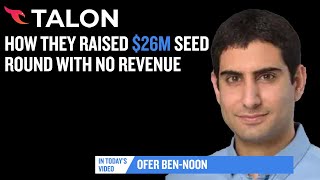
Talon Cyber Security
Boston, Massachusetts, United States
Valuation · 2021
$100M
Customers
12
Funding
$26M
Founded
2020
Talon Cyber Security Valuation & Funding (2026)
Talon Cyber Security is an Israeli enterprise cybersecurity company founded in June 2020 by Ofer Ben-Noon and Ohad Bobrov. The company has built a corporate browser designed to secure distributed workforces, targeting organizations with between 5,000 and 50,000 employees who rely on unmanaged or personal endpoints and contractor devices.
As of December 2021, Talon was pre-revenue and working with approximately a dozen design partners, with a goal of reaching 20 by the end of the fourth quarter. The company had deployed its browser across hundreds of devices and was pricing the product at single-digit dollars per device per month, with $5 cited as a reference point.
Talon closed a $26 million seed round in 2021, selling more than 20 percent of the company to a group of strategic investors including Lightspeed, George Kurtz, Mark Anderson, and Zohar Zisapel. Ben-Noon previously co-founded Argus Cyber Security in 2013, which was acquired by Continental in 2017 for $530 million after raising $30 million in total capital and growing to protect more than 60 million vehicles globally.
Last updated
Talon Cyber Security Revenue
We do not have information about Talon Cyber Security's revenue yet.
Talon Cyber Security Valuation, Funding Rounds
Founder / CEO
Ofer Ben Noon
CEO
Ofer Ben-Noon is the CEO and co-founder of Talon Cyber Security. He was 35 years old at the time of the December 2021 interview. Ben-Noon served as a captain in the Israeli Defense Forces Cyber Intelligence Unit 8200 and was a team member on two Israeli Defense Prize winning projects.
Ben-Noon co-founded Argus Cyber Security in 2013, building it into a global leader in automotive cybersecurity. Argus raised $30 million in total capital and was acquired by Continental in 2017 for $530 million. Following the acquisition, Ben-Noon remained as CEO of Argus within Continental, leading the business to protect more than 60 million vehicles globally before departing to start Talon.
Talon's co-founder is Ohad Bobrov, who founded Lacoon Mobile Security in 2011, described in the interview as the first cybersecurity company focused on smartphones. Ben-Noon and Bobrov both served in Unit 8200 and have known each other for approximately 15 years. They began working together on Talon in June 2020 and described the co-founder equity split as settled in roughly 20 seconds, with both parties treating it as an equal partnership from the outset. Net worth for either founder was not discussed in the interview.
Q&A
| Question | Answer |
|---|---|
| What's your age? | 38 |
Customers
As of December 2021, Talon had approximately 12 design partners and was targeting roughly 20 by the end of the fourth quarter of 2021. The company was pre-revenue at the time of the interview, with design partners participating in proof-of-value engagements rather than paying commercial contracts.
Talon's target customer is an organization with between 5,000 and 50,000 employees. The actual install base across design partners at the time of the interview was described as hundreds of devices, with growth toward thousands expected. The average organization on the platform at the time of the interview skewed toward roughly 1,000 employees, reflecting the early and mixed nature of the design partner cohort.
Pricing is structured on a per-device, per-month basis, described by Ben-Noon as single-digit dollars per device per month, with $5 cited as a reference figure. An employee using three devices, such as a laptop, phone, and tablet, would be charged for each device separately, though Ben-Noon noted that large organizations typically negotiate bundle arrangements. The company uses a try-before-you-pay model, beginning with a multi-week proof-of-value period before converting customers to paid contracts.
Talon Cyber Security serves 12 customers.
Talon Cyber Security Business Model
Talon Cyber Security monetizes through a per-device, per-month subscription model, priced at single-digit dollars per device. The model is described by Ben-Noon as closely analogous to endpoint detection and response pricing. Devices are the billing unit, not employees or seats, meaning a single employee with multiple devices generates multiple billing units.
As of December 2021, the company was pre-commercialization and had not yet converted design partners to paying customers. The go-to-market motion begins with a proof-of-value engagement lasting several weeks, after which volume growth triggers conversion to a paid relationship. Profitability, gross margin, churn, retention, CAC, LTV, and burn rate were not discussed in the interview.
Talon Cyber Security Employees & Team Size
Headcount at Talon Cyber Security was not discussed in the December 2021 interview. The company was approximately 18 months old at the time of the interview, having been co-founded in June 2020.
We do not have information about Talon Cyber Security's team yet.
Frequently Asked Questions about Talon Cyber Security
Is Talon Cyber Security still an independent company?
No. Talon Cyber Security was acquired by Palo Alto Networks.
Who founded Talon Cyber Security?
Talon Cyber Security was founded by Ofer Ben Noon.
How much funding does Talon Cyber Security have?
Talon Cyber Security raised $26M across 1 round.
Where is Talon Cyber Security headquartered?
Talon Cyber Security is headquartered in Boston, Massachusetts, United States.
Compare Talon Cyber Security to the industry
Talon Cyber Security operates across multiple industries. Browse revenue, funding, and growth data for Talon Cyber Security in each sector below.
Full Interview Transcripts
How This Security Company Raised $26m Seed Round With No RevenueDec 14, 2021
[00:00] Hey folks, my guest today is Ofer Ben-Noon. He's a seasoned entrepreneur with vast cybersecurity experience and was the founder and CEO of Argus, a global leader in automotive cybersecurity, which was acquired by Continental in 2017. Following that acquisition, he served as a member of the senior management at the company and as CEO of Argus, leading it to protect over 60,000,000 vehicles globally. He served as captain in the IDF Cyber Intelligence Unit 8200 and was a team [00:22] member of two Israeli Defense Prize winning projects. Ofer, are you ready to take us to the top? [00:28] >> Ready. [00:29] Alright. Something special is happening over there in Israel. You know, I have these founders on and they're all for exit IDF. You know, we've got Ari at Coralogix, Tomer at Yotpo. What's happening over there? [00:40] >> Well, I think it's two things. Right? One, is is the fact that, a lot of Israelis now are are are looking what can they do better for the world, how they can contribute a little bit more. And I think it's kind of the feeling of of the ecosystem that there are opportunities that we can bring value. And the other point is obviously the the background, right? So the fact that everything is always quite hectic, the background [01:09] >> coming from 8200 is also very much helpful where we are solving significant problems on a daily basis. So yeah, the atmosphere here is quite good now. [01:19] So you're tackling security in the enterprise now with this new corporate browser that you've built specifically for distributed workforces. How on earth can you get people or teams to convince their teams to switch from Safari, Chrome, or the browser they use onto your secure browser? [01:35] >> I think when teams already understanding that working from everywhere, they would need to have additional security on the endpoints, especially the less managed endpoints, potentially personal devices, or if it's contractor, and then in many cases they have devices from other companies. I think it's clear for people and it's well understood that they will need to have some type of protection on this unmanaged endpoint. If you think about the alternatives, right, to install now a fully managed [02:09] >> network filtering or is it to install a fully managed ADR on this device, then one of the alternatives that are having the least amount of privacy invasion is actually a browser because then in a sense your employee knows that you are only monitoring things which are corporate related, but anything else is not. [02:37] Mhmm. And so walk me through pricing. Obviously, every SaaS company is different, but how do you price this thing? [02:43] >> Very, very similar to to ADR. So the pricing model is is pretty much identical. [02:49] Sorry. What are you pricing as number of browser installation, number of seats, feature based upselling? [02:54] >> So it's number of browser installations. So it's in a sense, per device per month. [03:02] Okay. Per device per month. And and so, obviously, you know, if you're signing up an SMB with two customers, that's different than an enterprise with 500 customers or licenses signing up. What's your sweet spot? What's the average customer paying you per month or per year to use this technology? [03:17] >> So our target, customer would be organizations which are between 5,000 employees to about 50,000. So this would be kind of our our suites for organizations which are big enough, that have enough people working from all over the world, enough contractors, enough challenging use cases, because one of the biggest advantages that we can bring is kind of a consolidation of the different devices, different use cases. [03:51] So offer five to 50,000 employees as your target audience, but where are you at today? What's the average team size on your platform using you guys today? [03:59] >> We have in our organization still pretty much all ranges, some with hundreds of thousands of employees, some with, tens of employees, so in terms of the size of the customers. [04:11] But but if you take all the all the devices on your platform divided by all the brands using you, you can back into an average. What's that sweet spot? [04:20] Like is a thousand, maybe a thousand employees a fair sweet spot? [04:23] >> Something like that. Yeah, think that would be. [04:25] Okay. And walk me through how you're keeping your top of funnel wide. You mentioned people can get started with as little as just 10 devices or 10 employees. What do they get? Is it free or not? [04:35] >> So initially, it's kind of... We believe kind of in the model of [04:41] >> try to pay. So start, feel the value of the product, see that it brings you value. In a sense, I think that the best thing that any SaaS company give its customer is the conviction of bringing value rather than immediately charge you up upfront. So usually, we start with a small pro... With a process of a few weeks of demonstration or, call it, proof of value in which we can demonstrate the value to the customer. And [05:10] >> only then when when the volume start to increase, then we will convert into a paying customer. [05:16] And Ofer, before we go and give you a backstory from Argus into Talon, help me understand... Well, I mean, what... If someone listening right now and wants to start on you guys, what should they expect to pay per device on average per month? [05:27] >> So usually it would be a single digit dollars per device per month. [05:32] Okay. So something like 5 to $10 per month per per... Now if an employee has a cell phone, a laptop, and an iPad, is that $10, $20, $30 a month for that one employee because there's three devices? [05:45] >> In use case... In in use cases like that, then usually it would be per device. So meaning, yes, three. What usually happens is that on big organizations, then obviously they they have, bundles for for this type of lease. [05:58] Okay. But it's generally fair to say, just so my audience understands, you're charging sort of 5 to $10 per device, not per employee, because an employee could have three devices. Okay. Very cool. Let's get the backstory here. So did you get the idea for this at Argus? Did you see something there or at Continental? [06:16] >> So if we go back kind of through the history of Argus, in a sense, wanted to bring to the world something that brings a lot of value to solve a significant problem. And if you look at the world of connected cars somewhere there in 2013, there were not many companies. Like General Motors, I think, one... Was one of the only ones or the first ones that were really focused on on bringing connectivity, and then all of [06:44] >> the other manufacturers kind of march forward. So we had to understand there is a huge tectonic changes having employees or having, sorry, customers interested to connect their vehicles to the outside world in order to get them to gain to gain a lot of insights and also abilities to have more safety. And we understood that when you are bringing such capabilities into a market that wasn't dominated with security issues before that, then there will be a big [07:16] >> vacuum, a big issue that will come into the world. And then at the point after three years after the acquisition, I've started working with Ofer Ben- Ofer [07:30] >> Ofer Ofer [07:33] Lacoon Mobile Security. [07:35] >> Have you heard about Lacoon? [07:36] I have not, but you two got together in what year was that? When did you write the first line of code for Talon? [07:43] >> So that was middle of twenty twenty. [07:47] And did you guys play nice? Did you just say, oh, do you know? You're an equal partner. I love you, brother. Let's put it 5050, did you negotiate like hell? [07:55] >> Well, I and I know each other from the 8200 intelligence unit days. So that was, I think, only fifteen years ago. Was It clear to us that we are equal partners, that we are going into this journey, as brothers, play super well. It wasn't even something that I think we have discussed, more than, twenty seconds, so that was one of the of the first thing that were completely clear. [08:19] That's amazing. Who did you... So tell me tell me if you can name them, that would be amazing. Who was your first customer and how did you land them? [08:28] >> At the time that that we started with, with Argus, I think that, our our first customers were some of of the biggest car manufacturers, in in the world. I think actually at that time it was one of the biggest, tier one, manufacturers, and the logic and the reason why they came into the table [08:49] Car manufacturers, you're talking Ford, these kinds of brands? [08:52] >> Yes, yes, yes, yes, yes. And the logic is that all of them were coming into a relatively new world, into coming... Coming to new environment, and Cyber Security at the time wasn't a big thing for that area, right? Because cars weren't connected, now you had a cellular modem, and it was kind of the early stages. But one of the things that for us at Argus was very clear, is that the opportunity here to bring something to [09:26] >> the world was unique. By the way, that's also what Ohad and I were looking at mid-2020s. So Ohad was the Founder of Lacoon Mobile Security. It was the first cyber security for smartphones. And one of the things that both of us experience is this tectonic change. So when he had started in 2011 with Lacoon, smartphones weren't connected to organizations at all, and all organizations wanted to allow this access. And then, when we started working together, June [09:58] >> 2020, first point is that we knew that we wanted to work together, so that was this, brotherhood that you have mentioned. And second thing was, can we bring something dramatic to the world? And and I think that... [10:13] Ofer, just to move this just to move this forward, because, again, we've got about four or five minutes left here. So your first customers come from the space you came from, which is car manufacturers, manufacturers, you you know, know, not Ford, but people maybe like Ford or maybe Ford too, but you can't comment, but those kinds of brands. That was your first group of customers. Where are at today? Obviously, you're only a year, year and a [10:30] half in, but how many customers today? [10:32] >> So today we have about a dozen design partners getting probably by the end of this quarter to about 20, where the goal would be to bring as much value as possible. [10:48] So for 12 design partners, does that mean they're paying customers or are you guys pre revenue today? [10:52] >> Today, the company is pre commercialization. [10:55] Okay. So pre revenue. Help me understand how you're learning right now. This is a beautiful place to be in as a founder, right? You're doing the design things, you're saying what will work, what won't, when should we launch pricing? How are you thinking about those challenges? [11:08] >> I think one of the most important thing is to understand which problems are we tackling for the customers and exactly what are the biggest pain points that we are solving. Because each customer, by definition, has different issues, different challenges, and what is kind of the common denominator that most of them are having that we're able to bring that value as soon as possible. So I think that's the most important thing. The second most important thing would [11:41] >> be to understand and to identify exactly how is the fastest way to present this value. I think that one of the the main challenges with a lot of security companies is how to present the value that you are bringing to the customer. [11:57] Mhmm. And how many of the... I guess, how many devices are you managing across the 12 design partners right now? Like, what's your actual install rate or install base, usage rate base? [12:08] >> Now it's hundreds and going to thousands. [12:12] Okay. And so when I asked you earlier about pricing per device and you said sort of five to 10, it sounds like that you're still experimenting. You're not quite sure where pricing is going to end up, but you're testing right now on these 12 design partners. [12:23] >> These are usually the feedback that we are getting, but not only from the design partners. So in the sense, in many sessions, and you are touching and feeling what are the expectations. [12:32] I see. Talk to me a little bit more about the funding history, and this is unique because I believe, again, you exited to Continental back in 2017, and I think it was a fairly large it was a fairly large deal. Right? What did you exit for? [12:44] >> So the exit there was for $530,000,000. [12:48] Okay. And you were one of the founders there at that company. Correct? [12:51] >> Correct. [12:51] So it's a meaning... I imagine that was a very meaningful exit for you personally. Correct? [12:55] >> Yeah. [12:56] So why go raise capital? You've chosen to raise capital in this new company. Why raise capital? Why not be a little greedy? You and Ohad keep 100%, do your thing, use your own money to fund it. [13:07] >> Think the most important thing when you're starting a new company is to choose the partners that you wanna work with, along the way. And at least my view is that every new investor is actually a new a new partner, for the journey. So understanding that with this partnership, you are getting more and more friends, advisors, supporters, networks. So choosing Ride, I think, is is critical. And the opportunity to bring on board people like Lightspeed, teammates, [13:43] >> well as Zohar Zisapel, George Kurtz, Mark Anderson. These are not people that, you... Any entrepreneur should, choose not to have rather than these are people that you want to attract in any way that you can. So this is the main logic in in every funding that, by the way, also I had in my previous runs. [14:06] Yep. Yep. Well, mean, listen, investors would be writing you almost blank checks. How much did you raise at Argus? Was that a good return for investors? [14:14] >> At Argus, we raised total of 30,000,000. [14:19] Okay. So that should have been a fantastic deal then for investors. Not a 1000x, but certainly four, five, six, 10x, right, over a short period of time. So they're all going, offer whatever you do next, I'll write you a blank $10,000,000 check. Just let me in. Please let me in. And you said, Zohar, Lightspeed, teammate, you know, and Adav, we wanna let you guys in specifically for strategic reasons. How much did you choose to raise? [14:41] >> Our seed round was 26,000,000. [14:44] Okay. And most people in the seed round are selling sort of 10 to 20% of the business. I would argue since you're sort of a proven commodity, you've done this before. You had a bit more leverage. Were you able to get that money and sell less than 10% of the business? [14:55] >> No. We sold more. [14:56] Okay. So 10 to 20 is sort of the range. Were you sort of in that range? [15:00] >> More than 20%. [15:02] Oh, wow. Okay. Why did you... I would say that's pretty darn dilutive first seed round then. So these guys must be very strategic. [15:08] >> Again, my view here wasn't around how much do I dilute, it's how much value am I getting? And for me, was just I want each one of them to have a good interest in the company, a good interest in in our success. I want them as as a partner. So it's not about how much am I am I giving from the company, but it's how much am I getting from these partnerships. That's the logic. [15:36] Mhmm. And so how do they help you grow revenue? Right? If you're raising 26,000,000 and selling more than 20% of the business that, you know, your post money valuation call maybe somewhere around a $100,000,000, you got to grow into that valuation. You've done it before. So obviously, everyone believes you can do it again, but how are they going to help you get your first paying customers? [15:53] >> First point, this is the most important for anyone, is the product market fit, right? So these are people that have seen a lot, have been operators, a lot of them for significant portions of their career. Second point is exposing us faster to their network of connections, which is also super important. The third point is, in a sense, supporting us, the management, in the challenges that we are having because in a sense, a lot of the things [16:25] >> even that we have done once, not everything [16:29] >> are completely repetitive. These will be the most three points. [16:35] Okay, Ofer. We're out of time. Let's wrap up here, though, with the famous five. Number one, what's your favorite business book? [16:45] >> The tough one. I think I'll go with the The Hard Thing About Hard Things. [16:51] Number two, is there a CEO you're following or studying? [16:56] >> I'm trying to get a lot from many, but number one for me would be Zohar Zisapel here in Israel. [17:03] What company is he with? [17:05] >> Zohar was the founder of the RAD Group, probably one of the founding fathers of all of the Israeli high-tech here. [17:11] >> Oh, very cool. [17:12] Number three, what's your favorite online tool for building Talon? [17:15] >> That's easy, the browser. [17:18] Number four, how many hours of sleep to get every night? [17:22] >> Six. [17:23] Okay. And situation? Married, single, kids? [17:27] >> I'm married with two kids, four years old and 2.5. [17:32] Wow, busy guy. How old are you? [17:34] >> I'm 35. [17:36] >> 35. Last question. [17:37] Something you wish you knew when you were 20. [17:40] >> The importance of a team and and the fact that everything, everything, everything is about who do you surround yourself with and how to align this team to this joint vision and mission. [17:57] Guys, Talon, I mentioned, a new browser specifically to help you keep your team safe from threats online. It's the first point online of defense. He's done it before, sold his last company for $450,000,000, raising just 30,000,000. A capital efficient founder, we like to say. Jumping into Talon Sek, raised $26,000,000 from strategic partners. Sold more than 20% of the business, but he loves the strategy these partners are gonna bring to the table. They're pre revenue today, but [18:19] looking at getting that going here the next twelve months. We'll see what happens. Ofer, thanks for taking us to the top. [18:23] >> Thank you very much, Nathan. [18:27] One more thing before you go. We have a brand new show every Thursday at 1PM Central. It's called Shark Tank for SaaS. We call it deal or bust. One founder comes on, three hungry buyers, they try and do a deal live and the founder shares back end dashboards, their expenses, their revenue, ARPU CAC, LTV, you name it, they share it and the buyers try and make a deal live. It is fun to watch every Thursday 1PM [18:52] Central. Additionally, remember these recorded founder interviews go live. We release them here on YouTube every day at 2PM Central. To make sure you don't miss any of that, make sure you click the subscribe button below here on YouTube, the big red button and then click the little bell notification to make sure you get notifications when we do go live. I wouldn't want you to miss breaking news in the SaaS world, whether it's an acquisition, a big [19:14] fundraise, a big sale, a big profitability statement or something else. I don't want you to miss it. Additionally, if you wanna take this conversation deeper and further, we have by far the largest private Slack community for B2B SaaS founders. You want to get in there. We've probably talked about your tool if you're running a company or your firm if you're investing. You can go in there and quickly search and see what people are saying. Sign up [19:36] for that at nathanlatka.com slack. In the meantime, I'm hanging out with you here on YouTube. I'll be in the comments for the next thirty minutes. Feel free to let me know what you thought about this episode and if you enjoyed it, click the thumbs up. We get a lot of haters that are mad at how aggressive I am on these shows, but I do it so that we can all learn. We have to counter those people. [19:55] We got to push them away. Click the thumbs up below to counter them and know that I appreciate your guys'support. Alright, I'll be in the comments. See you.
Data and Sources
All figures on this page are taken directly from interviews or are estimates from public sources and proprietary models. Not financial advice. Read full disclaimer.
Claim this profile