
Each Tuesday, we reverse-engineer a real SaaS company's revenue, profit, CAC, funnels, and its top growth tactic.
Sign up to access all features
Sign up with GoogleSign up with LinkedInAlready have an account? Log in
GetLatka is trusted by 200k+ founders, researchers, and marketers.
No contracts, cancel at any time
Founder Interview
Company Metrics at Interview Time
Avg Order Value
$289
Units Sold
1,000+
Total Funding Raised
$500K
Paid Marketing Spend
$0
Team Size
4
Historical Snapshot
These numbers were reported by Ricky Rosa during his interview recorded in July 2026 and represent a historical snapshot of Oasis Devices at that point in time, not current figures. See Oasis Devices’s current numbers.
| Metric | Value | Source |
|---|---|---|
| Avg Order Value | $289 | Founder interview, July 2026 |
| Beta Units Shipped | Under 100 | Founder interview, July 2026 |
| Current Batch Units Sold | 1,000+ | Founder interview, July 2026 |
| Viral Post Views | 2.6 million | Founder interview, July 2026 |
| First Viral Post Views (2024) | 22,000 | Founder interview, July 2026 |
| Views at End of Day 1 of Launch | 840,000 | Founder interview, July 2026 |
| Total Funding Raised | $500K | Founder interview, July 2026 |
| Capital Spent to Reach Launch | $300K | Founder interview, July 2026 |
| Early Unit Production Cost | $600 |
Oasis Devices sold out its first public launch batch of 700 units and extended into a second batch, putting total units sold at over 1,000 at $289 each. Nathan Latka noted this represents over $250,000 in sales. The beta batch sold earlier in 2025 was under 100 units, also at $289.
The first roughly 40 beta customers came from a 2024 viral post on X that reached 22,000 views. The main public launch in June 2026 drove the bulk of sales after the launch post reached 2.6 million views, including a major organic wave from Japan.
The team is 4 people total: Ricky Rosa as solo founder and CEO, a creative director responsible for the launch aesthetics, and 3 engineers. All production of beta units was done by hand in Miami.
Oasis Devices raised approximately $500K in total over several years from angel investors including the founder of Whisperflow and investors from Meta Reality Labs.
Every sale to date came from organic virality on X. The company spent zero dollars on paid marketing or paid content production. The launch video was shot in-house with creative lighting by the team.
The Whisperflow founder is an angel investor in Oasis Devices, and the product officially supports Whisperflow as its primary speech-to-text layer. This partnership gave Oasis credibility with Whisperflow's existing power-user audience and led to a repost that seeded the viral launch.
Beta shipments included Lego figures of Liam and Noel Gallagher from Oasis as an Easter egg, building brand loyalty and word of mouth among early customers.
Ricky live-posted the stressful Christmas production process on X, including antenna fixes, vendor problems, and late-night soldering. This behind-the-scenes transparency built an audience that was primed to buy when the public launch arrived.
The launch materials focused exclusively on laptop use cases and did not mention phones or iOS, deliberately limiting the ask to one step from current behavior. This clarity helped the product resonate quickly with a specific audience of AI power users.
“This is a smart ring for interactions. We have no health tracking at the moment. We like to say it's the next generation keyboard and mouse with touch and voice.”
“Whisperflow really showed what practical voice could look like. Voice is pretty useful because it's like three to four times faster than typing. But you can't use it everywhere.”
“We've never spent anything like one dollar in marketing. So the first time we went viral for our beta launch, that's how we got the first customers, and now we went ultra viral for the actual launch and that's how we got the next customers.”
“We've raised around half a million dollars over many years. And now we're putting together a round, so we have a few commitments already and we're gonna be closing that in the next few weeks so we can get to China and get production ready and ship by Christmas.”
“We actually lose a little bit of money on each ring at the moment and then for the production run that we're gonna do, we're gonna be profitable.”
“The early ones was like six hundred bucks. They were very expensive. Especially cause all of the sensor coverings are custom.”
“Around 11 p.m. of the following day, it was 9 a.m. in Japan. And the Japanese people started waking up and they got a hold of it, and it just went crazy viral. Like orders started flying in, like retweets started flying in. And then it got to a million views in like an hour and then I went to sleep. I woke up, it's like two point six. Which was insane.”
“We really wanna build something generational. So I think the way to do that is by building a strong foundation for a strong company.”
“We spent like zero dollars in marketing and for the videos and stuff. Every single thing that you see on the website is gonna have a little button that you click and then you see the behind the scenes.”
This interview captures Oasis Devices in July 2026, just weeks after its first major public launch sold out over 1,000 units and the founder was actively closing a new funding round to move production to China. At the time of recording, the company had 4 team members, no paid marketing spend, and was preparing its first large-scale manufacturing run. Visit the Oasis Devices company profile on getLatka for current revenue, team size, and funding figures.
View Oasis Devices’s current profile and metrics| Founder interview, July 2026 |
| Target Production Cost (China bulk) | $60 to $100 | Founder interview, July 2026 |
| Minimum Bulk Order Quantity | 1,000 units | Founder interview, July 2026 |
| Paid Marketing Spend | $0 | Founder interview, July 2026 |
| Team Size | 4 | Founder interview, July 2026 |
| Engineers | 3 | Founder interview, July 2026 |
| New Round Committed | $150K | Founder interview, July 2026 |
| BLE Range Before Fix | 5 meters | Founder interview, July 2026 |
| BLE Range After Fix | 10 meters | Founder interview, July 2026 |
| Original Antenna Frequency | 2.4 GHz | Founder interview, July 2026 |
| Replacement Antenna Frequency | 4 GHz | Founder interview, July 2026 |
| First Batch Sales Target | 500 units | Founder interview, July 2026 |
| Extended First Batch | 700 units | Founder interview, July 2026 |
“You can only ask people to go one step from current. And so you can only introduce so much novelty at a time.”
Nathan Latka
0:01Hey folks, my guest today is Ricky Rosa. He's the solo founder and CEO of Oasis Devices with backgrounds in physics and computer science from Georgia Tech and earlier training as a nuclear engineer. He spent roughly half a decade quietly building smart rings when few believe the category could be more than health tracking. Inspired in part by Microsoft HoloLens internship. Now he's got a product, he's taking it to market and he's got sales. Ricky, you ready to take us to the top?
Ricky Rosa, Founder & CEO
0:26How's it going, man? Thank you for having us.
Nathan Latka
0:28You bet okay, so show us what you're selling.
Ricky Rosa, Founder & CEO
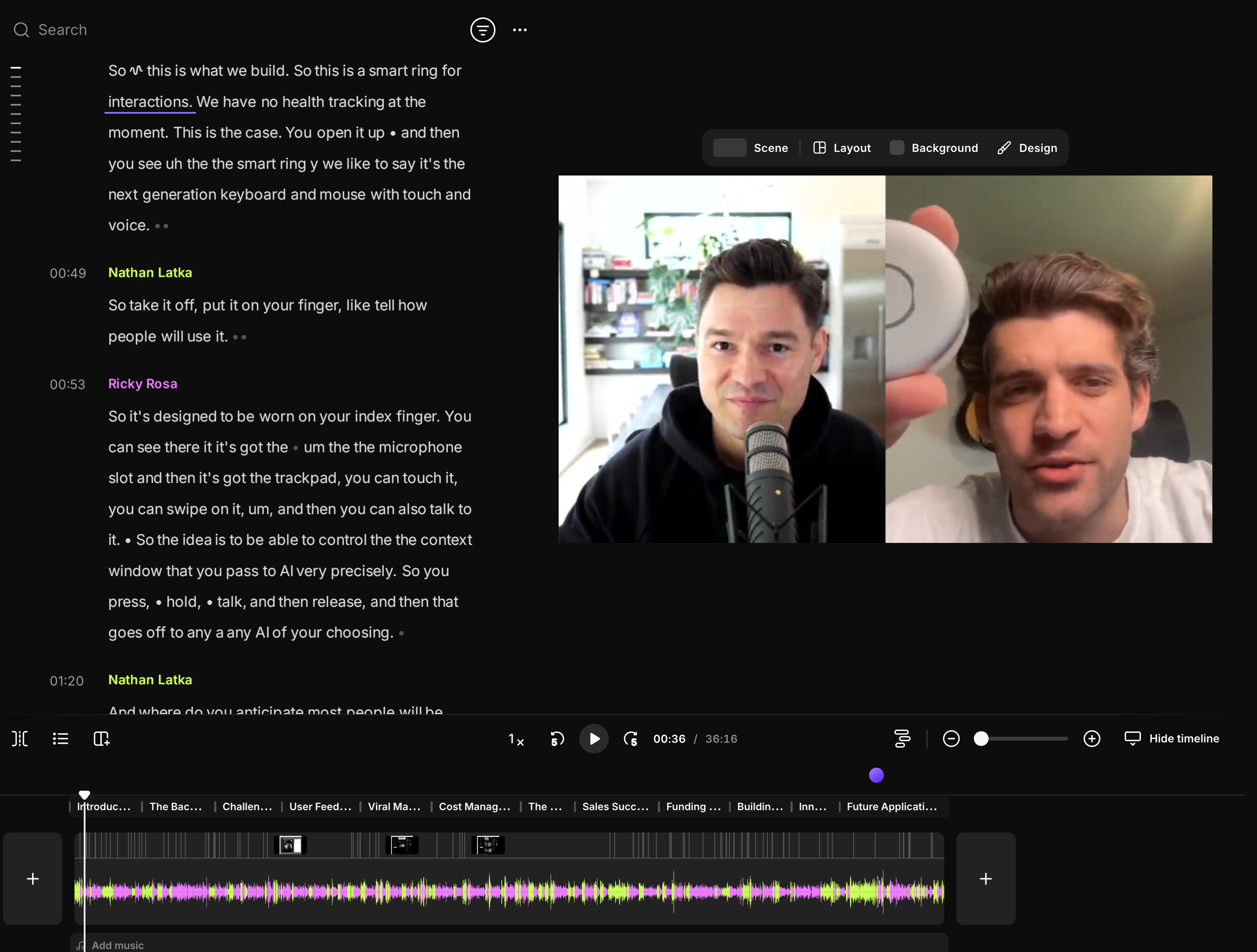
0:31So this is what we build. So this is a smart ring for interactions. We have no health tracking at the moment. This is the case. You open it up and then you see ⁓ the the smart ring y we like to say it's the next generation keyboard and mouse with touch and voice.
Nathan Latka
0:49So take it off, put it on your finger, like tell how people will use it.
Ricky Rosa, Founder & CEO
0:53So it's designed to be worn on your index finger. You can see there it it's got the ⁓ the the microphone slot and then it's got the trackpad, you can touch it, you can swipe on it, ⁓ and then you can also talk to it. So the idea is to be able to control the the context window that you pass to AI very precisely. So you press, hold, talk, and then release, and then that goes off to any a any AI of your choosing.
Nathan Latka
1:20And where do you anticipate most people will be using this? I mean, my so I'm a big whisper flow user. I get way more done when I can just hit FN on my keyboard. You know, where that becomes challenging is like if I'm in a coffee shop and it's loud, I'll actually connect a a a road microphone here into my computer. So when I push FN it comes through clearly. Or we're seeing all these memes right now on X of people with like masks over their face talking into a tube to go in. I mean, where do you anticipate your your power early users actually will use the thing?
Ricky Rosa, Founder & CEO
1:41Yes. Yeah. Th that's that's exactly what you you're you're exactly right. That's how we anticipate people to use it in offices, the crowded offices, you know, coffee shops, when your wife or husband is sleeping right next to you. So Whisperflow really showed what practical voice could look like. ⁓ and there are you know, the founder is an an angel investor in our company, so we really thought about, you know, what were the problems that they were facing. And it turns out voice is pretty useful because it's like three to four times faster than than typing. But you can't use it everywhere. Like it really breaks when a lot of people are in the room. And and what rings are really useful is to bring them very close to your mouth and whispering. So we tuned it for whispers and so you can you can you can have private voice anywhere anywhere you go.
Nathan Latka
2:27Mm-hmm. And so ⁓ just to be clear, right now you're exclusively sitting on top of the Whisperflow API, or can people use open source voice models with the ring as well?
Ricky Rosa, Founder & CEO
2:41So technically we create a virtual microphone on your laptop. ⁓ so we sit at that layer, but right now officially we only support Whisperflow to be able to, you know, handle the requests you know, well. We're a small team, right? So we have to kinda focus our our energies.
2:58Yeah, so give me more of the backstory now. I mean, just to give my audience some context, the way that some context, the way I found you was right here. You had a really well done video that you put up on X. well, I don't say really well. It popped up in my feed because X probably knows that I love sort of these kinds of tools, but it got, you know, 2.6 million views. You can actually see I posted here. I I purchased the 289 version. You're just selling the one version, right?
3:25Yeah, yeah, yeah. So this is our first public launch. We did a a little beta launch like twenty twenty four, which we shipped earlier this year, but this is our first like official public launch and that's why it's called Oasis One.
3:36And I said this is a this is a match made in heaven and we should lead a round of whisperflow power users into Oasis. But you've so you've already raised some capital, it sounds like. How much have you raised to get the prototype to where it is today?
Nathan Latka
3:49Very little. So we've raised around half a million dollars ⁓ over you know, across many years. And and and now we're we're putting together a round, so we we have a few commitments already and we're gonna be closing that in the next few weeks so we can get to China and get production ready and ship by Christmas.
Ricky Rosa, Founder & CEO
4:05So how the one you just held up and showed me, I mean, how did you get Batmade? I mean, were you soldering in your garage or did someone in China do like a small run for you?
4:10Yeah. No, no, no. We ev everything was handmade here in in Miami. So we have injection molding machines and everything in our office. It's like the whole shebang. We really handmade every single unit that we shipped earlier this year. And and the backstory, I know you asked. So the backstory is you mentioned at the beginning. So I was doing blockchain for MasterCard, which didn't really work out for them very well. But I I got to play with the Microsoft HoloLens back then. And I could see that this thing was gonna be the future. You know, the graphics are gonna get better. Obviously, lo and behold, now Zuckerberg and ⁓ Apple and everybody that's trying to do head mounted compute. But back then, ⁓ it was like very nascent. And there was one problem that I struck me very, you know, intently, which is ⁓ your arms got tired when you interacted. And it really reminded me of that Steve Jobs quote that said,
Nathan Latka
4:36Yeah.
Ricky Rosa, Founder & CEO
5:05the that they didn't want to make a touch screen laptop because you're you know because of gravity. When you touched it, your your your shoulders and and your arms got tired. And so I I knew that there was going to be an interaction problem in the future. So I started really thinking around that rabbit hole. ⁓ and so we decided to build a ring for for AR glasses. Obviously glasses are still, you know, th they're not as adopted as one might like. And so we kind of shifted gears when we met the Whisperflow guys and we thought, okay, well we can actually have a good run at replacing your your keyboard. ⁓ and that's kind of what we're doing now.
5:45Mm. Okay. So that was I just showed your bio. So you're that was research at MasterCard, linear algebra lecturer at Georgia, the Institute of Technology, Software at American Express. So I mean, what are you by trade? Are you an engineer? Are you an industrial engineer? would you do I mean what what's your background?
6:01So I started as a nuclear engineer, but my background is really in computer science and physics. That's what I went to school for at Georgia Tech. ⁓ but I I'm very I'm very versatile. So I you know, I have a lot of experience with CAD, I have a lot of experience with code. ⁓ I'm very hands on, so you know, I I really solder, you know, you know, my myself a lot. and ⁓ and yeah, so that that's kind of my background.
6:26When did you quit and go full time on the business?
6:28About three years ago? I think so.
6:30Okay. Okay. So around twenty twel late twenty twenty two. ⁓ Okay. And how did you I mean, the thing with hardware, it's different than software, right? I you gotta invest a lot of money just to get your first dollar of sale versus software you can pre sell. So, I mean, how much have you spent so far to get to the current point?
6:33He tries to write three, I think. Yeah. Yeah. We we've spent around three hundred K to get to this point. ⁓ which I don't know if you know anything about hardware, but it's a miracle that we got to ship a product with so little capital. Like it's literally like, you know, ⁓ you know it's it's a feat. It was a feat. That this is what is is it the gr Yeah, well you see the gray hair? This is I I turned some you know, capital efficiency into some like, you know, I had to trade in some melanin.
7:04Assume I assume my audience knows nothing about hardware production. W So what what do other hardware founders make mistakes on in terms of spending too much money early on? And what did you do differently?
Nathan Latka
7:21I think that you have to really figure out what the hell it is that you're building. And it's very easy to get caught up in like very novel experiences and very, you know, very fancy and flashy devices. And and we were we were guilty of that at the beginning, honestly. ⁓ but now what we notice is that you can only go you you can only ask people to go one step from current. And so you can't only introduce so much novelty at a time. And so what I think you should do before going and and spending a lot of money is like figure out exactly what that one step you're gonna ask people to take is.
Ricky Rosa, Founder & CEO
8:00Yep. Yep. Take me I wanna I'm trying to dive into this a little bit more. Take me into what's happening in this picture.
8:04Yeah. Ha ⁓ that is ⁓ me last Christmas building all of the rings that we shipped for our beta during Christmas and and early January. So that was a very stressful time. That's
8:22How many have you shipped? How many are in the wild today?
8:25So I a little under a hundred.
Nathan Latka
8:27Okay, how are you measuring feedback from these users? Do they call you? Do they text you? How do you know if it's working?
8:30Well yeah, yeah. I'm I I I'm very I'm very close to all of them. So I we we we we we text, we you know we used to have a a WhatsApp group, now we have a Discord, so so yeah.
8:39What's the most surprising feedback you've gotten?
8:42⁓ I think the most surprising thing out of this whole endeavor is that people seem to like using the ring in front of their damn laptops, which I never thought that it was gonna be a thing, right? Like we were we were building a next generation device for glasses and all this stuff, and now people are using that in front of laptops. That was very surprising to me. But ⁓ it seems to work. So so we're leaning into it.
Ricky Rosa, Founder & CEO
9:06Yeah, interesting. Okay. Take us into more let's geek out here on the tech a little bit. What are we looking at here?
9:11That's that's our main PCB. So that's what you're seeing there is the main computer. It's got a few sensors that we actually patented a few years ago. So I don't know how technical you want to go into it, but that there's two types of technologies for sensing. you got optical tech and capacitive tech. you know, capacitive is what your phone uses, optical is what your mouse uses. ⁓ when you have a form factor that's so tiny as a ring, neither one of them are a great fit. So we had to do some very clever innovation to combine them, do sensor fusion. And that's what we patented. We patented the the combination.
9:49Why hasn't any one of these other like major ring providers like Oura in or even Apple patented this this thing? Why were you the unique person to sort of find this combination?
9:58I spent a lot of time thinking about interactions. I mean, I don't know, you have to go ask them. ⁓ I'm sure they have some patents around the the interaction space, but this one in particular, I spent a lot of years kind of diving into how you would be able to scroll in two dimensions, like up, down, left, and right. And so there's some there's some problems associated with that that are not intuitive. And I think nobody had really gone down that rabbit hole and like found those problems. And so that's why that's why we we got to to do it.
Nathan Latka
10:30Okay. So for my audience, this is basically like you cut out one of these wafers and you then roll it and that that is what's inside the ring.
10:40Yeah, correct. So that's what's that's what's inside of this metal shell right here.
Ricky Rosa, Founder & CEO
10:45Wow, wild. Okay. Last picture here. What are we looking at?
10:49That's the s that's the that's the sensor fusion. So that's the sensor fusion in hardware. So that's ⁓ part of the capacitive electrode, but part of the optical sensor. ⁓ it's basically a laser and a and a capacitive touch sensor.
11:01And are you I mean, we can see the soldering marks in there. I mean, that looks so small for you to be doing by hand, but you did all that by hand?
11:07No, so so a f a few of these ⁓ a few of these components were actually soldered in in in a in a manufacturing plant, but in order to edit or or or change the locations, I did have to solder it by hand. ⁓ and that's why you see the marks there and that is very difficult.
11:25Yeah, yeah, I can imagine. Okay, interesting. ⁓ so you got a hundred out so the ones you shipped Christmas, you said Christmas twenty twenty five, right? Those were your first ones out in the wild. You've got a Discord group, you're learning. How did you get those first hundred customers? What's your go to market strategy?
11:39So we we actually we we've never spent anything like one dollar in marketing. So the first time we went viral for our beta launch, that's how we got the first customers, and now we went ultra viral for the actual launch and that's how we got the next customers ⁓ that we that we sold out the first batch la two weeks ago last week.
Nathan Latka
11:57I don't think virality is ever by accident. I think people have unique ability to tell stories and it helps it go viral. So so take some credit for this. What was your first viral post around Christmas and and why do you think it went viral?
Ricky Rosa, Founder & CEO
12:05Yeah. So so the first ⁓ kinda it was like mini viral story was tw 2024. ⁓ you know, we really decided to showcase the ring, ⁓ you know, its capabilities, you know, a few use cases, and it got some attention f ⁓ from like ⁓ early tech adopters, and that's kinda how we we ⁓ sold out the the beta batch. The second virality moment.
12:36Sorry, which one which one was that, Ricky? Was that on X or LinkedIn or somewhere else?
12:40No that was an X but it was a while it was like twenty twenty four, so it might take you a while to find it. there there you go. That yeah, that one.
12:43This. Okay, so this one got twenty two thousand views. This just by itself, this helped you sell a hundred of your first units.
12:51Yeah. Yeah. Well a l a a little bit under that. So so I think like like forty and then ⁓ you know, over over the the course of the year we sold more.
12:59Okay, and what were you charging back then? Was it the same price I paid, the two thirty something? How'd you come I mean, for someone else, you know, in the hardware space, maybe their pre-revenue, how do you decide what to price this thing at?
13:02Yeah, twenty nine. Yeah, twenty nine. I I mean full transparency. We really just ⁓ pulled it out of a hat, honestly, 'cause we we did we we we didn't know like a lot of things and we really want it to be, you know, l lower than aura. sorry we don't we we don't focus on on hard on health. ⁓ be wanna but we want it to be expensive enough to have some signal when people bought it, you know, like, okay, this is something that people really want. ⁓ so it took some tweaking but but i i it was ⁓ it was ⁓ seat of the pants, you kind of mechanics.
13:39And and what are your right now, you're running an expensive production line 'cause it's I guess in your garage, Miami, nearby, not in China yet. What is your right now all in cost to produce one of these things?
13:50We we actually lose a little bit of money on each ring, ⁓ at the moment and then for the production run that we're gonna do, we're act we're gonna be profitable. So so we're we're gonna sell it at out of profit, yeah.
13:59I see. So this costs you more than like two hundred and thirty, two hundred and forty bucks to make today. You're losing a little bit but you're learning.
14:05Yeah, yeah, yeah. So the so so the early w yeah, the early ones was like si yeah, six hundred bucks. We we we yeah, they're they're very expensive. Especially 'cause all of the the sens sensor coverings are custom and so ⁓ yeah, they were expensive. ⁓ but yeah, but but now not so much.
14:19Okay. But you think you can get that price down to what if you put on a bulk order order in China?
14:24You mean the cost?
14:25Yeah, what do you think you can drive it down to with a ball quarter?
14:28⁓ I think ⁓ well th the cost or the price? I think the price is gonna stay the s yeah, so yeah, so so the price is gonna stay the same, but we can probably get it to like between sixty and a hundred bucks or something.
14:32The cost. Your cost. Your cost. And how many units will you have to pre order for that amount?
14:42⁓ the w what we sold out like a thousand units or something?
14:45Okay, so you can buy in a thousand unit increments at about sixty to seventy landed cost to goods sold.
14:53I think so, yeah.
14:54What's a big mistake? I mean, you're in this right now. What's the biggest mistake hardware founders make when they go from their garage in the US to a manufacturing facility overseas?
15:02Dude, I actually ⁓ the founder of Whoop Will Ahmed has this great line ⁓ that I ⁓ it's always in my mind. He says something like the biggest ⁓ hardware mistake that hardware founders make is trying to be successful with your V one, which is completely counterintuitive. But when you think about it, it's like, Okay, well, if you sell ten thousand units and then you get five thousand returns, it's like you're in deep trouble, right? So you have to you have to be careful. you know, how fast you expand, you know, hardware is not like software. You know, y y you have to move atoms around. That takes cost, energy and and and sweat, honestly. So so you have to be mindful on how how fast you expand and how fast you learn and and and all these things.
15:47He's saying most hardware vendors expand too quickly, they bulk order too much too fast.
15:52Yeah, well that's that yeah, I I think y y you can pull out his tweet, but basically it it's something around it's something along the lines of ⁓ y y you know, the biggest mistake is trying to be too successful with your V one when you when you don't know that much about your c customers, about your market, about, you know, your product even, you know.
16:09Yeah, yeah. Interesting. Okay. So that's Christmas. You're losing money on every ring. Let's fast forward here. Your I mean your X thread does a nice job of sort of the timeline here. What's what's
16:16Yeah, I was I was ⁓ I was live posting ⁓ through all of the ⁓ yeah. Through all the stress.
16:24So this is like you literally just fine tuning every ring right here.
16:28Yeah, so that that w what I was doing there, we had some trouble with our BLE antenna. So I had to do some modifications to the shell to be able to pull out some wires so that I could take it to an RF engineer so that we could tune the antenna last minute. And I think if you go to the next post, we you could probably see I think it's it's no no no, like the the next actual post. So it's like something like ⁓ maybe maybe a little bit higher. It's like ⁓ last minute antenna voodoo. Yeah, there you go.
Nathan Latka
16:47This one?
Ricky Rosa, Founder & CEO
16:53So we were tuning so we were tuning the B L E antenna to increase range. So we had some issues where ⁓ a few of the units, like the the B L E connection dropped like after like five meters or something like that. So we really needed it to like increase it to ten.
17:07And what did you have to do on the har on the Adam side of things to make that work?
17:10We actually swapped the swap the antenna. I don't know how technical you wanna get, but w we we
17:15No, go you can get technical. I mean, I won't be able to follow all of it, but my audience, you know, why they'll look it up.
17:19Yeah, so basically we had a two point four gigahertz antenna, which is what you need for B L E, but when you put it inside of the the metal shell, it was yanked down to like one point seven or something. So we had to find an antenna that was like four like like f four gigahertz, so that when you put it inside of the ring, it got yanked down to like near two point four. It was like this voodoo trick that the RF engineer told us about. It's like very seat of the pants, kinda guesstimate.
17:47That's because the shell of the ring is interfering with the four and it degrades it to a two seven. Interesting. Interesting. Okay. And did you have vent you said vendor finally came through? Were you having vendor problems?
17:49Yeah. Yeah, exactly. Yeah, so this is our so our packaging vendor in China kinda fell through. So I found somebody in Maj in Miami to put ⁓ to to make our packaging. And he was like busy at the time, he was like our basel like going on. So he had a lot of orders. So I like I finally just went went to the shop, like knocked on his door, and he's like, dude, I really need this done like today. And so, you know, that's that we filmed the video. Yeah.
Nathan Latka
18:21That's wild. That's wild. Okay. So let's fast forward a little bit. This is you just making the acrylic edges of the box smooth.
18:28Yeah, those are the bo yeah, these are the boxes. Yeah.
18:31I love and here's what it looks like. How how what did this feel like when you finally got the first one of these things made?
18:35It was pretty surreal because it had been a few years in the making and at every step of the way there was a problem. Like yeah, I I I felt like the entire universe was like conspiring against me because like at every single step of the way, like there was a problem. And so when they it finally like came together, I like, All right, I can breathe now.
18:54All right. So this is cool. So you get all the production, the packaging, you've got these beautiful shots coming out. you sell out. So if I ordered pre order during Christmas and I got it to my house, it'd look like this, right? Okay.
18:58Yeah. Yeah, it looked like that. ⁓ it it came with those little Legos. it's like a little Easter egg that we shipped that are ⁓ Liam and Noelle Gallagher from Oasis. So it's like a little a little Easter egg. Yeah.
19:18I love that. I love that. When you say Easter egg, I mean if I convert that to marketing language, there's this concept of like variable reward and surprises that builds brand loyalty. Is that what you mean by Easter egg? Yeah, super cool.
19:27Yeah, yeah, yeah, pretty much. We we w we might still do something like that for for this this upcoming batch. So you might be getting some Legos.
19:35Yep, yep. And I I love this video. There's a quick flash of like some original sketches you had early on. Do you still have that sketch do you have that you don't have that sketchbook near you right now, do you?
19:40Yeah. No, I don't think maybe. ⁓ it's gonna take me a while to find it 'cause I it's the the I look like
19:49Yeah, yeah. I just love all these historical moments, right? We have to document this stuff so that when you're selling a million units a month, you can go back and go, Remember that sketch in that on that grid paper from twenty twenty two?
19:59Yeah, that's why I made that video. I was I was like going through my camera roll and and because when I w when we finally delivered the first one, it was like a a a very like wow moment. In my head, I was like, Jesus, like it's just so many years. So I went through the my camera roll and I was like looking like at how many pictures I took and like how many like years in the you know, like in the making. And and and I I put put all of the pictures related to Oasis into a folder and then I I Put them all in black and as I go. Actually this would look very cool in a video. I edited myself, so yeah.
Ricky Rosa, Founder & CEO
20:32It looks great. That looks great. Okay, so fast forward to the units you just launched recently. I'm gonna scroll up a little bit. I think where was the launch video on that? Right up here, maybe. Yeah, right here. Yeah. S so so how did these sell? How many did you sell?
Nathan Latka
20:42all the way up top, yeah. Yeah. w we're we we were originally ⁓ scheduled to sell five hundred, we extended it to seven hundred, we're na now we open batch two and it's like a little under a thousand. So I think we're on track to to ship, you know, a thousand for Christmas, or and maybe like early twenty twenty seven.
21:08Come on, man. How did that I seven hundred units at what was it, two hundred and eighty bucks a pop? That's like two hundred thousand dollars of like real revenue. I mean, how did you feel?
21:11Yeah. Yeah yeah, like in like two days. It was it was I mean, this entire launch was a trip. We didn't even know if it was gonna work or not, right? it it's like w we had a hunch 'cause we saw, like you said at the beginning, like people using DJI mics to code. And and I thought that was kinda l a little weird. It's kinda it's like w what the hell is going on here, right? but you know, we took a bet and it panned out
21:38Yeah. Okay. I love this. So so you now were you still spending six hundred bucks per ring here, or did you get your cost structure a little in shape, a little better?
Ricky Rosa, Founder & CEO
21:45No, no, we defin no no. For for for for for this launch the the cost structure is obviously, you know, what we want it to be for production. So I think
21:53Yeah. Okay. So I ordered on I ordered on June thirtieth. We're recording here July fourteenth. When when like what's the what's the lag time right now? When will you think I'll get this in my inbox?
22:01I think so to manage expectations we told everybody Christmas, but I think we might be able to ship some early batches to some people as soon as August or September or something like that.
22:12And what do you so like my whole world is usually interviewing software founders. And I'm realizing in this age of AI, the next frontier is actually physical, which is why I'm buying. I mean, look, I I bought these things, which just I never really got using them because I felt like a dork wearing them around, right? These were these were the meta glasses. I mean, I think if I showed up on a podcast with these on, you guys would all make fun of me in the comments. Okay. It they just look a little weird. ⁓ and then Ricky, like I went and played with.
22:30Yeah, yeah. Yeah.
22:39Like I don't love this brand is out of China. ⁓ I think it's called Even Realties. You know, the form factor on the Yeah, they're they're you know, it's a better form factor, but you can still kind of tell when I put them on. I don't know if you can see it. It's a teleprompter here, so I can see and they have a little ring that goes with it. Now these, you tell me, Ricky, they look a little better, right?
22:44Yeah, yeah, even realities, yeah. Yeah. Yeah, yeah. They do look better, yeah. They're they're not easier right now.
23:00Is your technology though better? Like they have a ring that allows me to scroll on the teleprompter. Is your technology better?
23:05Yes. So they're they're so this is what I was trying to touch on before. So they use ⁓ capacitive only technology. And so that's why they can only do up and down. ⁓ and indiscrete up and down. There's like some nuance there in the types of interactions that you can do. We really spent a lot of years and a lot of development so that you could do continuous inertial scrolling in two dimensions. So up, down, left and right. ⁓ yeah.
23:29So what do you how do you make your atoms smarter with AI? I mean, you're sort of cheating right now just using Whisperful, but like do you intend to push the edge on the software side of things or do you really just want to push the edge on the Adam side of things?
23:42I I think we we really need to push it on both. I think there's so right now, you know, if if you look at our our launch materials, we only focused on laptop work and that was very intentional. We didn't mention anything about phones or or iOS or anything like that. ⁓ we do have, you know, some mobile experiences that we're working on. We actually patented some context switching features that allow you to context switch directly from the ring. and so we're gonna reserve the right to announce that later on.
24:14Mm-hmm. Very interesting. Now you're are are you raising additional capital to scale quicker or are you good with what you have so far?
24:20No, we're we're racing we're we're racing this week. Like I said, so we we've close some checks, we're gonna close in the next two weeks so we can get on the plane to China and and and get everything set up.
24:28Do you anticipate doing just like like folks like me, sort of power users that love it, that are early adopters, or do you anticipate sort of a big fund coming in and writing, I don't know, a ten million dollar check?
24:36Pro probably both. So we we've had some angel investors from like meta reality labs all the way to like, you know, friends and family. we're really like an angel friendly, but there are some some funds circling around, especially from Japan. I don't know if you saw, but we went completely viral in Japan. There's it was nuts.
24:51You told me this, but I didn't understand it. Like I couldn't find anything on X where like you posted something in Japanese that went viral.
24:59No no no. So it is it was them reposting and quote tweeting it in Japanese. It was like you you can see you can see the replies there and the quote tweets. maybe you can't see because like ⁓ X auto translates it, but if you if you click like original language, like there there's a lot of them in Japanese.
Nathan Latka
25:19I see. On the reposts.
25:22Yeah, on the yeah, on the repost, like quote tweet.
25:25I see exactly what you're referring to. Yeah, sorry, guys, just so you guys can see what I'm looking at. This is what I'm seeing. And you didn't do anything to prompt this. It was like all organic.
25:33No, it was it was all organic. I mean, yeah, it it's actually funny. The story goes so, you know, we went on T V PN, you know, the Whisper Flow people reposted us, we started going viral, then at the end of the day, Mark and Jeresa and freaking bought one and reposted organically, and then we got like by by the the the twenty fourth hour, we got to like eight hundred and forty thousand views and it started dying down. And I was like, I really wanted to get to a million views, blah, blah, blah. It's like that was kind of our our our target. But it started dying down. I was like, all right, you know what? GG, good game. It's like good enough. Like, be happy with your with with what you accomplished. Like it's all good. And then around 11 p.m. of the following day, ⁓ it was 9 a.m. in Japan. And the Japanese people started waking up and they got a hold of it, and it just went crazy viral. Like orders started flying in, like, you know, retweets started flying in. And then it got to a million views in like an hour and then I went to sleep. I woke up, it's like two point six. Which was insane. So I I I'm I'm I'm forever indebted to the Japanese people.
26:37That's wild. I love that. Okay, what's the team today? Are you doing this solo?
Ricky Rosa, Founder & CEO
26:42So we're like we're we're a small team, we're like four people. So we have a creative director, which ⁓ credit to him because the entire kind of aesthetics of the launch came from his beautiful mind. And then ⁓ we have three engineers.
26:55Mm-hmm. Interesting. And if someone just I'm curious sort of how you think about this space, can can you do you need larger compute or just budget resources from a large player to really move quickly here? In other words, what I'm asking is if someone like Apple or Aura came along and just offered you thirty million bucks all cash to sell today, would you take the deal to move faster?
Nathan Latka
27:14⁓ I don't know that I would. I I think it's like shoulda, coulda, woulda. I don't know. I wanna w we'll cross the bridge when we get there. We really wanna build something generational. so I think the way to do that is by building a you know, strong foundation for for a for a strong company. I think Steve Jobs has a great quote of like, I have no patience for the people that build companies to like flip them. Like the the hardest problem set in in in in the space of tech is actually building the company, not the product. It's like You know, the product is the company. So that's what we're that's what we're after.
Ricky Rosa, Founder & CEO
27:45Yeah, like what I'm what I'm pushing you on is there's this big divide right now in the age of AI, right? Sam Altman at OpenAI knew he needed Microsoft for compute. Deep mind, right? They sold the Google because they know they needed that compute to speed up their go to market. Like, do you feel any of that pressure?
28:02In terms of so software or hardware? I mean ⁓ Yeah, well so in in in in the software world, ⁓ that's why the partnership with Whisperflow ⁓ is so important, right? It's because they're they're they're best in class in in this sort of speech to text that we're going after. And so ⁓ you know, leaning on them for the software, at least at the beginning, is ⁓ is a very smart move.
28:04Well, both. I mean, that's the question, right? It's Adams it's Adam's N bits.
Nathan Latka
28:28And a and obviously people responded to it, right? Like the the you know, the i it worked ⁓ for the launch.
Ricky Rosa, Founder & CEO
28:34What about the Adam side?
Nathan Latka
28:35The Adam side is a little bit different. I mean, I'm not sure I I don't know that I can give you a straight answer. except to say, you know, obviously Apple is the best at, you know, this sort of like supply chain side of things in the world. And doing a partnership with them, you know, would be great. But if not, well, I mean, we'll take them on.
Ricky Rosa, Founder & CEO
28:59Yeah. I love that. What other hardware star ups are you watching in the space?
29:03what other what startups?
29:05Yeah, what other no, no, what other hardware sort of startups are you w just watching? Not not necessarily direct competitors, but just other people combining sort of software AI with atoms and a physical form factor.
29:15I just spent some time with ⁓ Tomás Vega at Augmental in San Francisco. He's ⁓ more leaning towards like disability use cases, but he's had a ⁓ a a cool product coming out for Private Voice, which I think people should take a look at. It's it's very cool. ⁓ the Mentra guys, Caden ⁓ at Mentra is doing a very good job with with glasses. ⁓ yeah.
29:41Mm-hmm. Mm-hmm. Why has nobody nailed glasses yet?
29:46It's a good question. I mean, I I do have some hot takes there. I don't know if you wanna if you wanna go down the rabbit hole. I think Yeah, so I think here's here's what I think. I think if you look at the the history of technology, the real market segmentation happens around stationary and home devices and mobile devices. Kind of like the s last paradigm, you had desktop computing and then we moved into mobile computing, right? And the same thing is gonna happen with head-mounted compute.
29:52Yeah, splurge for a minute or two, why not?
Nathan Latka
30:15And most people talk about, you know, let's say glasses versus headsets or AR and VR or, you know, waveguide and pass through if you want to get technical and these sort of you know, segmentations. But but but they're all BS. Like the real segmentation is just really home devices and mobile devices. And I think n The technology is ready for home devices and not enough people are doing a good job at that. People are trying to go to the mobile devices too quickly. And obviously w when the technology is nascent, you have power constraints, you have space constraints, you have a lot of constraints. And if you go straight to mobile, all of these constraints com compound. So so does that make sense?
Ricky Rosa, Founder & CEO
30:55It doesn't. Yeah, I mean, look, who knows, right? I mean, I'm watching like Evan at Snapchat look like an look pretty crazy with his massive block on his face, but kudos to him for rocking it regardless. ⁓ I just I'm just curious to see who's gonna win this space. Look, I'm really excited to get your ring though. I'm I'm shocked that others have like I'm love aura, I've been on them for four years. I'm shocked they haven't moved in this space, but to their credit, it's totally different than health tech, right? It's it's completely different. I'm just curious, like.
31:02Yeah.
31:22I don't wanna be wearing ten rings, right? That's the thing. So I think two is fine.
31:26We'll we'll we'll try to fix no no, we'll try to fix this. We'll try to fix this. We'll we'll we'll wink we'll wink at the at the at the audience when was just say we'll try to fix this.
31:30Yeah, two is fine. What what other things besides health and like voice dictation do you think you could tackle with the current tech stack you're building into the ring?
31:44top tap to pay is a is a big one that we're looking at. So so you know, NFC based communications. So you could tap to pay, you could tap to swap contacts, tap to X really. Yeah.
31:47Mm. Interesting. Interesting. Very cool. Well, hey, look, Ricky, if people want to follow you along this journey, where can they find ya?
32:04Oasis Rick ⁓ everywhere and Oasis devices everywhere as well.
32:09Guys, there you've got it. Ricky got I mean, he got gone after a background at ⁓ some of the card companies and said, you know what, let me let me build a ring here, let me get to work. Started soldering, burning his fingers up. you know, caught about two really two, three years ago. Christmas twenty twenty five was his first shipment of a hundred rings that he was losing money on every ring. Each ring cost about six hundred bucks. He was real t retailing them for two hundred and eighty-nine bucks. Now, fast forward to just last month in June of 2026, his post went viral with a new and improved version. He solved some issues on the supply side, on the tech side. ⁓ and now he's got over a thousand sales at 289 bucks a pop. You guys can do the math. His first $250,000 of sales has got to feel really good. Now every investor wants in. He's headed to China and overseas to try and drive down his costs. He think he can get his ring costs down to 60 per unit, which obviously gives him sustainability if he can, you know, build there and sell for. two eighty nine on a go forward basis. Who knows what the future product looks like. Right now, though, the software is sitting on top of WhisperFlow. He's controlling all the atoms with real patents, real defensibility, real moat there. And maybe tap to pay is coming in the future, but we will see. Ricky, thanks for taking us to the top, man.
Nathan Latka
33:13Thank you, man. I appreciate it. Thank you for thank you for having me. All right. This is great. This is very great. ⁓ yeah, I was I was having my coffee, so I I was ⁓ you know, all all ready to go. My my brain
33:15All right guy All right guys cut.