
Executive Interview
How Agendrix Reached $381K MRR with 4,150 Customers and 103% Net Dollar Retention (Interview with CRO Sébastien Charland)
- Interview Date
- January 12, 2022
- Interviewee
- Sébastien CharlandCRO and Partner
Company Metrics at Interview Time
MRR (January 2022)
$381,000
Customers (2022)
4,150
Net Dollar Retention (2021)
103%
Average Contract Value (2021)
$1,100
Team Size (2022)
35
Historical Snapshot
These numbers were reported by Sébastien Charland during his interview with Nathan Latka in January 2022 and are a historical snapshot, not current figures. See Agendrix’s current numbers.
Key Takeaways
- 01Agendrix was generating $381,000 in MRR in January 2022 across 4,150 paying customers
- 02Average contract value was $1,100 per year as of December 2021
- 03Net dollar retention was 103% in 2021, with gross churn of 9% and expansion of 11 to 12%
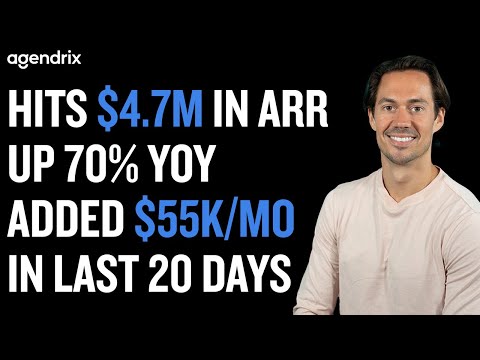
- 04Twelve days into the January 2022 price increase, Sébastien Charland estimated it would add about $55,000 in MRR over the full month
- 05The company raised $350,000 in seed capital in September 2016, its only growth capital round
- 06Agendrix has 35 team members including 14 engineers and 4 sales reps as of early 2022
- 07Customer acquisition cost is approximately $500 to $600, with paid marketing spend of about $15,000 to $20,000 per month
- 08The company deliberately focused on French-speaking markets in Canada and Europe to avoid larger English-speaking competitors
- 09Agendrix was founded in 2015 and launched from a web services agency that was shut down to focus on the SaaS product
- 10The company plans to stay bootstrapped and is expanding into HR modules to drive expansion revenue
Company Metrics at Time of Interview
| Metric | Value | Source |
|---|---|---|
| MRR (January 2022, USD) | $381,000 | Founder interview, January 2022 |
| MRR (one year prior) (January 2021) | $220,000 | Founder interview, January 2022 |
| ARR (2021) | $2.64M | Founder interview, January 2022 |
| Customers (2022) | 4,150 | Founder interview, January 2022 |
| Average Contract Value (2021, USD) | $1,100 | Founder interview, January 2022 |
| Net Dollar Retention (2021) | 103% | Founder interview, January 2022 |
| Gross Revenue Churn (2021) | 9% | Founder interview, January 2022 |
| Expansion Revenue Rate (2021) | 11% to 12% | Founder interview, January 2022 |
| Estimated MRR From January 2022 Price Increase (day-12 forecast, currency unconfirmed) | ~$55,000 | Founder interview, January 2022 |
| Team Size (2022) | 35 | Founder interview, January 2022 |
| Engineers (2022) | 14 | Founder interview, January 2022 |
| Sales Reps (2022) | 4 | Founder interview, January 2022 |
| Customer Acquisition Cost (2022) | $500 to $600 | Founder interview, January 2022 |
| Paid Marketing Spend (2022, monthly) | $15,000 to $20,000 | Founder interview, January 2022 |
| Seed Funding Raised (USD) | $350,000 | Founder interview, January 2022 |
| MRR (2016) | $30,000 | Founder interview, January 2022 |
| Valuation (2016) | $3,000,000 | Founder interview, January 2022 |
| Year Founded | 2015 | Founder interview, January 2022 |
| Base Plan Price Increase (January 2022) | 37% | Founder interview, January 2022 |
| Pro Plan Price Increase (January 2022) | 18% | Founder interview, January 2022 |
| Average Price Increase (January 2022) | 26% | Founder interview, January 2022 |
| Loan Amount (2021 buyout) | $2,100,000 | Founder interview, January 2022 |
| Loan Interest Rate (2021) | 10% variable | Founder interview, January 2022 |
| Loan Term | 5 years interest-only | Founder interview, January 2022 |
Growth Breakdown
Revenue
Agendrix grew from $220,000 in MRR a year prior to $381,000 in MRR by January 2022, driven by new customer additions and a significant price increase. Speaking on January 12, he estimated the increase would contribute roughly $55,000 of MRR across the full month of January. Annual contract value per customer stood at $1,100 as of December 2021.
Customers
The company reached 4,150 paying customers by early 2022, serving retail, restaurants, pharmacies, elderly residences, and security companies. Agendrix deliberately targeted French-speaking markets in Quebec, France, Belgium, and Switzerland to avoid competition from larger English-speaking rivals.
Team
Agendrix had 35 employees in January 2022, including 14 engineers and 4 sales reps. The company had historically been inbound-only and was actively building out its outbound sales function with quotas for the first time.
Profitability and Funding
Agendrix raised $350,000 in seed capital in September 2016, its only growth capital round. A 2021 transaction involving BDC and Desjardins was structured to buy out the original founder and did not bring operating capital into the business. The company intended to remain bootstrapped going forward.
Growth Strategy
French-Market Focus
Agendrix deliberately targeted French-speaking markets in Quebec, France, Belgium, and Switzerland. Sébastien Charland credited this decision with reducing competitive pressure from larger English-speaking workforce management platforms and enabling faster growth in regions with distinct labor laws.
Strategic Price Increase
After holding prices flat since 2016, Agendrix raised its base plan by 37% and its pro plan by 18% in January 2022, creating an incentive for customers to upgrade. The company gave customers several months of advance notice, called larger customers directly, and offered an annual plan lock-in to soften the transition.
Recession-Resistant Vertical Diversification
Starting around 2017 and 2018, Agendrix shifted its customer mix away from restaurants toward pharmacies, drugstores, retail, and elderly residences. This diversification proved critical during COVID-19, when restaurant customers declined while other verticals continued to grow.
Inbound to Outbound Transition
The company had been almost entirely inbound-driven through most of its history. By early 2022, it had built a four-person outbound sales team and was actively developing quota structures to accelerate new customer acquisition.
Paid Search Advertising
Agendrix spent approximately $15,000 to $20,000 per month on paid marketing, primarily through Google AdWords and Bing. The company had previously used Facebook advertising but moved away from it, focusing its budget on search channels where intent was higher.
Best Quotes
“We voluntarily decided to focus on French markets. They were a bit less crowded than The US or English speaking markets because of our largest world competitors. And there are some some work laws and labor laws, which are very specific to different regions, especially the French speaking ones where we have less competitors and grow better.”
“So what we did is we increased the base plan by 37% and we increased the pro plan by 18%, creating an asymmetrical advantage to switch to the pro plan, you know?”
“We did actually only one round in 2016 when I joined the company. We raised about in USD was 350,000 back in September 2016. That's the only time we actually raised growth capital, if you'd like.”
“We're expanding into new HR modules, which will entice, we believe, a lot of customers to upgrade to new plans. So that will normally increase our we basically it will increase the amount of MRR per customer.”
“We're gonna keep bootstrapping forever, I hope.”
What Happened Next
This interview captures Agendrix at a specific moment in January 2022, when the company had just executed its first price increase since 2016 and was reporting $381,000 in monthly recurring revenue across 4,150 customers. The figures here reflect what Sébastien Charland reported during the recording and should be treated as a historical snapshot. For current revenue, customer count, and other live metrics, visit the Agendrix company profile on GetLatka.
View Agendrix’s current profile and metricsFull Transcript
Chapters
- 0:00Introduction and Background
- 0:20How Sébastien Joined His Childhood Friends
- 0:49Company Launch and Agency Origins
- 1:56Equity Split and Early Valuation
- 6:272021 Founder Buyout Structure
- 6:57Product Overview and Target Customers
- 7:39Pricing: ACV and Monthly ARPU
- 8:00Revenue, MRR, and Growth Rate
- 8:57Geographic Focus on French-Speaking Markets
- 9:29Funding History and Capital Structure
- 13:03The 2022 Price Increase Strategy
- 14:58Estimated MRR From the Price Increase
- 16:282021 Churn, Expansion and Net Dollar Retention
- 17:22Team Size, Engineers, and Sales Reps
- 18:02CAC and Paid Marketing Spend
- 18:46Recession-Resistant Niche Diversification
- 19:33Bootstrapping Plans
Introduction and Background
Nathan Latka
00:00Hey, folks. My guest today is Sebastian Charlin. He's a CRO and partner at agendrix, a workforce management SaaS based in Sherbrooke, Canada, where he oversees a finance and CS teams with a customer base of 4,150 customers. He holds an MBA and CPA and joined his childhood friends in the company back in 2016. Sebastian, you ready to take us to the top?
Sébastien Charland
00:18Yes. Thanks for having me.
How Sébastien Joined His Childhood Friends
Nathan Latka
00:20Alright. Why were you late to the party? How many how many months or years or weeks were your friends coding this before you joined?
Sébastien Charland
00:26Approximately a year, year and a half maybe. My friends basically had a web service company where they would develop apps for customers and the initial founder of agendrix was one. So it was a service company before and they eventually merged with agendrix And following that and the first revenues, I jumped in. Quit my job Interesting. And joined them.
Company Launch and Agency Origins
Nathan Latka
00:49When did what year did the company launch?
Sébastien Charland
00:54Official year is 2015.
Nathan Latka
00:572015. And and did the agency shut down or is the agency still going today?
Sébastien Charland
01:01No. They shut it down and they moved all the employees, the big total of five people with the new product, Agendrix.
Nathan Latka
01:09Do you remember how much revenue the agency did the year before they shut it down?
Sébastien Charland
01:15I believe, like, $500,000.
Nathan Latka
01:17Okay. So not hard to It shut is so small. But yeah.
Sébastien Charland
01:21It it was their first year, and to their credit.
Nathan Latka
01:24Yep. Shut down and moved to SaaS. Interesting. And how were you friends with them? Did you work with them at the agency or high school or what?
Sébastien Charland
01:32Elementary school and high school. So the CMO was my high school friend and CEO today, but who was back then one of our developers was at elementary school since I was like, I think, five years old.
Nathan Latka
01:43Well, this is relevant. Know, lot of people listening right now have a company they launched, then one of their friends joins like a year later, and they're not sure how to do equity. Right? Because they're a year late. So without like, you know, share what you can, but like how much equity do you own? How do you think about that?
Equity Split and Early Valuation
Sébastien Charland
01:56Yeah, right now I own about, say, around 10% of the company. We are five partners, and then the other half is basically financial institutions who jump with us to buy back the president, you know, the initial founder of agendrix, who was older and who retired last year in 2021. And so they helped us buy him back. But back then, the company when I joined, I had more salary than the company had revenues. And so the valuation
02:26was just off the roof. I think it was, like, a 100 times MR or something like that, whatever the number was.
Nathan Latka
02:32And we were twenty sixteen. The actual valuation? What year?
Sébastien Charland
02:35That was in 2016 when I joined, and I think the valuation was perhaps $3,000,000 almost. And the company was doing $30,000 MRR. So you see where I'm going. I didn't get a lot of shares. With the buyback, we had a split equity and debt deal, which allowed us to buy back some shares and just sell some to to the banks, but there was no growth capital inflow. It was just like to buy back the shares.
Nathan Latka
03:07Mhmm. So just to sum that up, back in 2016, valuation was about 3,000,000 when you guys were doing 30,000 a month in revenue?
Sébastien Charland
03:14Yeah.
Nathan Latka
03:16Interesting. Okay. And so and so how much did you need to raise? Like, what was the raise to go buy out the older guy?
Sébastien Charland
03:23I cannot disclose the numbers to this day in 2021, but let's say it wasn't that far above that number. It was oh, actually, that's that's a that's a public number, but in total, we raised about $3,000,000 to buy everything back.
Nathan Latka
03:43Wait. So you raised 3,000,000 out of 3,000,000 valuation, so you sold 50% of the business to new investors?
Sébastien Charland
03:49Yeah. Sorry. So the split today is about yeah. And this is going this is getting messy. So back in 2016, we didn't have financial institutions. It was almost only the five young guys, if you want, plus Andrea was the founder.
Nathan Latka
04:03Oh, what's going on there, YouTube? Good to see you guys. Now imagine this. You love watching these interviews with SaaS founders, but imagine if we took all of the valuation data out from over 2,807 interviews I've done manually. Saves you a lot of time. Well, we've done this. We've built it into the beautiful interface inside of Founderpath. Check this out.
Sébastien Charland
04:22I'll show you how
Nathan Latka
04:23you can access this in a second. But you log in, you connect your Stripe account, you see your valuation real time, you can see what it it changed over the past eighty eight days and even set goals for valuation this year. Now the secret evaluation is there's many different ways to value a SaaS business. So the reason you're gonna see three or four different valuations inside of your Founderpath dashboard, this is all free by the way,
04:46is because depending on who's doing the buying of your SaaS company, you're gonna get a different valuation. A VC is gonna pay a different valuation, Private equity firm is different. If you're gonna do a minority sale, that's different. And if you sell the whole business, that's a different valuation. You can see all those when I hover over here, right? So the teal is what a VC would pay. Yellow is what private equity And red is if
05:08you sold the whole thing outright. Now what's cool about this is this is not built off random data. Again, you guys hear these interviews on YouTube. All these datas are built from real time valuation data points founder share with us on the show. So traction 1,200,000 seed round 3.7 raise. They sold 22 of their business. Go in here and filter by the event. Maybe you only wanna see companies that have sold the whole business. Well, here
05:33are a bunch that have been acquired the valuation and the multiple. Maybe you're going out right now and you're raising your seed round. We'll go in here and look at all this recent seed deals that went down, what they raised, what valuation they raised at and what percent that they sold. There's never been a larger dataset of SaaS valuations than what you can get now inside of Founderpath. And we're thrilled to bring it to you. All
05:58right. We're gonna go back to the YouTube video here in a second, but if you wanna check this tool out, if you wanna jump in and sign up, you can check it out for free to get your valuation at this link. This link, founderpath.com/products/valuations. Or if you go to founderpath.com and hover over products, click on get your valuation here, and go ahead and sign up to give it a whirl. Again, all that valuation data live right
06:23inside the platform. I hope to see you there. Alright. Let's jump back into the interview.
2021 Founder Buyout Structure
Sébastien Charland
06:27Now fast forward in 2021 when he wants to retire, financial institutions came in and basically bought directly half its shares and lent us, gave us like a loan to buy back his own shares and just buy them back and, you know, cancel the shares. But this was last year. That was last year. Yeah.
Nathan Latka
06:50Oh, I see. And and so the and the valuation was 3,000,000, four years prior, five years prior back in 2016.
Sébastien Charland
06:56Exactly.
Product Overview and Target Customers
Nathan Latka
06:57I see. I see. Okay, very cool. Let's talk more about the product. It's a very cool product. Tell me who's buying it and how are they using it.
Sébastien Charland
07:04Yeah, so we're a B2B mainly company or workforce software. So we basically sell to retail companies, restaurants,
07:14a lot in the care system right now, security companies, elderly residences, all that kind of stuff that we want to manage their workforce, the schedules, the time and attendance, communications, and we're going and moving into HR as well for onboarding, kudos, rerouting, and that kind of stuff.
Nathan Latka
07:34Mhmm. And how much do these customers pay on average per month to use the technology?
Pricing: ACV and Monthly ARPU
Sébastien Charland
07:39So in USD right now, our ACV is $1,100 So if you divide that by 12, it would give you roughly 90 to 92 dollars. Mhmm. That was as of December, but Yeah. Yeah.
Nathan Latka
07:54No. You're good. And then in your bio, you said 4,150 paying customers. Right?
Sébastien Charland
07:59Yeah.
Revenue, MRR, and Growth Rate
Nathan Latka
08:00Okay. So that puts your MRR about 381,000 a month?
Sébastien Charland
08:05Pretty much in USD, yes. This is going this is just increased because we had a price increase in January 2022 inflation, you know? Well, yeah,
Nathan Latka
08:13roughly. And I'll ask more about the price increase in a second because that's a big move in your CRO. So I think you're probably the right guy to ask that question. But talk to me about growth rate. If you're doing 381,000 today, what were you doing exactly a year ago?
Sébastien Charland
08:26Roughly 2,000,065. Okay. So 2,650,000. Sorry. So that's about 46% year over year growth in ARR. Yep.
Nathan Latka
08:38Yep. So divide that by 12. Right? So you're doing about 220,000 a month a year ago?
Sébastien Charland
08:44Correct.
Nathan Latka
08:44Three eighty one. Yeah. Got it. Okay. What's driving, like, where are you getting new customers from? What's driving the growth?
Sébastien Charland
08:52So geographically speaking, Canada,
Geographic Focus on French-Speaking Markets
Sébastien Charland
08:57Quebec, so the French part, and our second largest market is the European in Europe, but it's the French speaking parts. So France, Belgium, and Switzerland. We voluntarily decided to focus on French markets. They were a bit less crowded than The US or English speaking markets because of our largest world competitors. And there are some some work laws and labor laws, which are very specific to different regions, especially the French speaking ones where we have less competitors
09:28and grow better.
Funding History and Capital Structure
Nathan Latka
09:29And then in terms of funding history, have you just raised the round you did last year to buy out the early founder and put operating capital in the business or do have rounds before that?
Sébastien Charland
09:42We did actually only one round in 2016 when I joined the company. We raised about in USD was 350,000 back in September 2016. That's the only time we actually raised growth capital, if you'd like. In 2021, it was strictly to buy back shares and the rest was actually a loan. It didn't and no money came into the company.
Nathan Latka
10:10How much how much or how big was the loan? Or is that not public?
Sébastien Charland
10:15Well, yeah, it is. 2,100,000. Okay. So so it was half and half. $2.1
Nathan Latka
10:21was loan, 2.1 was equity.
Sébastien Charland
10:23Equity. Pretty much.
Nathan Latka
10:25And sorry, why did none of it go into the bit? So all of that went out of the company to buy Andre out?
Sébastien Charland
10:29Yeah. It's really it's really tricky. So yeah. So the financial institutions basically bought half the shares Andre had. And then for the other half, they basically lent money to the company, but it was only for a second, signing a paper and that money then went to Andre. That would allow us, the company, the five guys, to buy back the shares and then cancel them. So there would be less share remaining afterwards, so your equity proportion increases
10:59pro rata.
Nathan Latka
11:00I see. It's like the opposite. It's like the opposite of a stock option pool.
Sébastien Charland
11:04You're buying Exactly.
11:05Yeah.
Nathan Latka
11:06It's a public The inverse inverse of that.
Sébastien Charland
11:08Inverse of dilution. Yeah.
Nathan Latka
11:10Yeah. Yeah. Interesting. So are you still making debt payments back off that, or the investors canceled the debt as well?
Sébastien Charland
11:17They did not cancel it. So that Okay. So we're paying interest on that. We have very good lenders. We have a pretty good package for this and it's pretty For lean for the five
Nathan Latka
11:29the lender?
Sébastien Charland
11:31So it's Canadian institutions. The first one is BDC, Development Bank of Canada, Paragovernmental, and the second one is Desjardins, which is one of the largest credit unions in the country. They also have operations in The States.
Nathan Latka
11:45Was it were pretty clean terms, you know, no warrants, no origination fees, no financial covenants, or or does it have a lot of bad backfill terms?
Sébastien Charland
11:54Almost nothing. They're they're amongst the the soft ones. I'm not Yep.
Nathan Latka
12:00Yep. Yep. So it's fair to say interest rate is under five or 6%?
Sébastien Charland
12:04No. Okay. More more low double digit. It's pretty high. I'd say around 10 variable, it goes with the advantage we had in increasing our percentage in the business.
Nathan Latka
12:15That's market. It's market. You know, super clean terms these days, you're gonna see anywhere between 10 and 20% interest rates. If you get a lot of backfill terms of covenants, maybe you get down to 4%, 5%. It sounds like you guys did the former.
Sébastien Charland
12:27You got it. And but we're at the very least, we're in the very, very low end of that bracket.
Nathan Latka
12:33Yep. Yep. Yep. And how long do you have to pay it back? Is it a two year term, four year term?
Sébastien Charland
12:37Actually, it's five years with no interest.
Nathan Latka
12:39Oh, great.
Sébastien Charland
12:40Well no. Sorry. Five years with no capital. And then in five years, we have to renegotiate. We'll see then. It's it's
Nathan Latka
12:47What do you mean no capital?
Sébastien Charland
12:50We basically paying interest interest only. Yeah. Sorry. Ah. We're paying back any capital. No principal. Yeah.
Nathan Latka
12:56You have a balloon principal payment in 2026.
Sébastien Charland
13:01Yes. Principal. Lost in translation.
The 2022 Price Increase Strategy
Nathan Latka
13:03No worries. Okay. That's interesting model. Very cool. Okay. So your CRO, tell me about the price increase. Everyone's always scared to increase prices.
13:09How'd you
13:09guys do it without pissing off pissing off users?
Sébastien Charland
13:12That was so hard since it was our first time, and we hadn't increased price since 2016, first of all. And our costs were severely increasing, especially salaries, wages for developers.
13:27So initially we wanted to do something like 10% since it was so long, but at the same time it didn't feel right because going through the hassle of communicating with everyone.
13:38So last summer, we decided to do something a little steeper. We wanted to create an asymmetrical advantage to go with our pro plan. We have two plans. One is the scheduling only. The other one is a little more, you have scheduling plus time and attendance.
13:54Retention rates are better there because you're using it more. So what we did is we increased the base plan by 37% and we increased the pro plan by 18%, creating an asymmetrical advantage to switch to the pro plan, you know?
14:13So the average increase is about 26%. Well, if you compound everything, depending on our customer split right now. So overall, we went for a big increase because it had been five years. It hasn't been so bad. We sent a communication, we first call our larger customers, we gave four months of advance notice and we also said that anyone who would switch to an annual plan would lock up their price for one year. So that would delay
14:46furthermore the increase.
Nathan Latka
14:50And so over the past thirty days, you added a lot of revenue from upgrades. How much total new MRR did you get because of that?
Estimated MRR From the Price Increase
Sébastien Charland
14:58Did you say MRR? Yep. Yeah. Okay. So actually, it was effective starting January 1, and today we're the twelfth. So let me give you the my fairest estimate for for this month. So it's in CAD. I'm just gonna convert it. We're gonna get about 55,000 MRR in January just from the price increase. And most likely another 20 when the annual contracts come due for renewal at the end of this year because they delayed the increase.
Nathan Latka
15:28Yeah. So it's almost an 18 increase in revenue in the first twenty days of the new year because you were smart about how you did the price increase.
Sébastien Charland
15:36Yeah.
15:38Really the annual option, the lockup price was a suggestion coming from another CEO in a SaaS company in Quebec and that went really well. Giving three months notice, explaining why, cost of increase, all sorts of stuff, investments we were doing, plus giving the annual you know, option to lock up was really well received. Our churn so far is going to be less than 2% of revenues, anywhere between one and one point eight percent of our revenues.
Nathan Latka
16:09Mike churn this month and January?
Sébastien Charland
16:12I believe it's going to be annual.
Nathan Latka
16:16You think you only have 1.8% total revenue churn, gross revenue churn this whole year?
Sébastien Charland
16:21No. In consequence of the raise because we track the the churn reasons for fall loss and just
2021 Churn, Expansion and Net Dollar Retention
Nathan Latka
16:28Ignore the raise for a second. Let's let's look at 2021. What was what was total revenue churn in 2021 on a percent basis?
Sébastien Charland
16:35Mhmm. 9%.
Nathan Latka
16:36Nah. Okay. And what was expansion?
Sébastien Charland
16:39Between eleven and twelve. Okay.
Nathan Latka
16:41So you guys are, like, a 102, 103% net dollar retention.
Sébastien Charland
16:44You got it.
Nathan Latka
16:45Can you drive that up higher? Do you think you get to one twenty, one thirty?
Sébastien Charland
16:49Yes. We're expanding into new HR modules, which will entice, we believe, a lot of customers to upgrade to new plans. So that will normally increase our we basically it will increase the amount of MRR per customer.
17:08On the churn side, we're still trying to find more reasons why people drop the usage and stuff but it's not really an issue at less than one percent per month right now. So we're working more on the price increase, new modules, new markets.
Team Size, Engineers, and Sales Reps
Nathan Latka
17:22That makes sense. What's your total team size today?
Sébastien Charland
17:2535 people.
Nathan Latka
17:26How many engineers?
Sébastien Charland
17:29I believe there are 14 right now.
Nathan Latka
17:31Oh, wow. Okay. And you're a CRO. Do you do you manage the sales team and this and quotas?
Sébastien Charland
17:37No. I don't. Okay. We used to be a well, I have a I have a partner who's doing sales now. He's got a new team since the last year. We're trying to ramp up the outbound team. We used to be inbound only mostly. So since the last year, he's got a team of four. Right now, we're trying to build quotas, but it's it's hard not being you know, we haven't built like this since the start, so
18:00we're getting there.
CAC and Paid Marketing Spend
Nathan Latka
18:02Do you know what your CAC is to get a new customer that pays 1,100 for the year?
Sébastien Charland
18:06Yeah. A bit anywhere between 500 and 600.
Nathan Latka
18:09So where are you spending that money usually?
Sébastien Charland
18:13Google AdWords, even Bing. We used a few years back to be on Facebook. It was it was good, but it became sorry to say. I don't I don't wanna say a wrong word, but shitty.
Nathan Latka
18:24Yeah. Yeah. No. You're I've said way worse. Alright.
Sébastien Charland
18:26But mainly Google Ad
18:28so what are you
Nathan Latka
18:29gonna spend total this month on Google AdWords or just paid marketing?
Sébastien Charland
18:33Paid marketing, it should be about 20,000 15 or 20,000.
Nathan Latka
18:38Okay. Interesting. Hey, makes a lot of sense. And are you what are you targeting? Is there a specific niche you're targeting?
Recession-Resistant Niche Diversification
Sébastien Charland
18:46Retail niches, pharmacies, drugstores, elderly residences. We were trying it's funny because before, initially in 2015, 2016, most of our clientele's were restaurants. And in 2017, 2018, as I were coming up not as a CRO but VP of Sales back then and with my accountant background, I wanted us to diversify into recession proof or recession resistant industries. So we went into drugstores, retail, sports goods, things that would pass through this and we're keeping that effort, which has
19:24proven to be one of the best decisions ever, especially through COVID, because restaurants basically went down while the other industries we were in kept going up.
Bootstrapping Plans
Nathan Latka
19:33Sebastian, we're rooting for you. We love this story now. You planning to raise more capital here this year? Or can you stay pro you know, go to profitability and stay sort of bootstrapping moving forward?
Sébastien Charland
19:41We're gonna keep bootstrapping forever, I hope.
Nathan Latka
19:44I love that. Alright. Let's wrap up with the famous five. Number one, favorite book?
Sébastien Charland
19:50Favorite book? Oh, that's a hard one. I would say I'm gonna keep it with business because I watch your other podcast. I'm gonna say the hard thing about hard things.
Nathan Latka
19:59Number two, is there a CEO you're following or studying?
Sébastien Charland
20:02Yeah. The company is XPEL. It's on the NASDAQ. And the CEO is Ryan Pape. He grew he grew the business. It's a windows film and protective paint for for cars. He grew the business for like from like, almost bankruptcy back in 2021 to over $1,000,000,000 market cap today.
Nathan Latka
20:21Wow. Number three, what's your favorite online tool for building agendrix?
Sébastien Charland
20:27Right now, I believe it's OfficeVibe.
20:30OfficeVibe.
Nathan Latka
20:31Number four, what's your favorite or how many hours of sleep do you get every night?
Sébastien Charland
20:35Eight or nine.
Nathan Latka
20:36And what's your situation? Married, single, kids?
Sébastien Charland
20:40Single.
Nathan Latka
20:41Okay. And how old are you?
Sébastien Charland
20:4330.
Nathan Latka
20:4430 years old. Last question.
20:46Something you wish you knew when you were 20.
Sébastien Charland
20:50That's such a good one. I'd like to tell him that he doesn't have to rush the diploma, career management role, entrepreneurship, all that stuff,
21:03and that everything's gonna fall into place in time. In in order to think I wish I took a travel sabbatical after uni. I think I heard that term from professor Scott Galloway, you know, his podcast. I thought that resonated with me.
Nathan Latka
21:19Guys, agendrix.com launched in 2015, hit 30,000 a month in revenue in 2016, broke $220,000 a month exactly a year ago, and now $381,000 a month in revenue. They just added 50,000 in MRR the past twenty days because of a great price increase they did. Very smart release there. Again, now doing 4,500,000 in total ARR. They've raised a total of 4.2, 4.5 ish data. A lot of that went to buying out the early founder and shareholders to
21:45clean up the cap table, call it reverse dilution. Now 35 on the team, 14 engineers, four sales reps as they look to continue to scale. 103% net dollar retention, which is great, and CAC really healthy, $600 for a six month payback period as they look to scale, hopefully bootstrapped moving forward. Sebastian, thanks for taking us to stop. Merci.
22:04One more thing before you go. We have a brand new show every Thursday at 1PM Central. It's called Shark Tank for SaaS. We call it deal or bust. One founder comes on, three hungry buyers, they try and do a deal live and the founder shares back end dashboards, their expenses, their revenue, ARPU, CAC, LTV, you name it, they share it and the buyers try and make a deal live. It is fun to watch every Thursday 1PM
22:30Central. Additionally, remember these recorded Founder interviews go live. We release them here on YouTube every day at 2PM Central. To make sure you don't miss any of that, make sure you click the subscribe button below here on YouTube, the big red button and then click the little bell notification to make sure you get notifications when we do go live. I wouldn't want you to miss breaking news in the SaaS world, whether it's an acquisition, a big
22:52fundraise, a big sale, a big profitability statement or something else. I don't want you to miss it. Additionally, if you want to take this conversation deeper and further, we have by far the largest private Slack community for B2B SaaS founders. You want to get in there. We've probably talked about your tool if you're running a company or your firm if you're investing. You can go in there and quickly search and see what people are saying. Sign
23:14up for that at nathanlatka.com slack. In the meantime, I'm hanging out with you here on YouTube. I'll be in the comments for the next thirty minutes. Feel free to let me know what you thought about this episode. If you enjoyed it, click the thumbs up. We get a lot of haters that are mad at how aggressive I am on these shows, but I do it so that we can all learn. We have to counter those people.
23:33We got to push them away. Click the thumbs up below to counter them and know that I appreciate your guys'support. Alright, I'll be in the comments. See you.