Valuation
$225M
2026 Revenue
$30M
Customers · 2024
20K
Funding
$49.7M
YOY
255%
Team · 2024
142
Founded
2021
Beehiiv Revenue, Valuation & Funding (2026)
Beehiiv is a SaaS platform and ad network for newsletter publishers, founded in 2021 by Tyler Denk and two co-founders. The company enables content creators and businesses to send email, grow their audiences, and monetize through three revenue streams: a subscription SaaS fee, an ad network, and a boost co-registration network. As of June 2024, Beehiiv reported approximately $1.2 million to $1.4 million in total monthly revenue, with SaaS MRR of $850,000 to $900,000 and the ad network contributing several hundred thousand dollars per month.
The platform had 20,000 active publishers as of the interview date, defined as senders who sent at least one email in the prior 30 days. Those publishers collectively reach roughly 150 million unique subscribers, and the platform delivers approximately 1.3 billion emails per month. Beehiiv raised a $33 million Series B led by NEA in March 2024 at a $225 million valuation, bringing total funding to approximately $49.7 million.
Denk, who previously served as a growth engineer at Morning Brew and helped scale that business to $20 million in revenue before its $75 million acquisition, began coding Beehiiv in late 2020 and launched publicly in November 2021. The company is fully remote and, as of the interview, was targeting $1 million in monthly SaaS MRR as its near-term milestone.
Last updated
Beehiiv Revenue
Beehiiv reported total monthly revenue of approximately $1.2 million to $1.4 million as of the June 2024 interview. The SaaS subscription business alone was generating $850,000 to $900,000 in MRR at the time of recording, implying an annualized SaaS run rate of roughly $10.2 million. The ad network contributed an additional several hundred thousand dollars per month in revenue.
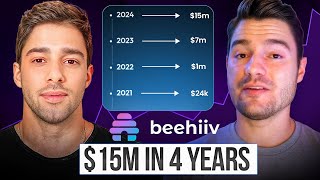
| Year | Milestone | Source |
|---|---|---|
| 2026 | Beehiiv Hit $30m revenue in June 2026 | Social Post |
| 2025 | Beehiiv Hit $20m revenue in July 2025 | Press & News |
| 2023 | Beehiiv Hit $7m revenue in December 2023 | |
| 2022 | Beehiiv Hit $1m revenue in December 2022 | |
| 2021 | Beehiiv Hit $24k revenue in December 2021 | |
| 2021 | Launched with $0 revenue |
Looking back, Denk said the company did between $6 million and $8 million in full-year 2023 revenue. At approximately June 2023, the ARR run rate was roughly $2.5 million to $3 million. That progression implies year-over-year growth of approximately 255% on the SaaS line when comparing the June 2023 run rate to the June 2024 run rate. The ad network did not exist in any meaningful form a year prior to the interview.
Beehiiv's near-term internal goal was to reach $1 million in monthly SaaS MRR. As a GetLatka forward estimate, applying a deceleration-adjusted growth rate to the June 2024 base of roughly $1.2 million to $1.4 million in total monthly revenue suggests a plausible full-year 2024 revenue range of approximately $14 million to $18 million, using a trailing growth rate of roughly 255% as the ceiling and a materially decelerated rate as the floor. This is a GetLatka estimate; Denk did not provide a forward revenue figure.
Beehiiv Valuation, Funding Rounds
Beehiiv reached a $225M valuation in 2024, set during its Series B round.
Beehiiv has raised $49.7M in total funding across 4 rounds, most recently a $33M Series B round in 2024.
Founder / CEO
Tyler Denk
Founder
Tyler Denk, Founder of Beehiiv, was 30 years old at the time of the June 2024 interview. He studied at the University of Maryland and began his career as a research lead before joining Morning Brew in 2017 as its second employee, serving as a growth engineer and later senior product lead. He spent approximately three and a half years at Morning Brew, helping grow the business to millions of subscribers and $20 million in revenue before its $75 million acquisition. Denk described his payout from that exit as enough for a comfortable lifestyle but not enough to self-fund a second company.
After Morning Brew, Denk joined Google briefly before committing full time to Beehiiv. He and co-founders Ben and Jake began roadmapping and writing code in November or December 2020. The seed round closed in July or August 2021, and the team went full time in September 2021. Beehiiv launched publicly in November 2021. Denk noted that the SendGrid annual contract, which cost between $40,000 and $75,000 upfront, was one of the largest early expenses and a key reason the team chose to raise venture capital rather than bootstrap.
Beehiiv is fully remote. Denk lives in Los Angeles. The company observes a monthly wellness day on the third Friday of each month, a practice Denk said he adopted from his time at Google. Net worth was not discussed in the interview; any estimate would require applying an ownership percentage to the $225 million valuation, but Denk did not disclose his current ownership stake, so no estimate is produced here.
Q&A
| Question | Answer |
|---|---|
| What's your age? | 32 |
| Favorite online tool? | - |
| Favorite book? | - |
| Favorite CEO? | - |
| Advice for 20 year old self | - |
Customers
Beehiiv had 20,000 active publishers as of June 2024, defined as accounts that sent at least one email in the prior 30 days. The platform also offers a free plan for users with up to 2,500 subscribers, and approximately 2,500 users were on that free tier at the time of the interview. Paid plans start at $39 per month and scale up to $299 to $399 per month before enterprise pricing.
Of the 20,000 active publishers, approximately 20% to 25%, or roughly 4,000 senders, monetized through at least one of Beehiiv's three revenue tools in the prior 30 days. Those 4,000 monetizing publishers collectively received approximately $1.2 million in payouts from the ad network, boost network, and premium subscriptions in the most recent month, implying an average of roughly $300 per monetizing sender. Denk acknowledged significant power-law concentration, with larger and more established newsletters capturing a disproportionate share. Notable advertisers on the platform include Netflix, HubSpot, monday.com, and Betterment. The boost network pays publishers $2 per lead generated through newsletter recommendations.
Beehiiv serves 20K customers.
Beehiiv Business Model
Beehiiv generates revenue through three streams: a recurring SaaS subscription fee, an ad network, and a boost co-registration network. The SaaS fee, which ranges from $39 per month to $299 to $399 per month before enterprise tiers, is the largest revenue line and was producing $850,000 to $900,000 in MRR as of June 2024. The ad network, which connects newsletter publishers with brand advertisers, was generating several hundred thousand dollars per month in additional revenue. Premium subscriptions, which allow publishers to charge their own readers directly, have been available since launch.
Approximately 15% of active users were net positive, meaning they earned more through Beehiiv's monetization tools than they paid in SaaS fees. Denk framed this as a core differentiator: most SaaS email platforms are a pure cost center, while Beehiiv aims to be value-additive to the publisher's economics. The platform delivered approximately 1.3 billion emails per month as of the interview date, reaching roughly 150 million unique subscribers across the ecosystem. Total payouts to publishers via the ad network, boost, and premium subscriptions reached $1.2 million in the most recent month reported. Gross margin and burn rate were not discussed in the interview.
Point-in-time figures shared on the GetLatka podcast, each linked to the exact moment it was said on camera.
Beehiiv Employees & Team Size
Beehiiv is a fully remote company. Specific headcount was not disclosed in the interview. Denk noted that the initial $2.6 million seed round was used to pay the founding team, hire a CTO, and bring on a few additional engineers. The company also recently hired a data analyst, which Denk mentioned in the context of building out monetization metrics. No further team size or composition details were provided.
Beehiiv employs approximately 142 people as of 2026, up from 70 in 2023. It serves 20K customers that rely on its solutions.
| Year | Milestone | Source |
|---|---|---|
| 2024 | Reached 142 employees (August 2024) | |
| 2023 | Reached 70 employees (November 2023) |
Frequently Asked Questions about Beehiiv
What is Beehiiv's revenue?
Beehiiv generates $30M in revenue.
Who founded Beehiiv?
Beehiiv was founded by Tyler Denk.
Who is the CEO of Beehiiv?
The CEO of Beehiiv is Tyler Denk.
How much funding does Beehiiv have?
Beehiiv raised $49.7M across 4 rounds.
How many employees does Beehiiv have?
Beehiiv has 142 employees.
Where is Beehiiv headquarters?
Beehiiv is headquartered in Los Angeles, United States.
Compare Beehiiv to the industry
Beehiiv operates across multiple industries. Browse revenue, funding, and growth data for Beehiiv in each sector below.
Full Interview Transcripts
The next Mailchimp? Email SaaS Hit $15m Revenue Last MonthJun 24, 2024
[00:00] Guys, Tyler Denk launched beehive,uh,.com in 2020. Late twenty twenty, they start coding for ten months. They launched officially in 2021. They get going today, finished last year about a year ago, had about 4,000,000 in terms of run rate today at 10 200,000. They make their money off three interesting lines. Obviously, ad, premium, boost, but also their SaaS fee. That's the biggest one. They've got 20,000 active senders, meaning they sent at least one email in the past [00:22] thirty days. About 4,000 of those senders make money. On average, they make about 1,200,000 cumulative last month or about $300 per sort of sender. Obviously, there's power laws there. They have a total of a 150,000,000 unique subs. So certainly making great inroads not only on the SaaS model, but also the ad network and all the growth tools he's building really, democratizing what he built and, and grew at Morning Brew. Hey, folks. My guest today is Tyler [00:44] Denke. He cut his teeth up in Maryland at the University of Maryland as a research lead before finding a marketplace adventure storm and ultimately jumping into the world he's now known for as the growth engineer in 2017 at Morning Brew. He accelerated there terms of product and growth and eventually senior product lead before building the business or helping build the business to millions of subscribers, $20,000,000 of revenue and a $75,000,000 exit before jumping then into Google [01:07] and now launching his full time focus Beehive about in August 2021. We're gonna jump to the full story today. Tyler, are ready to take us to the top? [01:15] >> Yeah. That was a hell of a recap in thirty seconds. Great job. [01:19] I appreciate that. Out of curiosity, you know, Morning Brew is on tear. You have this unique gene of being like marketer, but also you have an engineering gene in you. You write code. Why not stay at Morning Brew post acquisition? [01:33] >> Yeah. You said this was a short podcast, so very loaded question to get started with. But, yeah, Morning Brew is amazing. I had an opportunity to jump in as the second employee, and I think you nailed it. I have an engineering background, growth mindset, understand marketing, understand business, and that combination of understanding how all the pieces fit together and being able to build and code and understand how to build a polished product. That's kind of been [01:58] >> my sweet spot in my career. So I came into Morning Brew, amazing success story, learned a lot. The founders gave me a ton of room to run. But after three and a half years, I'd say like that blank white page of things to build, it was already established. Had the newsletter, we had the ecosystem, we had the growth. And I've always had a founder mentality where I just wanted more and ownership to be able to dictate [02:23] >> what to build. So I think it served its purpose. I obviously wouldn't be doing what I was do what I'm doing today if it weren't for the Morning Brew experience, but was definitely ready to try something new. [02:33] Well, it's great. Obviously, you build a product to eat your own dog food. That by itself is a natural advantage getting into any new startup. You're now building Beehive, which is effectively a marketplace between publishers and advertisers. Anything you'd add to that sort of one line overview? [02:47] >> Yeah. I actually say that would be, like, the second line of what we're doing. The first is we are a SaaS platform for publishers, content creators, businesses to send email. So anything from Mailchimp, Constant Contact, Substack, like, are kind of the competitors. If you are sending email to your audience or to your customers, we are first and foremost a SaaS platform to send emails. What you hit on is actually the second part, which is we are [03:11] >> building an ad network on top of the SaaS platform. So as someone who is sending newsletters to their audience, we have advertisers like Netflix, HubSpot, monday.com, Betterment that are looking to reach these niche audiences of newsletters, and we help connect them. So you can send a newsletter with the premium sponsor without having a sales team. [03:32] Tyler, you said last month on your website about 1,200,000 paid out to newsletters on Beehive last month, which would have been, what is that, May April, May May, of 2024 here. What what was that exactly a year ago, that same number? [03:45] >> Much smaller. So the ad network didn't really exist. The ad network was always something that we wanted to build, but you can't build an ad network with a few 100,000 impressions. We had to build a SaaS platform that was really good that attracted newsletters to move over, which brought more email sends impressions and then demand from advertisers. So the ad network a year ago today did not exist. We also have a post network, which is like [04:07] >> co registration being able to you basically get paid for recommending other newsletters that also didn't exist a year ago. And then premium subscriptions has existed from the beginning. That's what, when you can charge your audience directly $10 a month, dollars 100 a year, whatever you want to do there. We actually launched with that feature. So that's probably what you would see on the website a year ago in terms of the volume of revenue we were driving [04:32] >> for our users. [04:33] And and I wanna get sort of the headlines today. I don't wanna bury the lead and then go back and get this sort of origin story of you building the tool. What is the number one metric sort of focused on? Say revenue is easy, but is it number of publishers, number of email sends, impressions, something else? [04:46] >> Yeah. Revenue is easy because it actually means you do so many other things. Right? Right? Like, if retention is important to you, but a decrease in revenue will show that you aren't retaining users, or if a decrease or slowing of revenue shows that you aren't attracting the right users to adopt the platform and converting them. So revenue really is the north star, but layers below that is volume of email because we are building an ad network. [05:10] >> We need billions and billions of impressions, high quality impressions. Unique publishers because we want different types of content being sent on the platform from business to politics, to sports, to home goods, whatever you want to write about. We want, like, a very diverse ecosystem of different content creators and publishers creating content on the platform. But it yeah. Again, it all ties down to revenue. Slowing revenue means we aren't converting or we're churning, and those are things [05:38] >> that we're actively looking to prevent. [05:41] How many unique publishers are on the platform today, and how do you define unique? [05:45] >> Yeah. So unique publishers is the amount we do active. So active publishers means that they have sent an email in the past thirty days. And so we have about 20,000 active publishers on the platform today. And then some publishers are part of, like, a collective of, like, what we call an org or, an account, essentially. Someone might have multiple different newsletters under a single account. So the account is a bit less than that, but active publishers [06:12] >> is about 20,000. [06:14] Okay. And and does so active publishers means they sent let's go down one more step down the funnel. Of the 20,000, how many of them made at least a dollar last month through the ad network? [06:23] >> It's a good question. So we have a metric around not just the ad network, but any of so we have three monetization methods that I outlined. The ad network is one premium subscriptions are charging directly your audience a subscription fee, and then boost is the other. I believe right now we're at 20 to 25% of active users have monetized in the past thirty days. Our North Star is obviously going much higher than that, but it is [06:50] >> a very nascent ad marketplace as are the rest of our features. We're only two years old. So the fact that most SaaS platforms in the ecosystem are purely a cost. You pay them to send emails. They don't help you grow. They don't help you monetize. We help you grow with our growth suite. We help you monetize with the three ways that I just outlined. So the fact that 20 to 25% of our active users are earning [07:12] >> revenue through our platform, I think is an incredibly positive signal. Also, though our North Star metric really is how many of our users are earning more revenue than they are paying us. Right? Like, you might be paying us $99 a month, but you're earning $6,700 a month through the ad network alone, then we are value additive to your tech stack, which is very unique in the SaaS ecosystem where it's usually just an expense for your business. [07:38] Of those are there, Tyler? They make more than what their subscription fee is. [07:42] >> We're we're so we we just hired a data data analyst, like, a few months ago, so we're but but that is what we're working towards. If 25% are actively monetizing on a month to month basis, I don't know, probably half of that are net positive because we are very affordable. So probably, I'd say 15% are net positive. [08:00] And how many of the 20,000 unique publishers, unique active publishers, how many subscribers they have in total? [08:08] >> Our active so we're sending, what, 1,300,000,000 emails a month right now, and active readership's usually, I think, about 10 per 10%. Probably, like, a 150 to 200,000,000 subs unique subscribers across the ecosystem. Yeah. I I was not just to give the audience a heads up, I was not briefed on any of these questions nor do I have any of these metrics, like, readily available or prepared. This is kind of right off the cuff. [08:34] No. No. We like right off the cuff. Otherwise, we get scripted answers. So so we appreciate you being transparent. But 20,000 unique active publishers, and then you take that down to 25 monetizing, that's 4,000. And then if you divide that into the 1,200,000 you paid out last month, I mean, these are folks on average making hundreds, right, $320 per month on average. But I guess true or false, Tyler, I imagine you probably have power laws in [08:56] your user base. Right? You have some big newsletters that make the chunk of the revenue. [08:59] >> Yeah. There's definitely larger newsletters, more established, bigger brand name that brands want to work with. And that just by nature of size and reputation are getting more money, whether it's through premium subscriptions because they have a big name person behind them that can warrant charging $10.15, $20 a month for content or community, and then advertisers as well. But I actually think, yes, we have power users. The long tail is actually what's most interesting because previously a [09:24] >> lot of people saw a morning brew and Axios, a hustle having a lot of success. And it was so cost prohibitive and such a daunting task to have to scale an audience to be that large, to be able to monetize yourself. And what we've been able to solve with the long tail is the cold start problem where with Boost, you don't need a single subscriber. You can start monetizing day one. You can recommend five other newsletters [09:47] >> that are paying you $2 per lead. You might have 10 subscribers, which is your mom and your siblings. And every subscriber that comes in the door, can start monetizing $2 per recommendation. So you're net positive day one. And then the ad network as well, if you're a 500 person subscriber newsletter, Netflix was never looking at you previously to advertise. They didn't know that you existed. But with our marketplace, we can actually place high quality ads like [10:11] >> Netflix, HubSpot, Betterment into your newsletter and you're monetizing and again, cash flow positive month one. So I actually think the long tail is what's most exciting. Obviously volume and the big name players is what moves most of the volume of dollars and reputation. But the long definitely something we're excited about. [10:30] Switching away from the network for a second and just focusing on your growth tools, right, which is what I think most people wanna think about email marketing, they sort of think about the other tools that you use to send emails. You obviously charge a SaaS fee there. Do all 20,000 active senders also pay that SaaS fee or is it a subset of those 20,000? [10:44] >> So we have a free plan up to 25,000 2,500 subscribers, which is fairly generous, one of the most generous in the industry. So you can get started and just not tap into all of our premium features, but send emails, have a website, use different growth tools and customization tools without paying as long as you're under 2,500 subscribers. But then you can upgrade at any size to access ad network boost, referral program, advanced website customization. So there's [11:11] >> kind of like multiple tiered approach to the business model. It's both value based and whether you want premium features or not. [11:19] Mhmm. And how many folks do you have on the subscription sort of SaaS plan? [11:25] >> I don't have the number off the top of my head, but we're at about $859,100,000 MRR. Oh, great. That's our revenue currently. So you can kind of back into plans range from starting at $39 a month all the way up to $2.99, $3.99 before you hit enterprise. [11:43] Yeah. Well, thanks for sharing that number and congrats on the big milestone past $10,000,000 of ARR that hopefully that that that got a big cheers in the office. [11:51] >> Yeah. Yeah. Well, we're totally remote, so virtual cheers. [11:54] Yes. [11:55] >> Yeah. We're gunning for 1,000,000 MRR. That that's our goal for for as soon as possible, really. [12:00] Hey, folks. If we haven't met yet, my name is Nathan Latke. I launched and sold my first software company back in 2015 and went on to write a book about it, which you guys made a Wall Street Journal bestseller purchasing over 30,000 copies. Thank you so much for that. After the book, I launched this show and one went on to create founderpath.com. I raised a large fund to do non dilutive deals with b to b software [12:26] founders. So far, we've invested in over 400 software founders totaling a $150,000,000. Here in 2024, we're doing three to four new deals per week. So if you're looking for capital and don't wanna give up equity, go sign up at founderpath.com for free to get your offer. Alright. Let's jump into the interview. And just to be clear, you're you're not taking there's not like a percent of ad spend that you're keeping. Right? That $8.50 is all from [12:51] subscription SaaS. [12:53] >> So, yeah, there's it's hard to communicate because I am pretty transparent with our numbers as you can tell. And so, like, I communicate it, but it gets lost in translation because there's a few different revenue streams. The SaaS business is purely has nothing to do with ads. That is people paying us a monthly or annual recurring subscription for the SaaS platform, and that's at 8 to 900,000 a month currently. The ad network itself is bringing in [13:16] >> another several $100,000 in revenue. And then Monthly or annually? Monthly. [13:22] Oh, okay. Great. [13:24] >> Overall revenue as of, like, this recording is about 1.2 to 1,400,000 is where we'll end up this month. Mhmm. So yeah. [13:34] That it's it's it's interesting because look a lot of like, I've interviewed so many entrepreneurs and sequencing is so important. Then what I mean by that is you you there were companies before you're doing this marketplace model. I mean, I tried some of them like Paves. Right? But they just they just didn't deliver. Right? And they were only doing marketplace. They weren't doing this of full comprehensive scope that you're doing. I guess, how much would you [13:52] credit your success? And you seem like a humble guy, so maybe you're not gonna take credit, but to your sequencing. What you did first, what you launched second, once you launched third, that and how they all work together? [14:01] >> I would say that it's very intentional, right? Like I'm fully aware of Pave than the other marketplaces. One of Pave's competitors is Swapstack, and we actually acquired them last year. So like two sided marketplaces in any medium have kind of existed for a very long time where we benefit. And it's again, granted, it's much harder what we're doing. We are building a SaaS platform first that can stand alone as the best SaaS platform for sending emails [14:26] >> in the industry. Like, that comes before marketplace, before network, before monetization. That is just, we can build a better platform with better creator tools, helps you build a website and helps you scale your audience with the right data that's enjoyable to use. And so that is already a very difficult problem to do in a competitive space like email. Then later, once we have enough impressions but this was always the goal from day one, you just don't [14:51] >> build it initially, was we we were always going to layer on an ad network on top, which is a totally separate problem set. And it is very difficult from, like, where I stand to be able to optimize an ad network, but also make sure that the editor works perfectly well and the email automations go out perfect. Because, like, we are tackling two totally distinct problem sets on top of each other, and one doesn't work without the [15:12] >> other. So startups are kind of hard as is kind of doing two startups at once in some capacity has been difficult. But I think the payoff and the network effects, if we can nail it, are much greater. [15:26] Couple minutes left here. Some some questions just on growth since you're so transparent on the numbers, which we appreciate. If you're at 10,200,000 ARR today and that's just pure SaaS, right? If if you take go back a year ago today, what was revenue then? [15:38] >> Yeah. Great question. I don't have what what is it? June right now? [15:43] >> No idea. Probably 300, probably in the $2.50 to 300 range, I'd say. [15:47] So call it 3,640,000 a month or a year or something like that run right run rate wise? [15:53] >> Yeah. I think last year, we did between 6 and 8,000,000 in revenue for the year. Mhmm. Mhmm. [15:58] That's great. And then, when did you write the first line of code for the platform? I know you guys you just actually retweeted a video that says, hey. We coded for, you know, ten months and then finally posted a launch message. Was that the was that the was that what it was? Ten ten months pre revenue just building? [16:11] >> Yeah. So we raised our seed round in July or August 2021. Went full time right after that. So call it September 2021 is like when we went full time. November 2021 is when we launched publicly and accepting like new users who could sign up on their own. So November 2021 was the launch. If you back up ten months, me and my two co founders Ben and Jake started kind of roadmapping and building code probably November, December [16:39] >> 2020. So ten, eleven months prior to going all in. Mhmm. [16:44] And what was the size of the seed round? How much did you raise there? [16:46] >> We raised 2.6. Mhmm. So enough pay ourselves, hire a CTO, pay him, hire a few additional engineers. And know, I'm I'm a big fan of, like, being able to bootstrap. I think people who can do that, incredible. And, like, definitely hats off to them. We had, like, big vendors we had to pay up front. We had to lock in annual commitments. We're all fairly young. [17:06] Like what? Like what? What was the biggest expense early on? [17:09] >> Like, for example, we are built on top of SendGrid, which is like an email engine to actually send and distribute the emails. And to get the attention that we needed from them, we needed like an annual contract with some sort of like volume lock in, which is like, I don't know, between 40 and $75,000 upfront for the year of which my two co founders were 24, I was 27. We're not sitting on a ton of money [17:29] >> to just be able to pay that. So I do think the timing of entrepreneurship is always fairly interesting where if we had a successful exit previously and had a bit more capital, could we have done this bootstrapped growing a little bit slower and been able to use existing capital rather than being ventured back? It's interesting. But I think it also is worth considering just how competitive of an industry it is and something to be said about [17:54] >> not having to overanalyze every expense while we're trying to win market share. [17:59] Mhmm. I mean, you were employee number two at Morning Brew, just not enough equity to see meaningful cash distribution when they were acquired for $75,000,000? [18:07] >> Enough to have a nice car and apartment and, like, a decent life, but not enough to be able to fund a hill a whole second and, like, purchase and be able to pay, a CTO and everything else. So there's a difference, early but I'd say the takeaway from that was there's a big difference between early employee money and and founder money. [18:25] Fair enough. Fair enough. And the seed rounds, you know, 2021, most folks were selling, call it 20% of the company. Were you sort of in that same range? [18:32] >> No. We were closer to 10%. [18:34] Oh, 10. Okay. Got it. And then, you've raised more since then. When was the last round? [18:38] >> Yeah. So we did I can give you a whole funding background. 2,600,000 in the fall, of twenty twenty one. We did another 1.6, just like a seed extension in, I'd say May 2022, kind of like a, Hey, we have product market fit. We need a few more hires. That was supposed to be it. I don't think that we're never gonna raise again, but I've been wrong three times. We raised a 12 and a half million series [19:01] >> A in the summer of twenty twenty three. And then we just raised a $33,000,000 series B led by NEA in March 2024. [19:12] So people say right now it's crazy time to raise that equity. Were you able to get it to a valuation you liked obviously in the series B? [19:18] >> Yeah. So the valuation's actually public. So it's it was $2.25. So Mhmm. Less about valuation, more about ownership, having enough capital to build the business. But yeah. We did we did [19:31] Ownership drives is driven by mean, that's what that's 15% dilution. Right? So so you you can care about ownership, but obviously, when you're doing the capital raise, you gotta make sure you you put yourself in a position to not lose control of the business. Right? [19:43] >> Yeah. I think when ownership's probably overset in terms of, like, the different layers of ownership, there's ownership of, like, raw percentage of the business that you have outstanding. And then also, like, who controls the board, who has, like, the rights to be able to make the core decisions of which we are in control of the business. So [20:00] That's great. That's great. Anything before we wrap up? Anything you want the audience to know that we haven't chatted about already? [20:06] >> No. I'm super impressed with how quickly you're able to run through everything in fifteen. That was great. [20:11] Hey, Cody. We gotta get back to the gym. You know how it is, man. So let's wrap up here with the famous five. Number one, your favorite business book. [20:16] >> Favorite business book. Honestly, it may not be a business book, but thinking fast and slow is more of, like, a psychology book, and I think applicable to business than everything else. [20:25] Yeah. Number two, is there a CEO you're following or studying? [20:29] >> No. But I really admire Brian Chesky. [20:32] Mhmm. Number three, besides SendGrid, which online tool do you pay the most money for? [20:38] >> Probably something boring like AWS, Heroku, just like infrastructure, ClickHouse, something like that. [20:45] Number four, how many hours of sleep do you get every night, Tyler? [20:48] >> I prioritize sleep between seven and eight. [20:50] That's great. Yeah. Great. You you said earlier, I hope you mind don't mind me sharing this because on a rest day, which is the third Friday of the month, which is awesome. Nice balance. [20:57] >> Yeah. We do I picked that up from when I was at Google during COVID. They did, like, one every, like, few months, but we have a monthly wellness day. The third Friday of every month is a day off, so three day weekend. So, yeah, that is today. [21:09] Eight hours of sleep. And how old are you today? [21:11] >> 30. [21:12] 30 years old. End situation, married, single, kiddos? [21:15] >> Single, no kiddos. Well, I have a girlfriend, but I guess I got as a tax filing, that's single. [21:21] Yeah. Fair enough. I love that that's your default. It's like according to the government, my tax filing. [21:25] >> I just bought the accountants and everything else. So, like, I'm not used to saying, like, I'm in the mind of being single. But yes. [21:32] Yeah. Fair enough. Fair enough. Last question. Something you wish you knew back when you were 20. [21:37] >> It's a great question. [21:41] >> I actually wouldn't even say something that I would change or or something that I learned, but I I would actually double down on moving to a big city and getting to meet people. Now I live in Los Angeles. I stay in my room and work all day. But being in New York in my early twenties, being able to meet people at work, networking, happy hours, everything else, I've met such an incredible group of people that has [22:01] >> helped propel my career forward. So remote is amazing. I'm the biggest advocate of remote work, but I think if you can get to a city and even make the time to network yourself, you probably wouldn't regret that. [22:13] Guys, Tyler Denk launched beehive,uh,.com in 2020. Late twenty twenty, they start coding for ten months. They launched officially in 2021. They get going today. Finished last year about a year ago, had about 4,000,000 in terms of run rate today at 10,200,000. They make their money off three interesting lines. Obviously, ad, premium, boost, but also their SaaS fee. That's the biggest one. They've got 20,000 active senders, meaning they sent at least one email in the past thirty [22:35] days. About 4,000 of those senders make money. On average, they make about 1,200,000 cumulative last month or about $300 per sort of sender. Obviously, there's power laws there. They have a total of a 150,000,000 unique subs. So certainly making great inroads not only on the SaaS model, but also the ad network and all the growth tools he's building really, democratizing what he built and, and grew at Morning Brew. So, Tyler, appreciate you, man. Thanks for taking [22:57] us to the top. [22:58] >> Yo. Thanks for having me.
Read More About Beehiiv
Data and Sources
All figures on this page are taken directly from interviews or are estimates from public sources and proprietary models. Not financial advice. Read full disclaimer.
Claim this profilePeople Also Viewed

Smart Service
Smart Service is a cutting-edge, cloud-based field service management solution designed to help...

EXTE
EXTE is an advertising technology company focused on providing comprehensive solutions that bridge...

Serverfarm
Serverfarm is an award-winning data center developer and operator, and the global leader in Data...

Ecopol
Ecopol is a leading global producer of water-soluble and biodegradable films and delivery systems...

Giva Inc
AI-Powered HIPAA-Compliant Help Desk, Customer Service & ITSM Applications. Founded in 1999...

Ziflow
Ziflow online proofing streamlines the review and approval process for creative content to deliver...


