Valuation
$30M
2024 Revenue
$18.1M(Est.)
Customers · 2021
20
Funding
$10.3M
Team
85
Founded
2019
Cargamos Revenue, Valuation & Funding (2024)
Cargamos is a Mexico-based last-mile logistics company that combines micro fulfillment center infrastructure with proprietary software to help e-commerce brands deliver packages at a fraction of the prevailing domestic rate. Founded in November 2019 by Ivan Ariza and two co-founders, the company leases and repurposes physical spaces as micro fulfillment stations, then dispatches a gig-economy driver network to complete deliveries. The model is asset-light on real estate but capital-intensive on infrastructure build-out, which distinguishes it from pure software-as-a-service peers and explains its 28% gross margin.
As of late 2021, Cargamos reported approximately $1 million in monthly revenue, implying a roughly $12 million annualized run rate, up from $200,000 per month a year earlier. The company serves 20 large e-commerce brands, employs 105 full-time staff including 52 engineers, and coordinates a network of more than 10,000 registered drivers. Cargamos has raised a total of approximately $12 million to $13 million across a pre-seed round and multiple seed tranches, and was actively targeting a Series A of $20 million to $30 million at the time of the interview.
Last updated
Cargamos Revenue
Cargamos reported revenue of approximately $1 million per month as of November 2021, placing the business on a roughly $12 million annualized run rate. Ariza told Latka the company was targeting $1.2 million in monthly revenue by December 2021. A year earlier, in late 2020, monthly revenue was approximately $200,000, representing roughly 20% of the November 2021 figure. That implies year-over-year revenue growth of approximately 400% on a monthly basis, or growth from roughly $2.4 million annualized in 2020 to $12 million annualized in 2021.
| Year | Milestone | Source |
|---|---|---|
| 2024 | Cargamos Hit $18.1m revenue in October 2024 | Estimated |
| 2023 | Cargamos Hit $12.9m revenue in November 2023 | Estimated |
| 2022 | Cargamos Hit $16m revenue in November 2022 | |
| 2021 | Cargamos Hit $12m revenue in January 2021 | Watch[1] |
| 2020 | Cargamos Hit $2.4m revenue in January 2020 | Watch[2] |
| 2019 | Launched with $0 revenue |
The company charges e-commerce brand clients between $1 and $1.50 per package delivered, compared to a prevailing domestic delivery rate in Mexico City of approximately $6 per package. Revenue is recognized as Cargamos top-line income, not as gross merchandise volume. The company also earns revenue from fulfillment management and other e-commerce operations beyond pure package delivery, which is why monthly revenue of $1 million does not map directly to a simple per-package calculation against the fewer than 100,000 packages delivered per month.
Using the trailing growth rate as a ceiling and assuming meaningful deceleration as the business scales its infrastructure, a GetLatka estimate for 2022 annualized revenue would range from approximately $18 million (deceleration-adjusted floor, assuming growth slows to roughly 50%) to approximately $60 million (ceiling, if the 400% year-over-year pace were sustained). Given the capital-intensive nature of the model and the planned Series A deployment, the lower end of that range is the more conservative and likely scenario. This is a GetLatka estimate; Ariza did not provide a forward revenue figure.
Cargamos Valuation, Funding Rounds
Founder / CEO
Ivan Ariza
CEO
Ivan Ariza, confirmed as CEO of Cargamos, co-founded the company in November 2019 alongside two other partners. A fourth partner with an undisclosed but prominent logistics background was joining the company at the time of the interview. Ariza was 41 years old at the time of the interview and described having had a prior entrepreneurial exit before starting Cargamos, though he did not provide details of that prior company or its outcome in this interview.
Ariza bootstrapped Cargamos for three to four months before raising outside capital. He described averaging five to six hours of sleep per night, noting that the week of the interview was an outlier at two hours following the birth of his fourth daughter. Net worth was not discussed in the interview and no estimate can be responsibly derived, as Ariza did not disclose his ownership percentage or the company's current valuation.
Q&A
| Question | Answer |
|---|---|
| What's your age? | 44 |
| Favorite online tool? | - |
| Favorite book? | - |
| Favorite CEO? | - |
| Advice for 20 year old self | - |
Customers
Cargamos served 20 e-commerce brands as of November 2021. All customers are high-volume brands, and Ariza described the go-to-market strategy as targeting large enterprises first. With approximately $1 million in monthly revenue across 20 brands, the implied average revenue per brand is roughly $50,000 per month, though Ariza did not confirm that figure directly.
The company charges between $1 and $1.50 per package delivered, compared to the prevailing Mexico City domestic delivery rate of approximately $6 per package. Cargamos also charges for fulfillment management and other warehouse operations, so per-package pricing does not capture the full revenue relationship with each brand. No free tier was mentioned in the interview.
Cargamos serves 20 customers.
Cargamos Business Model
Cargamos generates revenue by charging e-commerce brands a per-package fee of $1 to $1.50 for last-mile delivery, plus fees for fulfillment center management and related e-commerce operations. The company leases physical space under a revenue-share arrangement with landlords, paying more as package volume from each station increases rather than paying a fixed lease. This structure reduces fixed real estate costs but does not eliminate them.
Gross margin was 28% as of November 2021, reflecting the capital and labor intensity of the hybrid infrastructure-plus-software model. The single largest cost line is payments to courier and service partners, which totaled approximately $600,000 in the month prior to the interview, equal to roughly 60% of that month's revenue. Service partner costs encompass not only delivery drivers but also the labor inside micro fulfillment stations for sorting, routing, and other operations. The company was not profitable as of November 2021, with Ariza stating plainly that Cargamos was not making money after paying engineers and other staff.
The driver network operates on a gig model similar to Uber. Of the more than 10,000 registered drivers in the network, approximately 30% to 40% are active in any given month, and approximately 3,000 drivers delivered at least one package in the month prior to the interview. Those 3,000 drivers earned an average of approximately $200 each through the platform that month, consistent with the $600,000 total courier expense figure. Drivers also work for other platforms such as Uber and Rappi. Monthly package deliveries were fewer than 100,000 as of November 2021. Ariza cited Amazon's Latin America fulfillment center build cost of more than $1 million per location as context for why the business requires significant capital. Burn rate and runway were not disclosed.
Point-in-time figures shared on the GetLatka podcast, each linked to the exact moment it was said on camera.
Cargamos Employees & Team Size
Cargamos employed 105 full-time team members as of November 2021. Approximately half of the full-time headcount, or roughly 52 people, were engineers. In addition to the full-time staff, the company coordinated a network of more than 10,000 registered gig drivers, of whom 30% to 40% were active in any given month.
Cargamos employs approximately 85 people as of 2026, down from 106 in 2023. It serves 20 customers that rely on its solutions.
| Year | Milestone | Source |
|---|---|---|
| 2024 | Reached 85 employees (October 2024) | |
| 2023 | Reached 106 employees (November 2023) | |
| 2023 | Reached 106 employees (September 2023) | |
| 2023 | Reached 108 employees (January 2023) | |
| 2022 | Reached 140 employees (November 2022) | |
| 2022 | Reached 140 employees (January 2022) | |
| 2021 | Reached 105 employees (November 2021) | |
| 2020 | Reached 53 employees (November 2020) |
Frequently Asked Questions about Cargamos
What is Cargamos's revenue?
Cargamos generates an estimated $18.1M in annual revenue.
Who founded Cargamos?
Cargamos was founded by Ivan Ariza.
Who is the CEO of Cargamos?
The CEO of Cargamos is Ivan Ariza.
How much funding does Cargamos have?
Cargamos raised $10.3M across 3 rounds.
How many employees does Cargamos have?
Cargamos has 85 employees.
Where is Cargamos headquarters?
Cargamos is headquartered in Polanco Reforma, Mexico.
Compare Cargamos to the industry
Cargamos operates across multiple industries. Browse revenue, funding, and growth data for Cargamos in each sector below.
Full Interview Transcripts
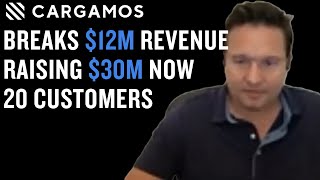
Cargamos Does Last Mile Delivery in Mexico, Breaks $12m Revenue, Raising $30m NowNov 10, 2021
[00:00] Hey, folks. My guest today is Ivan Ariza. He's building a cargamos.com delivery stations for any brand. He's an entrepreneur. He's had an exit under his belt and again now focused on cargamos. Ivan, you ready to take us to the top? [00:14] Yeah. Okay. So what does cargamos do? Tell me about a customer who's paying you. [00:20] >> In cargamos, we are trying to bring any brand to the new cloud logistics. So we empower these brands by creating a lot of, creating a big network with micro fulfillment centers and enable all these location for that guys. [00:37] And so are these real estate investors buying these micro, like these facilities, you're empowering them to help them run them as a micro like warehouse? [00:46] >> Actually, are trying to repurpose that use of the space right now. So we take use of the space and we repurpose to convert in this space and turn it into the micro fulfillment stations. [00:59] You're doing that personally as a company? [01:02] >> Yeah, our company, it takes both. We take an approach in infrastructure. So we handle the infrastructure as well and the software in a business as Are software buying [01:11] the real estate? [01:14] >> No. We don't buy. We we we leasing the real estate, but actually, we make an an approach like we work with with their buildings, with the landlord. So our approach is when we increase the package that leave the station, we're going to pay to the landlord. So we don't know pay any leasing or we don't buy the stations. We only take the space and repurpose it. [01:39] I understand. Tell me about price. What do customers pay you on average to use your technology? [01:45] >> Look. In Mexico, you usually need to pay $6 to to deliver a package from from Mexico City to Mexico City. Our proposal is to decrease the price by a big magnitude. So right now, our customers are paying more or less $1 to $1.5 per delivery. So the location more closer to the end customer help us to deliver this mission. [02:08] But who's paying you? These are companies paying big contracts, right? Or is the individual consumers paying a dollar? [02:14] >> Today, there are high volume e commerce brands that I they send us the package and we we help we that big brands to deliver the package. Our first strategy is approach the big brands, the big brands. [02:26] But yeah. So that's what I'm asking. What does a big brand pay you on average per month to use the technology and do these deliveries? [02:34] >> Look. Right now, we are working with the number 5345, the biggest e commerce right now in in in Mexico. So right now, we are delivering for that guy's thousands of orders. So they pay pay package that we deliver more or less $1 to $1.5. So right now, our figures are close to $1,000,000 per month. [02:59] Got it. So all in, you're making a million dollars per month right now? [03:03] >> Yeah. Close to to do that. Yeah. [03:05] I see. Can you break a million per month by the end of December? [03:09] >> Yes. We are trying to to break that number and we are hoping to do in December 1 $1,200,000 per month. [03:17] And Ivan, if you're doing a million right now, what were you doing exactly a year ago? Do you remember? [03:24] >> A year ago, we were selling more or less 20% of our current revenue right now. [03:30] Okay. So call it $200,000 per month. [03:32] >> Yeah. [03:33] Now is this your revenue or is this total volume and then you take a small cut of the million? [03:40] >> We take a a good cost for I mean, our sales, it's $1,000,000. We take and we we sold our deliveries and all the operation that we are handling right now, but we we take it now. We take everything, but it's not our profit. It's just net revenue. [04:00] Yeah. So what I'm saying is if you're doing a million dollars per month, that's your top line revenue. Do you have any big costs or is it you have SaaS margins of 83%, 84%, 85%? [04:09] >> No. Our margins right now are close to 28%. So that's our revenue right now. [04:16] What are your biggest costs there? [04:20] >> The labor, [04:23] >> the stations, and that's it. That's the most biggest one. [04:30] Well, sorry. What's your gross I mean, your labor and headcount, that would be bottom, bottom line. But when you look at gross revenue, right? So not net revenue, but gross revenue, is your gross revenue like 20%, your gross margin 20%? [04:42] >> No. Yeah, it's not. Our gross margin is 28%. Yeah. [04:47] Okay. So you're processing a million dollars of volume of which your gross revenue, your top line revenue is something like $280,000 per month. And then after you pay all your employees and stuff, then you maybe have profits at the end. [05:00] >> Okay. We are not making profit right now. We need to pay engineers and a lot of people, but right now we are not making money. [05:07] I'm sorry. You're misunderstanding. Let me try and rephrase this. The million dollars you're doing per month, is that volume of, like the value of the packages flowing through your system or is that your revenue? Is that cargamos revenue? [05:21] >> It's the cargamos revenue, money. [05:24] Okay. Got it. So you're at a 12,000,000 run rate today, but why are margins only 28%? Most software margins are 85%. [05:35] >> Okay. I'm not sure if I understand, but the company, what we are doing right now is we take package and we deliver package. For each package that we take and deliver, we ask for every package and one, two dollars per package. [05:52] All the package that we are delivering right now, all the whole package right now [05:56] >> and all the other components in the company that are doing logistics, we are asking to our clients, and they are paying us right now $1,000,000 If we break in our unit economic, that number, we're gonna see that our numbers, it's more or less in the gross margin, we are taking 28%. [06:17] Why is that so low though? That's my question. Most software companies, their cost of goods sold is under 20%. So their gross margin is 80%. You're saying you have 80% cost basis on that million in revenue you're doing. I'm trying to figure out what those extra costs are that most software companies don't have. [06:37] >> Ah, okay. Yep. I got it. We are not that completely software as a service company. We are not just a software as a service. We are paying [06:49] >> the leasings, we are paying the labor in the middle, we are paying service partners. So we are more similar like maybe a store in The United in The US or maybe DHL. So we are not completely a software as a service company. We are both. We are infrastructure and software as well. [07:09] I see. That helps. So last month, how much total did you pay for your leases? [07:18] >> The leases is not the big component. The big component is the labor in between. I mean, we pay any courier once they once he makes a deliver. We pay service partner as well with they, we pay a totally bill that, that has the the location and the labor as well for the autonomous So Ivan, [07:46] how much did you pay couriers last month? [07:50] >> Last month, we paid [07:54] maybe [07:58] >> 60% of that number. [08:00] >> So $600,000 Yeah. [08:01] I see. That's your biggest cost. [08:05] >> Yeah. That's my biggest Got [08:07] >> it. Okay. That makes more sense now. [08:09] Okay. Great. When did you launch the business? When did you write the first line of code? [08:15] >> November 2019. [08:23] And have you bootstrapped the business or did you decide to raise? [08:27] >> We bootstrapped the business the three to four beginning months, and then we raised some money. So until now, we are raising close to 12 to 13 million dollars. [08:41] When was the last round? [08:43] >> Three months ago. [08:45] And you raised 13,000,000 in one round? [08:48] >> Yeah. It was our seed round. Yeah. [08:51] You raised $13,000,000 in your seed round, and that was three months ago? [08:55] >> Yeah. [08:56] Did you do a pre seed round or no? [08:58] >> No. The pre seed round was the money that all the founders and close friends put in the company. [09:05] Many co founders? [09:07] >> We have both and it's we are joining a fourth that is not disclosed. We cannot disclose the name. Right now, we are bringing a big name in logistics to the company, but we are three three guys right now working really hard in this. [09:21] Okay. So the three of you the three of you got going in 2019, you did a pre c route pre seed round back then of 1,300,000, didn't you? [09:30] >> Yeah. [09:31] Okay. And then after that in 2020, you did another part of the seed round for 2,000,000. Correct? Correct. And then in total in 2021, you raised 2,000,000 early twenty twenty one and 7,000,000 just recently. Right? Right. Got it. So what I what I'm trying to understand is what's so what makes this so expensive? Why do you need so much money to build this business? [09:54] >> Look, across Latin America, if you think about big locations, for example, fulfillment centers, if you look at Amazon, for example, you're gonna find that a single location could cost even more than $1,000,000 So, right now in Latin America, we don't have these locations in place. We need to create some big locations, some automatization and put a lot of effort creating the buildings, [10:28] >> locations that we need to enable this infrastructure to a last mile. So it's quite expensive in this infrastructure side. In the software side, it's quite similar to other companies, but we need to raise money because we need to implement that capability to the market. [10:44] That makes sense. The 7,000,000 that you just raised a couple months ago, Ivan, what valuation did you raise that on? [10:50] >> The valuation, we don't have valuation right now. We are close to Series A, so we only raise money through convertible notes, but the the the amount is not on this closing right now. [11:03] Okay. Most people in their seed round, if they're raising on a note, there's a cap on the note. Did you have a cap? [11:10] >> Yeah, we have a cap, but we don't disclose that amount at this time. [11:14] Most folks, when they're raising that seed round though, they're selling about 20% of the business, right, at the cap. Right? So, I mean, are you sort of in that standard range? [11:24] >> Yeah. We are we are yeah. We are quite in the standard of the range. [11:28] Got it. So that would have then put you at around a 30,000,000 cap on that on that 7,000,000 note? [11:36] >> Yeah. More or less. We are quite higher than that, but yeah. [11:39] Well, now you're raising a series a at higher than that. Right? [11:42] >> Yeah. [11:43] Why are you raising a series A now? What do you need the capital for? More more leases? More logistics? [11:49] >> Yes. We are starting a stage where we need to put up more money. We are We want to connect [11:58] >> a lot of drivers, couriers, trucks, locations across the industry. So we need to put a lot of money in software, new locations to connect all these points that right now are disconnected. So, we are we we we want to connect the last mile that is actually really, really fragmented industry right now. [12:22] So you're raising a series a or looking at it. How much will you target to raise? [12:27] >> Right now, we are targeting to raise more than 20 to 30 million dollars. [12:32] Okay. So so somewhere between 25 and $30,000,000. Who's your biggest competitor in Mexico? [12:42] >> In Mexico, we are seeing maybe DHL, FedEx, Estafeta, all the guys that are doing domestic deliveries. Mhmm. [12:53] Got it. And tell me more about team size today. How many folks total? [12:57] >> Our team size today is more than 100 people, 105 people. And if we look at [13:12] >> the autonomous driver, we are talking about more than 10,000 drivers in our network right now. [13:17] And Ivan, how many engineers? [13:21] >> The engineers, it's more or less half of the company right now. [13:26] And the 10 k drivers that you just mentioned, are they all full time on your payroll or are they contractual as you have orders that you need delivered? [13:34] >> It's like it the the the model is really similar to Uber. So we we bring people and they they decide when to work or when when they want to work or not. [13:45] But last month, you had 10,000 drivers deliver at least one package. [13:51] >> That's not the active base. The active base is more or less 30 to 40% of the base. That's the amount of drivers that we are [14:02] So you had 4,000 drivers last month deliver at least one package? [14:06] >> Yeah. [14:07] And you paid them [14:08] and you paid them about $600,000, you told me earlier. So the average driver is making about a $150 a month? [14:15] >> No, no, no. No, no, no. [14:19] >> Okay, okay, okay, okay. It's not only drivers. When we talk about service partners is the whole equation. The equation include [14:33] >> micro fulfillment stations, include the people that are making, sorting, routing, all that happen in a micro fulfillment station. [14:42] How many delivery drivers delivered at least one package last month? [14:48] >> More or less, 3,000 drivers. [14:53] >> 3,000 drivers. Okay. [14:54] So you told me earlier that $600,000 of your expenses last month go to the drivers, those 3,000 drivers. Right? Yeah. So if we divide those, the average driver is making about $200 a month through your platform. Is that accurate? [15:09] >> $200 above. Yeah. Could be. Yeah. More or less. [15:14] Yeah. 3,000 drivers times 200 each is 600,000 in total expenses. But point being, that's not their full time salary because they're only working with you part time. Other times they'll go deliver for other people. Is that right? [15:24] >> Yeah. Exactly. They work for another companies. They work for Uber, Rappies. That's the force that we have right now. It's the people that work for a lot of I see. [15:37] And so in October, how many It sounds like you delivered about 800,000 individual packages. Is that right? [15:47] >> How many? [15:48] About 800,000. [15:51] 800,000. 800,000. [15:52] >> Yeah, more or less. Because you charge a dollar to a dollar 50 and you're doing a million bucks a month. [16:02] >> We have another components in the equation. We just don't deliver package. We handle as well fulfillment, Then we handle as well other e commerce operations. So yeah, in the midst, we are delivering less than a 100,000 orders right now per month. [16:21] Okay. Less than a 100. You're personally delivering less than a 100,000, but you make money through packages, not just delivering them. You do other things as well. Management in the warehouse, things like that. [16:30] >> Yeah. [16:31] I see. How many unique brands are you working with? E commerce brands? [16:36] >> Right now, it's more or less 20 brands working [16:40] Okay. 20 brands. 20 brands, $1,000,000 a month in revenue. Obviously folks can sort of calculate that each brand is putting, call it $50,000 through you guys. So enterprise motion here, what's the next thing? What's the next product line you guys are launching? [16:55] >> The next product that we're gonna launch is an a complete suite for fulfillment. We want to move the fulfillment to the next stage. So we want to break the package and all the merchandising, all the inventory for our mentions. And we want to put in the last mile. When we talk about last mile, I mean, want to bring that inventory to the next five miles from you. So, that's our next move. So, once we have all [17:27] >> the data integrated that we are delivering to our network and all that things, our next move is when I put the micro fulfillment to micro fulfillment around the cities. [17:38] Very cool. Ivan, we're rooting for you, man. Thanks for coming on. In the meantime though, let's wrap up with the famous five. Number one, what's your favorite business book? [17:45] >> My favorite business book, [17:49] >> Blue Ocean Strategy, maybe was the first time that I approached the strategy. [17:54] That's Number two. Two, is there a CEO you're following or studying? [17:57] >> Elon Musk. [17:59] Number three, what's your favorite online tool for building cargamos? [18:03] >> Slack. [18:05] Number four, how many hours of sleep do you get every night? [18:09] >> Last night, two hours. Two? Yeah, my daughter just came to this world. So, last night I just stayed two hours and I have already three other daughters. So, right now we have four daughters that are consuming quite time in the night for me. But now it's the, it's just this week. [18:31] What's the average? [18:33] >> The average is about five, six hours. [18:37] Okay, six hours. [18:38] >> You're married with four kids. [18:39] And Ivan, how old are you? [18:41] >> 41. [18:42] Last question. Something you wish you knew when you were 20. [18:47] >> Starting this business early. [18:50] Guys, there you have it. Cargamos on a tear launched in 2019. They did a 1,300,000 pre seed round and then did another 2,000,000 on that round in 2020 as they scaled to 200,000 a month in revenue. Now doing 1,000,000 a month in revenue, but they pay 600,000 of that million out to their delivery drivers. They're tackling last mile delivery in Mexico for 20 very large e commerce brands delivering hundreds of thousands of packages per month and [19:12] also managing fulfillment. Looking at raising a large round that closed a 7,000,000 seed earlier this year, sold about 15 to 20% of the business. 105 on the team as they look to continue to scale. Ivan, thanks for taking me to the top. [19:24] >> Thank you, Nathan. [19:26] One more thing before you go. We have a brand new show every Thursday at 1PM Central. It's called Shark Tank for SaaS. We call it deal or bust. One founder comes on, three hungry buyers, they try and do a deal live and the founder shares back end dashboards, their expenses, their revenue, ARPU CAC, LTV, you name it, they share it and the buyers try and make a deal live. It is fun to watch every Thursday 1PM [19:52] Central. Additionally, remember these recorded founder interviews go live. We release them here on YouTube every day at 2PM Central. To make sure you don't miss any of that, make sure you click the subscribe button below here on YouTube, the big red button and then click the little bell notification to make sure you get notifications when we do go live. I wouldn't want you to miss breaking news in the SaaS world, whether it's an acquisition, a big [20:14] fundraise, a big sale, a big profitability statement or something else. I don't want you to miss it. Additionally, if you want to take this conversation deeper and further, we have by far the largest private Slack community for B2B SaaS founders. You want to get in there. We've probably talked about your tool if you're running a company or your firm if you're investing. You can go in there and quickly search and see what people are saying. Sign [20:36] up for that at nathanlatka.com/slack. In the meantime, I'm hanging out with you here on YouTube. I'll be in the comments for the next thirty minutes. Feel free to let me know what you thought about this episode and if you enjoyed it, click the thumbs up. We get a lot of haters that are mad at how aggressive I am on these shows, but I do it so that we can all learn. We have to counter those people. [20:55] We got to push them away. Click the thumbs up below to counter them and know that I appreciate your guys'support. Alright, I'll be in the comments. See you.
Data and Sources
All figures on this page are taken directly from interviews or are estimates from public sources and proprietary models. Not financial advice. Read full disclaimer.
Claim this profilePeople Also Viewed
Weights & Biases
Developer of software tools intended for machine learning developers. The company's platform helps...
Paytronix Systems
Developer customer experience management systems. The company provides software-as-a-service...
ZipBooks Software Solutions Pvt
ZipBooks is an online invoicing and accounting software designed for small businesses. It offers...
BluePond AI
BluePond. AI , brainchild of industry experts, is built to tackle challenges faced by P&C Insurance...
CommentSold
CommentSold is the leading live video commerce platform that enables businesses and brands to...
Brame
BRAME is a software-as-a-service (SaaS) company in martech that offers the leading solution for...