
Founder Interview
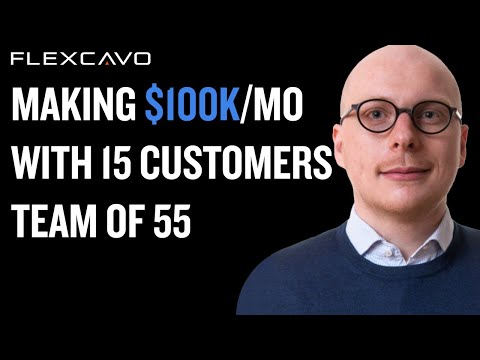
How Flexcavo Reached Over €100K/Month in Combined Revenue with 18x Year-Over-Year Growth (Interview with CEO Benedict Aicher)
- Interview Date
- April 5, 2022
- Interviewee
- Benedict AicherCo-Founder and CEO
Company Metrics at Interview Time
Combined Monthly Revenue (Q1 2022)
Over €100K/month
Year-Over-Year Growth (2022)
18x (Q1 2021 to Q1 2022)
Team Size (2022)
55
Total Equity Raised
$10,150,000
Historical Snapshot
These numbers were reported by Benedict Aicher during the interview recorded in April 2022 and are a historical snapshot, not current figures. See Flexcavo’s current numbers.
Key Takeaways
- 01Flexcavo reported over €100,000 per month in combined software and rental revenue as of Q1 2022
- 02The business grew 18x year over year from Q1 2021 to Q1 2022
- 03Flexcavo had 15 software customers at interview time, with the guest describing a range of ten to twenty
- 04The company managed over 10,000 pieces of equipment across its client base
- 05Flexcavo owned over 400 pieces of equipment on its own fleet, financed through structured debt with partner banks
- 06The rental-side business had served more than 100 unique construction company customers
- 07The team stood at 55 full-time employees, with roughly 40% in engineering roles
- 08Flexcavo's most recent equity round closed in September 2021; Benedict Aicher puts it at €5,000,000 and declines to name it — "Series A, Series C, depends on what you call it" — while it was announced publicly as a €6.4M seed led by VR Ventures
- 09The company was founded in 2020 and entered commercial software sales mode in February 2022
- 10The largest software customer managed between 6,000 and 9,000 units on the platform
Company Metrics at Time of Interview
| Metric | Value | Source |
|---|---|---|
| Combined Monthly Revenue (Q1 2022) | Over €100K/month | Founder interview, Apr 2022 |
| Year-Over-Year Growth (Q1 2021 to Q1 2022) | 18x | Founder interview, Apr 2022 |
| Software Customers (2022) | 10 to 20 | Founder interview, Apr 2022 |
| Rental-Side Customers (cumulative) (2022) | Over 100 | Founder interview, Apr 2022 |
| Equipment Units Managed (total) (2022) | Over 10,000 | Founder interview, Apr 2022 |
| Own Fleet Size (2022) | Over 400 units | Founder interview, Apr 2022 |
| Own Fleet Inventory Value (2022) | Over €10,000,000 | Founder interview, Apr 2022 |
| Team Size (2022) | 55 | Founder interview, Apr 2022 |
| Engineering Share of Team (2022) | 40% | Founder interview, Apr 2022 |
| Rental Sales Team (2022) | 7 | Founder interview, Apr 2022 |
| Software Price per 100 Units (2022) | €500 to €1,500 per month | Founder interview, Apr 2022 |
| Software Price per Unit per Month (2022) | €200 to €1,000 | Founder interview, Apr 2022 |
| Gross Margin Split (Software vs Rental) (2022) | 50/50 | Founder interview, Apr 2022 |
| Debt Coverage Ratio on Equipment (2022) | 1.5x to 3x | Founder interview, Apr 2022 |
| Total Equity Raised | $10,150,000 | Founder interview, Apr 2022 |
| Last Equity Round, the Founder's Figure (2021-09) | €5,000,000 | Founder interview, Apr 2022 |
| Year Founded | 2020 | Founder interview, Apr 2022 |
Growth Breakdown
Revenue
Flexcavo reported combined monthly revenue of over €100,000 in Q1 2022, spanning both its software subscriptions and equipment rental operations. This represented 18x growth compared to Q1 2021, when the business was generating roughly €7,000 per month. The guest described gross margin contribution as roughly equal between the two revenue streams.
Customers
At interview time, Flexcavo had 15 software customers, with the guest describing the count as somewhere in the range of ten to twenty. On the rental side, the company had served more than 100 unique construction companies. The largest software customer managed between 6,000 and 9,000 units on the platform, representing a significant share of the 10,000-plus units under management.
Team
Flexcavo had 55 full-time employees at the time of the interview, with approximately 40% working in engineering. The rental sales team had 7 members, and the company was actively hiring a dedicated B2B SaaS sales team, with the combined sales headcount expected to grow into double digits within the year.
Funding
GetLatka's funding record shows $10,150,000 raised across three equity rounds. On the tape Benedict Aicher gives them in euros — roughly €500,000 in mid-2020, a €1,500,000 angel round in February 2021, and €5,000,000 closed in September 2021, which he declines to name: "Series A, Series C, depends on what you call it." That last round was announced publicly as a €6.4M seed led by VR Ventures, with Picus Capital, Rivus Ventures and FJ Labs. Equipment purchases were financed separately through structured debt with partner banks, not from equity, with machines generating a debt coverage ratio of 1.5x to 3x.
Growth Strategy
Co-Creation with Construction Clients
Rather than designing software in isolation, Flexcavo worked directly with construction companies to identify pain points and build solutions alongside them. The guest emphasized that the real end user is the foreman on the construction site, and that software which does not work for that person will result in churn regardless of executive buy-in.
Dual Revenue Model: Software and Rental
Flexcavo combined a subscription software business with an asset rental business, using its own fleet of over 400 pieces of equipment to generate rental revenue while also providing the platform to manage client fleets. This allowed the company to serve customers as a full-service partner rather than a pure software vendor.
Structured Debt for Asset Financing
To avoid using equity capital to purchase equipment, Flexcavo secured structured debt through partner banks, using the equipment itself as collateral with put options. The machines generated enough revenue to cover debt service at a 1.5x to 3x coverage ratio, leaving the gross margin to fund operations.
Founder-Led Sales Transitioning to B2B Sales Team
The company relied on founder sales for an extended period, particularly on the rental side, before entering commercial software sales mode in February 2022. At interview time, Flexcavo was actively building a dedicated B2B SaaS sales team to accelerate software customer acquisition.
Own Fleet as Product Testing Ground
Flexcavo used its own equipment fleet to test and refine its software before bringing it to market commercially. This gave the team real operational data and allowed them to validate the platform in live construction environments before scaling software sales.
Best Quotes
“In the end, we're building a platform to foster and enable intelligent construction, and we connect two things. We connect equipment and technology. So yes, we're writing code for machinery fleets. These machines are on a construction site, the only reliable data source. On the other hand, we operate as well as asset enabled business, so we can provide assets too.”
“Obviously not equity. VCs would kick my ass if I would spend my equity on machines. It's debt. So it's a structured debt. The good thing there is, I mean, we all know car financing. It works pretty much the same way. So we secure our assets with put options, and then we simply have our partner banks that finance our assets.”
“Over 400 on our own fleet. However, we manage over 10,000 pieces or units for our clients.”
“I think from from a I always look at it from a gross margin perspective. I mean, you look at the pure revenue side of the business, obviously, the renting part is quite strong because you can charge quite high daily rates for big excavators. However, on a gross margin perspective, it's a fifty-fifty split.”
“A year ago? I would say we did the analysis. I think from q one twenty twenty one to q one twenty twenty two, we grew 18 x.”
“Monthly revenue is above that. So monthly revenue is already six digits if we had a software and rental.”
“Last number, I would say 55, but growing full time.”
“In the end, you just need to be consistent, and I think consistency beats motivation there, and being consistent gives you then actually power to reach what you want.”
What Happened Next
This page captures Flexcavo as it stood in April 2022, when Benedict Aicher reported over €100,000 per month in combined revenue and 18x year-over-year growth. The company had just closed a €5,000,000 round and was transitioning from founder-led sales to a dedicated B2B SaaS sales team. For current revenue, funding, customer count, and team size, visit the live Flexcavo company profile on GetLatka.
View Flexcavo’s current profile and metricsFull Transcript
Chapters
- 0:00Introduction and Company Overview
- 0:44What Flexcavo Builds: Software and Equipment
- 1:42Financing the Equipment Fleet with Structured Debt
- 2:17Fleet Size and Units Under Management
- 3:12Revenue Streams and Gross Margin Profile
- 3:47Software Pricing Model per Unit
- 8:11Customer Sweet Spot and Largest Client
- 11:21Fundraising Timeline and Round Details
- 17:02Monthly Revenue and Combined Business Scale
- 17:22Growth Target and Software ARR Goal
- 18:0818x Year-Over-Year Growth
- 19:54Team Size and Engineering Headcount
- 20:09Sales Team Build-Out
- 20:25Famous Five: Books, Tools, and Habits
- 21:31Closing Advice: Consistency Beats Motivation
Introduction and Company Overview
Nathan Latka
00:00Hey, folks. My guest today is Benedict Aicher. He's building flexcavo.de, a construction consulting business coming from a family business in construction. He moved into consulting at McKinsey after his bachelor's and master's, now following a vision of an able intelligent construction using Flex cavo. Benedict, your next take us to the top?
Benedict Aicher
00:18Yes. Sure. I mean, if you start a company, you always wanna disrupt in a certain industry. And you you already said it. My short pitch is always construction consulting. Construction is a born and raised in a construction family. I was eager to go back into that industry where I'm very passionate about to shake things up a bit.
Nathan Latka
00:35So just to be clear, you're writing code software to help construction companies manage projects easier or what does it do?
What Flexcavo Builds: Software and Equipment
Benedict Aicher
00:44In the end, we're building a platform to foster and enable intelligent construction, and we connect two things. We connect equipment and technology. So yes, we're writing code for machinery fleets. These machines are on a construction site, the only reliable data source. On the other hand, we operate as well as asset enabled business, so we can provide assets too. So it's both sides of the business, the asset business and the software business. It's in the end that
01:08truly believe that the world belongs to those who build. And if you're going to be the number one partner for construction companies, only code won't bring you far. Is So
Nathan Latka
01:17does Flexcavo own a fleet of trucks and power tools and construction equipment?
Benedict Aicher
01:21Indeed. Trucks, not, but the typical power equipment. So from small dumpers, loaders to large scale excavators, we indeed own them.
Nathan Latka
01:30Interesting. How much if you add up the price you paid, right, the inventory value of everything you hold on your balance sheet, how much is that?
Benedict Aicher
01:37Way above 10,000,000. Way above 10,000,000.
Nathan Latka
01:39So are you rich? I mean, where'd you get the money to buy all that equipment?
Financing the Equipment Fleet with Structured Debt
Benedict Aicher
01:42Obviously not equity. VCs would kick my ass if I would spend my equity on machines. It's debt. So it's a structured debt. The good thing there is, I mean, we all know car financing. It works pretty much the same way. So we secure our assets with put options, and then we simply have our partner banks that finance our assets. And then we use them over a lifetime of four to seven years. We act basically
02:06as a subscription model here, and after four to seven years, we give them on secondary market and sell them.
Nathan Latka
02:11Smart. And how many unique pieces of equipment do you have? Like thousands or?
Fleet Size and Units Under Management
Benedict Aicher
02:17Over 400 on our own fleet. However, we manage over 10,000 pieces or units for our clients.
Nathan Latka
02:24Oh, so if someone else owns three dump trucks, they can list them on your marketplace and you'll help them find work?
Benedict Aicher
02:31We're not in a peer-to-peer place. So we we exclusively work with construction clients. And if you're a construction company, the typical split would be 60% your own machines, 40% rented machines. And we help construction companies in the whole process of planning and then executing a construction site from a machinery perspective. So you can allocate your machines and as well in that process of allocation, you might lack a machine so we can provide you that
02:56machine. But we're not in the business of peer-to-peer where you say, okay. I have three idle
03:03That's in our business model.
Nathan Latka
03:05And so what do you make more money on renting out equipment or selling software to construction companies?
Revenue Streams and Gross Margin Profile
Benedict Aicher
03:12I think from from a I always look at it from a gross margin perspective. I mean, you look at the pure revenue side of the business, obviously, the renting part is quite strong because you can charge quite high daily rates for big excavators. However, on a gross margin perspective, it's a fifty-fifty split. So we always aim for growing both sides of the business. However, you know, SaaS, there are different contracts in place. I mean, if I
03:36would compare 1,000,000 SaaS ARR versus 1,000,000 asset ARR, different gross margins are there. And for us, in the end, gross and contribution margins are key to manage our burn.
Software Pricing Model per Unit
Nathan Latka
03:47Interesting. Okay. So let's just talk about SaaS for a second, move away from assets. What do the construction companies pay you on average per month or per year to use your software?
Benedict Aicher
03:55That pretty much depends on the size of your business. Obviously, if you're a small company, we're going to charge you a simple, small monthly fee, and then it scales with the number of units you want to manage. So let's say depending on the framework contract, it's a certain fixed amount of euros per month per unit, and then you can actually opt for further services like telematics or others.
Nathan Latka
04:18Oh, what's going on there, YouTube? Good to see you guys. Now imagine this. You love watching these interviews with SaaS founders, but imagine if we took all of the valuation data out from over 2,807 interviews I've done manually Saves you a lot of time. Well, we've done this. We've built it into the beautiful interface inside of Founderpath. Check this out. I'll show you how you can access this in a second, but you log in, you connect
04:41your Stripe account, you see your valuation real time, you can see what it changed over the past eighty eight days and even set goals for valuation this year. Now the secret evaluation is there's many different ways to value a SaaS business. So the reason you're gonna see three or four different valuations inside of your Founderpath dashboard, this is all free by the way, is because depending on who's doing the buying of your SaaS company, you're gonna
05:06get a different valuation. A VC is gonna pay a different valuation, private equity firm is different. If you're gonna do a minority sale, that's different. And if you sell the whole business, that's a different valuation. You can see all those when I hover over here. Right? So the teal is what a VC would pay. Yellow is what private equity and red is if you sold the whole thing outright. Now what's cool about this is this is
05:27not built off random data. Again, you guys hear these interviews on YouTube. All these datas are built from real time valuation data points founders share with us on the show. So traction, 1,200,000 seed round, 3.7 raise. They sold 22% of their business. Go in here and filter by the event. Maybe you only wanna see companies that have sold the whole business. Well, here are a bunch that have been acquired, the valuation and the multiple. Maybe you're
05:53going out right now and you're raising your seed round. We'll go in here and look at all this recent seed deals that went down, what they raised, what valuation they raised at, and what percent that they sold. There's never been a larger dataset of SaaS valuations than what you can get now inside of Founderpath. And we're thrilled to bring it to you. Alright. We're gonna go back to the YouTube video here in a second, but if
06:15you wanna check this tool out, if you wanna jump in and sign up, you can check it out for free to get your valuation at this link. This link, founderpath.com/products/valuations. Or if you go to founderpath.com and hover over products, click on get your valuation here, and go ahead and sign up to give it a whirl. Again, all that valuation data live right inside the platform. I hope to see you there. Alright. Let's jump back into the
06:41interview. What is the fixed per euros per month per unit?
Benedict Aicher
06:45It it ranges between 200 and 1,000 per per month. But then obviously, the the bigger contribution goes towards the number of assets we manage for the client that we help them manage.
Nathan Latka
06:58Okay. Got it. So I'm not sure I'm following this yet. So if someone has like four dump trucks that they want you to manage for them, right? So they're paying four units times 200, so fixed euros per month per unit?
Benedict Aicher
07:10It's a base flat fee basically. So no matter how many units you've got, the base fee for the software itself and then on top per unit. And as a note for dump trucks, it wouldn't make sense. So for dump trucks, you simply can manage them yourself. We're rather than the business of helping clients with 50 plus units up to 20,000 units currently with the biggest client. Imagine you've got 100 construction sites and all need to be
07:34up and running because as a construction company, your key enemy is downtime. And managing this network from a perspective, I need certain units at certain places at certain times. These days, it's mainly done by pen, paper, whiteboard. And we help them in the process of allocating those machines, managing their flow within their network, and automating workflows. Obviously, if you use pen, paper, whiteboard, and a phone, you can't really digitize and automate a workflow. However, it's always
08:03the same workflow. I need a unit. I request the unit. The unit gets transported. It arrives. I use the unit, and then I'm gonna send the unit back to my central location.
Customer Sweet Spot and Largest Client
Nathan Latka
08:11Interesting. So your sweet spot then are companies paying you, like, around a thousand dollars a month to manage some number of 50 plus units?
Benedict Aicher
08:18I would say the the typical monthly rate is about 1,000 up to a five digit sum. It really depends on the number of units. I mean, if you're a client with a
Nathan Latka
08:27What really asking though is what is the average customer of Flexcavo have in terms of number of units? I'm trying to get like your suites, but I understand there's a range.
Benedict Aicher
08:35Our suites, but we'd say our suites would start with like, yeah, a 100 units and then up to 10,000 units.
Nathan Latka
08:42Okay. So what would I pay for a 100 units?
Benedict Aicher
08:44For a 100 units, you would pay depending on what kind of service you would opt for somewhere in between, let's say, a 500 and €1,500 per month.
Nathan Latka
08:53Okay. Fair enough. So call it maybe like 2,000 USD per month. Now now if we add up all the units you're currently managing across all your customers, how many are you managing?
Benedict Aicher
09:01Currently way above 10,000.
Nathan Latka
09:03Wow. Okay. Got it. Okay. Cool. And are there power laws there? What does your largest customer manage on your platform? How many units?
Benedict Aicher
09:11Our largest customer would say that customer goes in the high four digit ranges. That's managed PaaS.
Nathan Latka
09:19Okay. So, I mean, that could be 9,000.
Benedict Aicher
09:22We are basically it's much like McKinsey there. We don't disclose the numbers of our customers because, obviously, if you're talking to construction companies, data security is a key concern for them.
Nathan Latka
09:34Yeah. I obviously I'm not asking you to name the customer. I'm asking you, of your largest customer, how many units they manage on your platform? And you said high four figures. I mean, I'm just saying that could be eight or 9,000 units from one customer.
Benedict Aicher
09:44Let's say it's somewhere between six and nine thousand. That they have got the point. I mean, it's it's fluctuating. I mean, it's fluctuating basically month per month because they buy units, they sell units. So as a construction company, you don't have a fixed number of units that you're gonna opt for for the next years. It really depends on the state of your project as well as the procurement state.
Nathan Latka
10:02I mean, the reason I asked that question, though, is you are very dependent on this one customer. There's a lot of concentration risk here.
Benedict Aicher
10:09True. That that might seem that way. However, we started to market the software fully beginning of that year, so we're currently ramping up sales.
Nathan Latka
10:16I mean,
Benedict Aicher
10:17we've been doing Founder sales quite for a long time. So if you look at the rental part of the business, that has been started earlier because it was easier to ramp up. You simply need to convince the banks to give you depth, and then you go on the market and work with customers. There we've worked with more than 100 customers in the rental perspective. The software obviously took a while to conceptualize and then to code. We
10:36used our own fleet to test that. So since February, I would say we're in commercial mode, and now we're ramping that up. I mean, there hasn't been the typical SDR/AE setup, so we're hiring a full B2B sales team to ramp up our software sales activities. So I wouldn't say concentration risk. It's a simple matter of where are you in the scaling phase.
Nathan Latka
10:54Well, there's 6,000 units and you're managing 10,000 total. 6,000 with one customer is concentration risk. 60% of the units you manage is with one customer. Obviously, that's diversifying over time. But
Benedict Aicher
11:04That's that's a snapshot of as of today.
Nathan Latka
11:07Well, yeah, that's what I'm asking. I understand obviously you're diversifying over time, today there's concentration. And then when you say there's a 100 customers on the renter side of the marketplace, what does that mean? Like last month, a 100 unique construction companies rented at least one unit from you?
Benedict Aicher
11:20Correct.
Fundraising Timeline and Round Details
Nathan Latka
11:21Okay, interesting. And then put this on a timeline for me. Benedict, when did you guys launch the business?
Benedict Aicher
11:26So we started talking about the business 2019. We went into really working on that 2020. We raised our first in JuneJuly twenty twenty, and then we started building the business as of JuneJuly twenty twenty. We raised another round in February 2021, and then recently end of last year we closed our seed round. So that's the equity fundraising timeline, and obviously accompanied by our debt.
Nathan Latka
11:52And so in 2020, what was that pre seed round? How much did you raise?
Benedict Aicher
11:55We raised roughly €500,000. Sorry — 500k. 500 million would be nice. So it's 500 k euros.
Nathan Latka
12:04$650,000 in your pre seed round. Now why did you need that money? What makes this expensive to build?
Benedict Aicher
12:12We thought about bootstrapping in the beginning, to be honest. However, you need to have a too blank rep there, and it was a simple consideration of speed. We've seen a lot of context in The States and other countries, and we said, Okay, we've got the concept before we actually raced around. We had LOIs, we talked to customers, so we pretty much knew what we need to build. And then it was a simple consideration of how quick
12:32do we need to be in terms of execution to make a land grab and not allow other players in the market to try to figure out their own solutions. Because obviously if you're in a construction space and you're attached to machines, OEMs could do some things, other rental players could do some things. So we decided we need money from the start basically, from pre seed phase, to quickly ramp up the team. The initial money was mainly
12:53spent on tech.
Nathan Latka
12:55And how much did you raise in your seed round?
Benedict Aicher
12:57Seed round was in total €5,000,000, and in between we had an angel round with 1.5.
Nathan Latka
13:06Okay. Sorry. Sorry. So again, 650,000 raised in 2020. In early twenty twenty one, you did an angel round of 1,500,000 or about 2,000,000 USD.
Benedict Aicher
13:14Yeah. And then you
Nathan Latka
13:16recently did a series a round for for 6,000,000 USD.
Benedict Aicher
13:19Series a, series c, depends on what you call it. We call it series c because pre seed angel round, the angel was a convertible and then a seed or if you may call it series a, you call it series a in September 2021.
Nathan Latka
13:31And most
13:34folks in their seed round these days are selling 10% to 20% of the business. Were you guys sort of in that same range?
Benedict Aicher
13:39I mean, market usual dilution there.
Nathan Latka
13:42Market usual dilution, you said? Yeah. Yeah. Yeah. Okay. Cool. So call it like 10 to 20%. I mean, so something between like a 15 and 20,000,000 valuation is what you raise that on.
Benedict Aicher
13:50Yeah. I mean, if you take the market usual then that's a rough number.
Nathan Latka
13:54Yeah. Great. And then fast forward to the the September round. Right? So 6,000,000. How much of this is you raising capital so that you can support your debt facility versus you raising capital to invest in, like, engineering to build the software?
Benedict Aicher
14:05I mean, debt facility is basically paid off by our machines. So we don't use equity to cross finance machines. We calculate basically on a debt coverage ratio, and our machines have a typical debt coverage ratio between one point five and three X on debt. So the debt service is paid off by the machines and then the machines as well cross finance with the gross margin our operations there.
Nathan Latka
14:25So to speak clear, the asset value of your machines is $3,000,000. You can raise a million in debt. That's a three x covered ratio.
Benedict Aicher
14:31No. I mean, when we talk about revenue power, I mean, if you look at the revenue of the assets, we always calculate how much on top of the debt service are we actually making revenue. And that's a 3x. So basically the remainder can be used to finance operations there. I see.
Nathan Latka
14:47I see. Okay. Cool. And then I guess going back to the overall business, you signed up your first customers back in 2020. How many today are paying to use the platform?
Benedict Aicher
14:55How many are today? They're walking in the range between ten and twenty.
Nathan Latka
15:01Okay, got it. So cool. So okay, now the concentration risk makes sense then, right? It makes sense that you've got one customer that makes up like the bulk of your inventory.
Benedict Aicher
15:11In the end, what we opted for is we opted for a co creation. I mean, obviously we can sit in Berlin and then design a nice software and then try to launch it and make customers use it. However, construction works differently. So we really sit on a table with construction clients, talk to them, try to figure out what are the pain points and then co create a software that is used by the construction folks. Because if
15:32you talk to the CFO, to the CEO, they might like the software. However, the real user of that is the foreman on a construction site. They need to understand how they tick, because if you simply sell a software, in the aftersales and customer success, you will fail and they will churn if the foreman doesn't want to use your software.
Nathan Latka
15:49That makes sense. So just to be clear again, two revenue streams, you've got 15 customers that pay you to manage all of their assets, whatever equipment, things like that. They pay on average, call it $23,000 a month. You then have another model where you rent out that equipment and you make a margin on the rental of an excavator for a day.
Benedict Aicher
16:08Correct. And I mean, they are not siloed models. In the end, you could look at it like that. You have asset only customers, you have software only customers, but our goal is always full service customer. You manage the machines, your own machines via our platform, and we supply with machines because for construction companies, it's way more convenient to switch CapEx to OpEx.
Nathan Latka
16:26Now, if you have 15 customers paying $2,000 a month, this is just on the software side, that would put your monthly recurring revenue about 30,000. You mentioned earlier your gross margin profile was fiftyfifty, right? So assuming the margin profile on software is 85%, that means on the rental side of the business, you're doing somewhere around, call it $708,100,000 bucks in a run rate today in terms of new rentals per month. Is that about accurate?
Benedict Aicher
16:48I mean, it's an average number there. And I said the target split is fiftyfifty. I mean, it depends on seasonality. Construction is seasonal. So in the winter months, you have low utilization on the assets and the summer months more. But I would say on average, that holds true.
Monthly Revenue and Combined Business Scale
Nathan Latka
17:02Yeah. So when you add up both your monthly recurring SaaS today plus your rental volume monthly, you're doing something like $8,090,000 dollars a month right now in revenue.
Benedict Aicher
17:15Would say no. Monthly revenue is above that. So monthly revenue is already six digits if we had a software and rental.
Growth Target and Software ARR Goal
Nathan Latka
17:22That's great. That's great. Okay. So what do you think you can grow at? Like, what percent you think you can grow the business this year?
Benedict Aicher
17:27I mean, the clear goal is basically surpassing on an overall basis the 300 k monthly revenue, adding both streams up. And obviously, I mean, from a rental perspective or from the subscription perspective, we already locked in the orders for 2022 with regards to our units. We know what unit base we're gonna achieve there. It's a simple utilization game there and execution game. And then on the software side, it's in a function of the b to b
17:50SaaS sales team. Yep. Yep. And all know their numbers for for solid series a, so the ask for a series A is above 1 million ARR. So that's obviously the the hidden number for the software.
Nathan Latka
18:02Yep. Now if you're doing over a $100,000 a month in revenue today combined, what were you doing about a year ago? Do you remember?
18x Year-Over-Year Growth
Benedict Aicher
18:08A year ago? I would say we did the analysis. I think from q one twenty twenty one to q one twenty twenty two, we grew 18 x.
Nathan Latka
18:1718 x. Got it. So I mean, you were doing something like I mean, you were almost like 7,000 a month a year ago, something like that.
Benedict Aicher
18:23Roughly.
Nathan Latka
18:24Yeah. Okay. So a lot of growth the past twelve months. It makes sense why you've raised the capital you've raised. Obviously, dilution's not a fun thing though. Right? So when you raise 6,000,000, right? I mean, you're selling probably what? Another 15 percent of business there?
Benedict Aicher
18:35I mean, in the end, there was a convertible note plus a seed round. So the convertible note was packed to the seed round. But in the end, I truly believe if you're building a category leader, everyone will be fine off in the cap table. So if you can manage the dilution and honestly, for me, it's rather a passion topic. So I'm I'm not thinking about exit. I'm thinking about the passion in the in the industry.
18:54I mean, born and raised there, brother's a civil engineer, father's doing the family business. So I rather care about building a solution that helps really construction clients to build more smarter. And and that's kind of, like, my key motivation. I mean Sure. To to be honest.
Nathan Latka
19:07Understand passion, but when you're raising this amount of money, you have a board. And if you're passionate about doing project a and the board says, we hate project a, well, guess what? You can't build your passion anymore. You're listening to the board because you give up control.
Benedict Aicher
19:16That's fair. That's fair.
Nathan Latka
19:17Right?
Benedict Aicher
19:17So but there are there are market average things that you can actually then try to argument against. And in the end, I mean, what I always tell is all my board is it's fine, but in the end, it's a different kind of beast, the construction industry. It is not the typical B2B sales industry. It's not fintech. So different different forces are enforced.
Nathan Latka
19:36Benedict, we're out of time here. Like, quick things just to get more context. Are you sole founder?
Benedict Aicher
19:40No. No. No. I'm I'm one of two founders. So I'm rather on the business You're side of the founders.
Nathan Latka
19:44And did you guys you guys split fifty fifty at the start?
Benedict Aicher
19:47Yeah. For sure.
Nathan Latka
19:48Very cool. Okay. That's great. And then how many folks full time are on the team today?
Team Size and Engineering Headcount
Benedict Aicher
19:54Last number, I would say 55, but growing full time.
Nathan Latka
19:58How many engineers?
Benedict Aicher
20:00I would say roughly 40% of the team are engineers.
Nathan Latka
20:03Okay. Got it. So call it 20%. 20 of them are engineers. That's great. And how many folks on the sales team yet? Are you still building that?
Sales Team Build-Out
Benedict Aicher
20:09On the sales team, would say on the rental sales team, we've got seven sales team members. Only sales team for the SaaS solution. We recently made a lot of hires, so that team will be as well in the upper single digit range, and then both teams grow into two digit ranges within the year.
Nathan Latka
20:23Okay. Got So, it.
Benedict Aicher
20:24Like, 14 on the combined sales team, something like that.
Famous Five: Books, Tools, and Habits
Nathan Latka
20:25We'll see what happens next. I love the combined model. Let's wrap up here with the famous five. Number one, favorite business book.
Benedict Aicher
20:31The Hard Thing About Hard Things.
Nathan Latka
20:33Number two, is there a CEO you're following or studying?
Benedict Aicher
20:40Yes, I would say CEO I'm following is Jeff Bezos and as well a lot of construction CEOs to just keep up with the with the industry.
Nathan Latka
20:48Number three, what's your favorite online tool for building Flexcavo?
Benedict Aicher
20:54My favorite online tool for building Flexcavo Yep. I would say for me, it's Slack because communication is key.
Nathan Latka
21:01And number four, how many hours of sleep do you get every night?
Benedict Aicher
21:05Depends. I try to get eight. However, I think on average it's rather six.
Nathan Latka
21:10Okay. And what's your situation, Benedict? Married, single, kids?
Benedict Aicher
21:13Single.
Nathan Latka
21:14Okay. And how old are you?
Benedict Aicher
21:16I'm 30.
21:1730.
Nathan Latka
21:18Last question. Something you wish you knew when you were 20.
Benedict Aicher
21:21Sorry. I didn't get that.
Nathan Latka
21:22Something you wish you knew when you were 20.
Closing Advice: Consistency Beats Motivation
Benedict Aicher
21:31In the end, you just need to be consistent, and I think consistency beats motivation there, and being consistent gives you then actually power to reach what you want.
Nathan Latka
21:41Guys, he helps 15 construction companies manage 10,000 pieces of equipment. Think excavators, things like that. When those companies aren't using them, he helps them rent them out. Makes money on both sides, the renting. And also those 15 customers pay about 2,000 to $3,000 per month to use the technology to make sure they have full utilization. He's doing over $100,000 a month right now in revenue in the combined model, up from $7,000 a month just a year
22:01ago. Nice growth. They just got done raising their $6,000,000 Series C. They've got about 8,000,000, 9,000,000 total raise to date. We'll see what happens next as our team of 55 looks to grow and expand. Benedict, thanks for taking us to top.
Benedict Aicher
22:12Thank you, Nathan.
Nathan Latka
22:14One more thing before you go. We have a brand new show every Thursday at 1PM central. It's called Shark Tank for SaaS. We call it deal or bust. One founder comes on, three hungry buyers, they try and do a deal live and the founder shares back end dashboards, their expenses, their revenue, ARPU, CAC, LTV, you name it, they share it. And the buyers try and make a deal live. It is fun to watch every Thursday one
22:39p. M. Central. Additionally, remember these recorded founder interviews go live. We release them here on YouTube every day at two p. M. Central. To make sure you don't miss any of that, make sure you click the subscribe button below here on YouTube, the big red button and then click the little bell notification to make sure you get notifications when we do go live. I wouldn't want you to miss breaking news in the SaaS world, whether it's
23:01an acquisition, a big fundraise, a big sale, a big profitability statement or something else. I don't want you to miss it. Additionally, if you want to take this conversation deeper and further, we have by far the largest private Slack community for B2B SaaS founders. You want to get in there. We've probably talked about your tool if you're running a company or your firm if you're investing. You can go in there and quickly search and see what
23:22people are saying. Sign up for that at nathanlatka.com slack. In the meantime, I'm hanging out with you here on YouTube. I'll be in the comments for the next thirty minutes. Feel free to let me know what you thought about this episode and if you enjoyed it, click the thumbs up. We get a lot of haters that are mad at how aggressive I am on these shows, but I do it so that we can all learn. We
23:42have to counter those people. We got to push them away. Click the thumbs up below to counter them and know that I appreciate your guys'support. Alright, I'll be in the comments. See you.