Latka logo

Valuation

$80M

2024 Revenue

$10.5M

Customers · 2021

10

Funding

$19.6M

Team

42

Founded

2019

Query.AI Revenue, Valuation & Funding (2024)

Query.AI is an early-stage cybersecurity software company headquartered in the United States, founded by Andrew Maloney and co-founder Dhiraj. The company offers what it describes as a security investigations control plane, a platform designed to give security operations teams centralized access to data spread across cloud, on-premises, and software-as-a-service environments without requiring that data to be physically moved or consolidated.

The company officially launched in March 2020 and signed its first paying customer in July 2020. By the end of 2021 it had grown to approximately 10 enterprise customers and was approaching a $1 million annual revenue run rate, up from just over $100,000 in total revenue at the close of 2020. In October 2021 the company closed a $15 million Series A round, bringing total disclosed capital raised to approximately $19.6 million across three rounds.

Maloney, who serves as co-founder and chief operations officer, told host Nathan Latka in December 2021 that the company was targeting $4 million in ARR by the end of 2022 and $15 million in ARR by the end of 2023. The team stood at 26 employees at the time of the interview, with plans to reach roughly 40 by the end of 2022.

Last updated

Query.AI Revenue

Query.AI generated approximately $960,000 in revenue in 2021, up from just over $125,000 in its first year of selling in 2020. At the close of 2020 and entering 2021, total revenue stood at just north of $100,000. By December 2021 the company was running at roughly $80,000 per month in revenue, compared to approximately $10,000 per month a year earlier, representing growth of roughly 800 percent on a monthly basis.

Query.AI Revenue GrowthReported revenue / ARR over time$0$2.5M$5M$7.5M$10M$12.5M201920202021202220232024$0$100K$960K$1.3M$1.6M$10.5MSource: GetLatka.com interview on Dec 15, 2021 with Andrew Maloney
YearMilestoneSource
2024Query.AI Hit $10.5m revenue in November 2024zoominfo.com
2024Query.AI Hit $3.1m revenue in October 2024Estimated
2023Query.AI Hit $1.6m revenue in November 2023Estimated
2022Query.AI Hit $1.3m revenue in November 2022
2021Query.AI Hit $960k revenue in November 2021
2020Query.AI Hit $100k revenue in January 2020Watch[1]
2019Launched with $0 revenue

Maloney told Latka that the company was targeting approximately $4 million in ARR by the end of 2022, representing roughly a four-times increase from the 2021 run rate, followed by approximately $15 million in ARR by the end of 2023. He described that trajectory as consistent with a hyper-growth profile. Profitability was not discussed in the interview.

As a GetLatka estimate, applying the trailing growth rate as a ceiling and a deceleration-adjusted rate as a floor, 2022 revenue could range from approximately $2 million (deceleration-adjusted floor) to $4 million (company-stated target ceiling). The company's own stated target of $4 million is used as the ceiling; the floor assumes meaningful deceleration from the high-percentage but small-base 2021 growth rate.

Query.AI Valuation, Funding Rounds

Query.AI reached a $80M valuation in 2021, set during its Series A round.

Query.AI has raised $19.6M in total funding across 3 rounds, most recently a $15M Series A round in 2021.

Query.AI Capital Raised & ValuationCumulative capital raised and post-money valuation by roundCapital raised (cum.)Valuation$0$0$20M$5M$40M$10M$60M$15M$80M$20M$100M$25M201920202021$80MSource: GetLatka.com interview on Dec 15, 2021 with Andrew Maloney
YearRoundAmountValuation% SoldSource
2021Series A$15M$80M19%
2020Seed$3.6M--
2019Pre-Seed$1M--

Founder / CEO

Andrew Maloney

CEO

Andrew Maloney is the co-founder and chief operations officer of Query.AI. He is responsible for go-to-market strategy, sales, marketing, and business operations. At the time of the December 2021 interview he was 38 years old and had three children. Maloney has worked in the security industry for more than 20 years.

Maloney and co-founder Dhiraj met approximately 16 years before the interview at ArcSight. Dhiraj incorporated the company before Maloney joined and is responsible for research, development, and product. Maloney described their working relationship as a full partnership, with each handling distinct halves of the business. He declined to disclose specific ownership percentages but confirmed that both founders hold strong equity positions and that combined founder and employee equity exceeds 50 percent of the company.

The transcript identifies Andrew Maloney as co-founder and COO. The CEO of Query.AI per the known roster is Andrew Maloney, though in the interview he is introduced and speaks in the role of co-founder and COO. Net worth was not discussed in the interview.

Q&A

QuestionAnswer
What's your age?41
Favorite online tool?-
Favorite book?-
Favorite CEO?-
Advice for 20 year old self-

Customers

Query.AI had just under 10 customers at the time of the December 2021 interview, with Maloney noting a couple of additional deals he hoped to close before year end. All contracts are structured as annual deals. The company signed its first paying customer in July 2020 on a multi-year paid annual contract.

Average selling price at the time of the interview was just under $100,000 per year. Maloney said the company planned to grow ASP to $125,000 in its 2022 forecast and believed it could reach $200,000 on average over the longer term. Pricing is tiered by number of security analysts, starting with one to three analysts in the first tier and moving up in buckets of three through 15 analysts, after which pricing becomes custom enterprise. There is no usage-based upsell today; the model is all-inclusive for integrations and APIs. A freemium or product-led growth option was under consideration for late 2022 but had not launched at the time of the interview.

Because contracts are annual, Maloney noted that upsell and expansion revenue opportunities had not yet been realized for most customers. The first customer, signed in July 2020 on a multi-year deal, would not have an upsell opportunity until the third year of that contract, meaning 2022 would be the first year expansion revenue could be captured from early accounts.

Query.AI serves 10 customers.

Query.AI Business Model

Query.AI sells annual software contracts to enterprise security operations teams, priced by number of analyst seats in tiered buckets. The average contract value at the time of the interview was just under $100,000 per year, with a target of $125,000 for 2022 and a long-term target of $200,000. With approximately 10 customers at roughly $96,000 average, the implied 2021 ARR was approaching $960,000.

The company employs a direct sales motion with three quota-carrying sales representatives as of December 2021. Year-one quota for a new sales rep was set at $1 million, with a three-month ramp period. The ongoing quota target was $1.2 million per rep. Maloney noted that new reps are not starting with an empty pipeline and that the company aims for reps to be closing their own new deals by the six-month mark at the latest.

Gross margin, burn rate, runway, churn, net revenue retention, CAC, LTV, and payback period were not discussed in the interview. The company noted it had a large government agency pilot deal closed in Q3 2021 and described expansion opportunities through managed security service provider style arrangements. A product-led growth or freemium tier was being evaluated for late 2022 but had not been implemented.

Point-in-time figures shared on the GetLatka podcast, each linked to the exact moment it was said on camera.

Customers (2021)

10

Andrew Maloney: We have just under 10 customers today [December 2021] with a couple more we hope to get done in the last couple of weeks.

Watch

Query.AI Employees & Team Size

Query.AI had approximately 26 employees as of December 2021, up from roughly 10 at the start of 2021, meaning the company added approximately 15 to 16 people during the year. The engineering team stood at approximately 12 to 14 people at the time of the interview, with offers outstanding and a sprint target of 16 engineers. The development team is based in India.

The company had three quota-carrying sales representatives and a VP of sales. Maloney said the company planned to reach approximately 40 employees by the end of 2022, with hiring focused on sales, marketing, and engineering.

Query.AI employs approximately 42 people as of 2026. It serves 10 customers that rely on its solutions.

Query.AI Team GrowthReported headcount over time01020304050201920202021202220232024004242Source: GetLatka.com interview on Dec 15, 2021 with Andrew Maloney
YearMilestoneSource
2024Reached 42 employees (October 2024)
2023Reached 42 employees (November 2023)
2022Reached 34 employees (November 2022)
2021Reached 26 employees (December 2021)Estimated
2020Reached 14 employees (November 2020)

Frequently Asked Questions about Query.AI

What is Query.AI's revenue?

Query.AI generates $10.5M in revenue.

Who founded Query.AI?

Query.AI was founded by Andrew Maloney.

Who is the CEO of Query.AI?

The CEO of Query.AI is Andrew Maloney.

How much funding does Query.AI have?

Query.AI raised $19.6M across 3 rounds.

How many employees does Query.AI have?

Query.AI has 42 employees.

Where is Query.AI headquarters?

Query.AI is headquartered in Brookings, South Dakota, United States.

Compare Query.AI to the industry

Full Interview Transcripts

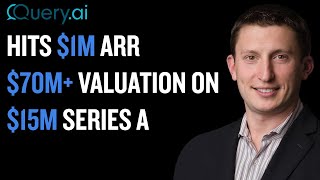
Security SaaS Hits $1m ARR, $70m+ valuation on $15m Series ADec 15, 2021

[00:00] Hey, folks. My guest today is Andrew Maloney. He's the co founder and chief operations officer at query.ai, where he's responsible for establishing and delivering on the company's go to market and business operations strategy. The tool provides the market's only security investigations control plane. Alright. Andrew, you ready to take us to the top? [00:15] >> Sounds great, Nathan. Thank you. [00:17] All right. Explain this to a commoner like me. What does that mean? Security investigations control plane. Question. [00:23] >> Great question. So first, thank you for having me. It's great to be here with you today. So query AI is a relatively early stage company. We just raised our our a round in October. The premise of what we're [00:33] doing Pre revenue or post? [00:35] >> We are post revenue. Yeah. We just we did our a round. We had two rounds this year. We just seed round early in the May timeframe, way now. Think it was May. Let's look at the the specifics of it. It's all gone together. It's been exciting year for us. But then we did October, a follow on a round of that to kind of help expand and continue the the growth in the market. To your question though, [00:53] >> it was more of like, is this and what does it do? We have been in and around security for twenty years, my co founder Dhiraj and I. And we've spent a lot of time in SIM type tool sets working with security operations teams and how to bring all of this data together to effectively run an investigation. What we found though is even in historical times with less data, more on prem environments, was very difficult to centralize [01:17] >> all of this. And what we found with the adoption of cloud and software as a service providers, data is truly everywhere. So this siloed data that is really a disparate environment, the inability to see this kind of centralized view has really slowed down security teams and their ability to run investigations and get to outcomes with high confidence. So the investigations control plan is really about bringing all of that together, centralized insights and access to all of [01:41] >> this decentralized data without having to worry about how to move the data around, how to get it centralized first, which offers a lot of capabilities and advantages to, you know, comparative to legacy approaches. [01:52] And what are customers paying on average per month or per year to use this technology you've built? [01:57] >> Our ASPs today are just under a 100 k. We're planning on growing those to one twenty five in our 2022 forecast plans. And I think realistically, we can get into the 200 range pretty easily on our average customer. That's annually. Right? Annually. Correct. Yes. Yep. That's great. Nice MRR, but we're not quite there. [02:12] Yeah. That would be incredible MRR. That would be great. Okay. Cool. Give me sort of the backstory here. When did you guys launch the business? [02:19] >> So we started our go to market operations in very late twenty nineteen. We officially launched the company Perfect Timing aligned with the pandemic in March 2020. So the first year was an interesting one for us just coming out stealth mode and getting those first customer traction as the whole world was shifting to remote workforce. But I think we've been a remote first company from the beginning. So for our operations capabilities, it didn't really change too much [02:41] >> of our tempo. [02:44] >> And I think we're we're very well aligned to this market shift and the move to the cloud. Right? Because the less data you can get in one environment, the more you start to adopt these disparate technologies, the more you have a need for a solution like ours. Mhmm. [02:54] Now when did you turn on your first paying customer? [02:57] >> It would have been July in 2020. Shortly after our launch. Yeah. 2021 is the year we're into. Sorry. [03:02] Twenty twenty twenty twenty. [03:04] >> You're all good. We're we're on the same page. [03:07] It's How did you how did you fund yourself from 2019 to 2020 before your first paid customer? [03:12] >> So we had a pre seed round from Angel Investors, which gave us the initial runway to build the prototype, do some market validation and testing. It's interesting kind of story. How much was that for? Just under $1,000,000. [03:25] Okay. [03:26] >> Yeah. Operations have been very lean and a lot of our development is out of India, which keeps our costs down, but they are query kind of employees. So those relationships have been very beneficial. Dhiraj has been in engineering for well over twenty years now. He and I met about sixteen years ago at a company called ArcSight. So he's got a lot of And you [03:43] guys just split fifty fifty at the beginning or no? [03:45] >> No. He actually started the company prior to to my joining from an incorporation perspective and was building a bit of a kind of a prototype. How do you more simply access data from a single solution, almost like a Siri for your SOC as it kind of started. The technology was even called Iris inside and you can literally natural language processing, ask it questions and get answers. And that is unique and interesting, but the real market problem [04:06] >> that we saw and aligned to as we really started to kind of test and validate is the need to do this across decentralized platforms because no one again has all that data in one place, which kind of an obvious moment looking back because we tried so long to get it all in one place, but it's really a paradigm shift in the way people think about security today. [04:23] So what's the energy like though between the two of you? Mean, would he call you a cofounder? Do you have more than 20% of the business? [04:28] >> He would call me a cofounder. We don't disclose publicly the ownership ownership percentages, but we're both in in strong positions and and wanna see the company succeed. But, we're definitely partners in this. So I would say fifty fifty partners without any kind of equity association to that, if you will. [04:42] Yeah. Yeah. Yeah. Fair enough. I mean, the reason I asked you, it sounds like you have a storied history. Right? You're not gonna join a company like this unless someone puts a very compelling compact for you that actually looks like co founder equity. [04:51] >> Yeah, I agree with that. Absolutely. And I think, the way that we split the responsibilities of the business and how we've kind of built this up, I think he would very much agree that we have completely done this together. I handle all the business operations, go to market, sales, marketing, customer success. He's responsible effectively for kind of R and D and bringing all of the product to life. [05:11] Okay. You get going in 2019, you sign up your first paid customer in 2020. How many customers are you now serving today? [05:17] >> So we have just under 10 customers today with a couple more we hope to get done in the last couple of weeks, always down to crunch time in the year. We've got a pretty aggressive growth plan coming into 2022, which will be both on kind of the revenue and the customer acquisition in terms of number of of new logos. But we've landed some some really strong accounts that we're very excited for. [05:37] No. It sounds like in an at the average ASP that you just articulated a couple minutes ago times 10 customers, it sounds like I can give you congratulations. You guys are either flirting with or just past a million dollar run rate. [05:45] >> We are flirting very close and, you know, have great plans to go and not just expand new customers and logos, but we got some deals that we see a lot of expansion opportunity with. [05:55] Andrew, you have you have ten days. Nothing happens out. You have ten days to get four to five k of new MRR. Hit that magic number, baby. [06:03] >> I will tell you too that my VP of sales is feeling that pressure as well. [06:07] I bet he is. Alright, very cool. What a fun story. Alright, so fill out the capital stack again. A million in 2019, what was the next round? [06:16] >> It was a million in '18 was the pre seed round. In early twenty twenty one, we did a seed round of 4,600,000. Okay. Well, 4.6, 3,600,000. We announced it including the pre seed. Let me make sure that I'm getting that right. So 4.6, that announcement included because of the first funding announcement we did for a total of 4.6. And then this year we just did a 15,000,000 in October, a second round, which was our A round [06:44] >> decision. [06:45] Yeah. How do you go out? I mean, again, you sort of just told us your revenue run rate. Imagine you guys aren't gonna go out and do a series A that's super dilutive. Most companies are selling 10 to 15% of the business, right, in a series A. Assuming you were in that range, you had to go out and convince the world that you're worth a $100,000,000 or something around that, right? Which is basically like a 100 [07:02] X multiple. How did you do that? [07:04] >> Well, multiples are crazy right now and valuation is I [07:08] mean, that's another one. [07:09] >> I will tell you, we didn't we didn't get to a 100,000,000 in that. We gave a little more away. It was important for us to find the right investors who could really help us move the business from a relationship, from an experience perspective. We feel like we've built a very, very solid board to help us drive the company forward. So I think we did very well. We didn't give too much of the company away, but we [07:29] >> also were telling a story on kind of what the future holds versus just what we've done today, right? Because you've got to drive towards revenue. We did it probably, I don't know if they late summer, we kind of started some of these conversations. We had some folks interested early on that we had kept up to date. So they saw the progress. They saw us kind of marching towards our targets and milestones, some of the forecast abilities [07:49] >> where we were going to end the year. And then obviously our operating plans going forward are very aggressive. Right? We'd like to be, at or as close to 15,000,000 in ARR by the end of twenty twenty three as we can be, which would make us, know, hyper growth kind of company. [08:01] And what would you have to what are you trying to finish 2222 with? [08:04] >> '22 would be collectively about 4,000,000. [08:07] So you're four x and then sort of three x after that is what you're targeting. [08:12] >> Yeah. The triple triple triple double double. [08:14] You'd be You'd a four. [08:16] >> You'd be a quadruple. [08:17] A quadruple triple triple double double. [08:19] >> Never hurts to overachieve. Like I said, there's a lot of opportunity we believe in our kind of upsell as well and expansion in customers. We've landed some really large deals with pilots to kind of other sub customers, whether it's MSSP style things or even a large government agency we did a deal with in Q3. [08:35] I wanna come to that in a second because NDR is really, really important in this space. Just to again, fill, finish the capital stack question. It sounds like you guys basically sold 15 to twenty percent three times over the past, you know, three years. Is that basically accurate? [08:49] >> There's different conversion rates based on when the equity was raised. Right? So there's a, there was caps, obviously, in some of the angel investments, they were done with safe documents without over disclosing too much. But Yep. Yep. Yep. Yep. [08:58] Yep. I mean, we've we've maintained, though. I mean, that that pre seed round in 20 pretty standard back then to do, you know, a million on a five cap sort of deal. [09:05] >> Right. So without disclosing all of the details, we have maintained over 50% employee equity in the company and still have room for new investments as we do. [09:12] How did you and Dhiraj decide if I I think I'm pronouncing his name correctly, correct me if I'm wrong, how'd you guys decide how much is set up in your ESOP pool? [09:20] >> I mean, standard's kind of a 10%. It is what we've gone for our employees'options, and we've we've prepped that up every time we've gone. There's often leftover shares depending on what your hiring plan looks like. Right? And we are, I would say rather conservative in our operations, but we do try to make sure that every employee has a meaningful ownership percentage and that they are bought into this because ultimately we are all partnered in this. [09:40] >> At this early stage of a company, it takes every employee wearing multiple hats to make it successful. [09:45] Yep. Yep. Yep. Okay. Cool. So again, between you, your co founder and the ESOP pool, over 50% equity investors on the rest so far? [09:53] >> I without looking at the cap tables or over displaying too much detail, that sounds about accurate. [09:58] Yeah. Yeah. Very cool. All right, talking more about the NDR stuff, right? So again, the highest actually, I mean, we're seeing even in series A rounds, the highest multiple companies right now are not the ones growing revenue the fastest. It's actually ones that are proving out they can hit 150 to 200% NDR, especially only being a year or two years old. Tell me a story about someone who started paying you guys, I'm making this up $5 k [10:17] a month a couple months ago, and they've already upgraded to whatever $10 k, $20 k, $30 k a month. [10:22] >> Well, I would tell you that with annual contracts, we haven't gotten to realize a lot of that value yet. We're definitely seeing for the early stage customers opportunities to grow those accounts. But I can't tell you we've realized all of those yet because as I mentioned, we closed our first customer in July 2020 and that was actually a multi year paid annual deal, right? So there was no upsell opportunity until the third year of that contract. [10:43] >> So we're just coming into the opportunity in 2022 where we'll have upsell potential. [10:48] Isn't that a massive liability with a sales motion to to basically only give yourself one shot each year to drive expansion when usage might be increasing from a customer every single month? [10:59] >> It certainly could be. I think we've looked at different ways to model this. It's pretty standard in our industry to do annual deals. And again, as early as we are, a lot of times it's more important to get the customers on, understand the usage, drive that value home, make them very successful and referenceable customers because they can help drive additional revenue. So there is investments, if you will, that may impact the short term revenue we can [11:24] >> acquire for a customer, but we feel like we can capture that back to some extent as we go forward, even if not directly from that customer in dollars in you know, multipliers of them being able to help us get other customers, case studies, references, those things are critical at early stage. You got to show the product works and hear it from somebody other than the company. [11:44] That's right. And in terms of growth rate, if you're sort of floating with that $80 k a month today in revenue, where were you exactly a year ago? Do you remember? [11:53] >> We had pretty significant growth this year. I think we came out of 19 in our first year selling only just over, I don't know, about 150, 125 k in in in overall revenue at that point was our first year selling. [12:06] But where were you exactly so in 2020, this in December 2020, what was your monthly revenue? Do you remember? [12:11] >> I I don't. Coming into 2021 was about a 125 k in total, so that divided by [12:16] 25 k. Was that. [12:17] >> Got it. No. I'm sorry. I may have misspoke. Our our we're both getting our years off. Our first customer was 2020. So Yeah. End of twenty twenty coming in 2021, we would have been just north of a 100 k in revenue. [12:29] Yeah. You were doing something like $10 k a month a year ago, now at $80 k a month. So, obviously, easy to multiply by 800% on small bases. Your bases are [12:37] >> getting Well, that's the thing. Those numbers aren't all that impressive when the numbers are small. But when you start talking about taking the million and quadrupling it and then from there expanding those larger numbers by three X, that's when it gets really exciting. We believe we're seeing that opportunity. It's a massive fleet, I think underserved market for one where again, the problem is well understood, incumbent and legacy technologies have a very standard approach, right? Kind of [13:03] >> the only kids in town doing it this way and really started to disrupt some things and we're getting more and more buy in. But again, you do something kind of net new and unique, you're starting a company from the ground up. There's a lot of that education and [13:17] >> evangelization frankly, to get people to start thinking about other options because they don't know what's there if you're just creating something net new. [13:23] Yep. Are What you guys upselling against? Is it number of seats, number of API calls, something else? [13:27] >> Yeah. So currently, we try to keep the pricing model as simple as possible. It's all based on tiers, and it's all based on number of analysts for our kind of direct sales go to market strategy. So it's like one to three analysts would be our first tier, and then the upsell would be additional analysts from that. So, say four to six and then so on and so forth in buckets of three until you get to 15 [13:44] >> and then it kind of goes enterprise custom because we wanna make sure it fits for the best model for the customer as well. [13:50] Okay. So your salespeople have that as leverage upsell number of analyst seats, but what is there a usage based upsell you have as well? [13:55] >> Not today. It's kind of an all you can eat in terms of, you know, number of integrations, APIs. We're even looking at a product like growth strategy that can enable us to, to give a freemium model away to get more people leveraging the product and seeing these kinds of very unique capabilities. That is something that we're looking at for kind of the end of twenty twenty two to roll out, but very excited for the potential there [14:15] >> and both the ability to kind of generate new opportunities for us, but just get the product in the hands of more people and start seeing some of the value that we're seeing realized with our direct customers today. [14:26] Very cool. Talk to me about team today. How many folks full time? [14:28] >> We have 26 ish employees today. We had two more start this week, so it's hard to keep track because we're growing pretty rapidly at this point. We started the year about 10. So we've added about fifteen, sixteen and we plan to get somewhere around the 40 range by the end of twenty twenty two with ramp hiring and, you know, sales, marketing. [14:47] How many engineers are currently in engineering right now. [14:50] >> Good question. So we are sprinting to, [14:53] >> 16 as fast as possible. We're at about, twelve, fourteen right now with, some offers out there pending. And building hiring is very difficult these days as I'm sure you're aware. [15:02] Yeah. Yeah. You're building your inside sales team and people always wonder what should I put what quota should I give my first sales rep as I try and figure out this motion? What what do you do? [15:10] >> For our year one, we stuck with a million and then we gave them some ramp time, right? Our objective now is to find very hungry reps that can work with early stage companies, do that discovery, help us learn because every conversation we have, we're still learning from that we're seeing really strong alignment and again, reception to the message we've got. So we started with a million. Our plan is to kind of keep it at 1.2 now [15:35] >> for the foreseeable future. So we can create a lot of upside for these reps if [15:38] you're spending a lot of money. [15:40] >> Three months is kind of standard, think. So we're planning those things and trying to get some of that out of the way this year. Right? So we've been onboarding sales reps for the last couple months trying to get them set up and going for early twenty twenty two. [15:50] So just to be clear, if you bring on one or two reps, you'll give them three months to get up to quota target. But in that third month, you really want them closing sort of $80,000 in new ARR each month effectively. [16:01] >> Ideally, we would. Mean, I know that there's going be some seasonality to that and it's not going to be a direct linear path for us at this point, but we do believe with the pipeline we've got on hand today, even bringing new reps in, they're not starting necessarily net new. So we can help them get started, give them some wind under their belt, and then hopefully they're bringing in their own new deals by, at minimum, the [16:19] >> six month mark. [16:20] How many quota carrying reps do you have today? [16:22] >> We've got, three currently under Yeah. Three. [16:26] It's a tough motion to get right, but you're you're in the thick of it. [16:29] >> It is. It's always a balancing act, but you don't wanna go too heavy too fast. You really gotta figure out the sales motion. So our focus for series a is very clearly find that repeatable path for revenue that we can really scale up. Because again, going towards that 15,000,000 number, we need to know that we've got a sales motion that we can put the right pressures behind and apply the right resources and ensure we're gonna get [16:47] >> the right outcomes. [16:48] Yep. No. I agree. Alright. Let's wrap up, Andrew, with the famous five. Number one favorite book. [16:52] >> Favorite book. That's not in order from what I saw. I don't have a single favorite book. There's there's my favorite business books. I I saw Snowball, or read Snowball, from Warren Buffett, I thought was an excellent book for a lot of people. [17:03] Read. That's a You have a lot A very long one. [17:06] >> I actually listened to it if I'm being fully transparent. [17:07] There we go. Now the truth comes out. [17:09] >> Little Blue Truck is a great kids book for those of you who have kids, which I think is a question coming up. Maybe I've jumped the gun. [17:14] Yeah. So how many kids do have? [17:16] >> I have three now, actually. We just welcomed our youngest daughter two months ago into the world. [17:20] Oh, wow. How cool. And how old are you? [17:22] >> I am 38 as of last week. December. Alright. [17:27] Look, we're going out of order, but that's okay. How many is there a CEO you're following or studying? [17:31] >> You know, I looked at that question, I don't really have one specifically that rang out. I've got a lot of friends, CEOs, or fellow entrepreneurs that, you know, I bounce ideas off of and just make sure, you know, there's a lot of comparison points, a lot of learnings. If I had to name one though, as I was thinking through this, Brian Murphy from ReliaQuest probably earned some credit. I've known him for a long time. He's done [17:50] >> a lot of great things with that company, built a really strong culture and a great team over there. So I definitely admire him and I think know, his focus on his people is an important thing that's often overlooked in business. [18:02] >> Yep. [18:03] Number four, how many hours of sleep do get every night? [18:04] >> That is a very near and dear one to me. I strive for seven to eight. It's probably more like six to seven, but I'm a big believer in sleep and kind of recharging for your health. So, I do try to get to that point. [18:15] Andrew, take us home. Something you wish you knew when you were 20. [18:18] >> Oh god, that wasn't in the list. [18:22] There's a [18:22] >> lot of ways to make money. Everybody's name I grew up in a blue collar family and it was all about like, you gotta be a doctor or a lawyer. And what I've learned is you can make money doing anything to include janitorial services if you wanna own the company that does the janitorial services. So don't limit yourself, follow your passion. And then you'd be surprised how many ways you can build businesses that are gonna make a [18:41] >> positive impact. [18:42] Guys, shore up your security with query.ai. They got going back in 2019, raised a million dollar pre seed round, 3.6 seed round, 15,000,000 series A sound between caught 10 to 20% of the business. They've already onboarded 10 enterprise customers flirting. They're so close to that million dollar run rate, about $80,000 a month right now in revenue, up from $10,000 a month a year ago. So really healthy growth, but as they look to continue to scale their team of [19:04] 26, 12 engineers, three quota carrying reps with a $1,200,000 target as Andrew looks to scale the team. Hiring engineers fast, Apply today. Andrew, thanks for taking us to the top. [19:13] >> Thank you so much, Nathan. Appreciate it. [19:16] One more thing before you go. We have a brand new show every Thursday at 1PM Central. It's called Shark Tank for SaaS. We call it deal or bust. One founder comes on, three hungry buyers, they try and do a deal live and the founder shares back end dashboards, their expenses, their revenue, ARPU, CAC, LTV, you name it, they share it and the buyers try and make a deal live. It is fun to watch every Thursday 1PM [19:41] Central. Additionally, remember these recorded founder interviews go live. We release them here on YouTube every day at 2PM Central. To make sure you don't miss any of that, make sure you click the subscribe button below here on YouTube, the big red button, and then click the little bell notification to make sure you get notifications when we do go live. I wouldn't want you to miss breaking news in the SaaS world, whether it's an acquisition, a big [20:04] fundraise, a big sale, a big profitability statement or something else. I don't want you to miss it. Additionally, if you want to take this conversation deeper and further, we have by far the largest private Slack community for B2B SaaS founders. You want to get in there. We've probably talked about your tool if you're running a company or your firm if you're investing. You can go in there and quickly search and see what people are saying. Sign [20:25] up for that at nathanlatka.com/slack. In the meantime, I'm hanging out with you here on YouTube. I'll be in the comments for the next thirty minutes. Feel free to let me know what you thought about this episode. And if you enjoyed it, click the thumbs up. We get a lot of haters that are mad at how aggressive I am on these shows, I do it so that we can all learn. We have to counter those people. We [20:45] got to push them away. Click the thumbs up below to counter them and know that I appreciate your guys'support. Alright, I'll be in the comments. [20:51] >> See you.

Data and Sources

All figures on this page are taken directly from interviews or are estimates from public sources and proprietary models. Not financial advice. Read full disclaimer.

Claim this profile