RaccoonCare
Valuation · 2021
$4M
2022 Revenue
$150K
Customers
20
Funding
$1M
Avg ACV
$7.5K
Team · 2023
12
Founded
2018
RaccoonCare Revenue, Valuation & Funding (2022)
RaccoonCare generated $150K in revenue in 2022.
RaccoonCare is a Ukrainian-founded SaaS company that develops a digital wellness application designed to combat sedentary lifestyles among office workers. Originally built for physical rehabilitation centers, the company pivoted in late 2022 to corporate wellness, targeting employers with 100 to 500 office-based employees who receive the app as a fitness and wellness benefit.
The company generated $150,000 in revenue in 2022 from 20 rehabilitation center customers and entered 2023 pre-revenue on its new corporate model, with 10 active pilots under negotiation for annual subscriptions priced at $12,000 per corporate account. CEO Svitlana Malovana has set a target of $1,000,000 in revenue for 2023.
RaccoonCare raised a total of $1,500,000 between 2018 and 2022 through a combination of equity, founder capital, and grants including the European Horizon 2020 program. Approximately 60 percent of that capital was spent on medical certification and device manufacturing. The two co-founders retain a combined 75 percent equity stake, having given up 25 percent in the equity portion of the raise.
Last updated
RaccoonCare Revenue
RaccoonCare generated $150,000 in total revenue in 2022, derived entirely from its original rehabilitation center business model. The company had 20 paying rehabilitation center customers that year. Prior to 2022, the company was pre-revenue, spending the period from 2018 through 2021 on medical certification and device manufacturing funded by raised capital.
Following its pivot to corporate wellness in late 2022, RaccoonCare entered 2023 pre-revenue on the new model, with 10 active pilots under discussion for annual agreements. Malovana stated a target of $1,000,000 in revenue for 2023, representing roughly a 567 percent increase over the 2022 base if achieved. That target is not confirmed and should be treated as a stated goal, not a projection.
As a GetLatka estimate, applying the company's own stated 2023 target as a ceiling and assuming significant pilot conversion risk as a floor, a plausible 2023 revenue range is $120,000 to $1,000,000, with the lower bound reflecting conversion of roughly 10 of the current pilots at the $12,000 annual contract value. This is a GetLatka estimate based on stated pilot count and contract value; actual results were not confirmed.
RaccoonCare Valuation, Funding Rounds
RaccoonCare reached a $4M valuation in 2021, set during its Pre-Seed round.
RaccoonCare has raised $1M in total funding across 1 round, most recently a $1M Pre-Seed round in 2021.
| Year | Round | Amount | Valuation | % Sold | Source |
|---|---|---|---|---|---|
| 2021 | Pre-Seed | $1M | $4M | 25% | Not recorded |
Founder / CEO
Svitlana Malovana
CEO
Svitlana Malovana is the CEO and co-founder of RaccoonCare. She is 32 years old as of the January 2023 interview. Malovana describes herself as a former IT lawyer with more than ten years of experience in the technology sector. She has been recognized as one of the top 25 IT women in Ukraine by Forbes Ukraine and is a contributor to that publication.
Before founding RaccoonCare, Malovana operated a legal business in Ukraine, the proceeds of which she used to help fund RaccoonCare during its pre-revenue years from 2018 through 2021. She continues to draw on outside income to support the company's payroll during the current pivot period. RaccoonCare has a second co-founder whose name was not disclosed in the interview. Malovana indicated she holds a slightly larger equity stake than her co-founder, though the two together retain 75 percent of the company. Net worth was not discussed in the interview and no estimate can be responsibly derived from the available data.
Q&A
| Question | Answer |
|---|---|
| What's your age? | 35 |
Customers
In 2022, RaccoonCare had 20 paying customers, all rehabilitation centers, generating $150,000 in annual revenue. The product helped rehabilitate more than 1,000 people in total through those centers.
Following the pivot to corporate wellness, the company's target customer is a company with 100 to 500 office-based employees. The annual subscription is priced at $120 per employee, making the baseline annual contract value $12,000 for a 100-employee account. Additional fees apply depending on the reporting and analytics packages a corporate customer selects. As of January 2023, RaccoonCare had 10 active pilots with corporate customers and was pre-revenue on the new model, with annual agreements under negotiation. No free tier was described; the pilots were structured as trial periods, with the three most recent pilots operating under a one-month free trial followed by a full subscription offer.
RaccoonCare serves 20 customers.
RaccoonCare Business Model
RaccoonCare operates on an annual SaaS subscription model. Corporate customers pay $120 per employee per year as a base fee, with additional revenue available from reporting and analytics add-ons. At a target account size of 100 employees, the average contract value is $12,000 per year. The old rehabilitation center model generated revenue on a per-employee or per-patient basis, with Malovana referencing a figure of $10 per month per employee under that pricing structure.
The company's primary customer acquisition method as of 2023 is cold outreach and network-based lead generation rather than scaled digital marketing. Malovana described using personal and professional networks to identify and approach the first corporate pilot customers. Profitability was not discussed in the interview. With 12 full-time employees and revenue of $150,000 in 2022, the company is operating at a loss, with Malovana confirming she is supplementing payroll from outside income. Gross margin, churn, LTV, CAC, and burn rate were not disclosed.
Point-in-time figures shared on the GetLatka podcast, each linked to the exact moment it was said on camera.
Customers (2022)
20
“Nathan Latka: In 2022, how many paying customers did you have? Svitlana Malovana: We had 20 rehabilitation centers who actually use the product.”
WatchFree trials / month (2023)
10
“Svitlana Malovana: Right now, we have in this model, we have 10 pilots and we are discussing the annual agreements and the annual subscription for $12,000.”
WatchRaccoonCare Employees & Team Size
RaccoonCare had 12 full-time employees as of January 2023. The engineering and back-office team is based in Ukraine and has continued working through the war, at times from bomb shelters. Malovana runs the company from New York. She noted the team was kept intact despite the financial pressure of the pivot, in part as a deliberate decision not to conduct layoffs during the war.
RaccoonCare employs approximately 12 people as of 2026. It serves 20 customers that rely on its solutions.
| Year | Milestone | Source |
|---|---|---|
| 2023 | Reached 12 employees (January 2023) | Not recorded |
Frequently Asked Questions about RaccoonCare
Is RaccoonCare still operating?
No. RaccoonCare has shut down.
What is RaccoonCare's revenue?
As of 2022, RaccoonCare generated $150K in revenue.
Who founded RaccoonCare?
RaccoonCare was founded by Svitlana Malovana.
How much funding does RaccoonCare have?
RaccoonCare raised $1M across 1 round.
How many employees does RaccoonCare have?
As of 2023, RaccoonCare had 12 employees.
Full Interview Transcripts
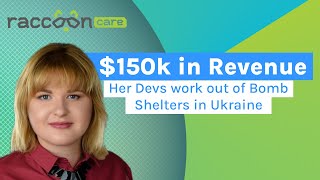
Her Devs work out of Bomb Shelters in Ukraine, $150k in Revenue for Employee Care SaaSJan 10, 2023
[00:00] Guys, RaccoonCare is helps rehabilitation centers rehabilitate folks. She's now pivoting to corporate. She's got 10 pilots running for these corporations who wanna use the raccoon.care app to help their employees stay active, especially if they're sitting at a desk a desk every day. Her engineers are working at a bomb shelters in Ukraine. She's in New York running the company 12 full time. They did a $150,000 in revenue last year, hoping to break a million this year. Hey, [00:24] folks. My guest today is Svitlana Malovana. She's a proud Ukrainian, former IT lawyer, and big fan of technologies and digital digitalization with ten plus years of IT experience. She's a contributor at Forbes Ukraine being named as the one of the top 25 IT women in Ukraine, and then her passion is helping human capabilities and productivity. She's fighting the sedentary lifestyle by developing digitized physical tools. Her most recent product is Raccoon dot care. It helps you increase [00:49] physical activities. Svitlana, are you ready to take us to the top? [00:53] >> Yeah. Sure. Hello, everyone. [00:55] Very good. I'm glad you're here. First off, are you safe? Are you in Ukraine right now? How are you? [01:00] >> I'm good. I'm safe. I'm in New York, and our back office is in Ukraine, but they are working sometimes out of bomb shelters, but they are safe, I hope. [01:12] Well, I I'm I we're we have all of our support. I'm glad you're safe. I'm glad your team is safe as well. [01:18] >> Thank you very much. Yeah. It's this support, we are very appreciate. [01:21] That's amazing. So tell us what the company does. Who who are you selling to? [01:27] >> Actually, like, what we do is we fight the sedentary lifestyle with the help of our SaaS, like, app. And at the moment we are selling to corporates with the office workers. So like from 100 to 500 office workers like as employees as a fitness as wellness benefit. And it's like a fitness app, but actually that help people who are sitting all the time near their laptop to do active breaks, to do like different [02:01] >> stretching even in workplace, even in costume, and also like different challenges to to actually get it done because we know that people are too busy with their life and they have don't they don't have time actually for their health. [02:16] And Svitlana, so what do these companies pay on average per month to use your technology to help them keep their employees physically active? [02:23] >> You mean like what is their business model? [02:25] What does the average customer pay you per month? [02:30] >> Actually like annual subscription is $120 per per employee. It's like basic fee. And the rest depends on what kind of reports companies want to get. [02:44] So taking all that into consideration, what does the average company pay you per year? [02:50] >> We are focusing, like, for example, 100 employees. So, like, in this case, they are paying us, like, $12,000 annually. [03:01] Okay. So your average cost your average paying customer today is paying you $12,000 per year? [03:07] >> We suppose because actually we just pivoted from physical rehabilitation field when we sell to rehabilitation centers to corporate wellness. So we just did this transformation this autumn. And before that, starting from 2018, we were selling to rehabilitation centers. And there we actually got this insight that there is one common thing between like an orthopedic neurological cases in sedentary lifestyle. That's why we decided to help people to be more healthy, more efficient, being active on daily basis. [03:43] Yes. Svitlana, think the the product makes total sense to me. I'm trying to get an understanding of economics. So what does the average customer today pay you per year? [03:52] >> Right now, we have in this, model, we have 10 pilots and we are discussing the annual agreements and the annual subscription for $12,000. [04:05] So Svitlana, you're it's this is totally okay. You're pre revenue today on the new model? [04:09] >> On the new model. Yeah. [04:11] I mean, are you it doesn't sound like you're doing much on the old model though, right? That's why you pivoted. [04:17] >> Actually, we see that here we can bring more value. So like it was medical, the previous one model, it was medical product that, like, need a lot of support. My I mean, like certification, evidence, so on. So that's why we decided to go and to solve one very easy problem, actually, sedentary lifestyle. [04:39] Oh, what's going on there, YouTube? Good to see you guys. Now imagine this. You love watching these interviews with SaaS founders, but imagine if we took all of the valuation data out from over 2,807 interviews I've done manually. Saves you a lot of time. Well, we've done this. We've built it into the beautiful interface inside of Founderpath. Check this out. I'll show you how you can access this in a second, but you log in, you connect [05:02] your Stripe account, you see your valuation real time, you can see what it changed over the past eighty eight days and even set goals for valuation this year. Now the secret evaluation is there's many different ways to value a SaaS business. So the reason you're gonna see three or four different valuations inside of your Founderpath dashboard, this is all free by the way, is because depending on who's doing the buying of your SaaS company, you're gonna [05:26] get a different valuation. A VC is gonna pay a different valuation, private equity firm is different. If you're gonna do a minority sale, that's different. And if you sell the whole business, that's a different valuation. You can see all those when I hover over here. Right? So the teal is what a VC would pay. Yellow is what private equity and red is if you sold the whole thing outright. Now what's cool about this is this is [05:48] not built off random data. Again, you guys hear these interviews on YouTube. All these datas are built from real time valuation data points founders share with us on the show. So traction, 1,200,000 seed round, 3.7 raise. They sold 22% of their business. Go in here and filter by the event. Maybe you only wanna see companies that have sold the whole business. Well, here are a bunch that have been acquired, the valuation and the multiple. Maybe you're [06:14] going out right now and you're raising your seed round. We'll go in here and look at all this recent seed deals that went down, what they raised, what valuation they raised at, and what percent that they sold. There's never been a larger dataset of SaaS valuations than what you can get now inside of Founderpath. And we're thrilled to bring it to you. Alright. We're gonna go back to the YouTube video here in a second, but if [06:36] you wanna check this tool out, if you wanna jump in and sign up, you can check it out for free to get your valuation at this link. This link, founderpath.com/products/valuations. Or if you go to founderpath.com and hover over products, click on get your valuation here, and go ahead and sign up to give it a whirl. Again, all that valuation data live right inside the platform. I hope to see you there. Alright. Let's jump back into the [07:02] interview. I again, I totally understand the product. I just I'm trying to understand economics. So that last biz like, today, right now, including all the revenue from the old business model, I mean, you're doing under $5,000 per month in revenue. Is that accurate? [07:15] >> Yeah. So, like, if we are talking about, like, monthly, it's, $10 per month for one employee. [07:21] Svitlana, how much how much revenue did the whole company do last year, all year? [07:27] >> 150 k. [07:30] And what's your goal for this Sorry? [07:33] What's your goal for this year, 2023? [07:36] >> For this year, for 2023, we want to get at least 1,000,000 revenue. [07:41] I love that goal. Ambitious. Alright. And last year with a $150,000 in revenue, how many customers was that from? [07:50] >> The for previous year? [07:52] In 2022, how many paying customers did you have? [07:57] >> We had 20 rehabilitation centers who actually use the product and it [08:05] >> we calculated like per number. So in total, we help to rehabilitate more than 1,000 people. [08:13] That's amazing. And then go back to 2021. If you did a 150,000 last year, what did you do one year before in 2021? [08:20] >> In 2021, we were getting medical certification. [08:24] So not zero, right? Yeah. So how did you support the business? You said you launched in 2018. How did you pay bills between 2018 and 2021 when you were pre revenue? [08:34] >> We like in total, we raised $1,500,000 where around 60% was spent on medical certification evidence. We also had devices, so also on manufacturing those devices. And if we are talking about how we get those money, it was our own money. So from my, like, legal business in Ukraine, we raise investments and also we got, like, fund [09:06] >> grants for for medical, actually. One of the grants is, like, Horizon2020, like, European grant program also for medical medical staff, for medical staff. [09:18] So the one the 1,500,000 you raised, that was in 2021? [09:22] >> It was like from 2018 till 2022. So it's in total. [09:30] Okay. How much of the 1,500,000 was not grants? It was equity. You were selling a part of the company. [09:38] >> Less than 1,000,000. [09:39] Okay. So [09:40] >> Almost 1,000,000. [09:42] Alright. Let's just say 1,000,000. So how much equity did you have to give up to raise a million? [09:48] >> Right now, 75% of the company belong to co founders, me and my co founder. [09:54] Oh, amazing. Okay. So you only had to give up 25% of the company when you did the equity raise. Okay. So it was a 4,000,000 post money valuation. And what sorry. Who did you say your co founder was? [10:04] >> Who my cofounder? [10:06] You have two co you have two founders, you and one other person? [10:08] >> Me me and another one cofounder. Yes. [10:10] Did So you guys put it equally at the start, or did you negotiate? [10:16] >> We, like, negotiate, but [10:21] I bet you got more. You strike me as tough. You're hard to you're hard to negotiate with, I bet. [10:28] >> I think I have, like, a couple of persons more just for investor to see, like, who is the decision making to be sure that there is one person, like, to talk to, but we bring like, I think like half and half resources and That makes sense. Money and so on. [10:50] That makes sense. How many people are full time on the company today? [10:54] >> 12 people. [10:55] 12 people. So how how are you paying 12 full time salaries today when you're basically I mean, you're you're under a $100,000 a year in revenue? [11:07] >> We actually have have 12 people and we did we decided not to fire them because of the war in Ukraine, but in twenty twenty twenty one, actually one of the reasons why we decided to pivot, it was actually war in Ukraine. Because like in the beginning of the year, we had clients like rehabilitation centers, we get subscription for them, but we still need to raise more to get like some extra medical certification. But to, like, [11:39] >> VCs, they just, like, canceled our contracts in February because the war starts. And that's why we decided to pivot because, like, we didn't have Let's be honest. [11:50] Sorry. I just I feel like we're on a my question was just today, how are you paying 12 full time people? Are they doing are they actually full time? Are they consulting? What's how are you doing that? [12:01] >> They they are full time, but we also, like, give them possible so we are they are full time working, but they also have some extra things to do to to get, like, extra money for living. [12:13] But but how do you what where do you How do pay? Yeah. How do you pay them when you're doing under a $150,000 a year in revenue or under about $10,000 a month in revenue. You can't pay 12 people full time salaries with 12 with 10,000 a month in revenue. Can you? [12:28] >> We still, like, have some, like, revenues for out of my other business. So, yeah, we pay them actually salary. [12:35] Oh, so you are putting more money into the company every month as you pivot? Yeah. Oh, I see. Okay. That makes sense to me. Okay. Great. So as we wrap up here, I wanna talk about these pilots because you just pivoted. You've got 10 pilots set up. How do you structure the pilot to optimize the likelihood that they actually start paying at the end? [12:58] >> Actually, we start looking for clients with some, like, not not scaling, like, models. So we start not focusing on some digital process of lead generation. We start looking for their focused customers to use our network to find this, like, first pilots. And we right now have, like, doing trial period together with them. And after this trial period with a part of the team, we are implementing into the full company and suggest them as a subscription on [13:30] >> the subscription basis like the SaaS model. Did I answer your question? [13:36] Well, most people when they were on a pilot, they'll say, we'll do this amount of work for you for x amount of time. And if we generate y results, then you start paying us $12,000 per year. Right? Do you have that kind of structure set up in your your pilot legal agreement? [13:52] >> With first, pilots not because actually we had to test if they like the product, if they like the, like, customer success and so on. So but three last actually pilot, we start with the model where they have like one month trial period and after that they are selling like full subscription. [14:16] I see. I see. Very cool. Alright. Let's wrap up here with the famous fives, Svitlana. Number one, what's your favorite book? [14:24] >> My favorite book is Leadership of Manchester United, something like that. About, like, management in Manchester United. [14:35] Number two, is there a CEO you're following or studying? [14:38] >> Sorry? [14:39] Is there a CEO you're following or studying? [14:44] >> Following. [14:45] Name name a founder you're following. [14:52] >> Let me think. I don't know. [14:55] Okay. We'll skip that one. Number three, what's your favorite online tool for building RaccoonCare? [15:03] >> Actually, I like ClickUp. I saw like your interview with them and I really like actually, CEO, I think, also will be the person who I'm following because, like, I try to bring a lot of of that product and of their, like, strategy and culture, everything. [15:21] Understood. Alright. Number number four. How many hours of sleep do you get every night? [15:26] >> Sorry? [15:27] How many hours of sleep do you get every night? [15:30] >> At least seven. [15:32] Okay. And what's your situation? Married? Single? Kids? [15:35] >> Single. [15:36] Okay. And do you mind me asking how old you are? [15:40] >> Yes. 32. So three two. [15:43] >> 32. Last question. [15:45] Something you wish you knew when you were 20. [15:52] >> More listen and less talk. [15:54] Guys, RaccoonCare is helps rehabilitation centers rehabilitate folks. She's now pivoting to corporate. She's got 10 pilots running for these corporations who wanna use the Raccoon. Care app help their employees stay active, especially if they're sitting at a desk a desk every day. Her engineers are working at a bomb shelters in Ukraine. She's in New York running the company 12 full time. They did a $150,000 in revenue last year, hoping to break a million this year. Or [16:18] certainly certainly rooting for Svitlana. Svitlana, thank you for taking us to the top. [16:24] >> Thank you very much. [16:25] One more thing before you go. We have a brand new show every Thursday at 1PM central. It's called Shark Tank for SaaS. We call it deal or bust. One founder comes on, three hungry buyers, they try and do a deal live and the founder shares back end dashboards, their expenses, their revenue, ARPU, CAC, LTV, you name it, they share it and the buyers try and make a deal live. It is fun to watch every Thursday 1PM [16:50] Central. Additionally, remember these recorded founder interviews go live. We release them here on YouTube every day at 2PM Central. To make sure you don't miss any of that, make sure you click the subscribe button below here on YouTube, the big red button and then click the little bell notification to make sure you get notifications when we do go live. I wouldn't want you to miss breaking news in the SaaS world, whether it's an acquisition, a big [17:13] fundraise, a big sale, a big profitability statement or else. I don't want you to miss it. Additionally, if you want to take this conversation deeper and further, we have by far the largest private Slack community for B2B SaaS founders. You want to get in there. We've probably talked about your tool if you're running a company or your firm if you're investing. You can go in there and quickly search and see what people are saying. Sign up [17:34] for that at nathanlatka.com/slack. In the meantime, I'm hanging out with you here on YouTube. I'll be in the comments for the next thirty minutes. Feel free to let me know what you thought about this episode. And if you enjoyed it, click the thumbs up. We get a lot of haters that are mad at how aggressive I am on these shows, but I do it so that we can all learn. We have to counter those people. We [17:54] got to push them away. Click the thumbs up below to counter them and know that I appreciate your guys'support. Alright, I'll be in the comments. See you.
Data and Sources
All figures on this page are taken directly from interviews or are estimates from public sources and proprietary models. Not financial advice. Read full disclaimer.
Claim this profilePeople Also Viewed
Ring at Home, Inc.
Ring at Home, Inc. is a company that provides products and services related to home security and...
Bot Eat Brain
A daily newsletter for ai news and memes.
SurgiHealth Docs
Streamline product information and instructions throughout your medical facility with ease while...
DATAlovers
Developer of a SaaS based predictive marketing software created to enrich the customer leads and...
Toushay - It's what's in store
Provider of a cloud-based consumer engagement platform for retailers. The company's platform...
Flowtap
Developer of an application for sales management. The company's application called Flowtap provides...