Latka logo

Valuation

$18M

2024 Revenue

$85.6M(Est.)

Customers · 2022

1K

Funding

$38M

Team

615

Founded

2015

Sumsub Revenue, Valuation & Funding (2024)

Sumsub is an identity verification and compliance platform offering anti-money laundering and know-your-customer technology to banks, fintechs, crypto companies, car-sharing services, and marketplace businesses worldwide. The company was founded in 2015 after a pivot from anti-Photoshop image-editing detection software, and it processes between 500,000 and 1,000,000 identity verifications per month as of April 2022.

The business has grown from $1,000,000 in annual revenue in 2019 to a $45,000,000 annualized run rate in April 2022, reaching $3,700,000 in monthly recurring revenue. That trajectory was achieved on roughly $6,500,000 in total outside capital, with the company reporting positive cash flow and an EBITDA margin of 10 to 20 percent at the time of the interview.

Sumsub serves more than 1,000 paying customers, including approximately 40 tier-one accounts each spending more than $100,000 per year, with the largest customers paying $5,000,000 to $7,000,000 annually. The company was planning a Series B raise of $80,000,000 to $100,000,000 at the time of the interview, targeting new market expansion, senior sales and marketing hires, and potential mergers and acquisitions.

Last updated

Sumsub Revenue

Sumsub reported $25,000,000 in full-year 2021 revenue, representing 4.4 times year-over-year growth. By April 2022, the company had reached a $45,000,000 annualized run rate, equivalent to $3,700,000 in monthly recurring revenue. That compares with approximately $700,000 in monthly recurring revenue at the start of 2021 and at the time of the 2020 seed round, and with $1,000,000 in total annual revenue in 2019.

Sumsub Revenue GrowthReported revenue / ARR over time · latest figure estimated$0$20M$40M$60M$80M$100M201520172019202120232024$0$1M$8.4M$25M$45M$50M$85.6MSource: GetLatka.com interview on Apr 7, 2022 with Vyacheslav Zholudev
YearMilestoneSource
2024Sumsub Hit $85.6m revenue in October 2024Estimated
2023Sumsub Hit $50m revenue in July 2023
2022Sumsub Hit $45m revenue in April 2022Watch[1]Estimated
2021Sumsub Hit $25m revenue in January 2021Watch[2]
2020Sumsub Hit $8.4m revenue in April 2020
2019Sumsub Hit $1m revenue in January 2019Watch[3]
2015Launched with $0 revenue

Co-founder and CTO Vyacheslav Zholudev told Latka that the acceleration in the second half of 2021 was driven by large international customers who first tested Sumsub in one region, confirmed performance, and then expanded traffic across additional geographies such as Brazil. Revenue in 2020 implied an annualized run rate of roughly $8,400,000, based on the $700,000 monthly figure the company was carrying at the time of its seed round that year.

Using the most recent trailing growth rate as a ceiling and applying a deceleration adjustment as a floor, GetLatka estimates Sumsub's 2023 revenue in a range of approximately $67,000,000 to $90,000,000. This is a GetLatka estimate based on the stated $45,000,000 run rate and the 4.4 times 2021 growth rate, discounted materially to reflect base-size deceleration. The actual figure was not discussed in the interview.

Sumsub Valuation, Funding Rounds

Sumsub reached a $18M valuation in 2020.

Sumsub has raised $38M in total funding across 4 rounds, most recently a $30M Series B round in 2022.

Sumsub Capital Raised & ValuationCumulative capital raised and post-money valuation by roundCapital raised (cum.)Valuation$0$0$4M$10M$8M$20M$12M$30M$16M$40M$20M$50M20152016201720182019202020212022$18MSource: GetLatka.com interview on Apr 7, 2022 with Vyacheslav Zholudev
YearRoundAmountValuation% SoldSource
2022Series B$30M--
2020Funding round$6M$18M33%
2017Seed$1.5M--
2015Pre-Seed$500K--

Founder / CEO

Andrew Sever

CEO

The guest in this interview is Vyacheslav Zholudev, co-founder and CTO of Sumsub, who was 36 years old at the time of the April 2022 recording. He holds a PhD in computer science and describes himself as a product-oriented technologist with more than 20 years of IT experience. He was working as a consultant and part-time contributor to Sumsub from its early days before joining full time in 2018, at which point the other co-founders offered him an equal equity split after observing his impact.

Sumsub has four co-founders in total. Three are brothers, two of whom are twins, and Zholudev is the fourth. The company's roster also lists Andrew Sever and Andrey Severyukhin as CEO and co-founder respectively, though neither appeared in this interview and their specific roles relative to the founding team were not elaborated upon by Zholudev.

The founding team began working together in 2012 on anti-Photoshop image-editing detection software, operating at times without salaries and on personal savings. They raised $500,000 in early capital around 2015 and pivoted that year to AML and KYC identity verification. Zholudev said he would question, in hindsight, whether pursuing a PhD was the right use of time. Net worth was not discussed in the interview.

Q&A

QuestionAnswer
What's your age?39
Favorite online tool?-
Favorite book?-
Favorite CEO?-
Advice for 20 year old self-

Customers

Sumsub had more than 1,000 paying technology customers as of April 2022, with an average contract value of approximately $10,000 to $20,000 per year. Within that base, roughly 40 accounts qualified as tier-one customers, defined as those spending more than $100,000 per year. The largest customers pay $5,000,000 to $7,000,000 annually.

Customers span banks, fintechs, crypto companies, car-sharing platforms, and marketplace businesses. Zholudev explained that large international clients typically begin with a single region, evaluate performance, and then expand to additional geographies, which drives significant revenue growth within existing accounts. Billing is structured per sub-service rather than per verification, as different clients require different combinations of identity checks, AML screening, and related compliance modules.

The company processes between 500,000 and 1,000,000 verifications per month across all service types, ranging from straightforward AML screening to full identity document plus selfie checks. Zholudev noted he did not have a precise breakdown by verification type at the time of the interview.

Sumsub serves 1K customers.

Sumsub Business Model

Sumsub charges clients per sub-service consumed rather than a flat per-verification fee, allowing customers to construct custom compliance flows from modular components. The average customer pays roughly $10,000 to $20,000 per year, while the top tier of approximately 40 accounts each exceeds $100,000 annually and the largest accounts reach $5,000,000 to $7,000,000 per year.

The company reported positive cash flow as of April 2022 and an EBITDA margin of 10 to 20 percent. At the April 2022 monthly recurring revenue of $3,700,000, a 10 percent EBITDA margin implies approximately $400,000 in monthly cash profit, a figure Zholudev confirmed as roughly accurate when the host raised it. Profitability was achieved on total outside funding of approximately $6,500,000, which Zholudev described as a point of leverage in Series B negotiations.

Growth to date has been driven primarily by word of mouth and by clients migrating from competitors, particularly in emerging and complex international markets. Zholudev acknowledged that the sales and marketing function was not yet in strong shape, with a team of roughly 20 to 30 people covering both sales and marketing, and said the Series B proceeds would be used in part to hire senior sales and marketing leadership and build out that function properly.

Point-in-time figures shared on the GetLatka podcast, each linked to the exact moment it was said on camera.

Customers (2022)

1000

Vyacheslav Zholudev: Over 1,000 tech customers, but 40 tier one customers paying more than 100,000 a year.

Watch

EBITDA margin (2022)

10%

Nathan Latka: How much do you profit per month? Do you know? Vyacheslav Zholudev: It's about 10 to 20%.

Watch

Annual profit (2022)

true

Vyacheslav Zholudev: We are cash flow positive.

Watch

Sumsub Employees & Team Size

Sumsub employed approximately 300 people as of April 2022. The engineering organization comprised roughly 50 to 60 engineers, with an additional 20 to 30 staff in quality assurance and engineering management roles. The sales and marketing team numbered approximately 20 to 30 people combined.

Zholudev noted that the sales and marketing function was not yet operating at the level the company needed and that one of the primary uses of Series B capital would be to bring in senior talent to professionalize that part of the business.

Sumsub employs approximately 615 people as of 2026, up from 363 in 2023, including 31 sales reps that carry a quota. It serves 1K customers that rely on its solutions.

Sumsub Team GrowthReported headcount over time015030045060075020152017201920212023202400615615Source: GetLatka.com interview on Apr 7, 2022 with Vyacheslav Zholudev
YearMilestoneSource
2024Reached 615 employees (October 2024)
2023Reached 363 employees (November 2023)
2023Reached 363 employees (September 2023)
2023Reached 450 employees (July 2023)
2023Reached 309 employees (July 2023)
2023Reached 316 employees (January 2023)
2022Reached 300 employees (April 2022)Estimated
2021Reached 148 employees (November 2021)
2021Reached 148 employees (August 2021)

Frequently Asked Questions about Sumsub

What is Sumsub's revenue?

Sumsub generates an estimated $85.6M in annual revenue.

Who is the CEO of Sumsub?

The CEO of Sumsub is Andrew Sever.

How much funding does Sumsub have?

Sumsub raised $38M across 4 rounds.

How many employees does Sumsub have?

Sumsub has 615 employees.

Where is Sumsub headquarters?

Sumsub is headquartered in London, England, United Kingdom.

Full Interview Transcripts

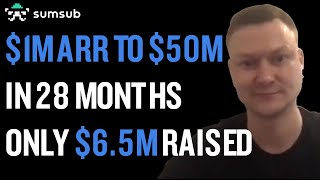
$1m ARR to $50m in 28 Months. This AML KYC SaaS Is A Secret Unicorn, only $6.5m RaisedApr 7, 2022

[00:00] Hey, folks. My guest today is Vyacheslav Zholudev. He's a CTO and cofounder of sumsub. He's a guy has over twenty years of IT experience and a PhD in computer science. He's a product oriented CTO and, again, the cofounder of sumsub, which is AML and KYC tool. Okay. Vyacheslav, are ready to take us to the top? [00:19] >> Yeah. Sure. Let's do it. [00:20] Alright. So for folks not familiar with banking and finance, what is AML and KYC? [00:27] >> Basically, can say AML is anti money laundering. Right? And KYC stands for know your customer. And basically, it's kind of identity verification. So you help companies to onboard honest users as many as possible, as quickly as possible, but at the same time keeping fraudsters at bay. Right? And of course, if company is regulated, then of course, we're keeping we help keeping this company staying compliant. [00:55] Now, are banks your main customer or who's your main customer? [01:00] >> Main customers? Yeah, we do have banks, fintech, actually crypto quite a bit, actually car sharings marketplace to share the economies, basically everywhere gateway is needed nowadays. [01:13] Mhmm. And so how what did some of these customers pay you per month to use the technology? [01:18] >> How much? [01:20] Yeah. How much they pay you? [01:21] >> Yeah. We have about, like, 40 customers that we consider top tier one customers that paying more than 100,000 a year. Right? But some of them paying over 1,000,000 in insurance. [01:33] This is fascinating. Okay. So this is these are obviously huge. So just to be clear, your largest customer's ACV is high. They pay you how much? 2,000,000 a year? 1,000,000 a year? [01:42] >> Even more. Maybe maybe $5 to 7,000,000. [01:47] Okay. And so someone one of these customers paying you 5 to $7,000,000 per year. How many? I imagine you bill based off number of verifications. Right? [01:56] >> Yeah. Yeah. It's a little bit more complicated than that because we charge per subservice, so to say, because some customers need one service. Some customers, like, construct the flow from different parts. So we kind of have subservices, and we bill per subservice. So how many customers you ask paying? [02:14] Well well, no. I mean, I guess the question yeah. Yeah. Guess yeah. Yeah. How many customers? That's a good thing. [02:20] >> Over 1,000 tech customers, but 40 tier tier one customers paying more than 100,000 a year. [02:27] Okay. What what is the that's great to understand your tier one folks. But what does the average customer pay you per year? More like 10 k or 5 k a year? [02:35] >> Yeah. Something like 10 to 20, I would say. [02:38] Okay. Interesting. And so, I guess, put this all on a timeline for me. When did you launch the business? [02:44] >> If you go to our website, it says 2015, but the story actually starts a little bit. Before then, in 2012 when I got met like, met cofounders, and we were doing actually anti Photoshop software to detect Anti what? Part Photoshop. So, basically, you detect which parts of an image were edited. Right? But then at some point [03:05] You were you were Kim Kardashian's worst worst nightmare. [03:09] >> Yeah. So yeah. But at some point, we realized that it's only part of a story because our customers, potential customers, they don't care about whether the image was modified or not. They care whether they can trust the end user. And then we pivoted in two thousand twelve fifteen, and that's when things started to look good for us. [03:27] Okay. Interesting. So, I guess, did the business almost like die before you pivoted? What made you wanna pivot? [03:33] >> Yeah. Because yeah. There were hard times actually. We're working like like, let's say, without salaries and or like with our own savings. [03:41] You were working three years between 2012 and 2015 with no salary? [03:46] >> No. No. No. There there were good times. So we also raised, like, some pension capital, like, 500,000 or something. But then there were hard times when there was, like, one year of, you know, just working. But I was actually working part time was my pet project back back in the day. It was a little bit later when I officially joined sumsub. [04:05] Oh, what's going on there, YouTube? Good to see you guys. Now imagine this. You love watching these interviews with SaaS founders. But imagine if we took all of the valuation data out from over 2,807 interviews I've done manually saves you a lot of time. Well, we've done this. We've built it into the beautiful interface inside of Founderpath. Check this out. I'll show you how you can access this in a second, but you log in, you connect [04:29] your Stripe account, you see your valuation real time. You can see what it changed over the past eighty eight days and even set goals for valuation this year. Now the secret evaluation is there's many different ways to value a SaaS business. So the reason you're gonna see three or four different valuations inside of your Founderpath dashboard, this is all free by the way, is because depending on who's doing the buying of your SaaS company, you're gonna [04:53] get a different valuation. A VC is gonna pay a different valuation. Private equity firm is different. If you're gonna do a minority sale, that's different. And if you sell the whole business, that's a different valuation. You can see all those when I hover over here. Right? So the teal is what a VC would pay. Yellow is what private equity and red is if you sold the whole thing outright. Now what's cool about this is this is [05:15] not built off random data. Again, you guys hear these interviews on YouTube. All these datas are built from real time valuation data points founder share with us on the show. So traction, 1,200,000 seed round, 3.7 raise. They sold 22% of their business. Go in here and filter by the event. Maybe you only wanna see companies that have sold the whole business. Well, here are a bunch that have been acquired, the valuation and the multiple. Maybe you're [05:41] going out right now and you're raising your seed round. We'll go in here and look at all this recent seed deals that went down, what they raised, what valuation they raised at, and what percent that they sold. There's never been a larger dataset of SaaS valuations than what you can get now inside of Founderpath. And we're thrilled to bring it to you. Alright. We're gonna go back to the YouTube video here in a second, but if [06:03] you wanna check this tool out, if you wanna jump in and sign up, you can check it out for free to get your valuation at this link. This link, founderpath.com/products/valuations. Or if you go to founderpath.com and hover over products, click on get your valuation here, and go ahead and sign up to give it a whirl. Again, all that valuation data live right inside the platform. I hope to see you there. Alright. Let's jump back into the [06:29] interview. When did you join and, like, quit your job and go all in on sumsub? What year? [06:35] >> 2018. [06:38] Okay. [06:38] >> But before, I was actually working at night. So, I mean, you know, this entrepreneurial life. [06:45] >> Yeah. Before, I was more like consultant and, like, bringing my experience to the guys so that they can build substantial business. But, actually, I can explain where like, why we almost died because I think it was about because of the expectation mismatch. Our customers, actually, they wanted our product, but they expected magic where you can detect, like, every modification even if the image was sent over WhatsApp or you saved multiple times. Right? But the life is [07:11] >> more complicated than that. So that's that's why we had to to pivot, and we don't regret because, obviously Yep. It looks good so far. [07:18] So what is the I guess, you'd say guys and we had to pivot all that. How many co founders are there? [07:24] >> Overall, four. Actually, the other three are brothers. Two of them twins, which makes a really funny case for our face matching algorithms. [07:34] That's funny. Okay. So there are three brothers. Would you say that they were, like, struggling until you came in in 2018? I mean, were you coming in to help save the business? [07:45] >> No. We're struggling before 2015 when we pivoted. Then we, again, we struggle a lot because, like, we're trying to find the right compromise between, you know because some customers also wanted magic, like super complicated solution, but you cannot build complicated solution overnight. So, like, it took us a while. But at the same time, I think it was a good thing that our first customers were from car sharing industry, and they were super picky about, like, the [08:11] >> rules and amount of documents. So and that's why from the, let's say, day one, our KYC system was built to be extensible, like, very generic so that we don't spend, let's say, developer resources, but rather offload it to technical support and things like that. [08:28] But, Vyacheslav, when you joined full time in 2018, I mean, having an equity conversation is tricky. It's like one versus three because they're all brothers. Right? Do you guys just split everything equally or no? [08:39] >> Initially, no. But then, like, they probably saw my impact, and then somehow they offered me because I don't have to negotiate. So it was just split equally now. [08:49] Okay. So it's basic you know, outside of other investors and all that and employee option pools, you each basically own a fourth of the business, something like that. [08:57] >> Yeah. Exactly. [08:58] Okay. Very cool. So let's okay. So the pivot so 2012 is launch date. It's a side project for you. You're You're helping the team through 2015, Photoshop software. They pivot in 2015 to more like AML, KYC, identity verification. You get excited, join full time 2018, prove your worth, get more equity, and grow the business. Now when did you start? Was 2018 the year where you start getting into AML and KYC? [09:21] >> No. Even before that because I was reading about that. And of course, like, I'm still kind of consulting and helping guys. But, yeah, I got probably most of my knowledge after 2017, I would say. [09:32] Okay. And did you guys so you mentioned you raised $500,000. What year was that? 2012? [09:38] >> It was 2015 or '13. Yeah. But we raised since then, I think, only just a little of capital, like, 6,000,000 in 2020. Right? And half of it actually went to secondary. So, actually, I'm I'm very happy how we managed to build such a product without almost no external funding. Right? And we are cash flow positive and [10:03] That's no. I mean, that's incredible. So I guess you can't get a secondary done unless your economics are really strong. So you guys have must have very strong economics. I mean, let's dive in there a little bit. Right? So if you've got a thousand customers paying an average 10,000 per year, that means you're doing more than 10,000,000 run rate today. Right? [10:22] >> No. It's more than that. Last year, we made 25 USD USD, 25,000,000 US dollars with 4.4 year over year growth. And now run rate, I think 45 or 50,000,000. [10:35] Okay. Got it. [10:37] So your your run rate, that's US dollars, 45,000,000? [10:41] >> Currently. [10:42] Okay. Up from sorry. You said 20 to 25,000,000 last year? [10:46] >> Yeah. Overall, the revenue last year was 25,000,000. [10:49] That's incredible. So so and are these run rates I mean, so have you basically doubled the business over the past six months? Is that what I'm understanding? [10:57] >> I mean, the end of our last year was really successful. We because we got some big customers on board onboarded, and then they also kind of trusted us more regions because we're dealing with international businesses, and very often, big companies actually first start with, like, let's say, Asian region and then they expand if they're happy in what you're doing. [11:18] Yeah. This makes sense. But just to be clear, if you're doing a 45,000,000 run rate right now, that means you're doing about 3,700,000 a month in revenue. Right? [11:26] >> Yeah. That's correct. [11:27] And then going back one year, you're saying you were doing about 2,000,000 a month in revenue? [11:32] >> Probably the beginning of the year. I don't remember exactly, but maybe it was even, like, 700,000 in the beginning. I mean, they did [11:41] The beginning of twenty the beginning of twenty twenty one? Yeah. Interesting. Okay. Okay. So really, really good growth here. Guess, to take and people are gonna hear this and go, what do mean they had troubles in 2018? They're they've got 4 50,000,000 run rate almost. So I guess, do you remember what revenue was back in 2018? [11:57] >> I remember in 2019, it was about 1,000,000. But in 2018, I don't remember. [12:04] Okay. But it was less than 1,000,000. Right? [12:06] >> Yeah. [12:07] So you've gone from a million dollar run rate to $50,000,000 run rate over the past thirty six months. [12:16] >> Yeah. I guess that's correct. [12:19] I mean, Vyacheslav, that's look. We have a lot of data on SaaS companies. I mean, you understand how impressive that is. Mean, that puts you in the top, like, 2% of fastest growing SaaS private SaaS companies in the world. [12:30] >> Yeah. We're pretty happy in what we're doing. [12:34] Alright. So I guess you raised 6,000,000 seed in 2020. Okay. What valuation was that at? Do you remember? [12:43] >> 18 post money. [12:46] Okay. So so it's 12 pre 18 post and all all of the 6,000,000 was secondary? [12:52] >> No. No. 3,000,000 went to company and 3,000,000 went to secondary. [12:56] Okay. So tell educate everyone on how secondaries work. I work with a lot of founders trying to do secondaries, but a lot of people don't understand what it means and how it works. [13:05] >> I mean, I'm I'm a CTO, so probably do you think I'm the best person actually to explain. [13:10] Well, let me ask you. Did you did you sell some shares personally? [13:13] >> Yeah. No. No. No. So there were shares, like, going into one investors, and then another investor came on board, and he bought the they bought they did those shares. [13:23] Okay. So employees, co founders didn't sell any equity? [13:26] >> No. No. [13:27] Oh, I see. Okay. So so the 50% secondary was to buy out the pre seed guys that put in 500? [13:32] >> Yeah. Yeah. [13:34] Oh, I see. Okay. This makes a lot of sense. So you're doing I I guess the the last thing I'll ask is if you were doing, you know, $700,000 in monthly recurring revenue back in when you did that seed round, right? That would've that would I mean, that that's effectively an 8,400,000 run rate. Right? Why do you think you only got a valuation of, like, two x revenue? [13:55] >> I don't know. Because we had, I think, lots of dependency on ICO back in the day, and it was kind of a little bit unstable, I think. So we didn't get a very good multiplicator, to be honest. Interesting. [14:08] What do you mean by your dependent on ICO? On, like, token offerings? [14:12] >> Yeah. Yeah. So we were doing really a little bit of KYC for some crypto projects, so to say. Yeah. So that's I see. Yeah. That's why I guess. [14:24] I see. Okay. So I guess, any plans to raise today or gonna keep bootstrapping? [14:30] >> Yeah. Exactly. We want to actually raise series b. [14:35] And [14:35] >> that's why also partially why we're talking, I guess, and we're also talking to a couple of funds at the moment. Yeah. So we have all the numbers ready, let's say, but we're, I would say, in a luxury position because we're not burning money. Right? So we can really [14:51] How much Vyacheslav do you profit per month? Do you know? [14:54] >> Bit is about 10 to 20%. [14:57] Okay. Well, 10% of 3,700,000 in MRR, I mean, that means you're taking about $400,000 in cash profit per month. Right? [15:05] >> Yeah. Around about that. [15:07] So you have a lot of leverage. So what kind of deal are you looking for? There's investors listening right now. What kind of deals will be the perfect deal? [15:13] >> I mean, initially, like, we'll look at what, like, similar companies like we are raised. So we're thinking about 80 to 100,000,000, but at the same time for us, now is more important as strategic partnership because we want to expand to new markets to land new offices in different regions. We have some interesting M and A opportunities and of course we are product oriented company and actually we were focusing on product too much, like we were not [15:42] >> focusing on sales and marketing, it was like more or less word-of-mouth. Right? And now it's time actually to probably raise some money and invest into proper, like, sales and marketing. [15:54] Mhmm. I love this. Okay. So you're thinking about raising 80 to 100,000,000 in your series b? [16:00] >> Yeah. [16:01] Okay. And what valuation would make you guys really happy? Like a range is fine. Obviously, don't you wanna say something specific, but what's a range? [16:09] >> Actually, don't know. Like, before this podcast, like, was asking our financial guys or, like, guys that are responsible for, you know, talking to the funds. Like, you give me an estimate and they say, no. No. No. We're not ready at this point yet. So probably I won't tell you. And I just am afraid to to lie right now because if I calculate it and multiply something, then probably won't be a right number. But [16:33] I mean, so look, I'll do it for you. Right? So that you don't have to have a history. I mean, based off what I've seen, like recent deals in the marketplace, even with valuations coming down in the past sort of six months, so you see this in the public markets. I mean, if you take your run rate today of 45,000,000, you were seeing companies like with your growth, incredible growth, over a 100% year over year, your [16:51] scale is impressive. You were seeing these companies trade at like 45, 50 X over the past six months. There's been a tight, like a little pullback. I still think you could probably get a 30 X multiple, which would mean you'd be raising 80,000,000 or a 100,000,000 on a $1,300,000,000 valuation. You're talking in Bs, does that make you feel like, woah. We're worth 1,300,000,000. I didn't expect that. [17:13] >> Yeah. Sometimes, like, I have these creative thoughts, but I prefer, like, to focus on product, know, and just go all in and not think about this because we have, like, specialists who are doing this part of the business, and I'm just trying as a founder also to understand the mathematics and mechanics of all of this fundraising and, like, revenue, whatever. [17:36] That's probably the smart way to do it. Let's go back to talking about products. Since you're CTO, how many verifications monthly are you processing right now? [17:44] >> It's from half a million to 1,000,000. [17:47] From how much? [17:48] >> Half a [17:48] million to a million? [17:50] >> Yeah. I should have prepared much better actually to this question, but wrong about that. [17:56] 500,000 to a million. That's across all your Yeah. [18:00] >> Yeah. I mean, there are different kinds of checks though, because I don't have a breakdown. Some of them are very easy to, like, let's say AML screening. Some of them are super complicated. Some of them are Most of them are actually classical IDV identity verification. It's basically some sort of ID document plus itself. [18:18] And and why would you say you've been able to grow so fast, 25 to 50,000,000 revenue without a sales team? I mean, would you say it's because you price against number of verifications so people upsell themselves? [18:30] >> There there is, of course, sales and marketing team. I mean, it's just How many? I would say, poof, marketing, like, sales made twenty, thirty. [18:39] Okay. [18:40] >> Twenty, thirty. But I I mean, honestly, probably it's not in the very good shape right now. That's, again, like, why we want to, like, hire like super senior people that can bring the order to this process but most of the like revenue actually comes from the new clients right and those clients that actually coming from our competitors and is one of the differentiators that we have, we work very well globally, like in emerging markets. And I [19:09] >> know that many guys out there tell the same thing, but also the quality that what matters. And we know how to work with those complicated regions. And when such clients come to us one particular region complicated region they AB test us they see that we perform and they say okay can you do Brazil right now yes we yes of course they try Brazil and they see again that we perform and that's how they really put some [19:33] >> of them put lots of traffic on us. Although, in the beginning, it was a little bit, you know, little, but then it grew really That's this makes sense. [19:42] What's the total team size today? How many people? [19:45] >> About 300, a little bit more. [19:48] 300 people. Wow. And how many engineers? [19:51] >> Engineers, I would say fifty, sixty, and plus maybe twenty, thirty, like, QA and, like, engineering managers. [19:59] 60. Well, is a heck of a story. I'm I'm really excited to see what you guys do over the next quarter. In the meantime, though, let's wrap up here with the famous five. One, favorite business book. [20:11] >> Business book. It's actually not a book, but a series of podcasts from Stanford University, I think, How to Build a Startup. I think I listened to it exactly like in 2016, and it actually helped me a lot, I think, to understand how you should approach the product, your customers. Like, for example, build the product that 10 people love and then scale it up and and things like that. [20:34] Number two, is there a CEO you're following or studying? [20:38] >> CEO. [20:41] >> Not re not not really. I'm also not a CEO. Although, like, sometimes, like, I'm doing things, like, also open to the customers. But I guess it's a Founder job. Right? It's not CTO job, but also. [20:54] Number three, what's your favorite online tool, technical tool that you use to release code at sumsub? [20:59] >> I mean, I admire, like, JetBrains product. They they develop the IDs, the development environments for the for the developers. [21:09] So What's their URL? [21:12] >> Jetbrains.com. [21:15] Jetbrains.com. Okay. Number four, how many hours of sleep do you get every night? [21:20] >> Now I get much more than your guess. I would say like seven to eight hours. I used to be, like, a six hour sleep guy, especially when I was working in parallel, but then I listened to Joe Rogan podcast with Matt Walker, I think, the guy who wrote the book, Why We Sleep, and then I kind of changed my head a little [21:41] That's amazing. You're a big podcast guy. Have you heard did you did you listen to our show before you came on? Were you ready for it? [21:48] >> I listened to to a couple of shows. Yeah. But actually, like, one week ago and yesterday, of course, just to, you know, get a feeling. And, of course, I needed to to listen to it because I need to prepare to give all those numbers. To be honest, I didn't know all of them, let's say, one month ago, like, half half a month ago. [22:06] I know, guys. Before the show, Vyacheslav goes, Nathan, please don't kill me. I said, I'm not gonna kill you. I think this is gonna be a great story, and you've it's been a great episode. So last two questions here. Married, single, kids. What's your situation? [22:17] >> Married, one daughter, playing crutch, going ice skating, enjoying Oh, amazing. [22:23] How old are you? [22:25] >> 36. [22:26] 36. Last question. [22:27] >> Something you wish you knew when you were 20. [22:31] >> Not new. I I was thinking about this question, and probably I would question myself whether I should be doing PhD. If [22:41] it's worth it. Right? [22:42] >> Yeah. Yeah. [22:44] Alright. I [22:44] >> mean, it was yeah. It was fun, but nonetheless, who knows? Anyway. [22:49] Guys, sumsub.com launched in 2012. They raised a 500 ks seed back in 2015. They pivoted in 2018 to AML and KYC verification processes. Now serving over a thousand customers paying on average $10,000 per year. They're doing $3,700,000 in MRR, up from 2,000,000 a year ago in 2021 and up from 700 k in MRR in late twenty twenty. So about a $45,000,000 run rate today, very capital efficient, only 6,500,000 raised. Looking at doing their series B this year. [23:19] We'll see what happens. They're looking to raise 80 to 100,000,000. And I think they can get over a billion dollar valuation. I think it's gonna be a very hot deal. I love the founders, the investors. Go get them. Go reach out. We'll see what happens. But Vyacheslav. Thanks for taking us to the top. [23:32] >> Yeah. Thank thank you. [23:35] One more thing before you go. We have a brand new show every Thursday at 1PM central. It's called Shark Tank for SaaS. We call it deal or bust. One founder comes on, three hungry buyers. They try and do a deal live and the founder shares back end dashboards, their expenses, their revenue, ARPU CAC, LTV, you name it, they share it and the buyers try and make a deal live. It is fun to watch every Thursday 1PM [24:01] central. Additionally, remember these recorded founder interviews go live. We release them here on YouTube every day at 2PM central. To make sure you don't miss any of that, make sure you click the subscribe button below here on YouTube, the big red button and then click the little bell notification to make sure you get notifications when we do go live. I wouldn't want you to miss breaking news in the SaaS world, whether it's an acquisition, a big [24:23] fundraise, a big sale, a big profitability statement or something else. I don't want you to miss it. Additionally, if you want to take this conversation deeper and further, we have by far the largest private Slack community for B2B SaaS founders. You want to get in there. We've probably talked about your tool if you're running a company or your firm if you're investing. You can go in there and quickly search and see what people are saying. Sign [24:44] up for that @nathanlatka.comslashslack. In the meantime, I'm hanging out with you here on YouTube. I'll be in the comments for the next thirty minutes. Feel free to let me know what you thought about this episode. If you enjoyed it, click the thumbs up. We get a lot of haters that are mad at how aggressive I am on these shows, I do it so that we can all learn. We have to counter those people. We got to [25:04] push them away. Click the thumbs up below to counter them and know that I appreciate your guys'support. Alright, I'll be in the comments. See you.

Data and Sources

All figures on this page are taken directly from interviews or are estimates from public sources and proprietary models. Not financial advice. Read full disclaimer.

Claim this profile