
Founder Interview
How Supademo Reached $4M ARR with 3,000 Paying Customers and 30% EBITDA Margins (Interview with Co-Founder Joseph Lee)
- Interview Date
- August 4, 2026
- Interviewee
- Joseph LeeCo-Founder
Company Metrics at Interview Time
ARR
$4M
Paying Customers
3,000
Free Users
200,000
EBITDA Margin (reported Aug 2026)
30%
Gross Margin (reported Aug 2026)
90%
Historical Snapshot
These numbers were reported by Joseph Lee during his interview with Nathan Latka recorded in August 2026 and are a historical snapshot, not current figures. See Supademo’s current numbers.
Key Takeaways
- 01Supademo reached $4M ARR as of August 2026, up from $100K ARR at end of 2023
- 02The company grew from $550K ARR in 2024 to $2M ARR in 2025, roughly 4x year over year
- 033,000 paying organizations and 200,000 free users on the platform
- 04Largest single customer pays $40,000 per year
- 05Team of 15 full-time employees including 7 engineers
- 06Raised only $1M on a SAFE at a $6M cap in 2023 and has never spent it
- 07Profitable from year one, generating approximately 30% EBITDA on $4M ARR
- 08Paid advertising spend is just $500 per month, used only to defend the brand name
- 09Free screenshot editor tool drives roughly 12,000 visitors per month
- 10Daily free and paid signups average 300 to 400 per day
Company Metrics at Time of Interview
| Metric | Value | Source |
|---|---|---|
| ARR (2026) | $4M | Founder interview, Aug 2026 |
| ARR (2025) | $2M | Founder interview, Aug 2026 |
| ARR (2024) | $550K | Founder interview, Aug 2026 |
| ARR (2023) | $100K | Founder interview, Aug 2026 |
| Paying Customers | 3,000 | Founder interview, Aug 2026 |
| Free Users | 200,000 | Founder interview, Aug 2026 |
| Largest Customer ACV | $40,000 | Founder interview, Aug 2026 |
| EBITDA Margin (reported Aug 2026) | 30% | Founder interview, Aug 2026 |
| Gross Margin (reported Aug 2026) | 90% | Founder interview, Aug 2026 |
| Team Size | 15 | Founder interview, Aug 2026 |
| Engineers | 7 | Founder interview, Aug 2026 |
| Total Funding Raised | $1M | Founder interview, Aug 2026 |
| Funding Instrument | SAFE | Founder interview, Aug 2026 |
| Valuation Cap (2023) | $6M | Founder interview, Aug 2026 |
| Paid Ads Spend per Month | $500 | Founder interview, Aug 2026 |
| Free Screenshot Tool Monthly Visitors | 12,000 | Founder interview, Aug 2026 |
| Daily New Signups | 300 to 400 | Founder interview, Aug 2026 |
| Year Founded | 2023 | Founder interview, Aug 2026 |
| 2025 Growth Rate | 400% | Founder interview, Aug 2026 |
Growth Breakdown
Revenue
Supademo closed 2023 at $100K ARR, grew to $550K ARR in 2024, reached $2M ARR in 2025, and hit $4M ARR by August 2026. That trajectory represents roughly 4x growth in each of the last two full years.
Customers
The platform has 3,000 paying organizations ranging from solo indie hackers to Fortune 50 enterprises. The largest customer pays $40,000 per year on a seat-based model rolled across their entire organization. There are also 200,000 free users on the platform.
Team
Supademo operates with 15 full-time employees, 7 of whom are engineers. Joseph Lee described the team as tight-knit and executing on all cylinders.
Profitability and Funding
The company raised $1M on a SAFE at a $6M cap in 2023 and has never spent it, remaining profitable from its first year of operation. As of August 2026, Supademo generates approximately 30% EBITDA margins on 90% gross margins, translating to roughly $1.2M in annual net profit on $4M of top-line revenue.
Growth Strategy
Powered By Badge and Viral Flywheel
Every demo shared by a free or paid user carries a powered by Supademo badge, which drives organic discovery and new signups. Joseph Lee credited this flywheel as the single largest source of new customers, accounting for roughly 30% of new signups.
Organic SEO and Free Tools
Supademo invested in SEO from launch, starting with bottom-of-funnel comparison and versus pages for competitors, then building free adjacent tools like a screenshot editor that brings in roughly 12,000 visitors per month. This SEO foundation has compounded into AEO and LLM-driven generative search traffic.
Reddit, Indie Hackers, and Community Outreach
In the early days, Joseph Lee personally posted on Reddit, Indie Hackers, and Quora, offering to build free hero demos for founders who dropped their product URL. This hands-on approach seeded the initial customer base and built community credibility before any paid spend.
YouTube Long-Form Content and Founder Brand
Supademo publishes workflow-focused YouTube videos showing how to use the product alongside tools like Claude, and Joseph Lee runs a personal channel documenting his founder journey. He estimated YouTube accounts for roughly 25% of new signups, with building in public across YouTube and X contributing another 20%.
Product Hunt Launch
An early Product Hunt launch helped Supademo rally the team around a shared goal and acquire its first wave of users. Joseph Lee noted it was especially valuable for team alignment and generating initial momentum, though the company has not repeated it recently.
Best Quotes
“We're at four million ARR, so it's been a schlag, it's been a journey, but yeah, excited to be here.”
“We raised a million, never spent it. We've been profitable pretty much from the first year of operating.”
“I was able to pay myself a salary from the get go. So with my last company, you know, I had paid myself very little.”
“I would go to different forums like Indie Hackers, Product Hunt, and Reddit. And actually put out a post saying, hey, I'm the founder of this company. we help people build, you know, more elegant world-class product demos. I want to create a product demo for you.”
“we've raised pricing like probably five times since then and retention has actually gone up and the type of customers we've attracted have been much better as well.”
“we're I believe we're making about thirty percent net. Well gross gross profit is about ninety ninety something percent, yeah.”
“we are super stingy and we try to be super capital efficient. and we're very frugal. I mean both my myself and my co-founder were immigrants. you know, I we don't come from rich families or backgrounds, so by practice we're very frugal.”
“I think a lot of people are gonna have opinions like looking at things from a surface layer, not really understanding that companies can have different positioning, they can have different sets of features, and be targeting a completely different ICP.”
“we get on average about anywhere from two hundred to three hundred, fifty, four hundred sign ups every day.”
“It was twenty twenty three. I think it was like at a pretty low valuation. I think it was like a six million dollar cap.”
What Happened Next
This interview captures Supademo at a specific moment in August 2026, when the company reported $4M ARR, 3,000 paying customers, and 30% EBITDA margins on $1M total funding raised. Joseph Lee also previewed an AI Command feature launching imminently and plans to open their AI demo agent to self-serve within two weeks of recording. For current revenue, customer counts, and product updates, visit the live Supademo company profile on getLatka.
View Supademo’s current profile and metricsFull Transcript
Chapters
- 0:01Introduction and Revenue Reveal
- 0:24Bootstrapped vs. Lightly Capitalized
- 0:38Why Raise $1M If Already Profitable
- 1:45What Supademo Does
- 2:23Paying Customers and Pricing Model
- 6:01Founding Story and First Line of Code
- 6:29Co-Founder Relationship and Equity Split
- 8:23Previous Company Freshline and Lessons Learned
- 13:46Getting First Customers via Reddit and Communities
- 19:52Revenue Milestones 2023 to 2026
- 24:08SEO Strategy and Free Tools
- 27:02Profitability and Capital Efficiency
- 28:06Current Growth Channels and Daily Signups
- 33:26Valuation and Funding Details
- 34:06AI Features and What Is Next
Introduction and Revenue Reveal
Nathan Latka
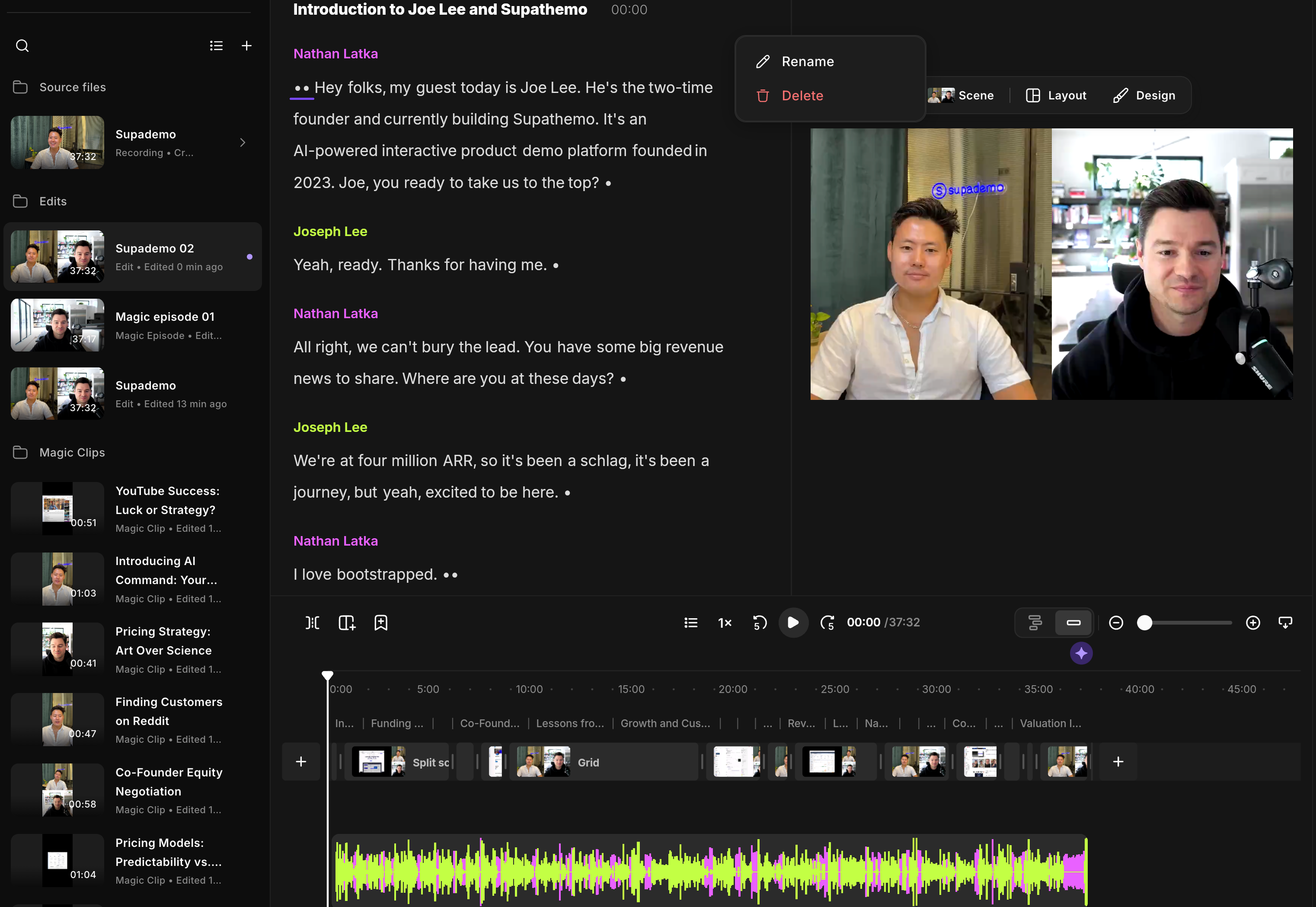
0:01Hey folks, my guest today is Joe Lee. He's the two-time founder and currently building Supathemo. It's an AI-powered interactive product demo platform founded in 2023. Joe, you ready to take us to the top?
Joseph Lee
0:12Yeah, ready. Thanks for having me.
Nathan Latka
0:14All right, we can't bury the lead. You have some big revenue news to share. Where are you at these days?
Joseph Lee
0:19We're at four million ARR, so it's been a schlag, it's been a journey, but yeah, excited to be here.
Bootstrapped vs. Lightly Capitalized
Nathan Latka
0:24I love bootstrapped.
Joseph Lee
0:27lightly capitalized. So we we raised a million, never spent it. We've been profitable pretty much from the first year of operating. So kind of in the middle I would say.
Why Raise $1M If Already Profitable
Nathan Latka
0:38I love that. Why so why'd you raise the million bucks if you're profitable?
Joseph Lee
0:41Well, first of all, I was broke.
Nathan Latka
0:43Uh-huh.
Joseph Lee
0:44I was I was a founder for like six years before that. And you know, you know, I was on that measly ramen ramen diet and and and founder salary, I think for six years and yeah, I think I I wanted to be able to have a little bit more financial freedom to to to swing for the fences and raising a little bit of money helped me helped me do that with confidence.
Nathan Latka
1:07So just to be clear, if you're saying sort of you were personally broke and wanted to not be personally broke, was the million that you raised a secondary? You took some chips off the table?
Joseph Lee
1:16no, no. I just I was able to pay myself a salary from the get go. So with my last company, you know, I had paid myself very little. and then I took some time off like exploring, traveling, looking at new opportunity spaces. So I didn't have a lot of personal runway to to go off of. So it was more so, hey, how do I give myself a little bit of freedom when it comes to to salary to be able to to not have to worry about that and fully focus on the business?
What Supademo Does
Nathan Latka
1:45Yeah, well, hey, with those open hooks, we'll jump on your backstory later. I don't want to bury the lead though. What does Super Demo do? What are you guys selling here?
Joseph Lee
1:51Yeah, we're an agentic demo automation platform. So essentially we help software companies primarily better demonstrate and explain why their product matters across onboarding for sales, marketing, trading, a lot of different use cases. So we have many different types of demos you can create. So you can create AI agents that demo your product for you and are trained on your content. but we also help you create interactive demos that let prospects try your product. without you know, talking to a salesperson or, you know, booking a demo with
Paying Customers and Pricing Model
Nathan Latka
2:23Mm-hmm. And you've got a lot of great logos up here. How many paying customers today?
Joseph Lee
2:28we have about three thousand paying organizations and about two hundred thousand free users.
Nathan Latka
2:34Okay. how those three thousand paying organizations, do you is your are you a per seat model or how do you charge?
Joseph Lee
2:42We are a per seat model, so the pricing it depends. it's a mixture of features and bifurcation by by seats. So we have people as small as indie hackers on one person teams, all the way up to Fortune one hundreds, probably fortune fifties using our products.
Nathan Latka
2:59Should people be charging per creator or you know, per credit usage or per products unbought? Like how do you price?
Joseph Lee
3:07That's a great question. man, it's it's not a simple I think you know, we've gone back and forth on it, and I think it's a challenging thing. I think with seats and like an unlimited usage model, I think the the benefit is predictability for finance teams. They can budget, they know what they're spending. I understand pricing based on outcome, and and that's actually where our agent primarily is positioned in. So it it prices based on demo calls. The problem there is the variability. the problem there also is proving the outcome, because you don't have access to the user's CRM to prove that you actually delivered that outcome. so yeah, it's it's challenging. I think we're kind of in this process, transitionary process where we are exploring, I think, all different pricing models. We also don't want to penalize people for creating more demos or creating more content because we're purely PLG, so product led growth and our customers find out from other people creating demos and sharing it out into the world. So we don't want to hamper our flywheel by penalizing people for creating more demos.
Nathan Latka
4:14If you don't want to create friction around using your product by putting up a pricing paywall, why do you make people sort of go to the growth plan before they get unlimited usage on the guided interactive HTML cloning demos?
Joseph Lee
4:26So that is pri primarily catered towards sales teams and specifically revenue functions that are probably overkill for smaller startups that you know aren't quite at PMF or aren't quite scaling at the levels that these larger organizations are at. they can get other types of demos for free. And when it comes to getting, we we let people try everything. So you can actually just start a trial of any of the plans. Get a trial for fourteen days. You don't need to put in a credit card. We let you create as many demos as you would like during that process and keep it if you want. so yeah, we're we're all about, hey, like show, don't tell. let the product do the talking.
Nathan Latka
5:10Your pricing page here has over a hundred rows in terms of features per plan. What's the balance between too complex versus making sure everyone knows what they're getting like they're getting what they pay for?
Joseph Lee
5:20Yeah. So I think the biggest thing with a product like ours, when you look at it at at the surface, it looks like a simple product, but it's actually very, very multifaceted. from the product side, I'll I think about it in the lens of progressive disclosure. Show people the core value or the core thing that they need to know about, and then progressively you know, add in breadcrumbs or ways for people to discover more power user features. So if you actually sign up for our product and check it out, that's exactly what we do. We really hone in on just like the simple recording experience in the get-go. And then we slowly start to show you more and more and more. And the idea is to obviously get you hooked.
Founding Story and First Line of Code
Nathan Latka
6:01Mm-hmm. Take us into launch date. When did you write the first line of code for the platform?
Joseph Lee
6:08so my co founder was actually the the original inventor of the product and when it comes to engineering it. so that was beginning of twenty twenty three. So about three and a half years ago. So yeah it hasn't been too too long, but it also yeah, it's crazy that it's already been almost, you know, three and a half, four years.
Co-Founder Relationship and Equity Split
Nathan Latka
6:29We're all waiting for more solo founder billion dollar errors companies. You have a co-founder, it sounds like. Did you guys just split it fifty-fifty? Was that a good decision?
Joseph Lee
6:40It was a great decision. I think a lot of I think co founders over fixate on like equity percentages. but I would rather spend the upfront time making sure that I am in business with the right person. So even before like working with him, I just wanted to make sure he was a great person and we complemented each other well from a skill set angle. And once we were able to check off all the All the boxes, it was pretty easy for me to just say, Hey, let's go fifty fifty and make this a big business and focus on making the pie bigger rather than, you know, nickel and diamond over the crumbs.
Nathan Latka
7:17I'm cruising around your LinkedIn page. You're doing snooping while we're chatting. How did you and is it pronounced kushic? How did you guys meet?
Joseph Lee
7:24so we actually met on YC co-founder matching. So yeah, I was co-founder matching with probably like 10 other founders. and I always tell Kaushik this you know, there were founders that wanted to work with me that were conventionally probably much better on paper, you know, the Stanford, the Fang, the YC experience. But what Kaushik kinda blew me away with was his ingenuity and his ability to be like super super scrappy and build things from from scratch even before like the AI era because we didn't have codecs and cloud code back then. So what was a disadvantage then was actually like a superpower now because he's very product minded, design focused and a great executor.
Nathan Latka
8:09The emails that fill my inbox are sort of marketing and sales founders saying, Nathan, can you help me find a technical co-founder? The way you articulated your co-founding story, it sounds like you had tech folks chasing you. Why were you so in demand?
Previous Company Freshline and Lessons Learned
Joseph Lee
8:23I I don't think I was that much in demand. but I think you know I think people appreciated that I'd been dragged through the mud. you know, I'd built companies before, I'd built event. Sure.
Nathan Latka
8:34T tell us about that. Let's spend some time on that. When you say draped through the mud, I mean, was Freshline just a terrible experience or what happened?
Joseph Lee
8:40No, it was I think we were we were building a very, very ambitious company. When we were starting the company, it was essentially the the world's first predictive marketplace for seafood. So in laypers' terms, that meant connecting fishermen, seafood companies to restaurants and dealing with all the supply chain and logistics of getting fish from point A to B to C to D using our tech. And you can imagine when people are going out to sea, there's a lot of seasonality, a lot of variability. you know a lot of moving parts that we were trying to automate and it was one of those things that I think we were trying to bite off a little bit more than we could chew instead of taking shortcuts and and stepping stones to get to our grand vision. I think we were maybe enamored and fixated with being, you know, the Airbnb or Uber and being a thin marketplace. And yeah we made a lot of mistakes, raised a lot of money, burned a lot of money. and the company luckily, you know, made a big pivot and is is healthy and and and profitable and thriving now, today, but that wasn't without a lot of mistakes and a lot of failures along the way, which made me better the second time around.
Nathan Latka
9:52Do you still have equity in the business?
Joseph Lee
9:54I do.
Nathan Latka
9:55Okay. So, I mean, how did you navigate that? There's a lot of founders that raise a bunch of money, but then they lose sort of energy over out over three, four, five years. You stuck with it for like over 10 years. How did you negotiate your way out in sort of a
Joseph Lee
10:07Yeah.
Nathan Latka
10:08non confrontational way?
Joseph Lee
10:10Luckily I I had a great co founder and I think we were transparent with each other from the get go on what our energy levels were like, what we wanted to get out of the business. And for me, again, it was voluntarily giving up a portion of my equity. I had, you know, vested everything. So technically I I could be a dick and just have kept all my my equity. But for me again it was the philosophy of hey, it's gonna be a long journey. no, my co-founder wanted to continue building and I didn't want my equity to be dead weight or detriment to what he wanted to do. And for me it was only fair that hey, vest back, reverse back a portion of my equity, a significant portion of my equity over time and just again focus on making the pie bigger rather than fighting over crumbs.
Nathan Latka
11:01How much equity did you end up giving back?
Joseph Lee
11:05I believe it was about thirty thirty to forty percent of my equity over over four years. of my equity pack. Yeah.
Nathan Latka
11:13Yeah. Yeah. Well, I guess how much total did you own? I guess did you own thirty, forty, fifty percent of the business and then you gave back thirty percent
Joseph Lee
11:19Yeah.
Nathan Latka
11:19of it?
Joseph Lee
11:20I can't remember the exact cap table, probably about thir thirty percent, thirty five percent is what I owned. Or maybe less than that. Yeah, maybe maybe twenty twenty five to thirty percent is what I owned before the dilution.
Nathan Latka
11:32So said, listen, co-founder, I've been at this for 10 years. I've enjoyed it. I want to go try something new though and explore. I own thirty percent on a fully diluted base. I'm fully vested. Listen, I want this to be easy. I'll give the company back, you know, ten or fifteen percent, which is equ equivalent to thirty to forty percent of your total vested stake. You know, you keep building it, I'll root from you from the sidelines. I'm gonna go build super demo.
Joseph Lee
11:54Kind of, kind of. And then we talked about, hey, what do you need to be in a position of success and confidence and you know, to make sure the ship is sailing in the right direction. So I think at the time he said, Hey, like it'd be great if he stuck around for another I think it was like eight months or so or or six months, which i is a long time when you're when you're burnt out. So I was like, you know what, I'm gonna push through with you and I'll travel back and forth and we'll we'll work to make this make this a a success over the six months and I did that and at that point he he felt good about the transition.
Nathan Latka
12:28How old were you back in twenty s twenty twenty two?
Joseph Lee
12:32twenty twenty two. Yeah, that's when I left the company on a full time basis. I think I was twenty six. Twenty six? Yeah.
Nathan Latka
12:39Okay. Okay, twenty six. So you launched this company ten years prior. I mean, you launched it very young. You started when you were sixteen, seventeen.
Joseph Lee
12:47I started it when I was no nineteen, I believe. Nineteen.
Nathan Latka
12:50Okay.
Joseph Lee
12:51Yeah. Yeah. so my math is not mathing right now, but yeah, nineteen twenty is when I started the company in university. I think it was in second year of university when I started the company, my co founder. Yeah.
Nathan Latka
13:03Mm-hmm. And Joe, how much how much did you guys raise all in at Freshline before you left?
Joseph Lee
13:08We all in all we raise about two point six million dollars, I believe. Yeah.
Nathan Latka
13:13Okay. And did the board complicate you leaving the company at all or do they were they helpful?
Joseph Lee
13:21luckily it was myself and my co-founder on the board and one other person. they were pretty supportive. I think they understood where I was coming from. I think it was helpful that I reverse vested a big portion of my stock. that made the conversation a little bit easier. but overall I think all of our investors across the board, across both companies, have been nothing but gracious and and helpful.
Getting First Customers via Reddit and Communities
Nathan Latka
13:46Okay, I love that. Okay, take us back into into super demo. So you get going in 2023, first line of code. You got a great co-founder. you're scaled today up to four million of revenue, three K customers. But what happened in between? What did you guys finish revenue-wise with in 2023?
Joseph Lee
14:01Twenty twenty three, I believe we were at the end of the year, we were at about a hundred K in AR. Yeah.
Nathan Latka
14:08How many customers was that would that have been? Probably like your first what a hundred to thousand?
Joseph Lee
14:12it was small because we priced, I think it was like twenty bucks a month was our highest year plan. so yeah, that's a lesson there, right? You always end up undercharging for relative to the value you always deliver and founders are always scared to raise pricing. It's funny though, we've raised pricing like probably five times since then and retention has actually gone up and the type of customers we've attracted have been much better as well.
Nathan Latka
14:40So how much is too much? Why not double your prices again tomorrow and then double them again the next day and then double again? When when do you stop?
Joseph Lee
14:46Yeah. Well, I mean, I think there is a cap to how much you can increase pricing. I think now is an interesting time because there is actually a downward pressure on prices because, you know, markets are getting more competitive, customers are are able to do more with less, build their own products as well. So, yeah, I'd say pricing is more of a an art than a than a science. frankly it's something that we probably haven't like brushed up on and and and touched up on as much. For n for now, I think we're just focused on how do we add as many customers and how do we just expand the surface area of who we serve before thinking about maximizing, you know, profitability.
Nathan Latka
15:26So that first year, some backwards math, 100K ARR divided by 12 months, divided by the 20 per month price point. You had like three, four hundred customers, something like that at the end of year one. Does that sound right?
Joseph Lee
15:37Probably, yeah.
Nathan Latka
15:38Can you teach us? I mean, there's folks listening right now that are wanting wanting to launch and be as successful as you. How did you get those first couple hundred customers?
Joseph Lee
15:45I think the big thing there is go to where your customers are. and a lot of this depends on whether you're sales led or product led. So for us, I've talked about this on a few podcasts, but it was about, you know, for the people, the customers, the founders, the marketers that are having problems of you know, spending a lot of time creating product demos, hating the sound of their own voice during recording, just having to do it all over again every time their product changes, where are they complaining? Right. And for for a lot of them, it was on Reddit. They were already in search of solutions. They were complaining about their problems. They were also doing this on you know places like Quora, on Indie Hackers, different kind of founder forums. and so we really niched down and focused on founders first because that's where we could kind of open up the beach head because enterprises they would take a lot longer when it comes to the sales cycle. So I would go to different forums like Indie Hackers, Product Hunt, and Reddit. And actually put out a post saying, hey, I'm the founder of this company. we help people build, you know, more elegant world-class product demos. I want to create a product demo for you. If you're having a problem or if you want to better demonstrate your product or you know get people to value faster, just drop your URL and I'm gonna do the work of signing up for your product, learning about it. this was pre AI, so I actually had to read their website too. And I would literally create them like a hero demo for them. It's like, hey, I've created this. it's a 10 to 15-click demo of like your aha moment. All you have to do is sign up, duplicate, and you can use it for free. And I would actually post that URL of their product in their thread or in their comment so that other people who didn't necessarily comment about their product could see it and they were saying, Whoa, I'm gonna click it, check it out, this is really cool. And I created a bit of a flywheel. So doing things like that. responding to product update posts from like our dream prospects, dream customers. I would like literally respond to Airtable's product updates or, you know, Atlasian's product updates and say, whoa, this is a really cool product, but I don't really understand what your product does. You should try creating a super demo here. I've already created it for you that explains the product. Try embedding it in your product update. So you just repeat that enough times and create enough density and you're going to get that initial flywheel. And for us as you know, a a product that is viral by nature. I I think once we've had the first one hundred people using it, it started to just compound because they were sharing it out with other people and they were like, Well, this is cool. I could use this for onboarding or training for documentation, etc.
Nathan Latka
18:23Just so you guys can copy what Joe did back on his Reddit post. Now, this was three years ago. The complaint I've gotten from folks trying to use Reddit today, Joe, is that people, it just it's nastier now. If you try to sort of post, even if you're truly coming to it to Reddit with a from a good heart, like you're about to like do stuff for free like you did in this post, people generally just troll on you instantly. How did you make sure that your conversation here stayed useful and valuable with 42 upvotes and 98 comments?
Joseph Lee
18:48Yeah. I think with anything, whether this is on Reddit or nowadays, people are creating more content on YouTube and LinkedIn, personal branding and and building in public, always starting with value and starting with outcomes before you actually ask for anything. So I think you're always gonna have naysayers and you're always gonna have people flagging and it is a much more competitive landscape today. The thing is, yeah, just not asking for anything and always giving first. And for us, even before this, I think I was posting on Reddit and giving whatever founder lessons or advice that I had, without even mentioning Super Demo, with without mentioning the company. So I would start with giving people value, not even mentioning my company. And then once I started to build a little bit more credibility and familiarity, that's when I started to, you know, put in super demo as a name and you know, people are a lot more accommodating and and welcoming as a result.
Revenue Milestones 2023 to 2026
Nathan Latka
19:52You've been on Red Hat nine years, 336 contributions, active in over 29 channels. And again, you're now, you know, obviously you can't just go in from scratch and expect traffic from Reddit on day one. You you've put in the work. What about product hunt? You've done three launches. Does product hunt still work in terms of getting new customers?
Joseph Lee
20:08We haven't done it in a while. but I think it was really, really useful for us at getting our like first initial base of customers, and and users. And more so than the users, I think it was a helpful exercise for our team to rally behind some sort of outcome. So the engineering making sure engineering team making sure that we have all the pieces in place to put together a successful launch and yeah, Just like rallying behind a common cause.
Nathan Latka
20:40Yep. How do you deal with comments like this? Now, this is three years ago, but a com a user saying this is a blatant, you know, copy clone. And maybe Joe, answer this through the lens of there's a lot of people looking at companies like Superbase right now, going, This is the exact kind of company that I could just vibe code. They'll say, Joe, I could just replace your four million revenue, I could vibe code this, right? So take us through just how you think about that.
Joseph Lee
21:01I think a lot of people are gonna have opinions like looking at things from a surface layer, not really understanding that companies can have different positioning, they can have different sets of features, and be targeting a completely different ICP. but even if you're targeting the same ICP, the world is a very, very, very big place. I think we all naively think that if something has been done, other people can't execute on the same opportunity. and for us, yeah, like it's not a winner takes all market in in most cases. It's there's plenty of opportunity, plenty of space for you to have your own unique twist on things and yeah, execute. And clearly we've we've done that over the last three years.
Nathan Latka
21:48Okay, first year of twenty twenty three twenty twenty three, a hundred thousand dollars of revenue. Where did you finish twenty twenty four?
Joseph Lee
21:54twenty twenty four, I believe we were at about five hundred and fifty K. Just the top.
Nathan Latka
22:00Okay. And what about what about twenty twenty five?
Joseph Lee
22:04I believe twenty twenty five, I think we were at about two million.
Nathan Latka
22:08Okay, so that's significant growth. Four X year over year growth there. What drove most of that growth?
Joseph Lee
22:14well, number one is the flywheel, right? We've done a lot of work making sure that the onboarding experience gets people to value and gets people to the aha moment quickly. And making sure that we add enough value within the free plan where they're going out and sharing out super demos with the powered by super demo badge that again brings in other customers. we also invested in SEO from the get go. So strictly focusing on very bottom of funnel search terms like super demo versus or compare super demo and we would basically create pages for all of our competitors and then moving up funnel doing things like tools that do so for example we have a free screenshot editor tool that brings in about i think 12,000 users or visitors every single month and then going top of funnel after that so that SEO has helped us compound into AEO and LLMs and generative search, which also drive a lot of traffic today. And then naturally from there, I think if once you have enough like eminence and time in market, you start to feel the pull from larger organizations that are willing to pay you $10,000, $20, $30,000, $40,000 a year. And then they in turn also bring in all these other types of customers because they're sharing your your product out there into the wild.
Nathan Latka
23:41What does your largest customer pay you today? Don't obviously name them, but how much dollars?
Joseph Lee
23:44Yeah. They pay us about forty forty thousand a year.
Nathan Latka
23:49Wow. And what gets them up to that? Are they just adding hundreds of seats or it's millions of demos? What drives up the price point?
Joseph Lee
23:55A lot of it is is a seat based, yeah. So they they roll it across essentially their entire organization.
Nathan Latka
24:01I see. And just staying on the SEO story here for a second. So again, showing the data to back up what you're verbally saying, your tools
SEO Strategy and Free Tools
Joseph Lee
24:08Yeah.
Nathan Latka
24:08bring in a ton of traffic according to AHREFs twenty two thousand. AHREFs I tend to find underestimates some of this. So it wouldn't shock me if you're actually bringing in more traffic, but your free screenshot editor is clearly the winner here. Forty three percent of that traffic coming from there. d does the free tool strategy still work today?
Joseph Lee
24:28it's a good question. I think it it creates top of funnel visibility into what you do. And the idea is once you get people in through the door, it's your job to cross pollinate them onto other tools and and other use cases. it does convert well when it comes to sign ups. So it has like a ten, I believe like twelve to fifteen percent sign up rate from this page. it does yeah.
Nathan Latka
24:52Well, Joe so let me stop you. So have a question. Someone's looking at this going free screenshot editor. What the hell does this have to do with product demos? How do you I mean, how do you know that this isn't just a bunch of crap traffic signing up to use your free tool?
Joseph Lee
25:04Yeah. so that that is the key. I think you need to figure out functionality that is somewhat related but somewhat adjacent to like your core core feature or core benefit, and assume that a sliver of those folks are gonna need product demos or interactive demos. So to give you an example, a product manager or product marketer that is creating content or product demos. They're probably gonna wanna take screenshots at some point with like beautiful backgrounds or device mock-ups or annotations. So the idea is some of those folks are probably searching for those keywords, whether it be a screenshot editor, whether it be a video editor, whether it be a a tutorial maker. and sure, we're gonna we're gonna bring in unqualified traffic to a certain extent. but that's just the name of the game, right? That's PL.
Nathan Latka
26:01Mm-hmm.
Joseph Lee
26:01You're not gonna be able to only bring in qualified traffic. but maybe some of the unqualified traffic or the people that weren't as qualified become qualified through education and learning about the tool through the onboarding experience.
Nathan Latka
26:16Okay, and any paid today or is it okay, you have a little bit of paid traffic, but wha how much are you spending per month on paid?
Joseph Lee
26:22very little. I think it's just more of like a defense mechanism. I think we pay like five hundred bucks. It's literally we just bid on super demo because if we didn't do it all of our cus all of our competitors would bid on our our name.
Nathan Latka
26:35Yep. You have so many backlinks. Is that because this is effectively a iframe or or your customers are installing JavaScript on their web page and it all links back to you? So you have sort of natural viral coefficiency built in there in terms of getting new backlinks.
Joseph Lee
26:46Yes. Exactly. They put it in their docs, they put it in their website, etcetera etc.
Nathan Latka
26:51Yeah, yeah, yeah. Does that pro I mean, could people just go into built with, look at, you know, scan the websites, all the internet for JavaScript that has your thing on it, then go pick off your customers one by one? I mean, have you had anyone try to do that that you know of?
Profitability and Capital Efficiency
Joseph Lee
27:02I'm sure people have tried that, but I think for you to go out and number one, be able to like cut through the inbox noise and have a conversation with them and then convince them that they should migrate a hundred demos that they've embedded into your own and do the work to re-record it or or maintain it, I think that's tough. there's also the change management that not a lot of people think about, right? You can build something, but the change management of training people how to actually adopt something. And to to actually use it in their day to day. That that's the real challenge, right? Cause even in our tool set, there's probably like ten different tools that I know there are better solutions for, but it's not worth my time to like endure the switching costs. It's just not a priority of mine to be like ten percent more efficient at that specific thing. Because that's just gonna slow me down from doing what I'm actually good at and building. yeah.
Nathan Latka
27:57So we got the full revenue story. We're hearing about how you grew. You're at four million of ARR today. You also mentioned your profitable. Are you comfortable sharing how profitable you are?
Current Growth Channels and Daily Signups
Joseph Lee
28:06yeah, we're I believe we're making about thirty percent net. Yeah. Well gross gross profit
Nathan Latka
28:12dude.
Joseph Lee
28:13is about ninety ninety something percent, yeah.
Nathan Latka
28:16Congratulations, man. That is just so freaking awesome, right? Thirty percent to the bottom line on four million revenue is about one point two million a year to the bottom line. What do you guys do? You just you go party in in in
Joseph Lee
28:25No.
Nathan Latka
28:26in Croatia or what?
Joseph Lee
28:27No, we are we are super stingy and we try to be super capital efficient. and we're very frugal. I mean both my myself and my co-founder were immigrants. you know, I we don't come from rich families or backgrounds, so by practice we're very frugal and we instill that within in our
Nathan Latka
28:50We talked about your history as we wrap up the show over the next three or four minutes. What's working today? We're recording in August here. Where are you getting I guess talk through how many new signups you got last month and where are they coming from?
Joseph Lee
29:02Yeah. it's a mix of of everything. So we we don't bank on one channel. I'd say it's probably like thirty percent referrals, word of mouth, powered by badge. we're surprisingly getting more customers from Reddit nowadays, so probably twenty percent from not Reddit, sorry, YouTube. we've been investing a lot in like long form content that's a little bit more defensible when it when it comes to AI because the the barrier to entry and the work you need to do to create video content is a lot higher than slop on on blog posts. So 20 say 25% YouTube, probably 20% building in public. I I build in public on YouTube, on X, a couple different channels, as do our employees. LLMs, SEO, AEO, I would say that's probably about 30% as well. So a a mix of different places. Sign ups it it fluctuates. we get on average about anywhere from two hundred to three hundred, fifty, four hundred sign ups every day.
Nathan Latka
30:05Free sign ups.
Joseph Lee
30:07so those are a mix of like people that become paid and free, but about three hundred every day.
Nathan Latka
30:15I guess what I'm trying to get to is what do you consider a good conversion rate from free to paid?
Joseph Lee
30:19Yeah. for a product like ours that's like purely PLG, doesn't require a credit card. I think ideally we want to get closer to probably twenty percent. that would be kind of world class. we're not there yet. but we're we're inching our way up towards towards that figure.
Nathan Latka
30:40Can you teach us the long form stuff you're talking about on YouTube? Tell tell where to go so we can get a good example.
Joseph Lee
30:46yeah, well if you if you check super demo, if you click it, we you can see that we ship a lot of different videos. Some of them are very tactical, so workflow related, that teach people how to use Claude and Super Demo or Claude and other tools alongside Super Demo to achieve their outcomes. we obviously have specific like targeted videos that are for AEO or or LLMs and and bottom of funnel traffic. And I also have like a personal channel where I talk a little bit more about like my founder journey and challenges and things that I've experienced. and that's more so like super top of funnel, educational. And then, you know, hopefully enough people find it enough value to learn about Super Demo and potentially become a customer.
Nathan Latka
31:39Well so I I imagine some of my audience might be looking at this going, Look, these YouTube videos, some of them are getting seven views. Your best ones are getting ten, twenty K views. Is this really driving new traffic to Joe?
Joseph Lee
31:49to Super Demo you mean?
Nathan Latka
31:51Well, yeah, th that's what I mean. Joe or Super Demo.
Joseph Lee
31:52Yeah. yeah. Yeah. It it is. It is. Yeah. especially the ones that are workflow focused because they can clearly see the outcome. They can clearly see the use case specific to to them. and then yeah, basically we we walk through how to implement it in their day to day, which obviously helps. So again, some of them are higher level like this and more educational, right? They're not meant to be conversion drivers, they're meant to be more educational and teaching people about the industry and our in our product line. And then there are ones that are a little bit more tactical as well.
Nathan Latka
32:28Do you know of a video that just like absolutely crushed it for you in terms of getting new customers or free signups at Suba Demo?
Joseph Lee
32:35I know one, if you scroll all the way down, I think my like second or third one did pretty well. Yeah, that one did pretty well. it got eleven K views.
Nathan Latka
32:43Do you know why? I I find it it's so hard to reverse engineer YouTube's algorithm. Was it lucky or did you plan it?
Joseph Lee
32:47I think part of it is luck. I obviously if you look at my my videos, I haven't been able to engineer the same level of success over and over, but I think it's one of those things where you gotta be consistent. and nowadays it's actually not even just about consistency, it's about quality because it's it's easy to be consistent when you have AI. It's really hard to build something high quality and hits the bar and gets people to come back. So it's it's not an easy thing to to crack. And you gotta like basically do it over and over again with different strategies. I feel like I figured it out better on like LinkedIn, less so on YouTube.
Valuation and Funding Details
Nathan Latka
33:26Joe, take us home here. Everyone's curious about valuations today, especially tools that are adding more AI features to their products, like what you're doing. When you raised the million bucks, what year was that? And are you comfortable talking about valuation?
Joseph Lee
33:38sure, yeah. It was twenty twenty three. I think it was like at a pretty low valuation. I think it was like a six million dollar cap. So yeah, yeah, we'll we'll definitely what's that? That's correct, yeah, on a
Nathan Latka
33:49convertible node. Convertible node. Yep.
Joseph Lee
33:53safe. Yeah.
Nathan Latka
33:54Yep. Yep. Okay. Interesting. And nothing else raised since then? I love that. Awesome. So what's next for you guys? Take us home. What can people expect on your product? How how are you building AI into your tool to help your customers get more done faster?
AI Features and What Is Next
Joseph Lee
34:06Yeah, well we just launched a new feature called AI Command today. So if so
Nathan Latka
34:13Where's that?
Joseph Lee
34:15you're you're gonna have to go into the product, the blog post hasn't hit, but
Nathan Latka
34:18Okay.
Joseph Lee
34:19basically it's like an assistant inside of your app, inside of your dashboard, and anything you can do on super demo, you can do through like natural language prompts. So can say, Hey, go into this folder and apply like this new branding to all ten demos and it'll do it. Then you can say, hey, translate this into these five languages and create trackable links from this like Excel list for all of these demos. It'll go ahead and do it in parallel. and then beyond that, obviously improving our AI demo agent. So that's gonna be self-serve in the next probably two weeks. so right now it's early stage like beta testing, but it's gonna be opened up to self-serve for anyone to use, PLG. And we're gonna be building more like agentic tools. So creating demos from prompts, auto updating demos when they are out of date, rerecording demos through prompts, just making it easier for people to create world class demos within the tools they use.
Nathan Latka
35:18And you wanna give your team some love real quick? How many folks are full time? How many engineers?
Joseph Lee
35:22we have fifteen people. I believe we have seven in our engineering team. I can't I can't c count right now, but yeah, fifteen people, tight knit, everyone's been executing on all cylinders and they're more importantly, they're good people. yeah.
Nathan Latka
35:40That's all important. Joe, if people wanna learn more about you online, where can they find you?
Joseph Lee
35:44they can connect with me on LinkedIn. So LinkedIn.com slash I think J H Y Lee is my handle. They can follow me on Twitter, J H Y Lee95. and then the company is superdemo s u p-a-d-e-mo dot com.
Nathan Latka
36:00Guys, there you have it. first company raised a bunch, plotted out at for 10 years, trying to connect fishermen basically in a tough marketplace, launched in college, moved on from that by giving back some of his equity and launched superdemo, first line of code in 2023 with his co-founder. They broke a hundred thousand bucks of ARR that year, more than three X that for X'd it in 2024 to 550K of ARR, and then four four X that again to about two million of ARR in 2025. As the flywheels started to take off, they were using things like their powered by label on their free users. Things like SEO, Reddit Threads, Cora, and Proctunt were all very successful for them. Today, here in 2026, over 3,000 paying customers, 4 million of ARR. And what I love, they're printing 30% EBITDA margins. So that's about 1.2 million annualized on 4 million top line, 30% of their revenue today coming from referrals and power by 20% YouTube, 20% build-in public, and the rest is all. LMs, SEO, AEO, GEO, you name it, getting 300 to 400 new signups per day. Joe, thank you for taking us to the top.
Joseph Lee
37:00Thanks for taking in. Cheers.
Nathan Latka
37:02All right. All right guys. Cut. Good stuff. Joe, what'd you think, man? You have fun?
Joseph Lee
37:05Yeah, that's great. Yeah. I I like the rapid fire. I mean you're you're on the on the ball when it comes to the research. You're able to research and like spit it out really fast. That's great.
Nathan Latka
37:15No, I just I I love showing the visual while you're telling the story. It just makes the podcast more valuable. So my post production team will have a obviously a blast with this. we'll get to work and thanks again for your time. All right. Take care, man. Nice to meet you. Bye.
Joseph Lee
37:25Thank you, appreciate it. All right, cheers. Bye.