Flossy Cut to Eight People, Then Rebuilt at 70% Month-Over-Month Growth
Miles Beckett's third company is his second attempt at the same market. The AI receptionist works because the discount plan already had to solve scheduling.
On this page
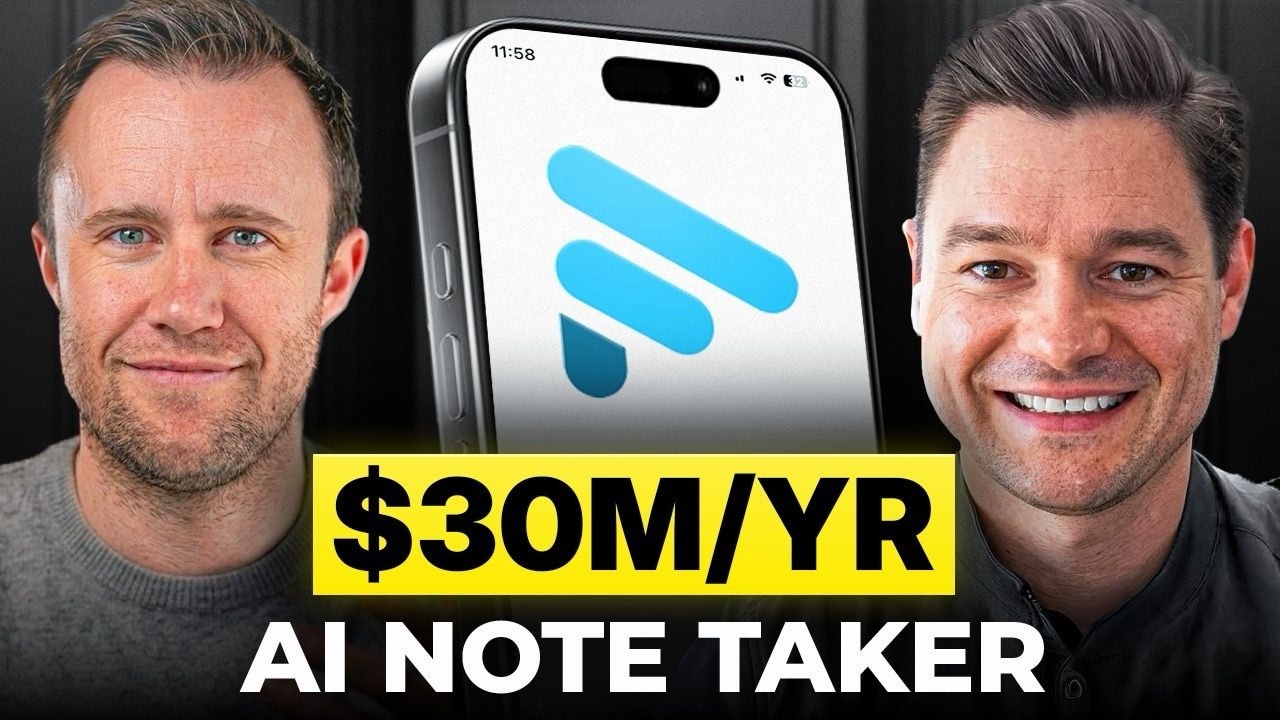
Miles Beckett has sold two companies. The third one he built twice, in the same market, five years apart, and the second version is growing 60 to 70 percent month over month.
The thing that made it work is not the AI. It is that when Flossy pivoted, it already knew how to book a dental appointment.
The thesis. Flossy spent four years as a dental discount plan matching patients to dentists. That business had to solve scheduling to function at all. When the pivot came, the scheduling logic — the hard part — was already built and tested, which is why an AI receptionist launched in late 2024 was at a few million of ARR by the start of 2026.
The first Flossy
Beckett and his partner sold SilverSheet to AMN Healthcare and started looking at adjacent problems. They picked dental for a reason he states plainly.
Dental insurance is really not worth it when you look at the numbers. So we started as a discount plan, we were matching patients to dentists, and basically passing the insurance rate on to the patients that book through us.
The seed round — about $3 million — closed right as the pandemic hit. Dental offices shut. They paid themselves nothing and sat on the cash while deciding whether the business worked at all. The original plan had been to become an insurer; the conversations with investors during the shutdown turned it into a discount plan instead. Product build started in the autumn of 2020, the model launched in spring 2021, and a roughly $15 million Series A landed in spring 2022, “right before the market crashed.”
Asked whether the revenue collapsed between 2022 and 2023, Beckett corrects the premise.
No. The venture markets changed completely.
The 2024 reset
Flossy cut about thirty people and bottomed out at eight. At the time of this conversation the team is back in the mid-twenties, and a couple of the original crew have returned — one from sales, one from customer success.
- 2020 · Seed About $3M, closed as the pandemic shut dental offices. The money sat untouched.
- Spring 2021 · Launch The discount plan goes live after a build that started in autumn 2020.
- Spring 2022 · Series A Roughly $15M, just before the market turned.
- 2023 · The AI moment Internal LLM tools first: a pricing algorithm, call analysis, then the receptionist.
- 2024 · The cut About 30 people let go; headcount bottoms at eight.
- Late 2024 · Fiona The AI receptionist becomes the company.
What Fiona actually does, and why Intercom isn’t the answer
Latka asks the obvious question — why would a dental practice not just use a general support tool? Beckett’s answer is the clearest articulation of vertical software logic on the tape.
The number one most important thing for a dentist in terms of communication with patients is booking those patients. It’s really about scheduling and booking. So right off the bat, if you look at an Intercom or a Fin, they’re not focused on scheduling. They’re focused on conveying information.
He is explicit that this is where the old business paid off: “we had a lot of prior experience with that from our original business because we were booking patients to go to dentists.” Fiona now handles phone, text and web chat, and Beckett describes it as becoming a full customer acquisition and engagement platform rather than a chat widget.
The numbers
Latka works the revenue out on air from the location count and the price, and lands on a four to five million run rate. Beckett does not take the higher number.
Yeah. We’re not quite there, but we’re pretty close.
By the close of the conversation Latka has settled on “between 3 and $4,000,000 of revenue,” and Beckett lets it stand. New ARR is landing at $50,000 to $100,000 a month, and he says some months have been more. The GetLatka profile carries $4M as an estimate for this conversation, which is the honest way to hold a figure the founder gave as a range.
Selling to private equity, not to dentists
The distribution is where the second Flossy diverges hardest from the first. The discount plan had to convince individual dentists to opt in, one location at a time. Fiona sells through the roll-ups.
One of our advantages is we have very deep relationships in the private equity world. And so there’s a lot of these dental roll-ups that are private equity backed. So we’ve signed multiple 100-location-plus DSOs that are then doing varying degrees of rollout.
The largest signed customer is around a hundred locations, with a couple of 500-plus deals late in conversation. Beckett describes the motion as having started bottoms-up — half a dozen locations from prior relationships to prove the product, then industry conferences — before tilting top-down as the DSO traction built.
The exit question
Latka offers the hypothetical: forty million dollars, all cash, today. Beckett declines without pausing.
No. I mean, not for me. We’re still trying to — we want to build a very big business here, and I think there’s a big opportunity. I think we are rapidly becoming the dominant platform in dental, and I think we will be.
He has priors on this. Equal, his first company, sold to Everyday Health for around $30 million — a deal so tight on cash they had to borrow $500,000 from the buyer to close it, and one he thinks only landed because he had negotiated a million-dollar breakup fee into the term sheet. SilverSheet had less revenue than Equal and a much larger exit, because one was a media business and the other was SaaS sold into a 2019 multiple environment.
The vintage problem
The most quotable stretch of the conversation is not about Flossy at all. Beckett invests and runs SPVs, and he is blunt about what happens to companies that raised into the peak.
Almost everybody who invested in 2020, ’21 at the peak is not gonna do well. That’s just the reality. It really comes down to were investors and management realistic about valuation and cap table, and did they take necessary measures to fix things. And I think the answer in most cases is people did not.
Flossy raised $15 million into that exact vintage, cut to eight people, recapped so the incentives work, and is now growing faster than it ever did on the original model. The measures he says most companies did not take are the ones he is describing having taken — and he says so, in the same breath.
That vintage is very, very hard. Unless you do things like we did.
Sources Miles Beckett’s interview with Nathan Latka, recorded January 2026; revenue, headcount and funding rows from the GetLatka Flossy profile.