How SevenRooms Grew Past a $6M Run Rate on Shadow Hosting and a Comcast Partnership — and Sold to DoorDash for $1.2B
In October 2018, SevenRooms co-founder and CTO Kinesh Patel confirmed to Latka a revenue floor north of $500K MRR — not the $10M ARR our old headline claimed. Here's what the tape actually says, and how the story ended in a $1.2B DoorDash acquisition.
On this page
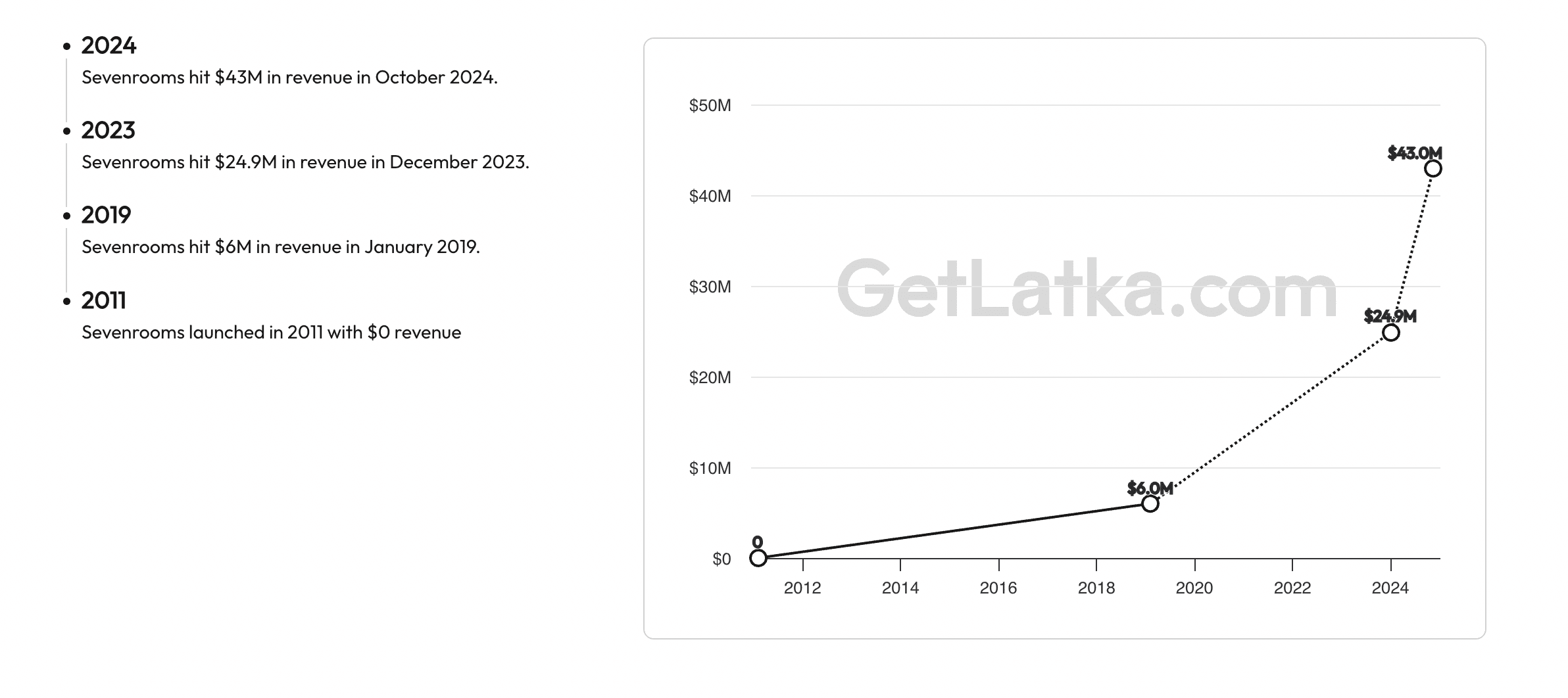
SevenRooms never told Latka it had hit $10 million in ARR. What co-founder and CTO Kinesh Patel actually confirmed, on tape with Nathan Latka on October 19, 2018, was a floor: more than $500,000 in monthly recurring revenue — a run rate north of $6 million a year — from thousands of restaurant, hotel, and nightlife locations paying about $500 a month each. The $10 million mark was a goal for the year ahead, one Patel said was "not a stretch goal." GetLatka's company page records $6M in revenue as of January 2019, sourced from that same interview, and estimates $43M for 2024.
The story ended bigger than any of those numbers. On May 6, 2025, DoorDash announced it would acquire SevenRooms for $1.2 billion in cash, and the deal closed that October.
A correction before anything else: our database title for this interview calls Kinesh Patel SevenRooms' CEO, and an earlier version of this post named a "CTO Knish Patel" as the founding lead. Both are wrong. On the tape, Patel is introduced as CTO and co-founder, and he says it himself: "my two co-founders, and Joel in particular, who's our CEO." SevenRooms was founded in 2011 by Joel Montaniel (CEO), Allison Page (chief product officer), and Patel (CTO). The company page's source line repeats the CEO mis-slot; we've flagged it.
Was SevenRooms at $10M ARR in 2018? No — here's the real number
The revenue math on the tape is the host's, not the guest's, and it's worth being precise about which is which. Patel said SevenRooms charged "about $500 a month per location," with unlimited users and usage, and that the platform was live in "the thousands" of locations across 250 cities. Latka then did the arithmetic on air: a minimum of 1,000 locations at $500 each means north of $500,000 a month. Patel's answer: "Correct, north of that."
That puts the confirmed floor above a $6M annual run rate — which is exactly the figure GetLatka's company page carries for January 2019. When Latka asked whether $10 million was realistic for the coming year, Patel said "double digits for sure" and, pressed, "not a stretch goal." A target, confidently stated — but a target. The old headline on this post promoted it to an achievement the body never supported. This version doesn't.
| Date | Figure | Source |
|---|---|---|
| October 2018 | North of $500K MRR (>$6M run rate) | Kinesh Patel, confirming host arithmetic on the Latka tape |
| January 2019 | $6M revenue | GetLatka company page, sourced from the same interview |
| December 2023 | $24.9M revenue | GetLatka estimate |
| October 2024 | $43M revenue | GetLatka estimate |
| October 2025 | $1.2B acquisition by DoorDash | DoorDash announcement, May 6, 2025; deal completed October 2025 |
The 2023 and 2024 figures are GetLatka estimates, not company-reported numbers. Everything from 2018–2019 traces to the tape.
Shadow hosting: how the first 100 customers were won
Patel's account of SevenRooms' early customer acquisition is the best material on the tape, and it survives scrutiny because it's a story about behavior, not numbers. Hospitality, he told Latka, is "sort of an incestuous industry — everyone kind of knows everyone," with a herd mentality that makes it brutal for outsiders to break in. The founders' answer was what Patel called shadowing host stands.
"We would actually go to those restaurants and spend entire shifts — dinner and lunch shifts — behind them, asking, hey, can we just see how you guys do this?"
Standing behind the host stand while staff checked in guests, the founders watched how reservation software was actually used, built relationships in the downtime between seatings, and let those relationships compound through an industry where everyone talks. That, Patel said, is where the first set of customers came from: "a lot of hustle, sweat, and tears."
The product thesis came from the same closeness to operators. Patel — who before SevenRooms led scientific-computing teams at ExxonMobil, working on physics simulation and data processing — saw that existing reservation systems ignored guest data entirely. "These customers are in the business of providing hospitality, and it starts with people," he said. SevenRooms deliberately built no consumer-facing app, focusing entirely on operator tools: discovery and booking, the in-dining experience, and post-dining follow-up.
The Comcast Ventures partnership
SevenRooms ran an unusual funding path: five years on angels and private investors before any institutional money. The first institutional round came at the end of 2017 — $8 million led by Comcast Ventures, announced that December, which brought press-reported total funding to $16.4 million. Comcast Ventures managing director Dinesh Moorjani joined the board with the round.
On the tape ten months later, Patel put total funding at "a little bit over $20 million," with Comcast accounting for about a quarter of it. Those two accounts reconcile: GetLatka's funding table shows a further $5.1M raised during 2018, which squares Patel's figure with the December 2017 press total.
Why Comcast? Patel gave two reasons. The strategic one: "People don't realize about Comcast is that they actually do own a lot of hospitality outlets," through NBCUniversal's theme parks and related properties — a built-in entry point to multi-unit hospitality groups, which Patel named as SevenRooms' sweet spot. The personal one was Moorjani himself, whom Patel described as "someone who understands local."
The retention math behind "data-driven"
The numbers Patel gave on unit economics hold together, with one asterisk. Gross MRR retention was 99% — monthly. Latka restated that on air as roughly 12% annual gross revenue churn, and Patel agreed ("right, on a gross basis"). Net revenue retention was "about 100%," with Patel expecting it to pass 100% as new products shipped. Payback on customer acquisition cost was under 12 months; the CAC itself was not disclosed.
The asterisk is structural, and Patel was candid about it. SevenRooms deals typically trial at a couple of locations but sign for all of them at once, because the platform's core value — a shared guest profile that follows a diner from one property to another — only fully works when every location is on it. That meant almost no expansion revenue from adding locations within an account. Latka spotted the implication immediately: expansion would have to come from new products. "Exactly," Patel said. The next product line he named was restaurant marketing — tools for social and online ad channels that operators weren't equipped to use.
Growth, Patel said, had been "close to 300%" over the prior year, a rate he hoped to maintain, split roughly 50/50 between new customers and expansion. The company was about 90 people, nearly all in Manhattan, running primarily inside sales, aiming for profitability within 12 months, with no plans to raise. Treat the 300% as the guest's characterization — at the confirmed revenue floor, it isn't independently checkable from the tape.
What happened after the tape
The no-raise plan didn't hold, and that turned out fine. In June 2020, SevenRooms announced a $50 million Series B led by Providence Strategic Growth — at a $230M valuation, per GetLatka's funding table — bringing total funding to roughly $80M across six rounds. Headcount, 90 on the tape, reached 361 by late 2023, per GetLatka's records.
Then the exit: DoorDash announced on May 6, 2025 that it would acquire SevenRooms for $1.2 billion in cash, and completed the acquisition in October 2025. There's a neat irony in the buyer. The strategy Patel described in 2018 — deliberately building no consumer offering, serving only the operator — ended with SevenRooms acquired by one of the largest consumer food apps in the world, precisely because DoorDash wanted the operator-side tools it never built.
Patel's parting advice on the tape reads differently knowing the ending: "Being naive is a great asset sometimes. Stay naive."
What this piece draws on:
- GetLatka interview with SevenRooms co-founder and CTO Kinesh Patel, recorded October 19, 2018 — the primary source for all 2018 figures; see the SevenRooms company page for the data extracted from it
- SevenRooms press release, December 2017 — $8M round led by Comcast Ventures, $16.4M total funding, Dinesh Moorjani joining the board
- SevenRooms press release, June 2020 — $50M Series B led by Providence Strategic Growth
- CNBC, May 6, 2025 — DoorDash's $1.2B acquisition announcement
- DoorDash newsroom, October 2025 — completion of the acquisition
- SevenRooms — Who We Are — founding team: Joel Montaniel, Allison Page, Kinesh Patel