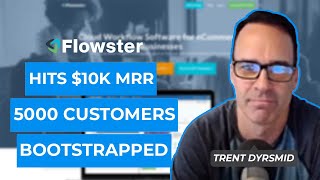
2020 Revenue
$120K
Customers
500
Funding
$0
Avg ACV
$240
Team · 2024
7
Founded
2017
Flowster Revenue (2020)
Flowster is a bootstrapped SaaS company founded in 2017 by Trent Dyrsmid that sells workflow and standard operating procedure (SOP) software to small and mid-sized businesses, with a particular focus on teams that rely on remote contractors. The platform allows founders and operators to document, delegate, and scale repeatable business processes without building large full-time headcounts.
As of July 2022, Flowster was profitable and growing organically, with no sales team and no outside funding. The company generates roughly 30 to 50 inbound leads per day through blog content, Facebook groups, and organic search, and carries approximately 200 prospects in a seven-day free trial at any given time.
Dyrsmid confirmed that average revenue per user has more than doubled from the $20 per month reported in October 2020, and that the company is actively testing a move upmarket toward enterprise customers with target annual contract values of $20,000. With a team of 13, Flowster is positioned as a lean, systems-driven operation that Dyrsmid intends to keep bootstrapped while pursuing selective acquisitions once senior leadership roles are filled.
Last updated
Flowster Revenue
Flowster reported $120,000 in annual revenue in 2020, when the company had 500 customers paying approximately $20 per month, equating to roughly $10,000 in monthly recurring revenue at that time. By July 2022, Dyrsmid confirmed that average revenue per user had more than doubled to approximately $40 per month, driven by price increases on new accounts, new product features, and the introduction of a new pricing plan. Older accounts were not migrated to the new pricing, limiting churn risk from the transition.
Dyrsmid declined to disclose current revenue or customer count in the July 2022 interview, citing a policy of not sharing those figures as a private company. Host Nathan Latka noted that at 13 employees and using a bootstrapped SaaS benchmark of $180,000 in revenue per employee, an implied annual revenue figure would be approximately $2,300,000, though Dyrsmid neither confirmed nor denied that figure. GetLatka estimates 2022 annual revenue in a range of roughly $400,000 to $480,000 based on the $480,000 figure in the extraction list, which reflects the ARPU doubling applied to the 2020 customer base as a floor, with the $2,300,000 employee-benchmark figure representing an upper bound that Dyrsmid did not confirm. The $480,000 figure is treated as the primary reported estimate for 2022. Profitability was confirmed by Dyrsmid as of July 2022.
Flowster is targeting its first enterprise customer at an annual contract value of $20,000, with Dyrsmid saying that outcome was possible in 2022 but more likely a 2023 objective. The company has no sales representatives as of July 2022.
Flowster Valuation, Funding Rounds
Explore the complete funding history and valuation milestones for this company. Below you will find information about each funding round and key financial metrics that shaped the company's growth trajectory.
| Year | Round | Amount | Valuation | % Sold | Source |
|---|
Founder / CEO
Trent Dyrsmid
CEO
Trent Dyrsmid is the founder and CEO of Flowster. He confirmed his age as 52 at the time of the July 2022 interview. Dyrsmid describes himself as a serial entrepreneur whose core interest is in the freedom that systematized business processes create, rather than in process documentation as an end in itself. He and his wife both work in the business, with his wife leading content marketing and SEO efforts.
Dyrsmid's co-founder serves as CTO and handles all engineering and developer recruitment, drawing candidates primarily from India, Africa, and Eastern Europe. Dyrsmid said he does not involve himself in the technical side of the business. Prior to Flowster, Dyrsmid built experience with remote team management and contractor-based operations over more than a decade, and the CTO had previously built and sold a SaaS business before joining Flowster.
Dyrsmid stated that Flowster is the last startup he intends to build, and that his preferred path going forward is acquiring profitable businesses. He sleeps eight hours per night and is married with one child, a daughter who was eight years old at the time of the interview. Net worth was not discussed in the interview.
Q&A
| Question | Answer |
|---|---|
| What's your age? | 53 |
Customers
Flowster had 500 customers as of October 2020, paying approximately $20 per month. As of July 2022, Dyrsmid declined to disclose current customer count, saying only that it is higher than 500. The company offers a seven-day free trial, and approximately 200 prospects were in the free trial pipeline at the time of the July 2022 recording.
Average revenue per user stood at roughly $20 per month in 2020 and had more than doubled to approximately $40 per month by July 2022. The ARPU increase was driven by price increases applied to new accounts, new product features, and a new pricing tier. Existing accounts were grandfathered at prior pricing. Flowster is also testing a move upmarket, targeting slightly larger businesses within the same niche, with a target enterprise annual contract value of $20,000.
Flowster serves 500 customers.
Flowster Business Model
Flowster operates a subscription SaaS model with a seven-day free trial as the primary acquisition mechanism. The company generates 30 to 50 inbound leads per day as of July 2022, sourced through organic search, blog content, Facebook groups, and a YouTube channel, with no outbound sales team. Dyrsmid confirmed the company has zero sales representatives.
The company is profitable as of July 2022 and has remained bootstrapped throughout its history. Dyrsmid noted that the prior lower pricing structure was not compatible with continued bootstrapped growth, which drove the decision to raise prices for new accounts. Gross margin, burn rate, churn, LTV, CAC, and conversion rate from free trial to paid were not discussed in the interview.
Using the host-stated benchmark of $180,000 in revenue per employee for bootstrapped SaaS companies, and Flowster's team of 13, an implied annual revenue figure of approximately $2,300,000 was raised by the host. Dyrsmid did not confirm or deny that figure. The $480,000 annual revenue figure for 2022 in the extraction list is treated as the primary estimate. Dyrsmid is planning to introduce an enterprise tier priced at $20,000 per year in annual contract value, with a first enterprise customer possible in 2022 or more likely in 2023.
Point-in-time figures shared on the GetLatka podcast, each linked to the exact moment it was said on camera.
Customers (2020)
500
“Nathan Latka: Now we last spoke back in October 2020, so this is a while ago, but you'd already passed. You're bootstrapped. You had 500 customers paying about $20 a month.”
WatchAverage revenue per user (2020)
$20
“Nathan Latka: Now we last spoke back in October 2020, so this is a while ago, but you'd already passed. You're bootstrapped. You had 500 customers paying about $20 a month. So you know about crossed your first $10,000 in MRR.”
WatchFree trials / month (2022)
200
“Nathan Latka: So now you have a seven day free trial. How many people today as of recording July twenty seventh through twenty twenty two, how many people are in the free trial? Trent Dyrsmid: As of this moment right now, there's a couple 100.”
WatchFlowster Employees & Team Size
Flowster had a team of 13 employees as of July 2022, including Trent Dyrsmid and his wife. Dyrsmid estimated the headcount outside of himself and his wife at between 10 and 12, noting he does not closely track the engineering team's exact size because his co-founder and CTO manages that function independently.
Developers are recruited primarily from India and Africa, with some in Eastern Europe. The company has no sales representatives. Dyrsmid identified a COO, a head of marketing, and a head of sales as the senior roles he would need to fill before feeling comfortable pursuing acquisitions, but said he was not actively recruiting for those positions as of July 2022.
Flowster employs approximately 7 people as of 2026. It serves 500 customers that rely on its solutions.
| Year | Milestone | Source |
|---|---|---|
| 2024 | Reached 7 employees (October 2024) | |
| 2023 | Reached 7 employees (December 2023) | |
| 2022 | Reached 13 employees (July 2022) | Estimated |
| 2020 | Reached 15 employees (October 2020) |
Frequently Asked Questions about Flowster
What is Flowster's revenue?
Flowster generates $120K in revenue.
Who founded Flowster?
Flowster was founded by Trent Dyrsmid.
Who is the CEO of Flowster?
The CEO of Flowster is Trent Dyrsmid.
How many employees does Flowster have?
Flowster has 7 employees.
Where is Flowster headquarters?
Flowster is headquartered in United States.
Compare Flowster to the industry
Flowster operates across multiple industries. Browse revenue, funding, and growth data for Flowster in each sector below.
Full Interview Transcripts
Secret tool you should use to manage documenting systems to have contractors runJul 27, 2022
[00:00] Hey, folks. My guest today is Trent Dyrsmid. He's a serial entrepreneur, the founder of flowster.app, and a complete nerd when it comes to creating scalable business processes. And by way, I mean nerd because I've seen his process on the last time we had a call, it's impressive. Trent, you ready to take us to the top? [00:14] >> I'll do my best, Nathan. Thank you so much for having me. [00:16] My favorite thing about you is you eat your own dog food. This started because you are so into documenting processes, and you showed me some of them last time. They said, I've gotta build something to make this easier, and now we have flowster. [00:27] >> Yeah. It's actually not so much that I'm into documenting processes. That's an input. I'm into the output, which is the freedom that that gives me in my life, because it allows me to delegate to to to train new people really quickly and to delegate work to people all around the world. And obviously, we're taking advantage of labor in low cost countries and that's been super beneficial for the company. [00:50] Now we last spoke back in October 2020, so this is a while ago, but you'd already passed. You're bootstrapped. You had 500 customers paying about $20 a month. So you know about crossed your first $10,000 in MRR. Couple questions here. Are you still bootstrapped? [01:02] >> We still are. Yes. [01:04] I love that. Love that. That's bonus point one. Number two, talk to us about customers. Are you still serving the same customers as two years ago, or have you changed markets? [01:13] >> So we still have, we get a lot of inbound from those customers, and they have been causing growth to occur at a steady rate. We are now wanting to grow faster. And so I'm in the midst of testing, moving up market a bit to slightly larger customers, same niche, same problems, just slightly more employees per customer. [01:35] Mhmm. Mhmm. Okay. That makes sense. So is it fair to say has your ARPU increased? Are you average customer pays more than $20 a month today? [01:42] >> Yeah. Yeah. Our ARPU is, actually double that now. [01:46] Oh, wow. Okay. So was that because of new product features or more seats per account, or what enabled that? [01:52] >> Raising prices was part of it and some new product features and some a new plan, actually. All of the all those three things have all contributed to it. [02:04] Let's break that down for a second. So raising prices are something founders always go, oh, but if I raise price, everyone's gonna cancel. But then you do it and you're surprised, like, no one cancels and you just doubled your revenue. So how did you think about increasing your price? [02:18] >> Really, we there was a somebody wrote a 185 page long pricing experiment. I wish I could remember who it was so I could give them attribution, but we, as a management team, looked at that very, very closely and decided to make some changes as a result of that because our the unit economics just weren't going to allow us to, to grow while continuing to bootstrap if we had, you know, the lower prices that we had in [02:45] >> the past. And so we really just decided to we we picked numbers out of the air. Well, not really out of the air, but we picked new numbers. And, we we didn't force all the the older accounts onto the new pricing plan. This was really just for newer accounts. Mhmm. So it it hasn't been detrimental so far. It's been positive. [03:04] So now you have a seven day free trial. How many people today as of recording July twenty seventh through twenty twenty two, how many people are in the free trial? [03:12] >> As of this moment right now, there's a couple 100. [03:16] Okay. Wow. Okay. So very healthy pipeline. How are you finding these customers? What's your growth strategy? [03:21] >> They're actually finding us oddly enough. We just because of the content marketing that we're doing and the Facebook groups and the YouTube channel and the and the and the and the stuff, we are adding around 30 to 50 leads a day into the funnel, and they just keep coming every day, day after day. [03:41] Oh, what's going on there, YouTube? Good to see you guys. Now imagine this. You love watching these interviews with SaaS founders, but imagine if we took all of the valuation data out from over 2,807 interviews I've done manually. Saves you a lot of time. Well, we've done this. We've built it into the beautiful interface inside of Founderpath. Check this out. I'll show you how you can access this in a second, but you log in, you connect [04:04] your Stripe account, you see your valuation real time, you can see what it changed over the past eighty eight days and even set goals for valuation this year. Now the secret evaluation is there's many different ways to value a SaaS business. So the reason you're gonna see three or four different valuations inside of your Founderpath dashboard, this is all free by the way, is because depending on who's doing the buying of your SaaS company, you're gonna [04:29] get a different valuation. A VC is gonna pay a different valuation, private equity firm is different. If you're gonna do a minority sale, that's different. And if you sell the whole business, that's a different valuation. You can see all those when I hover over here. Right? So the teal is what a VC would pay. Yellow is what private equity and red is if you sold the whole thing outright. Now what's cool about this is this is [04:51] not built off random data. Again, you guys hear these interviews on YouTube. All these datas are built from real time valuation data points founders share with us on the show. So traction, 1,200,000 seed round, 3.7 raise. They sold 22% of their business. Go in here and filter by the event. Maybe you only wanna see companies that have sold the whole business. Well, here are a bunch that have been acquired, the valuation and the multiple. Maybe you're [05:16] going out right now and you're raising your seed round. We'll go in here and look at all this recent seed deals that went down, what they raised, what valuation they raised at, and what percent that they sold. There's never been a larger dataset of SaaS valuations than what you can get now inside of Founderpath. And we're thrilled to bring it to you. Alright. We're gonna go back to the YouTube video here in a second, but if [05:38] you wanna check this tool out, if you wanna jump in and sign up, you can check it out for free to get your valuation at this link. This link, founderpath.com/products/valuations. Or if you go to founderpath.com and hover over products, click on get your valuation here, and go ahead and sign up to give it a whirl. Again, all that valuation data live right inside the platform. I hope to see you there. Alright. Let's jump back into the [06:05] interview. Is there one of those channels that is just clearly doing more than the others? Facebook, YouTube Search. Which Search. Search. Definitely. What's the number one keyword you rank for? [06:17] >> I see. I don't even know what it is off the top of my head. I don't run content for the team. That's actually my wife that does that. So I'm embarrassed to say I don't know what it is. [06:25] Okay. Search. So search drives you the most traffic. Interesting. Do you have does your wife have you guys built a system to, like, onboard writers to crank out blog content at scale, or how how have you built that machine? [06:35] >> We're actually, we have been doing that and now we've been stepping up our game over the last quarter. There's, something a concept that was taught by, Backlinko. What's the guy's name behind Backlinko? I'm forgetting his name. [06:49] I I know you're talking about, I forget his name too. [06:52] >> Anyway, Brian Dean. [06:55] Brian Dean. [06:55] >> So Brian Dean talks about these things called power pages, which are basically just big huge long blog posts. And so we've started to, publish power pages and then we're doing, we're working on a lot of guest posting to get the backlinks to increase the domain rating. And so it's been a combination of that and just kind of our quote unquote regular blog posts that that are getting traction. We have one in particular, which I forget what [07:21] >> the keyword is, it's SOP templates for digital agencies or something similar to that. And that actually gets a pretty decent amount of traffic. [07:30] That's interesting. Okay. So that's working nicely. And you you look at obviously you and your wife are running this. How many full time employees outside of you two are at the company? [07:41] >> I think it's twelve, eleven, 12. I because I don't run the dev team. I don't I don't always know exactly the head count, but let me just think. One, two, three, four, five. Yeah. It is between ten and twelve. [07:57] And so talk to me about how you've done the engineering. [08:00] >> So my cofounder is the CTO. He's the technical brains of the company. We have hired exclusively so he was trained as a software developer his entire life. He's he's run software teams. He's built and sold a SaaS business in the past. And so I really don't tell him how to do his job at all. He just recruits developers typically out of India and Africa. We do have a few in Eastern Europe, I think. Again, I I [08:28] >> don't I can't speak specifically because I just don't stick my nose in that particular area of the business. Mhmm. [08:35] The reason I'm asking is because I always am on the hunt for who's gonna be the first one person team to reach, you know, like a $100,000,000 in revenue. And it's gonna have to be someone that can really build systems and rely on contractors at scale. If anyone's gonna do that, it's gonna be you. Right? [08:53] >> My ego is not that big, but maybe. [08:56] Maybe. Okay. We'll see. Talk to me though about this. I imagine a lot of folks use you to onboard contractors to run repeatable tasks. Right? So what are some best practices you've seen for creating system to take off, you know, a founder's plate, for example, and give it to a contractor? [09:12] >> So there's I mean, that's kind of a long answer, but I'll do my best to answer it quickly. Did when with what the the first part of the question is you've gotta create systems. So where should you create systems? Well, it's gonna be one of two areas depending upon where the where in the life cycle your business is. If you're earlier on and your bigger problem is pipeline and lead gen, then create systems in the area [09:36] >> of prospecting, funnels, all of that kind of stuff. But if you're a little bit later stage and you're like, no, we got lead gen and pipeline all figured out, but fulfillment is our issue or something else that's after the acquisition of the customer, then I would say, look where the biggest fires are and try and reverse engineer and see what's causing those fires And instead of being a firefighter, be a fire preventer. So create processes for [10:00] >> one of those two areas or maybe it's both in your organization. And then, we have a and we actually have a free template for this that you can link to in your show notes, but we've we've had tremendous success. [10:11] Give it a call. What do know the name of it so the audience can search it? [10:14] >> Yeah. Hire if you just search for the word hiring, if you go into our marketplace and just type in hiring, I think it says virtual assistant hiring process or something like that. And so we don't have to go into the details here unless you want to, but we we've been doing this now for over a decade and we almost never have a hiring fail. So if you have great systems and then you use our system to [10:34] >> find a human being, odds are you're gonna have really good success right out of the gate with, delegating that work. [10:41] Yeah. Yeah. This is the best system I built for this is I put together the process in a word doc. I probably should be using flowster. I record a loom video. [10:48] >> Oh, you're killing me, man. [10:50] I know. I know. And then I I go on to Upwork, and the trick is I I I go on to Upwork and I post a job. And what most people do is they click on, the cheapest labor. What I do is I put filtering in place, I I click on the most expensive hourly rate. And I pay 10 people to do the same task. And then I look at the work quality, and then I I [11:06] use the one ongoing, which who who gave me the best hourly rate for the best value output of following the procedure I gave them. You they could automate all this through flowster effectively. [11:16] >> Yeah. And our and our process isn't much different than that. We we pick five people. We pay them to do the thing. So we give them the flowster SOP. We all pay them to do it. We do and then there's one little trick that we do to test their honesty. If it's a fifteen minute task, if we know it should take fifteen minutes, we'll tell them that it takes an hour because that way the person who [11:36] >> comes back and says, yep, took the whole hour, I know that that person's gonna milk me for extra labor dollars. Whereas if the other person comes back and says, no, actually I got it done really quick. They, they just passed an honesty test that they didn't even know they were taking. [11:49] That's pretty cool. I love that. Okay. Very cool. How many customers now today? [11:56] >> Not gonna disclose that actually. [11:58] Oh, okay. Why is that? You said 500 about two years ago. Is that something that's drastically changed? [12:03] >> It's more. [12:05] Okay. And why why I guess, why choosing not to disclose that anymore? You just feel like it's sensitive data doesn't help you at all? [12:10] >> I just being a private company, we don't disclose revenue. We don't disclose customer count. Nope. [12:16] Well, wait. But you, you did though. Alright. I mean, something changed Yeah. Between us So what changed? [12:21] >> We just decided that we didn't wanna do that anymore. [12:24] Okay, fair enough. But ARPUs increased to $40. You're still bootstrapped. You were burning $20 a month last time we chatted. Are you profitable now today? [12:34] >> We are. [12:35] Okay, that feels good. So any plans to, you know, use the profits to go out and maybe buy an adjacent competitor? [12:42] >> That is definitely on the radar screen. I'm very fascinated. Like, I've my wife this is the last startup I ever wanna do. I just wanna buy businesses going forward. I look at what, the founder of OptinMonster, and I can't remember the fellow's name, but he has built. Syed, yes. That dude is a freaking genius. He has built an empire based upon buying profitable businesses. It's just your Warren Buffett model, but he did it in SaaS. That [13:11] >> is [13:11] super specifically in WordPress plugins. Super neat. [13:15] >> Yeah. So that is super appealing to me, but we're not at the point yet where I want any distractions. What we've been doing has been working, and I wanna stay laser focused on it and just do more of it. [13:27] Mhmm. I guess at what point in terms of I don't know what the number is. The head count when you break 10,000,000 in ARR. Like, what at what point do you go, okay. I have some bandwidth now and things are systematized. I wanna go look on being more aggressive in the M and A space. [13:40] >> Yeah. For me, it would be when certain roles are filled. So when I have a COO and when I have a leader of marketing and I have a leader of sales and those are all senior people, you know, a $100,000 plus each, at that point, I don't need to, like, spin the wheels every day. I just need to be the the the head coach. At that point, I think it would be, not sabotaging my core effort [14:07] >> to take some of my focus and look for acquisitions that could be strategic. [14:11] Yep. Yep. Very cool. Love that. Now you don't wanna talk about customer count. Are you comfortable sharing? Have you guys broke a million dollar run rate at this point? [14:19] >> Not gonna say. Sorry. [14:20] Don't wanna share. Most people at your stage are making about a bootstrapped or doing about $180,000 in revenue per employee. So if you have 13 employees, now obviously they're lower cost. Right? If you they're from the countries you mentioned. So it's maybe not direct math. But if for audience, if you wanna take 13 times a 180 grand revenue per employee, it'd be about $2,300,000 in AR. Maybe not there yet, but on the way and profitable, which [14:42] we love. So let's let's move forward there. Do you wanna add something to that? Okay. Yeah. Great. Let's move forward. Talk you talked about some of the opening roles you have now. How do you go about recruit? Like, you're you're trying to hire a COO, it sounds like. How do you go recruit that person? [14:57] >> So I'm actually not trying to hire the COO just yet. If I was gonna hire a salesperson, I would be following Marc Roberge's guidelines literally to the letter. I consider this to be the bible. Then as far as a COO, I would be reaching out into my network. My wife is a member of EO. We'd be reaching into that network. It would very, very much recruiting affair more than a like, hey. We got an open position [15:26] >> and we're accepting applications. Mhmm. Mhmm. [15:28] Very cool. Alright, Trent. We're out of time here. Let's wrap up with the famous five. Number one, favorite business book. [15:34] >> Well, lately, it's been Marc Roberge's book. I'm I'm really fascinated by that book. [15:39] Number two, do you have any salespeople today? [15:41] >> No. [15:42] Yeah. It's it's interesting you're reading that book because it's really hard to put that book into practice unless you have ACVs above 5 or $10 k because that's when it makes sense to have a sales rep with commission. [15:52] >> Yep. [15:53] Are you planning on launching some sort of enterprise feature where you can charge $20 k a year? [15:57] >> We are. Yes. [15:58] Ah, okay. Very cool. Very cool. This year you'll land at your first enterprise customer or that's the 2023 objective? [16:05] >> It could happen this year. [16:07] Okay. Very cool. Number two, is there a CEO you're following or studying? [16:13] >> Not that I could give you a quick answer to. So Okay. No. [16:17] Number number three, what's your favorite online tool for building flowster besides your own? [16:22] >> My favorite online tool for building flowster [16:29] >> I'm sorry that I'm blanking because flowster is my favorite tool. There's just so many others that I use that, you know, that everybody else uses that I don't think are particularly like, I would say, oh my gosh. That one's my favorite. So I, I don't have a great answer for you there. I'm sorry. [16:48] You said SEMrush last time. Number four, how many hours of So sleep [16:51] >> do you actually, yes. That would be and and we now we're using Ahrefs. So, yes, I would say because SEO is our largest source of traffic and we use that tool, but my wife uses it, not me. That's why it didn't pop into my mind. Yeah, But, I would say that's pretty high up to list. [17:06] The very strange pattern you guys have on Ahrefs, I looked you up ahead of this in my research team. Did you guys pop to a domain rating, which you said was your big objective with getting backlinks of, like, sixty, seventy back in late mid twenty twenty and then crashed back down to 27. And now you're currently at like sort of 38. Do you know what caused that pop back in 2020 or the decline? [17:25] >> No. I don't. As a matter of fact, I didn't even know that we had that pop back then. [17:28] I'm sure your wife's I'm sure your wife's on it. [17:30] >> That's usually the case. [17:31] So, okay. Number four, how many hours of sleep do you get every night? [17:35] >> Eight. [17:36] Eight. And what's your open week? [17:37] >> Seven to eight. Yeah. [17:38] Okay. Honestly, what's situation, married single kids? We know you're married. Still one kiddo? [17:42] >> Married with one kiddo. Stopped at one. She's eight now, and, one is is more than enough for [17:47] a That's a that's amazing. And I think you've had two birthdays. Are you 52 now? [17:52] >> I I'm loathe to admit it, but yes, I am. [17:54] Alright. 52. Last question. Something you wish you knew when you were 20. [17:58] >> Oh, man. The first thing is, spend less than I make, And the second thing is have more patience. I I'm I mean, there's yeah. [18:08] Guys, flowster [18:09] >> myself down. [18:11] Patience is key, guys. Flowster app launched back in 2017. If you're trying to build a massive team and not hire a bunch of FTEs and want contractors that run systems, flowster app should be your operating system effectively. They passed 500 customers back in 2020 and about $10,000 of monthly recurring revenue. Trent's not sharing revenue today, but he did share that ARPU has more than doubled and they are moving more enterprise. He's learning from Mark Roberge and [18:31] they are profitable today, Still bootstrapped, which we love with a team of 13 as they look to continue developing product. Trent, thanks for taking us to the top. [18:39] >> Thanks very much for having me, Nathan. I appreciate it. [18:42] One more thing before you go. We have a brand new show every Thursday at 1PM Central. It's called Shark Tank for SaaS. We call it deal or bust. One founder comes on three hungry buyers. They try and do a deal live and the founder shares back end dashboards, their expenses, their revenue, ARPU CAC, LTV, you name it, they share it and the buyers try and make a deal live. It is fun to watch every Thursday one [19:07] p. M. Central. Additionally, remember these recorded founder interviews go live. We release them here on YouTube every day at two p. M. Central. To make sure you don't miss any of that, make sure you click the subscribe button below here on YouTube, the big red button and then click the little bell notification to make sure you get notifications when we do go live. I wouldn't want you to miss breaking news in the SaaS world, whether it's [19:28] an acquisition, a big fundraise, a big sale, a big profitability statement or something else. I don't want you to miss it. Additionally, if you wanna take this conversation deeper and further, we have by far the largest private Slack community for B2B SaaS founders. You want to get in there. We've probably talked about your tool if you're running a company or your firm if you're investing. You can go in there and quickly search and see what people [19:50] are saying. Sign up for that at nathanlatka.com slack. In the meantime, I'm hanging out with you here on YouTube. I'll be in the comments for the next thirty minutes. Feel free to let me know what you thought about this episode and if you enjoyed it, click the thumbs up. We get a lot of haters that are mad at how aggressive I am on these shows, but I do it so that we can all learn. We have [20:10] to counter those people. We got to push them away. Click the thumbs up below to counter them and know that I appreciate your guys'support. Alright. I'll be in the comments. See you.
Flowster Hits $10k MRR After eCommerce Brand Hits $3.1m In Amazon SalesOct 6, 2020
Introduction hello everyone my guest today is trent dearsmith he's a serial entrepreneur husband and father in addition to hosting the bright ideas e-commerce podcast he's the founder of flowster.app a business workflow management application used by thousands of e-commerce businesses around the globe in 2019 is ecommerce business ranked 254th on the inc 5000. all right trying to ready to take it to the top you betcha let's go for it so just be clear are you also running an ecommerce business and you use flowster to grow it correct the e-commerce business was the one that was created first and then there's a story of how one led to the other but the short version is the one did lead to the other and flowster was created and released to the public in fall of 2018 and the e-commerce business was created in the summer of 16. okay so let's start with summer of 16 what was the e-commerce business so it's a business that is an amazon reseller nothing particularly unique about it other than the way that we went about it and the way that i went about it was to take a very process oriented approach to growth so we began by documenting every single one of our processes and then we made extensive use of virtual assistants overseas that resulted us in us being able to basically out hustle our competitors and that's what led to the company being on the inc 5000 okay so let's start with the headline and then work backwards to the documentation of the va's what was revenue when you guys reported to inc uh 3.1 million i think it was and what year was that revenue uh that was 20 well that was we we got the award in 2019 so whatever i think that was the three year number okay and what were you reselling mainly what was your best-selling product that year supplements supplements interesting okay now let's work backwards you out executed with documentation and cheaper overseas va talent why were you so good at documentation for someone listening right now that wants to get good at documentation for hiring va's what would you recommend so not my first rodeo i built and sold a company before and very early on in my in my first journey i read michael gerber's book the e-myth and i was immediately intoxicated with the idea of documenting processes and delegating because my primary driver nathan is i don't live to work i work to live i'm an entrepreneur first and foremost to design a lifestyle that i want and that lifestyle means that i don't want to be bogged down in minutia every single day day after day to run my company so how to literally walk me through a process you documented and how you document it are you using google docs and then copying that out into a va system like get us into the weed a little bit here sure so in the beginning it was very simple we used we started with google docs i would simply take my 27 inch monitor and i would take a browser on the left and a browser on the right and in the left hand browser i would do the thing that i didn't ever want to do again the process and then i would just screenshot the hell out of everything that i was doing and i'd write detailed instructions so instead of if that thing was going to take me 10 minutes creating the process might take me three hours but then i don't ever have to do it again and in our case one of the things that we started with was well how do we identify competitors on amazon how do we research products on amazon and so there's a very sequential process to doing that to finding these product products that made economic sense for us to carry it's very laborious and and so that was the first thing that i delegated and how did you know that it would be a competitive advantage to document that process and have a va to do it and the economics associated with paying that va versus a smart developer coming along and a competitor to you and writing you know a macro or something to do the same thing so i suppose a developer could have run a macro and i'm not a developer so i can't speak to that specifically but i know that in the amazon reseller space the vast majority of the competitors are not particularly tech savvy so i didn't have a bar that high to climb to what i realized is it's basic b2b sales the more appointments that i could get with prospective brand partners the more opportunities i would have to give my pitch and the more times that i would get somebody to say yes so that's just really basic stuff and i thought well i just need to send a lot of emails i need to i need to identify a lot of products i need to run them through a set of mathematical filters to create a short list then i need to get all the contact information for the correct person at each one of those companies so that i can send them an email with the right message and i need to do that hundreds and hundreds and hundreds of times a week and as you might imagine that's a fairly laborious process and i didn't want to do it because it's really really mind-numbingly boring work so i decided i would document every last little minutiae detail of that and then hire a little army of virtual assistants to do it for me and as the ink plaque on the wall behind me would attest it actually have two of them now it worked pretty well how did how long was the document that one process well i what i just described was actually multiple processes so the first step is finding competitors and that was really only like a six or seven step process and then we have a process for called product extractions and i'm going from memory i don't have it on the screen in front of me right now but that was probably a 35 or 40 step process and then there's another process after that which is finding the contact well actually we put then we put all the data into a spreadsheet and the spreadsheet had these macros or pre-made formulas in it so it would automatically do all the math and then for the products which were one row for each product everyone that passed muster then there was another process given to a yet another va to go and find the company find the executive on linkedin find their email address validate the email address and then we would have a another then they would all be imported into our hubspot crm and then we used yet another application to send the email messages out in bulk to those people and that was repeated week after week interesting i love this okay uh so that's helpful to understand at some point you did get tech savvy though because you built a sas tool called flowstrap when was the first line of code for that written we started coding in uh middle of 2017. okay and how did you get your oh sorry go ahead i was gonna say it happened because i was so as a result of the first year success we had with the reseller business i was invited to speak at a conference with approximately 500 other amazon resellers in the audience and i took an hour and i explained what i've explained to you but obviously in more detail and i said hey everybody i don't have anything for sale i'm literally just going to fire hose with information so good luck and i had no plans to start a software company i never thought that people would want to buy copies of these procedures well much to my surprise my assumptions were incorrect i was inundated with requests after that talk of would i sell copies of all of these procedures that i developed and so we thought well sure we'll try it out and see how it goes well we sold 412 thousand dollars of them in the first seven days it was at that moment that i had the light bulb go on and i thought well that's going to be a thing and we want to do more of that so i immediately called a good buddy of mine who had built and sold his software company he was the technical guy and i said this is what happened i want to build a software company and he said i'm in and you already have the specs because the specs for the process correct interesting okay so so i think we have an idea but what does flowster our app do for e-commerce amazon sellers today so it is twofold one you have the application itself which is a process management application so in theory anybody in any industry could go into the app and they could document their processes for all the things that are known in advance and highly repeatable and then they can assign them to people on their team and give them due dates and all the things that you would expect the second layer is the content and this is the layer that's really critical to our success in e-commerce and to our desire to to build to get more traction in the e-commerce industry as you might imagine creating processes from scratch it's a lot of work so we had the benefit of already having having created i think at the time there was about 70 or so of them because we we were in that business we needed them for ourselves that took a year to create that first bit of content before it was ever even publicly available so the big benefit of flowster for e-commerce now is that you can go and sign up and you can immediately tap into our amazon seller playbook and you can get all of these proven processes and you can add other users from your team and you can literally just say okay so this process here is going to be assigned to dave and it's going to be due on thursday and dave will get a notification from the software he'll look at the process it's so incredibly detailed that there's no additional training provided you literally just start doing the things check check check check and working your way through the checklist i'm in the flow strap right now i open up one of the templates the workflow there's also a marketplace but i go into templates i click on finding competitors on amazon and there's a sort of a split screen the left side is the check boxes the right side are the screen shots this is look almost looks like coded versions of your early google docs when you were building your supplement reseller business those steps say things like number one find prime sellers number two analyze the sellers and then step three says check if seller has not been previously extracted if your system works so well and everyone signs up for it doesn't it get to a point where the systems don't work because everyone's running the same process in other words everyone's already been extracted in theory you could make a case for that but the numbers are so so huge that there's not enough everyone's to do it so if you think about the amazon marketplace there's a half billion products and there's always new products and there's always new brands every single year and there are last count that i've heard six million odd amazon resellers but only four percent of those amazon resellers nathan ever exceed a hundred thousand dollars a year in revenue so we're talking about yeah there's lots of competition but and and i only have you know and i only have so much reach because we're not we're not running crazy amounts of ads for this most of the promotion of the product that we're talking about is done via one affiliate so there's literally only a couple thousand people a year who even know that it exists now that happens to generate millions in sales for us uh which is great from cash flow and funding the growth of flowstar and so on but historically speaking it hasn't it hasn't made our business any harder uh there are other factors to do with the amazon marketplace just competition in general which on their own make our business harder but i did not see any negative impact to our business at all once the that collection we call it webs it stands for wholesale ecommerce business systems it's just a collection of content that a reseller would need to run and scale their business and we didn't experience any negative impact as a result of there's been about a thousand people now that bought it in trent or this is it all sas models you have about a thousand customers paying monthly for it so at the time no it was this was sold on a one-time fee okay yeah that's at 412 early on because i didn't have a sas when i sold it initially um and so we continued did we didn't it wasn't broke we didn't want to fix it so we continued into this day for that customer segment for that product they still pay a one-time fee and then they get flowster basically included for free for a year now going forward we're launching a derivative of that product to an entirely different market segment and that's the brand owners themselves so instead of like the first market is the resellers this you know small company that wants to partner up with brand owners who own all the products that are Currently serving 5000 customers sold on amazon but there's a trend in the amazon marketplace and that trend is this the manufacturers of these goods brand owners more of them are wanting more control over the amazon channel so that means that they're going to start opening their own amazon seller central accounts and we see there and being an opportunity for us because they don't know how to do it they don't know how to run amazon it's a complex sales channel so we're creating another version of this product specifically for them and that is sold exclusively on subscription okay got it so just to be clear right now you have an info product on steroids i would say top one percent sort of steroids there there's no option right now there's no one paying your occurring fee for flowster no we do flowster does have recurring revenue because uh two things one when you pay for the content one time included in the first year is the annual subscription fee but in year two you've got to fork it out and pay for it so so how many have done that that's what i'm trying to get at how many are paying you money okay so we have we have about 5 000 users on the platform we run currently a freemium model about 500 or 600 of those users are in an active subscription at this point in time 500 okay so 5000 have paid the one time to get the set of documents that's the first test you ran from stage when you presented and people asked can i buy this one time okay 1 000 people have paid the one time fee yeah how where did the other 4 000 come from um my podcast seo people just find flowster and they go sign up for it on flowster correct they didn't they're not necessarily an amazon reseller they're not they don't even maybe know what webs is they literally just found floster they looked at the home page it resonated with them and they thought i'm going to give this thing a try i see and of those five thousand ten percent have converted to paid they're actually paying you an annual subscription yes i see okay what are they paying on average per month or per year currently the average mrr is 20 bucks 20 bucks okay that is that is about to change how so so when we first came out with pricing we really didn't know what to do so we looked at some competitors and we just price matched um but as we have iterated our product and our go to market strategy in our target audience we've identified ways to differentiate ourselves i have two million dollars worth of sales to kind of give me some idea of what this would be worth to a brand because as as you might understand i mean with our amazon reseller business i've talked to many many many brands over the last four years so going forward this product will be available for 99 per month and that is so we call it the amazon seller playbook it's specifically designed for brands that want to run their own amazon seller central account and that's going to be what we're aggressively marketing for the next x number of months i would think a long time because that's at 99 a month versus the legacy pricing of just i think 15 bucks a month per user our average mrr is going to go up significantly got it so on just that recurring business the 500 Monthly recurring revenue paying 240 per year on average i mean that's what 120 000 a year business Bootstrapped today uh yeah right in that neighborhood 10 000 a month yeah that's great with plans change obviously over time as you introduce this new model correct heavy boost sorry have you bootstrapped this love love that love that and so how many folks are on the team now today so we have the co-founder who's the cto we have myself we just hired a full-time vp of marketing uh so and then there's my wife who's also involved and then we have i don't know the number of developers in india that would be the cto but i'm gonna go with three or four or five something like that so all told were and some other va's doing some content generation assistance so somewhere around 15 people 15 people do you or your wife own more equity my wife and i own equal the co-founder and i mean so my wife and i own half of the co-founders i see i see it let's say happy cap table happy marriage that's how it works that's how it works okay so 15 people and i assume you're since you've bootstrapped you're running this profitably or right at breakeven uh it was at break even for the longest time until we hired the vp of marketing and i gave her a marketing budget and now we're going to be burning through a fairly decent amount of cash but thanks to the historical sales of my webs product i have a reasonably decent war chest of cash and can fund it for long enough to get our unit economics on the new target audience figured out so that we can either determine what's going to be our bootstrap growth rate or do i need to go raise yeah that makes a lot of sense and so how much burn are you comfortable stomaching per month right now as you reinvest in this marketing and growth we're talking 10 grand a month in net burn or more 20 talking about 20. okay so not horrible yeah sounds like an interesting investment um and do you have sort of the economics panned out on what your cac looks like to get a new Customer acquisition cost 500 subscriber sorry sorry another sorry a new 240 a year subscriber so that cac i know uh that cacks about 115 dollars great economics because yeah i mean if if i was to just continue to pursue more of my historical customer the economics are compelling however the market size isn't large enough and that's why we're still going to keep selling that stuff to those folks because it generates so much cash for us but in order to really make the sas business and get the mrr or arr really going up and to the right we need to have a much bigger target market and that's brands there are there are tens of thousands if not hundreds of thousands of brands just in north america alone many of whom are already on the amazon sales channel in one way shape or form and many of whom are thinking i want more control how do i eliminate these amazon related problems i know how i do it i get rid of all the third-party sellers i open my own seller central account i stop selling to amazon and then i achieve control understanding churn economics is critical in selling any sas company when you look at your again annual recurring folks what does annual churn look like so i'm taking the numbers here from a dashboard we use something called chart mogul and according to chart mogul we have gross m i have with our historical set of customers a gross mrr turn of 9.48 as of september with net mrr churn of 2.67 as of september got it so net mrr churn of 2.5 is the equivalent of net revenue retention being about 98 which is not bad at this price point what that what that means to bit their trend is if you're churning nine point something annually it means you're expanding by about five or six percent to get you net revenue retention of about 98 what are you expanding how are you upselling customers two ways so in our new pricing table which is not yet published there are two factors that cause expansion the first one is number of templates number of workflow templates allowed in an account and the second one is number of users we went through um and i forget who published it now um i wish i could give credit but there was an exhaustive study on value-based pricing in the stat sas space you might have even read it maybe you know probably profit well patrick usually does those studies i think so it was like 150 pages long and i spent a good amount of time reading through what he wrote in that and that's how he came up with that pricing makes a lot of sense trent let's wrap up here with the famous five number one what's your favorite business book so my favorite right now and i'm in the middle of reading it is multipliers probably my favorite of all time would be the e-myth for obvious reasons it had a big impact on my thinking but multipliers is one i'm particularly enjoying right now number two is there a ceo you're following or studying not one in particular but i do as the benefit as the host of a podcast as you might understand obviously you get interact with a lot of people and i try and pull as many gold nuggets as i can from those conversations what is your show by the way what's the title of it and are you publishing weekly daily uh we publish weekly so i have the bright ideas e-commerce podcast and we are soon launching the flowstr podcast very good and which general sense i mean what's an episode get in terms of downloads in the first couple weeks it's live um i know that my show the bright ideas show right now is getting according i moved to a new host okay um according to their stats i'm getting about 170 000 starts per month of the of all of the episodes pretty good yeah pretty cool that could be better i you know i always think like same with my show right it's it we're niche specific we don't want to be serial and have a hundred million dollars with joe rogan but if we can just reach the 5 000 for in your case biggest sort of amazon brands that is a massive win for you 100 million business on the back of that audience yeah so all right number four number three what's your favorite online tool for building flowster my favorite well my favorite online tool is flowster well besides your own besides my own well so right now i'm on a mission to become proficient in seo and build an seo team and really get our seo and content marketing going and i've uh just formed a little partnership with sem rush and i'm really enjoying the help that they're giving me and the tool that they've provided number four how many hours of sleep do you get every night eight and situation married single we know you're married how many kids any kids yep one daughter she's six oh great and how old are you i am 50. 50. last question trent what's something you wish you knew when you were 20 i wish i better understood the value of focus and patience i was particularly impatient and you'd be amazed how fast the years go by and and you hop around too much and i tried to do too many things and try to do too many things at once would have loved to have had the mindset i have these days guys in 2019 he built his own e-commerce brand to 3.1 million sales started documenting all this process to help other amazon sellers sort of do the same thing and said you know what i'm going to build an app for this it's called flowster this is after give a presentation where i sold 412 000 worth of his documentation you know documented processes to the audience has now codified that five thousand free years have tried it 500 pay per month they pay an average 20 bucks per month so called 120 000 bucks in ar he's now about to launch more enterprise focused pricing as they start to move upstream all bootstrapped uh profitable until recently when they started making bigger investments in marketing trent we're rooting for you and thanks for taking us to the top nathan it's been a pleasure thank you for having me on the show one more thing before you go we have a brand new show every thursday at 1 pm central it's called shark tank for sas we call it deal or bust one founder comes on three hungry buyers they try and do a deal live and the founder shares back end dashboards their expenses their revenue arpu cac ltv you name it they share it and the buyers try and make a deal live it is fun to watch every thursday 1 pm central additionally remember these recorded founder interviews go live we release them here on youtube every day at 2 p.m central to make sure you don't miss any of that make sure you click the subscribe button below here on youtube the big red button and then click the little bell notification to make sure you get notifications when we do go live i wouldn't want you to miss breaking news in the sas world whether it's an acquisition a big fundraise a big sale a big profitability statement or something else i don't want you to miss it additionally if you want to take this conversation deeper and further we have by far the largest private slack community for b2b sas founders you want to get in there we've probably talked about your tool if you're running a company or your firm if you're investing you can go in there and quickly search and see what people are saying sign up for that at nathan lacka dot com forward slash slack in the meantime i'm hanging out with you here on youtube i'll be in the comments for the next 30 minutes feel free to let me know what you thought about this episode if you enjoyed it click the thumbs up we get a lot of haters that are mad at how aggressive i am on these shows but i do it so that we can all learn we have to counter those people we got to push them away click the thumbs up below to counter them and know that i appreciate your guys support all right i'll be in the comments see ya
Data and Sources
All figures on this page are taken directly from interviews or are estimates from public sources and proprietary models. Not financial advice. Read full disclaimer.
Claim this profilePeople Also Viewed
Idesoftbcn
Idesoftbcn is a software development company specializing in programming Android and iOs systems...
Orangedox
Track your Documents : Share, track and brand your documents.
ThumbnailTest
Test different thumbnails and titles live on YouTube, and get every view possible out of your...
Exa.io
Developer of a cloud-based data processing acceleration service designed for animation studios and...
virevol ai
Our mission is to automate all decision making and execution of running your retail. So you can...
Nelio Software
Nelio Software empowers business and bloggers with WordPress plugins.