
Founder Interview
How Found Surface Passed $1M in Revenue in 2025 and Is Scaling US Knitwear Manufacturing with 17 People (Interview with Founder Aidan Meany)
- Interview Date
- August 11, 2026
- Interviewee
- Aidan MeanyFounder
Company Metrics at Interview Time
Revenue (2025)
$1M+
Team Size (2026)
17
Machine Payback Period
Under 4 months
Production Cost Reduction on Sweaters (year over year)
95%
Historical Snapshot
These numbers were reported by Aidan Meany during his interview with Nathan Latka recorded in August 2026 and represent a historical snapshot, not current figures. See Found Surface’s current numbers.
Key Takeaways
- 01Found Surface passed $1M in revenue in 2025, its first year crossing that milestone.
- 02The company operates a 16,000 square foot programmable knitwear factory in the Flats district of Cleveland, Ohio.
- 03The factory broke ground in late 2024 and began production approximately 10 weeks before the August 2026 interview.
- 04Found Surface runs 17 people and claims the throughput equivalent of what would have required 150 workers in traditional manufacturing.
- 05The company bootstrapped its first knitting machine with roughly $70,000 from a former boss and friends and family, recouping that investment in under four months.
- 06Aidan Meany acquired a fleet of Stoll flatbed knitting machines at pennies on the dollar after Karl Mayer shut down the brand.
- 07Found Surface sells B2B, offering customizable knitwear at prices it claims are cheaper than comparable imported goods in many cases.
- 08The company operates across three markets: customizable apparel, medical technical textiles, and PPE and defense.
- 09Aidan Meany left Syracuse after two years of industrial and interaction design study to found Found Surface, starting in a burnt-down tea factory in Cleveland in 2021.
- 10Aidan Meany retains 100% ownership of Found Surface with no institutional capital raised.
Company Metrics at Time of Interview
| Metric | Value | Source |
|---|---|---|
| Revenue (2025) | $1M+ | Founder interview, Aug 2026 |
| Team Size (2026) | 17 | Founder interview, Aug 2026 |
| Facility Size (2026) | 16,000 sq ft | Founder interview, Aug 2026 |
| Machine Payback Period | Under 4 months | Founder interview, Aug 2026 |
| Production Cost Reduction on Sweaters (year over year) | 95% | Founder interview, Aug 2026 |
| Initial Machine Funding from Former Boss | ~$20,000 | Founder interview, Aug 2026 |
| Initial Machine Funding from Friends and Family | ~$50,000 | Founder interview, Aug 2026 |
| Founder Ownership (2026) | 100% | Founder interview, Aug 2026 |
Growth Breakdown
Revenue
Found Surface crossed $1M in revenue in 2025, its first meaningful revenue milestone. The company bootstrapped from near zero capital intensity in its early sewing days to a full programmable knitting operation, with Aidan Meany crediting the acquisition of a fleet of Stoll machines at pennies on the dollar as a key inflection point.
Team
The company employs 17 people as of the August 2026 interview. Aidan Meany noted that this team achieves the throughput that would have required 150 workers under traditional apparel manufacturing methods, reflecting the automation-driven labor model at the core of the business.
Facility and Production
Found Surface broke ground on its 16,000 square foot factory in the Flats district of Cleveland in late 2024 and began production approximately 10 weeks before the interview. The facility is still ramping and is expected to reach maximum throughput about a year after the August 2026 interview, at which point the company projects it can produce tens of millions of units annually.
Funding and Ownership
Aidan Meany has maintained 100% ownership of Found Surface with no institutional capital raised. The business was funded through bootstrapping, a friends and family round of roughly $70,000 for the first machine, favorable net terms from an adjacent sewing equipment importer, and a real estate partnership that provided the first year of the factory space rent-free.
Growth Strategy
Opportunistic Equipment Acquisition
When Stoll, the maker of the flatbed knitting machines Found Surface was trained on, was shut down by acquirer Karl Mayer, Aidan Meany moved quickly to purchase a fleet of machines at pennies on the dollar. This gave the company state-of-the-art equipment at a fraction of market cost and became the foundation of factory one.
Community and Partner-Based Financing
Rather than raising institutional capital, Found Surface built a network of aligned partners including a real estate partner who provided the first year of factory space rent-free, a neighboring sewing equipment importer who extended favorable net terms, and support from the city of Cleveland and commercial real estate firm Newmark. These relationships replaced traditional fundraising.
B2B Focus Across Three Verticals
Found Surface targets businesses rather than consumers, selling into customizable apparel for pro sports, museum gift shops, and brands; medical technical textiles; and PPE and defense. This B2B model allows the company to price competitively against imports.
Vertical Integration from Fiber to Finished Knit
The company co-develops raw materials with American spinning partners and farms in Texas and North Carolina, aiming to control the supply chain from yarn to finished product. This integration is positioned as both a cost and quality advantage, and as a national security argument for domestic procurement customers.
Proprietary Software and ERP
Found Surface built its own ERP system and shop floor applications to manage machine minutes, production scheduling, and throughput. Aidan Meany credited this software infrastructure as central to the company's ability to demonstrate cost competitiveness and win continued support from partners and customers.
Best Quotes
“The sweaters that we're making that that that you've seen, year over year we've dropped the cost for us to produce them ninety-five percent.”
“we we are in in many cases, especially on the customizable stuff, cheaper than what you'd have to import.”
“We we sell those beanies B to B for a price that like a business could sell sell it for twelve bucks.”
“we recouped the investment on that machine in less than four months.”
What Happened Next
This interview captures Found Surface in August 2026, about ten weeks after the company began production in its new Cleveland factory and a year after it passed $1M in revenue. At the time of recording the plant was still ramping; Aidan Meany said it would reach maximum throughput around this time in 2027, when he expects to ship tens of millions of units. Visit the Found Surface company profile on GetLatka for current metrics and updated figures as the business continues to scale.
View Found Surface’s current profile and metricsFull Transcript
Chapters
- 0:00Introduction and Company Overview
- 1:05Three Markets: Apparel, Medical, and Defense
- 2:05The Case for US Manufacturing and Automation
- 3:31Machine Minutes and Factory Throughput
- 5:09Digital Flatbed Knitting Technology Explained
- 7:56Yarn Tooling and Custom Fiber Engineering
- 9:13From a Burnt-Down Tea Factory to Factory One
- 10:37Factory One: Timeline and Build-Out
- 11:28Financing the Factory: Bootstrapping and Creative Deals
- 14:54First Machine: ~$70K and Payback in Under Four Months
- 16:00Stoll Shuts Down and the Fleet Deal
- 18:17Why Apparel Factory Margins Broke: MOQs and Overproduction
- 19:43Beanie Economics and Wholesale Pricing
- 23:11Passing $1M Revenue in 2025
- 23:452027 Throughput Goals
Introduction and Company Overview
Nathan Latka
0:00Hey folks, my guest today is Aidan Meany. He learned how to sew from his grandmother at 14 and went on eventually to launch Found Surface. It's a programmable knitwear factory in Cleveland running digital machines that knit patterns, logos, and colorways directly into the fabric. So think semi-custom garments in days rather than months, a 50-unit minimum instead of the thousands from traditional mills that they demand. It also develops its own cotton yarns with American spinning partners and farms in Texas. and North Carolina. So they are vertically integrated from fiber to finished knit. Aidan, how did I do?
Aidan Meany
0:35Really great. Really great.
Nathan Latka
0:36Okay.
Aidan Meany
0:37I was waiting, you know, there's lot of big words there. So it's like I was waiting for somewhere you to slip up, but you did not. That was great.
Nathan Latka
0:43Well, you you you caught my eye because I'm fascinated by how folks that are passionate about some industry are applying technology. It's obviously I'm based in Austin. So anytime they're focused on sort of the US and American manufacturing, that's very fascinating too. And so I mean, some of these pictures of you getting going is fascinating. Why don't you just first walk us through, maybe let me zoom in on one of your products here. What is it that you're selling?
Three Markets: Apparel, Medical, and Defense
Aidan Meany
1:05Yeah, so we we are in three markets. We're in customizable apparel, which services Pro Sports, you know, museum gift shops, brands, you know, f from fashion to promo products. and then we're in the medical space where we do technical textile development and medical products. And then we also are in PPE and defense for for textile products and finished goods. So those are the three main areas that we're in. when it comes to the more customizable apparel merchandise side of things. That's where we got started. That's where my, you know, early days, you know, were were were in. It was more in the you know, fan gear, fashion products, those sorts of things. so that's really where I got started. But you know, there's textiles in everything. And so what our mission over everything has been is how do we make America one of the, you know, global superpowers in textile development and textile manufacturing.
The Case for US Manufacturing and Automation
Nathan Latka
2:05Everyone, if they've just read the press, what they will assume is, well, look, I can't buy a shirt. You know, Target can't sell me a shirt for thirty bucks if they manufacture in the US. Everyone assumes that needs to be done overseas somewhere. I'm gonna guess you would disagree with that. So educate my audience. Why do you think the trend is changing and how are you you playing a role in that?
Aidan Meany
2:24Yeah, so the argument for ages has been labor, right? So the argument has always been we can't compete with labor. That's why we offshore everything. and and really everybody's automating now. It doesn't matter where you are in the world, though they're reducing labor. Like it it is it is happening through software and hardware. So we we now need to re-enter the arena. And sort of retake control of our supply chains this way, not just for national security reasons, but also because there's a ton of amazing jobs that we can bring back that look very different than the old days when we were manufacturing apparel, but are are are really interesting and really like fulfilling jobs that that might not be as you know repetitive and you know hard, you know, from a from a physical labor standpoint, but you get to be a part of a team like like we are over here where, you know, our throughput is the team of what would have needed a hundred and fifty people and we're seventeen.
Machine Minutes and Factory Throughput
Nathan Latka
3:31W what is that throughput today? That's a good question.
Aidan Meany
3:34Yeah, so we're we moved into a facility in turned on production about 10 weeks ago. We've been building it out for a year. we the facility will reach its maximum throughput about this time next year. And we'll be able to do millions of units. So we'll be able to do, you know, kind of pick your spread because we do things that range in knit time. Our whole business, like again, this is like the economic flip, right? Is like it's not It's no longer a well, how cheap can you pay people hourly to make as much stuff as you can? Right. It's now it's a finite number of machine minutes that equate back to how many machines we can plug in and run and how we manage that fleet. And so if you're if you're talking beanies and smaller goods, smaller knit time or like shorter knit time versus sweaters, blankets, larger, you know, wall coverings, larger goods, those just have higher, you know, higher number of Machine minutes in our total capacity of our fleet. So our fleet will be in. I mean, right now we've our our our fleet manages a couple million minutes a year. that's the pool. But it's kind of a crazy way to think about manufacturing apparel. It's very, very different than what people are used to. But that's how we get to be competitive again.
Nathan Latka
4:53No, know I love it. And I had a sense that this is the direction this would go, which is why I wanted to have you on. 'cause you're a blend of art and and you're talking the numbers to me too, which is awesome. Let's land this though for a second. This this Ryan Shaw's sitting here, do you know the machine minutes this would take to produce today versus what it might have taken ten years ago?
Digital Flatbed Knitting Technology Explained
Aidan Meany
5:09yeah, you're at you're at like 40, 40 minutes for that whole piece. and and traditionally, like traditionally, this would take a machine that only made sweaters like this. And you'd you'd have a machine in a building that took up an entire room, like the room I'm in right now, and it would only make sweaters like this, and you couldn't really change it unless you brought in someone to fundamentally change the machine, right? Our our machines can make this, they can make College pennants, they can make blankets, they can engineer new types of textiles for the military. They can do all these different things in one machine because it's digitally controlled. And so the main gain is in the flexibility there that we can just plug these things in and designate different machines to different categories of products.
Nathan Latka
5:57Is your most impressive machine, is it one of these videos? Is like is it this machine down here or this machine here or is it not pictured?
Aidan Meany
6:03Yeah, bottom left there.
Nathan Latka
6:05This one. Okay, tell us about this. What's happening here?
Aidan Meany
6:08Yeah, so these are what we're filling out factory one with. And so really it it's called digital flatbed knitting. You're controlling almost a thousand needles in that machine. every moment that that carrier passes over the bed of needles, it's instructing the needles not only what yarns to pull from, but also the angle and pitch to form the desired stitch that you want. So this is why we're working in medical, because it's like it can get to that degree of granularity where where you're you're making very important healing products, you know, down to you know the level of stitches that that you can control. So these can do, like I said, a w a wide range of products. And we do tons of work just in textile engineering, just making fabrics Making fabrics that need to have utility in certain areas, you know, of the of the product. and we're so, you know, we're so in the weeds and knowledgeable about what textiles can and can't do that we feel like we can crush some of these insane markets and industries like promotional products, which is a $20 billion a year industry where more than half of it is a soft good, right? So just in just in the US, like businesses are buying swag. We all want awesome swag for our teams. You would wanna be mission aligned with who's providing your swag and make that stuff in the States. And so that's that's the a huge opportunity that we've pounced on is like we want to make every business, regardless of what market you're in, we want to be your swag provider because you know you're contributing to the the dominance of making textiles in America again, even through
Nathan Latka
7:50Mm-hmm.
Aidan Meany
7:50your sweater or your, you know, your giveaway blanket for your donors or whatever, you know, whatever the product is.
Yarn Tooling and Custom Fiber Engineering
Nathan Latka
7:56And how many just staying on this machine for a second, how many different types of yarn are inside of this thing right now?
Aidan Meany
8:01So it's it's tooled up per run or per category. So like the the primary stuff that we run on here, we do a lot of we do a lot of blankets, we do a lot of like really like fine gauge stuff. This is our fine gauge machine, so like we do a lot of like almost like t-shirt weight things. and t-shirts are something we're we're doing. and and the economics of that are insane. But basically you you tool up max four cones of yarn. To it for something like that. We've done products where we've had to actually bring in, like spool tons of plies of ends of yarn together to try and engineer something new. a good example of this is like we've had projects where the available yarn to us provided by a client was too fine for the product that we wanted. And so we had to spool together bunches of it to like tons of ends of it into the machine to mimic a thicker yarn. before we could proof a concept the product and then just go make the thicker yarn. So like
Nathan Latka
9:05Interesting.
Aidan Meany
9:06we've we've we're very flexible on that. We've done lots of different things.
Nathan Latka
9:09So we're looking here at factory one or factory two.
From a Burnt-Down Tea Factory to Factory One
Aidan Meany
9:13This is factory one. We were in a in a HQ space for two and a half years that acted as a as really like a test kitchen. And we did do production out of it, but it's where we proved lots of models of manufacturing. I'm I moved into it. It was a burnt down tea factory with no windows. I moved into it, it was cheaper than my studio apartment, and I bootstrapped the whole business out of there with folks from Kent State that were willing to gr like donate their time and just sew stuff the old school way for people. And it was through our work with Kent State on a more partnership level where we were able to have these conversations about how the United States would re-enter this this this global industry. And it was through flat knitting. So it was like we we determined this is the manufacturing method. These are the machines we need to make globally competitive product again. And and yeah, I mean it's it's insane. So we don't call that factory one. That was that that was HQ. but we didn't make a lot of stuff out of there. We were we were running all kinds of production out of there at a small scale to figure this thing out before we deployed it here.
Nathan Latka
10:16What year was that that you moved into the burnt down tea shop?
Aidan Meany
10:19That was end of 2021, into twenty-two. yeah, into into twenty-three. and we I mean we we still have it. We just don't, you know, we moved our main team out of there. It's a lot of like logistics and stuff out of there too. So we still, yeah, yeah, yeah. We still have place is sentimental. We don't wanna give it up.
Factory One: Timeline and Build-Out
Nathan Latka
10:37So when so when did when did this ac when did this factory then open? Like when did you I guess break ground and when did it open?
Aidan Meany
10:45we broke ground a year and a half ago. and then we we started production ten weeks ago.
Nathan Latka
10:52Okay, so broke round like late twenty twenty four and then opened it officially for production about in June July twenty twenty six.
Aidan Meany
10:59Correct. And it was an old CNC machining shop that was abandoned for like a decade or so. And we had to like take the whole roof off of it. And I mean, I mean, you know, we wanted to make a place where we're like, this is where this is what we want people to think of when they think of apparel manufacturing again, not rows and rows of people smashed together with their heads down, like this is this is what automation looks like. This is what, you know, yarn in product out looks like. that's yeah, we're we're very proud
Nathan Latka
11:27This
Aidan Meany
11:27of it.
Financing the Factory: Bootstrapping and Creative Deals
Nathan Latka
11:28this doesn't look cheap to open. Are you just like a rich person or something? Or did you raise money? How much did this cost to open up?
Aidan Meany
11:35so I I've maintained full ownership of the business. I'd say that it is it is a a mix of I've I I've bootstrapped and friends and family this thing. it we have not raised serious capital. we have we when we were in our first space, we were next to one of the largest importers of sewing equipment who gave us net question mark a lot of the time to like to really help us grow. And so we were able to in our in our first space take build a book of business that was willing to be a part of this this this reshoring effort and say, hey, like I value this relationship, I understand your guys' vision and mission. I need, you know, I need t-shirts, I need I mean, all kinds, we made baby robes, we made, you know, components and straps and bags and all these crazy things out of that building. that like let us save money and like build this thing up. And then we we met an incredible partner on the on the real estate side who gave us insane, I mean, we didn't pay rent for the first year of this space. Like
Nathan Latka
12:45And where's it's based in Cleveland?
Aidan Meany
12:47we were in a a location called the Flats in Cleveland, which is w which is downtown.
Nathan Latka
12:52I see. I mean, so did you have were you able to negotiate a good rate with him like going forward? I don't know how many square feet this is, but this rent, if you're paying market, doesn't look cheap, right?
Aidan Meany
13:00No, and he's he's, you know, found a way to essentially be an investor in the business without, you know, literally investing capital. So like he I mean we we've we just had a ribbon cutting yesterday actually and like you know, we're going at this almost as as partners in a way. and yeah, it's it's been a community at like c city of Cleveland is involved heavily. Newmark, Terry Coyne involved heavily. or our globe sewing, right? Giving us net question mark. It's been this like real Cleveland community effort that has said, hey, if you guys just keep delivering on what you say you're gonna deliver, we're we're we're gonna do what we can to invest in this and like really help you guys out. The sweaters that we're making that that that you've seen, year over year we've dropped the cost for us to produce them ninety-five percent.
Nathan Latka
13:50Mm-hmm, mm-hmm.
Aidan Meany
13:51And like we have another 60% before the end of the year that we're gonna drop the cost of produce. And so we just keep showing people that it is not magic. It's just working hard and it's understanding software tools. We've built our own ERP system. We got all our own shop floor apps. We do all this stuff to show people like we can compete. And when we deliver product that we said we were gonna do, you know, a couple weeks back. It it it lets people, you know, get through throw us a bone when we say, Hey, we need five more machines, right? Like
Nathan Latka
14:22But Aidan, how I'm sorry, my audience is gonna look at this and go, No, Nathan, you're missing something here from Aidan. These are not cheap. I mean, I imagine each of these machines are half a million bucks a pop, right? I mean, something like that.
Aidan Meany
14:30Not quite that crazy. There I mean there's there there's there's six figure range depending on the on the, you know, spec or the you know, product and the internal build of it. But I will tell you like
Nathan Latka
14:39Okay, but maybe you're you're maybe a convincing guy though, but you didn't just get all this for free. I mean, you have to I mean, when you say don't you didn't raise meaningful, did you get like a grant, a half million grant from the city and then a friends and family for three hundred K? Or how did you fund this thing? I want more people to do what you're doing, which is why I'm pushing so hard
Aidan Meany
14:53Yeah. No,
Nathan Latka
14:53on this.
First Machine: ~$70K and Payback in Under Four Months
Aidan Meany
14:54no, no. It yeah, it's it's it's not a problem. There have been some weird things that have aligned, some weird stars that have aligned. So the when we decided, okay, we're gonna go with flat knitting machines, right? Up until then, it was it was bootstrapped. Like there was no s no real equipment investment that was needed. There was no sizable amount of capital that was that was that was really needed. We were able to go as this kind of like band of grads that wanted to make a buck after college and sew things for fun. And you know, it was like pretty, pretty low, capitally intensive. Once we were like, we're gonna go like run this production and like figure out this method and like we flipped that switch. We were able to purchase one machine bootstrap. Yeah, I pulled together, you know, you know, couple, you know, like 20 grand from one of my former bosses and like 50 grand from friends and family, right? We're able to like pull enough to get one of these machines. we recouped the investment on that machine in less than four months. having no idea like honestly how to run it, like when we got it.
Nathan Latka
15:55And it this this matches some of the pricing you saw, right? Sort of in these ranges, depending on how old it is.
Stoll Shuts Down and the Fleet Deal
Aidan Meany
16:00Yes, yes, yes, yes, correct. So so then what happened was we go, Great, we proved the model. We have one of these machines, we have a a spreadsheet that explains what we think we can do at scale. This is awesome, you know. Let's go get more, let's figure it out. Maybe let's raise, right? That was kind of like the the point we were at. We go to buy more machines and Stoll shuts down. They they they ran they they got bought by Karl Mayer, they got and Karl Mayer shut down. The maker of the machines that all of our technical staff was trained on how to use. And you know, it's this huge like, shit moment. And
Nathan Latka
16:38Mm-hmm.
Aidan Meany
16:40we we ran to them and we go, you know what? We think we can pivot to another provider down the road, but maybe we can go get like a four, five, six for one deal because they're shutting down. And we did. And we did. And we got and we got we got an amazing deal out of that. And I mean like like pennies on the dollar. for for for this fleet that was that's state of the art. and it lets us now again hit this checkpoint of we gotta make globally competitive product and then we'll make our own machines. Like that's a that's a part of the plan. Is is like, you know, we know a lot about fundamentals and knitting. So that's when yes, yes they said. No, I'm I'm I'm an open book man. I'm
Nathan Latka
17:16Okay. See now it's making more sense. Yeah, yeah. You're you're you're a creative entrepreneur. I get it. This is great. Okay. So fast forward to it. You break ground in twenty twenty four, sixteen thousand square feet in the flats in Cleveland. You get it open in twenty twenty six. You're a creative deal maker. You're opportunistic. You want to be vertically integrated and prove that you we can do this sort of in the US. So when you look at where you're at today, I think you said you had seventeen people today.
Aidan Meany
17:41Yep. Yep.
Nathan Latka
17:41When you look at twenty twenty six, w what do you think you guys all hit in terms of total revenue if you crush your goals? We still have a couple months left. If you crush your goals, what do think you hit? Okay. Okay. And that feels
Aidan Meany
17:51Thank you.
Nathan Latka
17:52reasonable to you, or is that a stretch goal?
Aidan Meany
17:54No, that's like that's like what's in you know, if we close, you know, do reasonably well in the pipe, yeah.
Nathan Latka
18:01Okay. And and as people are saying, can this really be economically viable in the US? Right, they're gonna be thinking, Well, can the margins make sense? So I'll ask you the margin question. I mean, can you make meaningful margins on five million top line or are you really you struggling to stay break even?
Why Apparel Factory Margins Broke: MOQs and Overproduction
Aidan Meany
18:17That's that's traditionally been the issue, right? Is like in factory, especially in apparel, it's just been I could go on forever about this. I'm like trying to have a short answer. But really, like, you know, for ages, brands have squeezed factories to to get down to like single digit mar you know, like really bottom of the barrel margin. And factories, the only skin that they've had in the game has been raise the MOQ, right? So they've just said, great, we'll make it as cheap as you want. But you're gonna buy 10, 20,000 of these. And and and that's that's the way it's gonna be. That's the only way we can do this, right? So the brand needs have changed over time. We have hit a we've we've we've hit a moment where buying 20,000 of anything doesn't make sense, even if you're Patagonia, right? They're like, I gotta go then pay to get all this stuff imported and housed and and and then distributed to my stores in. I've got way too many of this stuff and we're never gonna sell all of it. Forty percent of everything that's bought is is is in limbo to be thrown away, burned, shipped to the corners of the earth that no one cares about. So we're talking like hundreds of billions of dollars worth of product that brands are are have no plan for, they just expect to lose it. This is like a an insane problem. Like it is an
Nathan Latka
19:38Mm-hmm.
Aidan Meany
19:39insane issue. And so the
Beanie Economics and Wholesale Pricing
Nathan Latka
19:43Well you didn't let me let me try and pin you down here just because we're running short on time. The beanie, it sounds like
Aidan Meany
19:45Yeah, sorry.
Nathan Latka
19:46it's very popular product you guys run. It's you know, maybe easy to produce, but it's high quality, different colors, logos, etc. I if this is sold by old navy and produced at a lower quality in China, what are they gonna retail it for? What do you retail it for?
Aidan Meany
20:02So we're running beanies. Obviously the materials matter, right? So we've decided to use homegrown cotton, and that's gonna be the most expensive option you can possibly do, right? If you're at Old Navy, you're doing pot polyester made in Vietnam, you're gonna sell that thing for I mean, I honestly not exactly sure, but you're gonna be in the, you know, mm single digit, you're gonna be maybe like eight bucks, nine bucks, maybe, right? What what we're after is like if we were making them out of polyester, we could do that. Like we could we could hit that like the the production system that we have can meet that need. Now you're talking about input and you're talking about domestic infrastructure for yarn production and all these other things that are essentially like our chips. This is the way I look at it for tech, right? Like we don't make our own chips, we don't make our own yarn.
Nathan Latka
20:53Mm-hmm.
Aidan Meany
20:54we want to because we'll be able to make an an insane impact there. So currently
Nathan Latka
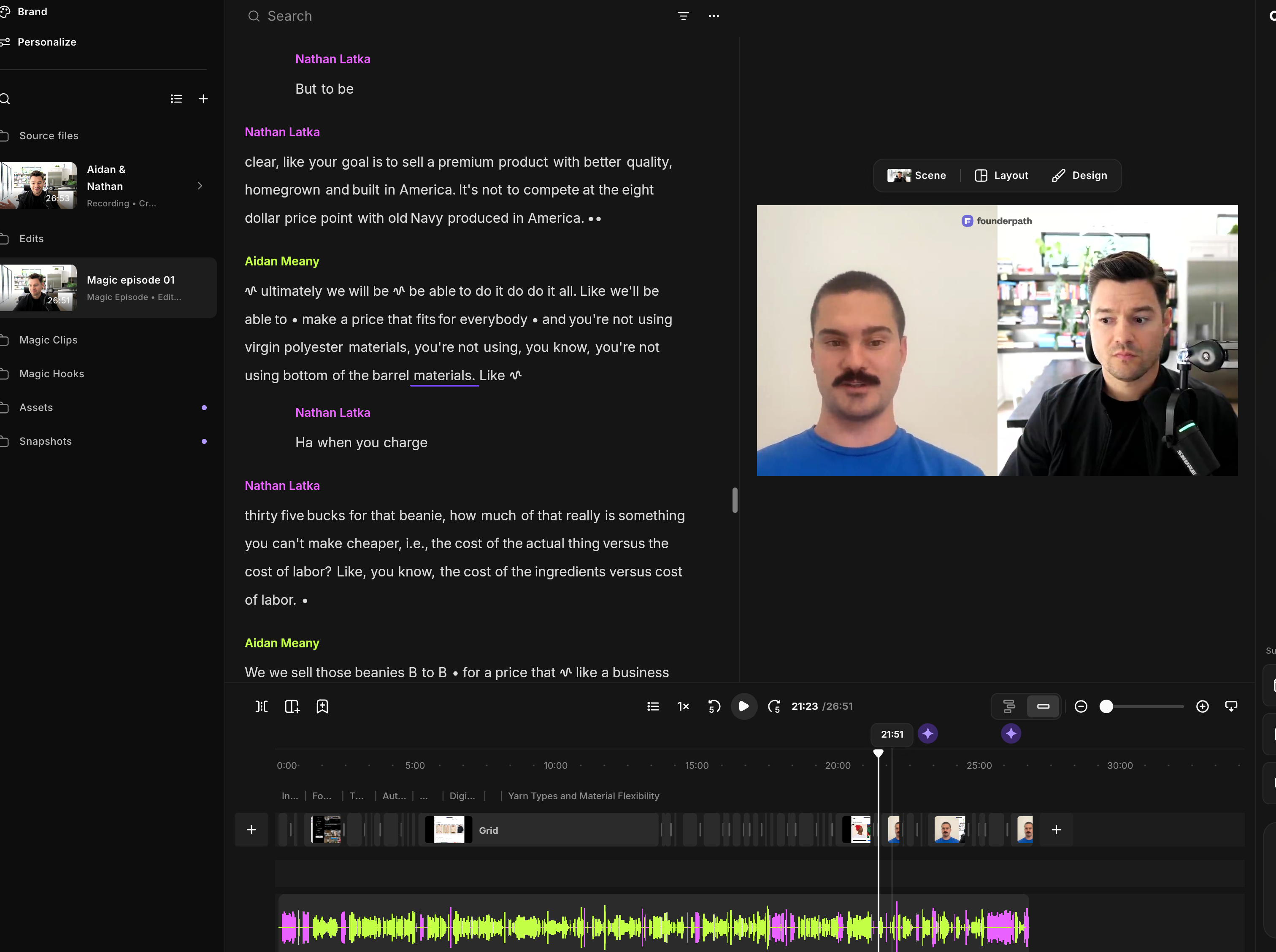
20:58But to be clear, like your goal is to sell a premium product with better quality, homegrown and built in America. It's not to compete at the eight dollar price point with old Navy produced in America.
Aidan Meany
21:08ultimately we will be be able to do it do do it all. Like we'll be able to make a price that fits for everybody and you're not using virgin polyester materials, you're not using, you know, you're not using bottom of the barrel materials. Like
Nathan Latka
21:23Ha when you charge thirty five bucks for that beanie, how much of that really is something you can't make cheaper, i.e., the cost of the actual thing versus the cost of labor? Like, you know, the cost of the ingredients versus cost of labor.
Aidan Meany
21:34We we sell those beanies B to B for a price that like a business could sell sell it for twelve bucks.
Nathan Latka
21:43Okay, so you wholesale these at like eight, nine, ten bucks if someone's bulk ordering fifty, a hundred, a thousand
Aidan Meany
21:48Okay.
Nathan Latka
21:48of them.
Aidan Meany
21:49We we we are in in many cases, especially on the customizable stuff, cheaper than what you'd have to import.
Nathan Latka
21:56I okay, th and that's where you think you're alpha. That is why you're doing what you're doing.
Aidan Meany
21:59yeah. It's been like that since we opened this factory. Yeah.
Nathan Latka
22:03Very cool.
Aidan Meany
22:04and and again, we're not D to C. So like the stuff we have that you could go buy a single beanie, yeah, it's expensive. It's what we would hope a brand would retail it for, right? But there's so much more, like the, you know, the
Nathan Latka
22:17You're fully integrated here, right?
Aidan Meany
22:18like the PPE stuff we're selling is is is cheaper than what they're buying it for now. You know, we're coming in and solving real issues for businesses that are getting higher margins and sell them for the same price.
Nathan Latka
22:28Yeah. The next time COVID hits, if if China doesn't want to sell us masks, you figure out a farm in Austin or whatever to to to or Texas to work with to source the yarn to produce a million units per year out of your factory in Cleveland.
Aidan Meany
22:42Absolutely. We do full I mean, we have a whole supply chain team that goes and co develops the w the raw materials needed for a project. So we've got design development prototyping as well. Like people come to us and they say, I need this thing and I have nothing to show for it except this conversation with you. And in six months you're you're you're making ten thousand units of it. I mean it's
Nathan Latka
23:02Yeah. I love that. I love that. Well, hey, your goal is five million of this year. We should celebrate where you're already at. Are you comfortable sharing what year you guys passed a million bucks of revenue?
Passing $1M Revenue in 2025
Aidan Meany
23:11Sorry, say that one more time.
Nathan Latka
23:13Are you guys comfortable sharing what year you passed a million bucks of revenue? it was last
Aidan Meany
23:16Last year. Yeah.
Nathan Latka
23:17year. Okay. So you think you're gonna five X this year, year over year?
Aidan Meany
23:20yeah. yeah. I mean it it it's it's been a crazy i again, it's been so much of this like slow, low capital intensive process that then all of a sudden we found a model because it's just like, what equipment do they have over there and plug it in? Like it's
Nathan Latka
23:34Yeah. Yeah.
Aidan Meany
23:35not it's not like there's a ton of stuff behind the scenes, but ultimately that's the phase we're in. is just like go get the same tools.
2027 Throughput Goals
Nathan Latka
23:45Yep. Yep. Well we're rooting for you. We hope you scale. If you hit all your goals next year in twenty twenty seven, how many units do you think you'll produce?
Aidan Meany
23:53In twenty twenty seven we'll we'll we'll surpass a like right now our plan is to surpass a ten figure throughput. So the d cost
Nathan Latka
24:00So more than more than ten thousand units shipped in twenty twenty seven.
Aidan Meany
24:05ten ten sorry, eight figure through eight figure throughput. So we're talking tens of millions of units.
Nathan Latka
24:13Yeah, eight figure. So you think you'd ship more than ten million units in twenty twenty seven with your current factory set up?
Aidan Meany
24:19Correct. Yeah. Correct. Yeah.
Nathan Latka
24:21Awesome. Awesome. We're rooting for you, man. If people want to follow you online, where can they find you?
Aidan Meany
24:25I'm on X. that's primarily where I'm where I'm throwing out whatever's in my head out. so that's just Aidan at Aidan Meany underscore. we're we do a cool like blog on our website, foundsurface.com. Instagram's at found surface. yeah, we're we're trying to boost a little bit more of our messaging, you know, but it we're de we're definitely the the business behind the business a lot of the time, you know. So Yeah, we don't, you know, we forget about marketing to go make cool stuff sometimes.
Nathan Latka
24:59Nothing wrong with that trade, guys. Aidan Meany left Syracuse after two years of industrial and interaction design to found and run Found Surface. He moved into a burnt down tea shop in 2021 and said, you know what? We haven't enough success here. We're gonna break ground on a 16,000 square foot facility in 2024 in the flats near Cleveland. Ultimately, then negotiated with his Producers and suppliers of equipment, which were going out of business. He got a great deal on very high-end equipment for producing things like beanies and shirts and custom materials to wear for your favorite sports team. And ultimately broke a million bucks of revenue in 2025. This year in 2026, they started producing hardcore in their new factory. He still owns 100% of the business. He's gotten very creative with financing. 17 full-time folks today. And he believes throughput next year in 2027 will be in the millions. Of units with a five million dollar revenue target here in twenty twenty six. Bring manufacturing back to America. This is a guy that's doing it with an art flair to boot. Aidan, thanks for taking us to the top, man.
Aidan Meany
25:58Nathan, that was awesome. I wish I could, you know, run that back. That was awesome. Thank you for having
Nathan Latka
26:02All right guys.
Aidan Meany
26:04me.
Nathan Latka
26:05Cut. Aidan, what'd you think, man? You enjoy that?
Aidan Meany
26:07Dude, that was great. That was great. I I I mean, you you had stuff ready to go. I was I mean, I've been on several podcasts and a lot of folks it's kinda like, Who's gonna take the lead here? you know, like so that was great.
Nathan Latka
26:17You gotta love what you do. I mean, I'm a curious guy and and I just anything I see someone that fascinates me, I wanna go. I mean, look, my I have a whole f production crew. If this does well, we'll fly the whole crew out and do a full feature, you know, hour long documentary on you guys. So we'll see what happens.
Aidan Meany
26:30Come on out. Come on out. It's I mean it is it it is a sight to say. Like I said, we did a ribbon cutting yesterday and you've got people in here that are like, I've never seen clothes get made.
Nathan Latka
26:43I love it. I love it. I gotta jump here with my next founder, man, but great to meet you. See you, brother. Bye, bye bye.
Aidan Meany
26:46Likewise. Thanks, David. Talk to you soon. See you.