
Founder Interview
How FreightWaves Reached $15M ARR and 700 Enterprise Customers While Spending Zero on CAC (Interview with Founder and CEO Craig Fuller)
- Interview Date
- September 16, 2021
- Interviewee
- Craig FullerFounder and CEO
Company Metrics at Interview Time
Enterprise Customers (2021)
700
Year-over-Year Growth (2021)
90%
Total Capital Raised (2021)
$92M
Cash on Balance Sheet (2021)
$26M
Historical Snapshot
These numbers were reported by Craig Fuller during his interview with Nathan Latka in September 2021 and are a historical snapshot, not current figures. See FreightWaves’s current numbers.
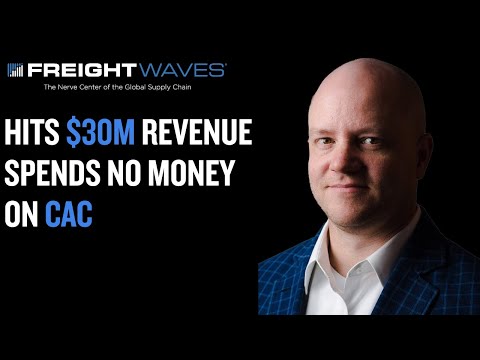
Key Takeaways
- 01FreightWaves had approximately 700 enterprise customers in 2021 with an average contract value of $25,000
- 02The company was adding 20 to 30 new enterprise clients per month, with about 80% of that inbound
- 03FreightWaves lost $5.5M in events revenue in 2020 due to COVID but still grew the overall business
- 04Total capital raised reached $92M, with $44M in equity and $10M in debt
- 05The company raised a $16M round from Triangle in 2021 at a post-money valuation of $286M
- 06FreightWaves operates with a negative CAC model, using media advertising margins to offset customer acquisition costs
- 07The company had 200 employees in 2021, split roughly fifty-fifty between media and SaaS
- 08Craig Fuller founded the company in 2016 with a $2M participating preferred round representing 25% of the company
Company Metrics at Time of Interview
| Metric | Value | Source |
|---|---|---|
| Enterprise Customers (2021) | 700 | Founder interview, Sep 2021 |
| Average Contract Value (2021) | $25,000 | Founder interview, Sep 2021 |
| New Enterprise Clients per Month (2021) | 20 to 30 | Founder interview, Sep 2021 |
| Inbound Sales Percentage (2021) | 80% | Founder interview, Sep 2021 |
| Average Sales Cycle (2021) | 52 days | Founder interview, Sep 2021 |
| SaaS ARR (start of year) (2021) | $6.5M | Founder interview, Sep 2021 |
| SaaS ARR (prior year) (end of 2020) | $6.5M run rate | Founder interview, Sep 2021 |
| Events Revenue (2019) | $5.5M | Founder interview, Sep 2021 |
| Media Business Gross Margin (2021) | 60% | Founder interview, Sep 2021 |
| Year-over-Year Growth (2021) | 90% | Founder interview, Sep 2021 |
| Total Capital Raised (2021) | $92M | Founder interview, Sep 2021 |
| Equity Raised (2021) | $44M | Founder interview, Sep 2021 |
| Debt Raised (2021) | $10M | Founder interview, Sep 2021 |
| Most Recent Round (2021) | $16M | Founder interview, Sep 2021 |
| Post-Money Valuation (Triangle round) (2021) | $286M | Founder interview, Sep 2021 |
| Series B Valuation (2019) | $92M | Founder interview, Sep 2021 |
| Cash on Balance Sheet (2021) | $26M | Founder interview, Sep 2021 |
| Team Size (2021) | 200 | Founder interview, Sep 2021 |
| Founder Equity Stake (2021) | mid-teens percent | Founder interview, Sep 2021 |
| Year Founded | 2016 | Founder interview, Sep 2021 |
| Initial Round Size (2016) | $2M participating preferred | Founder interview, Sep 2021 |
| Initial Round Equity Given (2016) | 25% | Founder interview, Sep 2021 |
Growth Breakdown
Revenue
FreightWaves ended 2020 with a SaaS ARR run rate of $6.5M, up from approximately $4M the year before. By September 2021 the company was on track to close the year at $15M in SaaS ARR, representing more than a doubling in a single year. The media business ran roughly in parallel, generating approximately $7M in revenue in 2020 and growing at a similar pace.
Customers
The company served approximately 700 enterprise customers in 2021, adding 20 to 30 new enterprise clients each month. About 80% of new business was inbound, driven by the media brand rather than paid outreach, and the average sales cycle from first conversation to close was 52 days.
Team
FreightWaves had 200 employees in 2021, split roughly fifty-fifty between the media operation and the SaaS product, with approximately 70 employees serving both sides of the business. Craig Fuller founded the company alone in 2016 with no co-founders and no software, only a PowerPoint presentation.
Funding and Cash Position
The company had raised $92M in total capital by September 2021, including $44M in equity and $10M in debt, with $26M sitting on the balance sheet and an additional $20M available but not yet drawn. The most recent round was $16M from Triangle in early 2021. Craig described the business as cash neutral, growing 90% year over year without needing to consume capital for customer acquisition.
Growth Strategy
Media-First Brand Building
FreightWaves built its editorial team before its sales team, hiring journalists who had come from established trucking publications. The resulting content drove so much traffic that the site quickly outperformed the publications those journalists had left, creating a ubiquitous brand presence that made every reader in the freight industry a potential SaaS prospect.
Negative CAC Through Advertising Margins
Craig described a metric the company calls negative CAC: the contribution margins generated by the media advertising business offset the cost of acquiring SaaS customers, so the net customer acquisition cost is effectively zero or below zero. This means all capital can be directed at R and D and product rather than marketing spend.
Inbound-Led Sales Motion
Roughly 80% of new enterprise customers came inbound in 2021. Even when the business development team reached out proactively, prospects already knew the FreightWaves brand from its content, shortening the sales cycle to an average of 52 days from first conversation to close.
Blog Content and Paid Search
The company relied on original editorial content as its primary top-of-funnel driver. Paid search through Google was added only three months before the interview, making it a very recent complement to the organic content engine rather than a foundational channel.
Capital Structure Optimization
Craig structured funding rounds to minimize dilution over time, using a mix of equity, non-dilutive debt, and committed-but-undrawn capital. This approach let the company shore up its balance sheet and pursue acquisitions opportunistically without taking on unnecessary dilution, preserving founder and early investor value as the valuation grew from $92M at the Series B to $286M at the 2021 round.
Best Quotes
“Bloomberg is really Bloomberg of freight, the Bloomberg of the supply chain is really the best description for FreightWaves. If you think of our business versus Bloomberg, Bloomberg is in many ways what they do in the financial markets, we do in the physical economy.”
“We have about 700 enterprise customers, so the average contract is about $25,000 add consistently 20 to 30 new enterprise clients a month. About 80% of that is inbound, So we didn't start spending any I think most SaaS companies do the first thing they do is they go and do AdWords through Google to drive activity, and then they hire a business development team. We did the opposite.”
“We have something called negative CAC, which means the more content we produce and the more revenue that we generate through advertising, it offsets much of your marketing and customer acquisition costs. So effectively, if you think of why most SaaS companies end up spending capital, number one is R and D, and then at some point in the cycle, they flip to marketing and customer acquisition. The nice thing is our customer acquisition is effectively zero or negative, so we have no capital tied up in direct customer acquisition.”
“We're a company that doesn't burn capital. We're basically cash neutral. And we're still growing 90% on a year over year basis.”
“We have $26,000,000 currently on the balance sheet with another 20,000,000 that we haven't drawn down, as I described. And we're cash neutral. And so there's really business is, like I said, is growing 90%, and we don't need to because we have this media business that just throws off cash, I don't have a lot of customer acquisition costs.”
“I went from having a job that paid me $115,000 a year to raising $2,000,000 and being basically independent at that point. And then over the course of the past five years, I've now built that to $40, $50, $60,000,000 in equity value.”
“I live and breathe the finance. I'm certainly not a finance person, but I live and breathe it because it's the, that is the oxygen that every, you have to understand finance if you're going be a founder of a company at some point, because it is the oxygen that drives our businesses.”
What Happened Next
This interview captured FreightWaves at a moment of rapid acceleration in September 2021, when the company was on track to close the year at $15M in SaaS ARR and had just raised $16M at a $286M post-money valuation. The figures Craig Fuller shared here are a point-in-time snapshot from that conversation and do not reflect the company's current performance. Visit the FreightWaves company profile on GetLatka for the most recent reported numbers and funding history.
View FreightWaves’s current profile and metricsFull Transcript
Chapters
- 0:00Introduction and FreightWaves Overview
- 1:35The Bloomberg of Freight: How Craig Describes the Business
- 2:36Building a Media Brand to Market a SaaS Product
- 4:54700 Enterprise Customers and the Inbound Sales Model
- 6:33How the Media Business Makes Money and the Negative CAC Model
- 8:01SaaS ARR Trajectory: 2019 to 2021
- 9:40Events Revenue Lost in 2020 and How the Business Recovered
- 11:57Total Capital Raised: $92M and the Capital Structure
- 15:11Valuation History: Series A, Series B, and the 2021 Triangle Round
- 17:22Acquisitions, Rule of 40, and Growth Strategy
- 19:04Founder Equity and Dilution Philosophy
- 20:21The First $2M Round: Participating Preferred and Lessons Learned
- 24:08Current Cash Position and Why FreightWaves Is Not Raising
- 25:20Famous Five: Books, Tools, and Closing Thoughts
Introduction and FreightWaves Overview
Nathan Latka
00:00Hey, folks. My guest today is Craig Fuller with FreightWaves. He's the CEO and Founder, the leading provider of data analytics for the global logistics industry. The company provides the fastest view of transportation and logistics market activity across all modes. The company is also the number one source for media and market analytics in the global freight industry. Craig, you ready to take us to the top?
Craig Fuller
00:20>> Yeah, glad to be here. Thanks for having
Nathan Latka
00:23So you have to, sometimes I put out crazy predictions in my email newsletter, which go out to about 60,000 people, and I always get interesting feedback back. I think that's maybe the genesis. You got some inbound from that. What were people saying?
Craig Fuller
00:34>> Well, I think the note was that FreightWaves was likely to be acquired by some of the companies that are also in SaaS. And because we have a set of journalists and we get a lot of market intelligence, our it was interesting because our SaaS business is actually bigger than some of the companies that you mentioned that would acquire us. So I just thought was interesting. It's always good to get news and people talking about the company,
01:01>> so I don't hate that or begrudge it. But it's always interesting to sort of see how people put things together.
Nathan Latka
01:06We were talking, I interviewed the team at Flock Freight. I had Xvi on from, well, I had FreightWaves on like a bunch of these companies, and I'm always looking like I think a very smart move to arbitrage CAC in any SaaS business is to build a media brand, and you already had that, and I had no idea there was a SaaS brand behind that, and so you reached out and I said, Please, please come on, this
01:27is great. So let's dive into this. So how would you describe today FreightWaves to the market? Because you don't lead with SaaS.
The Bloomberg of Freight: How Craig Describes the Business
Craig Fuller
01:35>> No, I think Bloomberg is really Bloomberg of freight, the Bloomberg of the supply chain is really the best description for FreightWaves. If you think of our business versus Bloomberg, Bloomberg is in many ways what they do in the financial markets, we do in the physical economy. And so what I mean by that is we are focused on the intersection of how product moves, physical product moves through the global economy, and Bloomberg tends to focus on how
02:04>> money moves through the global economy. And so we have a media business that has journalists, we have about 40 folks that are in our editorial media side, bringing original content and context to what's happening around the global economy, but using our data to inform that. And then we have a subscription SaaS business, which we sell to our industry that provides real time fundamental data to help them manage their business more effectively. So pricing data Go and
Building a Media Brand to Market a SaaS Product
Nathan Latka
02:36ahead. 40 journalists on media, how many full time at the SaaS?
Craig Fuller
02:40>> So the whole company's got 200 employees, and you could sort of break up the company at about fiftyfifty between full that it's fully dedicated to media and then fully dedicated to SaaS. And then the balance of it would be around 70 employees to sort of do both.
Nathan Latka
02:56Okay, so 70 are sort of shared. So people are going to ask, and this is a bit what came first? Are you a software guy
Craig Fuller
03:02>> at heart or you're media guy at heart? Well, set out to build a software business and realized that in order to build a software business of a new category, you have to have someone to market the product. And I tried to go find the existing media businesses that I could go essentially have write about the topic that we were doing. And out of frustration of not really getting any of these stories picked up that we were
03:29>> trying to pitch, we started talking to some PR agencies, and we were getting ridiculous quotes. One quoted us, we got turned down by a number of publicists and PR agencies, which is like getting turned down by a lawyer. That never happens. But agreed to take us on, and he quoted us 40,000 a month. And that was like all of our seed capital. And so as I balked at him and said, you should do this yourself. And
03:55>> he goes, you should hire an editor and write content yourself because what you're describing is difficult to talk about. And we did, and we realized really quickly because the journalists had come from one of the other major trucking publications, and we were getting a lot of traffic. In fact, our site was in many ways beating his site that he had come from. And we realized really quickly that there was this gap of information in the market,
04:24>> And we just doubled down on it, and it started to really work. What it has enabled us to be is really the source of information of what's happening in our business. And we ended up that enabled us to scale our SaaS business, which is all about data. So we provide real time fundamental data for the market, and our editorial team brings context to that data.
Nathan Latka
04:48Yep. Now, if we just talk about customers to the SaaS tool today, what are you at?
700 Enterprise Customers and the Inbound Sales Model
Craig Fuller
04:54>> We have about 700 enterprise customers, so the average contract is about $25,000 add consistently 20 to 30 new enterprise clients a month. About 80% of that is inbound, So we didn't start spending any I think most SaaS companies do the first thing they do is they go and do AdWords through Google to drive activity, and then they hire a business development team. We did the opposite. We had the content team, and then we hired a business
05:24>> development team, and then we ended up, just three months ago, adding sort of pay per click Google advertising. So we're relatively new in doing the other things to sort of drive sales on top of the funnel. Almost all of our activity comes in through our media business. And even if it's not a direct response or they're not coming directly off of an article we've written, what's nice about it is when our business development group reaches out
05:50>> to those companies, the company already has familiarity with the company. They just may not have realized we had a SaaS business or had not ever reached out to inquire about the data that we sell. So having that ubiquitous presence enables us to really trim down our cycle in terms of closing deals. Our average sales cycle is about fifty two days from the first conversation to close. But I often say that everyone at some point is in
06:19>> our funnel, because if they're reading our if they're in our industry, they're likely reading our content. And so they're always sort of in that funnel.
Nathan Latka
06:27Does the media business make money like sponsorships?
Craig Fuller
06:29>> No.
Nathan Latka
06:30Okay. What's the model there? How does it make money?
How the Media Business Makes Money and the Negative CAC Model
Craig Fuller
06:33>> So it's advertising. So it's a free advertising site. We don't gate it in terms of a paywall. We monetize it through advertising. And it's about a 60 some odd margin business today. We have a term called negative CAC. So if you think of SaaS companies have CAC, which everyone sort of understands as customer acquisition costs, so we calculate that, you figure out what does it cost to acquire these customers. And we have a metric, track that
07:00>> independent of our
07:03>> media business. But then we have something called negative CAC, which is if you took the margins that you generated, if you treated us only as a SaaS business, and you looked at our media business as basically a marketing engine, then you can look at the advertising or the contribution margins in our ad business as offsetting your marketing costs. So we have something called negative CAC, which means the more content we produce and the more revenue that
07:31>> we generate through advertising, it offsets much of your marketing and customer acquisition costs. So effectively, if you think of why most SaaS companies end up spending capital, number one is R and D, and then at some point in the cycle, they flip to marketing and customer acquisition. The nice thing is our customer acquisition is effectively zero or negative, so we have no capital tied up in direct customer acquisition. All of our capital is tied up in
08:00>> R and D and product.
SaaS ARR Trajectory: 2019 to 2021
Nathan Latka
08:01Trailing twelve months revenue across the whole business, what percent was media versus what percent was SaaS?
Craig Fuller
08:06>> So it's about fiftyfifty, and I know that sounds convenient, and I don't intend it to be. It's just that both businesses are growing in tandem. And if you looked at our SaaS business, we'll complete the year about $15,000,000 of ARR in terms of recurring. It's about a three year old business. And then if you look at our media business, it will be on the same sort of trajectory at the end of the year.
Nathan Latka
08:31And back channel for me, let's just talk SaaS for a second. So if you're around $15,000,000 AR by the end of this year, where were you exactly one year ago?
Craig Fuller
08:38>> Yeah, we were about 6.5 at the start of the year.
Nathan Latka
08:43Wow, so at the start of 2021 or 2020?
Craig Fuller
08:47>> 2021, yeah.
Nathan Latka
08:48Wow, okay, so you end 2020 with a $6,500,000 run rate. You think you more than doubled this year, which is great. Take us back one more year, 6.5, and then what was the year before that?
Craig Fuller
08:58>> Around 4,000,000 the year before.
Nathan Latka
09:00Really interesting, okay. And was it always a fiftyfifty split between media and SaaS?
Craig Fuller
09:05>> No.
09:06>> Media has been bigger than SaaS, and what we're finding as we scale that our SaaS business is accelerating faster than our media business. And so media split, there's our media growth is slowing just because it so explosive in the start. It's easier to monetize media, frankly, than it is SaaS. Don't know that a lot of people realize that.
09:28>> The great thing about SaaS is that once you get that engine going, it has its own set of momentum, which doesn't require you to put as much into it. So
Events Revenue Lost in 2020 and How the Business Recovered
Craig Fuller
09:40>> is, if we look at the business, we're starting to see a mix shift in our revenues. Mean, half our revenues in 2019 was in physical events. It was zero last year. Oh, wow. So we lost half our revenue last year, but we still managed to triple the size of the company.
Nathan Latka
09:58How much revenue did do in 2019 on events?
Craig Fuller
10:01>> 5,500,000.
Nathan Latka
10:03Wow, remarkable. Okay, and SaaS knows that it was 4,000,000, so less than 50%.
Craig Fuller
10:07>> What's in ARR? The ARR has a little bit of lag just because it isn't ARR is typically what you end with, right?
Nathan Latka
10:15Yep, yep.
Craig Fuller
10:15>> And so whatever you're sort of closing contracts under, your revenue recognition. So it isn't it perfect to say
Nathan Latka
10:22that it was
Craig Fuller
10:23>> Yeah. In revenue.
Nathan Latka
10:24Just to be clear, though, so when you say end of year 2020, you're at a $6,500,000 run rate on the SaaS. That's taking December 2020 revenue times 12 equals $6,500,000
Craig Fuller
10:33>> Taking contracts that are signed multiplied by the value of those contracts.
Nathan Latka
10:38The four, got it. The media business, look at the total revenue in 2020, did about what, dollars 7,000,000?
Craig Fuller
10:43>> So the media business in 2020, yes, 7,000,000 approximately. That's about right.
Nathan Latka
10:49Where did you make up? I mean, you lost $4,000,000 in event revenue. How did you make all
Craig Fuller
10:53>> that up in advertising? Well, at the end of the day, marketing budgets are fungible, right? So if you think about companies that are advertising, they're either advertising through events, and they have an event budget, and they go out to events. But when that dried up, they still have marketing budgets. They still have a desire. I mean, one of the advantages is we're in probably the hottest market on the planet is supply chain Very hot. Information in
11:23>> supply chain. So our industry has done exceptionally well. So marketing budgets were not cut during COVID. In fact, our industry has been historically reliant upon relationships to drive new customer acquisition, and that's how the freight and supply chain industry builds its customer engagement. A lot of that money was then redeployed to assets like ourselves because we have this broad distribution and engagement.
Nathan Latka
11:52Total, you've raised capital. How much total have you raised to date?
Total Capital Raised: $92M and the Capital Structure
Craig Fuller
11:57>> So total, if you take total capital raised, we're at $92,000,000 of total capital raised. The equity raise is about 44. So
12:12>> the way to think of that is that some of that has been debt. We've taken some debt that was non dilutive, or largely non dilutive, I should say. And then some of it we haven't drawn down. We have How much
Nathan Latka
12:26debt have you raised?
Craig Fuller
12:28>> $10,000,000 of debt.
Nathan Latka
12:30Interesting. And a lot of people don't understand debt can be dilutive because there can be warrants attached to those. Standard, I would say, is like half a point to maybe up to two points. Do banks own more than or bigger lenders own more than 2% of FreightWaves right now, warrant wise?
Craig Fuller
12:44>> Well, this would have been a growth capital. It would have been a private equity fund. It wasn't bank debt.
Nathan Latka
12:51I see.
Craig Fuller
12:51>> And it wasn't SVB. I know you're probably referring to like an SVB line of It's not the debt we're referring to. It's high yield debt for that, but it's relatively non dilutive. So if you think of debt is actually great as an instrument for growth if you're very confident in the growth of your business. Where debt is a problem is where you're taking it as a last resort because it has a lot of covenants and restrictions
13:17>> to it that can be very costly if you don't manage those.
Nathan Latka
13:21The other thing I want to touch on that other founders rarely touch on is, I always say, like, don't raise VC unless you absolutely need it because it limits your optionality moving forward. But you can also just create more flexibility if you just take secondary along the way, create liquidity for everybody. If I take 92,000,000 in total funding minus 10,000,000 in debt, right, and then subtract the 44,000,000 in equity, that means there's about 30,000,000 there unaccounted
13:43for. I assume most of that was secondary. Is that accurate?
Craig Fuller
13:45>> No, it's not secondary. It's capital that we've raised that we haven't drawn down. So some of the ways that you can create flexibility in your cap structure is to actually draw money. So you raise it, it's allocated for you, the fund is set aside, but you don't need all that capital for some period of time. So you can actually call on that capital at some future date. And so it's relatively non dilutive. And so it goes
14:07>> back to how do I shore up my balance sheet? And how do I have capital available to me for acquisitions, or capital available for growth, or even as an insurance policy, but I don't actually have to draw that money down immediately? And so we've done a lot of those types of structures that has given us optionality. So you're giving up some degree of dilution, but if you take equity dilution 100, that dilution is immediate to you
14:34>> versus taking it at some future date. If you've indexed your growth at some future value and the investor has agreed to it, it enables you to take a far less dilutive amount of capital. The thing that's often misunderstood about capital is people can put ridiculous a company is zero, a pre revenue company got a billion dollar valuation in our space, and what is not understood is, that's great, that sounds great, but there's not a lot explained
15:02>> as to what that billion actually means. You can have massive preference. You can have that capital set aside for future days. A lot of things that isn't often understood that's sort of behind the headlines.
Valuation History: Series A, Series B, and the 2021 Triangle Round
Nathan Latka
15:11Yep. So what valuation did you raise when you raised the 16,000,000 from Triangle earlier this year?
Craig Fuller
15:16>> So our post on that was two eighty six.
Nathan Latka
15:18Okay, post 286. And did you pull that full 16 immediately or no?
Craig Fuller
15:21>> We did pull that full 16. It's on the balance sheet of the company.
Nathan Latka
15:25I see. So go back, like how do you decide to pull all of that, but maybe at Kayne, you didn't pull the full $30,000,000 last year?
Craig Fuller
15:30>> Yeah, don't want to get into all the nuances of what we didn't pull and who we didn't pull from just because I don't think that information is.
Nathan Latka
15:37Well, the reason I ask is, let me pull this down further. Let's just I'm making an assumption here, guys. So caveat here. Craig's not confirming this, I'm assuming. Let's say Kayne said, Here's a 30,000,000 tranche available on July at a set valuation. And you don't pull the full 30 because you don't need the full 30, but you've shirred up your balance sheet, you use that leverage, you derisk the business to go raise from Triangle to higher
15:56valuation. You pull full at Triangle because it's a higher valuation, less dilution for you. Kayne is left stuck with a 15,000,000 or $20,000,000 commit, whatever you have it pulled. Do you pay unused fees on that money?
Craig Fuller
16:06>> No, not necessarily. That money's still available for future use should you want to pull it down.
Nathan Latka
16:12But at a lower likely at a lower valuation than what you're at now.
Craig Fuller
16:15>> That's all up to how you've structured your deal. It doesn't necessarily have to be a lower valuation. You can certainly raise that capital at a future date at some calculation based on how well you're performing. So just because you've raised it doesn't mean you pulled it into your balance sheet. And it also doesn't require you to call on that capital until you're ready. No different than if I raised a venture capital firm. When I raised the
16:43>> capital, I may raise $100,000,000 VC firm. I'm not pulling that money down. I'm calling it money as I need it.
Nathan Latka
16:49Yep, yep, yep. Let's go back a couple of years because maybe you can share more since these are much older. When you did the $20,000,000 Series B in 2019, what valuation was that at?
Craig Fuller
17:00>> That would have been $92,000,000 I think.
Nathan Latka
17:02Oh, wow. Okay, so you almost tripled. That's incredible. And what about Series A? $13,000,000 in 2018.
Craig Fuller
17:08>> 42, I think, was the number post.
Nathan Latka
17:11Okay, and so tell me about acquisitions. You have what I think is the hardest thing to get in SaaS, which is you have a moat, which is attention with your media business. You're in a great spot to go buy companies. Are you in acquisition talks right now to buy any companies?
Acquisitions, Rule of 40, and Growth Strategy
Craig Fuller
17:22>> We've done four acquisitions so far. They've been small tuck ins. And so the challenge with acquisitions, if you're a high growth so we're a company that doesn't burn capital. We're basically cash neutral. And we're still growing 90% on a year over year basis. It's very hard when you look at the Rule of 40. If you look at the valuation metrics, we could go buy something for scale's sake. The problem is the stuff that you look at
17:52>> to acquire doesn't have as good of a rule of 40 profile. So they're either not
18:01>> they rank lower on the rule of 40 matrix, which actually is a direct correlation between how well you're positioned on that rule of 40 matrix to what your valuation is, either at exit or on a capital raise. And so if your rule of 40 is very high, which ours is, anything that is lower than that potentially, if it's big enough, knocks down the valuation of the company. And so let's say that we're trading at 15 times
18:32>> revenue. If we take something that knocks our rule of 40 down to a 60, and we're trading at 10 times revenue or 12 times revenue, then I've just given up a couple of turns of value of that unless I bought that business at a very low valuation. So to make up for the arbitrage that you give up on value. So buying something for the sake of scale, for us, doesn't make a lot of sense. Buying something
18:57>> that is accretive to our rule of 40 matrix would make sense if you can find it.
Founder Equity and Dilution Philosophy
Nathan Latka
19:04Yeah, this is really interesting. Okay, a couple other things here before we wrap up because I could go on forever. This is a great, great story. I think it's the future of how SaaS business will be built around attention and media first. But Craig, for you specifically, at your scale with how much you've raised and how you've been smart about allocation or valuation, how much equity do you still own in the business?
Craig Fuller
19:24>> Yeah, I'm not disclosing that.
Nathan Latka
19:26Can you give
19:28a range, a big range?
Craig Fuller
19:30>> It is high more than zero. Look, when you're doing you think about sort of the rules are for every round you do, a founder is getting diluted 20%. So to compound that over five rounds or whatever it's been, you're in the mid teens. And I think that's a fair number for me.
Nathan Latka
19:46Cool. Okay, cool.
Craig Fuller
19:47>> So I was going say, if he gives me a range of between zero and one hundred, I'm going to kill him. But mid teens I
19:52>> think mid teens is probably appropriate. I don't have co founders. I founded the business myself. But you could mid teens is the right answer for that.
Nathan Latka
20:03Out of curiosity, finding this yourself back in 2016, you raised that first $2,000,000 in capital. Did you get dinged on your valuation because people are like,
20:09you're a sole founder, Craig.
20:10If get hit by a bus, we're screwed.
Craig Fuller
20:11>> I had a PowerPoint presentation, and that's all I had. So I didn't even have software. I didn't even have a co founder. I didn't have any employees. And so I raised $2,000,000 as debt. Now that was the most I'm happy to talk about that.
The First $2M Round: Participating Preferred and Lessons Learned
Nathan Latka
20:21Wait, how do you raise $2,000,000 as debt on day one?
Craig Fuller
20:24>> That's crazy. Well, the problem was it was also equity. So it was participating preferred. It was the worst deal I've ever done. It was 25% of the company for $2,000,000 and I had to pay it back. The investor has been paid back. So he has received his full 2,000,000
20:42>> plus 8% interest for the three years that we held it.
Nathan Latka
20:45And you I'm sorry?
Craig Fuller
20:46>> You don't get the equity back when you pay it back?
20:49>> No. Craig, what the fuck? Well, Nathan, I think you have to remember that when you're a founder who has an idea and not a lot of people are writing checks and you could get a $2,000,000 check for a business that didn't exist at that moment in time, there wasn't even a software package behind it, then I think that's a pretty good deal. I mean, if you think about the amount of wealth, and I think this is
21:13>> something that has to be said is like, you could sit there, I never regret taking money at the time, because the information I had at the time, these were the best deals I could get, right? And so I took them because they were the best set of circumstances for me. But I went from having a job that paid me $115,000 a year to raising $2,000,000 and being basically independent at that point. And then over the course
21:37>> of the past five years, I've now built that to
21:43>> $40, $50, $60,000,000 in equity value. I think that's a pretty good idea, a pretty good deal, and I'm not done yet. So I can sit there, the 2021 version of me can sit there and judge the 2016 version of me. But there's no point in it. Like, I'm a lot better off than 99% of every founder that's been out there. And the fact is that the person who wrote the check believed in me when nobody else
22:09>> did, and they benefited from it. I took another round where the investor put $75,000 in the company, and that's worth millions today. Today. So these things you do as a founder, but if you look at it on a percent base, I think a lot of people get caught up in the percentages. The percentages are less important than what you're actually creating in real value. And I think we would all be better served if that's what we
22:36>> focused on, and not just, I own 85% of the business, because ultimately that doesn't matter at the end of the day. And what does matter is what you're actually creating in value over time.
Nathan Latka
22:47Yep. Softbank is famous for just lighting money on fire. A smart entrepreneur, an enterprising entrepreneur like yourself might take advantage of that. Flock Freight now has more capital behind them and Softbank on their cap table. Are you in any talks to sell the business to Flock Freight
23:04right now?
Craig Fuller
23:05>> No, I'm not in no, it would be hard for a company like Flock Freight to buy us. And I'll tell you why is because we are a information provider, and we sell data to competitors and Flock Freight and competitors of Flock Freight. So our business is we are the for lack of a better description, the Bloomberg of freight.
Nathan Latka
23:25So it would
Craig Fuller
23:26>> be like Bloomberg selling to Goldman Sachs. Like, A, it would kill, Goldman Sachs could never write the check that Michael Bloomberg would want. And the moment that Goldman Sachs bought Bloomberg, Bloomberg would lose 99.9% of its business. And so for us, it is unlikely that we would sell to a business that's in our industry. We're more likely to sell to a S and P or a Bloomberg or a Reuters or Refinitiv or somebody that's in market
23:54>> data businesses, take the company public because that's really what we do. We are not in the business of selling to someone that's using our data to make decisions.
Nathan Latka
24:05Are you in talks right now to raise any more capital?
Current Cash Position and Why FreightWaves Is Not Raising
Craig Fuller
24:08>> We don't need it. We have $26,000,000 currently on the balance sheet with another 20,000,000 that we haven't drawn down, as I described. And we're cash neutral. And so there's really business is, like I said, is growing 90%, and we don't need to because we have this media business that just throws off cash, I don't have a lot of customer acquisition costs. And so I can continue to scale my business indefinitely without having to consume capital. And
24:37>> I think as founders, that first deal I took that was highly dilutive, every deal since, I've tried to mitigate the amount of dilution I take. And so taking capital for the sake of taking capital is sort of senseless because it moves, it makes it that much more difficult to achieve the goals you want.
Nathan Latka
24:55You're on it, Craig. This is great. This is so far, are you enjoying yourself? I know there's a lot of numbers, but this is the thing love.
Craig Fuller
25:02>> I love, like, I live and breathe the finance. I'm certainly not a finance person, but I live and breathe it because it's the, that is the oxygen that every, you have to understand finance if you're going be a founder of a company at some point, because it is the oxygen that drives our businesses.
Famous Five: Books, Tools, and Closing Thoughts
Nathan Latka
25:20Yep. Let's wrap up with the famous five here. Quick, number one, favorite book.
Craig Fuller
25:25>> Sun Tzu's Art of War.
Nathan Latka
25:26Number two, is there a CEO you're following or studying?
Craig Fuller
25:30>> I am a huge fan of Michael Bloomberg.
Nathan Latka
25:32Number I sense we're going be reading in the press very soon, Bloomberg requires FreightWaves for $500,000,000 in cash and stock.
Craig Fuller
25:41>> I could neither confirm nor deny whether that was true or not.
Nathan Latka
25:45Totally taking this clip, and if I see it in three months, I'm saying it. You heard it here first. All right, Michael Lohr. Number three, what's your
Craig Fuller
25:51>> favorite online tool for building the business? I'm sorry, what was the question?
Nathan Latka
25:53Favorite online tool for building the business?
Craig Fuller
25:59>> LinkedIn. Mean, LinkedIn is not great. Twitter is wonderful, so A little more creative.
Nathan Latka
26:04All right, a little more creative. Number four, how many hours of sleep do you get, Craig?
Craig Fuller
26:11>> Eight hours.
Nathan Latka
26:12End situation, married, single, kids?
Craig Fuller
26:13>> I'm married.
26:14>> I have five kids.
Nathan Latka
26:16Wow, five kids. How old are you?
Craig Fuller
26:18>> I'm 42.
Nathan Latka
26:19Last question. Something you wish you knew when you were 20.
Craig Fuller
26:24>> I don't know. That's a tough one.
Nathan Latka
26:29Guys, FreightWaves, building the future of transportation, logistics, tracking physical objects, think of it like Bloomberg for physical goods, doing it the right way. He is running a business where he has CAC arbitrage, a profitable distribution network with his media business, makes up almost $15,000,000 of revenue. His SaaS business has another $15,000,000 in revenue. The market's loving. It raises series c 16,000,000 with a 286 pre money valuation just recently. Team at 200 people split fifty-fifty between
26:54the two businesses, growing 90% year over year. We're rooting for you, Craig. Thanks for taking us to the top.
Craig Fuller
26:59>> Thanks, Nathan.
Nathan Latka
27:02One more thing before you go. We have a brand new show every Thursday at 1PM Central. It's called Shark Tank for SaaS. We call it deal or bust. One founder comes on three hungry buyers. They try and do a deal live and the founder shares back end dashboards, their expenses, their revenue, ARPU CAC, LTV, you name it, they share it. And the buyers try and make a deal live. It is fun to watch every Thursday one
27:27p. M. Central. Additionally, remember these recorded founder interviews go live. We release them here on YouTube every day at two p. M. Central. Make sure you don't miss any of that, make sure you click the subscribe button below here on YouTube, the big red button and then click the little bell notification to make sure you get notifications when we do go live. I wouldn't want you to miss breaking news in the SaaS world, whether it's an
27:48acquisition, a big fundraise, a big sale, a big profitability statement or something else. I don't want you to miss it. Additionally, if you want to take this conversation deeper and further, we have by far the largest private Slack community for B2B SaaS founders. You want to get in there. We've probably talked about your tool if you're running a company or your firm if you're investing. You can go in there and quickly search and see what people
28:10are saying. Sign up for that at nathanlatka.com/slack. In the meantime, I'm hanging out with you here on YouTube. I'll be in the comments for the next thirty minutes. Feel free to let me know what you thought about this episode and if you enjoyed it, click the thumbs up. We get a lot of haters that are mad at how aggressive I am on these shows, but I do it so that we can all learn. We have to
28:30counter those people. We got to push them away. Click the thumbs up below to counter them and know that I appreciate your guys'support. Alright, I'll be in the comments. See you.