
Founder Interview
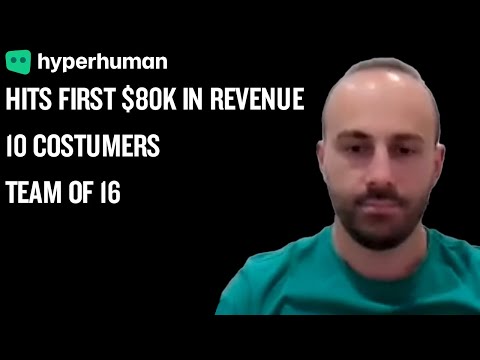
How Hyperhuman Hit $84K in Revenue with 111 Teams and 400 Hours of Fitness Video Content on Platform (Interview with CEO Bogdan Predusca)
- Interview Date
- April 27, 2022
- Interviewee
- Bogdan PreduscaCEO and Founder
Company Metrics at Interview Time
Revenue (2022)
$84K
Total Funding Raised
$1.2M
Team Size (2022)
16
Individual Professionals on Platform (2022)
3,000
Video Content on Platform (2022)
400 hours
Historical Snapshot
These numbers were reported by Bogdan Predusca during his interview with Nathan Latka recorded in April 2022 and are a historical snapshot, not current figures. See Hyperhuman’s current numbers.
Key Takeaways
- 01Hyperhuman reported $84K in total revenue as of April 2022
- 02The platform had 111 teams signed up, with approximately 10 converted to paying customers at the time of the interview
- 033,000 individual professionals were on the platform, with roughly 5 to 10% paying
- 04Average revenue per user for individual professionals was approximately $20 per month
- 05The platform had transformed raw recordings into 400 hours of quality video workouts, a 10x expansion from the original raw footage
- 06Hyperhuman raised two seed rounds totaling $1.2M, approximately $600K each, selling roughly 20% of the business in total
- 07The team consisted of 16 people across three continents
- 08Four tech investment funds backed the company, with no business angels involved
Company Metrics at Time of Interview
| Metric | Value | Source |
|---|---|---|
| Revenue (2022) | $84K | Founder interview, April 2022 |
| Total Funding Raised | $1.2M | Founder interview, April 2022 |
| Seed Round 1 (2021) | $600K | Founder interview, April 2022 |
| Seed Round 2 (2022-04) | $600K | Founder interview, April 2022 |
| Equity Sold to Investors (total) | 20% | Founder interview, April 2022 |
| Team Size (2022) | 16 | Founder interview, April 2022 |
| Teams on Platform (2022) | 111 | Founder interview, April 2022 |
| Paying Teams (2022) | 10 | Founder interview, April 2022 |
| Individual Professionals on Platform (2022) | 3,000 | Founder interview, April 2022 |
| Free Trials (Teams) (2022) | 100 | Founder interview, April 2022 |
| Free Users (2022) | 3,000 | Founder interview, April 2022 |
| ARPU (Individual Professionals) (2022) | $20 | Founder interview, April 2022 |
| Pricing Per Seat (Teams) (2022) | $149.99 | Founder interview, April 2022 |
| Video Content on Platform (2022) | 400 hours | Founder interview, April 2022 |
| Investors (2022) | four tech investment funds | Founder interview, April 2022 |
Growth Breakdown
Revenue
Hyperhuman reported $84K in revenue as of April 2022. Revenue came from two streams: individual professional subscriptions averaging $20 per month and team subscriptions priced at $149.99 per month, with the teams product added earlier in 2022.
Customers
The platform had 111 teams signed up, with approximately 10 converted to paying customers at interview time and the remainder in free trials. On the individual side, 3,000 professionals were on the platform with roughly 5 to 10% paying.
Team
Hyperhuman had 16 full-time employees across three continents at the time of the interview, including two people dedicated to content moderation. The rest of the content transformation work was handled by the company's AI technology.
Funding
The company raised two seed rounds totaling $1.2M, approximately $600K each, from four tech investment funds with no business angels. In total, investors received roughly 20% equity across both rounds.
Growth Strategy
AI-Powered Video Transformation
Hyperhuman's core growth driver was its AI that identifies exercises in raw recordings and transforms them into structured, reusable video workouts. This 10x expansion of raw footage into finished content removed the need for video editing, tech, or marketing skills from the customer.
Freemium to Paid Conversion
The platform used a freemium model allowing professionals to create content up to a certain level for free, then converting them to paid subscriptions. For teams, a free trial period was used to demonstrate value before activating a subscription.
Layered Product Expansion
Hyperhuman launched first with individual professionals as an MVP, then added a Teams layer in early 2022 to address the larger B2B opportunity with gyms, studios, and fitness apps needing a constant feed of quality content.
B2B Events and Business Development
Bogdan noted that reaching the B2B teams market required being present at industry events and other cash-intensive activities, which was a key reason the company raised capital to fund marketing and business development alongside product development.
Targeting Existing Video Libraries
Rather than asking customers to create new content from scratch, Hyperhuman positioned itself as a way to unlock value from recordings gyms and trainers already had, lowering the barrier to adoption and accelerating time to value.
Best Quotes
“So our mission is to make world's health and fitness videos universally accessible and reusable. That was our goal. That was our challenge to be solved by technology, by our AI.”
“We have transformed about thirty or forty hours of raw recordings into four hundred hours of quality video workouts. So it's 10x from raw recordings to new content created from a very, let's see.”
“We now have, I think, 3,000 individuals, so professionals on the platform. Not everyone is paying because we have a freemium model. We can create up until a certain level of content completely free all the time. So we have about, I think, five to 10% paying on the professional side.”
“We have 16 people now.”
“We raised the one early seed and one late seed. So the first round was closed in December, 500 ks euros, that's about 600 something k dollars. And just about two months ago, we raised a late seed of the same amount about €500,000. So, in total, raised in about one year and a half one point two million dollars, I think.”
“I actually we have four tech investment funds. See. That's a very nice thing to have. Only no business angels, just funds that have experience in this industry.”
“We raised money to be able to develop the technology, to be able to grow and to be able to have the marketing budget.”
“You should not do that. You should not do 20% per round. Then in three rounds, you are not even the majority of them. No. So it's around that percentage for both. For total, total.”
What Happened Next
This interview captured Hyperhuman at an early stage in April 2022, just after launching its Teams product and with most of its 111 team sign-ups still in free trials. The figures here, including $84K in revenue, 16 team members, and $1.2M in total funding, reflect what Bogdan Predusca reported at that point in time and are not current. Visit the Hyperhuman company profile on GetLatka for the latest available data.
View Hyperhuman’s current profile and metricsFull Transcript
Chapters
- 0:00Introduction and Background
- 0:37Who Hyperhuman Sells To
- 2:25How the Teams Product Works
- 3:57Video Content on the Platform
- 8:30Individual Professionals and Freemium Model
- 9:52Monthly Recurring Revenue Breakdown
- 10:43Converting Trials to Paid Accounts
- 11:49Team Size and Headcount
- 11:58Funding Rounds and Capital Raised
- 12:40Cap Table and Investor Mix
- 13:24Why They Raised Capital
- 14:38Famous Five Rapid Fire
- 15:49Closing Summary
Introduction and Background
Nathan Latka
00:00Hey, folks. My guest today is Bogdan Predusca. He is the CEO and founder of a company called hyperhuman.cc, tech entrepreneur passionate about building innovative products and great teams. He has over eighteen years in tech ranging from startups to global enterprises. He's been part of multiple high profile mergers and acquisitions, and he's nurturing nurtured a growth and solutions oriented mindset and diverse multicultural teams. Again, now building hyperhuman.cc, which is a smart content production platform for the health
00:24and fitness industry. Bogdan, you ready to take us to the top?
Bogdan Predusca
00:28Nathan, that was a long intro, but yes, exciting things, exciting times for this industry.
Who Hyperhuman Sells To
Nathan Latka
00:37So who are you selling to directly? Is it a gym? Is it a fitness trainer or a yoga instructor? Who is it?
Bogdan Predusca
00:41So we started from the need. The need was the digitalization of the health and fitness video content. So our mission is to make world's health and fitness videos universally accessible and reusable. That was our goal. That was our challenge to be solved by technology, by our AI. And who's the service? Who's the client? Of course, content creators, professionals in this industry, trainers, yoga instructors, coaches, but you also have the businesses on the other end, the traditional
01:16businesses, the brick and mortar, the gyms, the studios and the 100 ks plus fitness apps, nutrition apps, wellness platforms that need a constant feed of quality, consistent quality content in this new world of digital or hybrid training.
Nathan Latka
01:37So, Bogdan, we're gonna I wanna make sure we don't lose people. So just be like really specific here. So like Brave Fitness is a screenshot you use on your website, their YouTube channel. They are your ideal customer. Is that accurate?
Bogdan Predusca
01:49Exactly. Exactly. Okay.
Nathan Latka
01:51So that's a fitness gym. It's a physical location, not a virtual yoga instructor that's training on Peloton or something like that. Right? So do you only sell the physical locations?
Bogdan Predusca
02:03No, no. That's for the physical locations, it's a new type of service they can provide to clients, of course, being flexible training in the location and at home or wherever you want. So you need a content for that. And on the other hand, the digital platforms that need a constant feed of content. So we are the platform for content.
How the Teams Product Works
Nathan Latka
02:25So let's say that this gym has 10 trainers that the gym pays full time. Is the gym going to say, hey trainers, you can purchase this app and upload your own workouts here to get new clients to train at the gym or will the gym buy it and make the trainers upload videos so that more people sign up for gym memberships?
Bogdan Predusca
02:43The last one. Exactly. So basically, it's a very simple any type of a team's concept. The team pays for their members, their members create content for their clients, acquire new clients, retain new clients throughout these digital services that they
Nathan Latka
03:00now And how many gyms or people like gym, groups like gyms are paying for the platform today?
Bogdan Predusca
03:07So imagine we just added the Teams layer early this year and we have, I think now 111. So 111
03:19is the latest number of businesses that we are now serving and they are creating and their team is creating this new type of smart video app.
Nathan Latka
03:30Imagine this is kind of like someone buying Salesforce for their sales team and then having to convince the sales reps to actually use Salesforce. How many of these 111 gyms have actually had at least, you know, one video uploaded by one of their trainers?
Bogdan Predusca
03:42Everyone. Every single one is willing and eager to transform their existing recordings because many already have videos.
Nathan Latka
03:52I see. So how many total videos are on the platform today across 111 customers?
Video Content on the Platform
Bogdan Predusca
03:57So just to give you an insight, a total number, we have transformed about thirty or forty hours of raw recordings into four hundred hours of quality video workouts. So it's 10x from raw recordings to new content created from a very, let's see.
Nathan Latka
04:20Oh, what's going on there YouTube? Good to see you guys. Now imagine this, you love watching these interviews with SaaS founders, but imagine if we took all of the valuation data out from over 2,807 interviews I've done manually. Saves you a lot of time. Well, we've done this. We've built it into the beautiful interface inside of Founderpath. Check this out. I'll show you how you can access this in a second, but you log in, you connect
04:43your Stripe account, you see your valuation real time. You can see what it changed over the past eighty eight days and even set goals for valuation this year. Now the secret evaluation is there's many different ways to value a SaaS business. So the reason you're gonna see three or four different valuations inside of your Founderpath dashboard, this is all free by the way, is because depending on who's doing the buying of your SaaS company, you're gonna
05:08get a different valuation. A VC is gonna pay a different valuation. Private equity firm is different. If you're gonna do a minority sale, that's different. And if you sell the whole business, that's a different valuation. You can see all those when I hover over here, Right? So the teal is what a VC would pay. Yellow is what private equity and red is if you sold the whole thing outright. Now what's cool about this is this is
05:30not built off random data. Again, you guys hear these interviews on YouTube. All these datas are built from real time valuation data points founder share with us on the show. So traction, 1,200,000 seed round, 3.7 raise. They sold 22% of their business. Go in here and filter by the event. Maybe you only wanna see companies that have sold the whole business. Well, here are a bunch that have been acquired the valuation and the multiple. Maybe you're
05:55going out right now and you're raising your seed round. We'll go in here and look at all this recent seed deals that went down, what they raised, what valuation they raised at, and what percent that they sold. There's never been a larger dataset of SaaS valuations than what you can get now inside of Founderpath. And we're thrilled to bring it to you. Alright. We're gonna go back to the YouTube video here in a second, but if
06:17you wanna check this tool out, if you wanna jump in and sign up, you can check it out for free to get your valuation at this link. This link, founderpath.com/products/valuations. Or if you go to founderpath.com and hover over products, click on get your valuation here, and go ahead and sign up to give it a whirl. Again, all that valuation data live right inside the platform. I hope to see you there. Alright. Let's jump back into the
06:44interview. So today across 111 customers, there's four hundred hours of video workouts on the platform.
Bogdan Predusca
06:51Exactly. So about four hours.
06:53Counting also the, of course, the professionals that they uploaded the videos. Yes.
Nathan Latka
06:59Got it. So so so about four hours per customer today? Per gym?
Bogdan Predusca
07:03Yes.
07:04Imagine starting from forty minutes or thirty minutes of recording shootings that they already have.
Nathan Latka
07:11Super interesting. And so how much do one of these gyms pay for the platform per month or per year?
Bogdan Predusca
07:16So it's a basic software as a service subscription based on different tiers. Basically, it's one, three or twelve month subscription. It's starting at $149.99
Nathan Latka
07:29And so what is the average one pay today? $150 a month?
Bogdan Predusca
07:33We see a trend between three months. So going into the three months because that's the most, let's say, the sweet spot where you can see how it works and also create a digital strategy around it. But it's too early to tell what's the winner in terms of duration.
Nathan Latka
07:50Yeah, Bogdan, sorry, if you just look at your paying customers today and look at the most common that price point you're paying per month, That's what I'm asking. Is it $150 a month?
Bogdan Predusca
07:58The business says that's the price point that they are paying at this point. Individuals, it's a much, let's say, cheaper subscription for individual professionals.
Nathan Latka
08:08So I thought you said you were selling to the gyms. You weren't asking the trainers to pay.
Bogdan Predusca
08:12We already have that delivered. That was our MVP, if you want. Last year, we launched it for individual professionals. And this year, we added the Teams layer on top of it.
Nathan Latka
08:24Okay. So there's 111 Teams currently paying about $150 a month. And then how many individuals are on the platform that are paying?
Individual Professionals and Freemium Model
Bogdan Predusca
08:30We now have, I think, 3,000 individuals, so professionals on the platform. Not everyone is paying because we have a freemium model. We can create up until a certain level of content completely free all the time. So we have about, I think, five to 10% paying on the professional side.
Nathan Latka
08:52And what do the professionals pay per month on average?
Bogdan Predusca
08:55We see a distributed, let's say, price point between three months subscriptions to one year subscription. The starting point is, I think at this point, we have a discounted
09:10$59.99 per month for three months.
Nathan Latka
09:14Okay. So $20 a month is your average?
Bogdan Predusca
09:16About.
Nathan Latka
09:17Okay. So $20 a month times, you know, 300, which would be 10% of your 3,000 individuals, right? So $20 times 300, you're doing like $6,000 a month from individuals in revenue, something like that?
Bogdan Predusca
09:30Yes. So it's still early in terms of revenue. Of course, we are, I think now fifteen months old. So we launched the product in August last year, the MVP, the commercial version by the end of the year. And we now iterated and added the Teams layer. So it's a very fast paced, let's say.
Monthly Recurring Revenue Breakdown
Nathan Latka
09:52That makes sense. Now, can I take 111 Teams using you at $150 apiece? You're doing about $16,000 a month of revenue on the Teams product?
Bogdan Predusca
10:02Just to add a comment here, many are in the trial phase. So basically, they have a trial, a free trial before their subscription is activating.
Nathan Latka
10:13So how many paying customers do you have on the Teams side?
Bogdan Predusca
10:16Right now, I think we have about five to 8% converted to paying customers.
Nathan Latka
10:22Okay. So there's about 10 that are paying on the team side.
Bogdan Predusca
10:25All the remaining are one are now in the trial that ends in a few weeks from now.
Nathan Latka
10:30Got it. So you've got 6,000 of monthly recurring revenue from individuals and another 1,500 from teams, but you're focused on teams moving forward and have about another 100 that haven't converted yet in a trial.
Bogdan Predusca
10:40Exactly. That's the goal and that's the
Converting Trials to Paid Accounts
Nathan Latka
10:43How are you converting people? You know, it's very diff Some people really struggle with this. How are you converting the trials to paid accounts? What's the playbook?
Bogdan Predusca
10:50It's a very simple thing. It's if you transform and create value for them, if you transform their existing videos with no pain points like video editing skills needed, tech skills needed, marketing skills needed. They get it. It's easy. They can use it in multiple channels for multiple purposes.
Nathan Latka
11:10So you're doing this for them. You're saying give us your old videos, we'll do all the work for you. We'll cut them up in little segments. We'll edit them all that.
Bogdan Predusca
11:15Yes. How do pay for that? We we have a video AI that identifies the the exercises. We give them the exercise library back. They can use it to create new content that create that new content is fast productive, produced on our end.
Nathan Latka
11:32So have full time editors though, Bogdan, on your team?
Bogdan Predusca
11:35Technology. That's that's the the the secret if you want.
Nathan Latka
11:41So how many folks are on your team today full time?
Bogdan Predusca
11:43We have two people on the content moderation side.
Nathan Latka
11:46How many how many the total are on your whole team?
Team Size and Headcount
Bogdan Predusca
11:49We have 16 people now.
Nathan Latka
11:51One six?
Bogdan Predusca
11:52One six on three continents.
Nathan Latka
11:54Okay. So you raised some money then to pay to pay them because you're not doing enough revenue.
Funding Rounds and Capital Raised
Bogdan Predusca
11:58We raised the one early seed and one late seed. So the first round was closed in December, 500 ks euros, that's about 600 something k dollars. And just about two months ago, we raised a late seed of the same amount about €500,000. So, in total, raised in about one year and a half one point two million dollars, I think.
Nathan Latka
12:29And what you sold about 20% of the business?
Bogdan Predusca
12:32It's usually around that. Across
Nathan Latka
12:37both rounds or altogether you sold 20% to investors?
Cap Table and Investor Mix
Bogdan Predusca
12:40You should not do that. You should not do 20% per round. Then in three rounds, you are not even the majority of them. No. So it's around that percentage for both. For total, total.
Nathan Latka
12:54Yeah. So we look at your cap table today, 20% is going be owned by these two investors that put in capital twice. See the Yes.
Bogdan Predusca
13:00I actually we have four tech investment funds. See. That's a very nice thing to have. Only no business angels, just funds that have experience in this industry.
Nathan Latka
13:13Why did you need to raise capital to do this? You know, you're now you've raised, which means you have to grow. And if you don't, you're screwed. Right?
Bogdan Predusca
13:19Exactly.
Nathan Latka
13:20So you're going get diluted. There's going be a down round. It's not going to be pretty. So why do you need money?
Why They Raised Capital
Bogdan Predusca
13:24Yeah, that's the most challenging part and people just don't see this other part of the raising game. We raised money to be able to develop the technology, to be able to grow and to be able to have the marketing budget. If you see now what's happening in the industry, you compete against products, platforms, competitors that throw in millions of dollars in marketing, business development activities, awareness activities. You need some capital to be able to go into
14:00the B2B side. So for the team side, you need to be there where your clients are, events and all other activities that are cash intensive. The software, the product development, the design part is the most or the least cash intensive part.
Nathan Latka
14:18Understood. Understood. Okay. So, and just to be clear, the last turn you did 600 ks seed, it sounds like you did that, you sold 10% twice, so 20% total. So it was like a 5,000,000 valuation, something like that.
Bogdan Predusca
14:28Yes, that's very we are very grateful for having this, let's say, deployment of capital in Okay.
Famous Five Rapid Fire
Nathan Latka
14:38So you're scaling, you're rolling out your team's product. We'll see what happens. We're certainly rooting for you. But for today, we're out of time. Let's wrap up with the famous five, Bogdan. Number one, last book that you read.
Bogdan Predusca
14:48I I didn't get the question.
Nathan Latka
14:50Yeah. No problem. What's the last book that you read?
Bogdan Predusca
14:53I'm reading right now a very good book for for scaling. Peak performance. That's Peak performance.
Nathan Latka
14:59Number two, is there a CEO you're following or studying?
Bogdan Predusca
15:04Yes. A few, including my former boss at Fitbit.
Nathan Latka
15:09A huck what?
Bogdan Predusca
15:10My former boss at Fitbit, I'm also I'm still following him.
Nathan Latka
15:15Number three, what's your favorite online tool for building the business?
Bogdan Predusca
15:20Spreadsheet and Google Doc.
Nathan Latka
15:22Mhmm. And number four, how many hours of sleep do you get every night?
Bogdan Predusca
15:27Nine to eight to nine. It's very, very important.
Nathan Latka
15:31And, Bogdan, what's your situation? Married? Single? Kids?
Bogdan Predusca
15:34I'm in a relationship.
Nathan Latka
15:36No kids?
Bogdan Predusca
15:38No.
Nathan Latka
15:39It's very And
15:40how old are you?
Bogdan Predusca
15:4136.
15:4236.
Nathan Latka
15:43Last question. Something you wish you knew when you were 20.
Bogdan Predusca
15:46To do this earlier.
Closing Summary
Nathan Latka
15:49Start earlier. Guys, hyperhuman.cc, they raised 600,000 seed last year, another 600 ks this year, sold about 20% of the business to investors. They're helping though gyms take old video content and put them into a beautiful app with segmented videos, beautifully edited. They have over four hundred hours of content on their platform today. They're doing about $7,000 a month right now in revenue, looking to scale with this new capital. Team of 16. We'll see what happens next.
16:13Bogdan, thanks for taking us to the top.
Bogdan Predusca
16:14Many many thanks. A pleasure talking to
Nathan Latka
16:19One more thing before you go. We have a brand new show every Thursday at 1PM Central. It's called Shark Tank for SaaS. We call it deal or bust. One founder comes on, three hungry buyers, they try and do a deal live and the founder shares back end dashboards, their expenses, their revenue, ARPU, CAC, LTV, you name it, they share it and the buyers try and make a deal live. It is fun to watch every Thursday, 1PM
16:44Central. Additionally, remember these recorded founder interviews go live. We release them here on YouTube every day at 2PM Central. To make sure you don't miss any of that, make sure you click the subscribe button below here on YouTube, the big red button, and then click the little bell notification to make sure you get notifications when we do go live. I wouldn't want you to miss breaking news in the SaaS world, whether it's an acquisition, a big
17:06fundraise, a big sale, a big profitability statement or something else. I don't want you to miss it. Additionally, if you wanna take this conversation deeper and further, we have by far the largest private Slack community for B2B SaaS founders. You want to get in there. We've probably talked about your tool if you're running a company or your firm if you're investing. You can go in there and quickly search and see what people are saying. Sign up
17:28for that at nathanlatka.com/slack. In the meantime, I'm hanging out with you here on YouTube. I'll be in the comments for the next thirty minutes. Feel free to let me know what you thought about this episode and if you enjoyed it, click the thumbs up. We get a lot of haters that are mad at how aggressive I am on these shows, but I do it so that we can all learn. We have to counter those people. We
17:48got to push them away. Click the thumbs up below to counter them and know that I appreciate your guys'support. Alright, I'll be in the comments. See you.