Valuation
$5M
2024 Revenue
$86.7K(Est.)
Customers
10
Funding
$1.2M
Avg ACV
$8.7K
Team
8
Founded
2021
Hyperhuman Revenue, Valuation & Funding (2024)
Hyperhuman is a smart content production platform for the health and fitness industry, founded in 2021 and headquartered across three continents with a core team of 16 people. The company uses artificial intelligence to transform raw video recordings from gyms, studios, and individual fitness professionals into polished, segmented workout content, multiplying raw footage by roughly 10 times in finished output.
Bogdan Predusca, CEO and founder, launched the minimum viable product in August 2021 and added a Teams layer for business customers in early 2022. As of April 2022, the platform had approximately 3,000 individual professionals and 111 business accounts in trial or active use, with combined monthly recurring revenue of roughly $7,000.
Hyperhuman had raised a total of $1.2 million across two seed rounds by April 2022, selling approximately 20 percent of the company to four technology investment funds. The capital has been deployed toward product development, team growth, and the marketing spend required to compete in a category where larger platforms invest millions in customer acquisition.
Last updated
Hyperhuman Revenue
Hyperhuman was generating approximately $7,000 in combined monthly recurring revenue as of April 2022, roughly $72,000 on an annualized basis. The revenue came from two streams: individual fitness professionals contributing roughly $6,000 per month and business Teams accounts contributing approximately $1,500 per month.
The individual professional revenue was derived from approximately 300 paying users, representing 5 to 10 percent of the 3,000 professionals on the platform, each paying an average of $20 per month. The Teams revenue came from roughly 5 to 8 percent of 111 business accounts that had converted from free trial to paid subscriptions, each paying $149.99 per month. Predusca noted that the majority of the 111 business accounts were still in a free trial phase set to expire within weeks of the interview.
The company launched its MVP in August 2021 and was 15 months old at the time of the interview, making the revenue figures early-stage. Profitability was not discussed in the interview. A forward revenue estimate is not produced here because the business was in active trial conversion and the trajectory was too early to model reliably without a confirmed growth rate.
Founder / CEO
Bogdan Predusca
CEO
Bogdan Predusca is the CEO and founder of Hyperhuman. He was 36 years old at the time of the April 2022 interview and brings 18 years of experience in technology, spanning startups to global enterprises. He described his background as including multiple high-profile mergers and acquisitions and experience managing diverse, multicultural teams.
Predusca previously worked at Fitbit, where he reported to a boss he said he continues to follow as a leadership reference. He launched Hyperhuman's MVP in August 2021 and added the Teams product layer in early 2022. Net worth was not discussed in the interview.
Q&A
| Question | Answer |
|---|---|
| What's your age? | 39 |
| Favorite online tool? | - |
| Favorite book? | - |
| Favorite CEO? | - |
| Advice for 20 year old self | - |
Customers
As of April 2022, Hyperhuman had approximately 3,000 individual fitness professionals on the platform, of whom 5 to 10 percent were paying subscribers. The company also had 111 business accounts, referred to as Teams, of which 5 to 8 percent had converted to paying status, with the remainder in a free trial period.
The Teams product is priced starting at $149.99 per month, with one-month, three-month, and twelve-month subscription options. Predusca said the three-month subscription was the most common choice among business customers. Individual professionals are offered a discounted starting price of $59.99 per month for a three-month subscription, with an average revenue per user of approximately $20 per month across the paying individual base.
Hyperhuman operates a freemium model for individual professionals, allowing content creation up to a certain volume at no cost. The Teams product includes a free trial before the subscription activates.
Hyperhuman serves 10 customers.
Hyperhuman Business Model
Hyperhuman generates revenue through a subscription model with two distinct tiers. The Teams tier targets gyms, studios, and fitness businesses, which pay for platform access on behalf of their trainers and staff. The individual tier serves solo fitness professionals under a freemium structure with paid upgrades.
The platform's core value proposition is a 10x content multiplication ratio: Predusca stated that 30 to 40 hours of raw video recordings had been transformed into 400 hours of finished workout content across the platform's 111 business customers as of April 2022. The average business customer had approximately four hours of finished video content on the platform. Two full-time employees handle content moderation, while the AI handles exercise identification and content structuring.
The Teams conversion rate from free trial to paying was 5 to 8 percent, and the individual professional conversion rate from free to paid was 5 to 10 percent. Average revenue per individual paying user was approximately $20 per month. Gross margin, burn rate, runway, LTV, CAC, and churn figures were not discussed in the interview.
Point-in-time figures shared on the GetLatka podcast, each linked to the exact moment it was said on camera.
Average revenue per user (2022)
$20
“Nathan Latka: So $20 a month is your average? Bogdan Predusca: About.”
WatchFree trials / month (2022)
100
“Nathan Latka: So you've got 6,000 of monthly recurring revenue from individuals and another 1,500 from teams, but you're focused on teams moving forward and have about another 100 that haven't converted yet in a trial. Bogdan Predusca: Exactly. That's the goal and that's the”
WatchFree users (2022)
3000
“Bogdan Predusca: We now have, I think, 3,000 individuals, so professionals on the platform. Not everyone is paying because we have a freemium model.”
WatchHyperhuman Employees & Team Size
Hyperhuman had 16 full-time employees as of April 2022, distributed across three continents. Two team members were dedicated to content moderation. The remainder of the team composition by function was not detailed in the interview.
Hyperhuman employs approximately 8 people as of 2026, down from 9 in 2023. It serves 10 customers that rely on its solutions.
| Year | Milestone | Source |
|---|---|---|
| 2024 | Reached 8 employees (October 2024) | |
| 2023 | Reached 9 employees (December 2023) | |
| 2022 | Reached 16 employees (April 2022) |
Frequently Asked Questions about Hyperhuman
What is Hyperhuman's revenue?
Hyperhuman generates an estimated $86.7K in annual revenue.
Who founded Hyperhuman?
Hyperhuman was founded by Bogdan Predusca.
Who is the CEO of Hyperhuman?
The CEO of Hyperhuman is Bogdan Predusca.
How much funding does Hyperhuman have?
Hyperhuman raised $1.2M across 2 rounds.
How many employees does Hyperhuman have?
Hyperhuman has 8 employees.
Where is Hyperhuman headquarters?
Hyperhuman is headquartered in Las Vegas, Nevada, United States.
Compare Hyperhuman to the industry
Hyperhuman operates across multiple industries. Browse revenue, funding, and growth data for Hyperhuman in each sector below.
Full Interview Transcripts
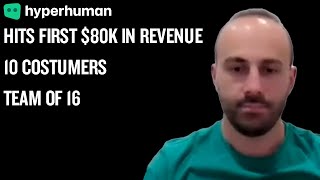
Fitness SaaS Hits First $80k in Revenue, 400 Hours of Video Content on Platform todayApr 27, 2022
[00:00] Hey, folks. My guest today is Bogdan Predusca. He is the CEO and founder of a company called hyperhuman.cc, tech entrepreneur passionate about building innovative products and great teams. He has over eighteen years in tech ranging from startups to global enterprises. He's been part of multiple high profile mergers and acquisitions, and he's nurturing nurtured a growth and solutions oriented mindset and diverse multicultural teams. Again, now building hyperhuman.cc, which is a smart content production platform for the health [00:24] and fitness industry. Bogdan, you ready to take us to the top? [00:28] >> Nathan, that was a long intro, but yes, exciting things, exciting times for this industry. [00:37] So who are you selling to directly? Is it a gym? Is it a fitness trainer or a yoga instructor? Who is it? [00:41] >> So we started from the need. The need was the digitalization of the health and fitness video content. So our mission is to make world's health and fitness videos universally accessible and reusable. That was our goal. That was our challenge to be solved by technology, by our AI. And who's the service? Who's the client? Of course, content creators, professionals in this industry, trainers, yoga instructors, coaches, but you also have the businesses on the other end, the traditional [01:16] >> businesses, the brick and mortar, the gyms, the studios and the 100 ks plus fitness apps, nutrition apps, wellness platforms that need a constant feed of quality, consistent quality content in this new world of digital or hybrid training. [01:37] So, Bogdan, we're gonna I wanna make sure we don't lose people. So just be like really specific here. So like Brave Fitness is a screenshot you use on your website, their YouTube channel. They are your ideal customer. Is that accurate? [01:49] >> Exactly. Exactly. Okay. [01:51] So that's a fitness gym. It's a physical location, not a virtual yoga instructor that's training on Peloton or something like that. Right? So do you only sell the physical locations? [02:03] >> No, no. That's for the physical locations, it's a new type of service they can provide to clients, of course, being flexible training in the location and at home or wherever you want. So you need a content for that. And on the other hand, the digital platforms that need a constant feed of content. So we are the platform for content. [02:25] So let's say that this gym has 10 trainers that the gym pays full time. Is the gym going to say, hey trainers, you can purchase this app and upload your own workouts here to get new clients to train at the gym or will the gym buy it and make the trainers upload videos so that more people sign up for gym memberships? [02:43] >> The last one. Exactly. So basically, it's a very simple any type of a team's concept. The team pays for their members, their members create content for their clients, acquire new clients, retain new clients throughout these digital services that they [03:00] now And how many gyms or people like gym, groups like gyms are paying for the platform today? [03:07] >> So imagine we just added the Teams layer early this year and we have, I think now 111. So 111 [03:19] >> is the latest number of businesses that we are now serving and they are creating and their team is creating this new type of smart video app. [03:30] Imagine this is kind of like someone buying Salesforce for their sales team and then having to convince the sales reps to actually use Salesforce. How many of these 111 gyms have actually had at least, you know, one video uploaded by one of their trainers? [03:42] >> Everyone. Every single one is willing and eager to transform their existing recordings because many already have videos. [03:52] I see. So how many total videos are on the platform today across 111 customers? [03:57] >> So just to give you an insight, a total number, we have transformed about thirty or forty hours of raw recordings into four hundred hours of quality video workouts. So it's 10x from raw recordings to new content created from a very, let's see. [04:20] Oh, what's going on there YouTube? Good to see you guys. Now imagine this, you love watching these interviews with SaaS founders, but imagine if we took all of the valuation data out from over 2,807 interviews I've done manually. Saves you a lot of time. Well, we've done this. We've built it into the beautiful interface inside of Founderpath. Check this out. I'll show you how you can access this in a second, but you log in, you connect [04:43] your Stripe account, you see your valuation real time. You can see what it changed over the past eighty eight days and even set goals for valuation this year. Now the secret evaluation is there's many different ways to value a SaaS business. So the reason you're gonna see three or four different valuations inside of your Founderpath dashboard, this is all free by the way, is because depending on who's doing the buying of your SaaS company, you're gonna [05:08] get a different valuation. A VC is gonna pay a different valuation. Private equity firm is different. If you're gonna do a minority sale, that's different. And if you sell the whole business, that's a different valuation. You can see all those when I hover over here, Right? So the teal is what a VC would pay. Yellow is what private equity and red is if you sold the whole thing outright. Now what's cool about this is this is [05:30] not built off random data. Again, you guys hear these interviews on YouTube. All these datas are built from real time valuation data points founder share with us on the show. So traction, 1,200,000 seed round, 3.7 raise. They sold 22% of their business. Go in here and filter by the event. Maybe you only wanna see companies that have sold the whole business. Well, here are a bunch that have been acquired the valuation and the multiple. Maybe you're [05:55] going out right now and you're raising your seed round. We'll go in here and look at all this recent seed deals that went down, what they raised, what valuation they raised at, and what percent that they sold. There's never been a larger dataset of SaaS valuations than what you can get now inside of Founderpath. And we're thrilled to bring it to you. Alright. We're gonna go back to the YouTube video here in a second, but if [06:17] you wanna check this tool out, if you wanna jump in and sign up, you can check it out for free to get your valuation at this link. This link, founderpath.com/products/valuations. Or if you go to founderpath.com and hover over products, click on get your valuation here, and go ahead and sign up to give it a whirl. Again, all that valuation data live right inside the platform. I hope to see you there. Alright. Let's jump back into the [06:44] interview. So today across 111 customers, there's four hundred hours of video workouts on the platform. [06:51] >> Exactly. So about four hours. [06:53] >> Counting also the, of course, the professionals that they uploaded the videos. Yes. [06:59] Got it. So so so about four hours per customer today? Per gym? [07:03] >> Yes. [07:04] >> Imagine starting from forty minutes or thirty minutes of recording shootings that they already have. [07:11] Super interesting. And so how much do one of these gyms pay for the platform per month or per year? [07:16] >> So it's a basic software as a service subscription based on different tiers. Basically, it's one, three or twelve month subscription. It's starting at $149.99 [07:29] And so what is the average one pay today? $150 a month? [07:33] >> We see a trend between three months. So going into the three months because that's the most, let's say, the sweet spot where you can see how it works and also create a digital strategy around it. But it's too early to tell what's the winner in terms of duration. [07:50] Yeah, Bogdan, sorry, if you just look at your paying customers today and look at the most common that price point you're paying per month, That's what I'm asking. Is it $150 a month? [07:58] >> The business says that's the price point that they are paying at this point. Individuals, it's a much, let's say, cheaper subscription for individual professionals. [08:08] So I thought you said you were selling to the gyms. You weren't asking the trainers to pay. [08:12] >> We already have that delivered. That was our MVP, if you want. Last year, we launched it for individual professionals. And this year, we added the Teams layer on top of it. [08:24] Okay. So there's 111 Teams currently paying about $150 a month. And then how many individuals are on the platform that are paying? [08:30] >> We now have, I think, 3,000 individuals, so professionals on the platform. Not everyone is paying because we have a freemium model. We can create up until a certain level of content completely free all the time. So we have about, I think, five to 10% paying on the professional side. [08:52] And what do the professionals pay per month on average? [08:55] >> We see a distributed, let's say, price point between three months subscriptions to one year subscription. The starting point is, I think at this point, we have a discounted [09:10] >> $59.99 per month for three months. [09:14] Okay. So $20 a month is your average? [09:16] >> About. [09:17] Okay. So $20 a month times, you know, 300, which would be 10% of your 3,000 individuals, right? So $20 times 300, you're doing like $6,000 a month from individuals in revenue, something like that? [09:30] >> Yes. So it's still early in terms of revenue. Of course, we are, I think now fifteen months old. So we launched the product in August last year, the MVP, the commercial version by the end of the year. And we now iterated and added the Teams layer. So it's a very fast paced, let's say. [09:52] That makes sense. Now, can I take 111 Teams using you at $150 apiece? You're doing about $16,000 a month of revenue on the Teams product? [10:02] >> Just to add a comment here, many are in the trial phase. So basically, they have a trial, a free trial before their subscription is activating. [10:13] So how many paying customers do you have on the Teams side? [10:16] >> Right now, I think we have about five to 8% converted to paying customers. [10:22] Okay. So there's about 10 that are paying on the team side. [10:25] >> All the remaining are one are now in the trial that ends in a few weeks from now. [10:30] Got it. So you've got 6,000 of monthly recurring revenue from individuals and another 1,500 from teams, but you're focused on teams moving forward and have about another 100 that haven't converted yet in a trial. [10:40] >> Exactly. That's the goal and that's the [10:43] How are you converting people? You know, it's very diff Some people really struggle with this. How are you converting the trials to paid accounts? What's the playbook? [10:50] >> It's a very simple thing. It's if you transform and create value for them, if you transform their existing videos with no pain points like video editing skills needed, tech skills needed, marketing skills needed. They get it. It's easy. They can use it in multiple channels for multiple purposes. [11:10] So you're doing this for them. You're saying give us your old videos, we'll do all the work for you. We'll cut them up in little segments. We'll edit them all that. [11:15] >> Yes. How do pay for that? We we have a video AI that identifies the the exercises. We give them the exercise library back. They can use it to create new content that create that new content is fast productive, produced on our end. [11:32] So have full time editors though, Bogdan, on your team? [11:35] >> Technology. That's that's the the the secret if you want. [11:41] So how many folks are on your team today full time? [11:43] >> We have two people on the content moderation side. [11:46] How many how many the total are on your whole team? [11:49] >> We have 16 people now. [11:51] One six? [11:52] >> One six on three continents. [11:54] Okay. So you raised some money then to pay to pay them because you're not doing enough revenue. [11:58] >> We raised the one early seed and one late seed. So the first round was closed in December, 500 ks euros, that's about 600 something k dollars. And just about two months ago, we raised a late seed of the same amount about €500,000. So, in total, raised in about one year and a half one point two million dollars, I think. [12:29] And what you sold about 20% of the business? [12:32] >> It's usually around that. Across [12:37] both rounds or altogether you sold 20% to investors? [12:40] >> You should not do that. You should not do 20% per round. Then in three rounds, you are not even the majority of them. No. So it's around that percentage for both. For total, total. [12:54] Yeah. So we look at your cap table today, 20% is going be owned by these two investors that put in capital twice. See the Yes. [13:00] >> I actually we have four tech investment funds. See. That's a very nice thing to have. Only no business angels, just funds that have experience in this industry. [13:13] Why did you need to raise capital to do this? You know, you're now you've raised, which means you have to grow. And if you don't, you're screwed. Right? [13:19] >> Exactly. [13:20] So you're going get diluted. There's going be a down round. It's not going to be pretty. So why do you need money? [13:24] >> Yeah, that's the most challenging part and people just don't see this other part of the raising game. We raised money to be able to develop the technology, to be able to grow and to be able to have the marketing budget. If you see now what's happening in the industry, you compete against products, platforms, competitors that throw in millions of dollars in marketing, business development activities, awareness activities. You need some capital to be able to go into [14:00] >> the B2B side. So for the team side, you need to be there where your clients are, events and all other activities that are cash intensive. The software, the product development, the design part is the most or the least cash intensive part. [14:18] Understood. Understood. Okay. So, and just to be clear, the last turn you did 600 ks seed, it sounds like you did that, you sold 10% twice, so 20% total. So it was like a 5,000,000 valuation, something like that. [14:28] >> Yes, that's very we are very grateful for having this, let's say, deployment of capital in Okay. [14:38] So you're scaling, you're rolling out your team's product. We'll see what happens. We're certainly rooting for you. But for today, we're out of time. Let's wrap up with the famous five, Bogdan. Number one, last book that you read. [14:48] >> I I didn't get the question. [14:50] Yeah. No problem. What's the last book that you read? [14:53] >> I'm reading right now a very good book for for scaling. Peak performance. That's Peak performance. [14:59] Number two, is there a CEO you're following or studying? [15:04] >> Yes. A few, including my former boss at Fitbit. [15:09] A huck what? [15:10] >> My former boss at Fitbit, I'm also I'm still following him. [15:15] Number three, what's your favorite online tool for building the business? [15:20] >> Spreadsheet and Google Doc. [15:22] Mhmm. And number four, how many hours of sleep do you get every night? [15:27] >> Nine to eight to nine. It's very, very important. [15:31] And, Bogdan, what's your situation? Married? Single? Kids? [15:34] >> I'm in a relationship. [15:36] No kids? [15:38] >> No. [15:39] It's very And [15:40] how old are you? [15:41] >> 36. [15:42] >> 36. [15:43] Last question. Something you wish you knew when you were 20. [15:46] >> To do this earlier. [15:49] Start earlier. Guys, hyperhuman.cc, they raised 600,000 seed last year, another 600 ks this year, sold about 20% of the business to investors. They're helping though gyms take old video content and put them into a beautiful app with segmented videos, beautifully edited. They have over four hundred hours of content on their platform today. They're doing about $7,000 a month right now in revenue, looking to scale with this new capital. Team of 16. We'll see what happens next. [16:13] Bogdan, thanks for taking us to the top. [16:14] >> Many many thanks. A pleasure talking to [16:19] One more thing before you go. We have a brand new show every Thursday at 1PM Central. It's called Shark Tank for SaaS. We call it deal or bust. One founder comes on, three hungry buyers, they try and do a deal live and the founder shares back end dashboards, their expenses, their revenue, ARPU, CAC, LTV, you name it, they share it and the buyers try and make a deal live. It is fun to watch every Thursday, 1PM [16:44] Central. Additionally, remember these recorded founder interviews go live. We release them here on YouTube every day at 2PM Central. To make sure you don't miss any of that, make sure you click the subscribe button below here on YouTube, the big red button, and then click the little bell notification to make sure you get notifications when we do go live. I wouldn't want you to miss breaking news in the SaaS world, whether it's an acquisition, a big [17:06] fundraise, a big sale, a big profitability statement or something else. I don't want you to miss it. Additionally, if you wanna take this conversation deeper and further, we have by far the largest private Slack community for B2B SaaS founders. You want to get in there. We've probably talked about your tool if you're running a company or your firm if you're investing. You can go in there and quickly search and see what people are saying. Sign up [17:28] for that at nathanlatka.com/slack. In the meantime, I'm hanging out with you here on YouTube. I'll be in the comments for the next thirty minutes. Feel free to let me know what you thought about this episode and if you enjoyed it, click the thumbs up. We get a lot of haters that are mad at how aggressive I am on these shows, but I do it so that we can all learn. We have to counter those people. We [17:48] got to push them away. Click the thumbs up below to counter them and know that I appreciate your guys'support. Alright, I'll be in the comments. See you.
Data and Sources
All figures on this page are taken directly from interviews or are estimates from public sources and proprietary models. Not financial advice. Read full disclaimer.
Claim this profilePeople Also Viewed
Dobooks
Developer of digital interactive books intended to provide magical applications. The company's...
Tripetto
For making vivid conversational exchanges with your audience
Discovry
Discovry is a Bristol and Exeter-based social media marketing platform built for small businesses...
HippoFish
OUR MISSION To develop stellar cloud-based retail and ticketing software solutions that focus on...
Sprint Boards
Sprint Boards is an online platform that provides a free retrospective tool for Agile Scrum. It...
SmartFarming
Developer of a farm management application designed to provide the farmers with agricultural...