
Founder Interview
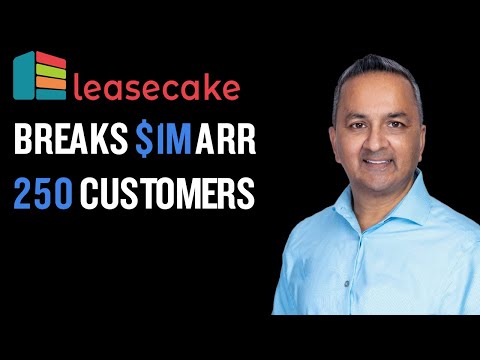
How Leasecake Grew to 250 Customers and Zero Gross Churn While Tracking to $1M ARR (Interview with CEO Taj Adhav)
- Interview Date
- October 13, 2021
- Interviewee
- Taj AdhavCEO
Company Metrics at Interview Time
ARR Run Rate (2021)
$1M
Customers (2021)
250
Net Revenue Retention (2021)
127%
Gross Churn (2021)
0%
Valuation (2021)
$12.2M
Historical Snapshot
These numbers were reported by Taj Adhav during his interview with Nathan Latka recorded in October 2021 and are a historical snapshot, not current figures. See Leasecake’s current numbers.
Key Takeaways
- 01Leasecake was tracking to $1M in ARR as of October 2021
- 02The company serves 250 customers managing more than 10,000 locations across the US and other geographies
- 03Average contract value is $10,000 per year, structured as an annual licensing fee on a per-lease model
- 04Net revenue retention stands at 127% with zero gross churn over the prior twelve months
- 05The company raised a $2M convertible note in 2018 followed by a priced seed round in February 2021
- 06Valuation at the seed round close was $12.2M post-money
- 07The team includes 23 full-time employees, 8 of whom are engineers
- 08Revenue grew from roughly $10,000 to $15,000 per month a year earlier to a roughly $1M ARR run rate at interview time
Company Metrics at Time of Interview
| Metric | Value | Source |
|---|---|---|
| ARR Run Rate (2021) | $1M | Founder interview, Oct 2021 |
| Customers (2021) | 250 | Founder interview, Oct 2021 |
| Locations Managed (2021) | 10,000+ | Founder interview, Oct 2021 |
| Average Contract Value (2021) | $10,000 | Founder interview, Oct 2021 |
| Net Revenue Retention (2021) | 127% | Founder interview, Oct 2021 |
| Gross Churn (2021) | 0% | Founder interview, Oct 2021 |
| Team Size (Full-Time) (2021) | 23 | Founder interview, Oct 2021 |
| Engineers (2021) | 8 | Founder interview, Oct 2021 |
| Convertible Note Raised | $2M | Founder interview, Oct 2021 |
| Seed Round Raised (2021-02) | $3.2M | Founder interview, Oct 2021 |
| Post-Money Valuation (2021) | $12.2M | Founder interview, Oct 2021 |
| Year Founded | 2018 | Founder interview, Oct 2021 |
| Monthly Revenue (approx., prior year) (2020) | $10,000 to $15,000 | Founder interview, Oct 2021 |
| Sales Cycle (2021) | 2 days to 2 months | Founder interview, Oct 2021 |
| Leases per Average Customer (2021) | 25 to 100 | Founder interview, Oct 2021 |
Growth Breakdown
Revenue
Leasecake was tracking to a $1M ARR run rate by October 2021, up from roughly $10,000 to $15,000 per month a year earlier. Taj Adhav credited a hockey-stick acceleration that began in June 2021, with a prior surge in 2020 despite COVID conditions.
Customers
The company serves approximately 250 customers at interview time, representing around 1,000 individual users and more than 10,000 locations across the US and international markets. Five distinct customer segments include franchisees, franchisors, corporate tenants, private equity firms, and tenant rep brokers.
Team
Leasecake has 23 full-time employees and 32 total workers at interview time, with 8 engineers kept entirely in house. Investment from the seed round is directed primarily toward sales and engineering, including new features and product offerings.
Funding
The company bootstrapped from founding in 2018 with the support of a $2M convertible note from early family office investors. In February 2021 Leasecake closed a priced seed round of $3.2M at a $12.2M post-money valuation, which was oversubscribed. A Series A was planned for mid-2022 to support global expansion.
Growth Strategy
Per-Lease Pricing Model
Leasecake charges an annual licensing fee on a per-lease basis, with an average contract value of $10,000 per year. This model scales with the customer from 3 to 3,000 locations and was designed to keep the entry price accessible for a brand-new software category.
Expanding Legacy Customers Upward
Early customers were onboarded at lower price points to drive adoption in an uneducated market. Taj Adhav noted the company is actively moving those customers to 2x to 3x their original pricing, which is a primary driver of the 127% net revenue retention.
No-Touch Sales Motion
Leasecake operates a no-touch sales model where demos are largely self-explanatory and sales reps follow a set-it-and-forget-it approach. This keeps the sales cycle short, typically two days to two months, even for multimillion-dollar corporate operators.
First-Mover Category Creation
Taj Adhav positioned Leasecake as the inventor of location management as a software category, distinct from property management tools built for landlords. Winning a global technology award across 58 countries in 2017 validated the concept and helped attract early investors and customers.
Network Effects and Operating System Positioning
The company frames itself as an operating system for location management, aiming to become a must-have application on every operator's mobile device. Taj Adhav described Leasecake as a network effects play and an operating system play, and said that if you are going to build an operating system, time is your enemy, which is the reason he raised capital instead of continuing to bootstrap.
Best Quotes
“leasecake was started really kind of over a cup of coffee at a diner because I just was kind of looking for what's my next gig. And it turns out there was this massive unserved market that we've invented. We've created a whole new category that we're going after.”
“everybody in business owns or leases commercial real estate. Where's the app for that? And so while leasecake is this operating system for lease management, we're also really an OS for location management, primarily for tenants and of all different types and sizes.”
“So that's our average deal size, and it's an annual licensing fee. And it really kind of scales up or down whether you have three locations, 30 or 300 or 3,000.”
“$10,000 a year. That's the ACV.”
“we have seen a pretty strong adoption, strong enough to have 127% net revenue retention. Some of our earlier customers were at a lower price point. We're now moving them up rather quickly to effectively 2x to 3x what they were originally paying.”
“We're basically at $1,000,000 in ARR. We're tracking to be $1,000,000 in ARR. And I think it was very important to make sure it was an affordable price point. It's a totally new domain, so we can't just say, hey, it's a $50,000 enterprise sales cycle. We typically have a fast sales cycle of anywhere between two days to two months, I'd say, on average.”
“No customer churn, no revenue churn.”
“What I wish I knew was, man, find something that makes you happy. Success will be absolutely yours to have, right? Never ever become a CPA because your parents told you to.”
What Happened Next
This interview captures Leasecake in October 2021, when Taj Adhav said the company was tracking to $1M in ARR with 250 customers and more than 10,000 managed locations, eight months after closing a $3.2M priced seed at a $12.2M post-money valuation, with a Series A planned for mid-2022. The figures here are what he reported on the recording date and should be read as a historical snapshot. Leasecake has continued to operate and grow since this conversation: in August 2023 the company promoted COO Scott Williamson to CEO, with Adhav moving into a chief brand officer role. Visit the Leasecake company profile on GetLatka for current metrics and funding history.
View Leasecake’s current profile and metricsFull Transcript
Chapters
- 0:00Introduction and Taj Adhav's Background
- 1:39How Leasecake Was Founded
- 2:09What Leasecake Does: Location Management OS
- 2:37The Problem Inside Commercial Leases
- 3:54Pricing Model and Average Contract Value
- 6:44Customer Count and Net Revenue Retention
- 7:38Revenue: $1M ARR Run Rate and Growth Trajectory
- 8:34Seed Round Valuation and Term Sheet
- 9:30Funding History: Convertible Note and Seed Round
- 10:34Co-Founder Equity Split and Ownership
- 12:27Team Size and Engineering
- 13:00No-Touch Sales Model
- 13:08Gross Churn and Expansion Revenue
- 14:03Famous Five: Books, Tools, and Habits
- 15:14Advice to His 20-Year-Old Self
Introduction and Taj Adhav's Background
Nathan Latka
00:00Hey, folks. My guest today is Taj Adhav. He spent more than twenty five years in technology and business. After starting as a big four CPA, he managed more than 2,000,000,000 in assets for Disney development company. As an early hire at Channel Intelligence, he helped drive the company to a successful exit to Google in 2013. Taj, you're ready to take us to the top?
Taj Adhav
00:17>> Absolutely. Thank you very much, Nathan. Looking forward.
Nathan Latka
00:19So what was Channel Intelligence? What were you guys building back then?
Taj Adhav
00:23>> It was an e commerce data platform that effectively put buy now buttons on manufacturers'product pages as the internet and e commerce was really taking off. So we literally managed billions of micro transactions and billions of dollars of
00:42>> making it easy for consumers to click and find the places they can buy products. Were
Nathan Latka
00:48you early enough there to get some equity or no?
Taj Adhav
00:50>> Yeah, absolutely. I was employee number eight. When I was a CPA at Disney, I'm like, man, I need to repot myself and was their CFO. Then I transitioned into business development. I saw the power of software, so it was good to get in early.
Nathan Latka
01:03That's great. I mean, I ask, are we talking like 1% or like 10%?
Taj Adhav
01:07>> Probably like, I think by the time the exit happened, dilution takes place. So sub 10%. But enough to give me a taste and not enough that it left me hungry.
Nathan Latka
01:21Yeah, yeah. So we can say between sort of 1 to 10%, something like that. Right.
01:27Sorry. You cut out. Yeah. Yeah. Yeah. Yeah. So that that happened in 2013. And I think that exit price was what? That was a $125,000,000 deal, right?
Taj Adhav
01:35>> Correct.
Nathan Latka
01:36Yeah. So did you go right into leasecake after that or no?
How Leasecake Was Founded
Taj Adhav
01:39>> No, I frankly kind of lost. Did some consulting gigs, started my own businesses, lived in other parts of the planet, came back and leasecake was started really kind of over a cup of coffee at a diner because I just was kind of looking for what's my next gig. And it turns out there was this massive unserved market that we've invented. We've created a whole new category that we're going after. And frankly, it's kind of based on
What Leasecake Does: Location Management OS
Taj Adhav
02:09>> this simple idea that everybody in business owns or leases commercial real estate. Where's the app for that? And so while leasecake is this operating system for lease management, we're also really an OS for location management, primarily for tenants and of all different types and sizes.
Nathan Latka
02:29So what does this mean? If McDonald's has 100,000 locations on the East Coast, they're going to use your app to manage all that real estate? Or how does that work?
The Problem Inside Commercial Leases
Taj Adhav
02:37>> Yeah, so basically whether you're in the franchise business, you're a corporate tenant, whether it's retail or office or in private equity, the use case is there's tools like property management, facility management. Those are traditionally geared for landlords. Location management is a new domain. So in your example, whether you're a franchisee or a franchisor with, say, thousands of locations, the things that matter to you most are typically the things that can potentially blow up and you're not
03:11>> looking at the details. Within a commercial real estate lease, there are 100 different things that could potentially trip you up. One of the most obvious is missing a renewal option. The others are dates that are specific when a personal guarantee should expire or do you need to get permission from a landlord to sell your locations. All of those kinds of things are really buried in a piece of paper that sits in a drawer that no one
03:37>> looks at until it matters. So we've created a cloud based system that puts all of that information in a very easy to use application and provides proactive notifications as well and team collaboration.
Nathan Latka
03:49It's And so what are
03:51customers paying on average for this technology?
Pricing Model and Average Contract Value
Taj Adhav
03:54>> Yeah, so we're based on a per lease model. Our average customer is probably around 10,000 to $15,000 a month on average as our deal size has gotten larger. We've seen explosive growth through COVID, which frankly surprises the investor community, but it doesn't surprise us. So that's our average deal size, and it's an annual licensing fee. And it really kind of scales up or down whether you have three locations, 30 or 300 or 3,000.
Nathan Latka
04:29So, Taj, just to be the average customer paying $10,000 a month or $120,000 a year upfront?
Taj Adhav
04:33>> Nope, $10,000 a year. That's the ACV.
Nathan Latka
04:36Got it.
04:37That's not the ARPU, that's the ACV is $10,000.
Taj Adhav
04:40>> Yep, that's correct. And I
Nathan Latka
04:41we found that this model
Taj Adhav
04:42>> is a very simple model to understand. And because we're a network effects play, we're an operating system play, it's important as we look at these clients and we say, there's a better way to do this than spreadsheets or Judy in the back that's keeping track.
Nathan Latka
04:59Yeah, Taj, I totally get the product. It makes complete sense. I think the audience totally gets that. People are rushing to sign up right now. So when you're charging up a per lease model, someone paying you $10,000 per year, how many leases are they probably managing at that price?
Taj Adhav
05:11>> Anywhere between, let's say, 25 to 80 to 100.
Nathan Latka
05:16If you're charging like 200 to 500 per lease, something like that.
Taj Adhav
05:20>> Yep, that's right.
Nathan Latka
05:22Okay, cool. When did you launch the business? What year?
Taj Adhav
05:25>> Let's see. Probably beginning of twenty eighteen, late twenty seventeen is when we won this global technology award across 58 countries. And we said, I think we've got a business. So that's when we started. And we basically shoe strung or bootstrapped our way into having a team and grew it. That led to our VC round, our CVC round in February.
Nathan Latka
05:49February 2021?
Taj Adhav
05:51>> Yeah, that's correct.
Nathan Latka
05:52How much was that for?
Taj Adhav
05:54>> 3,000,000. It was oversubscribed, 3.2, I think it was.
Nathan Latka
05:57Okay. And why did you need to raise capital? Why couldn't you keep bootstrapping?
Taj Adhav
06:01>> Well, we found that the opportunity was too great for us to kind of nurture this along. When you're the first mover and you're there to educate a marketplace, we had such a substantial lead as our earliest investors were really family office insiders with customers over the product. So we felt that if you're going to build an operating system, time is your enemy. You need to have an application that demands to be on everyone's mobile devices as
06:32>> soon as possible. So That's really what we're about and that's the reason we raise the capital.
Nathan Latka
06:38You get going in 2018, raise some capital this year. How many customers are you serving now today?
Customer Count and Net Revenue Retention
Taj Adhav
06:44>> About two fifty customers represents maybe about 1,000 different users in our system and 10,000 plus locations across The U. S. And other geos.
Nathan Latka
06:54Now, can I multiply two fifty customers times that $10,000 ACV? You're doing about $220,000 a month right now in MRR?
Taj Adhav
07:02>> No, that's not the case because what we've done is had a lower price point model.
Nathan Latka
07:09We
Taj Adhav
07:09>> have seen a pretty strong adoption, strong enough to have 127% net revenue retention. Some of our earlier customers were at a lower price point. We're now moving them up rather quickly to effectively 2x to 3x what they were originally paying. We've got some legacy customers, long story short, and we're excited about where it can take us.
Nathan Latka
07:34So are you guys north of $200,000 a month right now in revenue, or you think you'll break that this year?
Revenue: $1M ARR Run Rate and Growth Trajectory
Taj Adhav
07:38>> We're basically at $1,000,000 in ARR. We're tracking to be $1,000,000 in ARR. And I think it was very important to make sure it was an affordable price point. It's a totally new domain, so we can't just say, hey, it's a $50,000 enterprise sales cycle. We typically have a fast sales cycle of anywhere between two days to two months, I'd say, on average. And these are pretty large operators that are kind of multimillion corporations in and of
Nathan Latka
08:09>> themselves.
08:09And if you're doing like $70,000, $80,000 a month today in revenue, where were you a year ago? Do you remember?
Taj Adhav
08:15>> Yeah. We were at probably, let's say,
08:20>> $20.15 grand, I'd say. No, actually, even less, $10. $10 to $15 grand.
Nathan Latka
08:26Yes. A lot of growth here. You raised the seeds right in the middle of all this growth, 3,200,000 raised. Now, did you do that on a priced round or a safe?
Taj Adhav
08:32>> It was a priced round. Yep.
Seed Round Valuation and Term Sheet
Nathan Latka
08:34Okay. And what sort of valuation did you go and raise at?
Taj Adhav
08:39>> Let's see, it was a 12 post, so it's 12.2 right now.
Nathan Latka
08:4312 post. And looking back, was that the right price or could you get higher or lower? What do you think?
Taj Adhav
08:49>> I think we got a really fair deal. We pushed and we negotiated a term sheet that was very palatable to us as founders.
08:59>> Think our initial term sheet was a little bit lower, but I think we found the right number to make sure that it was kind of a win win on both sides.
Nathan Latka
09:07It sounds like when you closed that earlier this year, what you're probably doing, like $40,000 or $50,000 a month in revenue?
Taj Adhav
09:14>> Probably a little less than that. Saw this hockey stick happen, Nathan, probably in June. Hockey stick happened again back in 2020 despite COVID, but certainly with more rocket fuel in the engine. This summer was phenomenal.
Funding History: Convertible Note and Seed Round
Nathan Latka
09:30Now is the $3,200,000 you raised in February the only money you've raised, or did you raise any before that in 2018?
Taj Adhav
09:36>> We did have a convertible note that was provided to our earliest investors, so that kind of helped us continue to bootstrap. But you know, this round, this is the only price round that we've had.
Nathan Latka
09:52So that note, was that a $2,000,000 note?
Taj Adhav
09:54>> Correct. Yeah.
Nathan Latka
09:55So that 2,000,000 converted in with the 3.2, so 5,000,000 to 12. I mean, that's a pretty darn diluted. I mean, that's a pretty dilutive seed round, right?
Taj Adhav
10:03>> It's one of those things where you kind of have to make your bets and find the right kind of partners that believe in ultimately this operating system plan.
Nathan Latka
10:14Do you have co founders or were you the sole founder at the start?
Taj Adhav
10:18>> I have co founders. So to date, myself and two other founders that have been instrumental.
Nathan Latka
10:25When you guys were out there on day one coding this together in 2017 and you had the tough early on conversations, did you guys just split it evenly, a third, a third, a third, or no?
Co-Founder Equity Split and Ownership
Taj Adhav
10:34>> No. We did, I think, a very thoughtful approach in terms of value, contributions,
10:42>> the longevity of each individual's role. So it was myself and Jim Bankston and Dave Schrader. So that's really
10:53>> the core team. We brought it
Nathan Latka
10:55Is this a long way of saying you own them more than the other two?
Taj Adhav
10:58>> That's correct. Yeah.
Nathan Latka
11:00Alright. So you you start out with maybe, like, what, 70%? They split the rest, and you guys go from there?
Taj Adhav
11:06>> Pretty much. Yeah.
Nathan Latka
11:07Okay. Fair. So so got it. So today, what? I mean, if you guys have raised at that valuation, you've sold like 30% of the business to investors, something like that today?
Taj Adhav
11:16>> A little bit more than that, yep.
Nathan Latka
11:18Okay, okay. Any plans to raise additional capital moving into 2022?
Taj Adhav
11:22>> Absolutely. I think as we built an operating system, this is not just a U. S. Play. This is a global play. Many of our customers are already asking and many of our customers are already in those markets, so Series A is definitely in the plans for mid-twenty twenty two, and we're excited about that.
Nathan Latka
11:44You raised the $3,200,000 I'm curious. Where are you investing that money out today?
Taj Adhav
11:52>> Primarily sales. On the software side, yes, we've invested, but I think this is about a lather, rinse, repeat model. What are the key metrics? How many different sales pods? What verticals are we going after? We have five distinct customer segments. We've got franchisees, franchisors, corporates, private equity, and tenant rep brokers, within those different industry verticals. It's about making sure that we get our metrics right and we have those completely dialed in. It's sales primarily and then
12:25>> engineering, new features, new product offerings.
Team Size and Engineering
Nathan Latka
12:27How many are on the team today?
Taj Adhav
12:30>> Let's see. We've got 32
12:34>> hires in the company, workers in the company, 23 full time employees.
Nathan Latka
12:40How many of those folks are engineers?
Taj Adhav
12:43>> About eight of them.
Nathan Latka
12:47Okay. And you've chosen to keep everything in house development wise or are you using any outsourced firms?
Taj Adhav
12:52>> No, they're all in house.
Nathan Latka
12:54Okay. And do you pair those engineers with any sort of quota carrying sales reps or no? It's a no touch model?
No-Touch Sales Model
Taj Adhav
13:00>> It's a no touch model. Our sales reps are, you know, of set it and forget it. The demos are relatively self explanatory.
Gross Churn and Expansion Revenue
Nathan Latka
13:08And you mentioned healthy net dollar retention, is 127% is great, but peel back that onion for me. What's gross churn look like over the past twelve months?
Taj Adhav
13:16>> Zero.
Nathan Latka
13:17Okay, got it. So your expansion revenue has been 27% for net 127.
Taj Adhav
13:22>> Correct, right. No customer churn, no revenue churn.
Nathan Latka
13:25What about revenue?
Taj Adhav
13:26>> Okay, yeah, was going say no revenue.
Nathan Latka
13:28So no one went from one location or 10 locations down to eight locations? No downgrade revenue, nothing like that?
Taj Adhav
13:35>> The location count may have gone down, but our revenue count has compensated
13:44>> for any reductions. So that net revenue retention of 127% is irrespective of any location degradation, if you will. We haven't seen much of location degradation because I think, frankly, the ones that are leading into technology, the ones that are winning,
14:01>> and they need a better system.
Famous Five: Books, Tools, and Habits
Nathan Latka
14:03All right, Taj, that's good stuff. Let's wrap up here with the famous five. Number one, what's your favorite business book?
Taj Adhav
14:09>> Zero to One.
Nathan Latka
14:11Number two, is there a CEO you're following or studying?
Taj Adhav
14:15>> Bob Iger is an absolute role model. I mean, I've got Disney experience and the stuff that he's learned are many of the stories that I've also learned.
Nathan Latka
14:23Number three, what's your favorite online tool for building a business?
Taj Adhav
14:27>> Favorite online tool building a business?
14:35>> Would say HubSpot was a great beginner for us even though we're graduating in Salesforce.
Nathan Latka
14:40Okay. And number four, how many hours of sleep do you get every night?
Taj Adhav
14:45>> Four and a half.
Nathan Latka
14:47Taj, that's not healthy.
Taj Adhav
14:49>> It's not. It's not sustainable, but I do take naps, my friend.
Nathan Latka
14:52Okay. Got it. Got it. So you're taking naps. And what's your situation? Married, single, kids?
Taj Adhav
14:57>> Married, got a great, great spouse, thirty five years. Kids are off and they're living there.
Nathan Latka
15:03How many kids?
Taj Adhav
15:05>> Two daughters.
Nathan Latka
15:06Two. Very cool. And how old are you?
Taj Adhav
15:09>> I am a lot older than you would think.
Advice to His 20-Year-Old Self
Nathan Latka
15:14Okay. You don't want to share your age. No problem. We ask because then the next question as we wrap up here is take us back to your 20 year old self. What's something you wish you knew?
Taj Adhav
15:23>> What I wish I knew was, man, find something that makes you happy. Success will be absolutely yours to have, right? Never ever become a CPA because your parents told you to.
Nathan Latka
Taj Adhav
15:40>> have no regrets, but that's my story.
Nathan Latka
15:42Leasecake.com founded in 2018. They raised 2,000,000 on a note, then raised a price around 3,200,000 on a 12 post money earlier this year as they continue to scale up to about $1,000,000 in terms of run rate. That's up from just $10,000 a month a year ago. So really healthy growth, serving two fifty customers. Over 10,000 locations are managed by these B2B corporate clients, again, who need this location management system called leasecake. Taj, thanks for taking us
16:06to the top.
Taj Adhav
16:07>> Thanks very much, Nathan. Enjoyed it.
Nathan Latka
16:10One more thing before you go. We have a brand new show every Thursday at 1PM Central. It's called Shark Tank for SaaS. We call it deal or bust. One founder comes on, three hungry buyers, they try and do a deal live and the founder shares back end dashboards, their expenses, their revenue, ARPU, CAC, LTV, you name it, they share it and the buyers try and make a deal live. It is fun to watch every Thursday 1PM
16:35Central. Additionally, remember these recorded founder interviews go live. We release them here on YouTube every day at 2PM Central. To make sure you don't miss any of that, make sure you click the subscribe button below here on YouTube, the big red button and then click the little bell notification to make sure you get notifications when we do go live. I wouldn't want you to miss breaking news in the SaaS world, whether it's an acquisition, a big
16:58fundraise, a big sale, a big profitability statement or else. I don't want you to miss it. Additionally, if you want to take this conversation deeper and further, we have by far the largest private Slack community for B2B SaaS founders. You want to get in there. We've probably talked about your tool if you're running a company or your firm if you're investing. You can go in there and quickly search and see what people are saying. Sign up
17:19for that at nathanlatka.com/slack. In the meantime, I'm hanging out with you here on YouTube. I'll be in the comments for the next thirty minutes. Feel free to let me know what you thought about this episode. And if you enjoyed it, click the thumbs up. We get a lot of haters that are mad at how aggressive I am on these shows, but I do it so that we can all learn. We have to counter those people. We
17:39got to push them away. Click the thumbs up below to counter them and know that I appreciate your guys'support. Alright, I'll be in the comments. See you.