Growth Era
Jacksonville, Florida, United States
2023 Revenue
$1.6M(Est.)
Customers · 2022
45
Funding
$0
Team
219
Founded
2018
Growth Era Revenue (2023)
Growth Era generated an estimated $1.6M in annual revenue in 2023. Source: GetLatka estimate
Growth Era (operating as Next Sales) is a bootstrapped, tech-enabled sales development service founded in 2018 and headquartered in the United States. The company provides outsourced sales development representative services to B2B SaaS companies, staffing and managing SDR teams that book qualified meetings for client account executives at a fixed monthly rate per seat.
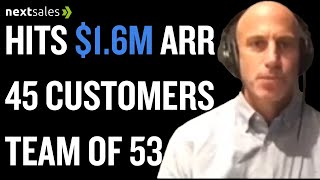
Andrew Jacoby co-founded the company and served as its CEO before stepping aside to become Chief Innovation Officer, bringing in Bryce Kaspar as CEO. As of mid-2022, the company reported approximately $1.6 million in annualized revenue, serving 45 clients with a team of 53 employees, 36 of whom are active SDRs.
The company is fully bootstrapped with no outside funding. Net dollar retention stood at 105% as of 2022, reflecting a shift from early high churn to net expansion after operational improvements led by the incoming CEO.
Last updated
Growth Era Revenue
Next Sales reported annualized revenue of approximately $1.6 million as of mid-2022, based on a monthly run rate of $135,000 to $140,000 that Jacoby cited during the interview. The company's revenue trajectory shows consistent year-over-year growth from its founding: $129,000 in 2019, $450,000 in 2020, $1.2 million in 2021, and the $1.6 million annualized figure in 2022.
| Year | Milestone | Source |
|---|---|---|
| 2023 | Growth Era Hit $1.6m revenue in November 2023 | Estimated |
| 2022 | Growth Era Hit $1.6m revenue in January 2022 | Watch[1] |
| 2021 | Growth Era Hit $1.2m revenue in January 2021 | Watch[2]Estimated |
| 2020 | Growth Era Hit $450k revenue in January 2020 | Watch[3]Estimated |
| 2019 | Growth Era Hit $129k revenue in January 2019 | Watch[4]Estimated |
| 2018 | Launched with $0 revenue |
Year-over-year growth from 2019 to 2020 was approximately 249%. Growth from 2020 to 2021 was approximately 167%. Growth from 2021 to the 2022 annualized run rate was approximately 33%, reflecting a deliberate decision by the incoming CEO to slow top-line growth and address operational and churn issues rather than continue aggressive top-of-funnel expansion. Jacoby noted that the prior year's monthly run rate was roughly $100,000, confirming the step-up to the current $135,000 to $140,000 range.
GetLatka estimate: applying the most recent trailing growth rate of approximately 33% as a ceiling and a further deceleration to roughly 15% as a floor, 2023 annualized revenue would fall in a range of approximately $1.84 million to $2.13 million. This is a GetLatka estimate based on the 2021-to-2022 growth rate and an assumed deceleration; the company did not provide forward guidance.
Growth Era Valuation, Funding Rounds
Explore the complete funding history and valuation milestones for this company. Below you will find information about each funding round and key financial metrics that shaped the company's growth trajectory.
| Year | Round | Amount | Valuation | % Sold | Source |
|---|
Founder / CEO
Bryce Kaspar
CEO
Andrew Jacoby co-founded Next Sales in 2018 and served as its CEO before transitioning to the role of Chief Innovation Officer. Jacoby, who was 49 years old at the time of the interview, described himself as a sales and marketing professional who began his career as an SDR. He noted that Bryce Kaspar, the current CEO, was actually the company he worked for as an SDR back in 2008, making the relationship a full-circle moment.
Jacoby explained that he stepped back from the CEO role when the company crossed roughly $1.2 million in revenue, recognizing that operational complexity around people management exceeded his strengths as a creative, zero-to-one founder. The incoming CEO, Bryce Kaspar, had previously built and sold multiple companies and was doing executive coaching before joining Next Sales. Kaspar's first priority upon joining was slowing growth to fix churn and stabilize operations.
Net worth was not discussed in the interview and no ownership percentages were disclosed, so no estimate is possible.
Customers
As of mid-2022, Next Sales was serving 45 clients. The company charges $3,800 per month per seat, where one seat is defined as working 1,000 contacts per month through a multi-step, multimedia outbound sequence that includes email, LinkedIn, and phone calls.
Jacoby stated that 80 to 90 percent of booked meetings result from a human SDR making a phone call, not from automated sequences alone. The company targets clients with an annual contract value of at least $20,000, which Jacoby described as the minimum for the SDR service model to generate a viable return. The company aims to deliver at least a 200% ROI for its clients.
Growth Era serves 45 customers.
Growth Era Business Model
Next Sales operates on a monthly subscription model billed per seat, at $3,800 per seat per month, where each seat covers 1,000 contacts worked per month. The company's sole deliverable is booked, qualified meetings placed on client calendars; SDRs do not participate in closing.
Net dollar retention was 105% as of mid-2022, up from a period of elevated early-stage churn that Jacoby described as a structural challenge in the first six months of any client engagement, before clients begin seeing pipeline return. The operational fix implemented by the incoming CEO resolved the churn problem within six months of his arrival, shifting the portfolio to net expansion.
Revenue per employee stood at approximately $31,000 as of 2022, calculated by dividing the $1.6 million annualized run rate by 53 total employees. Jacoby acknowledged this figure is low and attributed it to the labor-intensive nature of the model, offset by using Eastern European talent and heavy automation for everything except the actual phone calls. Gross margin, burn rate, CAC, LTV, and payback period were not discussed in the interview.
Point-in-time figures shared on the GetLatka podcast, each linked to the exact moment it was said on camera.
Growth Era Employees & Team Size
Next Sales employed 53 people in total as of mid-2022, of whom 36 were active SDRs. Jacoby noted the company had previously grown to more than 105 employees before slimming down to the current 53, describing the reduction as a move toward greater efficiency. The majority of SDR talent is sourced from Eastern Europe, a decision Jacoby said was driven by testing across multiple geographies and following the results.
Growth Era employs approximately 219 people as of 2026, up from 53 in 2022, including 158 sales reps that carry a quota. It serves 45 customers that rely on its solutions.
| Year | Milestone | Source |
|---|---|---|
| 2023 | Reached 219 employees (November 2023) | Not recorded |
| 2023 | Reached 227 employees (July 2023) | Not recorded |
| 2023 | Reached 224 employees (July 2023) | Not recorded |
| 2023 | Reached 227 employees (January 2023) | Not recorded |
| 2022 | Reached 53 employees (August 2022) | Not recorded |
| 2021 | Reached 284 employees (November 2021) | Not recorded |
| 2021 | Reached 284 employees (January 2021) | Not recorded |
| 2020 | Reached 190 employees (November 2020) | Not recorded |
Frequently Asked Questions about Growth Era
Is Growth Era still operating under that name?
No. Growth Era was rebranded.
What is Growth Era's revenue?
As of 2023, Growth Era generated an estimated $1.6M in annual revenue.
Who founded Growth Era?
Growth Era was founded by Bryce Kaspar.
How many employees does Growth Era have?
As of 2023, Growth Era had 219 employees.
Where is Growth Era headquartered?
Growth Era is headquartered in Jacksonville, Florida, United States.
Compare Growth Era to the industry
Growth Era operates across multiple industries. Browse revenue, funding, and growth data for Growth Era in each sector below.
Full Interview Transcripts
You should hire him to be your SDR. He's crushing it for 45 B2B SaaS founders already.Aug 10, 2022
[00:00] Hey guys, recording this here on what is it? Friday the nineteenth. Maybe you're seeing this on Monday at the latest, but wanna let you know we are almost sold out for Founder500 in Austin, Texas here in about a week. It's gonna be an amazing event. 500 B2B SaaS founders. I'm looking at the attendee list. There's almost 60 founders with more than $67,000,000 in ARR. It's an incredible group. There's over a hundred and fifty [00:27] with more than 1,000,000, more than a million revenue. It's an incredible group. You don't wanna miss it. Grab your hotel, grab your flight, grab a ticket right now. I'll put the link in the bio, in the description here on YouTube. And I think there's only about three tickets left. Okay, about three tickets left. I'd love to see you guys there. Don't be bashful. Grab your ticket now. Hey folks, my guest today is Andrew Jacoby. He's an [00:48] entrepreneur focused on tech enabled productized services designed to help companies grow sales. He co founded his current company Next Sales in 2018. And after hiring a CEO, currently serves as the chief innovation officer. Andrew, you ready to take us to the top? [01:00] >> I'm ready, Nathan. Let's do it. [01:02] All right. First, give me in your head. What does a founder have to go through or think to go, you know what? I don't wanna be the CEO anymore. Let me replace myself. That's a good [01:10] >> When you suck, really. [01:14] >> What it was was that I'm I'm 49 years old. And as you get older, you gain a little bit of humility and you start to realize you can't do everything. When I was younger, I thought I could do everything and I could and as I got older, I realized I'm good at some things. I'm more of a creative zero to one kind of person. And once I got the thing to a certain level that it went [01:36] >> from ideas to, hey, man, spreadsheets, HR, finance, I had to tap out and bring somebody else in who can operate at that level better than I could. That's awesome. And [01:48] and what level was that? Like, was it a revenue figure you passed where it got too complex? Team size? [01:54] >> Right. It was a it was a good it's a good question. We're we're not a we're a we're a tech enabled service, so we obviously use a lot of tech as does everybody. But we're a human based business. I mean, we rent out human labor essentially. I mean, obviously, there's IP parts of it as well and IT as well. But ultimately, it's people. So when you're scaling with people, it's not as easy as saying, hey, Nathan. [02:14] >> You want to buy a thousand seats? Here's a thousand logins. Go get them, man. [02:17] It's not like What margin do you like to make per By the way, obviously I don't like the people model. I like SaaS. If you could do the people you can do the people model efficiently, it's a whole different story. So like, what margin do you like to make per hour of human time that's on your team? [02:28] >> That's it. We don't do it. We don't think of it that way. But to answer your first question, our year one, so we did in '20 our first year was 2019. We did about $129,000. Year two, we did about $450,000. And it started to get a little bit raggedy around the edges around that $500,000 mark. Year three, we did about $1,200,000, and that was when I tapped out at the sort of around that [02:51] >> level. So around a little bit over little bit north of a million bucks. And luckily, we had an executive coach at that time, and he was a successful entrepreneur in his own right and had built and sold multiple companies but was doing coaching and consulting on the side. He was getting an itchy trigger finger to get back in the game because consulting, you're not actually in the cockpit. And he was looking for an opportunity. And luckily [03:15] >> enough, we he he joined [03:17] and became Finish that story. So $1.2 million in 2021. What do you think you'll do this year? [03:22] >> That's a good question. I don't know. This year, the first thing that he did was, hey, guys, we gotta, like, put on the brakes. Because we were basically, like, I'm a sales and marketing guy by background. And so all I I'm a hammer and everything is a nail. More top of funnel, more leads, more meetings. Let's print meetings, close business. Print meetings, close business. And that's great. It works to grow the company, but, you know, it [03:45] >> operationally can get messy that way. So he just said, look, guys, this year, 2022, we've got to slow things down. We've got to clean up the churn problem. [03:54] Oh, what's going on there, YouTube? Good to see you guys. Now imagine this. You love watching these interviews with SaaS founders, but imagine if we took all of the valuation data out from over 2807 interviews I've done manually. Saves you a lot of time. Well, we've done this. We've built it into the beautiful interface inside of Founderpath. Check this out. I'll show you how you can access this in a second, but you log in, you connect [04:18] your Stripe account, you see your valuation real time, you can see what it changed over the past eighty eight days and even set goals for valuation this year. Now the secret evaluation is there's many different ways to value a SaaS business. So the reason you're gonna see three or four different valuations inside of your Founderpath dashboard, this is all free by the way, is because depending on who's doing the buying of your SaaS company, you're gonna [04:42] get a different valuation. A VC is gonna pay a different valuation, Private equity firm is different. If you're gonna do a minority sale, that's different. And if you sell the whole business, that's a different valuation. You can see all those when I hover over here, right? So the teal is what a VC would pay. Yellow is what private equity And red is if you sold the whole thing outright. Now what's cool about this is this is [05:04] not built off random data. Again, you guys hear these interviews on YouTube. All these datas are built from real time valuation data points founder share with us on the show. So traction 1,200,000 seed round 3.7 raise. They sold 22% of their business. Go in here and filter by the event. Maybe you only wanna see companies that have sold the whole business. Well, here are a bunch that have been acquired the valuation and the multiple. Maybe you're [05:29] going out right now and you're raising your seed round. We'll go in here and look at all this recent seed deals that went down, what they raised, what valuation they raised at and what percent that they sold. There's never been a larger dataset of SaaS valuations than what you can get now inside of Founderpath. And we're thrilled to bring it to you. All right, we're gonna go back to the YouTube video here in a second, but [05:51] if you wanna check this tool out, if you wanna jump in and sign up, you can check it out for free to get your valuation at this link, this link, founderpath.com/products/valuations. Or if you go to founderpath.com and hover over products, click on get your valuation here, and go ahead and sign up to give it a whirl. Again, all that valuation data live right inside the platform. I hope to see you there. Alright. Let's jump back into [06:18] the interview. What's the churn problem? [06:20] >> Well, no. Right now, we have we don't we've he's been in place for six months and we have no more churn problem. We don't We think of it a different way, Nathan. We think about it as net revenue retention. So that's how we look at the portfolio, the health of the portfolio. [06:33] But tell me how bad it was. I mean, I like that metric. [06:35] >> It was bad. Right. It was bad. I mean, it wasn't it's Let's put it this way. It's bad in the first six months of our kind of business because you're stroking a check to me for for a while before you're getting an ROI. And people freak out. Nobody likes to stroke checks and nobody likes to do that. They want to like get ROI immediately. Everybody wants to put We live in a push button world. And what [06:56] >> we're doing Well, is we're doing for us, it's $3,800 a month per thousand contacts worked, that we consider a seat of SDR service. So essentially, what was happening was that, you know, we were people were coming in in the first six months. There's a high churn rate because they'll freak out and it's hard to keep them calm. Once they hit the six month mark, once you hit the nine month mark, once you start seeing a [07:17] >> return, those meetings turning into pipeline, that pipeline turning into business, then all of a sudden, you're you're you're fine. The churn goes away, essentially. I mean, it goes almost goes to nothing and you start going to expansion. Right now, we have net positive. So we're, you know, we're probably at 105%. We'd like to improve that, But, you know, our business expands now and that's all due to the operational. So I would say just to give you [07:40] >> a sense revenue wise, because I know you're gonna ask me because I know your show. This month You listen, Yeah. Right. I'm a big fan. Awesome, dude. This yeah. Yeah. This month, we'll probably do between $135,000 and $140,000 MRR. [07:54] That's great. [07:54] >> And last year, I know you're gonna ask me what we did last year, probably around $100,000 a month. Yeah. That's good growth. [08:00] You know, [08:00] >> so it's it's still growing. But as you saw in the first three years, we were growing hundreds of percent. And I love it when I [08:07] have someone I love it when I have someone who comes on. You can always probably do this interview yourself. [08:11] >> You got my favorite book. I got everything, man. I'm good. [08:15] That's awesome. People always go You're a good person to ask this. People always go, Nathan, I freaking love your show, but like, why would I ever come on? And what I tell them is, well, first off, you know, we just passed 20,000,000 downloads. So the year episode will get 20,000 downloads. There's a lot of investors that listen. There's a lot of potential customers that listen. You'll see an influx. But for you, knowing all of that, like, [08:33] why why agree to come on? [08:35] >> Well, be I mean, number one, I I respect what you're doing. I think it's great. And number two, you're you're a gatekeeper to an audience that we want. We we've we've worked on we work with b to b SaaS companies and the consulting cloud around them. Yeah. That's what that's who we're trying to reach. [08:51] We So tell me more about that. We skipped we skipped over that. Right? So the what is the product? What what does what do people [08:56] >> pay Next Sales $3,800 a month to do? We staff up we we built an we built a sales development as a service engine that we bolt on to companies. So essentially, if you're saying to yourself, hey, man, I wanna go hire a bunch of SDRs or I'm gonna go hire an SDR to build top of funnel for me. We say, go ahead. Go do that if you wanna do it. When you've gotten beaten up, punched in [09:17] >> the face 1,500 times trying to do that, then you come to us and we say, okay. We have the intellectual property. It's all we've done. We've built the HR engine. It's a tough job to hire for, as you know, Nathan. It's high churn. You're dealing with young kids, and it's not an it's a hard, emotionally difficult job every single day. I started in the business. That's how I know what it's like. Actually How many are you [09:38] >> today? Actually, believe it or not, our CEO, I was his SDR in 2008. It's So amazing. Full circle. Sorry, Bryce. [09:45] Wait. So how so how many, like, trained SDRs do you have available on your team today? [09:50] >> Right now, we have 36 SDRs. [09:52] Oh, wow. [09:53] >> Yeah. We have 36 SDRs, 53 employees total. At one point, we were Yeah. We've become much more efficient. At one point, we were over 105 employees and we've slimmed Yeah. The model [10:07] How does that how does that math work? I mean, a team of 53 So if you're doing $1,600,000 run rate right now divided by 53 employees, that only leaves like $31,000 of like revenue to per employee, like to pay them. [10:18] >> That's really, really low. Right. Well, the the way we're able to do it, the way that we're able to work the model is we use labor efficiencies by going to, well, first of we're using heavily using technology. So everything that can be automated is automated. We've built a model that that handles all the sales ops, all of the list building, everything included. And we found that the best talent that we've been able to find for the [10:46] >> spend is in Eastern Europe. And this is after testing everywhere you can imagine. [10:50] >> These are these sales so of the 53, these are these are the 36 SDRs? [10:53] Yes. Wow. I mean, okay. So let me ask the obvious question. [10:56] >> My audience is probably wondering, Nathan, I sell in The US. I don't want an SDR with like a heavy, heavy Polish accent trying to sell to US customers. I don't think that's gonna work. [11:06] >> Right. Yeah. If that were the case, we wouldn't be in business. I would have the same I would have the same I had the same prejudice in the beginning. And then but I'm a I'm like a scientist. So I don't, you know, I I don't to me, I'm I'm do experiments. And I might test that hypothesis and say, okay. Well, I've got guys in The States because I've hired in The States. And then I've got guys [11:27] >> in Eastern Europe, let's say, or guys and gals. And and if the results are better over there, even with the accent, I'm going where the results are. I'm going where I get the biggest ROI on my money. I don't have a I don't have an opinion beyond that. I want the best return on my capital. And the interesting thing also, Nathan, about this is that I could put you on the phone with two SDRs. One would [11:50] >> have an accent that's strong and the other one would have an accent that's weaker. And you would be surprised. Sometimes, like, that's not the determining factor of success. There's x factors. There's emotional capabilities. There's there's all kinds of stuff. What we try to do is we try to produce a huge return for our clients. We shoot for at least a 200% ROI. [12:08] Got it. How many customers are you working with today? [12:10] >> Clients, we have about 45 different clients right now now at all. So you basically [12:15] I was gonna say, for 45 clients, how many what are you act if I pay $3,800 tonight, you're giving my s you're giving my SDRs a thousand leads or what are you actually delivering there? [12:26] >> Right. We work a thousand. It's a thousand contacts per month. That's how we that's how we think of it. What we're doing is we're putting those people into a multistep multimedia sequence. Well, their email, LinkedIn, we have all the tools and they're going out. They're getting like they're like that's not a thousand phone calls. That's a thousand contacts that are being worked through a phone. [12:45] How does that translate? So you have 36 SDRs on your team, but working working leads could be all automated. So at what point does the SDR pick the up phone or do something to help work the [12:54] >> lead in this channel? Because it's a great question. In this world, it's all about tech. We have this huge, like, oh, I can just it's push button top of funnel. I will tell you this today, Nathan. 80 to 90% of the results, meaning the leads that the the meetings that we book, are human being picking up a telephone, speaking to another human being, and booking that meeting. So with all the tech it doesn't mean the tech's [13:16] >> not involved. Doesn't mean the sequences aren't going. [13:18] Andrew, hold on. [13:19] I don't wanna I don't wanna lose this. That you're working a thousand leads. Your 36 SDRs are calling calling these leads for me. B to B SaaS company that wants help, but I don't wanna hire a full time SDR. I'm paying you $3,800 a month. They're working a thousand leads. They're setting up meetings. Is that the pass off point? Your SDRs setting up meetings on my someone on my team's calendar? [13:38] >> That's exactly right. We don't do anything except set the meeting. Our goal is that your s your AE resources or whoever your salespeople are should not be involved unless there is a qualified interested prospect on the other end of that line. That's our that's our utopia. [13:54] How many of those were there last month total across all 45 customers? How many meetings did you book? Qualified meetings? [13:59] >> Oh, that's a good I don't I don't I'd have to look. I don't know, man. [14:02] Won't say the reason I'm [14:03] >> I don't I I would it's a good it's a good question. I should it's a curveball. Don't know. I have to look. [14:07] The reason I'm asking is, what do you think a b to b SaaS customer would want if they're paying you to work a thousand meetings? Would they be happy with 20 booked meetings? [14:17] >> Everybody would be happy with infinite booked meetings. Right? Like, so everybody gets on the phone with me and they're like, alright. Well, I want 50 booked meetings. Where do you come up with that? What we do is let's be realistic. Let's go outbound and see what's possible in the real world. Let's get a quota and let's try to beat that quota. Let me give you this. I mean, basically, the financial algorithm is pretty simple. You're paying [14:36] >> me money for x, for sales activities. We are going to try to convert those sales activities into leads. You don't care about leads. You care about meetings. So what is the cost per meeting? Then once we have that established, how many meetings do you need to close a deal? And everybody screws this up as well because they think they close everybody. And, yeah, okay. On non cold traffic, if it's your, you know, your wife's or your [14:58] >> your husband's, you know, bridge partner, fine. You might close that deal or whatever or golf partner. You might close that deal at a higher rate. But if it's a cold call lead, somebody on the other end, your call your close percentage is going go way down. So let's get a realistic funnel. Let's get a realistic financial algorithm together. And what that looks like, it's like, let's say you're you're in the game. Let's put it this way. [15:19] Wait, Andrew. On. Hold on. Let me break this down before you keep going. [15:24] >> Sure. [15:25] At some ACV, this model doesn't work because the pricing plan is too cheap. What's that We cut [15:33] >> say 20. The more the merrier. But in an ideal world, you at least have a $20,000 ACV. Admittedly. [15:38] So all of you listening right now. Right? That that's that's interesting. Right? So if you're selling something for less than $20,000 a year, and you have no option to sell anything for more than $20,000 a year, this won't work for you. It also gives you a hint to how you break $10,000,000, could $20,000,000. [15:49] >> Work. [15:50] It work. [15:51] >> It's just general. I can tell you it wouldn't because the volume would have to be so high. [15:54] Right. Exactly. [15:55] >> It would be very hard to make it work. [15:57] So, I'm just The lesson I wanna give to the audience right now though is, guys, if you wanna build a $10,000,000 SaaS company, you have to have a clear path to an engine that allows you to close $50,000, $60,000 deals. That's the financial algorithm. [16:07] >> You're buying sales meetings at X and you've got to You add your close percentage to that and then you have a cost per closed customer. And if that's more than you spent on the sales activities, you're golden. [16:18] Yep. Yep. Very cool. Now, you bootstrap. Andrew, we're running out of time here. You're bootstrapped, right? [16:23] >> Yep. 100%. [16:24] No. Any plans to raise or no? [16:26] >> We've had people ask at the moment, no, we're happy to run on our own capital at the moment. Love that. Not saying that not not in, you know, it might happen in the future, but at the moment, we're happy. We don't see a better return for our own money except in the business. We think that's the best return we can get for our capital. [16:41] And last question here. It's really hard for me to tell who's good at this and who's not, right? So we've worked with Ready Hire and Aloob, Steven, who worked with ZoomInfo early on. [16:50] >> We've worked with the full funnel crew. [16:52] I get outreached by probably 10 of these kinds of companies a day, and it's always so difficult for me to cut through the noise and figure out who's good. Who's good? Besides you, who's how do you measure who's good? [17:02] >> Well, I would I would I you know, we we focus on being the best that we can be. I mean, ultimately, at the end of the day, you have to try. You have to find a way to give to to you have to what if I were you I'll put it this way. Better way to answer ask that question is if I were you, what would I do to determine what company I was gonna work with? [17:20] >> I would talk to the customers. Right. I'd test I [17:22] would talk I'd test every one of them. [17:23] >> Right. Right. I would either test if I could or if not, I would at least talk to their customers and get specific financial information about it. Not financial, like, meaning, how many leads are you getting for them? How many meetings are you getting? That kind of thing. I would wanna find out that information if I could. And if not, I would I would at least wanna talk to the customers and say, look, man, what have you [17:42] >> done for them? That's the best you can do. Otherwise, you have to try that. Everyone's gonna say they're the best, man. Everybody's [17:47] Andrew, good stuff, man. Let's wrap with the famous let's wrap with the famous five. Number one, favorite book. [17:52] >> Favorite book at the moment would be Searching for and Maintaining Peace by Jacques Philippe. [17:58] >> Maintaining peace. [17:59] Number two, is there a CEO you're following or studying? [18:03] >> I would have to say always Charlie Munger, Warren Buffett. [18:07] >> Yep. [18:08] Number three, what's your favorite online tool for building Next Sales? [18:11] >> Right now, I love Notion. I'm a huge Notion fan. We don't even use it in the company, but I'm the innovation officer. I think Notion is our future. I love Notion. Great. [18:19] Number four, how many hours of sleep do you get every night? [18:22] >> Six to eight, man. Okay. That's good. And situation, married, single kids? Divorced, no kids. [18:27] >> No kiddos. Okay. [18:28] And how old are you? [18:29] >> I'm 49 years old. [18:30] 49. Last question. [18:32] >> Something you wish you knew when you were 20. [18:35] >> Wish I knew when I was 20. [18:38] >> There's no easy way. [18:41] Guys, started off as an SDR and said, you know Let me go to system help people do this better. Launched in 2018. 2019 at $129,000 in revenue. Scaled to 1,200,000 last year, about a $100,000 a month run rate. Now up to a $140,000 a month run rate. Also replaced himself as a CEO because he realized he can't do everything and he loves being creative in the CIO role instead chief innovation officer. They're serving 45 B2B SaaS [19:01] customers, helping them book meetings for their AEs so that you don't have to hire full time SDRs yourself and incur that P&L expense. Interesting model. A lot of people are going this route these days when they want trying to figure out their sales motion. 53 on his team right now, 36 are SDRs ready to help you guys out. Andrew, thanks for taking us to top. [19:17] >> Thank you, Nathan. I appreciate it, man. [19:20] One more thing before you go. We have a brand new show every Thursday at 1PM Central. It's called Shark Tank for SaaS. We call it deal or bust. One founder comes on, three hungry buyers, they try and do a deal live and the founder shares back end dashboards, their expenses, their revenue, ARPU CAC, LTV, you name it, they share it and the buyers try and make a deal live. It is fun to watch every Thursday, 1PM [19:45] Central. Additionally, remember these recorded founder interviews go live. We release them here on YouTube every day at 2PM Central. To make sure you don't miss any of that, make sure you click the subscribe button below here on YouTube, the big red button, and then click the little bell notification to make sure you get notifications when we do go live. I wouldn't want you to miss breaking news in the SaaS world, whether it's an acquisition, a big [20:08] fundraise, a big sale, a big profitability statement or something else. I don't want you to miss it. Additionally, if you wanna take this conversation deeper and further, we have by far the largest private Slack community for B2B SaaS founders. You want to get in there. We've probably talked about your tool if you're running a company or your firm if you're investing. You can go in there and quickly search and see what people are saying. Sign up [20:29] for that at nathanlatka.com/slack. In the meantime, I'm hanging out with you here on YouTube. I'll be in the comments for the next thirty minutes. Feel free to let me know what you thought about this episode and if you enjoyed it, click the thumbs up. We get a lot of haters that are mad at how aggressive I am on these shows, but I do it so that we can all learn. We have to counter those people. We [20:49] got to push them away. Click the thumbs up below to counter them and know that I appreciate your guys'support. All right. I'll be in the comments. See you.
Data and Sources
All figures on this page are taken directly from interviews or are estimates from public sources and proprietary models. Not financial advice. Read full disclaimer.
Claim this profilePeople Also Viewed
Zingle AI Lab
Data pipelines break. Dashboards drift. Warehouse costs explode. And every data engineer still...
Articence Inc
Enabling Contextual Intelligence for unstructured text data
Knowingo+
Provider of a cloud-based learning platform intended to revolutionize the way people learn. The...
CollectiveCrunch
Provider of a data analytics platform intended to model technical data in the climatic context. The...
CambioML
Retrieve and transform data from PDFs and forms
Crikle
Crikle is a sales enablement platform built to help businesses accelerate sales.