

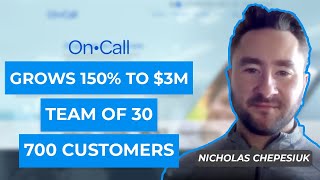
 Watch: OnCallHealth Grows 150% to $3m Run Rate for Virtual Patient Care HealthTech
December 2020
OnCallHealth Grows 150% to $3m Run Rate for Virtual Patient Care HealthTech
Read the transcript
hello everyone my guest today is nicholas chupswick he is the founder and ceo of on-call health prior to starting the company in 2016 he was an early higher education technology company tophat and marketing technology company turnstile which was acquired by yelp nicholas you ready to take us to the top let's go all right on-call health sounds like something that would be taking off in our current era of pandemic around the world what do you guys do yeah so we're a sas company we provide a solution to healthcare providers all the way up to large brands so they can launch and grow their own virtual care programs so essentially offering virtual appointment options over video or text to their own patient base and what makes that complicated why hasn't somebody done that i think there's a lot of there's a lot of workflow challenges uh a lot of um security and technology requirements and then uh as well as integrations excuse me and uh no problem and uh there's a big human element as well around uh change management provider training and uh and patient tech support that are required to make a virtual healthcare program successful uh we've seen as well just a lot of uh drive from organizations that maybe before the pandemic uh were opposed to adopting this type of technology or didn't have it as one of their top priorities and now seeing a lot of urgency and making it uh one of their top priorities give me a size of sort of the customer you're going after what's the average customer pay you per month to use the tech yeah so we have um we have about 700 customers uh about 600 of them are small practices paying us about 75 dollars a month on average uh and then we uh we have um over 100 customers that we put into our enterprise uh sort of bracket which uh has more uh more advanced kind of uh branding and control over uh workflow uh in the system and those customers are paying us anywhere from uh about 1 000 to 20 000 a month i can do the math for you where we're around uh we're well over 3 million er now that's great and where were you exactly one year ago uh less than a million oh wow so so incredible growth um yeah right here was your product really already built for the needs that folks had during coba that had to move to all virtual or did you have to add in a bunch of extra features we were really well positioned i believe because we launched kind of at the start of 2017 so we were really well positioned at the beginning of this year to capitalize on kind of this moment and uh that being said we're i mean we're always adding on to our integrations and api just to keep capturing more of the market mm-hmm and did you have you know that's all bootstrapped uh no we've raised uh our series a earlier this year how much did you raise uh we raised six million usd was that the right move do you regret it no really excited about the partner um we're canadian company but pushing uh uh way more into the us and uh base ten uh is our uh uh series a uh lead investor they're san francisco based and they've been amazing in terms of helping us push into the us more what valuation are you able to negotiate a range is fine i mean you were raising during cove at a hot you could argue really hot company during covid you have a real revenue yeah i mean we got kind of uh a standard not uh absurd but a standard sort of series a multiple on revenue okay fair to say you sold somewhere between call at 10 and 20 of the business uh yeah okay got it cool so somewhere between like a 50 and 80 million valuation sure okay very interesting and and where is most that money going where are you spending it uh so we uh the series a is really going in to go to market um we've been very outbound sales driven to get to this point uh not too much on the marketing side so really building that out partnerships and then building out kind of a full sales team now when you say lots of outbound sales today are those quota carrying sales reps yeah um no no hard quotas yet but uh but um but yes we have a a few account executives how do you get good accounting executives if there if there's no commission component to them hitting the quota you know the best folks they want to they want to eat what they get a kill oh totally yeah we have uncapped commission but uh just not uh enforcing you know hard i see i see i see so so they can earn how many how many have commission opportunity all of the account execs how many is that uh we have three account execs and then our customer success a lot of our accounts expand so we work with um you know for example like a pharmaceutical company or an insurer that have networks of hundreds of thousands of healthcare providers that we can expand across uh so there's a ton of upsell uh as part of customer success is actually the largest team in our organization and uh how many people uh i think close to 10 right now oh wow 30 out of 30 total yeah that's interesting now do you there there's a kind of a big trend in media stats right now where there are ceos and and the you know cross and vps of sales giving the customer success team quota targets and incentivizing them on an expansion metric do you guys do that yeah again not i think we'll start to look at more individual metrics next year now that we've really started to refine our processes but uh but yeah absolutely um we're we based it off net revenue retention but but yes exactly like we want to give our csm's uh commission as well what's your target net revenue retention um we've been well over a 100 for as long as i can remember just especially because of a lot of that account expansion um but yeah definitely at least 100 net revenue retention is our goal and what allows you to drive the expansion you can't drive expansion without an upsell so what are you upselling is it number of seats is that product upsells a utility-based upsell yeah so there's two components to our pricing we charge for our enterprise package which includes our uh like fully branded apps the customers get to become the publisher of their own virtual care apps that we help them create and then uh it's essentially like a white label rather than being a custom development uh and then and analytics uh and um and then we do charge per seat which is just per healthcare provider so tell me how that works if if i'm a small healthcare provider that signs up today with you for 75 per month and i'm buying more seats next year as i'm expanding with you it's because i'm hiring more health practitioners at my little shop that's right i see and the larger brands will buy licenses at scale from you know thousands of providers for example so they have a bunch of providers working under them and they're paying for all those providers to access your tool yeah the interesting thing is you know we we do work with some kind of conventional hospital systems but the larger like our largest customers are like i said pharma companies and insurers that don't directly employ healthcare providers but they have networks of them and so it's really interesting nowadays that they can launch a completely new revenue stream uh by using their network of healthcare providers that they don't have to directly employ and they also don't have to pay for the overhead of running physical clinics so our technology think of it like a shopify for virtual healthcare um or shopify plus in that case uh being that tech enabler for them to bring their services online and uh basically uh run run an entire virtual care program so nicholas if you've got 600 of these smaller practices at 75 bucks per month i mean that makes up about forty five thousand dollars of your 250 000 months of revenue a three million dollar run rate so it's less than fifteen percent of your business are these small practices i could see you va you know you know validate you spending your time in engineering and customers because on those accounts if you felt like you could take a 75 a month account and get it to a grand a month or 20 grand a month over time but i imagine small practices generally stay small practices why why spend any time focus on small practices since you're never going to get them up to 10 20 grand a month yeah totally agreeing at that night we started out as an smb uh vendor until we could work our way up the value chain or the yeah and and uh so our first kind of 100 customers were all smbs so that is to some extent a legacy part of our business i see we're very focused on the enterprise that being said i think there's a huge long tail opportunity in smb because in my belief every health care provider is going to have some sort of virtual care technology as part of their practice uh in the next few years so we're really focused on making that very self-serve it's very self-serve sign up and account management which we don't really have today and and uh making that kind of a more automated part of our business so we can focus more on the enterprise back in 2017 when you started coding this technology how did you fund the mvp uh so we uh we did kind of like a uh an angel round uh with kind of local investors in toronto and and uh raised about 200k uh that allowed us that lasted us a a long time how long uh a couple years and then uh we raised a uh a seed from uh ripple ventures in late 2018 or sorry 20 early 2019 and then our series a this year what was the seed how much uh it was 1.5 usd interesting okay so 200 to 1.5 to 6 million today yes was the six million the first price round uh no the seed was priced as well oh interesting okay yeah and um yeah i mean we've we've been trying we're very focused on capital efficiency so not trying to raise massive rounds yeah yeah i mean what does it mean for a founder like you to be capital efficient uh well it's an evol it's an evolving definition i think now in this next phase of the business that's becoming less important to me uh i'm trying to optimize more for growth at this stage and be a little bit more liberal with spending uh but getting to this point uh you know we we were able to uh to reach kind of a million arr with only about a million raised so um for me i think it's really important to i come from a sales background so we had paying customers from day one and uh i think you know that's the engine of the business and um yeah have always just been focused on always growing revenue at the same time as we develop the product yeah well i mean obviously just raised around now you have to deploy the capital to drive future growth so your burn burns going to go up a little bit currently but you don't want to drive it too high you want to see a path to profitability right i mean how comfortable are you are you in terms of how high do you want to drive burn how high would you be comfortable driving burn right now it's a great question um i think we are really going to ramp up like i said to go to market team and we will see more significant burn but at our current growth rate i i think we can keep up and uh you know have a pretty manageable burn rate uh without having to take on any debt which we haven't had to do today what would you consider manageable i mean if you're doing uh 250 a month right now right so you could maybe get up to spending 350 400 500 grand a month so your net burns 250 you have six in the bank that so gives you plenty of runway i mean would you feel comfortable burning total expenses annually or monthly like 500 grand i think we will have to get up to that for for a while uh and yes i would be i would be comfortable with that uh just because it's it's such an incredibly hot market right now for this technology it feels like a very unique uh sort of moment in time in which we're well positioned to capitalize yep no it makes a lot of sense to me um interesting okay very cool um last one i'll ask about is payback period so i mean what are you willing to spend to get a new 75 a month customer that changes quite a bit uh especially since we have really only started spending significantly on marketing this year um but uh but the unit economics have been working uh quite well uh let me just see yeah i think our payback period um is uh a few months for our or six months for an smb and oh great two months for an enterprise that's really good yeah those are really healthy very good all right nicholas let's let's wrap up here with the famous five number one favorite business book i just finished uh principles by ray dalio and and loved it number two is there a ceo you're following or studying um i mentioned shopify i think that's my favorite company so i i really tracked the entire executive team there yep number three what's your favorite online tool for building the business we live on salesforce slack and notion uh slack is part of salesforce now i hope they buy notion next we'll see number four how many hours i'll sleep to get every night oh i'm i'm a big sleep guy eight hours for sure and what's your situation married single kids uh in a relationship no kids okay and how old are you i'm 29 29 last question what's something you wish you knew when you were 20 always be present i love that guys on call health they went from a million dollar run rate a year go to over 3 million run rate today they've just raised an additional 6 million bucks to drive growth helping practices handle the now because of the pandemic virtual demand they're getting from their patients launched the company in 2017 again well positioned currently 700 customers on the platform 600 smaller practices 100 enterprises looking to drive growth of the company 30 people on the team today three quota carrying reps they look to scale well over 100 net revenue retention rate as they upsell white label product and additional seats nicholas thanks for taking us to the top thanks so much nathan take care one more thing before you go we have a brand new show every thursday at 1 pm central it's called shark tank for sas we call it deal or bust one founder comes on three hungry buyers they try and do a deal live and the founder shares back end dashboards their expenses their revenue arpu cac ltv you name it they share it and the buyers try and make a deal live it is fun to watch every thursday 1 pm central additionally remember these recorded founder interviews go live we release them here on youtube every day at 2 p.m central to make sure you don't miss any of that make sure you click the subscribe button below here on youtube the big red button and then click the little bell notification to make sure you get notifications when we do go live i wouldn't want you to miss breaking news in the sas world whether it's an acquisition a big fundraise a big sale a big profitability statement or something else i don't want you to miss it additionally if you want to take this conversation deeper and further we have by far the largest private slack community for b2b sas founders you want to get in there we've probably talked about your tool if you're running a company or your firm if you're investing you can go in there and quickly search and see what people are saying sign up for that at nathan lacka dot com forward slash slack in the meantime i'm hanging out with you here on youtube i'll be in the comments for the next 30 minutes feel free to let me know what you thought about this episode if you enjoyed it click the thumbs up we get a lot of haters that are mad at how aggressive i am on these shows but i do it so that we can all learn we have to counter those people we got to push them away click the thumbs up below to counter them and know that i appreciate your guys's support all right i'll be in the comments see ya
 SimplePractice
 VSee Lab, Inc