
Founder Interview
How Rosella Brokerage Is Rebuilding Commercial Insurance with AI-Powered Brokers After a $3.7M Pre-Seed (Interview with Co-Founder Sean Stuart)
- Interview Date
- August 11, 2026
- Interviewee
- Sean StuartCo-Founder
Company Metrics at Interview Time
Total Funding Raised
$3.7M
Team Size (2026)
30
Sales Reps (Brokers) (2026)
15
Historical Snapshot
These numbers were reported by Sean Stuart during his interview recorded in August 2026 and represent a historical snapshot, not current figures. See Rosella Brokerage’s current numbers.
Key Takeaways
- 01Rosella Brokerage raised a $3.7M pre-seed round from Peak XV and Intact Private Capital in April 2026.
- 02The company went to market roughly three months before this August 2026 interview, after eight or nine months building the technology.
- 03The team totals 30 people, with 15 full-time specialist brokers and the remainder in engineering and finance.
- 04Brokers earn a base salary, equity, and 40% commission on new business they bring in, plus 20% renewal commission every year in perpetuity.
- 05The company operates strictly in commercial lines, targeting high-risk sectors such as trucking, demolition, and electrical contracting.
- 06Rosella Brokerage earns roughly 15% of the gross written premium placed, which it calls gross commission revenue, its true ARR equivalent.
- 07A single broker in his first week signed two deals totaling $500,000 in gross written premium — roughly $75,000 in gross commission to Rosella at the 15% rate, by the host's arithmetic on the call.
- 08The company's primary growth motion is outbound cold outreach, not inbound, with brokers proactively calling targeted businesses.
- 09Sean Stuart cited industry retention of 90% as a key reason the brokerage model compounds better than many SaaS businesses.
- 10Sean co-founded the company after being unable to get travel insurance coverage while running 80 marathons in 80 days across the US East Coast.
Company Metrics at Time of Interview
| Metric | Value | Source |
|---|---|---|
| Total Funding Raised | $3.7M | Founder interview, Aug 2026 |
| Funding Round Type (2026) | Pre-Seed | Founder interview, Aug 2026 |
| Team Size (2026) | 30 | Founder interview, Aug 2026 |
| US-Based Employees (2026) | 22 | Founder interview, Aug 2026 |
| Sales Reps (Brokers) (2026) | 15 | Founder interview, Aug 2026 |
| Broker New Business Commission (2026) | 40% of gross commission revenue | Founder interview, Aug 2026 |
| Broker Renewal Commission (2026) | 20% of gross commission revenue per year | Founder interview, Aug 2026 |
| Average Gross Written Premium per Policy (2026) | $100,000 | Founder interview, Aug 2026 |
| Rosella Commission on Gross Written Premium (2026) | 15% of gross written premium | Founder interview, Aug 2026 |
Growth Breakdown
Revenue
Rosella Brokerage earns gross commission revenue of roughly 15% of the gross written premium it places on behalf of clients. The company went to market roughly three months before this August 2026 interview, after eight or nine months building the technology. Sean Stuart declined to give a revenue figure, saying it was not yet exactly computed because of BOR contracts signed but not yet recognised.
Customers and Deal Flow
The company focuses on high-risk commercial segments including trucking, demolition, and electrical contracting. In one early example, a single broker in his first week signed two deals worth $500,000 in premium — roughly $75,000 in gross commission to Rosella at the 15% rate, by the host's arithmetic on the call.
Team
The team totals 30 people, about 22 of them in the US. Fifteen are specialist brokers who receive a base salary, equity, and a 40% commission on new business plus a 20% annual renewal commission in perpetuity; the rest work in engineering or finance.
Funding
Rosella Brokerage closed a $3.7M pre-seed round in April 2026 from Peak XV and Intact Private Capital. Sean noted the company raised on the strength of the market opportunity and founding story rather than on established metrics — the company had not yet gone to market when the round closed.
Growth Strategy
Outbound Cold Outreach as Primary Growth Motion
Rather than relying on inbound leads, Rosella Brokerage proactively identifies and calls target businesses it believes it can save money on insurance. The team analyzes which trucking operators, electrical contractors, and other high-risk businesses are the best candidates before reaching out directly.
AI-Powered Broker Matching
The company uses large language models to ingest and track the constantly changing underwriting appetites of thousands of insurance carriers, matching each client to the best available insurer. This allows brokers without deep insurance backgrounds to serve complex commercial clients effectively from day one.
Supercharging Non-Traditional Brokers
Rosella Brokerage deliberately hires people with strong industry domain knowledge, such as finance professionals who know construction, and equips them with AI tools to handle the insurance complexity. This lets the company scale broker productivity faster than traditional hiring and training cycles would allow.
Targeting Underserved High-Risk Commercial Segments
The company focuses on sectors like trucking, demolition, and electrical contracting that are too small for the largest brokers such as Marsh and Aon, but too complex for generalist local brokers. This positioning gives Rosella a clear value proposition and reduces direct competition.
Compounding Renewal Revenue Model
Brokers earn 20% renewal commission every year in perpetuity on their book of business, which Sean cited as a structural advantage over tech sales where quotas reset annually. This model incentivizes brokers to stay and grow their book, supporting long-term revenue retention for the company.
Best Quotes
“we don't represent the insurance company, we represent the customer. So at its simplest core, your business has a perfect insurance company, but you don't know which one. There's two thousand. We use our technology and our brokers as well to help you find the best match. And so we can save businesses twenty, thirty, forty thousand dollars.”
“our motion is not a lot of inbound at all. It's it's people calling. We do a lot of analysis of who is the best truck driver, who is the best electrical contractor to reach out to, and then we'll call you because we think we can get you a better price.”
“we had one broker who he never been in the insurance industry. He comes from a financial background. he's worked with a lot of construction companies. It was his first week of joining the company. He signed two deals, both were in total worth half a million dollars in premium.”
“the biggest company in the space is a hundred billion dollars. It's a brokerage. It's not a AI tool. You look down at the next biggest twenty companies, they're all brokerages. They've gone from twelve I think twelve million in ARR to four billion in ARR, some of these companies in a space of ten, fifteen years. The market opportunity is in being the brokerage itself.”
“I mean we had no metrics when we when we raised. and it was really the market opportunity and the story. I think they saw what we did, which was that at the time there was two companies doing this, both hadn't raised any capital. It wasn't a hot sector.”
What Happened Next
This interview captures Rosella Brokerage roughly three months after the company went to market in mid-2026, with a $3.7M pre-seed round closed in April and a team of 30 building out its AI-native commercial brokerage model. Sean Stuart declined to give a revenue figure on the record — he said gross commission revenue was not yet exactly computed because of unrecognised BOR contracts — so what the page reports is team size, broker commission structure and single-deal examples, all a snapshot of that moment rather than current figures. Visit the Rosella Brokerage company profile on GetLatka for the latest reported metrics and funding history.
View Rosella Brokerage’s current profile and metricsFull Transcript
Chapters
- 0:00Introduction: Sean Stuart and the Origin of Rosella
- 0:39Running 80 Marathons in 80 Days and the Insurance Problem
- 3:11Who Are the Biggest Players in Commercial Insurance Broking?
- 5:28What Rosella Brokerage Sells and How It Works
- 8:20Outbound Growth Motion and the Team in Austin
- 9:07How Rosella Pays Its Brokers: Salary, Equity, Commission
- 9:33Average Policy Size and Rosella's 15% Cut
- 10:32How AI Matches Clients to the Right Insurer
- 12:15Revenue Model: Gross Commission Revenue vs. GWP
- 13:33Early Deal Example: $500K Premium in Week One
- 16:41Raising $3.7M Pre-Seed from Peak XV and Intact Private Capital
- 18:10Why Build the Brokerage, Not Just an AI Tool?
- 18:57Acquiring Retiring Brokerages: Not the Plan Yet
- 19:17Where to Find Sean Stuart
Introduction: Sean Stuart and the Origin of Rosella
Nathan Latka
0:00Hey folks, my guest today is Sean Stuart, quite the background from Sydney. He understands marketing and sales. He published a great book in 2020. It looks like it had over 10,000 sales, which he can back up via Amazon, 307 likes there. So he understands distribution, got into the VC side of the game at Aurora Ventures, but before deciding, you know what, I probably want to jump in to the operating side. And the way he discovered what to jump into is he's great at marathons and he had a bit of an accident, which I'll let him talk about. And when he was frustrated with the insurance options for this marathon he was running. He said, you know what? I need to totally reinvent brokerages. And that is where Rosella comes in. Sean, you ready to take us to the top?
Running 80 Marathons in 80 Days and the Insurance Problem
Sean Stuart
0:39Thank you very much for having me. It's a wild background with not much logical backbone. But to to share the story, it it all started at a pub, as all good ideas do in Sydney. My three best friends and I had a crazy idea that we could run the whole East Coast of America. At the time we hadn't run a single marathon between us, and we looked at a map and decided that we could do it. And so we told all of our friends and family, everyone thought that we were crazy. we started training. I got injured pretty much instantaneously and so our prospects weren't looking very good. And at the arrival we get to Key West in Florida. Looking ahead, we've we've got to run eighty marathons in eighty days. But one really important part of the story was I had to find travel insurance. So we were coming from Australia. We'd heard horror stories of the two hundred thousand dollar hospital bed. And so I I went to law school and so I was unfortunately bestowed with this this job. And when I would read these contracts, I would find on the fine print on page seventy eight, two marathons is excluded, extreme events is excluded. And so basically we couldn't find anyone to give us coverage. Fast forward to to day forty, I had cellulitis, I was going into septic attack, which means basically you're a few ways from dying unless you receive treatment. I couldn't go to hospital, couldn't afford it. didn't have any way of going, insurance wouldn't cover me. And so basically the kindness of the American people we were staying with, I got antibiotics and kept running and turned out to be okay. the thing I really like to be honest with about with audiences and especially founders is the day after I was okay, I did not think I should start an AI native commercial insurance brokerage. let's be super clear about that. It's more you have some people who are innately entrepreneurial. And when they're thinking about what to dedicate their life to and what problems they want to solve, you just draw back from your experience. And so I have no shortage of shower thoughts of a beer application or a study guide. But it just happened that this was the one that I'd felt most viscerally and my co founder had built an AI platform for bankers, was a really successful engineer, and so we came together and moved our lives from Sydney to America and the rest is history.
Nathan Latka
3:03this will be graphic content if you approve. Can we hold up the picture of your foot or can you text it to me afterwards so I can have my post-production team edit it in?
Sean Stuart
3:10For sure.
Who Are the Biggest Players in Commercial Insurance Broking?
Nathan Latka
3:11Because I mean, that is the ultimate concept of founder market fit is Sean live through the problem he's now building for. There's a lot of founders right now that just are sucked up in the AI hype. They just launch some AI tool. They know nothing about the space or very little and they end up failing after six months of work and no traction. So you researched insurance extremely well to help my my audience just get in the right frame of mind here. Who who are the biggest logos, insurers in this space today that get the closest to offering this sort of extreme type of insurance, but ultimately didn't get you what you needed?
Sean Stuart
3:41So you would go to an insurance broker. There's two thousand insurance companies. Ninety percent of businesses have a broker already. The biggest brokers you can go to are companies like Marsh, Aon, these are a hundred billion dollar companies. Absolutely massive. The reality is they wouldn't help someone like me. They only deal with the big end of town and enterprises. So who do you go to? It's a local retail brokerage. Now I don't like to be offensive. There's some very smart people in the industry, but insurance broking is not exactly where the highest quality of talent goes to. And so typically the industry saying is it's a land of B and C students. So you would have someone who who maybe failed college, they live in your small town in Chattanooga or somewhere, and that person is reading complex legal contracts and really making some of the biggest decisions that your business will ever make for you. So that's that's like who we kind of had to get help when we were dealing with this problem.
Nathan Latka
4:37So I'm I'm just to get to get educated on the space live with my audience. Like I'm plugging this, I'm acting like I was you before I was running that race, right? And I'm basically saying, Hey, I need insurance for a marathon I'm running, eighty of in eighty days. It's basically saying think about medical disability travel. and ultimately it's saying, Okay, you should think about sports, cover direct, saddler's. I mean, are these some of the smaller local folks you're referring to?
Sean Stuart
4:59So because we were coming from Australia, we needed travel insurance was was the main one. And so we were looking at travel providers internationally in Australia, and that was where I would read these really long contracts. And so I just wanted someone to help me to explain where I could go. And that's when I first learned about the world of insurance broking and MGAs and Lloyds of London, which are all super interesting, but their own rabbit hole.
Nathan Latka
5:22Yep. Okay. So you understand the problem very clearly. Tell me about the solution you built. What are you selling today?
What Rosella Brokerage Sells and How It Works
Sean Stuart
5:28So we help businesses get better value out of their insurance. we don't represent the insurance company, we represent the customer. So at its simplest core, your business has a perfect insurance company, but you don't know which one. There's two thousand. We use our technology and our brokers as well to help you find the best match. And so we can save businesses twenty, thirty, forty thousand dollars. We typically operate in the high risk space. So think demolition companies. trucking companies, something like running eighty marathons in eighty days where the stakes are high, and most traditional insurers would be a little bit reluctant to go into that space.
Nathan Latka
6:08So I mean, why don't you have running and travel here? I see trucking logistics, electrical, retail, restaurant.
Sean Stuart
6:13so we actually don't do personal lines insurance for now. we do strictly commercial. Now, the problem is the same. The the reason that we don't do personal lines is that travel insurance is actually one of the worst segments to be a broker for. so basically that the reason why no one would help me is because let's say my policy costs a thousand dollars. That broker is only getting paid a hundred dollars on that policy, and it's one off. And they have to do a lot more than a hundred dollars worth of work. So there's actually structural reasons why no one helps those types of people. And so to build a sustainable business, like we're entrepreneurs, we want to build something that can actually grow, we picked a similar problem, but in a much more sustainable part of the market.
Nathan Latka
6:59Okay, into these commercial categories you have highlighted here.
Sean Stuart
7:02Correct. It's a similar problem though, right? It's like a a small trucking operation. They can't find someone who knows their space who could help them navigate the complexity because they're maybe a bit too small for those big three that I mentioned, Marsh, Aon. And so that's really where we come in.
Nathan Latka
7:17So let's do that. Okay. I I run a tr a small I have four trucks. I'm here in Austin, Texas. I have drivers on those trucks. I don't want one of them to get drunk, crash on the runway, and then I get sued to oblivion. I find you guys, I click talk to us. Tell me what happens next when I fill this in.
Sean Stuart
7:30So you'll speak to a qualified trucking specialist at our company. They'll really get to understand your business. They're not going to just ask a l a litmus of basic questions. They're going to understand what are your goals, what do you want to achieve. And then
Nathan Latka
7:42Mm-hmm.
Sean Stuart
7:43we'll use our technology in the back end to help match you to the best insurance company. We also provide a bunch of other services as well. So we use data to actually get your cost of insurance down over time. So if you're a truck trucker, I don't want to throw too much jargon on you, but let's say your trucks keep breaking down. There's a playbook of how to make that improve over time, which ultimately means you just pay less for insurance and and we help with all of that.
Nathan Latka
8:08Okay, so we played Catan the other night, I know a little bit about your situation in Austin. You were telling me how you're in a house right now in East Austin, like packed
Sean Stuart
8:14Mm-hmm.
Nathan Latka
8:14with brokers. So is this lead right now hitting somewhere in your house? You have like an army of brokers about to call me.
Outbound Growth Motion and the Team in Austin
Sean Stuart
8:20Correct. You we we typically actually do outbound. So our motion is not a lot of inbound at all. It's it's people calling. We do a lot of analysis of who is the best truck driver, who is the best electrical contractor to reach out to, and then we'll call you because we think we can get you a better price. And so if you call this, he would be one of very few who who actually calls in into us.
Nathan Latka
8:43Interest. Okay. So tell me the team size today. How many folks are full time and how many of those are brokers?
Sean Stuart
8:48So in the US we have about twenty two employees. in total the team's about thirty. I said it's about fifteen brokers. The rest are engineering or finance from a range of different backgrounds.
Nathan Latka
9:01Okay. And how did you convince these brokers to work for you? Do you pay them like a hundred grand salary? Is it full commission? What how do they get paid?
How Rosella Pays Its Brokers: Salary, Equity, Commission
Sean Stuart
9:07They get a base salary in that ballpark, a little bit less. They get equity and then they also get commission. So these our brokers get forty percent of new business that they bring in, and then they get a renewal commission every year, which is honestly why insurance broking is one of the best professions, in my opinion, because tech sales, your quota resets every year. Brokers, it doesn't. You get paid an annuity that keeps on compounding.
Average Policy Size and Rosella's 15% Cut
Nathan Latka
9:33Book of business.
Sean Stuart
9:34Correct?
Nathan Latka
9:35Okay. I know nothing about the the sizing of these things. Is the average plan that you're selling a thousand bucks a month, a hundred thousand a month? Like what's the average ticket value?
Sean Stuart
9:46about a hundred thousand in premium.
Nathan Latka
9:48Okay. And what would that be if I'm the trucking company, Nathan's trucking company, I have a hundred thousand dollar premium. What I'm what am I paying probably per month?
Sean Stuart
9:56so though the important thing is the the customer doesn't pay us, the insurance companies pay us. So we get about fifteen percent on average, and so you're the customer, you give a hundred thousand to the insurance company, they give us back about fifteen thousand dollars. And sometimes that can be all up front, sometimes that can be month to month.
Nathan Latka
10:16I I see, I see. Okay. So just to be clear, you're effectively sitting in the middle, right? So you're not doing the
Sean Stuart
10:22Correct.
Nathan Latka
10:22insurance, you're lead gen, you're really good at outbound. You're getting that trucker lead, Nathan. And then if I go spend a hundred thousand dollars, give me an example of someone you might sell me to, like the actual insurer.
How AI Matches Clients to the Right Insurer
Sean Stuart
10:32so if let's say you were an electrical contractor, we might go to a company like Hanover, Chubb, nationwide, some of the biggest insurance, or we might go to a special specialty carrier like Shield MGA. we have hundreds, and so that's honestly where AI becomes really important. I know when you hear that you think, okay, maybe that's a buzzword, maybe the AI is not actually that useful. Two thousand insurance companies constantly changing what businesses they ri underwrite. And the level of specific specificity is like, hey, we will do electrical contractors if they use this particular technique or they cut wires in this way, but we won't do these ones. And it always changes. So that's why large language models are actually incredible for finding the right match for a for a company.
Nathan Latka
11:16Interesting. Interesting. Okay. So just to be clear, like I'm on Hanover right now. They have all these products. You're basically saying instead of me, the electrician in Austin, having to go click through all these frickin' links to find what I need, you already ingest all this and you're gonna match me.
Sean Stuart
11:30Correct, but but the truth isn't and actually some of these companies I mentioned, you can't even buy them directly. They're only through brokers. and and the reason why is because again, our mental model is like when I was buying travel insurance for the run, go on a website, click a button, I'm covered for everything. This is highly complex. And so people thought that the broker channel would decrease over time with the internet. It actually went up. And the reason is because a broker is not just helping you find insurance company, they're actually explaining it to you and they're giving advice on which is the best one for you and how to reduce risk over time.
Nathan Latka
12:05Got it. Okay. This is making more sense to me now. So I guess what's the right way for me to understand your guys' growth? Is it to ask you the total cumulative dollar value of premiums you placed per year?
Revenue Model: Gross Commission Revenue vs. GWP
Sean Stuart
12:15yeah, I mean that's that's one way. GWP growth. I I actually take a bit of issue with that model. I mean, we have a competitor, won't name names, who they're an insurance company, they're not a broker, and they say that GWP is ARR, which is a really bad mental model because as we know, annualized recurring revenue, super high margin. In insurance, if you're an insurance company and you make forty million dollars of ARR, you've got to pay that out in claims. The insurance industry is one of the lowest margin industries out there. It's like five percent. and so that's not really what what it's positioned as. Now, as a broker, it's a little bit different. Our cut is our ARR. We get it every single year. So that's a better, a better mental model for brokers. But it's really important to be to be clear which one it is.
Nathan Latka
13:03What does GWP stand for?
Sean Stuart
13:05Gross written premium.
Nathan Latka
13:06gross written premium. Interesting. Okay. So you guys launched, I think, in late twenty twenty five, right?
Sean Stuart
13:12So we've been around for a year. we've been building technology for about eight or nine months. We went to market in the last three months and started scaling then.
Nathan Latka
13:21Okay, so launched like March twenty twenty six. Okay. And and walk me through like what's growth look like today. Are you comfortable sharing, I guess, your gross written premium life to date?
Early Deal Example: $500K Premium in Week One
Sean Stuart
13:33I can share some interesting numbers and case studies. So we had one broker who he never been in the insurance industry. He comes from a financial background. he's worked with a lot of construction companies. It was his first week of joining the company. He signed two deals, both were in total worth half a million dollars in premium. so really why our model is so disruptive is because we supercharge brokers with AI and we take someone who understands the business really well, but maybe they don't know what those two thousand insurance carriers are. But they can then help customers because they have the technology to support them to do that.
Nathan Latka
14:13And so let's use that one sales rep that did two sales and five, which equaled five hundred K of premium. Break down those economics for me. So of the five hundred K of premium, Rosella, your company, will get about a fifteen percent kickback from the insurer.
Sean Stuart
14:26Correct.
Nathan Latka
14:27Okay. So that would be about seventy is that seventy-five thousand dollars?
Sean Stuart
14:32About that. Now there's a lot of complexity in what I just said. So you can have a contract signed, there's things like placement, things like E and S, so there's a lot of complexity, but that is the most basic version of how that works.
Nathan Latka
14:44Okay. And of the seventy five thousand dollars that comes back to Rosella, how do then you split that with this broker? He gets forty percent of that.
Sean Stuart
14:52Correct. And then in year two they get twenty percent of that. So it's a renewal income.
Nathan Latka
14:57Okay. And is it twenty percent in perpetuity or does it keep declining?
Sean Stuart
15:00every every year in perpetuity, which is the standard across industry.
Nathan Latka
15:04Okay, so 20% in year two and then 20% every year thereafter.
Sean Stuart
15:07Correct.
Nathan Latka
15:08Interesting. Okay, so then, so then if they're getting 40% of $75,000, you guys are keeping as a company something like $30,000, right? Okay, and you believe that's how your company should be valued. You sort of talk negatively about a competitor using some funky numbers. You think the right number should be net, net. What is the number Rosella is keeping? And you know, you hit a million, two million, five million, that's how you should be valued.
Sean Stuart
15:31I think we should just be valued based on so it's called gross commission revenue. that is really pretty much ARR. So that contract we talked about, let's say that they renew every year, that's seventy thousand dollars of revenue to the business. Now, yes, the cogs will be the broker's cut, which is twenty percent year on year, but in the insurance industry retention's ninety percent. So it's better than a lot of these software companies, especially, you know, in the SaaSpocalypse where everyone's churning. Insurance retention doesn't go anywhere, ninety percent.
Nathan Latka
16:01Yep. Okay, very cool. This this makes very clear sense to me now. Are you comfortable sharing? I'm sensing you're shy, but you didn't strike me as a shy guy when you're playing Catan. Are you comfortable sharing? Like add up the seventy K's right now. Like what's your what's your ARR today, your gross commission revenue run rate, I guess is the right word.
Sean Stuart
16:16I can't share that now just because it's not exactly computed because we have these things called BORs, which is when you sign a contract but you don't recognize the revenue and so I can't give an exact number. But
Nathan Latka
16:28What do you think you'll be at by the end of twenty twenty six?
Sean Stuart
16:31probably about a million in ARR.
Nathan Latka
16:32Okay. Okay. What enabled you to raise I think you raised three point seven million pre seed, right, in April?
Sean Stuart
16:40Correct.
Raising $3.7M Pre-Seed from Peak XV and Intact Private Capital
Nathan Latka
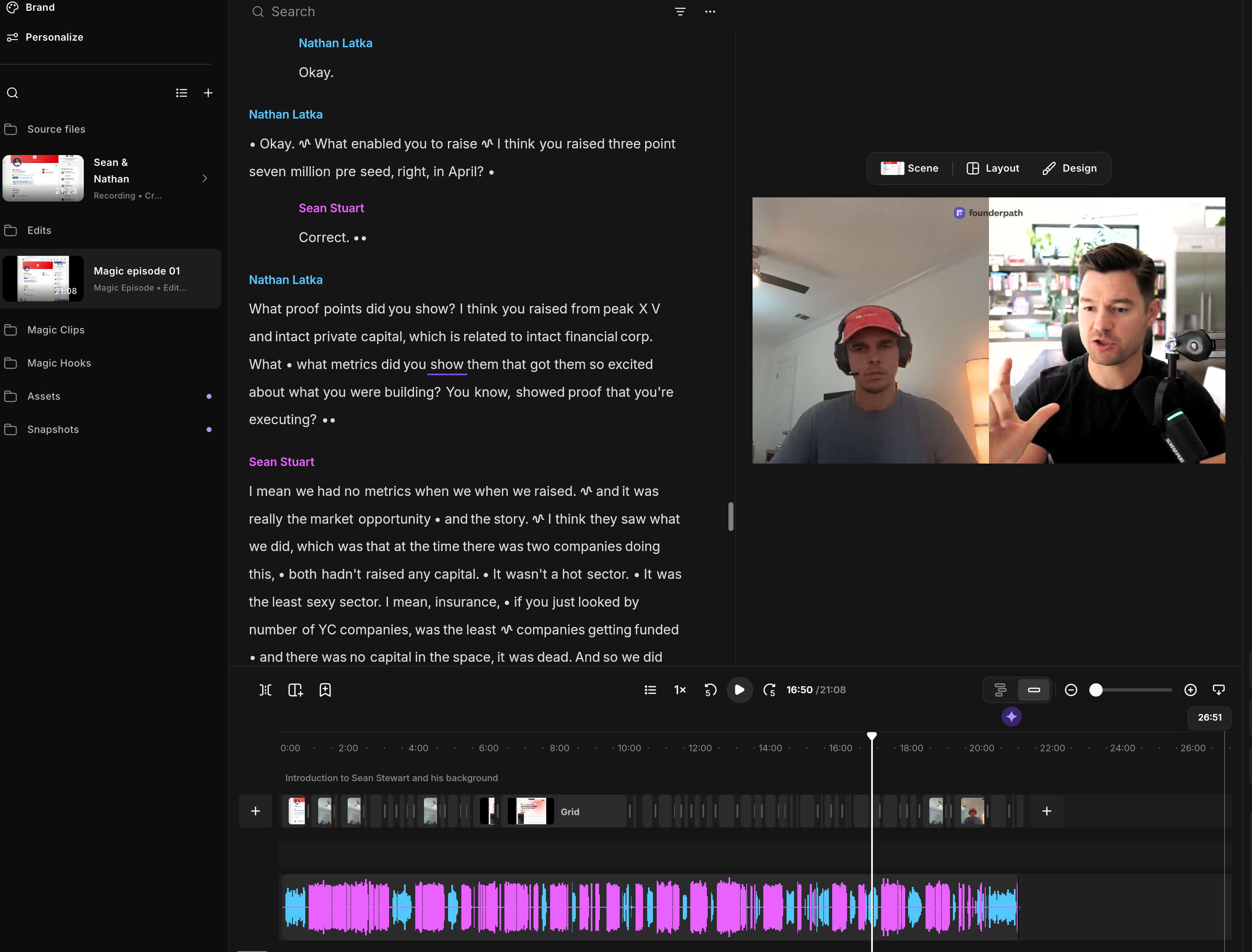
16:41What proof points did you show? I think you raised from Peak XV and Intact Private Capital, which is related to intact financial corp. What what metrics did you show them that got them so excited about what you were building? You know, showed proof that you're executing?
Sean Stuart
16:55I mean we had no metrics when we when we raised. and it was really the market opportunity and the story. I think they saw what we did, which was that at the time there was two companies doing this, both hadn't raised any capital. It wasn't a hot sector. It was the least sexy sector. I mean, insurance, if you just looked by number of YC companies, was the least companies getting funded and there was no capital in the space, it was dead. And so we did something I don't want to say contrarian, but we did something that was not popular. And then, you know, after eight months, two $47 million rounds of our biggest competitors, lots of new people entering the space every single month, a lot of capital flowing in. So I think, you know, right place, right time.
Nathan Latka
17:41Mm-hmm. Well, Sean, so wrap us up here. A lot of founders right now are building like AI tools, right? Maybe most people would say, I'm gonna go build an AI tool for brokerages or insurances. You're doing the opposite. You're saying we're just gonna go build a better brokerage that's AI powered and AI pilled. You have and you're licensed, right? Two, two, one, three, six, nine, six, four. You're actually building the technology. Why do you think this is it's better to actually just go and actually rebuild from scratch versus just building and doing the maybe more lazy thing, an AI tool for brokers or insurers?
Why Build the Brokerage, Not Just an AI Tool?
Sean Stuart
18:10the biggest company in the space is a hundred billion dollars. It's a brokerage. It's not a AI tool. You look down at the next biggest twenty companies, they're all brokerages. They've gone from twelve I think twelve million in ARR to four billion in ARR, some of these companies in a space of ten, fifteen years. The market opportunity is in being the brokerage itself. There's probably two broker tool companies that are worth more than billion and both of them were started a long, long time ago. I mean Why is it the case? Try and sell to a brokerage. The industry average age is I think there's twenty five percent of people are about to retire in the next like five years. And so super old, super stodgy industry, they don't like buying technology. the best way to capture value is to just be the brokerage yourself.
Acquiring Retiring Brokerages: Not the Plan Yet
Nathan Latka
18:57Do you have any plans to grow faster by buying some of these, you know, ninety year olds running a brokerage about to retire or seventy year olds running a brokerage about to retire?
Sean Stuart
19:07we get approached sometimes for people who want to join us. they have their own book of business. at the moment that's not our strategy for the next year, but we'll definitely consider it two or three years down the line.
Where to Find Sean Stuart
Nathan Latka
19:17All right, good stuff, man. If people want to follow your story online, Sean, where can they find ya?
Sean Stuart
19:21LinkedIn and if you wanna I've I've written a few books, if you wanna check out, just go on Amazon, type in Sean Stuart.
Nathan Latka
19:27What are your other ones? I just saw the Curious Ape.
Sean Stuart
19:30I wrote a fiction novel as well. it's a a mystery novel when I was living in Argentina for for a year.
Nathan Latka
19:37very good. It's it book people say because I you I did a book too, they Nathan, should I do a book? And I don't think people realise how hard it is.
Sean Stuart
19:43Yeah. Yeah. This I'd recommend doing almost anything else.
Nathan Latka
19:46Yeah, it it is. People go, When's the next one? I'm like, What do mean, the next one? I barely survived the first one.
Sean Stuart
19:51Yeah, exactly, man. It's not the play. I'm glad you're in
Nathan Latka
19:54Guys,
Sean Stuart
19:55podcast land. That's a much more better career.
Nathan Latka
19:57That's right, guys. Rosella Brokerage.com. Two founders from Sydney pick up their lives, move to Austin, Texas, hire a team of 30 people. 15 of them are actually brokers themselves. He clearly understood this problem because he had his own issues getting insurance when he was running 80 marathons in 80 days and says, I'm gonna apply AI to this, but instead of selling a tool. To brokers or insurers. He said, you know what? I'm just going to build the world's best brokerage directly. That's exactly what he's doing. What he cares about most is his gross commission revenue. You know, industry standards are, you know, if they place $500,000 of premiums, they might get a 15% kickback. They then, of that kickback, pay out 40% of that to their broker who's full time at Rosella, their company. And then the company keeps the rest. And that's how they fuel growth, fuel additional growth activities, things like that. If you want to follow their story, check them out at rosella brokerage.com. Sean, thanks for taking us to the top.
Sean Stuart
20:46Thanks, Nathan. Really enjoyed it.
Nathan Latka
20:48Boom, cut. What'd you think, man?
Sean Stuart
20:50That was fun. That was cool, dude. I like your style. Very rapid fire. No bullshit. It's good.
Nathan Latka
20:55It's it's this weaving of storytelling but also hard on the data. And I ch it's I I want to get them both together, you know. Epic dude. Epic. This is great. And now I feel like I I better understand. So I can recommend you appropriately because I know what you do now. So this is awesome. All right, brother. All right, sounds good. Later.