
Founder Interview
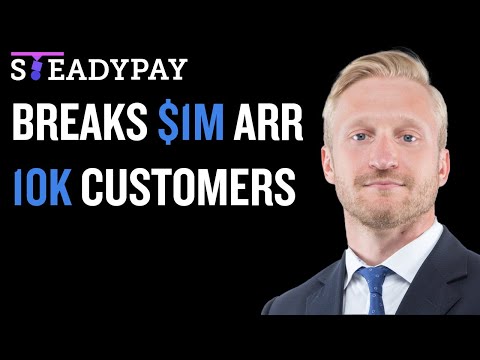
How SteadyPay Reached $1M ARR and 10,000 Customers with 150% Growth (Interview with Co-Founder and COO Oleg Mukhanov)
- Interview Date
- April 27, 2022
- Interviewee
- Oleg MukhanovCo-Founder and COO / CFO
Company Metrics at Interview Time
ARR (2022)
$1M
Customers (2022)
10,000
Revenue Growth (2022)
150%
ARPU (2022)
$8 per month
CAC (top product) (2022)
£40
Historical Snapshot
These numbers were reported by Oleg Mukhanov during his interview with Nathan Latka recorded in April 2022 and are a historical snapshot, not current figures. See SteadyPay’s current numbers.
Key Takeaways
- 01SteadyPay reached $1M ARR in 2022, up from $384K ARR in 2021
- 02Customer base grew from 4,000 to 10,000 between 2021 and 2022, a 150% increase
- 03Average revenue per user is $8 per month due to multiple subscription tiers
- 04Lowest tier is $5 per month for credit building only; flagship tier is £16 per month
- 05CAC for the top product is approximately £40 fully loaded against £200 or more in annual revenue
- 06SteadyPay closed a $5M seed round in early 2022 and previously raised just over £1M equity in late 2019
- 07The company broke even at the $1M ARR milestone before deploying the new seed capital
- 08Total loans advanced over two and a half years reached approximately $3M, recycling the facility more than twice
- 09Total loss rate on the lending book is close to 3%, with a below-10% default rate
- 10Primary customer acquisition channels are Facebook and Google Ads, with B2B partner co-marketing growing
Company Metrics at Time of Interview
| Metric | Value | Source |
|---|---|---|
| ARR (2022) | $1M | Founder interview, April 2022 |
| ARR (2021) | $384K | Founder interview, April 2022 |
| Customers (2022) | 10,000 | Founder interview, April 2022 |
| Customers (2021) | 4,000 | Founder interview, April 2022 |
| Revenue Growth (2022) | 150% | Founder interview, April 2022 |
| ARPU (2022) | $8 per month | Founder interview, April 2022 |
| Flagship Membership Fee (2022) | £16 per month | Founder interview, April 2022 |
| Entry Tier Price (2022) | $5 per month | Founder interview, April 2022 |
| CAC (top product, fully loaded) (2022) | £40 | Founder interview, April 2022 |
| Annual Revenue per Top-Tier Customer (2022) | £200 or more | Founder interview, April 2022 |
| Total Loans Advanced (2022) | $3M | Founder interview, April 2022 |
| Default Rate (2022) | Below 10% | Founder interview, April 2022 |
| Total Loss Rate (2022) | Close to 3% | Founder interview, April 2022 |
| Implied Annual Interest Rate (2022) | 20.8% | Founder interview, April 2022 |
| Warehouse Facility Size (2022) | $1M | Founder interview, April 2022 |
| Facility Utilization (2022) | Approximately $800K to $900K deployed | Founder interview, April 2022 |
| Seed Round Raised | $5M | Founder interview, April 2022 |
| Pre-Seed Equity Round | Just over £1M | Founder interview, April 2022 |
| Early Debt Facility | £1.5M | Founder interview, April 2022 |
| Year Founded | 2018 | Founder interview, April 2022 |
| Debt Finance Providers (2022) | Two | Founder interview, April 2022 |
| Average Customer Income (UK) (2022) | £2,000 per month net | Founder interview, April 2022 |
Growth Breakdown
Revenue
SteadyPay grew from $384K ARR in 2021 to $1M ARR in 2022, representing 150% growth. The company generates approximately $83,000 per month in subscription revenue across its 10,000 customers, with an average of $8 per customer per month due to multiple pricing tiers.
Customers
The platform grew from 4,000 customers in 2021 to 10,000 customers in April 2022, a 2.5x increase in one year. Customers onboard in two to three minutes through an automated open banking connection with no manual underwriting required.
Team and Operations
SteadyPay operates as an app-only platform with fully automated onboarding, KYC, AML, and credit risk assessment handled by technology. The company has two groups of finance providers supporting different business lines.
Profitability and Funding
The company broke even at the $1M ARR milestone before deploying its new seed capital. SteadyPay closed a $5M seed round in early 2022 and previously raised just over £1M in equity and £1.5M in debt at the end of 2019. Total equity raised on file is $6M across a pre-seed and seed round.
Growth Strategy
Facebook and Google Ads for Direct Acquisition
SteadyPay built its initial customer base through Facebook and Google paid advertising, which the guest credited as working really well for reaching gig economy workers. This direct marketing approach was used to generate critical mass before layering on other channels.
B2B Partner Co-Marketing
The company is increasingly pursuing partnerships with employers and gig platforms such as ride-hailing companies, offering SteadyPay as an employee benefit. The strategy uses the direct-acquired customer base as proof of clustering around specific employers before approaching those employers for bulk partnerships.
Open Banking for Automated Underwriting
By connecting directly to customer bank accounts via open banking, SteadyPay eliminates manual underwriting and enables two to three minute onboarding. This low-friction acquisition funnel reduces CAC and supports rapid scaling without proportional headcount growth.
Multi-Tier Subscription Model
Offering a $5 per month credit-building entry tier alongside the £16 per month flagship product allows SteadyPay to acquire customers at lower price points and upsell over time, broadening the addressable base while maintaining a blended ARPU of $8 per month.
Capital Recycling on the Warehouse Facility
SteadyPay recycled its £1.5M debt facility more than twice over two and a half years, advancing approximately $3M in total loans. Rapid repayment cycles driven by the income-smoothing model allow the company to redeploy capital efficiently and earn a spread between its 20.8% implied yield and its cost of debt.
Best Quotes
“So what we do, we automatically provide them the shortfall if they earn below average, and they repay us when they earn above average. So effectively, we convert irregular pay to a fixed salary, and we do not charge interest. We just charge membership fee. Think about us as Netflix for credit.”
“We connect directly to their bank accounts, and we use technology to actually get all the data. So and everything from ID check, KYC, AML, establishing their credit risk, as well their average and tracking it in real time is done by tech, direct directly to the through the banking connection.”
“So in '20 at the end of twenty nineteen, beginning of twenty twenty, 1,000,000 of equity, 1,500,000 of debts. Before that, call it 500,000 of equity, and now another 5,000,000 of equity.”
“So currently, as of today, we have 10,000 customers on our platform.”
“if you take the average, you're getting just over 1,000,000 annual recurring revenue right now.”
“Exactly a year ago, we were at about what was it? About 4,000 customers. So we increased our customer base by two and a half times.”
“Managed to do it actually in a cost efficient manner. So not only we grew to 1,000,000 annual recurring revenue, we actually broke even at that stage, which is quite exciting.”
“So we started with direct marketing because we're app only. So there is no point in trying even before do that other channels. So we've done Facebook, Google worked really well. And we are starting to push more and more into b to b partnerships.”
“I think the average CAC for our across our product, let's say for the top product, we're talking at about 40 CAC fully loaded versus 200 and plus pounds annual revenue.”
“In terms of total loss, actually, it's getting close to, like, 3%, which you're talking about.”
What Happened Next
This interview captured SteadyPay at the moment it crossed 10,000 customers and $1M ARR in April 2022, having just closed a $5M seed round. The figures here are a point-in-time snapshot reported by co-founder Oleg Mukhanov and do not reflect the company's current performance. Visit the SteadyPay company profile on GetLatka for the latest available metrics and funding history.
View SteadyPay’s current profile and metricsFull Transcript
Chapters
- 0:00Introduction to SteadyPay and the Guest
- 0:31How the Product Works: Salary as a Service
- 1:26Open Banking and Automated Onboarding
- 2:05Average Customer Income and Product Example
- 6:31Company Timeline: From 2018 MVP to Launch
- 7:39Funding History: Pre-Seed, Debt, and Seed Round
- 8:42Current Customer Count and Revenue
- 9:31Year-Over-Year Growth and Breaking Even
- 10:00Seed Round Valuation Discussion
- 10:24Warehouse Facility Structure and Capital Recycling
- 17:01Default Rates and Total Loss Rate
- 18:50Customer Acquisition: Facebook, Google, and B2B Partnerships
- 21:21CAC and Unit Economics
- 21:43Market Size and Scalability
- 22:29Famous Five Rapid Fire
Introduction to SteadyPay and the Guest
Nathan Latka
00:00Hey, folks. My guest today is Oleg Mukhanov. He's the co founder and COO slash CFO at SteadyPay, an award winning London lending fintech focused on providing income stability solutions for the gig economy. Also an angel investor and adviser to early stage startups. He was previously a partner and COO at a London and New York based venture capital fund called Enso Ventures, as well as executive director of some of their portfolio companies. Oleg, you're ready to take
00:23us to the top?
Oleg Mukhanov
00:24Yeah. Alright. Thank for having me, Nathan.
Nathan Latka
00:26This is sort of like buy now pay later, but for personal paychecks,
How the Product Works: Salary as a Service
Oleg Mukhanov
00:31Well, yes or no. So what we're effectively doing is new type of SaaS. We like to call it salary as a service. Right? So new use new use for the same abbreviation. So effectively, what's happening is that about 50% of workforce globally do not have fixed paycheck, meaning that some months, weeks, or fortnights, they earn above average. Sometimes they earn below average. And whenever they earn below average, there is not much they can do because they're
00:58usually priced out of the traditional markets, can't access traditional products. So what we do, we automatically provide them the shortfall if they earn below average, and they repay us when they earn above average. So effectively, we convert irregular pay to a fixed salary, and we do not charge interest. We just charge membership fee. Think about us as Netflix for credit.
Nathan Latka
01:19And this makes a lot of sense. But I guess my question is, how does someone establish to you? What data do they have to give you so you can establish what the average is?
Open Banking and Automated Onboarding
Oleg Mukhanov
01:26That's actually the cool trick which we're doing, and that's why we could grow so quickly. We connect directly to their bank accounts, and we use technology to actually get all the data. So and everything from ID check, KYC, AML, establishing their credit risk, as well their average and tracking it in real time is done by tech, direct directly to the through the banking connection. So in The UK, we use something called open banking. In other countries,
01:54we might use API connections, scripts, screen scraping or whatnot. That's why effectively customers can onboard in two or three minutes, and the rest is done automatically.
Average Customer Income and Product Example
Nathan Latka
02:05So when you look at your entire user base using you right now, what what is for the average paycheck per per month, would you say?
Oleg Mukhanov
02:12Yeah. So we're talking at pretty close to the average income in The UK. So we're talking about £2,000, call it $2,500 net into your bank account after taxes. That's kind of low, mid to mid level of income. So basically, the backbone of UK economy.
Nathan Latka
02:31That that's per month per month. Right?
Oleg Mukhanov
02:33Correct. Correct.
Nathan Latka
02:34Okay. So now let's say I'm a user, just so my audience can really understand this. Let's say April has been a bad month for me. You see via my Open Banking API connection that I've only collected net after taxes about $1,500. You'll give me an extra thousand dollars?
Oleg Mukhanov
02:50Correct. So no questions asked as long as you're within the risk parameters. Yeah. You just get automatically another one k into your bank account to make up for it.
Nathan Latka
03:00And when do I how long do I have to pay that back?
Oleg Mukhanov
03:03Oh, it depends on how much you earn next month. So for instance, next month, you can earn another 200 below your average. We'll give you some more money to make up for it. Obviously, there is a limit depending on the customer. So we're aiming for about £1,000 per customer limit. But effectively, you pay us back only when you earn at or above average. Mhmm.
Nathan Latka
03:26So the the obvious question is, what if my business is declining and I never have a month again where I go above average? How do you get you ever get your money back?
Oleg Mukhanov
03:34That's a really good question. There are two things to keep in mind. Number one is we do not charge interest, but we do charge membership. So as long as you pay membership fee, we still make certain amount of economics from our customers. And number two, it's underwriting. At the end of the day, we provide a credit to our customers, and there is no escape from the fact that some of the customers might not pay us back,
03:56some customers with default. And that's where the whole magic of using open banking and machine learning to actually identify good customers comes in play.
Nathan Latka
04:08Oh, what's going on there, YouTube? Good to see you guys. Now imagine this. You love watching these interviews with SaaS founders, but imagine if we took all of the valuation data out from over 2,807 interviews I've done manually. Saves you a lot of time. Well, we've done this. We've built it into the beautiful interface inside of Founderpath. Check this out. I'll show you how you can access this in a second, but you log in, you connect
04:31your Stripe account, you see your valuation real time. You can see what it changed over the past eighty eight days and even set goals for valuation this year. Now the secret evaluation is there's many different ways to value a SaaS business. So the reason you're gonna see three or four different valuations inside of your Founderpath dashboard, this is all free by the way, is because depending on who's doing the buying of your SaaS company, you're gonna
04:55get a different valuation. A VC is gonna pay a different valuation. Private equity firm is different. If you're gonna do a minority sale, that's different. And if you sell the whole business, that's a different valuation. You can see all those when I hover over here, Right? So the teal is what a VC would pay. Yellow is what private equity and red is if you sold the whole thing outright. Now what's cool about this is this is
05:17not built off random data. Again, you guys hear these interviews on YouTube. All these datas are built from real time valuation data points founders share with us on the show. So traction, 1,200,000 seed round, 3.7 raise. They sold 22% of their business. Go in here and filter by the event. Maybe you only wanna see companies that have sold the whole business. Well, here are a bunch that have been acquired the valuation and the multiple. Maybe you're
05:43going out right now and you're raising your seed round. We'll go in here and look at all this recent seed deals that went down, what they raised, what valuation they raised at and what percent that they sold. There's never been a larger dataset of SaaS valuations than what you can get now inside of Founderpath. And we're thrilled to bring it to you. All We're right, gonna go back to the YouTube video here in a second, but
06:05if you wanna check this tool out, if you wanna jump in and sign up, you can check it out for free to get your valuation at this link. This link, founderpath.com/products/valuations. Or if you go to founderpath.com and hover over products, click on get your valuation here, and go ahead and sign up to give it a whirl. Again, all that valuation data live right inside the platform. I hope to see you there. Alright. Let's jump back into
Company Timeline: From 2018 MVP to Launch
Nathan Latka
06:31the interview. I see. Okay. What's the membership fee per month?
Oleg Mukhanov
06:35So membership fee depends on the tier of the product, but for our flagship product, it's £4 per week or £16 per month, give or take.
Nathan Latka
06:45Okay. So about 20 US dollars on average per month. Right. Something like that. Yeah. Okay. Interesting. So $20 per month. And then, I guess, now that we sort of understand pricing, what the product is, put this all on a timeline for me. When did you write the first line of code for the platform?
Oleg Mukhanov
06:57So we started in 2018, and we started two workflows in parallel. One is writing our MVP, but at the same time, getting approval with our regulator in The UK, FCA. Because it's such a new product and nobody has done it before, we actually went through the sandbox pro program. So we were working directly with the regulator to figure out what would be the right regulatory framework for us. Then we launched closed beta for our product in
07:25beginning of two thousand nineteen. So we had 100 people to test whether it works or not. Then closed our first institutional rounds in the end of two thousand nineteen and started scaling up in the beginning of twenty twenty.
Funding History: Pre-Seed, Debt, and Seed Round
Nathan Latka
07:39And so how much did you raise in 2019?
Oleg Mukhanov
07:42So in 2019, we raised less than 1,000,000 in total between family and friends and bootstrapping between the founders. Then at the end of nineteen, we raised just over £1,000,000 of equity and 1.5 millions of debt to actually provide lending to our customers. And then we just closed couple months ago our series a with another 5,000,000.
Nathan Latka
08:07Okay. So just because sorry. In 2020, 1,500,000 equity and 1,500,000 debt?
Oleg Mukhanov
08:11So in '20 at the end of twenty nineteen, beginning of twenty twenty, 1,000,000 of equity, 1,500,000 of debts. Before that, call it 500,000 of equity, and now another 5,000,000 of equity.
Nathan Latka
08:24Got it. So you just this year raised another 5,000,000 of equity. Any more debt or you're still using that million dollar facility?
Oleg Mukhanov
08:30We're in the process of actually refinancing it as we speak as a next step.
Nathan Latka
08:33Very cool. Okay. Cool. Got it. So I guess I guess well, I guess the right question is, so today, how many customers are you serving?
Current Customer Count and Revenue
Oleg Mukhanov
08:42Yeah. So currently, as of today, we have 10,000 customers on our platform.
Nathan Latka
08:46Oh, well, that's a big milestone. Congratulations.
Oleg Mukhanov
08:48Yeah. Thank you.
Nathan Latka
08:49Can I take 10,000 times $20 a month? You're doing about $200,000 a month in revenue from fees?
Oleg Mukhanov
08:55Yes and no. Because customers are on a different tier of the offering because that's the revenue for the top tier, and the lowest tier is $5 per month, which is credit building only. So effectively, if you take the average, you're getting just over 1,000,000 annual recurring revenue right now.
Nathan Latka
09:11Okay. Got it. So you're at about $83,000 a month in revenue across 10,000 customers?
Oleg Mukhanov
09:15Correct.
Nathan Latka
09:16Okay. Got it. Yeah. So so that's about more like an average of $8 per customer per month or Yeah. Something like
Oleg Mukhanov
09:22Because of the different tiers on the customers.
Nathan Latka
09:25Congrats on breaking them breaking the million dollar mark. That's obviously a big milestone. Where were you exactly a year ago? Do you remember?
Year-Over-Year Growth and Breaking Even
Oleg Mukhanov
09:31Exactly a year ago, we were at about what was it? About 4,000 customers. So we increased our customer base by two and a half times.
Nathan Latka
09:44Yeah. So you grew from, like, $32,000 a month to $83,000 a month. Right?
Oleg Mukhanov
09:49Yeah. Managed to do it actually in a cost efficient manner. So not only we grew to 1,000,000 annual recurring revenue, we actually broke even at that stage, which is quite exciting.
Seed Round Valuation Discussion
Nathan Latka
10:00Broke even last year? Yeah. Very cool. Obviously, you raised more today, so you're maybe burning. Now, when you raise that 5,000,000 seed, most I mean, most of the metrics I'm seeing say when folks are raising their seed, you're selling, you know, between 10 to 20% of the business. Were you in that same range?
Oleg Mukhanov
10:14Yeah.
Nathan Latka
10:15Okay. So you're about a 40,000,000 valuation, something like that. $30, $40,000,000?
Oleg Mukhanov
10:20Well, not gonna give you exact number, but it's getting close to that. Yes.
Warehouse Facility Structure and Capital Recycling
Nathan Latka
10:24Okay. Okay. Got it. So less than 30,000,000 valuation, but still healthy. Talk to me a little bit more about the warehouse facility. I mean, I'm very familiar with sort of bankruptcy mode SPVs, these fintech folks raising balance sheet capital. You're usually raising a warehouse facility, and you gotta pay an interest rate on that million dollars you raised. Right? Yes. I mean, is that how yours works?
Oleg Mukhanov
10:41Well, it's more like an RCF. So or you can call it accordion facility. So you break real limits, and then you do monthly drawdowns, and you pay interest on the drawn down portion. So our original facility actually is quite healthy from the interest perspective, but does carry some warrants, as you can expect, in the early stage facility.
11:02But no commitment fee or anything, which is which is quite exciting. I think the next next facility which we're raising right now will be with no equity equity element, but we'll probably start have to pay some commitment fees moving more into the kind of institutional style facility.
Nathan Latka
11:18Yeah. Commitment or unused fees. Right? So if it's a $10,000,000 facility, you only use 2,000,000. You got to pay fees on the 8,000,000 you haven't deployed yet.
Oleg Mukhanov
11:25That that's right.
Nathan Latka
11:26Which brings up a big question for you. Right? So like your ability to recycle capital quickly, especially over a year is ultimately what generates, you know, could generate an interesting return for you. You know, you don't have to call it an interest rate. But just to be clear, you're like, let's say I then that that example earlier. Right? I'm only making 1,500 this month. You give me another thousand. Let's say the next month I make 3,500.
11:48Do I pay you back that full thousand that next month? Exactly a thousand?
Oleg Mukhanov
11:52You don't. So actually, when you get a top up, you've got indicative repayment schedule, and it depends on your payment cycle. So if you'd say on the monthly payment cycle, usually, repay it within three months. If you have a big balance, if you have average balance, two months. If you have a smallish balance, it's one month. Because we've done a lot of modeling and analysis of the cash flows of our customers to figure out what actually
12:18healthy for them, not only from a top up perspective, but also from the repayment perspective.
Nathan Latka
12:23Well, if you force me to take three months to repay it, though, and I'm paying a $20 a month fee, that's a $60 fee against a $1,000 loan, which is effectively 6% over three months. Correct?
Oleg Mukhanov
12:33Yeah. So, our annual interest is at 20.8%.
Nathan Latka
12:38Yeah. Yeah. So you can back you've structured this in a way where it's not actually sort of an interest rate because you have a fixed fee model. But because of how you structure the timing, you can really back into an interest rate about 20% on your on your facility.
Oleg Mukhanov
12:50Correct. Yeah. And the the way we wanted to structure it on one hand, to make it reasonably priced, but on the other hand, to actually make it simple for the customers. Because if you look at the majority of customers in this income bracket, the level of financial sophistication is not that great. And people genuinely either do not understand interest or intentionally do not want to understand how it works.
Nathan Latka
13:11Yeah. I would completely agree with that. So as of today, like, now, how much total capital do you have deployed out of your facility?
Oleg Mukhanov
13:19Oh, that's really good. That's a really good question. It's safe to say that over the last two and a half years, we recycled facility more than twice already.
Nathan Latka
13:30Okay. So you've deployed more than $2,000,000 in total sort of loans done effectively.
Oleg Mukhanov
13:34Well, actually, if I convert into dollars, we're talking closer to $3,000,000 of loans advanced over that period of time.
Nathan Latka
13:41I see. I see. And so how do you determine what size of your next warehouse facility should be? It's tricky math to do because you're constantly having to recycle, so you have to project and forecast demand.
Oleg Mukhanov
13:53Yeah. Correct. So good old financial modeling and forecasting. You basically back calculate how many customers you will get, then you split them between different subscription tiers. You take the average balance per customer at any point in time, and that's how you get to your target facility size. So
Nathan Latka
14:11But if you look at your utilization on your current million dollar facility, I mean, is it fair to say you probably have, like, 800, 900,000 of it out right now? It's basically fully deployed?
Oleg Mukhanov
14:19Yeah. Sounds about right.
Nathan Latka
14:21Yeah. Interesting. And if you if you needed to do more top ups, but you've already used your whole warehouse facility, you could dip into your equity if you wanted until you raise the next warehouse facility. Right?
Oleg Mukhanov
14:31Correct.
Nathan Latka
14:32Yeah. And are you only have you generated capital stack here or is all your capital just coming from this one provider, the $1,000,000 warehouse?
Oleg Mukhanov
14:39No. Actually, depending on the business lines because we're doing pilots of another business line where we have another finance provider. So we have two groups of finance providers at the moment.
Nathan Latka
14:52Okay. Okay. And most of these initial warehouse facilities into fintech companies like yours, you typically have one to 2% warrants, which you've already addressed. There's also usually an interest rate of something between like 10 to 13%. Were you guys in that range?
Oleg Mukhanov
15:04Well, a bit higher, but yes.
Nathan Latka
15:06Okay. So call it north of 13%. So if you're making 20% minus 13%, you have a spread of about 6% on a million lent out. So that's additional revenue for you on top of the million dollar SaaS run rate. Right?
Oleg Mukhanov
15:17Yeah. But if you actually look at it, that's the most expensive pricing you will ever pay, and you pay just to do the proof of concept. Because if you actually look at the warehouse facility at the good size, call it 5,000,000 plus, you're probably looking at high single digits, low double digits without equity. Meaning that you're not going to make much of the economics in early stages when you're proving the concept. It's only when you start
15:41scaling up and refinance, that's where the majority of economics will start trickling in.
Nathan Latka
15:45Yeah. Well, that's, that used to be true. But with the current interest rate environment, it's becoming harder and harder to figure out for FinTech companies what yields and spreads might look like four or five years from now, you know, even one year from now. So, I mean, I know a lot of people that raised a warehouse facility at 14%, then they got it down to 8%, but it's floating against SOFR. Right? And so if it's floating,
16:04you have no idea what you're you're not in control of your yield moving forward. So like, it's very interesting to me. You're going to this right now. I mean, how are you thinking about locking down that warehouse facility? Would you prefer a fixed rate that's higher one that's variable but lower to start with?
Oleg Mukhanov
16:17I would say couple of things to keep in mind. One is I prefer fixed. Again, it's a little bit easy because we pay fixed subscription to all customers and we pay fixed interest. So it's actually quite good natural hedge in a way because we do not have any floating rates. But second one, we can always play around with the composition of our portfolio because we have a range of products depending on the limits and depending on
16:41the services. And one thing we have a control on in case, let's say, amounts certain levels of lending becoming quite expensive, we can always rebalance our portfolio. Potentially, it means we will leave some of the customers on the table, but at the same time, we have pretty good flexibility on managing our capital structure.
Default Rates and Total Loss Rate
Nathan Latka
17:01Yep. How much capital have you lent out that you that is now defaulted? You're not gonna get it back?
Oleg Mukhanov
17:05Below 10%.
Nathan Latka
17:07Okay. So below a 100,000 of the million? Yep. That's pretty high, though. I mean, you I mean, you wanna be under a 3% vintage default rate in these kind of businesses.
Oleg Mukhanov
17:15Well, there is a difference between default rate and total loss rate in our case. Right? Because people might have defaulted on repayment, but they still pay subscriptions. Hence, they still legally owe us, meaning that we actually have a good percentage of customers who go into default and then go back into good customers. So technically, they could be in default, and it's down to us actually to enforce them or not. And given that it's a gig economy
17:39workers with this volatile income, there is very little benefit in enforcing it. We're actually taking an approach more of being friendly nurturing and getting customers back on track. In terms of total loss, actually, it's getting close to, like, 3%, which you're talking about.
Nathan Latka
17:53I see. How do you make sure there's a lot of services like you. How do you make sure that the same gig economy worker doesn't apply for you guys and seven others at the same time, and all of you guys are now giving them way too much debt?
Oleg Mukhanov
18:03We see their bank accounts. So we see
Nathan Latka
18:05But they they have multiple bank accounts.
Oleg Mukhanov
18:07Okay. That's a really good question. So we require couple we require quite a lot of things on the back end. But the most important one, we need to be connected to the account where they're getting their main income. And across this account or several accounts, because we have functionality to connect across reconcile several accounts, there should be certain expenditure visibility. Meaning that above 70% of all the income they're getting, we need to see where it's spent
18:35on. Meaning, if they have one bank account and then they get income there and then transfer all the income to another bank account, they're not going to qualify. Because although we see the income, we do not see enough of the visibility on the outgoings.
Customer Acquisition: Facebook, Google, and B2B Partnerships
Nathan Latka
18:50I see. That makes sense to me. And I guess the last question here before we wrap up, what what kills businesses like the one you're building is two things. One, yield compression. Right? A lot of money comes in and people lower their rates and there's no yield left for you to make. The second is CAC arbitrage. Can you keep getting customers cheaply so you can keep recycling really fast on larger and larger warehouse facilities? So how
19:10are you getting customers today? What is your CAC arbitrage today?
Oleg Mukhanov
19:14So we started with direct marketing because we're app only. So there is no point in trying even before do that other channels. So we've done Facebook, Google worked really well. And we are starting to push more and more into b to b partnerships. Because if you think about it, it's a push pull strategy. Let's say if we work if we have enough ride hailing customers on our platform, then it becomes quite an obvious thing to do
19:42is go to this ride hailing company and effectively offer that as employee benefit. And we're getting more and more inquiries and pushes in these regards. So if you think about it, we use direct marketing to generate the critical mass enough to be noticeable and have those specific groups clustered around specific employers and then go directly to employers to capture the residual employment base through the partnership angle.
Nathan Latka
20:07So these massive marketplaces are good targets for you, like Fiverr, Toptal, also the ride, you know, the Ubers where there's thousands or hundreds, none of the contractors is great for you too. Problem that you're seeing here though is, is if you partner with Uber and do this for Uber employees, right, to stream out the driver's revenue, you know, the income streams, and Uber will realize how big of a business this is. This is why embedded
20:26finance is taking off. How do you compete against that over the long term? Wouldn't people just build your you internally themselves?
Oleg Mukhanov
20:32That's actually a really good question. At the end of the day, it's still quite heavily regulated in consumer credit business, meaning the barriers for entry are quite high. And you do carry underwriting and default risk, meaning that you need to have a proper treasury collection and credit risk function. So if you throw a lot of money in it, throw a lot of people, you can build it. But actually, what we've been noticing is that the businesses
20:56just prefer to outsource this function to any someone else. And also from the reputational risk because couple of companies tried to do that, and they had pretty bad publicity because effectively they got accused of putting people in the modern slavery when you give the debt and you cannot leave this employer before you repay the debt. They would rather have this relationship with a third party so they're not involved. And I think that's a good hedge from
21:20that happening.
CAC and Unit Economics
Nathan Latka
21:21That makes a lot of sense. Yeah. So what what is your CAC today to get a new $20 a month customer?
Oleg Mukhanov
21:28That's a good question. I think the average CAC for our across our product, let's say for the top product, we're talking at about 40 CAC fully loaded versus 200 and plus pounds annual revenue.
Market Size and Scalability
Nathan Latka
21:43Yeah. Yeah. That that works. Yeah. That math works. For for now, that works. So how big can this be? If everything works out perfectly, how big can this be?
Oleg Mukhanov
21:51So that's a really good question. So we're talking at the gig economy in UK only of about 20,000,000. In The US, we're talking 80,000,000 people who have income volatility. But if you add additional services such as credit building, which which started offering about a year ago some overdraft protection, we can easily be helpful or useful in one form or another to about 70 or 80% of workforce, Basically, excluding top top paid office white collar workers who
22:21would not require any of those products. So with that in mind and given that it's fully automated, it could be instantly scalable.
Famous Five Rapid Fire
Nathan Latka
22:29Yep. Well, I'm rooting for you. We'll see what happens. In the meantime, like, we're out of time. Let's wrap up with the famous five. Number one favorite book?
Oleg Mukhanov
22:37Shoe Dog by Phil Knight.
Nathan Latka
22:38Number two is
22:40is there a CEO you're following or studying?
Oleg Mukhanov
22:44Not really, but I am fascinated by Elon Musk and his combination of building a business but being very vocal and controversial at the same time.
Nathan Latka
22:53Number three, what's your favorite online tool for building SteadyPay?
Oleg Mukhanov
22:57Microsoft to do list. Cannot live without it.
Nathan Latka
23:01Number three or four, how many hours of sleep do you get every night?
Oleg Mukhanov
23:04I try to do at least six.
Nathan Latka
23:06Okay. And what's your situation? Married, single, kids?
Oleg Mukhanov
23:09Not married in a relationship. No kids.
Nathan Latka
23:11Okay. And how old are you?
Oleg Mukhanov
23:13I'm 36.
Nathan Latka
23:14Last question. Something you wish knew when you were 20.
Oleg Mukhanov
23:17Oh, god.
23:21Probably that's the consequences are not as big and severe as you expect them to be. So just plan less and do more.
Nathan Latka
23:31Guys, there you have it. Steadypay.co celebrating here on the podcast, their ten thousandth customer and breaking a million dollar run rate, up from a $380,000 run rate just a year ago, healthy growth. They also disclosed a seed round called $5,000,000, sold between ten and twenty percent of their business. Again, they're helping gig economy workers flatten out less volatility with their income streams by advancing them capital on down months and taking it back on up months. They
23:53make a little bit of spread on their warehouse facility, million dollar facility, 20% interest rate earned last twelve months on, call it, 14% cost. That'll obviously grow margin over time with that when that flywheel grows. They're negotiating right now for the next warehouse facility. We will see what happens with that. In the meantime, though, Oleg, thanks for taking us to the top.
Oleg Mukhanov
24:09Yep. My pleasure, Nathan. Thank you for having me.
Nathan Latka
24:14One more thing before you go. We have a brand new show every Thursday at 1PM Central. It's called Shark Tank for SaaS. We call it deal or bust. One founder comes on, three hungry buyers, they try and do a deal live and the founder shares back end dashboards, their expenses, their revenue, ARPU, CAC, LTV, you name it, they share it and the buyers try and make a deal live. It is fun to watch every Thursday 1PM
24:39Central. Additionally, remember these recorded founder interviews go live. We release them here on YouTube every day at 2PM Central. To make sure you don't miss any of that, make sure you click the subscribe button below here on YouTube, the big red button and then click the little bell notification to make sure you get notifications when we do go live. I wouldn't want you to miss breaking news in the SaaS world, whether it's an acquisition, a big
25:01fundraise, a big sale, a big profitability statement or else. I don't want you to miss it. Additionally, if you want to take this conversation deeper and further, we have by far the largest private Slack community for B2B SaaS founders. You want to get in there. We've probably talked about your tool if you're running a company or your firm if you're investing. You can go in there and quickly search and see what people are saying. Sign up
25:23for that at nathanlatka.com/slack. In the meantime, I'm hanging out with you here on YouTube. I'll be in the comments for the next thirty minutes. Feel free to let me know what you thought about this episode. And if you enjoyed it, click the thumbs up. We get a lot of haters that are mad at how aggressive I am on these shows, but I do it so that we can all learn. We have to counter those people. We
25:42got to push them away. Click the thumbs up below to counter them and know that I appreciate your guys'support. Alright, I'll be in the comments. See you.