Latka logo

Valuation

$3.2M

2023 Revenue

$2.7M

Customers

17

Funding

$1M

Avg ACV

$158.7K

Team

11

Founded

2017

How Tydy CEO Kiran Menon grew to $2.7M revenue and 17 customers in 2023.

Employee Data & Onboarding Orchestration, Completed Onboarding Automation

Last updated

Tydy Revenue

In 2023, Tydy's revenue reached $2.7M. The company previously reported $1.6M in 2022. Since its launch in 2017, Tydy has shown consistent revenue growth.

Tydy Revenue GrowthReported revenue / ARR over time$0$600K$1M$2M$2M$3M2017201820192020202120222023$0$120K$275K$600K$3MSource: GetLatka.com interview on Sep 29, 2022 with Tydy CEO Kiran Menon
YearMilestoneQuote
2023Tydy Hit $2.7m revenue in November 2023
2022Tydy Hit $1.6m revenue in November 2022
2022Tydy Hit $1.6m revenue in September 2022
2021Tydy Hit $600k revenue in November 2021
2021Tydy Hit $600k revenue in June 2021
2020Tydy Hit $275k revenue in June 2020
2019Tydy Hit $120k revenue in June 2019
2017Launched with $0 revenue

Tydy Valuation, Funding Rounds

Tydy reached a $3.2M valuation in 2021, set during its Pre Seed round.

Tydy has raised $1M in total funding across 2 rounds, most recently a $600K Pre Seed round in 2021.

Tydy Capital Raised & ValuationCumulative capital raised and post-money valuation by roundCapital raised (cum.)Valuation$0$750K$2M$2M$3M$4M201720182019202020212017 cumulative: $400K • 2017 Pre Seed: $400K @ $2M valuation2021 cumulative: $1M • 2017 Pre Seed: $400K @ $2M valuation • 2021 Pre Seed: $600K @ $3M valuation$1M2017 Pre Seed: $2M valuation$2M2021 Pre Seed: $3M valuation$3MSource: GetLatka.com interview on Sep 29, 2022 with Tydy CEO Kiran Menon
YearRoundAmountValuation% SoldQuote
2021Pre Seed$600K$3.2M19%
2017Pre Seed$400K$2.3M18%

Founder / CEO

Kiran Menon

Kiran is the co-founder and CEO of Tydy - the Employee Data & Onboarding Platform. Kiran started Tydy after 17 years of Sales and Consulting experience. Previously he ran sales for Opera Software, the browser and advertising company.

Q&A

QuestionAnswer
What's your age?43
Favorite online tool?-
Favorite book?-
Favorite CEO?-
Advice for 20 year old self-

Customers

Tydy serves 17 customers.

Tydy Employees & Team Size

Tydy employs approximately 11 people as of 2026, down from 46 in 2023. It serves 17 customers that rely on its solutions.

Tydy Team GrowthReported headcount over time010020030040050020172018201920202021202220232024001111Source: GetLatka.com interview on Sep 29, 2022 with Tydy CEO Kiran Menon
YearMilestone
2024Reached 11 employees (October 2024)
2023Reached 46 employees (November 2023)
2022Reached 27 employees (November 2022)
2022Reached 27 employees (September 2022)
2021Reached 12 employees (November 2021)
2020Reached 453 employees (November 2020)

Frequently Asked Questions about Tydy

What is Tydy's revenue?

Tydy generates $2.7M in revenue.

Who founded Tydy?

Tydy was founded by Kiran Menon.

Who is the CEO of Tydy?

The CEO of Tydy is Kiran Menon.

How much funding does Tydy have?

Tydy raised $1M.

How many employees does Tydy have?

Tydy has 11 employees.

Where is Tydy headquarters?

Tydy is headquartered in New York , New York , United States.

Compare Tydy to the industry

Tydy operates across multiple industries. Browse revenue, funding, and growth data for Tydy in each sector below.

Full Interview Transcripts

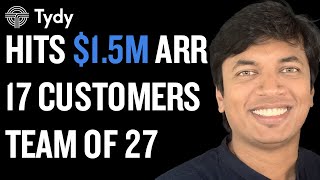
He got 17 customers to pay $80k/yr up from $40k/yr 1 year ago for Employee Onboarding SaaSSep 29, 2022

Heidi was launched back in 2017 they sold 17.5 percent of the company and raised 400k to get going now they've hit 1.5 million bucks in ARR up from 600 Grand an hour just a year ago having raised under a million bucks they raised another 600k last year at 3.2 posts so they've been I'd say very Capital efficient team at 27 they're trying to help you onboard your new employees faster they're doing some Enterprise space big companies onboarding one to two thousand new employees per month and that's how they price face fee 80 000 bucks per year then utility-based fee on top of that based off the volume of new onboards you're completing each month hey folks my guest today is Kieran Menon he's the co-founder and CEO of Tidy tydy the employee data and onboarding platform he started tidy after 17 years of sales and Consulting experience and previously ran sales for Opera software the browser and advertising company Karen you ready to take us to the top I am Nation let's do this all right so what did Opera do like a terrible job onboarding you and you said I'm gonna leave and launch my onboarding company actually no I mean I always uh kind of admire the culture at Oprah and so um kind of looked at a lot of the other companies I'd worked at before and said you know there was a lot of lacking in those processes and so yeah that's when the journey started it's amazing so what year was that when'd you launch uh we we actually started dating it about in about 2017. okay 2017 and who's we are you a single co-founder or multiple in the team or what no we're three co-founders three of us have known each other since when we were in school um kind of went our separate ways and then you know got back together to start dieting and since you're all friends you just split Equity evenly 33 each pretty much yeah it's amazing all right before we get too deep into that the back story here tell us give us an example of a customer using taihi today and how they use you yeah sure so um we work with large Enterprises you know companies with uh two thousand to five thousand plus employees and uh what we fundamentally do is we work with a company like genpag or Unilever or ABN Dev and we kind of bring together the HR data and ID systems so that people teams now have a single place to go to to kind of orchestrate their processes on board people passed the smarter and also retain them longer so fundamentally you know the the problem statement that we went after is multiple apps complexity across various processes you have HR ID admin Ops uh bring all of that together and just create one single place to kind of manage it very interesting and so for this technology for your technology what are customers paying on average per month or per year um so it's traditionally a yearly contract and we usually do three-year contracts with Enterprise that's one good thing working with Enterprise you know it's it's long term and uh today we do on average uh our eighth TV is above eighty thousand dollars and if I'm paying you 80 000 bucks a year how many employees am I likely managing with tidy um so the average company is doing between about two thousand to five thousand people every month and and sorry what does that mean two thousand five thousand interviews per month no on boarding so people being added onto the system okay so that's how you charge it's number of people you onboard per month yeah yeah interesting so how do you know to charge in year three you how you make them project how many they think they're going to be onboarding three years from now and they pay for that or sign up today yeah so we kind of do a split between our pricing one is in a platform subscription but yeah which is based on the total number of uh employees in the organization and then the Top-Up which is a per user fee on top of that which is for every new user that's added so you know a company with a hundred thousand employees would already have about 50 000 of them on Tidy by the end of uh Year One oh what's going on there YouTube good to see you guys now imagine this you love watching these interviews with SAS Founders but imagine if we took all of the valuation data out from over 2807 interviews I've done manually saves you a lot of time well we've done this we've built the into the beautiful interface inside of founder path check this out I'll show you how you can access this in a second but you log in you connect your stripe account you see your valuation real time you can see what it changed over the past 88 days and even set goals for evaluation this year now the secret valuation is there's many different ways to value a SAS business so the reason you're going to see three or four different evaluations inside of your founder path dashboard this is all free by the way is because depending on who's doing the buying of your SAS company you're going to get a different valuation a VC is going to pay a different valuation private Equity Firm is different if you're going to do a minority sale that's different and if you sell the whole business that's a different valuation you can see all those when I hover over here here right so the teal is what a VC would pay yellow is what private equity and red is if you sold the whole thing outright now what's cool about this is this is not built off random data again you guys hear these interviews on YouTube all these datas are built from real-time valuation data points Founders share with us on the show so traction 1.2 million seed round 3.7 raise they sold 22 percent of their business go in here and filter by the event maybe you only want to see companies that have sold the whole business well here are a bunch that have been acquired the valuation and the multiple maybe you're going out right now and you're raising your seed round well go in here and look at all this recent seed deals that went down what they raised what valuation they raised at and what percent that they sold there's never been a larger data set of SAS valuation than what you can get now inside of founder path and we're thrilled to bring it to you all right we're gonna go back to the YouTube video here in a second but if you want to check this tool out if you want to jump in and sign up you can check it out for free to get your valuation at this link this link founderpath.com forward slash products forward slash valuations or if you go to founderpath.com and hover over products click on get your valuation here and go ahead and sign up to give it a whirl again all that valuation data live right inside the platform I hope to see you there all right let's jump back into the interview okay so if I'm paying you a base fee of 80k just to sign up how many employees do I likely already have uh probably about 40 to 50 000. wow okay got it so 50k base and then I'm saying Hey listen Kieran I'm gonna onboard two to five thousand per month for the next two or three years and you're saying okay the extra fee for that is why right exactly it's a couple of dollars on double that I see interesting okay so base fee is about 50k employees if I'm paying you 80 000 bucks a year or something like that um cool all right and then I guess give me more of the more the backstory here so you launched 2017 with three co-founders how did you guys get your first customer it was actually um you know given the um kind of time we'd spent in the market we kind of had a lot of networks that we reached out to and uh went out and kind of spoke to a lot of people so it's not that we woke up one day and came up with this uh solution um we actually did go out and talk to a lot of Executives and then we realized you know the the whole workplace deck was kind of exploding um but when you kind of looked at right at the beginning the onboarding piece uh there was a huge vacuum in 2017 2018 but it was still nice to have it wasn't you know a need um and so very candidly our our growth has happened in the last two years since the pandemic uh for the first two or three years we were kind of building the product with a couple of POC customers like Unilever and Fidelity Investments um and then in the last couple of years it has pretty much taken off for us uh fundamentally just be clear so you were pre you had like no SAS Revenue back in 20 between 2017 and 2020. you were just doing PLS yeah okay so no SAS Revenue pocs only uh we were doing probably about a hundred thousand dollars oh you did have SAS Revenue yeah we did oh okay so I guess what year did you have your first dollar of SAS Revenue 2019 2018 and 2019 beginning yeah ah okay so so got it so how did you start there's a lot of people listening right now launching companies going I want to get a POC with Unilever and then you know make them pay 50 000 bucks for that and then convert them to a ten thousand dollar a month plan right how did you do that what was the POC app not with them specifically but on average recharging for pocs and how did you move someone from a POC to a paid plan yeah we were we we kind of um made one thing very clear is that we'll kind of co-design the solution but we're not doing it for free so if we want to do a POC it's still going to be a paid for POC um and I think you know my my 17 years of sales in Consulting kind of helped me in that um and so we basically started by discharging about you the fee which was five dollars per user and there was no platform subscription none of that um hindsight that was a terrible move because uh you know the revenue was fluctuating all over the place and we couldn't kind of keep track of what would our budgets be cash flow be any of that which is when we kind of move the pricing more to a platform subscription plus a Top-Up on a per user so when a company like Unilever you say Hey listen you're gonna pay five bucks per user to do a POC we're in a co-design a solution together they say okay we want to design this for 100 users so we're going to pay you what 500 bucks to build or 5 000 bucks to build the POC something like that yeah yeah pretty much and we started with one geography so it was much easier to kind of create the value show the value in about six months dying and then we went from a single geography to equity feeding to Global procurement and saying hey you know what if we made this available for the entire kind of uh organization and whoever wanted it could kind of pick it up and get started got it okay so then you move those pocs into pure SAS play and you said well you did a hundred thousand dollars in total revenue in 2020. yeah 2019 yeah okay so 2019 you're doing like you finished with like 10 grand a month in mrr which is 120 000 AR is that right correct I see very interesting okay um fast forward today how many customers are you serving uh today we have 17 Enterprise customers uh across seven zero or one seven across 25 countries and we're doing about a million and a half billion ARR yeah I was gonna say 17 at 80 000 bucks a year is about 1.5 in ARR now if you're doing 1.5 in AR today that is about a hundred and twenty thousand bucks a month this month where were you exactly one year ago uh we were about uh 500K ARR so Sega doing okay so you've about doubled oh no you more than doubled year over year right yeah yeah yeah well yes well so if you're you're doing about 50 000 bucks a month a year ago now you're at 120 130 000 bucks a month so yeah still have a couple days left in the year where you can get that full 300 year over your growth exactly that's what we're hoping for yeah what drove that growth was it expanding historical accounts more seats across 17 customers or is it adding brand new customers all together actually it was the significant edition of new customers I think um in at the end of last year we only had about eight or nine customers and then um you know we've been showing value for at least a year with those guys and so the kind of uh brand started spreading from a referral perspective as well um and the good thing with the Enterprise is if you're able to show value uh very quickly the other Enterprise is one of the kind of electron as well and try and actually um you know bring in the same solution because the problems are very similar and so last year my ATV was not 80 000 my ACB was probably closer to about 40 000 and so what I was able to do in the last 12 months was actually double my ATV and be more confident of the fact that I can actually charge more and still have companies coming in and buying tidy yep yep very that makes tons of sense and then I guess the only year we haven't talked about is 2020. so if you finish 2019 at 120 000 run rate what was 2020 finishing at about 275. yeah 275 so 120 to 275 to 600 to 1.5 million that's that's good growth heavy bootstrapped or raised uh we've raised about a million dollars to know and that's about it ah okay I would say so that's pretty anyone that's raised less than their AR I say is capital efficient so uh so that's good when did you raise that money um so we actually did it over a couple of uh rounds so the first one was obviously in 2017 with a couple of integrals kind of coming in and uh you know not a couple but a few Angels coming in and bringing it about uh 400k and then last year we raised the rest which was about looking forward interesting so that round though in 2017 I imagine that was probably pretty dilutive what did you sell like 20 20 of the company we we 17 and a half okay okay not terrible most people sell 20 in their seed round so you sold 17.5 or pre-seat I would say yeah okay yeah interesting and then you said you raised what another 600k last year mm-hmm yeah and what would you call that I mean is that a seed or is that a seed extension or oh I think it was a precede extension it really wasn't even a seed I mean in today's world heat is probably a few million dollars right that you're that you're raising but uh yeah it's probably pre-seed extension yeah yeah interesting um and what did you also sell 17 then uh about yes about the 18 and a half 18 and a half okay and why did you need that money what makes this expense company expensive to build why couldn't you bootstrap um I think we needed resources to kind of um you know uh go out and deliver the projects the way it works with Enterprises they're very happy giving you the money up front but upfront means on deployment and on average our deployments take about three to four months so from a cash flow perspective there's that little bit of a dip that happens during uh contract training to deployment and during that deployment you need to kind of bring in additional resources so um that's primarily kind of the bridge that we wanted to uh cross and so that's why we kind of brought in the money why wouldn't they give you though I mean if you were you're growing fast right you had 600 can AR last year but you basically if you sold 18.5 percent you raise the 600k at a 3.24 million post money which is not I mean it's an okay multiple on 600k of ARR but it's not you know 10x it's only like 5x why couldn't you get a 1020x multiple there and save yourself dilution yeah I think what I've realized is that we're not traditional fact which sells to FMB so we're Enterprise sales and traditionally I think Enterprise sales always and suffers from a lot more questions and a lot more kind of uh you know BC um I would say being unsure so just being completely candidates that's one of the main reasons right we we're very sure we want to go up the Enterprise and we want to build an Enterprise product not an SMB product and so uh I think that kind of uh creates a few questions that makes a ton of sense um talk to me about how you built the team how many folks full-time today so so we actually have about 27 people um the advantage for us is um you know where where U.S headquartered um uh most of our customers are UF um but our entire engineering and delivery team is based out of India ah which did you use the Outsourcing company or do you find someone local to build around them no so it's my video and co-founder he kind of based out of Bangalore and so he kind of just goes out and get people that's a well it's getting harder and harder they're aiming in Bangalore to an eye Pune there's so many big companies moving there I mean what are you guys paying right now for senior front-end engineer oh it's it's uh I don't know how I would convert that but in Indian rupees it would probably be about you know uh 2 million interesting so 2 million per year yeah interesting yeah so that's like well I mean it's only like 30 000 US Dollars that's not too expensive yeah it's not too expensive no it's not but if you want really good um you know seasoned professionals with like seven years of experience you suddenly kind of just double that up and but still I mean at 60 that you'd pay what 200 000 bucks a year in the U.S yeah yeah interesting so do you plan to keep scaling your engineering team over there in Bengaluru we do what we're trying to do now though is build our gdm team out of the US more so you know having more sdrs these kind of account management account management is a big thing for us because we're also kind of a lot of opportunity to upsell within the Enterprise um so so that's kind of my focus for the next year yeah that makes a lot of sense okay so it's 20 foot on the team how many are engineers uh 19 19. oh wow okay and how many do you have any sales reps that carry a quota besides you yeah yeah there is so I have two I have two ah okay so how do I mean there's people listening right now trying to set up their first sales reps and like so what quota do you give your first rep so it's um the first one that kind of came in came in about four or four years ago or so so he's been with us through the entire journey and um kind of came in pretty fresh and so just shadowed me and um kind of learned from that perspective so it's been about last year I was doing majority of the sales or all of the sales this year's when he's gotten a quarter and he's actually started closing deals and six figure deals with that so what's his quota like 500 Grand a new ARR or it is uh it's actually 700k okay and if he hits or she hits 700 000 bucks then quota you're then gonna you obviously pay him a base and then as the commission double the base uh commission is actually ten percent of whatever he brings in ah okay so let's say that he brings in 700 Grand he would make 70k extra on top of his base is his base also about 70. so together it's 140. yeah uh okay so very standard Playbook there then it is it is yeah yeah interesting any plans to hire more I mean you said your go to market motion you're building it in the states any plans to hire more sales reps in the States this year or next year yeah so aesdrs for sure within the next quarter we're gonna kind of build up uh the team with one more AE and one more SDR in the US but also kind of bringing in the car management team in the US um because I think it's a really important apart from the sales process kind of really invest in the relationship and also in the upsell process yeah yeah this makes sense who do you see as your biggest competitors uh one of the uh companies we kind of just uh find with um I think the CHR over there was uh like you know Kieran if you competed with servicenow I would have brought your price down significantly because I wouldn't kind of play one against the other but you're in a very unique Niche space today as far as the employee experience you could do so I can't really fit you against anyone um but but I would say you know what about like remote what about like remote.com or deal yeah so so I would say the biggest competitor for us is the internal teams today um you know because what we're doing is we're integrating these 15 16 different systems that exist within the organization so you know your work pay with service now with ADP with um OCTA with uh you know background verification vendors um so there are so many different moving parts that we're bringing together and creating a lipstick kind of data set from an employee uh perspective so uh if I were to say you know who are the closest kind of not competitors but the company that closes is probably Rippling but drippling does it more from an SMD perspective and we're doing it more from an Enterprise perspective yeah yeah that makes a lot of sense all right on that note Kieran let's wrap up here with the famous five number one favorite book oh I I actually love um uh the monk Consultants Ferrari it was one of my first kind of yes that's a good one number two is our CEO you're following or studying sorry say that again is there a CEO that you're following or studying oh yeah I I have been a big fan of uh Richard Branson from from when I was in college so yeah um number three what's your favorite online tool for building tidy uh I actually love um using slack it's just so easy to kind of communicate with the team where needed and very quickly so yeah number four how many hours of sleep do you get every night I have two kids and the startup uh one of my kids is three years old so I get about six hours on a good day okay fair enough so so married with two kids yep and how old are you I'm 40. 40. last question something you wish you knew when you were 20. uh that typing was a possibility now what was oh that type that tidy was the possibility yeah guys there you have it tidy was launched back in 2017 they sold 17.5 percent of the company and raised 400k to get going now they've hit 1.5 million bucks in ARR up from 600 Grand an hour just a year ago having raised under a million bucks they raised another 600k last year at 3.2 posts so they've been I'd say very Capital efficient team at 27 they're trying to help you onboard your new employees faster they're doing some Enterprise space big companies onboarding one to two thousand new employees per month and that's how they price base fee 80 000 bucks per year then utility-based fee on top of that based off the volume of new onboards you're completing each month Kieran thanks for taking us to the top thanks Nathan pleasure one more thing before you go we have a brand new show every Thursday at 1pm Central it's called Shark Tank for SAS we call it deal or bust one founder comes on three hungry buyers they try and do a deal live and the founder shares back-end dashboards their expenses their revenue our poo CAC LTV you name it they share it and the buyers try and make a deal live it is fun to watch every Thursday 1 p.m Central additionally remember these recorded founder interviews go live we release them here on YouTube every day at 2PM Central to make sure you don't miss any of that make sure you click the Subscribe button below here on YouTube their big red button and then click the little bell notification to make sure you get notifications when we do go live I wouldn't want you to miss breaking news in the SAS World whether it's an acquisition a big fundraise a big sale a big profitability statement or something else I don't want you to miss it additionally if you want to take this conversation deeper and further we have by far the largest private slack Community for B2B SAS Founders you want to get in there we've probably talked about your tool if you're running a company or your firm if you're investing you can go in there and quickly search and see what people are saying sign up for that at nathanlacka.com forward slash slack in the meantime I'm hanging out with you here on YouTube I'll be in the comments for the next 30 minutes feel free to let me know what you thought about this episode and if you enjoyed it click the thumbs up we get a lot of haters that are mad at how aggressive I am on these shows but I do it so that we can all learn we have to counter those people we got to push them away click the thumbs up below to count on them and know that I appreciate your guys's support all right I'll be in the comments see ya

Data and Sources

All figures on this page are taken directly from interviews or are estimates from public sources and proprietary models. Not financial advice. Read full disclaimer.

Claim this profile

People Also Viewed

NextME logo

NextME

NextME makes it simple for businesses to manage waitlists and serve more customers. Track visits and wait times, engage your customers in real-time with a custom virtual waiting room, and grow your business like never before. NextME leverages proprietary historical data to help businesses quote more accurate wait times during peak hours. We believe in superior customer service and that waiting in line can be done virtually, not physically. NextME's digital waitlist for businesses is available to download in the App Store today: http://apple.co/1IUTQWw We're hiring! See our current opening positions here: https://bit.ly/3llzOho Need an extra hand with a product demo? Give us a call at (877) 639-8631

BluAgent logo

BluAgent

BluAgent Technologies is a fully integrated SaaS platform that streamlines and simplify the entire safety and compliance process

Digital Horizon logo

Digital Horizon

Digital Horizon is a VC firm focused on backing exceptional entrepreneurs building B2B software-based solutions and marketplaces. With a presence in London, Tel Aviv and Moscow, Digital Horizon aims to seek out early-stage technology companies with the ultimate goal to assist them in building and scaling their business.

Trefis logo

Trefis

Provider of a business analysis technology. The company provides a data analytics technology for investors and decision-makers in business that allows users to share, use, and collaborate on analysis.

Liquid Logics logo

Liquid Logics

Liquid Logics, a True cloud-based SaaS Full Cycle Lending Software Solution for the residential Mortgage banking Industry. Based in the greater Kansas City area, Liquid Logics developed a full cycle Loan creation, Automated Underwriting and Mortgage Brief Case empowering borrower transparency and direct control of the loan process, changing their experience the way Travelocity did to the travel market. Liquid Logics unlike other legacy Loan Origination System who promise future roadmaps for online systems, provides today, online secure products that are focused on allowing consumers and lenders to effectively self-manage the flow of information and bi-directional direct communication between all interested parties of the transaction on all platform mobile, PC or tablets. The suite of products will provide real efficiency and profitability while gaining a competitive advantage. For more information please visit liquidlogics.com or contact us directly at 816-295-6240

DCatalog logo

DCatalog

DCatalog is the leading technology provider of digital publishing solutions. Our technology allows you to convert your PDFs into a unique digital content experience. Our suite of innovative digital publishing software solutions leverage a cloud based platform allowing you to deliver content via the web, tablets, mobile devices, and social channels. The elite features of DCatalog surpass any other software solution in the publishing industry. How It Works: DCatalog will convert PDFs and other printed materials into online and offline customized digital editions. Customizations include the ability to personally brand the content with a logo, embed unlimited video and audio, translate into various languages, track analytics, and sell products from within the edition, plus a whole lot more. DCatalog publishing solutions allow many brands worldwide to create digital editions in minutes, including digital catalogs, brochures, magazines and more. We are always willing to create custom solutions to serve the unique needs of every client. Our publishing solutions help clients reduce costs, expand reach, and improve effectiveness, while providing readers with a media-rich, visually stimulating digital content experience. Since the business was founded in 2008, DCatalog has experienced rapid growth as a privately held company headquartered in the capital of innovation, Silicon Valley.

Tydy Revenue 2023: $2.7M ARR, $3.2M Valuation