
Founder Interview
How Tydy Tripled to $1.5M ARR and 17 Enterprise Customers on Under $1M Raised (Interview with CEO Kiran Menon)
- Interview Date
- September 29, 2022
- Interviewee
- Kiran MenonCo-Founder and CEO
Company Metrics at Interview Time
ARR (2021)
$500K
Customers (2022)
17
Avg Contract Value (2022)
$80,000
Total Funding
$1M
Team Size (2022)
27
Historical Snapshot
These numbers were reported by Kiran Menon during his interview with Nathan Latka recorded in September 2022 and represent a historical snapshot, not current figures. See Tydy’s current numbers.
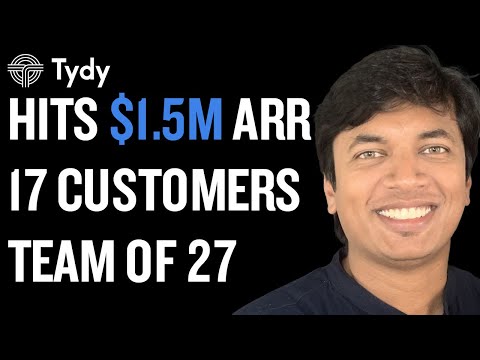
Key Takeaways
- 01Tydy was founded in 2017 by three co-founders who have known each other since school
- 02The company finished 2019 with approximately $120K in ARR after its first SaaS revenue in late 2018 or early 2019
- 03Revenue grew from $500K ARR in 2021 to 17 enterprise customers by 2022 with an average contract value of $80,000
- 04Average contract value doubled from $40,000 in 2021 to $80,000 in 2022
- 05Tydy raised $400K in a pre-seed round in 2017 and a further $600K pre-seed extension in 2021, totaling $1M
- 06The team of 27 included 19 engineers based in Bangalore and 2 sales reps in the US
- 07Enterprise customers typically had 40,000 to 50,000 employees and onboarded 2,000 to 5,000 new people per month
- 08Tydy used three-year enterprise contracts with a platform subscription plus a per-user top-up fee
- 09Word of mouth and referrals among enterprise HR teams drove the addition of new customers in 2022
- 10The first sales rep carried a $700K quota and earned 10% commission on closed deals
Company Metrics at Time of Interview
| Metric | Value | Source |
|---|---|---|
| Year Founded | 2017 | Founder interview, Sep 2022 |
| ARR (2019) | $120K | Founder interview, Sep 2022 |
| ARR (2021) | $500K | Founder interview, Sep 2022 |
| Customers (2021) | 8 | Founder interview, Sep 2022 |
| Customers (2022) | 17 | Founder interview, Sep 2022 |
| Avg Contract Value (2021) | $40,000 | Founder interview, Sep 2022 |
| Avg Contract Value (2022) | $80,000 | Founder interview, Sep 2022 |
| Total Funding | $1M | Founder interview, Sep 2022 |
| Pre-Seed Round (2017) | $400K | Founder interview, Sep 2022 |
| Pre-Seed Extension (2021) | $600K | Founder interview, Sep 2022 |
| Equity Sold (Pre-Seed 2017) | 17.5% | Founder interview, Sep 2022 |
| Equity Sold (Pre-Seed Extension 2021) | 18.5% | Founder interview, Sep 2022 |
| Team Size (2022) | 27 | Founder interview, Sep 2022 |
| Engineers (2022) | 19 | Founder interview, Sep 2022 |
| Sales Reps (2022) | 2 | Founder interview, Sep 2022 |
| Sales Rep Quota (2022) | $700K | Founder interview, Sep 2022 |
| Sales Rep Commission Rate (2022) | 10% | Founder interview, Sep 2022 |
| Typical Contract Length (2022) | 3 years | Founder interview, Sep 2022 |
| Typical Customer Employee Count (2022) | 40,000 to 50,000 | Founder interview, Sep 2022 |
| Monthly New Onboards per Customer (2022) | 2,000 to 5,000 | Founder interview, Sep 2022 |
| ARR (2022) | $1.5M | Founder interview, Sep 2022 |
Growth Breakdown
Revenue
Tydy recorded approximately $120K in ARR at the end of 2019, its first full year of SaaS revenue. By the end of 2021 the company had reached $500K ARR, and by September 2022 it was serving 17 enterprise customers with an average contract value of $80,000 per year, up from $40,000 the prior year.
Customers
Tydy ended 2021 with around 8 enterprise customers and grew to 17 by September 2022. Customers included large global enterprises such as Genpact, Unilever, AB InBev, and Fidelity Investments, each typically employing 40,000 to 50,000 people and onboarding 2,000 to 5,000 new employees per month.
Team
The team stood at 27 people in September 2022, with 19 engineers based in Bangalore led by the CTO and co-founder. The US-based go-to-market team included 2 sales reps, with plans to add at least one more AE and one SDR within the next quarter.
Funding
Tydy raised $400K in a pre-seed round from angel investors in 2017, selling 17.5% of the company, and a further $600K pre-seed extension in 2021, selling approximately 18.5%. Total capital raised stood at $1M as of the interview, which the host noted was less than the company's ARR, making it capital efficient by his measure.
Growth Strategy
Paid POCs That Convert to Long-Term Contracts
Rather than offering free pilots, Tydy charged for proof-of-concept engagements from the start, starting with a per-user fee of $5. This approach, informed by Kiran's 17 years of sales and consulting experience, established commercial relationships early and made conversion to multi-year platform contracts more straightforward.
Enterprise Word of Mouth and Referrals
Kiran credited a significant portion of new customer additions in 2022 to referrals spreading among enterprise HR and people teams. Once Tydy demonstrated value within one large organization, peer enterprises with similar onboarding challenges sought out the same solution, reducing the need for outbound sales effort.
Expanding from Single Geography to Global Deployment
Tydy's initial deployments were scoped to a single geography within a customer's organization. After proving value in roughly six months, the team approached global procurement to expand the solution company-wide, which drove both revenue growth and deeper account relationships.
Raising ACV Through Pricing Confidence
Between 2021 and 2022, Kiran doubled the average contract value from $40,000 to $80,000 by becoming more confident in Tydy's pricing power. He noted that enterprises continued to buy at the higher price point, validating the move and improving revenue per customer without requiring proportionally more customers.
Building a Dedicated US Go-to-Market Team
With the engineering team established in Bangalore, Kiran focused on building a US-based sales and account management function. The first quota-carrying sales rep was given a $700K target in 2022, and plans were in place to add an AE, an SDR, and an account management team to capture upsell opportunities within existing enterprise accounts.
Best Quotes
“We work with large enterprises, you know, companies with 2,000 to 5,000 plus employees. And what we fundamentally do is we work with a company like Genpact or Unilever or AB InBev, and we kind of bring together the HR data and IT systems so that people teams now have a single place to go to to kind of orchestrate their processes, onboard people faster, smarter, and also retain them longer.”
“Today, have 17 enterprise customers across”
“We were about 500 k ARR.”
“We've raised about a million dollars till now, and that's about it.”
“We kind of made one thing very clear is that we'll kind of co design the solution, but we're not doing it for free. So if we want to do a POC, it's still going to be a paid for POC. And I think, you know, my seventeen years of sales in consulting kind of helped me in that.”
“Our growth has happened in the last two years since the pandemic. For the first two or three years, we were kind of building the product with a couple of POC customers like Unilever and Fidelity Investments. And then in the last couple of years, it has pretty much taken off for us fundamentally.”
“We're not traditional SaaS, which sells to SMB. So we're enterprise sales. And traditionally, I think enterprise sales always kind of suffers from a lot more questions and a lot more kind of VC, I would say, being unsure.”
“It is it's actually 700 k.”
“Commission is actually 10% of whatever he brings in.”
What Happened Next
This interview captured Tydy at a specific moment in September 2022, when the company had 17 enterprise customers and $500K ARR as of the prior year, with an average contract value of $80,000. The figures here reflect what Kiran Menon reported on tape and should be read as a historical snapshot. For the latest recorded revenue, customer count, funding, and team size, visit Tydy's company profile on GetLatka.
View Tydy’s current profile and metricsFull Transcript
Chapters
- 0:00Introduction and Company Overview
- 1:47How Enterprise Customers Use Tydy
- 2:44Pricing Model: Platform Fee Plus Per-User Top-Up
- 7:41Early Growth: POCs with Unilever and Fidelity
- 8:44Charging for POCs and Moving to SaaS Contracts
- 10:28Current Customer Count and ARR
- 11:52Doubling ACV from $40K to $80K
- 12:36Total Funding Raised and Capital Efficiency
- 12:46Pre-Seed Rounds and Dilution
- 14:54Why Enterprise Sales Creates VC Hesitation
- 15:35Team Structure: 27 People, 19 Engineers in Bangalore
- 17:39Sales Rep Quota and Commission Structure
- 19:13Competitive Landscape: Rippling, ServiceNow, Internal Teams
- 20:25Famous Five Rapid-Fire Questions
- 21:43Closing Summary and Wrap-Up
Introduction and Company Overview
Nathan Latka
00:00Tydy was launched back in 2017. They sold 17.5% of the company and raised 400 k to get going. Now they've hit $1,500,000 in ARR, up from $500k in ARR just a year ago, having raised under a million bucks. They raised another 600k last year. So they've been, I'd say, very capital efficient. Team at 27, they're trying to help you onboard your new employees faster. They're doing the enterprise space, big companies, onboarding one
00:22to 2,000 new employees per month, and that's how they price base fee $80,000 per year, then utility based fee on top of that based off the volume of new onboards you're completing each month. Hey, folks. My guest today is Kiran Menon. He's the cofounder and CEO of Tydy, t y d y, the employee data and onboarding platform. Started He Tydy after seventeen years of sales and consulting experience and previously ran sales for Opera Software, the browser
00:44and advertising company. Kiran, you ready to take us to the top?
Kiran Menon
00:48I am, Nathan. Let's do it.
Nathan Latka
00:50Alright. So did Opera do, like, terrible a job onboarding you, and you said I'm gonna leave and launch my own onboarding company?
Kiran Menon
00:56Actually, no. I mean, I always kind of admired the culture at Opera. And so kind of looked at a lot of the other companies I've worked at before and said, you know, there was a lot of lacking in those processes. And so, yeah, that's when the journey started.
Nathan Latka
01:12It's amazing. So what year was that? When'd you launch?
Kiran Menon
01:15We we actually started Tydy at about in about 2017.
Nathan Latka
01:19K. 2017. And who's we? Are you a single co founder or multiple on the team or what?
Kiran Menon
01:24No. We're three co founders. Three of us have known each other since when we were in school. Kinda went our separate ways and then, you know, got back together to start Tydy.
Nathan Latka
01:33And since you're all friends, you just split equity evenly, 33% each?
Kiran Menon
01:38Pretty much. Yeah.
Nathan Latka
01:39That's amazing. Alright. Before we get too deep into that, the backstory here, tell us give us example of a customer using Tydy today and how they use you.
How Enterprise Customers Use Tydy
Kiran Menon
01:47Yeah. Sure. So we work with large enterprises, you know, companies with 2,000 to 5,000 plus employees. And what we fundamentally do is we work with a company like Genpact or Unilever or AB InBev, and we kind of bring together the HR data and IT systems so that people teams now have a single place to go to to kind of orchestrate their processes, onboard people faster, smarter, and also retain them longer. So fundamentally, you know, problem statement
02:23that we went after is multiple apps, complexity across various processes. You have HR, IT, admin, ops, bring all of that together and just create one single place to kinda manage it.
Nathan Latka
02:36Very interesting. And so for this technology, for your technology, what are customers paying on average per month or per year?
Pricing Model: Platform Fee Plus Per-User Top-Up
Kiran Menon
02:44So it's traditionally a yearly contract, and we usually do three year contracts with enterprises. That's one good thing working with enterprises, you know, it's long term. And today, we do on average, our ACV is about $80,000
Nathan Latka
02:58And if I'm paying you $80,000 a year, how many employees am I likely managing with Tydy?
Kiran Menon
03:05So the average company is doing between about 2,000 to 5,000 people every month.
Nathan Latka
03:10And and and sorry. What does that mean? 2,000 to 5,000 interviews per month?
Kiran Menon
03:14No. Onboarding. So people being added onto the system.
Nathan Latka
03:18Okay. So that's how you charge. It's number of people you onboard per month?
Kiran Menon
03:22Yeah. Yeah.
Nathan Latka
03:23Interesting. So how do you know what to charge in year three? You you make them project how many they think they're gonna be onboarding three years from now, they pay for that or sign up today?
Kiran Menon
03:31Yeah. So we kind of do a split between our pricing. One is in a platform subscription per year, which is based on the total number of employees in the organization. And then there's the top up, which is a per user fee on top of that, which is for every new user that's added. You know, a company with a 100,000 employees would already have about 50,000 of them on Tydy by the end of year one.
Nathan Latka
03:57Oh, what's going on there, YouTube? Good to see you guys. Now imagine this, you love watching these interviews with SaaS founders, but imagine if we took all of the valuation data out from over 2,807 interviews I've done manually. Saves you a lot of time. Well, we've done this. We've built it into the beautiful interface inside of Founderpath. Check this out. I'll show you how you can access this in a second, but you log in, you connect
04:20your Stripe account, you see your valuation real time. You can see what it changed over the past eighty eight days and even set goals for valuation this year. Now the secret evaluation is there's many different ways to value a SaaS business. So the reason you're gonna see three or four different valuations inside of your Founderpath dashboard, this is all free by the way, is because depending on who's doing the buying of your SaaS company, you're gonna
04:45get a different valuation. A VC is gonna pay a different valuation. Private equity firm is different. If you're gonna do a minority sale, that's different. And if you sell the whole business, that's a different valuation. You can see all those when I hover over here. Right? So the teal is what a VC would pay. Yellow is what private equity and red is if you sold the whole thing outright. Now what's cool about this is this is
05:06not built off random data. Again, you guys hear these interviews on YouTube. All these datas are built from real time valuation data points founder share with us on the show. So traction 1,200,000 seed round 3.7 raise. They sold 22 of their business. Go in here and filter by the event. Maybe you only wanna see companies that have sold the whole business. Well, here are a bunch that have been acquired the valuation and the multiple. Maybe you're
05:32going out right now and you're raising your seed round. We'll go in here and look at all this recent seed deals that went down, what they raised, what valuation they raised at, and what percent that they sold. There's never been a larger dataset of SaaS valuations than what you can get now inside of Founderpath. And we're thrilled to bring it to you. All right. We're gonna go back to the YouTube video here in a second, but
05:54if you wanna check this tool out, if you wanna jump in and sign up, you can check it out for free to get your valuation at this link. This link, founderpath.com/products/valuations. Or if you go to founderpath.com and hover over products, click on get your valuation here, and go ahead and sign up to give it a whirl. Again, all that valuation data live right inside the platform. I hope to see you there. Alright. Let's jump back into
06:20the interview. Okay. So if I'm paying you though a base fee of 80 k just to sign up, how many employees do I likely already have?
Kiran Menon
06:29Probably about forty to fifty thousand.
Nathan Latka
06:31Wow. Okay. Got it. So 50 base, and then I'm saying, hey. Listen, Kiran. I'm gonna onboard 2 to 5,000 per month for the next two or three years. And you're saying, okay. The extra fee for that is why?
Kiran Menon
06:42Right. Exactly. It's a couple of dollars on top of that.
Nathan Latka
06:45I see. Interesting. Okay. So base fee is about 50 employees if I'm paying you $80,000 a year or something like that. Cool. Alright. And then, I guess, give me more of the more of the backstory here. So you launched 2017 with three cofounders. How did you guys get your first customer?
Kiran Menon
07:02It was actually, you know, given the kind of time we'd spent in the market, we kind of had a lot of networks that we reached out to and went out and kind of spoke to a lot of people. So it's not that we woke up one day and came up with this solution. We actually did go out and talk to a lot of executives, and then we realized, you know, the whole workplace tech was kind of
07:25exploding. But when you kind of looked at right at the beginning, the onboarding piece, there was a huge vacuum in 2017, 2018, but it was still nice to have. It wasn't a need.
Early Growth: POCs with Unilever and Fidelity
Kiran Menon
07:41And so very candidly, our growth has happened in the last two years since the pandemic. For the first two or three years, we were kind of building the product with a couple of POC customers like Unilever and Fidelity Investments. And then in the last couple of years, it has pretty much taken off for us fundamentally.
Nathan Latka
07:59Just to be clear, so you were pre you had, like, no SaaS revenue back in '20 between 2017 and 2020. You were just doing POCs?
Kiran Menon
08:07Yeah.
Nathan Latka
08:08Okay. So no SaaS revenue, POCs only?
Kiran Menon
08:11We were doing probably about a $100,000.
Nathan Latka
08:14Oh, you did have SaaS revenue?
Kiran Menon
08:16Yeah. We did.
Nathan Latka
08:17Oh, okay. So I guess what year did you have your first dollar of SaaS revenue? 2019?
Kiran Menon
08:22Twenty eighteen end, 2019 beginning. Yeah.
Nathan Latka
08:25Ah, okay. So so got it. So how did you there's a lot of people listening around launching companies going, I wanna get a POC with Unilever and then, you know, make them pay $50,000 for that and then convert them to a 10,000 a month plan. Right? How did you do that? What was the POC not with them specifically, but on average recharging for POCs, how'd you move someone from a POC to a paid plan?
Charging for POCs and Moving to SaaS Contracts
Kiran Menon
08:44Yeah. We were. We we kind of made one thing very clear is that we'll kind of co design the solution, but we're not doing it for free. So if we want to do a POC, it's still going to be a paid for POC. And I think, you know, my seventeen years of sales in consulting kind of helped me in that. And so we basically started by just charging a per user fee, which was $5 per user.
09:07And there was no platform subscription, none of that. Hindsight, that was a terrible move because, you know, the revenue was fluctuating all over the place. Then we couldn't kind of keep track of what would our budgets be, cash flow be, any of that, which is when we kind of move the pricing more to a platform subscription plus a top up on a per user.
Nathan Latka
09:28So when a company like Unilever, you say, hey, listen, you're gonna pay $5 per user to do a POC. We're gonna co design a solution together. They say, okay. We wanna design this for a 100 users, so we're gonna pay you, what, $500 to build or $5,000 to build the POC, something like that?
Kiran Menon
09:40Yeah. Yeah. Pretty much. And we started with one geography. So it was much easier to kind of create the value, show the value in about six months'time. And then we went from a single geography to actually speaking to global procurement and saying, hey, you know, what if we made this available for the entire kind of organization? And whoever wanted it could kinda pick it up and get started.
Nathan Latka
10:05Got it. Okay. So then you move those POCs into pure SaaS play. You said, well, you did a $100,000 in total revenue in 2020?
Kiran Menon
10:12Mhmm. In Yep. 2019. Yeah.
Nathan Latka
10:15Okay. So 2019, you were doing, like you finished with, like, $10 a month in MRR, which is a $120,000 AR. Is that right?
Kiran Menon
10:21Correct.
Nathan Latka
10:22I see. Very interesting. Okay. Fast forward to today. How many customers are you serving?
Current Customer Count and ARR
Kiran Menon
10:28Today, have 17 enterprise customers across
Nathan Latka
10:31Seven zero or one seven?
Kiran Menon
10:34One seven. One seven. Okay. 17 enterprise customers across 25 countries, and we're doing about a million and 0.5 in ARR.
Nathan Latka
10:42I Yeah. Was gonna say 17 at $80,000 a year is about 1.5 in ARR. Now if you're doing 1.5 in ARR today, that is about a $120,000 a month this month. Where were you exactly one year ago?
Kiran Menon
10:54We were about 500 k ARR.
Nathan Latka
10:58So sick of doing okay. So you you've about doubled. Oh, no. You more than doubled year over year. Right?
Kiran Menon
11:03So yeah.
Nathan Latka
11:04Yeah. Yeah. Yeah. Well, yes. Well, so if you're you're doing about $50,000 a month a year ago, now you're at a 120, $130,000 a month. So still have a couple days left in the year where you can get that full 300% year over year growth.
Kiran Menon
11:15Yeah. Exactly. That's what we're hoping for.
Nathan Latka
11:18Yeah. What drove that growth? Was it expanding historical accounts, more seats across 17 customers, or is it adding brand new customers altogether?
Kiran Menon
11:26Actually, it was the significant addition of new customers. I think at the end of last year, we still only had about eight or nine customers. And then, you know, we've been showing value for at least a year with those guys. And so the kind of brand started spreading from a referral perspective as well. And the good thing with the enterprise is if you're able to show value very quickly, the other enterprises want to kind of latch
Doubling ACV from $40K to $80K
Kiran Menon
11:52on as well and try and actually, you know, bring in the same solution because the problems are very similar. And so last year, my ACV was not $80,000 My ACV was probably closer to about $40,000 And so what I was able to do in the last twelve months was actually double my ACV and be more confident of the fact that I can actually charge more and still have companies coming in and buying Tydy.
Nathan Latka
12:17Yep. Yep. Very that makes tons of sense. And then I guess the only year we haven't talked about is 2020. So if you finish 2019 at a 120,000 run what was 2020 finishing?
Kiran Menon
12:26At about $2.75.
12:29Yeah. 275. So 01/20 to 275 to 600 to 1,500,000.
Nathan Latka
12:32That's that's big growth.
Kiran Menon
12:33Yep. Have you bootstrapped or raised?
Total Funding Raised and Capital Efficiency
Kiran Menon
12:36We've raised about a million dollars till now, and that's about it.
Nathan Latka
12:39Ah, okay. I would say so that's pretty anyone that's raised less than their ARR, I say, is capital efficient.
Kiran Menon
12:45So so that's good.
Pre-Seed Rounds and Dilution
Nathan Latka
12:46When did you raise that money?
Kiran Menon
12:48So we actually did it over a couple of rounds. So the first one was obviously in 2017 with a couple of angels kinda coming in and, you know, not couple, but a few angels coming in and putting in about 400 k. And then last year, we raised the rest, which was about 200.
Nathan Latka
13:03Interesting. So that round on 2017, I imagine that was probably pretty dilutive. What do you sell, like, 20% of the company?
Kiran Menon
13:10We we 17 and a half.
Nathan Latka
13:12Okay. Okay. Not terrible. Most people sell 20% in their seed round. So you sold 17.5 for pre seed, I would say. Yeah. Okay. Yeah. Interesting. And then you said you raised, what, another 600 k last year?
Kiran Menon
13:24Mhmm. Yeah.
Nathan Latka
13:26And what would you call that? I mean, is that a seed or is that a seed extension? Or
Kiran Menon
13:30I think it was a pre seed extension. It really wasn't even a seed. I mean, in today's world, seed is probably a few million dollars, right, that you're that you're raising. But, yeah, it's probably precede extension.
Nathan Latka
13:42Yeah. Yeah. Interesting. And what did you also sell 17% then?
Kiran Menon
13:49About yes. About 18 and a half.
Nathan Latka
13:5118 and a half. Okay. And why did you need that money? What makes this expense company expensive to build? Why couldn't you bootstrap?
Kiran Menon
13:57I think we needed resources to kind of, you know, go out and deliver the projects the way it works with enterprises. They're very happy giving you the money upfront, but upfront means on deployment. And on average, our deployments take about three to four months. So from a cash flow perspective, there's that little bit of a dip that happens during contract signing to deployment. And during that deployment, you need to kind of bring in additional resources. So
14:25that's primarily kind of the bridge that we wanted to cross. And so that's why we kind of brought in the money.
Nathan Latka
14:31Why wouldn't they give you though? I mean, if you were you're growing fast. Right? You had 600 k in ARR last year, but you basically if you sold 18.5%, you raised the 600k at roughly a 3,240,000 post money, which is not I mean, it's an okay multiple on 600 of ARR, but it's not, you know, 10 x. It's only like five x. Why couldn't you get a ten, twenty x multiple there and save yourself dilution?
Why Enterprise Sales Creates VC Hesitation
Kiran Menon
14:54Yeah. I think what I've realized is we're not traditional SaaS, which sells to SMB. So we're enterprise sales. And traditionally, I think enterprise sales always kind of suffers from a lot more questions and a lot more kind of VC, I would say, being unsure. So being completely candid, that's one of the main reasons. Right? We we're very sure we wanna go after enterprise, and we wanna build an enterprise product, not an SMB product. And so I
15:26think that kind of creates a few questions.
Nathan Latka
15:29That makes a ton of sense. Talk to me about how you built the team. How many folks full time today?
Team Structure: 27 People, 19 Engineers in Bangalore
Kiran Menon
15:35So so we actually have about 27 people. The advantage for us is that, you know, we're US headquartered. Most of our customers are US, but our entire engineering and delivery team is based out of India.
Nathan Latka
15:52Ah, which did you use the outsourcing company or do you find someone local then build around them?
Kiran Menon
15:58No. So so my CTO and cofounder, he kind of based out of Bangalore, and so he kind of just goes out and get people.
Nathan Latka
16:08That's well, it's getting harder and harder there. Ain't been in Bangalore, Chennai, Pune, there's so many big companies moving there. I mean, are guys paying right now for a senior front end engineer?
Kiran Menon
16:17Oh, it's it's I don't know how I would convert that. But in Indian rupees, it would probably be about, you know, 2,000,000.
Nathan Latka
16:27Interesting. So $22,000,000 per year?
Kiran Menon
16:28Yeah. Interesting.
Nathan Latka
16:29Yeah. So that's like well, I mean, it's only, like, 30,000 US dollars. That's not too expensive.
Kiran Menon
16:35Yeah. It's not too expensive. No. It's not. But if you want really good, you know, seasoned professionals with, like, seven years of experience, you suddenly kinda just double that up.
Nathan Latka
16:45But still, I mean, that's 60 that you'd pay, what, $200,000 a year in The US.
Kiran Menon
16:49Right? Yeah. Yeah. Yeah. Interesting.
Nathan Latka
16:53So do you plan to keep scaling your engineering team over there in Bangalore?
Kiran Menon
16:56We do. What we're trying to do now, though, is build our GTM team out of The US more. So, you know, having more SDRs, AEs, kind of account management. Account management is a big thing for us because we're also kind of a lot of opportunity to upsell within the enterprise. Yeah. So so that's kind of my focus for the next year.
Nathan Latka
17:17Yeah. That makes a lot of sense. Okay. So it's 27 on the team. How many are engineers?
Kiran Menon
17:2219.
Nathan Latka
17:2319. Oh, wow. Okay. And how many do you have any sales reps that carry a quota besides you?
Kiran Menon
17:28Yep. Yeah. Yeah. Yeah. There is so I have two. I have two.
Nathan Latka
17:32Ah, okay. So how do I mean, there's people listening right now trying to set up their first sales reps. And like, so what quota do you give your first rep?
Sales Rep Quota and Commission Structure
Kiran Menon
17:39So it's the first one that kinda came in, came in about four years ago, so he's been with us through the entire journey and kind of came in pretty fresh. And so just shadowed me and kind of learned from that perspective. So till about last year, I was doing majority of the sales or all of the sales. This year is when he's gotten a quota and he's actually started closing deals and 6 figure deals with that.
Nathan Latka
18:06So What's his quota? Like, $100 a new ARR or a million new?
Kiran Menon
18:10It is it's actually 700 k.
Nathan Latka
18:14Okay. And if he hits or she hits $700,000 in quota, you're then gonna you obviously pay him a base. And then is the commission double the base?
Kiran Menon
18:23Commission is actually 10% of whatever he brings in.
Nathan Latka
18:27Ah, okay. So let's say that he brings in $700k. He would make 70 k extra on top of his base. Is his base also about 70? So together, it's $140k?
Kiran Menon
18:35Yep. Yep.
Nathan Latka
18:36Ah, okay. So very standard playbook there then.
Kiran Menon
18:39It is. It is.
Nathan Latka
18:40Yeah. Yeah. Interesting. Any plans to hire more? I mean, you said your go to market motion, you're building it in The States. Any plans to hire more sales reps in The States this year or next year?
Kiran Menon
18:47Yeah. So AEs and SDRs for sure within the next quarter, we're gonna kind of build up the team with one more AE and one more SDR in The US, but also kind of bring in an account management team in The US because I think it's really important apart from the sales process to kind of really invest in the relationship and also in the upsell process.
Nathan Latka
19:07Yeah. Yeah. This makes sense. That's who do you see as your biggest competitors?
Competitive Landscape: Rippling, ServiceNow, Internal Teams
Kiran Menon
19:13One of the companies we kind of just signed with, I think the CHRO over there was like, you know, Kiran, if you competed with ServiceNow, I would have brought your price down significantly because I wouldn't kind of play one against the other. But you're in a very unique niche space today as far as the employee experience is concerned, so I can't really pitch you against anyone. But but I would say, you know,
Nathan Latka
19:39the biggest competitor What about like Remote.com or Deel?
Kiran Menon
19:43Yeah. So so I would say the biggest competitor for us is the internal teams today, you know, because what we're doing is we're integrating these fifteen, sixteen different systems that exist within the organization. So, you know, your Workday with ServiceNow, with ADP, with Okta, with, you know, background verification vendors. So there are so many different moving parts that we're bringing together and creating a holistic kind of data set from an employee perspective. So if I were
20:13to say, who are the closest kind of,
20:17not competitors, but the company that closes, it's probably Rippling. But Rippling does it more from an SMB perspective, and we're doing it more from an enterprise perspective.
Famous Five Rapid-Fire Questions
Nathan Latka
20:25Yeah. Yeah. That makes a lot of sense. Alright. On that note, Kiran, let's wrap up here with the famous five. Number one, favorite book.
Kiran Menon
20:32Oh, I I I actually love The Monk Who Sold His Ferrari. It was one of my first kind of self teaching books. Yeah.
20:40That's a good one.
Nathan Latka
20:41Number two, is there a CEO you're following or studying?
Kiran Menon
20:44Sorry. Say that again, Ian?
Nathan Latka
20:46Is there a CEO that you're following or studying?
Kiran Menon
20:50Oh, yeah. I I have been a big fan of Richard Branson from from when I was in college. So
Nathan Latka
20:56Number three, what's your favorite online tool for building Tydy?
Kiran Menon
21:02I actually love using Slack. It's just so easy to kinda communicate with the team when needed and very quick. So yeah.
Nathan Latka
21:12Number four, how many hours of sleep do get every night?
Kiran Menon
21:15I have two kids and a startup. One of my kids is two years old, so I get about six hours on a good day.
Nathan Latka
21:23Okay. Fair enough. So so married with two kids?
Kiran Menon
21:26Yep.
Nathan Latka
21:26And how old are you?
Kiran Menon
21:29I'm 40.
21:3040.
Nathan Latka
21:31Last question. Something you wish you knew when you were 20.
Kiran Menon
21:36That Tydy was a possibility.
Nathan Latka
21:38Now what was?
Kiran Menon
21:39Oh, that Tydy.
21:40That Tydy was a possibility. Yeah.
Closing Summary and Wrap-Up
Nathan Latka
21:43Guys, there you have it. Tydy was launched back in 2017. They sold 17.5% of the company and raised 400 k to get going. Now they've hit $1,500,000 in ARR, up from $500k in ARR just a year ago, having raised under $1,000,000. They raised another 600k last year. So they've been, I'd say, very capital efficient. Team at 27, they're trying to help you onboard your new employees faster. They're doing the enterprise space, big
22:05companies, onboarding 2,000 to 5,000 new employees per month, and that's how they price base fee $80,000 per year, then utility based fee on top of that based off the volume of new onboards you're completing each month. Kiran, thanks for taking us to the top.
Kiran Menon
22:17Thanks, Nathan. Pleasure.
Nathan Latka
22:20One more thing before you go. We have a brand new show every Thursday at 1PM central. It's called Shark Tank for SaaS. We call it deal or bust. One founder comes on, three hungry buyers, they try and do a deal live and the founder shares back end dashboards, their expenses, their revenue, ARPU, CAC, LTV, you name it, they share it and the buyers try and make a deal live. It is fun to watch every Thursday 1PM
22:45Central. Additionally, remember these recorded founder interviews go live. We release them here on YouTube every day at 2PM Central. To make sure you don't miss any of that, make sure you click the subscribe button below here on YouTube, the big red button and then click the little bell notification to make sure you get notifications when we do go live. I wouldn't want you to miss breaking news in the SaaS world, whether it's an acquisition, a big
23:07fundraise, big sale, a big profitability statement or something else. I don't want you to miss it. Additionally, if you wanna take this conversation deeper and further, we have by far the largest private Slack community for B2B SaaS founders. You want to get in there. We've probably talked about your tool if you're running a company or your firm if you're investing. You can go in there and quickly search and see what people are saying. Sign up for
23:29that at nathanlatka.com slack. In the meantime, I'm hanging out with you here on YouTube. I'll be in the comments for the next thirty minutes. Feel free to let me know what you thought about this episode. If you enjoyed it, click the thumbs up. We get a lot of haters that are mad at how aggressive I am on these shows, but I do it so that we can all learn. We have to counter those people. We got
23:49to push them away. Click the thumbs up below to counter them and know that I appreciate your guys'support. Alright, I'll be in the comments.
Kiran Menon
23:55See you.