9 Lessons Ahrefs Used to Turn $300K Into $100M+ Revenue
No sales team until $100M ARR, a killed $7 trial, programmatic short-form only, data on every surface: nine operating lessons from Patrick Stox's March 2024 SaaSOpen talk on how Ahrefs grew from a $300K bootstrap, each anchored to what was actually said.
On this page
- 1. You can grow revenue past $100M without a sales team — if the product pulls
- 2. Kill tactics that get abused, even beloved ones
- 3. Users request parity; your own team invents the edge
- 4. Put the product inside the teaching
- 5. Two of every five posts should be updates, not net-new
- 6. Programmatic content works — short-form only
- 7. Give away tools and data — they were half of Ahrefs' traffic
- 8. Own the comparison page, and translate your winners
- 9. Show your data everywhere it can possibly appear
- The formula, in Stox's own words
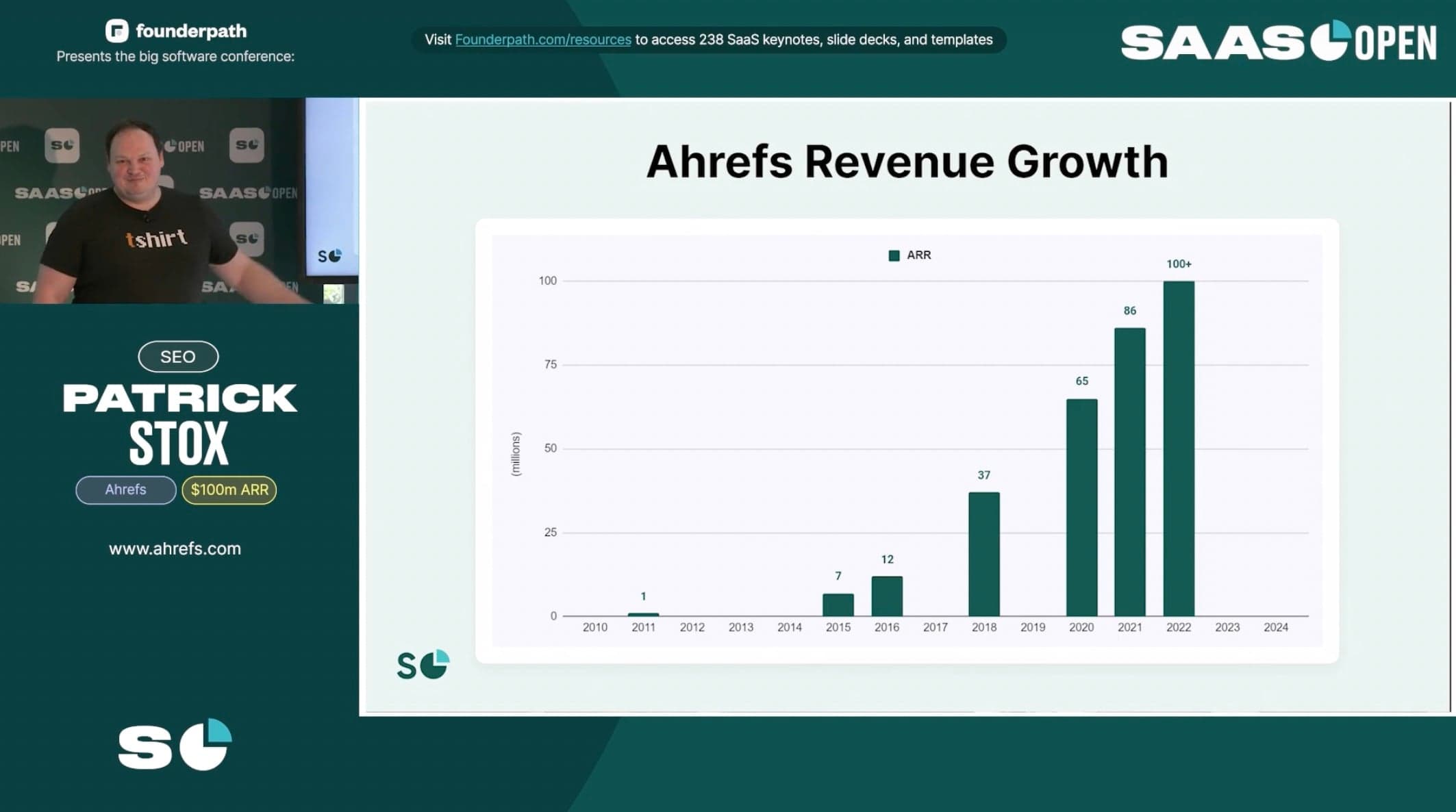
Ahrefs turned roughly $300,000 of founder Dmytro Gerasymenko's personal savings into well over $100 million in annual revenue — no venture capital, no sales team until the very end, and by its own admission almost no measurement of the metrics most SaaS companies live by. In March 2024, Patrick Stox — Ahrefs' product advisor, technical SEO and brand ambassador — stood in front of a thousand software CEOs at SaaSOpen and explained how, in a talk recorded for the Latka channel. What follows are nine operating lessons, each anchored to what he actually said on stage. The full dated revenue history is in our companion piece, How Ahrefs Achieved $100M Revenue; this one is about what you can copy.
1. You can grow revenue past $100M without a sales team — if the product pulls
"We basically used word-of-mouth, blogs, and YouTube. We didn't have a sales team till we hit about $100 million."
The sequencing tells you where Ahrefs put its faith. First marketing hire: 2015, when the company was already at about $7 million in revenue with roughly 15 people. First salesperson: 2021, at 90 employees and, per Stox, "pretty close to $100 million ARR." Every dollar that would normally fund a go-to-market org went into the product instead — including its own data centers, a decision Stox said saved hundreds of millions versus cloud pricing. The catch: this only works if users genuinely love the tool. Stox's proof point was his own audience — Ahrefs users "in there every day, constantly."
2. Kill tactics that get abused, even beloved ones
Ahrefs once ran a paid trial — $7 for seven days. It got abused, so the company killed it, and as of March 2024 there was no trial at all, free or paid. Stox was matter-of-fact about ignoring the standard playbook wholesale: "Pretty much everything that is conventional, that everyone's like go do this — we did none of that." He allowed that Ahrefs might have grown faster doing more of it. But the underlying discipline is real: when a growth mechanic costs more in abuse than it returns in customers, delete it and move on.
3. Users request parity; your own team invents the edge
"Users, I don't think, will ever give you the next unicorn idea. They're always like: this is what the other tools are doing, give me that."
Ahrefs collects feedback from everywhere — a voting system on feature requests, sales and support channels, Twitter, LinkedIn, and a public ask that CMO Tim Soulo runs roughly every two years ("people are mean on Reddit," Stox noted). That input matters, but Stox was clear most of it amounts to requests for features competitors already have — and "if that was our entire product strategy, we would fail as a company." The differentiated ideas come from power users and the internal team. His example: Ahrefs had an internal report on which authors were linking to a page; he suggested productizing it, and the author report shipped. The feedback loop also recruited him — he publicly gave Ahrefs product feedback for a couple of years running until the company messaged him with a job offer.
4. Put the product inside the teaching
Every piece of Ahrefs content follows one formula: here's an SEO problem, here's how to fix it in Ahrefs. Stox called it simple but noted most companies don't do it — in his own enterprise days he didn't even have access to the products he was writing content for. The same formula runs the YouTube channel, which had about 550,000 subscribers as of the talk, fronted by Sam Oh — "a phenomenon," in Stox's words — with individual SEO videos pulling hundreds of thousands to millions of views. Because the product appears as the solution inside a genuine lesson, "it doesn't come off as sales."
5. Two of every five posts should be updates, not net-new
Stox described SEO content as a race in which everyone is constantly updating, and said about two out of every five blog posts Ahrefs publishes are refreshes of existing posts rather than new pieces. He paired that with two blunter tips: competitor research is legal — "they have successful pages, you can view it, make the same things, easy win" — and intent comes first, because if the search results for a keyword are all guides, your product page is not going to rank for it — "sorry, it's not going to happen."
6. Programmatic content works — short-form only
Ahrefs built an SEO glossary — old-school "what is X" definition pages — that was drawing about 65,000 monthly visitors at the time of the talk. The early entries were handwritten; newer ones are programmatically generated, just a couple of paragraphs each. Stox drew a hard line: "I don't believe in using AI-generated content long form. Don't think it turns out good." The same short-form logic powers roughly 60 niche pages — SEO for travel agencies, dentists, plumbers — built programmatically as lead generation, with a sign-up pitch attached. Notably, for all the talk of not measuring things, Stox admitted Ahrefs does measure whether those pages produce leads.
7. Give away tools and data — they were half of Ahrefs' traffic
As of March 2024, about half of Ahrefs' site traffic — roughly 3.5 million monthly organic visits at the time, down from a peak near 6 million after a temporary pre-rendering issue — went to free tools. The company launched around 100 free writing tools in 2023 that brought about 700,000 visits, added features to its wordcount.com property for another 500,000, and ran an Alexa-style "top websites" programmatic play ranking for brand searches. Stox was honest about conversion expectations on that last one: "extremely low." The point is exposure — a visitor sees Ahrefs' traffic and link data on a page and realizes the dataset exists. Abuse forced some free-tool limits, but he still called it a great lead-gen tactic.
8. Own the comparison page, and translate your winners
"Control the narrative. Don't let your competitors control the narrative."
Ahrefs had exactly one comparison page at the time of the talk — built on industry opinions and unique features rather than the usual pricing-table grid, which Stox dislikes — and it was drawing about 1,500 visitors a month. He called it a personal favorite and said he wants many more. The cheaper win he confessed to missing for years: translation. Localizing existing successful content produced an uplift of over half a million visits. "We didn't do that for a long time. It's kind of a miss."
9. Show your data everywhere it can possibly appear
The thread through everything is Ahrefs' index — the company runs its own search engine, yep.com, launched in 2022, and joined the IndexNow protocol alongside Bing, Yandex and Naver, so page changes across the web reach its crawler within moments. That data shows up in original studies (one Ahrefs study found 96.5% of pages get no Google search traffic — the stat itself earns links), in a live-stats widget in the blog sidebar, on the 404 page (which pitches the broken-link checker), and through 50-plus integration partners like Screaming Frog and SEO Tools for Excel that pull Ahrefs data into other workflows. If you have proprietary data, Stox's advice was unambiguous: "This literally is gold. Use your own data."
The formula, in Stox's own words
"Build a better product, create content, and then feature your data and your product within that content. It's not a complicated formula." What makes Ahrefs unusual is not the formula but the refusal to dilute it — no sales org, no metric theater, no growth hacks that outlive their usefulness. For the company's full dated numbers, see the Ahrefs profile on GetLatka.
Sources
- Patrick Stox, Ahrefs, presenting at SaaSOpen, recorded March 28, 2024 — video on the Latka channel
- Ahrefs profile on GetLatka (revenue milestones and team data)
- ahrefs.com, yep.com, wordcount.com