ClickUp Revenue: The Road From $3M a Month to $300M ARR
ClickUp's revenue is roughly $300M ARR, per the company's September 2025 announcement. Zeb Evans talked to Latka twice — at under $3M MRR in 2020 and near $80M in 2021 — and the two tapes bracket the steepest part of the curve.
On this page
- What is ClickUp's revenue? The dated record
- September 2020: 30,000 paying teams, and a correction downward
- November 2021: the number he wouldn't say
- The bootstrap years: his own $2.5M and a month of runway
- The growth engine: SEO first, freemium mechanics second
- Funding and the $4B valuation
- After the tapes: $300M ARR, then a 22% layoff
ClickUp's revenue is roughly $300 million in annual recurring revenue. The company announced it was "accelerating to $300 Million Annual Recurring Revenue" in a September 9, 2025 press release — the most recent figure it has put on the record — and GetLatka's ClickUp profile carries $300M for 2026. The valuation is $4 billion, set by a $400 million Series C in October 2021 co-led by Andreessen Horowitz and Tiger Global. ClickUp has not raised a priced round since, so that valuation is now almost five years old.
Founder and CEO Zeb Evans sat down with Nathan Latka twice, fourteen months apart, and the two tapes happen to bracket the steepest part of the curve: in September 2020 Evans put monthly revenue at "a little bit less than" $3 million; by November 2021 he wouldn't give a number, but when Latka said "I have you right now pegged like 80," Evans answered, "that's close." What follows is what Evans actually said on each tape, what the public record adds, and where the numbers don't quite line up.
What is ClickUp's revenue? The dated record
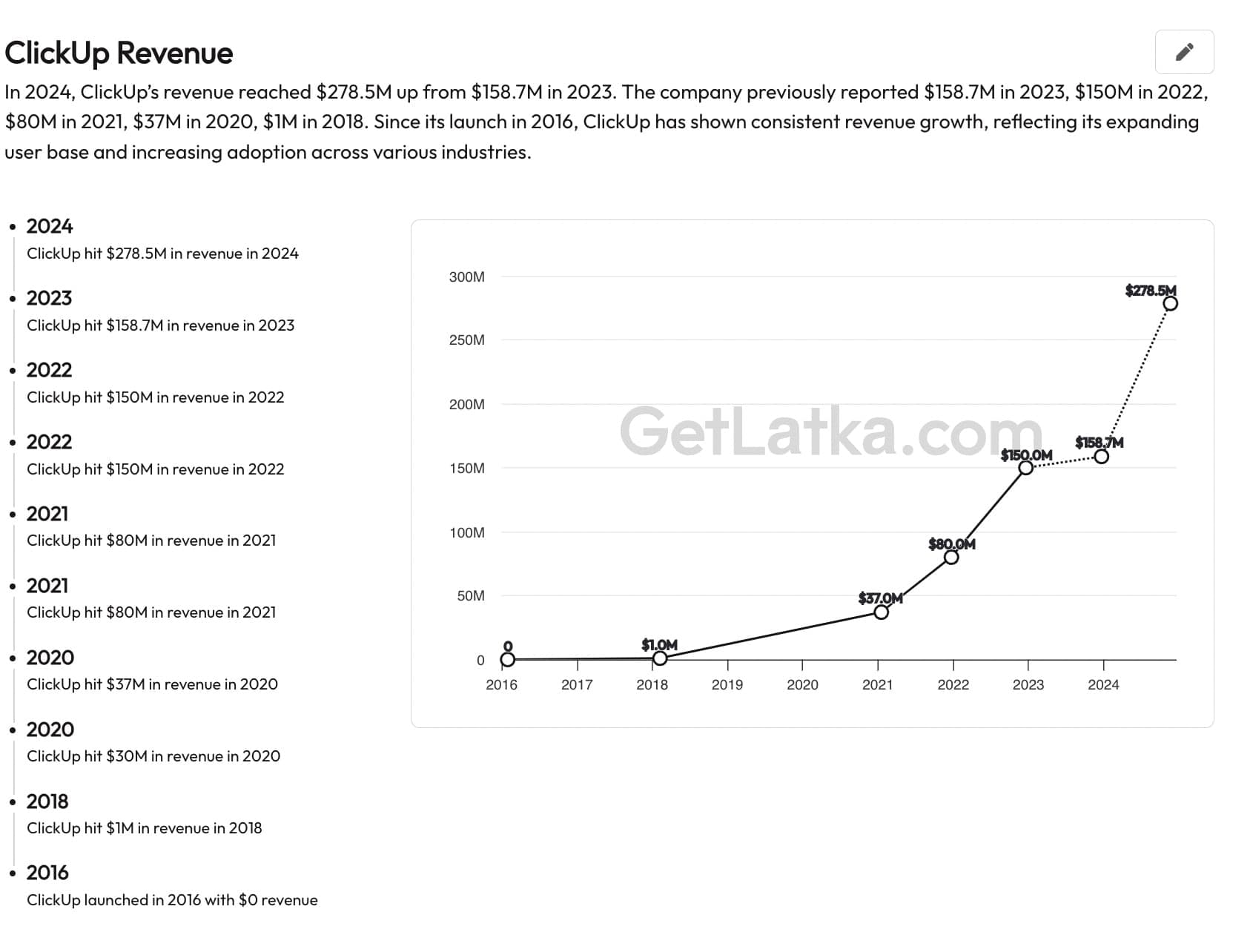
Because ClickUp is private, every figure below deserves a date and an owner. The company-reported anchors are sparse; GetLatka's database fills the gaps, and two of those database rows are estimates, not company statements.
| Date | Figure | Who said it |
|---|---|---|
| Sep 2020 | "A little bit less than" $3M MRR | Zeb Evans, on tape with Latka |
| Dec 2020 | $37M | GetLatka database |
| Oct–Nov 2021 | ~$80M ARR | Latka's estimate; Evans: "that's close" |
| Jun 2022 | $150M | GetLatka database |
| Nov 2023 | $158.7M | GetLatka database (estimate) |
| Oct 2024 | $278.5M | GetLatka database (estimate) |
| Sep 2025 | $300M ARR | ClickUp press release |
The 2023 and 2024 rows are GetLatka estimates. The three hard, company-sourced anchors are September 2020, November 2021, and September 2025.
September 2020: 30,000 paying teams, and a correction downward
On the first tape, recorded September 22, 2020, Evans told Latka ClickUp had about 30,000 paying teams at roughly 10 seats per team — about 300,000 paid seats — paying $10 to $15 per seat per month. Latka did the multiplication on air and floated "somewhere around $3,000,000 in MRR?" Evans corrected him down: "We're a little bit less than that." Asked whether ClickUp would break a $36 million run rate by the end of 2020, Evans called it a "stretch goal." Both round numbers were the host's arithmetic; the guest's own claim was the correction. Worth noting: 300,000 seats at rate card would imply $3M–4.5M a month, so the sub-$3M figure suggests real-world discounting off those list prices.
The rest of that tape is the operating profile of a capital-efficient company. Gross churn was "under 2%" monthly, net revenue retention "more like one fifty," and about 95% of signups were still organic, which Evans said pushed blended acquisition cost low enough to aim for "low thousands" per paying customer. The team was about 130 people — 20 engineers and roughly 40 in customer service. Evans said he hired his first head of sales, Tommy, at around $6–8 million in revenue; before that, he took enterprise sales calls himself under a fake name, Tyler, because "you kind of appear small when the CEO is the person doing the sales."
November 2021: the number he wouldn't say
By the second interview, published November 21, 2021 — three weeks after the Series C — Evans declined to state revenue: "We can't really talk specific revenue numbers right now." He gave team counts instead: 800,000 teams using ClickUp, of which 85,000 paid (the same figure in the Series C press release), up from roughly 200,000 total teams at the Series B and about 100,000 at the Series A. Latka pegged revenue "like 80" and Evans conceded "that's close." The episode's own title says $85M, but that number is the show's framing — on tape, ~$80M with "that's close" is as far as Evans went. GetLatka's database logs $80M for October 2021.
Run the arithmetic on his teams figures and about 11% of teams on the platform were paying (85,000 of 800,000). Asked if he was happy with that conversion, Evans said "there's always room to improve" and described newly formed product-growth squads focused on activation and free-to-paid conversion. An earlier version of this article claimed 60% of ClickUp's paying customers converted from free — a statistic that appears in neither tape nor any company statement we can find, so it's gone.
One forward-looking exchange from that tape deserves a flag. Latka asked whether ClickUp would be "far beyond" $100 million the following year — "more than 200?" Evans: "Yeah, oh yeah." The record says the growth was real but slower: GetLatka logs $150M in June 2022, and the $200M+ mark shows up only in the database's 2024 estimate. That was a projection, and it should be read as one.
The bootstrap years: his own $2.5M and a month of runway
ClickUp was founded in 2017 — the year on the company's GetLatka profile, and Evans told Latka it launched at "the end of 2017." (An earlier version of this post said 2016 in one place and 2017 in another; 2016 is when Evans shut down his previous company and moved to Palo Alto, not when ClickUp started.) The oft-told Craigslist origin also gets flattened in the retelling: Evans was clear on the 2020 tape that the safer-Craigslist competitor never got built — "we didn't actually get started on that... it was in the idea phase" — while ClickUp began as an internal tool the team stood up in about a month, born of juggling "15 different productivity apps" at his prior company. Palo Alto neighbors with tech companies asked what they were working on, started using it, and the internal tool became the product.
Evans funded it himself: $2.5 million in convertible notes from his own pocket, carried over from a profitable social-media-automation business he shut down. He put a $5 million cap on those notes, and told Latka in November 2021 the conversion at the $200 million Series A left him with "like another 30 or 40 percent of the company" on top of his founder stake.
The bootstrap nearly ended the company. Evans told Latka the bank account got down to about $25,000 — roughly one month of runway against what had been $100,000-a-month burn — before he "pulled my head out of product," cut costs, added paywalls, and ran a holiday promotion: "literally in a matter of like 45 days... we were cash flow positive." He couldn't pin the year himself ("had to be like 2017... it might have been 2018"), and dated the first $1 million in revenue to 2018 with an explicit hedge: "I believe so. I'm not the numbers person."
The growth engine: SEO first, freemium mechanics second
Evans is unusually specific about where the first customers came from: comparison-keyword SEO written before anyone searched for ClickUp by name. "We did like Asana versus Trello and just capitalized on those," he told Latka in September 2020 — plus Reddit and Quora — and he wrote the early SEO himself. Even after paid acquisition started in 2020, he said 95% of users still arrived organically.
The freemium design is more deliberate than "generous free plan." Evans described a 100-use paywall: every gated feature works free for 100 uses, so users build the habit before discovering it's paid. About 95% of paying teams entered on the cheapest Unlimited tier, while the mid-tier Business plan produced the most revenue — expansion, at that ~150% net retention, did the rest. He also credited weekly Friday releases for churn under 2%: "we ship a new version of ClickUp every Friday... people livestream the event."
Funding and the $4B valuation
| Year | Round | Amount | Valuation |
|---|---|---|---|
| 2017–2018 | Convertible notes (Evans' own money) | $2.5M | $5M cap |
| 2020 | Series A — Craft Ventures (David Sacks) | $35M | $200M |
| 2020 | Series B | $100M | $1B |
| Oct 2021 | Series C — a16z and Tiger Global co-led; Lightspeed, Meritech | $400M | $4B |
Round data per Evans on the Latka tapes, ClickUp's October 27, 2021 press release, and GetLatka's database, which totals $537.5M raised.
Evans confirmed the Series A valuation himself on the 2021 tape — "our Series A was 200 million" — and Latka noted the pattern: roughly 10% sold per round. ClickUp called the Series C "the biggest investment in workplace productivity history" in its own release. Evans' stated rationale for taking money at all, from the 2020 tape, is the quotable part:
"Go as far as you can without raising to get product market fit. And then when you do raise, you have the leverage." — Zeb Evans to Nathan Latka, September 2020
After the tapes: $300M ARR, then a 22% layoff
The post-2021 record comes from press releases and news coverage, not Latka tapes. On September 9, 2025, ClickUp announced it was passing $300 million in ARR, claiming more than 20 million users and 400% year-over-year growth in AI-product sales. In February 2026 it announced six senior executive hires and framed them around a "path to $1B+ ARR" — a target, not a result.
Then in May 2026, Evans cut roughly 22% of staff — about 290 of some 1,300 employees, per TechCrunch and The Next Web — restructuring around what he called a "100x org," with AI agents outnumbering employees and new salary bands reaching $1 million for the people who remain. GetLatka's profile now lists roughly 1,000 employees, down from a peak of about 2,000 in September 2024. Evans framed the move as a productivity bet rather than cost-cutting, which is at least on-brand.
Two cautions for anyone quoting the headline numbers today. The $4 billion valuation dates to October 2021 and has not been re-marked by a priced round in either direction. And "accelerating to $300M ARR" is the company's own phrasing from September 2025 — there has been no newer company-stated revenue figure since.
Sources
- Zeb Evans on the GetLatka podcast, September 22, 2020 (full transcript on the ClickUp profile)
- Zeb Evans on the GetLatka podcast, November 21, 2021 — youtube.com/watch?v=nhVouHaO6so
- GetLatka: ClickUp revenue, funding and team data (updated August 27, 2026)
- ClickUp press release, October 27, 2021 — $400M Series C at $4B
- ClickUp press release, September 9, 2025 — accelerating to $300M ARR
- ClickUp press release, February 4, 2026 — executive hires, path to $1B+ ARR
- TechCrunch, May 25, 2026 — ClickUp's mass layoff
- The Next Web — 22% layoff and $1M salary bands