Grammarly Revenue: $700M ARR at a $13B Valuation — and a New Name
Grammarly disclosed more than $700M in annual revenue in May 2025, alongside a $1B non-dilutive financing from General Catalyst. Here is the dated record — and what we cut from the old version of this post.
On this page
Grammarly crossed $700 million in annual revenue, and the number is the company's own. On May 29, 2025, announcing a $1 billion growth financing from General Catalyst, Grammarly disclosed annual revenue of more than $700 million and more than 40 million daily users. GetLatka's database carries the same figure: $700M ARR for Grammarly, alongside 30 million customers at an average contract value of $23 — and 30M × $23 works out to roughly $690M, which squares with "more than $700 million" within rounding.
The valuation is older than the revenue figure. Grammarly has been worth $13 billion on paper since November 2021, when it raised just over $200 million from Baillie Gifford and funds managed by BlackRock. The 2025 billion was non-dilutive — General Catalyst gets repaid from a capped share of the revenue its capital generates, not with shares — so no new price has been set since.
What is Grammarly's revenue? The dated record
Grammarly is private and publishes no financial statements, so the honest revenue record is a short list of dated disclosures, not a smooth year-by-year curve. This is everything the company or a named outlet has actually put on the record:
| Date | What was disclosed | Where |
|---|---|---|
| May 2017 | Raised $110M led by General Catalyst; reported profitable, with about 7 million daily users | The Wall Street Journal |
| October 2019 | Raised $90M at a valuation above $1 billion | TechCrunch |
| November 2021 | Raised just over $200M from Baillie Gifford and BlackRock funds at a $13 billion valuation | TechCrunch |
| May 2025 | Annual revenue of more than $700M; 40M+ daily users; $1B non-dilutive financing from General Catalyst | Company announcement; TechCrunch |
Everything between those dates is third-party estimation. We have deliberately left the gaps empty.
Where this article's old numbers went wrong
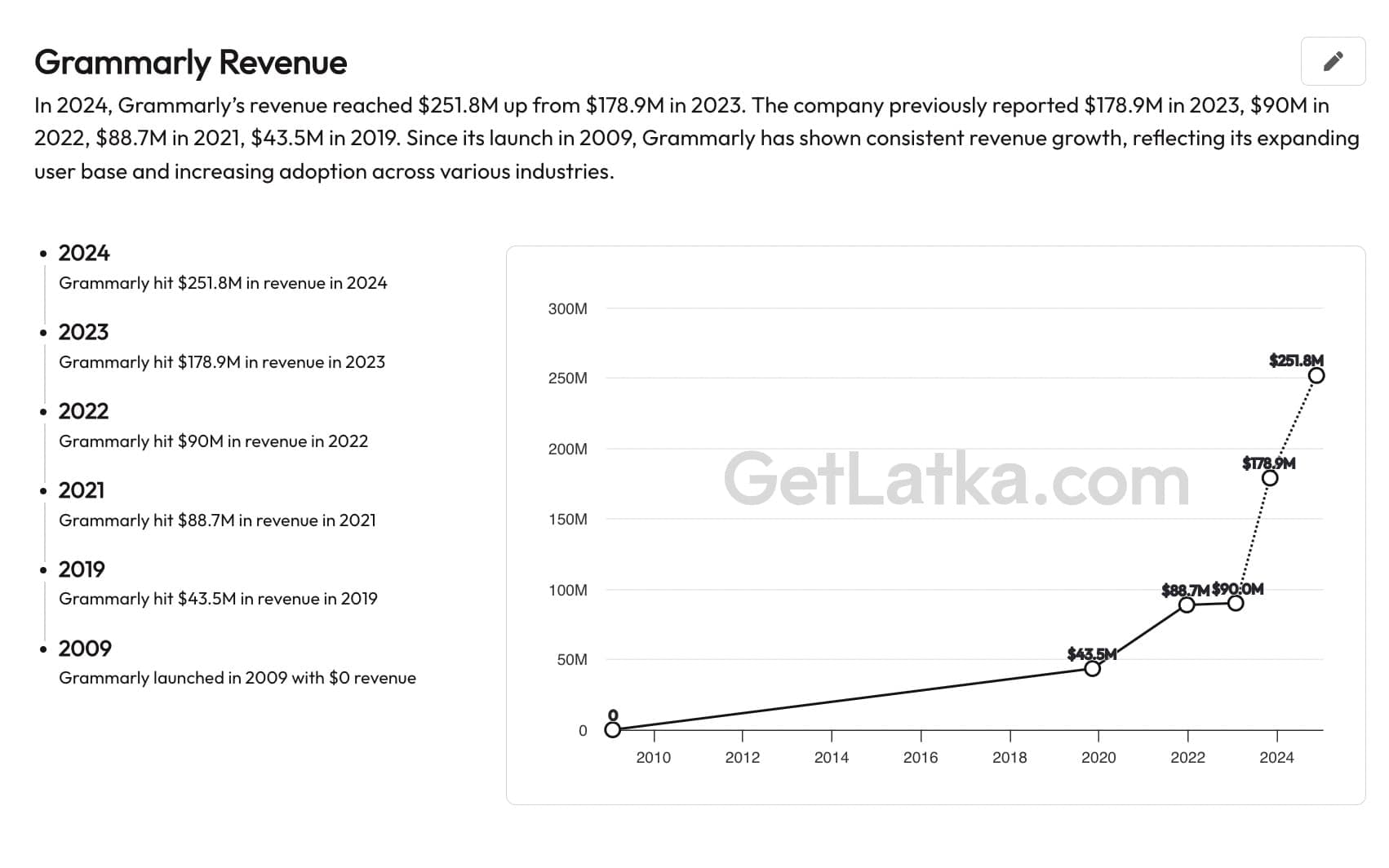
An earlier version of this post claimed Grammarly earned $251.8 million in 2024 — under section headers that simultaneously claimed $800 million. Neither figure carried a source, they contradicted each other on the same page, and neither can be reconciled with the more-than-$700-million figure Grammarly itself published in May 2025. The old year-by-year table ($43.5M in 2019, $88.7M in 2021, $90M in 2022, $178.9M in 2023) could not be traced to any disclosure either, so it is gone. Where we cannot source a number, we show you the gap instead.
Grammarly's valuation and funding history
Grammarly bootstrapped for its first eight years. Max Lytvyn, Alex Shevchenko, and Dmytro Lider — who had previously built the plagiarism-detection service MyDropbox — founded it in 2009 as a paid subscription tool for students. By the company's own account it moved to a freemium model in 2015 and reached one million daily active users that year.
The first outside capital came in May 2017: $110 million led by General Catalyst, at which point The Wall Street Journal reported the company was already profitable with about seven million daily users. A $90 million round in October 2019 pushed the valuation past $1 billion, and the November 2021 round set the $13 billion mark that still stands. Counting equity rounds only, that is roughly $400 million raised — the figure GetLatka's database shows — before the $1 billion non-dilutive financing of May 2025.
Who runs Grammarly?
Shishir Mehrotra, co-founder and CEO of Coda, has run the company since Grammarly's acquisition of Coda closed in early 2025; the deal was announced on December 17, 2024. He succeeded Rahul Roy-Chowdhury, CEO from May 2023, who moved to an advisory role. Before Roy-Chowdhury, Brad Hoover led the company for over a decade.
From Grammarly to Superhuman: the 2025 pivot
"Grammarly revenue" is becoming a harder thing to track, because the company no longer trades under that name. After buying Coda (announced December 2024) and the email client Superhuman (announced July 1, 2025), the company renamed itself Superhuman in late October 2025, as Fast Company reported. Grammarly, the writing assistant, is now one product in a four-part suite alongside Coda, Superhuman Mail, and the Superhuman Go assistant. The May 2025 revenue figure landed after the Coda deal closed but before the Superhuman acquisition and rebrand — treat any future disclosure as a combined-platform number.
Is Grammarly's revenue dropping?
The earlier version of this post said yes — directly above a table showing revenue growing 40 percent year over year. The public record supports neither that table nor the drop. What is true: the paper valuation has not moved since November 2021, a stretch in which many 2021-vintage software valuations were repriced downward. But a valuation frozen because no new equity round has been priced is not a revenue figure. The one revenue signal since is the company's own — more than $700 million a year as of May 2025 — plus an investor willing to put $1 billion against future revenue collections. Competition from general-purpose AI assistants is a real strategic question, and it is the stated logic behind the Coda and Superhuman deals. Nothing published to date shows Grammarly's revenue shrinking.
Sources
- TechCrunch: Grammarly secures $1B in non-dilutive funding from General Catalyst (May 29, 2025)
- Grammarly: $1 Billion Growth Financing With General Catalyst
- TechCrunch: Grammarly raises $200M at a $13B valuation (November 17, 2021)
- The Wall Street Journal: Grammarly, With $110 Million, Brings Artificial Intelligence to Writing (May 2017)
- TechCrunch: Grammarly acquires productivity startup Coda, brings on new CEO (December 17, 2024)
- Superhuman: Superhuman is being acquired by Grammarly (July 2025)
- Fast Company: Inside the Superhuman effort to rebrand Grammarly (October 2025)
- Grammarly: A History of Innovation at Grammarly
- GetLatka: Grammarly revenue, funding and team data