Surge AI Revenue and Valuation: How Edwin Chen Bootstrapped Past $1 Billion
Reuters reported in July 2025 that bootstrapped Surge AI passed $1 billion in 2024 revenue, out-earning Scale AI — and began raising its first outside round at a reported valuation between $15 billion and $25 billion. Here is every figure that actually has a source.
On this page
Surge AI crossed $1 billion in revenue in 2024. That figure comes from Reuters, which reported in July 2025 that the bootstrapped data-labeling company had out-earned its far better-known rival Scale AI (roughly $870 million in 2024, per the same report) without ever raising venture capital. GetLatka's database records $1.2 billion for 2024 and $1.4 billion as of August 2025. On valuation, the picture is a range, not a number: Reuters reported in July 2025 that founder Edwin Chen had hired advisors to raise up to $1 billion at a valuation above $15 billion — the company's first outside round — and subsequent reports over the summer put the discussed price near $25 billion, while our database records a $20 billion secondary-market valuation. Every figure in this piece is dated and attributed, because with Surge the gap between what is known and what gets written is unusually wide.
How much revenue does Surge AI make?
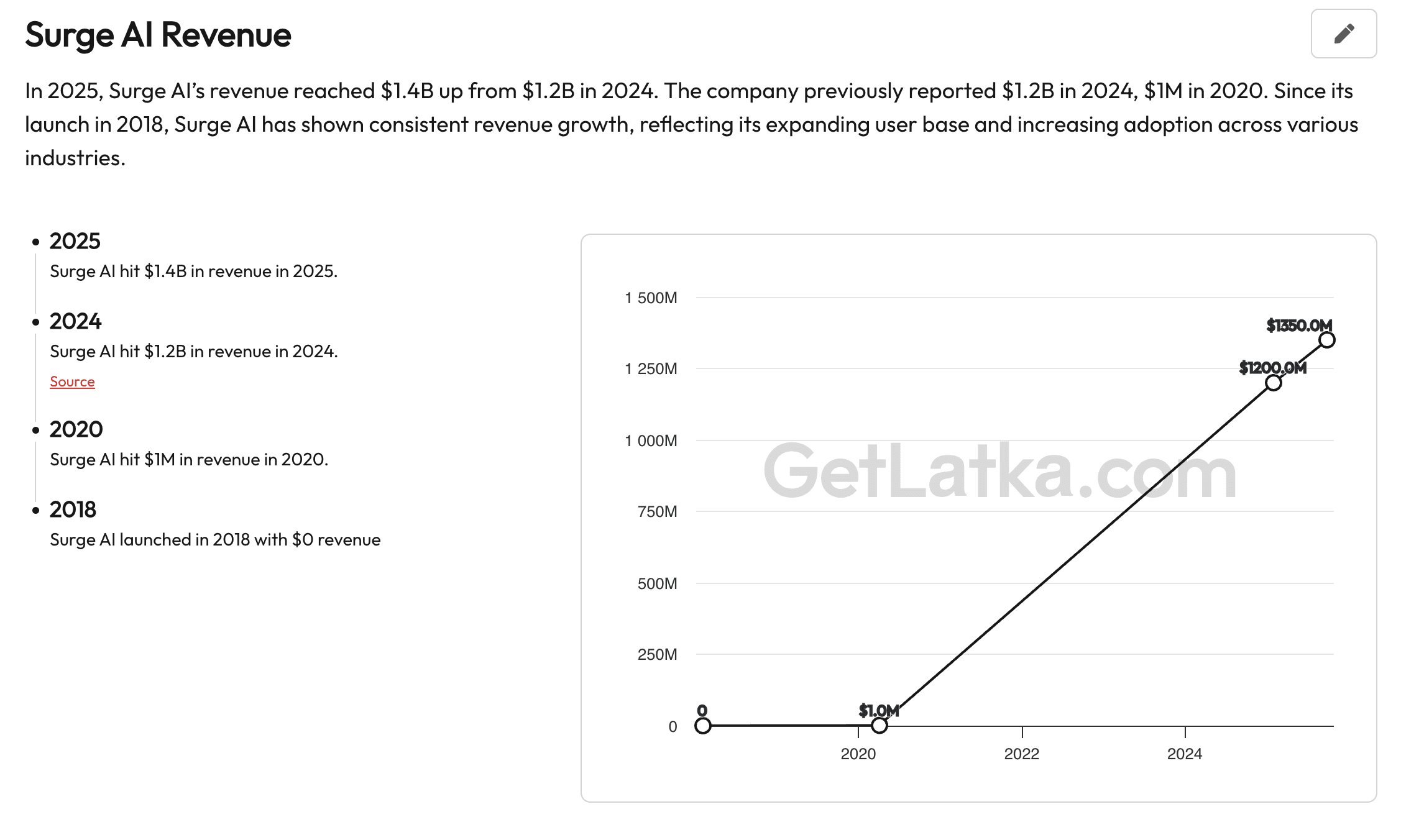
Surge AI is private and publishes no financials, so the revenue record is a handful of dated, sourced points rather than a curve. Here is what we can actually stand behind:
| Date | Revenue | Source |
|---|---|---|
| March 2020 | $1M | GetLatka database |
| Full-year 2024 | over $1B | Reuters, July 2025 |
| December 2024 | $1.2B | GetLatka database, citing Wikipedia's sourcing |
| August 2025 | $1.4B | GetLatka database |
No audited statements exist in public. Monthly revenue has never been disclosed — any post quoting Surge's June or July revenue to the million is inventing it.
The efficiency math is what makes these numbers remarkable. Our database counts 121 employees as of June 2025. Set against the $1.2 billion recorded for 2024, that is roughly $9.9 million of revenue per employee — with the caveat that the headcount is a mid-2025 snapshot and the revenue is a 2024 figure, so treat it as an order-of-magnitude claim, not a precise ratio. Even at half that, it would put Surge among the most capital-efficient software-adjacent companies ever measured, and it was achieved with no primary venture funding on record before 2025.
Surge AI's valuation: $15 billion, $20 billion, or $25 billion?
All three numbers are in circulation, and they don't describe the same thing.
Reuters reported in July 2025 that Surge had hired advisors for a raise of up to $1 billion — its first outside capital — at a valuation over $15 billion. That was the opening target of a negotiation, not a closed round. Reporting later in the summer of 2025 put the discussed valuation around $25 billion, which would price Surge close to Scale AI's roughly $29 billion post-Meta valuation.
GetLatka's database, meanwhile, records a $20 billion valuation set in a 2025 secondary-market transaction (sourced from SiliconAngle's coverage), alongside a $25 million seed round in 2025 — the only primary funding on record. Secondary trades, primary-round targets, and reported negotiating figures are three different instruments, which is why honest coverage gives you a range. What no public source supports is a closed $25 billion round; if that changes, the change will come with a date and a lead investor attached.
Who is Edwin Chen?
Chen is a machine-learning engineer who worked at Google, Facebook, and Twitter before founding Surge, and he built the company without venture capital — both facts repeated across the 2025 press coverage of the raise. He kept an unusually low profile for someone running a ten-figure business; there is no Latka tape with him, and we won't put quotes in his mouth that we can't source.
What is on the record is the company's technical footprint. OpenAI's 2021 paper introducing GSM8K, the grade-school math benchmark that became a standard test for reasoning models, credits Surge AI with assembling the dataset. And in 2022 the Surge AI blog published an analysis arguing that around 30% of the labels in Google's widely used GoEmotions dataset were wrong — a pointed public argument that the industry's training data was worse than anyone wanted to admit, made three years before the market priced Surge's answer to that problem in the billions.
The Meta–Scale AI deal made neutrality worth billions
In June 2025, Meta announced it was investing $14.3 billion for a 49% stake in Scale AI, valuing Scale at about $29 billion, with Scale founder Alexandr Wang joining Meta to lead its superintelligence effort. The fallout was immediate and well documented: Reuters reported that Google, Scale's largest customer, planned to cut ties, and OpenAI confirmed it was winding down its own Scale work.
The logic is simple — frontier labs did not want their most sensitive asset, training data, flowing through a vendor half-owned by a direct competitor. As an independent, bootstrapped alternative, Surge was the obvious beneficiary, and the timing of its first-ever raise, one month after the Meta deal, is hard to read as coincidence.
What nobody outside the company knows is how much business actually moved. No lab has disclosed shifting contracts to Surge, and no dollar figures for post-deal wins have been published anywhere credible. An earlier version of this article claimed specific labs moved specific percentages of their labeling spend within 72 hours, complete with monthly revenue figures — none of that was ever disclosed by anyone, and we've removed it.
Where the record disagrees
Two open discrepancies worth flagging. First, the founding year: our Surge AI company page lists 2018 and a first $1 million in revenue in March 2020, while most public reporting, including Wikipedia's sourcing, dates the company's launch to 2020. An early incorporation ahead of a 2020 launch would reconcile the two, but we can't confirm that. Second, the valuation: $15 billion-plus (Reuters, July 2025), ~$20 billion (secondary market, per SiliconAngle), and ~$25 billion (later reports) describe different transactions at different moments, and none is a closed primary round as far as the public record shows.
The honest summary: a company reported by Reuters to have passed $1 billion in 2024 revenue with no venture funding, run by a founder who spent a decade inside Google, Facebook, and Twitter watching bad training data ruin good models, that became the neutral counterparty of choice the moment its biggest rival sold half of itself to Meta. That story needs no embellishment — which is fortunate, because the embellished version of it didn't survive contact with the sourcing.
Sources: GetLatka — Surge AI revenue, valuation and team data; Reuters, July 2025 (Surge AI's $1B+ 2024 revenue and first capital raise at a $15B+ valuation) and June 2025 (Meta's $14.3B investment in Scale AI; Google and OpenAI pulling back from Scale) — reuters.com; OpenAI's GSM8K paper crediting Surge AI — arxiv.org/abs/2110.14168; Surge AI blog, 2022, on GoEmotions label quality — surgehq.ai/blog; Wikipedia — Surge AI; SiliconAngle, 2025, on the secondary-market valuation — siliconangle.com.