
Interview
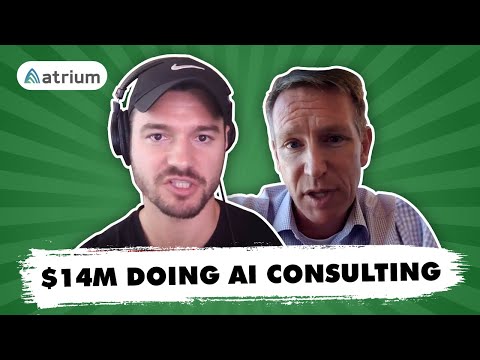
How Atrium Reached 30+ Customers and 85 Employees in 18 Months as an AI Consulting Firm (Interview with CEO Chris Heineken)
- Interviewee
- Chris HeinekenCEO
Company Metrics at Interview Time
Customers (2019)
Just over 30
Team Size (2019)
85
Revenue (2018, first year)
About $3M
Total Funding (raised among the founders)
$800K
Year Founded
2018
Historical Snapshot
These numbers were reported by Chris Heineken during the interview and are a historical snapshot, not current figures. See Atrium’s current numbers.
Key Takeaways
- 01Atrium got going in early 2018 and did about $3M in revenue that year, over about three quarters of a year of operation; it had been in business for 18 months at the time of the interview
- 02The company had just over 30 customers at the time of the interview
- 03Team size reached 85 employees with a goal to hit 100 by end of the calendar year
- 04$800K in seed funding was raised among the four co-founders
- 05Gross margins ran between 40% and 50%, with operating margins around 20%
- 06The company had been profitable "really every month" since it got going
- 07Atrium had operations in Bozeman, Montana and a team in Jaipur, India, and was looking to pick up office space in Indianapolis
- 08Salesforce was a key partner and a major source of deal flow
- 09Client engagements could span $100,000, $200,000 and up, depending on how much AI the client wanted built in
- 10The company grew completely organically; the only money it raised was the founders' own $800K
Company Metrics at Time of Interview
| Metric | Value | Source |
|---|---|---|
| Customers (2019) | Just over 30 | Interview |
| Team Size (2019) | 85 | Interview |
| Revenue (2018, about three quarters of a year of operation) | About $3M | Interview |
| Total Funding (raised among the founders) | $800K | Interview |
| Seed Round (from founders) (2018) | $800K | Interview |
| Gross Margin (2019) | 40% to 50% | Interview |
| Operating Margin (2019) | 20% | Interview |
| Typical Engagement Size (low end) (2019) | $100,000 | Interview |
| Number of Co-Founders | 4 | Interview |
| Year Founded | 2018 | Interview |
Growth Breakdown
Customers
Atrium reached just over 30 customers in its first 18 months of operation. Clients included for-profit and not-for-profit universities working on enrollment and student attrition, and engagements could span $100,000, $200,000 and up, depending on how robust a client wanted to build AI into its infrastructure.
Team
The company grew from zero to 85 employees in 18 months, with a target of 100 by the end of the calendar year. The founding team credited a strong pre-existing network built over 20 years in consulting as a key enabler of rapid hiring.
Profitability and Funding
Atrium raised $800K in seed money among its four founders and had been profitable "really every month" since. Gross margins ran between 40% and 50% and operating margins were roughly 20%, so the company did not need to raise money to fund its accounts receivable.
Revenue Mix
Atrium did about $3M in revenue in 2018, its first year, over about three quarters of a year of operation: it got started in January but did not really get going until February or March. Some clients had their own data science teams to build and maintain the algorithms once Atrium got them going; many did not, and worked with Atrium on the ongoing "care and feeding" of that work. "We see both scenarios," Chris Heineken said.
Growth Strategy
Partner Co-Marketing with Salesforce
Atrium decided very early on to "partner very heavy with Salesforce" for its "tremendous ecosystem and a great market reach," and "a lot of our deal flow comes through that relationship," Chris Heineken said. Clients typically wanted AI woven into cloud infrastructure they had already invested in, such as Salesforce, and he expected Atrium's AI-led business transformation work to bring in other best-of-breed providers as well.
Organic Growth Through Network
The team was on its "third or fourth incarnation" and had been in the consulting world for a long time, which Chris Heineken called "a twenty year head start." Customers who joined over the first year and a half "helped us build the business," and Atrium did it "completely organically," without venture capital: the only money raised was the founders' own $800K.
Long-Term Customer Relationships
Project-based technology systems integrators "really struggle with having long term customer relationships," Chris Heineken said, so Atrium judged itself by how long its customer relationships lasted. The aim was to stay on for the care and feeding of the predictive models and analytics it built, "so that we're around for multiple years," which he called "the single biggest inflection point for us as far as whether we can figure that out or not."
Multi-Location Delivery Model
Chris Heineken described three "solution centers of gravity": operations in Bozeman, Montana; Indianapolis, where Atrium was "looking to pick up infrastructure and office space"; and a team in Jaipur, India "that is critical to our delivery capabilities." Building out those locations through recruiting was one of the two places Atrium put its money; the other was mindshare in the market.
Focus on Concrete AI Outcomes
There is "a lot of hype" in AI, Chris Heineken said, and "very few companies that are really helping large Fortune 1000 companies figure out what's real." Where Atrium accelerated was in bringing that "to concrete terms for companies": clients typically came to it wanting to improve lead conversion, customer churn and employee productivity with machine learning and AI.
Best Quotes
“What we do is we help companies define what they can do with artificial intelligence. We help them create a vision for the possibilities, and then we help them implement that vision.”
“We're a consulting company. We work with several SaaS companies as enablers. So one of our biggest partners is salesforce.com among others. And so we're very familiar with the SaaS community.”
“We bootstrapped it to begin with. We did some initial seed money from our founders. Since then, we've actually been profitable really every month since we've been going.”
“We raised 800,000 to begin with among our founders.”
“We are at 85 today, hope to be 100 by the end of this calendar year.”
“We're running between 40 to 50% gross margins and 20% operating margins.”
“Our point of view is we're in for a really long haul. We want to be in a space where we can control our own destiny.”
What Happened Next
At the time of this interview, Atrium was about 18 months into operation, profitable, and hoping to grow from 85 people to 100 by the end of the calendar year. Chris Heineken said the company planned to stay a consulting business rather than build its own product, and that a private-equity secondary was "not in our vision right now": with operating margins of roughly 20%, Atrium did not need to raise money to fund its accounts receivable, though he would look at investment that could "dramatically accelerate" it. Visit the Atrium company profile on GetLatka for current figures and any updates since this recording.
View Atrium’s current profile and metricsFull Transcript
Chapters
- 0:00Introduction and What Atrium Does
- 0:32Consulting vs. SaaS and the Salesforce Partnership
- 0:48Typical Client Engagements and Pricing
- 2:18Customer Count and 18 Months of Growth
- 2:45Agency to Product: Will Atrium Make the Leap?
- 3:58Team Size and Hiring at Scale
- 4:17How the Team Scaled So Quickly
- 5:27Bootstrapping, Seed Funding, and Profitability
- 5:51First Year Revenue and Growth Trajectory
- 6:19Repeat Business and Long-Term Customer Relationships
- 7:38Private Equity Secondaries and Capital Strategy
- 8:35Margins, Reinvestment, and Office Locations
- 10:09Famous Five: Books, Tools, and Habits
- 11:13Advice to a 20-Year-Old Self
Introduction and What Atrium Does
Nathan Latka
00:00Hello, everyone. My guest today is Chris Heineken. He's the CEO of Atrium, leading a world class team and empowering companies to embrace the next generation of tech through the power of AI. Chris, you ready to take us to the top?
Chris Heineken
00:12I'm ready to go, Nathan.
Nathan Latka
00:13Nice Alright, to be thank you.
00:14Yeah, you described this as consulting services
00:18companies for AI. What does that mean?
Chris Heineken
00:21What we do is we help companies define what they can do with artificial intelligence. We help them create a vision for the possibilities, and then we help them implement that vision.
Consulting vs. SaaS and the Salesforce Partnership
Nathan Latka
00:32So are you a consulting company or a SaaS company?
Chris Heineken
00:35We're a consulting company. We work with several SaaS companies as enablers. So one of our biggest partners is salesforce.com among others. And so we're very familiar with the SaaS community.
Typical Client Engagements and Pricing
Nathan Latka
00:48So how are you typically... Mean, me a general sense. I'm sure you work with a lot of different customers. But on average, what are companies paying you per month or per year to use your consulting services?
Chris Heineken
00:58It really ranges. What they typically are looking to do is take some of the infrastructure they've already invested in and make it smarter, make it more intelligent. And so we do quite a bit around helping companies with analytics and getting predictive algorithms built within their business. And so typically they're coming to us and wanting to improve things like lead conversion, customer churn, employee productivity, those types of things with machine learning and AI, and weave that into
01:31the investments they've already made in cloud infrastructure like a salesforce.com. So the level of engagement that we have with them can span you know, $100,000, $200,000 on up from there, depending upon how robust they want to build artificial intelligence into their infrastructure.
Nathan Latka
01:48And are these typically one time or is that $100,000 like for a year? It's like a retainer, they want you always live.
Chris Heineken
01:55The the interesting thing about we do is we do a lot of decision support outsourcing. So some companies we were working with have, for example, data science teams that can build and maintain the algorithms once we get them going. Many of our customers don't have that, and often they will work with us to help support, do the care and feeding of the work that we're implementing. So it actually... We see both scenarios.
Customer Count and 18 Months of Growth
Nathan Latka
02:18And how many of these customers are you serving now today?
Chris Heineken
02:21We have just north of 30 customers today. So we've been in business for eighteen months. We got going in early twenty eighteen, and it's been a fantastic ride for the last eighteen months. It's a really interesting kind of captivating space. It's kind of a little bit Wild West pioneering days. And that's what it kind of feels like when we're working with our customers.
Agency to Product: Will Atrium Make the Leap?
Nathan Latka
02:45Many of the largest SaaS companies today start off as agencies like what you're building. And then they realize, oh my gosh, we're solving the same problem for every customer. You then build some code around it and before you know it, you spin that out as your own SaaS product. Are you seeing that pattern internally with the stuff you're working on AI today?
Chris Heineken
03:01We definitely see a lot of patterns and industry patterns, if you will. We work with, for example, some universities, for profit, not for profit, and some of the challenges they're looking to solve for, whether it's enrollments and improving their enrollment or improving their student attrition, those are all interesting problems that many different universities are going after, and they share a lot of the same features and datasets. So we haven't gotten into a place where we started
03:30to build out
03:33product, and nor do I think we're going to go to that place just because I think being a consulting business and a services provider has a... It's just a very different DNA than a product company. So we'll certainly dabble with helping companies with reusable assets, assets that will help with accelerating projects, but we don't plan to get into the product space. That's something that we would leave to some of the other larger partners that are out
03:57there in the SaaS community.
Team Size and Hiring at Scale
Nathan Latka
03:58Yeah. And what's your team size today? How many people?
Chris Heineken
04:01We are at 85 today, hope to be 100 by the end of this calendar year.
Nathan Latka
04:05Okay. Many would argue over eighteen months going from nothing to 85 employees is like just... I mean, it's a full time job just finding that much talent, hiring them, much less actually running the agency. How have you scaled so quickly?
How the Team Scaled So Quickly
Chris Heineken
04:17So this is our third or fourth incarnation as a team. We've been very fortunate that the crew that we're working with has been in the consulting world for a long time in this space that we're in. And now we're kind of weaving together some of the new paradigms with artificial intelligence and machine learning and applying that to what we've known in the past. So in some respects, we've had a twenty year head start. Our network is
04:41really strong, so we have an ability to have continuity with our team. And we've also benefited tremendously from being in a very hot space. There's a lot of buzz about what we're doing in artificial intelligence, but there are very few companies that are really helping large Fortune 1000 companies figure out what's real. And there's a lot of hype, I think where we accelerate is helping bring that
05:11to concrete terms for companies and what they can invest in. And we've been very fortunate that we've had some great customers join us over the last year and a half. They've helped us build the business and in such a way where we've done it completely organically.
Bootstrapping, Seed Funding, and Profitability
Nathan Latka
05:27So Chris, have you bootstrapped?
Chris Heineken
05:29We bootstrapped it to begin with. We did some initial seed money from our founders. Since then, we've actually been profitable really every month since we've been
05:39going.
Nathan Latka
05:39So how much have you raised total?
Chris Heineken
05:41We raised 800,000 to begin with among our founders.
Nathan Latka
05:45You're one of the founders, right?
Chris Heineken
05:46Yes.
Nathan Latka
05:47Yeah. How many of you are there?
Chris Heineken
05:49There are four of us in total.
Nathan Latka
05:50Four. Okay, got it.
First Year Revenue and Growth Trajectory
Nathan Latka
05:51Very good. Now, you go back, I always like to ask this with an agency, first year revenue. Do you remember what you guys broke last year?
Chris Heineken
05:58Well, so, last year we did about 3,000,000.
Nathan Latka
06:01Okay. I mean, I would say, and you're only in business for eight or nine months, right?
Chris Heineken
06:05We got started in January. We didn't really, really get going until like February, March.
Nathan Latka
06:10Yep.
Chris Heineken
06:11So it was about 3,000,000 on three quarters of a year.
Nathan Latka
06:14And what do you think you'll break this year?
Chris Heineken
06:16We'll do north of 14 this year.
Repeat Business and Long-Term Customer Relationships
Nathan Latka
06:19Yeah, I mean, it's again, really incredible growth. Now, can you keep going back to the same customers over and over and selling them new stuff? Or do you have to go sell a million dollars worth of new product every single month?
Chris Heineken
06:31If we do it right, we're going to be going back to these customers for a long time. And historically, agency... You talk about us as an agency, it's interesting. A lot of the digital agencies, the thing that's great about them is they have a lot of repeat business, repeat customers. You get into our space, which is more technology systems integration. A lot of the project based companies really struggle with having long term customer relationships. They tend
06:58to have... It's on and off, a lot of nomadic existence. And from our perspective, our key for are we doing this right is how long of a customer relationship are we having. And that's why it's so critical for us, you ask that question about how much recurring work are we doing and do we have any kind of product. The key for us is being able to help companies do the care and feeding on the work that
07:25we're doing long term, so the predictive models, the analytics, so that we're around for multiple years. That's really going to be, I think, the single biggest inflection point for us as far as whether we can figure that out or not.
Private Equity Secondaries and Capital Strategy
Nathan Latka
07:38Yeah, you're seeing a trend today where private equity firms are coming in and doing a big secondary round into agencies once they hit $20,000,000 to $30,000,000 kind of in annual revenues. You're not quite there yet, but you might be there soon, right? If someone came in and offered you guys in the early founders, employees, they're like, call it $20,000,000 in a secondary in exchange for, you name it, x percent of the company. That would obviously get you guys
07:58early liquidity. Would you look at a deal like that or no?
Chris Heineken
08:01That's not in our vision right now. Our point of view is we're in for a really long haul.
08:09We want to be in a space where we can control our own destiny. Feel If like there's an area where we can point the investment to something that's going to dramatically accelerate us either through IP, service offering, geography, we'll certainly look at it. But for now, we're running at roughly 20% operating margins. We don't need to raise money to fund our accounts receivable.
Margins, Reinvestment, and Office Locations
Nathan Latka
08:35What does that mean by the way? That is that so you have 20% gross gross kind of EBITDA margin or net or gross margin?
Chris Heineken
08:42We're running between 40 to 50% gross margins and 20% operating margins.
Nathan Latka
08:47Yeah, that's good.
08:48So call it you know, a million bucks a month almost if you're gonna break 14 this year, you're talking $200,000 ish to the bank each month net. Roughly.
Chris Heineken
08:56Yeah, that's good.
Nathan Latka
08:57Where do you reinvest that? Do you just put it into, again, more headcount, sell more human hours?
Chris Heineken
09:03It's a combo of building out areas with recruiting. So we've got three different solution centers of gravity, as I'd refer to them. So we've decided, as you mentioned at the top, we've got operations in Bozeman, Montana. We're looking to pick up infrastructure and office space in Indianapolis. And we have a team in Jaipur, India that is critical to our delivery capabilities. So building out those areas, as well as just creating a presence and a set of
09:34mindshare for us in the market. So we decided very early on to partner very heavy with Salesforce. Some of that's based on the fact that they have a tremendous ecosystem and a great market reach. As we start to... And a lot of our deal flow comes through that relationship. As we start to deliver on our vision of helping companies do business transformation with AI, that's going to mean that we work with other companies just outside of
10:02Salesforce, but other best of breed providers. And so getting the mind share in the market is another area where we place investment.
Famous Five: Books, Tools, and Habits
Nathan Latka
10:09Yeah, interesting. All right, Chris, let's wrap up with the famous five. Number one, favorite business book.
Chris Heineken
10:15Oh, boy, that's a good one. Recency, I'll give you Start with Why. I think an entrepreneur, when you're starting to get going, you really need to gut check yourself as far as why are you doing this and that you're in it for the long haul.
Nathan Latka
10:28Number two, is there a CEO you're following or studying?
Chris Heineken
10:32I got a fascination with Elon Musk. I think it's tremendous what he's doing in the space.
Nathan Latka
10:38Yep.
10:39Number three, what's your favorite online tool for building your company?
Chris Heineken
10:42Google. We do a ton with Google, whether it's conferencing, sharing docs, instant message, email. They're an amazing provider for a startup company.
Nathan Latka
10:53Number four, how many hours of sleep do get every night?
Chris Heineken
10:56I'm good for six to seven. And I need every one of those.
Nathan Latka
11:00What's your situation? You married single kids?
Chris Heineken
11:03I'm married. I have three daughters. I have a 17 year old 13 year old and an 11 year old to keep me busy.
Nathan Latka
11:08Alright, and how old are you?
Chris Heineken
11:10I'm 45. Just turned 45 two days ago.
Advice to a 20-Year-Old Self
Nathan Latka
11:13Congratulations, that's exciting. All right, last question. What do wish your 20 year old self knew?
Chris Heineken
11:21Enjoy the ride. This is the third time I've gone through kind of a startup incarnation. And for entrepreneurs, it's very easy to be always looking at what's next. Take like thirty seconds and think about and enjoy the ride that you're on.
Nathan Latka
11:36Guys, Chris building Atrium. They do consulting specifically in the AI space. They have over 30 customers will break 14,000,000 revenue this year, up from 3,000,000 in 2018. Their team is about 85 folks right now as they look to continue to scale. He says he is not looking at getting into the product space for AI. If I was a betting man, I'd say they're probably going to end up sitting on a billion dollar AI idea over the
11:57next couple years. We'll see what happens, Chris. In the meantime, thanks for taking us to the top.
Chris Heineken
12:02Great meeting you, Nathan. Thank you for having me.